Blog

Extra inning baseball book reviews for 2020: How to make the Dodgers-Yankees rivalry become historically dull, dim-witted and disappointingly vapid … but not out of left field

Dodgers yankees 2019
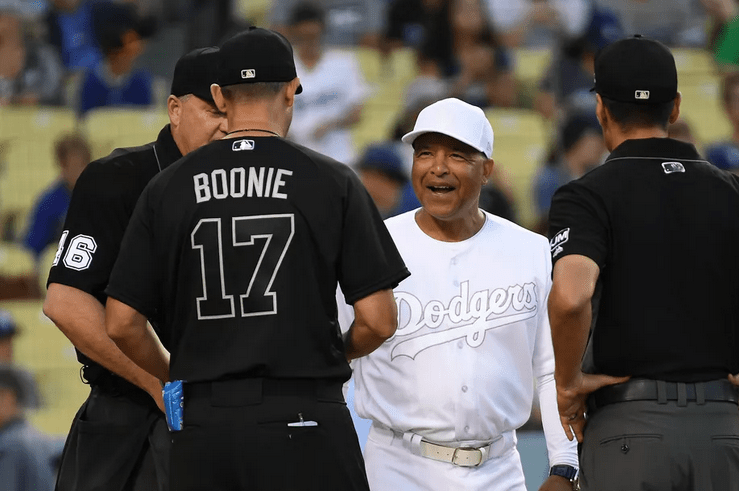
In Aug., ’19, the Yankees came to L.A. to face the Dodgers in a highly-publicized interleague matchup. And MLB made them wear these ridiculous uniforms, starting with Dave Roberts and Aaron Boone exchanging the lineup cards. Photo by Richard Mackson/USA Today.

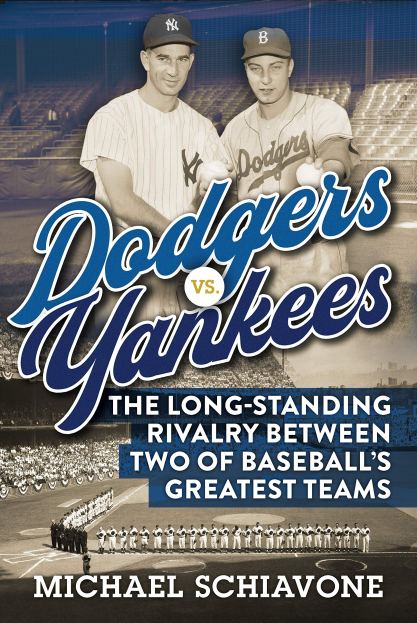
Dodgers vs. Yankees: The Long-Standing Rivalry Between Two of Baseball’s Greatest Teams

cover
The author:

Michael Schiavone

The publishing info:
Sports Publishing/Skyhorse
$24.95
288 pages
Released June 30, 2020 (after original promised release dates of May 5 and June 2)

The links:
At the publisher’s website
At Amazon.com
At BarnesAndNoble.com
At Powells.com
At Target.com
At Indiebound.org

The review in 90 feet or less

Who can really tell what the future brings at this point? “Past performance is no guarantee of future results” could be the motto of what the 2020 MLB season comes to be, if it actually comes to be. Yet if they make it to late October week and discover a Dodgers-Yankees matchup in the World Series awaits — is it best three-of-five now with six DHs per side? — that would seem to give odds makers a reason to feel some validation, for whatever they seem to be espousing at this point in time based on no idea who else will opt out of playing, who becomes sick and … the world’s future condition in general.

The Dodgers currently launch as as a 15/4 favorite to win it all, just ahead of the 4/1 Yankees by VegasInsider.com, while at Vegas.com, it’s the Yankees (3/1) over the Dodgers (6/1). There’s Forbes.com citing something called SportsInformationTraders.com that has the Dodgers (+375) with an edge over the Yankees (+450). At BetOnLine.ag, they are co-favorites at  +400.

14682a_medSo now in anticipation of this projected occurrence, if we were to calculate odds on whether this latest book from Michael Schiavone actually gives us something to advance our education and/or entertainment of the history of the Dodgers-Yankees rivalry – it goes back to the 1941 World Series, most recently to that 1981 strike-plagued campaign, and then a few inter-league meetings that resulted in some oddly-dressed version in 2019 – they would be far longer than the 1,000-to-1 we’ve already seen pinned on chances that the Orioles, Tigers or Marlins have in winning the 2020 title.
The low-bar expectancy is solely based on Schiavone’s 2018 travesty, “Dodgers: 60 Years in Los Angeles,” which is summed up in a back-cover blurb by Molly Knight as a “must-read for not only Dodger fans but for anyone interested in how America’s pastime went national.” This gives its content some benefit of the doubt based on an opinion by the author of the equally dubious “Best Team Money Can Buy” mess of a book about the Guggenheim Dodgers a few years ago that is nothing more than a scripted press release than any sort of journalistic endeaver.

Nonetheless, because it involves a title focused on local history, and we assume readers could often be swayed only by that fact, we dug into it, process it and came up with our conclusion: Continue reading “Extra inning baseball book reviews for 2020: How to make the Dodgers-Yankees rivalry become historically dull, dim-witted and disappointingly vapid … but not out of left field”

Extra inning baseball book reviews for 2020: Fred Claire’s new lineup card of hope

1 SRXLAnr7YMRngVmb2cV1Vw
Fred Claire, right — with his wife, Sheryl and daughter Jennifer — becomes emotional watching a video tribute to him on June 10, 2017 after the Dodgers’ Oldtimers Game and before throwing out the ceremonial first pitch prior to the Dodgers-Reds contest. Photo: Jon SooHoo/Dodgers

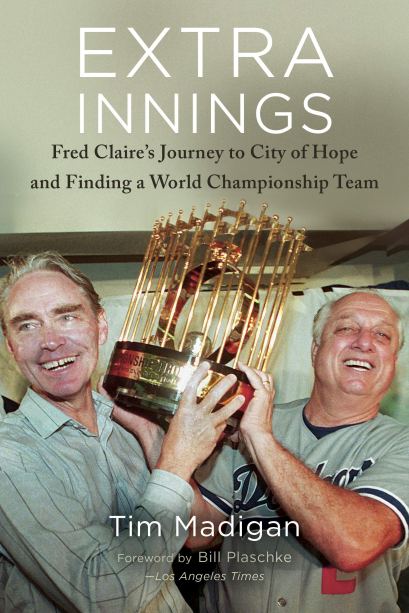
Extra Innings: Fred Claire’s Journey to City of Hope
And Finding a World Championship Team

91XEIAULmvL
The author:

Tim Madigan

The publishing info:
Mascot Books
$24.95
240 pages
Released July 7, 2020

The links:
At the publisher’s website
At Amazon.com
At BarnesAndNoble.com
At Powells.com
At Indiebound.org
At the author’s website

The review in 90 feet or less

In an April, 2017 column for the Los Angeles Times, Bill Plaschke did a 30-year look-back at how Fred Claire’s character and successes led to him becoming the team’s new general manager. But it came under a somewhat curious headline: “Almost forgotten, Fred Claire played a role in the Dodgers’ last World Series.”

How was it possible to even consider anyone like Fred Claire as forgotten?

After a dozen years as a sports writer, the last with the Long Beach Press-Telegram covering the Dodgers, he enters the team’s organizational flow chart with a role in its public relations department in 1969. Some 20 years later, he’s installed as the best in-house candidate to fill the vacant role of general manager under extremely strained circumstances (see: Campanis, Al; “Nightline”).

It was not a fun time to be associated with the franchise. Peter Gammons writes as much in Sports Illustrated (Aug. 10, 1987), and Claire manages to deviate from the narrative with this quote: “There are still a lot of great scouts and instructors in the Dodger organization. We have some good prospects. I am extremely positive about our future. We just have some things to pull together.”

Refashioning the roster with tenacity and talent (Kirk Gibson) as well as relevant role players (Mike Davis, Mickey Hatcher, Rick Dempsey, Alfredo Griffin, Tim Belcher, Jesse Orosco, Jay Howell, John Shelby), the team of character wills its way to the 1988 World Series title – still the last one in franchise history. Without those deals, there’s no dramatic Game 1 walkoff, or a backup catcher walking Orel Hershiser through the Game 5 clincher in Oakland. Dempsey would save that ball from the final strikeout and give it to Claire. He was The Sporting News’ MLB Executive of the Year.

From 1994 to 1997, the team reaches the post-season twice. But now it’s May, 1998, and Claire has no knowledge of the new Fox ownership team regrettably trading off Mike Piazza to the Florida Marlins in May, 1998 in a pure business cable rights TV deal. Claire ends up getting let go, along with manager Bill Russell, a month later. Continue reading “Extra inning baseball book reviews for 2020: Fred Claire’s new lineup card of hope”

Extra inning baseball book reviews for 2020: Tom Seaver, Pat Jordan, and the lonesome, poignant pursuit of happiness … drop and drive

spread
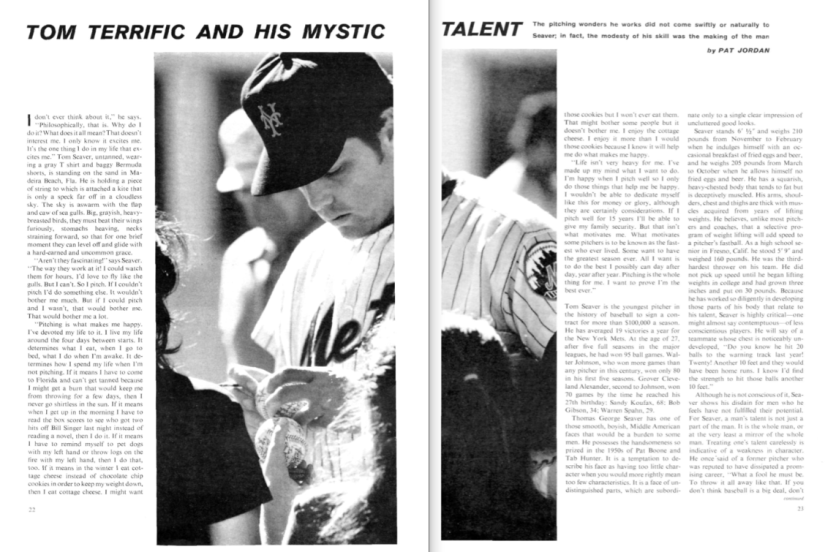
The start of Pat Jordan’s six-page Sports Illustrated profile on Tom Seaver from July, 1972.

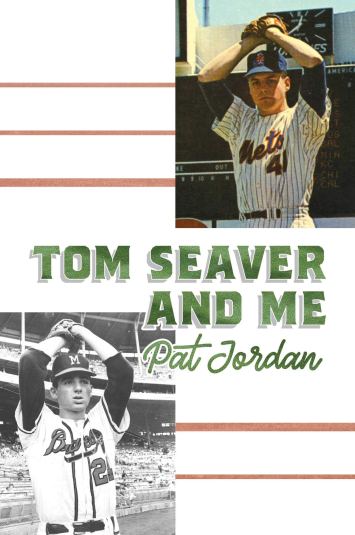
Tom Seaver and Me

712KVjfWAXLThe author:
Pat Jordan

The publishing info:
Post Hill Press/Simon & Schuster
$28
192 pages
Released May 26, 2020

The links:
At the publisher’s website
At Amazon.com
At BarnesAndNoble.com
At Target
At Powells.com
At Indiebound.org
At the author’s website

The review in 90 feet or less

When you’ve come to trust the honest, reflective storytelling of Pat Jordan – his 1975 bio “A False Spring,” followed by the 1999 “A Nice Tuesday” would be a general baseline — it’s an easy sell when a book of his somewhat pops up with little advanced notice on the subject of his relationship with a Hall of Fame pitcher.

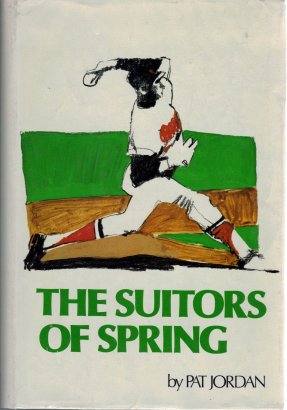
91Cle454TyLFor us, it’s his 1973 book, “The Suitors of Spring,” that we pick up once and awhile and can easily enjoy again — character studies Jordan, a self-proclaimed free-lancer had been selling to Sports Illustrated about some of the game’s famous pitchers. There’s a chapter on Tom Seaver called “To Fly Like The Gulls” amidst profiles that try to figure out Bo Belinski, Steve Dalkowski, Johnny Sain, Sam McDowell and others of interest during that time frame.

The Seaver profile is directly connected to a July 24, 1972 issue of Sports Illustrated that allowed Jordan six pages of valued space for him to size up Seaver. In “Tom Terrific and his Mystic Talent,” Jordan pulls from two extensive interviews he did with Seaver at his home in the fall of ’71 and during spring training of ’72. He sizes up Seaver as a deep thinker, one whose talents did not come naturally, who learned the value of hard work from growing up in Fresno, who figured out what made him happy, what he could control, and what he didn’t care about controlling. A lot of it was counter to what Jordan was experiencing.

(Two years later, when Jordan wrote another SI profile, this time on Bert Blyleven, the fact that he couldn’t help but compare him to Seaver kind of showed how much an impact was made from the previous bio).

Connecting more dots, it can be deducted that Jordan’s granular examinations of what makes major-league pitchers sail or fail is born from his own trajectory of a pitching career — a rising star from his Little League and high school days, where people would come from miles away just to watch him, then signing a $50,000 bonus in 1958 with the Milwaukee Braves based on the belief his remarkable fastball could get him places, only to lose it after just more than three years in the low minor leagues.

“A False Spring” is his account of how that pro journey went for him. “A Nice Tuesday” is his attempt to make a comeback at age 56 in such a Bouton-esque way.

With this, “Tom Seaver and Me” allows the 79-year-old Jordan to reflect on how and why he and Seaver connected in the first place some 50 years ago, and why there is now a disconnect by neither of their choices.

In March of 2019, the Seaver’s family disclosed publicly what Jordan had sensed first hand for the last few years prior. Seaver, who will turn 76 in November, was suffering from dementia and would not be making any more public appearances. They had been said before that the effects of Lyme disease that was causing him to have memory problems. With that announcement it was clear Seaver would not be participating in any 50-year reunions of the 1969 Mets’ World Championship team. (However, in June of ’19, a group of Mets that included Art Shamsky, Ron Swoboda, Bud Harrelson and Jerry Koosman went to Calistoga to visit Seaver).

Jordan and Seaver 2013 USA Today
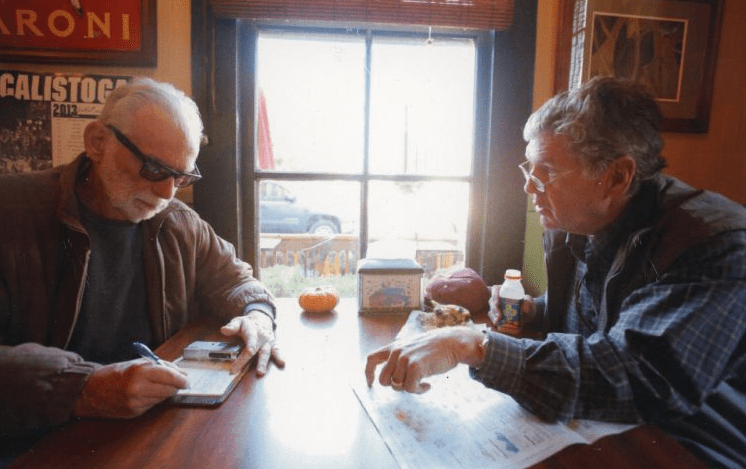
Pat Jordan with Tom Seaver in Calistoga, Calif., in 2013 (Photo by Kelley L. Cox, USA Today)

Jordan, whose work over the years have made it into the Best American Sports Writing, Best American Mystery Stories, Best American Essays and Norton Anthology of World Literature, pulls on all his visits to pull together what reads like another of his gloriously extended magazine pieces. They have this gruff, loving relationship of two men who realize their talents took them in opposite trajectories, but it’s really Jordan who bests sizes up Seaver rather than the other way around. Continue reading “Extra inning baseball book reviews for 2020: Tom Seaver, Pat Jordan, and the lonesome, poignant pursuit of happiness … drop and drive”

Extra inning baseball book reviews for 2020: How a ball baptized in a Cooperstown creek soaks up, and rebirths, some vital Hall history

Robinson Hall Ball
Jackie Robinson’s final resting place at Cypress Hills Cemetery in Brooklyn, N.Y., along with with “The Hall Ball” in the foreground, taken by Ralph Carhart on Sept. 17, 2010.

The Hall Ball: One Fan’s Journey to Unite
Cooperstown Immortals with a Single Baseball

51zTYMhUa0L
The author:

Ralph Carhart

The publishing info:
McFarland & Company
$29.95
175 pages
Released June 24, 2020

The links:
At the publisher’s website
At Bookshop.org
At Amazon.com
At BarnesAndNoble.com
At Powells.com
At Indiebound.org
At the author’s website

The review in 90 feet or less

A pilgrimage to the Baseball Hall of Fame in Cooperstown, N.Y., shouldn’t be just on some bucket “wish list,” but a must-commit adventure, preferably if you can do it with family in various generations and factor in the travel navigation that will likely take you through New York to Syracuse to a rental car that could easily be a horse and buggy.

You step back in time. You see a city that’s far more an oasis that you’d imagine in Field of Dreams. And, it has its own dream field — Doubleday Field, where you can compare photos of the grandstands and how everything looks the same today as it did some 80 years ago when the shrine was created to honor the giants of the sport.

It’s been about 10 years now since our first and only visit. A great friend of mine had the idea to take our sons there for a Father’s Day trip – his son actually worked in Cooperstown at the time, at the nearby Ommegang Brewery. It was too perfect. The gang arrived, and that weekend included having a catch on the Doubleday Field, then watching a bunch of former MLB players participate in an exhibition game of sorts. We ended up connecting with Tim Leary, the former Dodgers pitcher, and have stayed in contact ever since. We even had a special basement tour of the Hall to handle some items not accessible to the public, thanks to Brad Horn, who spent nearly 15 years as the facility’s director and VP of communications and education and now teaches at Syracuse.

Whether or not we actually noticed of a small creek that ran next to Doubleday Field as we explored the grounds, we can’t recall. But considering to absorb in that surrounding area of walking trails and quaint neighborhood strolls, we could see plenty of hiding spots for stray foul balls from the field.

We weren’t on a real fishing expedition and didn’t bother trolling it for any treasures.

But one time, Ralph Carhart did.

And this became his brilliant idea for a story.

As it turned out, we were in Cooperstown during the same summer – 2010. Ralph was there with his wife, Anna. During their time, she pulled a ball out of that creek. It was a Diamond brand, intended for high school games, not real major league caliber. But it became eventually “The Hall Ball” (after it was temporarily lost in the car for a couple of days) and a major-league adventure.

NYT
Ralph Carhart, from a 2017 New York Times story on his Hall Ball quest, taken at Calvary Cemetery in Queens, N.Y, as he tried to find an unmarked graves for Bryan Thomas for The New York Times)

Carhart, a Brooklyn-based theater director and manager, decided to fashion his own script – what if this ball was taken to every member of the Baseball Hall of Fame, dead and alive, to connect with it? What if the Baseball Hall of Fame eventually took possession of it and displayed it to share with others?

Of course, with most of the Hall of Famers no longer living at this point, it would take a lot of cemetery visits. Carhart would end up in 34 states, plus Cuba, spread over several years, funded as best he could.

(Maybe to no surprise, the journey left Carhart as the lead for the Society for American Baseball Research’s 19th Century Baseball Grave Marker Project.)

Finding those who have passed was one element. Tracking down the living members would be a feat unto itself. As he explains on page 79:

Lasorda hall
Tommy Lasorda doesn’t seem to know what to make of “The Hall Ball,” where he photographed on April 22, 2012.

“Soon enough, I developed a ‘rap,’ a quick four-sentence version of the project I told the players to give them maximum information in minimal time. Specifically, ‘My name is Ralph Carhart and I have been taking this baseball to all the members of the Baseball Hall of Fame, living and deceased. If they are alive, I take a picture of them holding the ball, and if not, I take a photo of the ball at their grave. Once I have photographed all of them, it is my intention to donate the ball to the Hall of Fame. As of today, I have photographed X members. I am hoping you will be number Y.’

“When I gave the rap to Tommy Lasorda, he looked at me incredulously and asked me to repeat myself. I did, and he let me take the photo, but the look of bewilderment you see on Lasorda’s face is genuine. He was the first who made it clear that he thought the project strange.”

Those who know Lasorda, maybe not a surprise, eh?

The encounters along the way are part of the story, of course, as you find out those who couldn’t be reached, remained elusive (think Sandy Koufax) and could be added in future updated editions?

Having MLB official historian John Thorn do a fantastic piece for the book’s forward gives this project a blessing as what he calls “strangely moving … part travelogue, part baseball history, part photo journal.” He also equates the project to flagpole sitting – “all of us who deeply care about some one thing – beyond how they might feel about some one or more persons – will understand” this attempt and “a lucky few of us do get to share that unrequited love in print.” Continue reading “Extra inning baseball book reviews for 2020: How a ball baptized in a Cooperstown creek soaks up, and rebirths, some vital Hall history”

Extra inning baseball book reviews for 2020: The sequel to ‘My Three Sons’ in a non-major way … and it isn’t their first Cowboy Monkey Rodeo

A13l2gqllkL._SX800_
The Diekroeger family, with book author Kathy second from left.

I Should Have Quit This Morning:
Adventures in Minor League Baseball

61Eeddig2wLThe author:
Kathy Diekroeger

The publishing info:
Independently published
319 pages
$14.99
Released April 8, 2019

The links:
At Amazon.com
At Indiebound.org

The review in 90 feet or less

Reaching back to a review a baseball book more than a year old usually strays from our mission to just review “new” publications. Yet having stumbled upon this during research for another project, we couldn’t help but fish it out of the stream, dry it off, and hold it up to the sunlight.

It’s a beauty.

Here’s the mother of three boys who played baseball at Stanford, which means, in her lifetime, she watched “more than 2,100 baseball games – and stopped counting when two of them made it into the professional ranks.”

For the next four years, she kept hearing their stories – humorous, heartbreaking, soul-searching. Capturing the stories of 28 players she knew based on their time with her sons – a couple who went onto some MLB notoriety – Diekroeger said she decided it was the right time to “document and share those experiences with anyone who considers themselves a fan of baseball.”

Bring it on.

Diekroeger, who degrees from Dartmouth and Stanford, lives with her husband in the small San Francisco Peninsula town of Woodside.

Her offspring/social science experiments:

179370-11486102Fr== Kenny, 29, who has his own Stanford BA and MBA in management science and engineering, works in the financial world these days after logging four seasons in the minor leagues as a second baseman. The Kansas City Royals’ fourth-round pick in 2012 – he was also a second-round pick by Tampa Bay in 2009 but passed on a $2 million bonus, opting for college – reached Triple A Omaha in 2015.

At Stanford, the 2010 Pac-10 Freshman of the Year was once considered a No. 1 overall draft prospect during his high school days.

61gC6OgTmTL._AC_SL1114_== Danny, 28, became the Stanford shortstop and was the double-play combo with his older brother for awhile. Danny was a 10th round pick by St. Louis in 2014. His three-year, four-team trip through the minors ended in 2017, getting as high as Double-A level. With a computer science BA and Masters, his LinkedIn bio has him as a software engineer with a cryptocurrency firm.

== Mikey, 24, followed his brothers to Stanford and played third base from 2015-17. He may have been the wisest, never going into a pro attempt.

All and all, the kids were all right, enjoyed playing, then were smart enough to see a greater future in the money-making world elsewhere.

But the stories they, and their teammates, could tell. About the draft, their first contracts, getting moved up the chain, getting moved down, what bizarre things they ate, weather delays, playing through injuries, crazy in-game promotions, how they traveled, where they slept …

Yup, first-hand accounts, no holding back. Continue reading “Extra inning baseball book reviews for 2020: The sequel to ‘My Three Sons’ in a non-major way … and it isn’t their first Cowboy Monkey Rodeo”