Blog

Extra inning baseball book reviews for 2020: Viola: Two tricks you’d never expect to look for, thanks to a whizkid at Purdue and a cable tech guy in Tacoma

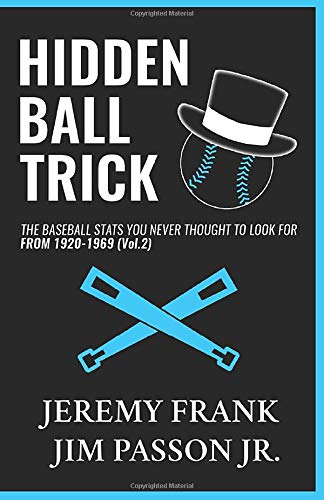
Hidden Ball Trick
The Baseball Stats You Never Thought To Look For
Vol 1: 1876-1919 and Vol 2: 1920-1969

41ZuVk04h-L

The authors:
Jeremy Frank and
Jim Passon Jr.

The publishing info:
Independently published
Vol. 1:
$11.99
232 pages
Released May, 2019
Vol 2:
$14.95
274 pages
Rreleased May 2, 2020

The links: At Amazon.com: Volume 1 and Volume 2


The review in 90 feet or less

4149fNCdi9LConsider the independent sources of this dependent material.

Jeremy Frank is a 19-year-old from Illinois studying data science at Purdue. He began his Twitter account, MLBRandomStats, in October 2015 as a freshman at Stevenson High School, near his hometown of Buffalo Grove, Illinois.

The Purdue school paper caught up with him for a story last April, and since then, the Lafayette (Indiana) Journal & Courier tracked him down as well to work something up.

It goes back to how this Twitter account seemed to blow up in July, 2018 after Frank posted something rather randomly interesting about Joey Votto’s pop-up rate. It now has 13,000 retweets and 33,000-plus likes.

In May 2019, the CBS affiliate in Chicago also did a piece on “the phenom” who admits he’s “just really good at math.” He’s got more than 56,000 followers now – still rather modest by some measures. Jayson Stark, for example, has 596,000-plus. But …

5b97567e-4d64-4647-915e-30bf063b76f2-IMG_8173

“I’ve used quite a few Jeremy Frank notes in my Useless Information column over the last couple of years,” said Stark, who currently works with MLB Network and is senior baseball writer for The Athletic. “One I remember is a note about how Yu Darvish had struck out 24 hitters in his last nine innings pitched, with a breakdown of how many strikeouts he stuffed into each inning. I then used his note to do more investigating, and it turned out no starting pitcher had ever struck out 24 hitters in any nine-inning span. That’s amazing, but I would have missed that if Jeremy hadn’t noticed and tweeted about it. So I think I need to tell him: Thanks!”

Frank now has a podcast at Purdue.

passonpngPasson is a passionate 42-year-old cable tech from Montana, now in Tacoma, Wash. His podcast, “Romantic About Baseball,” with Adam MacKinnon (who recently did a book for Rockridge Press called “Baseball For Kids” release last April).

Frank and Passon are  no doubt discombobulated at this point with no 2020 MLB data to process or road trips to pursue.

Yet they put their heads together a few years back and decided, from the blurb on the back cover of these two books, “One doesn’t have to be a statistics professor to appreciate the game from a numerical perspective.”

A format that’s deceivingly simplistic ends up speaking volumes about what you can discover and precociously slip into any record-keeping book about the history of Major League Baseball.

Frank and Passon have now put together two of three volumes of material on, well, stuff they’ve found and, as the cover suggests, never thought to look for.

As the first volume handles the game’s dead-ball era going back to its 1876 roots (actually, it precedes that with a discussion of how The National Association of Professional Base Ball from 1871-75 laid the groundwork) and ending with the eventful season of 1919 – The Black Sox Scandal, a national pandemic that shortened the season, and the emergence of Babe Ruth, the newest edition that is now out takes on a 50-year stretch from 1920 to 1969, which in itself was another noteworthy season – the divisions split into West and East, the league adds on four new teams and it’s a huge adjustment of the rules after a pitcher-dominated ’68 season.

The plan for a third volume will likely cover 1970-2020 – should that last season even happen.

“While it may be a little bit annoying to someone who would need to get all three, trust us, the quality of the content inside each book is greatly enhanced thanks to this decision,” they say in the intro to the first book. Continue reading “Extra inning baseball book reviews for 2020: Viola: Two tricks you’d never expect to look for, thanks to a whizkid at Purdue and a cable tech guy in Tacoma”

Extra inning baseball book reviews for 2020: History, as you cut-and-paste it to serve your hysterical purpose

IMG_1003
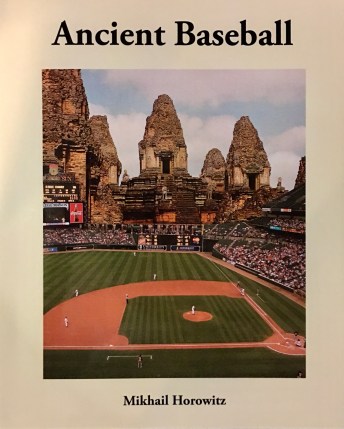
The scoreboard that survived the eruption of Mount Vesuvius in 79 CE still stands in the ruins of Pompeii Stadium. It says right there on page 23.

Ancient Baseball

IMG_1006

The author:
Mikhail Horowitz

The publishing info:
Alte Books; $15; 38 pages; released recently-ish (with a vague copyright of 2019)

The links:
At the publisher’s website, and no where else on Amazon.com, BarnesAndNoble.com, Powells.com, or Indiebound.org. But the author does have an official site.

The review in 90 feet or less

It arrived in a Manilla envelope, carefully stuck between two pieces of cardboard. The envelope was hand addressed, from a post-office box in Accord, New York. There was one “two ounce” stamp affixed to it, along with four “Earth Day” forever stamps, all upside down.

It came from a random recommendation from the Twitter account of  John Thorn, the official historian of Major League Baseball.

He also has a back-cover blurb: “Who knew baseball history could be so much fun? No more archive trawling for me – Horowitz sees baseball everywhere in the ancient world. Gorgeous, erudite, laugh-out-loud funny.”

It came, as well, with a stamp of approval by Tim Wiles, the former director of research for the National Baseball Hall of Fame: “Many have tried to explain baseball’s mysterious connections to time, eternity, mythology and human spirituality, but most such attempts leave us empty-handed. Mikhail Horowitz has caught lightning flashes of insight over and over again in this slim volume … Read it and reap.”

It came with these words, perhaps by the author, or publisher, or another who dared to decipher its true meaning: Continue reading “Extra inning baseball book reviews for 2020: History, as you cut-and-paste it to serve your hysterical purpose”

Extra inning baseball book reviews for 2020: Miss baseball? Miscellaneously speaking, this could get you caught up

games too long
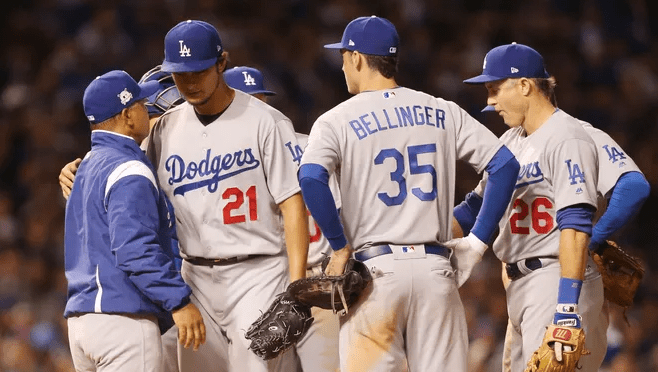
Do baseball playoff games take too long? It’s a question tackled in a 2017 USA Today story (using this Dodgers’ mound photo of manager Dave Roberts taking Yu Darvish out of a contest). It’s also discussed in Chapter 27 of this book. Photo by Dennis Wierzbicki/USA Today

Baseball Miscellany
Everything You Ever Wanted to Know About Baseball

baseball-miscellany-9781683583738_xlg
The author:

Matthew Silverman

The publishing info:
Sports Publishing/Skyhorse
205 pages
$14.99
Released May 19

The links:
At the publisher’s website
At the SimonAndSchuster site
At BarnesAndNoble.com
At Powells.com
At Target
At Indiebound.org
At the author’s website

The review in 90 feet or less

After all we poured through in our previous review of the Sports Publishing/Skyhorse refresh of “The New Baseball Bible,” this update of “Baseball Miscellany” by the same publishing house measures in at half the size, half the number of pages, far more colorful and graphically bent, printed on much better paper stock, a much tighter binding and, all in all, likely far more easier for a reader to navigate. (And it’s five bucks cheaper).

Smaller can be more useful, depending on the reader’s attention span.

Still, you’re at the mercy of the author’s construction and content decisions.

mattMatthew Silverman – not to be confused with the 44-year-old Harvard-educated President of Baseball Ops for the Tampa Bay Rays – has done plenty of other baseball books that involve collecting material, specifically with his work on New York Mets history.

Unlike the Dan Schlossberg “Bible” format of 20-plus chapters that break down the game historically and every other which way, Silverman’s approach is to pose 30 questions – the last three, in a category of “Extra Innings” – and then meander from from there.

Most chapters are filled in by quips, quotes and antidotes, enough that don’t directly  relate at all the chapter’s original focus, but none-the-less serve a purpose of continued educations.

Continue reading “Extra inning baseball book reviews for 2020: Miss baseball? Miscellaneously speaking, this could get you caught up”

Extra inning baseball book reviews for 2020: A bible that still carries weight, especially when held right-side up

2020 new cover
Not quite actual size. But you get the picture …

The New Baseball Bible:
Notes, Nuggets, Lists and Legends From
Our National Pastime


The author:
Dan Schlossberg
Publishing info: Sports Publishing/Skyhorse, 465 pages, $19.99, released March 17
Links: At the publisher’s website (which still only lists the 2017 edition); at Amazon.com; at BarnesAndNoble.com; at Powells.com; at Target; at Indiebound.org; at the author’s website

The review in 90 feet or less

Bibles should be thumped in higher regards at this moment in time. Because they can serve a higher purpose. Right-side up, especially, with favorite passages recited in order to help put things into perspective.

179704_4001272630637_1112735565_n-285x205In the beginning, Dan Schlossberg created a lot of this.

It may seem like night and day since he proclaimed “The Baseball Book of Why” in 1984. Or even “The Baseball Almanac: Big Bodacious Book of Baseball” of 2004 for Triumph Books, followed by “Baseball Gold: Mining Nuggets from Our National Pastime” in 2007 and Baseball Bits: Little-Known Stories, Facts, and Trivia from the Dugout to the Outfield” in 2008. There are many others in between for the former Associated Press sports editor from New Jersey, a regular writer for Street & Smith’s Official Baseball Yearbook, Sports Collectors Digest, The Sporting News and official World Series programs. His resume includes more than three dozen books.

For this particular book of numbers, facts and stories that’s about as large as old Sears catalogue (with a typeface that still reminds us one, along with the muddied black-and-white photos), the lineage goes back to “The Baseball Catalog” of 1980 (and a millennium edition in 2000) from Jonathan David Publishers. This is now the third version of “The New Baseball Bible,” which Sports Publishing took over with a version in 2002, and last updated it in 2017 before the latest refresh.

So, what’s new?

2017 coverLComparing this one to three years ago – which we can, having both editions here in front of us – the cover tweaks include noting that Schlossberg is now identified as a “former AP sportswriter” (he now can be found contributing to Forbes.com), the forward is now by official MLB historian John Thorn (versus former Dodger Jay Johnstone) and the preface comes from former MLB umpire Al Clark (instead of writer Alan Schwarz). The cover collage also adds Mike Trout as the main figure in the center, replacing Ken Griffey Jr., while Hank Aaron and Eddie Matthews are added (and a group of three old-timers we’d be hard pressed to identify are left off).

And a yellow coloring of the book title instead of white.

Improvement overall already.

Ramping up from 408 pages to 467, the most notable additions:

== Aside from chapters on Beginnings of Baseball, How Some Rules Apply, Umpires, Playing the Game, Equipment, Ballparks, The Game, Famous Faces, Managers, The Brass (commissioners and owners), Trades, The Supporting Cast (stadium announcers, organists, vendors, etc.), The Media, Big Moments, The Language of Baseball, Superstitions and Other Traditions, Spring Training, Other Leagues and Other Lands, Fans, The Expansion Eras and A New Century, there are three additional chapters: Cooperstown (all things related to the Hall of Fame), After 108 years (the Cubs’ 2016 title) and Turbulent Times (labor pains, Astros’ scandals and a change in how offense is played).

The most poignant addition of having Thorn do the new forward and talk about for all the baseball history he has written, Schlossberg has been more than a kindred spirit, matching him publication for publication going back to the mid 1970s. It’s akin to watching the Beatles/Paul McCartney and the Beach Boys/Brian Wilson look and admire each other and then have it inspire their next pieces of work.

“For all these years, Dan and I have been friends rather than rivals, belonging to a mutual admiration society, population: two,” says Thorn, who later adds that the only book he can ever compare “The Baseball Bible” series to “as a foundation of wit and wisdom” is Jim Bouton’s “Ball Four.” Continue reading “Extra inning baseball book reviews for 2020: A bible that still carries weight, especially when held right-side up”

Extra inning baseball book reviews for 2020: When Cleveland rocked 25 years ago, we can still roll with it

s-l640
A memento from the 1995 World Series, available for sale on eBay.com.

Cleveland Rocked:
The Personalities, Sluggers and Magic of
the 1995 Indians

61UIHMBWipLThe author:
Zack Meisel

The publishing info:
Triumph Books
$28
288 pages
Released May 12

The links:
At the publisher’s website
At Amazon.com
At BarnesAndNoble.com
At Powells.com
At Target
At Indiebound.org

The review in 90 feet or less

When the movie “Major League” arrived in 1989, it kinda rocked the box office.

Tom Berenger, Charlie Sheen, Wesley Snipes, Dennis Haysbert, Corbin Bernsen … plus Milwaukee County Stadium, and Brewers broadcaster Bob Uecker, recruited to somehow merge into this a fictionalized story using a real MLB team and logos to grab onto some kind of authenticity.

Yet, was it really doing the real Indians of Cleveland any favors?

il_794xN.1504888065_g58x
A “Major League” tribute illustration, available on Etsy.com

The R-rated “Slap Shot”-type of tale about how an evil woman owner of the team is trying to break the stadium lease with the city by fielding the most mismatched roster possible that will sink ticket sales and then she can move the franchise to Miami. It wasn’t based on a true story. But one couldn’t help compare the team to how the real ’89 Indians of Joe Carter, Cory Snyder, Brook Jacoby, Greg Swindell and Doug Jones were operating amidst their third losing season in a row, a 73-89, next-to-last finish in the AL East.

91v9tWcaEmL._AC_SY741_In the movie, the guys rallied together. In real life, not so much. (Oh, and here’s also 10 “wild” facts about the movie, thanks to the late, great Mental Floss magazine).

Because the movie grossed about $50 million just with its domestic release, “Major League” it would spawn two sequels.

By the time “Major League II” came out in 1994 — sub in Omar Epps for Snipes as Willie Mays Hayes, as if we wouldn’t notice, and then drop it down to a PG rating – the real Indians had started to turn a corner under manager Mike Hargrove. They were going along at a 66-47 clip and second in the newly created AL Central (the first year beyond a simple East-West division for each league) when everything came to a ridiculous stop for the strike/lockout. The Indians were almost assured a playoff spot in ’94. But with the season done (ask the Montreal Expos about “what if?”), there would be no World Series and everything would bleed over into the threat of replacement players and the delayed start of a 1995 season.

(You may be hearing more about how the current MLB situation reminds some of that ’94-’95 period when it comes to how to split up income. Some things just don’t change).

Back on that Indians’ ’94 roster was Albert Belle, a rookie back in ’89, coming off an All-Star year where he led the league with 129 RBIs and was third in AL MVP voting. Manny Ramirez was a 22-year-old who would finish second in AL Rookie of the Year voting (17 HRs, 60 RBIs, .269). Jim Thome, drafted by the team in ’89,  was a 23-year-old third baseman showing some power – the first of 11 straight seasons of 20 or home homers. Kenny Lofton, Eddie Murray, Sandy Alomar, Carlos Baerga, Omar Vizquel and Paul Sorrento were the core of the lineup. The pitching staff focused on 40-year-old Dennis Martinez and 39-year-old Jack Morris at the top, with Charles Nagy and Jason Grimsley. But no one in the bullpen had more than five saves.

When “MLII” hit theaters in March, 1994, it debuted at No. 1 in the box office. Yet critics gave it a 5 percent rating on Rotten Tomatoes.

Yet from where we sit – as well as where Steve Yeager fits in, considering he played the Indians’ coach in every movie – the timing of both movies have to be factored into if you’re trying to tell the tale of Cleveland Indians’ real-life resurgence and redemption versus the public perception and acceptance of them as a down-and-out franchise. Continue reading “Extra inning baseball book reviews for 2020: When Cleveland rocked 25 years ago, we can still roll with it”