


The book: “The Performance Cortex: Now Neuroscience Is Redefining Athletic Genius”
The author: Zach Schonbrun
How to find it: Dutton Books, 352 pages, $28, released April 17.
The links: At Amazon.com, at the publisher’s website.
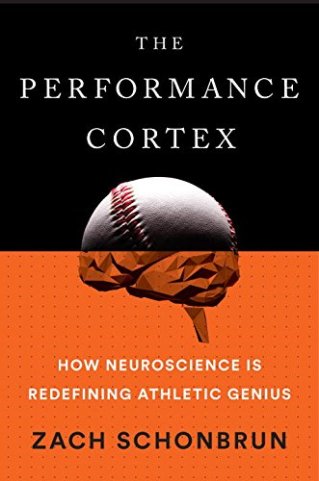 A review in 90-feet or less: It might be shelved under categories such as “medical books” or “sports psychology,” even “training and conditioning.” But when it shows up the baseball section – the cover illustration is a hint — it’s likely because this is the sport where the basis of this thinking and probing emanates, so don’t over think too much outside the batter’s box too much.
Or, as Schonbrun says in the introduction, his narrative remains “anchored by the baseball diamond, to that purest of athletic exchanges, when a batter stands at the plate awaiting a pitch…. It’s time to give those milli-seconds their due.”
We saw in Bob Tewksbury’s new book “Ninety Percent Mental” there is all sorts of ways the mind can be used in the baseball process. Here, we go to the real science of what appears to be more than just intuitive, thanks to the inquisitive approach by Schonbrun, a New York Times contributor since 2011 with a masters in journalism from Columbia.
 He logically explains that this is just baseball’s latest outside influence, following in the succession of orthopedists, psychologist, optometrists, strength coaches, nutritionists, sabermetrics, sleep doctors and yoga instructors.
He’s allowed to follow the journey of Jason Sherwin and Jordan Muraskin, who started a company called deCervo, which aims to be a neutral bystander in the measuring and improvement of cognitive performance.
There is a point in the book — perhaps early, but our brain is still processing it — when this all sounds like something best digested in an audio version. The written words on the pages can be very intimidating, like a college intro science elective for a dance major.
And then there’s another chapter? Does this really have a conclusion? It’s like a magazine story unraveled.
In our head, we hear the voice of famed neurobiologist Dr. Amy Farrah Fowler reciting the paragraphs to a point where even Sheldon Cooper’s impatience gets the best of him. Continue reading “Day 24 of 30 baseball book reviews for 2018: Don’t be too dense in getting a cerebral cortex around a baseball vortex”

 A review in 90-feet or less: It was
  In fact, back in 1997, Disney actually issued a dark blue Angels jersey with periwinkle sleeves for the Freeway Series meeting with the Dodgers (see page 120, in the chapter entitled “Diamond Duds.) It was so hated that they never did it again.
 A review in 90-feet or less: Mike Piazza says on page 204:
 Baldassaro, a professor emeritus of Italian at the University of Wisconsin-Milwaukee, started this as a project related to his 2011 book, “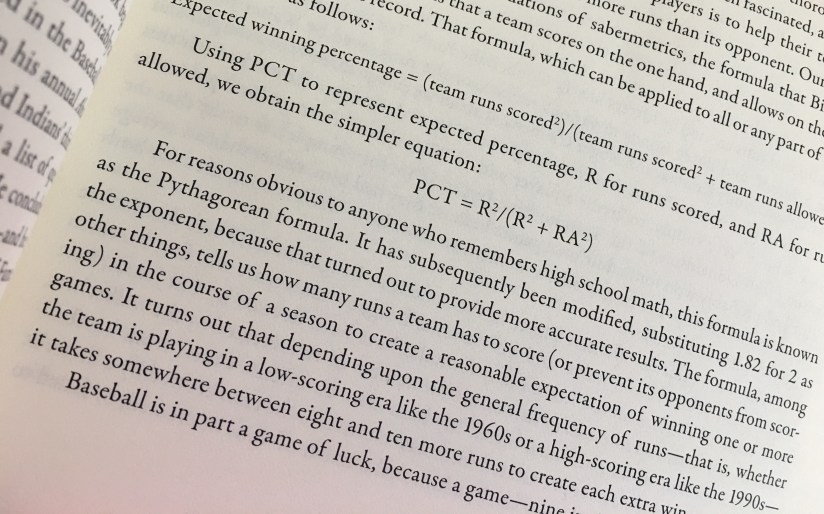
 A review in 90-feet or less: In one of the most unassuming yet powerfully potent paperbacks anyone can possibly find and reference today to win a baseball argument, SABR veteran Kaiser, a 70-year-old university history professor and well-received author from Watertown, Mass., almost single-evenhandedly waters down all the arguments that Wins Against Replacement (WAR) is a superior measurement of one’s greatness when compared to how Wins Above Average (WAA) determines the greatness of a player within the context of his team’s success.
 “With the obvious exception of track and field, there are few if any human endeavors, inside or outside of sport, in which performance can be measured as accurately as in baseball. And now, with more than a century’s worth of evidence upon which to draw, using simple, powerful statistical methods, we find, generation after generation, an astonishingly small number of men who are much, much better than everyone else, and who indeed have shaped the broader story of winners and losers to a remarkable extend. … This book is about how great players make great teams. Historically, hitters have been more important than pitchers, all the more so because great pitchers very rarely remain great for very long.”
 Tom Hoffarth's The Drill: More Farther Off the Wall