This is the latest post for an ongoing media project — SoCal Sports History 101: The Prime Numbers from 00 to 99 that Uniformly, Uniquely and Unapologetically Reveal The Narrative of Our Region’s Athletic Heritage. Pick a number and highlight an athlete — person, place or thing — most obviously connected to it by fame and fortune, someone who isn’t so obvious, and then take a deeper dive into the most interesting story tied to it. It’s a combination of star power, achievement, longevity, notoriety, and, above all, what makes that athlete so Southern California. Quirkiness and notoriety factor in. And it should open itself to more discussion and debate — which is what sports is best at doing.
The most obvious choices for No. 2:
= Tommy Lasorda: Los Angeles Dodgers = Kawhi Leonard: Los Angeles Clippers = Derek Fisher: Los Angeles Lakers = Morley Drury: USC football = Darryl Henley: UCLA football = Robert Woods: USC football, Los Angeles Rams
The not-so-obvious choices for No. 2:
= Lonzo Ball: Chino Hills High basketball, UCLA basketball, Los Angeles Lakers = Gianna Bryant: Mamba Academy basketball = Leo Durocher: Los Angeles Dodgers = Adam Kennedy: Anaheim/Los Angeles Angels = Cobi Jones: UCLA soccer = Shai Gilgeous-Alexander: Los Angeles Clippers
The most interesting story for No. 2: Tommy Lasorda: Los Angeles Dodgers manager (1976 to 1996) Southern California map pinpoints: Fullerton, Los Angeles (Dodger Stadium)
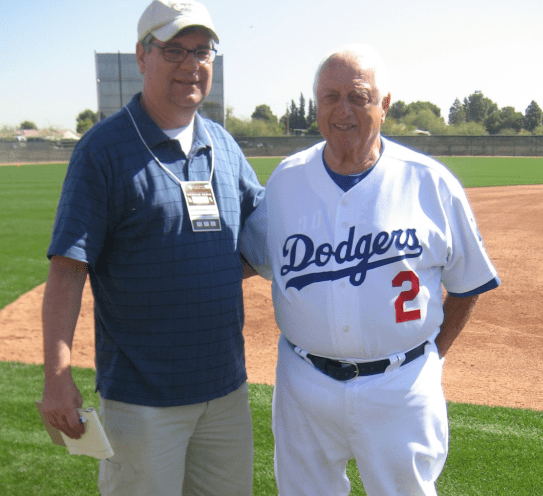
Glendale, Arizona, 2010: Tom Hoffarth with Tommy Lasorda.
What’s your opinion of Tommy Lasorda?
Curses. We have quite a few to share.
He motivated and manipulated. He spoke in sound bites as deftly as he could unravel magnificent yarns of stories that seemed to good to be true.
But he always did better with an audience.
One day, at an event in downtown L.A., Lasorda grabbed me by the left forearm. There was urgency.
“We’re going to Paul’s Kitchen,” he said, leaning in. “You gotta go with us.”’
The invite to go to one of L.A.’s most historic Chinese restaurants seemed to mean — With Lasorda and six friends, you get extra egg rolls.
I couldn’t commit because of a deadline for a story to write. I had to take a Teriyaki rain check.
So, the Pied Piper that he was, Lasorda did the quick exit with and a group in tow, out the door of Sports Museum of L.A. — this was after a 2010 press conference that had to do with where Kirk Gibson’s 1988 Game 1 bat and uniform might end up going — and over to a familiar spot where he could hold court for the rest of the afternoon.
This is the latest post for an ongoing media project — SoCal Sports History 101: The Prime Numbers from 00 to 99 that Uniformly, Uniquely and Unapologetically Reveal The Narrative of Our Region’s Athletic Heritage. Pick a number and highlight an athlete — person, place or thing — most obviously connected to it by fame and fortune, someone who isn’t so obvious, and then take a deeper dive into the most interesting story tied to it. It’s a combination of star power, achievement, longevity, notoriety, and, above all, what makes that athlete so Southern California. Quirkiness and notoriety factor in. And it should open itself to more discussion and debate — which is what sports is best at doing.
The most obvious choices for No. 6:
= Steve Garvey: Los Angeles Dodgers = Mark Sanchez: USC football, Mission Viejo High football = Eddie Jones: Los Angeles Lakers = Bronny James: USC basketball = Carl Furrillo: Los Angeles Dodgers = Sue Enquist: UCLA softball = Joe Torre: Los Angeles Dodgers manager
The not-so-obvious choices for No. 6: = Marc Wilson: Los Angeles Raiders = Anthony Rendon: Los Angeles Angels = Ron Fairly: Los Angeles Dodgers/California Angels via USC
The most interesting story for No. 6: Steve Garvey: Los Angeles Dodgers third baseman/first baseman (1969 to 1982) Southern California map pinpoints: Los Angeles (Dodger Stadium); Palm Springs
Steve Garvey offered a modest populist proposal in the fall of 2023 — nothing to do with endorsing another reverse mortgage plan, some hair restoration, weight-loss supplements or switching to dog food brands.
It would all happen very painlessly through something called efund.
Ah, the joy of six.
“Our campaign is focused on quality-of-life issues, public safety, and education. As a U.S. Senator, I will serve with commonsense, compassion, and will work to build consensus to benefit all of the people of California,” the script said quoting one of the Los Angeles Dodgers’ most popular and productive players in the 1970s and ’80s.
The CEO of Team Garvey said he needed a lot support as a Republican in a very Democratic state for the March 5, 2024 primaries.
None of this really came out of the blue.
During his baseball career, he had been planting seeds about his next career in some type of high-profile public office. For those who made a connection to the red No. 6 on the front of his Dodgers’ jersey — which he also carried onto a few more seasons in San Diego — the nostalgia was thick and the opportunity ripe as a controversial Republican president was somehow circling back to the pulpit and gaining momentum on a campaign of anti-blue sentiment.
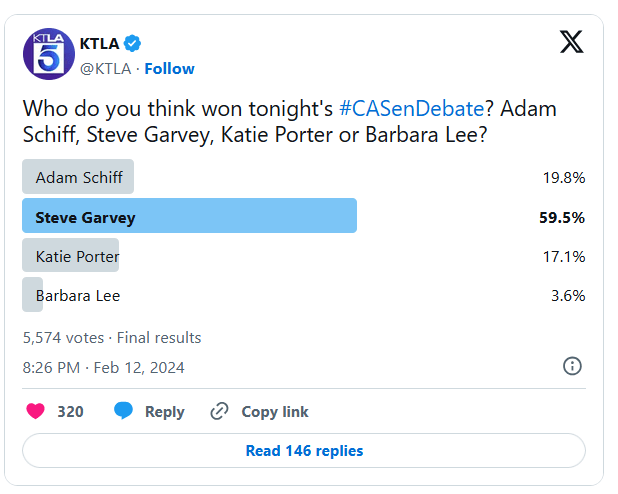
The twist in all this — the California primaries reward the top two vote-getters regardless of party moved onto the Nov. 5 general election. In this wrestling match to finally get the seat once held by Diane Feinstein, Democratic candidate Adam Schiff was an early favorite but he created a campaign strategy targeting Garvey as his main competitor — inciting more Republican support for Garvey — because Democrat Katie Porter provided a far-more serious threat to Schiff.
As a result, Schiff manipulated it so he and Garvey finished 1-2 in the primaries with nearly the same number of votes.
Now there were eight months left of campaigning for a spot that really wasn’t that close.
Back in February of 2024, a Los Angeles Times story tried to layout the contradictory “family values” life Garvey has led coming to this point — including a disassociation with one of his daughters and his grandson. He has seven children. Not all keep in touch.
“Dozens of ex-athletes have attempted to transition into politics, some of them driven by noble aims. But what sets Garvey’s Senate run apart from all the others is that I’m not sure what it is about at all. In fact, it seems entirely devoid of a purpose beyond the name of the candidate himself.
“It’s not just that Garvey is running as a Republican in a deep-blue state in perhaps the most polarized era in modern American history; it’s that he doesn’t even seem to be trying. He speaks in aphorisms that mean absolutely nothing; he won’t even express a definitive opinion about the standard-bearer of his own party. It’s as if he’s running just to say he ran, because this is what he always appeared destined to do when he was younger. It’s as if he’s trying to fill out the gaps in his own story.
“There’s something kind of sad about this. But it also feels like a telling metaphor for modern American politics at a moment when celebrity has outweighed substance. Best as I can tell, Steve Garvey is running for office because of his own hollow conception of fame. …
“For a while, it appeared Garvey stood above it all, and then his own hypocrisy rendered him a punchline. Maybe it’s cynicism; maybe it’s naivete. But either way, it’s as if he’s trying one last time to will into truth his own hollow fiction.”
At the website Sons of Steve Garvey, billed as “random rantings and ravings about the Los Angeles Dodgers, written by a small consortium of rabid Dodger fans,” there was never a Garvey endorsement of his political aspiration.
We had a flashback to 1998 when we caught up with Garvey at a North Hollywood baseball card shop named Porky’s. At the time, Jessie “The Body” Ventura had just won the governorship Minnesota. Garvey told us that Barbara Boxer, who had just been re-elected California state senior, “could have been had” if another Republican — like him? — had stepped up to get that spot.
Even then, he said he had his eye on Feinstein, whose six-year term was coming up in 2000. But he knew he wasn’t getting any younger.
“You know, I’m going to be 50- in December,” he told me than (and he just had a two-week old daughter born).
A bumper sticker one can obtain with a donation to the Garvey campaign.
So now, in 2024, the 75-year-old Garv thought he could change the narrative of a “man of the people” journey.
A baseball card created for Garvey’s senate campaign issued to contributors.
Mailers to constituents tried to make his case through a mock up of a baseball card. Another mailer tried to make sure that even if he has supported Donald Trump in previous presidential elections, he would like to be thought of more as someone aligned with former president Ronald Reagan — sending out a 1984 photo of the two once together in San Diego.
Garvey tried to use a new-age baseball stat — Wins Above Replacement — as a way to show how Schiff’s shortcomings could be best measured.
The back side of the campaign card.
“He just doesn’t need to be replaced. He needs to be defeated,” Garvey wrote.
Even though a story in The Nation projected that Garvey could not be underestimated, it all played out as suspected. Photo ops on Skid Row in L.A. and a trip to Israel in the middle of a war to try to see for himself what was going on weren’t effective.
The fact remains that, by early November, Schiff easily send Garvey to the showers with a 59-41 percent victory that was called by an Associated Press projection about one minute after the California voting precincts closed.
Garvey (who goes with the social media handle of @SteveGarvey6) used even more twisted numerical logic in his November election-night remarks in Rancho Mirage, which occurred just days after the Dodgers’ 2024 World Series triumph, to make it appear he achieved something (by fact that California is the most populated state and likewise produces the most voters):
In baseball, like in many professional sports, there’s a tradition of members of the opposing team to congratulate the winners. Often times with a handshake on the field or even a visit to the opponent’s clubhouse. In that same spirit I congratulate Congressman Adam Schiff on his victory. Using their enormous power the voters have elected him the next U.S. Senator from California. And I respect that and wish him good choices for all of the people in the years to come. I want you to know that despite the outcome that when the counting is over we will have gotten the fourth-most number of votes in the country. This means that everyone in California does have a voice. And it will only grow louder and louder. ….
I fell in love with California since my first day when I arrived on September 1,1969, when I was a rookie with the Los Angeles Dodgers. And want it to once again be the heartbeat of America. And I want the American Dream to live on and thrive. Because as the great Ronald Reagan once said — “As long as that dream lives, as long as we continue to defend it, America has a future, and all mankind has reason to hope.” Thank you again. God bless you and God Bless America.
This is the latest post for an ongoing media project — SoCal Sports History 101: The Prime Numbers from 00 to 99 that Uniformly, Uniquely and Unapologetically Reveal The Narrative of Our Region’s Athletic Heritage. Pick a number and highlight an athlete — person, place or thing — most obviously connected to it by fame and fortune, someone who isn’t so obvious, and then take a deeper dive into the most interesting story tied to it. It’s a combination of star power, achievement, longevity, notoriety, and, above all, what makes that athlete so Southern California. Quirkiness and notoriety factor in. And it should open itself to more discussion and debate — which is what sports is best at doing.
The most obvious choices for No. 60:
= Hardiman Cureton: UCLA football = Clay Matthews Jr.: USC football = Dennis Harrah: Los Angeles Rams
The not-so-obvious choices for No. 60:
= Chin-Lung Hu: Los Angeles Dodgers = Andrew Toles: Los Angeles Dodgers
The most interesting story for No. 60: Andrew Toles: Los Angeles Dodgers outfielder (2016 to 2018) Southern California map pinpoints: Dodger Stadium
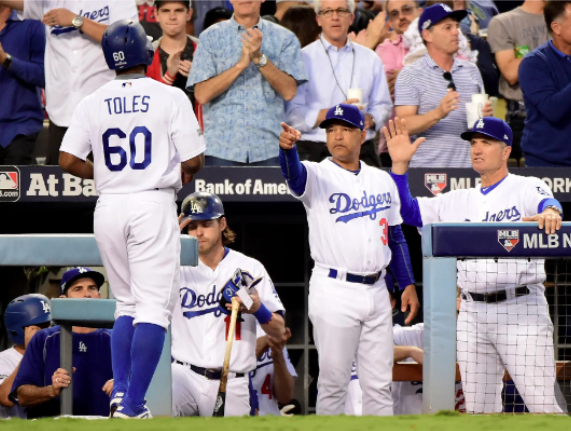
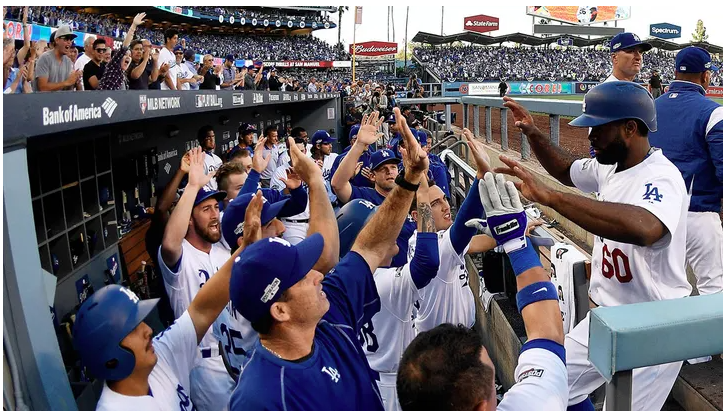
Andrew Toles (60) is acknowledged (above) by Dodgers manager Dave Roberts and coach Bob Geren and (below) by teammates in the Dodgers’ dugout after scoring on a Corey Seager single in Game 3 of the 2016 National League Championship Series at Dodger Stadium against the Chicago Cubs. Toles hit .462 (6 for 13) with an.082 OPS in the six-game series. (Both photos: Harry How/Getty Images)
Every year since 2019, the Los Angeles Dodgers try to keep it under the radar about the ways they have kept Andrew Toles in their collective hearts and minds.
In his three Major League Baseball seasons, the 5-foot-9, 190-pound left-handed hitting outfielder was in just 96 games and 249 plate appearances. His. 286 batting average factors into a career 1.9 WAR. He will likely never play again, but the Dodgers have never looked at from that lens.
In years past, by renewing him as a player under contract on the restricted list, Toles and his family have had some peace of mind that his MLB health insurance will continue. Toles’ ongoing struggle with bipolar disorder and schizophrenia. The anxiety, a daily concern to his existence, was likely exacerbated by a career-setback knee injury at a time when he was making strides to be an every-day, reliable player.
One battle after another.
Media reports have made it appear there is a simple action of kindness the Dodgers take every spring, but there is far more to it. In the spring of 2026, the Dodgers eventually issued a statement of some clarification in a statement:
“We’ve been in contact with the Toles family and have worked together on how to best move forward. Continuing with the previous setup was no longer possible due to eligibility. The Toles family has asked that Andrew’s privacy be respected. Out of respect to the Toles family, we will not comment any further.”
Out of respect to this story and how the Dodgers have proceeded, it is always worthy of our attention.
This is the latest post for an ongoing media project — SoCal Sports History 101: The Prime Numbers from 00 to 99 that Uniformly, Uniquely and Unapologetically Reveal The Narrative of Our Region’s Athletic Heritage. Pick a number and highlight an athlete — person, place or thing — most obviously connected to it by fame and fortune, someone who isn’t so obvious, and then take a deeper dive into the most interesting story tied to it. It’s a combination of star power, achievement, longevity, notoriety, and, above all, what makes that athlete so Southern California. Quirkiness and notoriety factor in. And it should open itself to more discussion and debate — which is what sports is best at doing.
The most obvious choices for No. 17:
= Shohei Ohtani: Los Angeles Angels and Los Angeles Dodgers = Bill Kilmer: UCLA football = Phillip Rivers: Los Angeles Chargers = Jari Kurri: Los Angeles Kings and Mighty Ducks of Anaheim
The not-so-obvious choices for No. 17:
= Puka Nacua: Los Angeles Rams = Carl Erskine: Los Angeles Dodgers = Jeremy Lin: Los Angeles Lakers
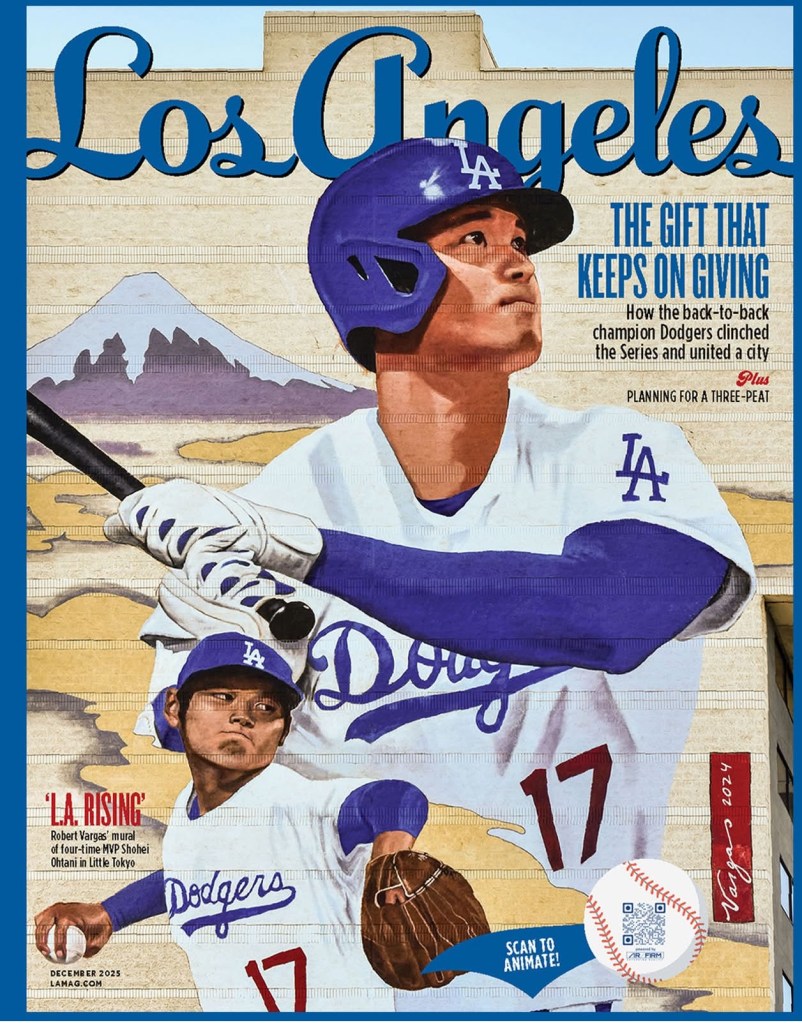
The most interesting story for No. 17: Shohei Ohtani: Los Angeles Angels pitcher/designated hitter/outfielder (2018 to 2023); Los Angeles Dodgers pitcher/designated hitter (2024 to present) Southern California map pinpoints: Anaheim, Los Angeles (Dodger Stadium)
Everything everywhere all at once, Shohei Ohtani’s supernatural existence in a Major League Baseball uniform might be best captured with an English-created adjective. It’s not in any global dictionary. Yet.
The word is “Ohtanic.” Figure out a way to create a Japanese character equivalent, and it’s likely the slogan of his latest endorser. We just added it to our Microsoft Word reference list so it’s not red and underlined any more.
In a June 2025 Substack post, Doug Glanville, the former MLB player-turned-media analyst, landed on that as the most appropriate way to summarize what he has seen from the Los Angeles Dodgers’ pitcher/hitter to that point in time.
“I landed on ‘Ohtanic’ … ‘When Shohei Ohtani does something that only Shohei Ohtani can do.’ ” Glanville explained. “Circular? Yes. True? Also yes. … He exists in this strange stasis. Maybe like the Last Action Hero or Batman — super, but without superpowers. Ohtani does not need smoke and mirrors. He is right there, in the open. And that is the point. …
“He embodies a kind of limitless greatness, rooted in craft, powered by discipline, and entirely human. And still, that does not quite capture the essence of who he is and what he does.”
Glanville wrote that nearly four years after Ohtani made the AL All-Star team, both as a hitter and pitcher, batting leadoff as the DH and starting on the mound, getting the first outs, and credited with the win as a member of the Los Angeles Angels.
“Ohtanic” was also generated nine months after Ohtani had what some called “one of the greatest performances in MLB history.” Going 6-for-6 with three homers, 10 RBIs and two stolen bases, reaching 50 homers for the season as well as 50 stolen bases, which clinched the NL West Division for the Dodgers as they would win a World Series. That also clinched Ohtani’s first NL MVP Award to go with the two he had previously in the AL.
At that moment, Joe Posnanski wrote on Sept. 20, ’24: Did Shohei Ohtani just have the greatest game in baseball history? … Let’s instead call it the most amazing game in baseball history. Let’s instead call Ohtani the most amazing player in baseball history. All the great players in baseball history, Ruth and Mays and Aaron and Bonds and Gehrig and Clemente and Pujols and Bench and Ichiro and Charleston and Mantle and Morgan and Griffey and Gibson and Trout and on and on… and we’ve never seen anyone like Shohei Ohtani.
Shohei Ohtani just had one of the greatest performances in MLB history:
6-for-6 3 Home runs 2 Doubles 1 Single 10 Runs Batted In 4 Runs Scored 2 Stolen Bases
He became the first player in MLB history to reach the 50/50 (and now 51/51) club.
Then came Game 4 of the National League Championship Series at Dodger Stadium, on Oct. 16, 2025, four months after Glanville’s dictionary suggestion.
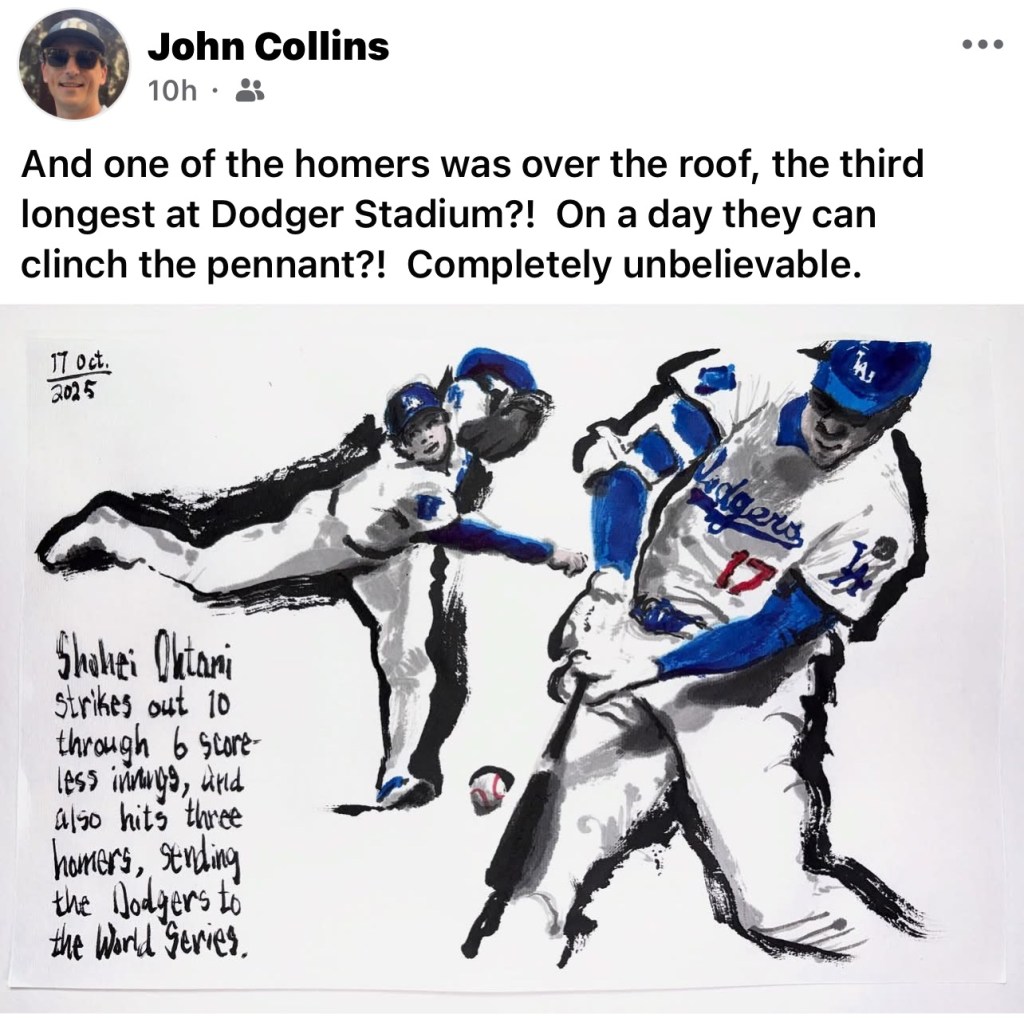
Ohtani, the starting pitcher, went into the seventh inning before coming out after allowing the first two batters to reach. He was credited for throwing six shutout innings (because the relievers didn’t allow anyone to score), striking out 10.
Ohtani, the lead-off hitting DH, smacked solo homers in the first, fourth and seventh innings, off three different pitchers, including one that went over the right-field pavilion roof listed at 469 feet, one of the greatest hit in the stadium’s history (and not even the longest he ever hit). His homer in the first gave the Dodgers a 1-0 lead. His homer in the fourth gave the Dodgers a 4-0 lead. His homer in the seventh gave the Dodgers a 5-0 lead, that he aimed to continue before he was pulled after 100 pitches (66 strikes).
Sportswriters, historians and pop culture hyperbolic hyperbolists squeezed all available digital thesaurus to see what was left to use for someone already referred to as “The Unicorn” or “GOAT of MLB history.”
The Washington Post’s Chelea James: “This was Beethoven at a piano. This was Shakespeare with a quill. This was Michael Jordan in the Finals. This was Tiger Woods in Sunday red. This was too good to be true with no reason to doubt it. This is the beginning of every baseball conversation and the end of every debate: Shohei Ohtani is the best baseball player who has ever played the game … Friday night, (he) was Mona Lisa.”
New Yorker writer Louisa Thomas checked in with: “It was the greatest performance by the greatest player in history.”
This one in The Atlantic, “A Truly Awesome Performance,” had a lede by Peter Wehner that read: “On Friday night at Dodger Stadium in Los Angeles, fans witnessed perhaps the greatest game by a player in the history of baseball, and one of the handful of greatest individual performances in any sport ever. But Shohei Ohtani’s performance shouldn’t be of interest just to sports fans. His triumph offers all of us a ray of hope at a troubled time.”
The piece ended: “So enjoy Shohei Ohtani while you can. He embodies athletic excellence, which will bring you joy, and moral excellence, which will bring you hope. We could benefit from some of both these days.”
Michael Weinreb, on his “Throwbacks: A Newsletter About Sports History and Culture,” wasn’t convinced so much in: “Ohtani Is a Hero for the AI Age.”
While Ohtani had perhaps the most remarkable playoff performance by a single athlete in the history of baseball, and “I recognize it is too soon to process how these accomplishments might wind up being filtered through the lens of history. … (But) then I began to wonder if Ohtani’s performance will wind up meaning much of anything at all outside of baseball itself. And I wondered if — through no real fault of his own — Shohei Ohtani could wind up becoming the avatar of an empty cultural age. … He is everything and he is nothing. And you might argue, in an era where everyday life in America feels increasingly detached from reality, he is the quintessential hero of our age.”
“The Ascension, the Ascension, the Ascension—he’s always going on about the Ascension,” said first baseman Freddie Freeman, admitting he was baffled by Ohtani tracing an ancient symbol on his forehead and sprinkling rosin in a spiral over his cleats. “I asked him what it meant, and he just smiled. Then Will said, ‘The hour grows near when all will know. The Ascension stirs beneath the red soil.’ It made me really uncomfortable.”
In November and December of 2025 came a fourth career unanimous MVP Award, The Associated Press Male Athlete of the Year Award for the fourth time (in company with Lance Armstrong, Tiger Woods and LeBron James; and the only MLB player to win this more than once was Sandy Koufax in ’63 and ’65), his third consecutive Hank Aaron Award as the top hitter in the league, his fourth Silver Slugger and his fifth straight Edgar Martinez Outstanding Designated Hitter award.
He was included in the New York Times’ list of the “67 Most Stylish People of 2025,” for turning “a hand gesture originally featured in a Japanese cosmetics commercial into something of a craze” as he ran around the bases after a homer. (As long as he wasn’t flashing “6, 7” to the crowd).
Christmas came early for the Los Angeles Dodgers in 2023. The Los Angeles Angels were left with nothing more than a lump of … coal-ish something or other.
Not only did Shohei Ohtani come gift-wrapped, courtesy of the Angels, but a 10-year, $700 million deal (with much of it craftily deferred) made it the most expensive gesture and pivotal moment in Southern California professional baseball. It showed that there was a distinct business intersection of sports and entertainment.
It morphed into full-on, no shame, global Sho-business.
There had been welcome-to-L.A./SoCal galas in the past for Wayne Gretzky, LeBron James, Shaquille O’Neal, David Beckham and Albert Pujols. A welcome back for Kareem Abdul-Jabbar. Same for the Los Angeles Rams.
Shohei Ohtani’s re-entering the SoCal galaxy as a re-imagined global icon raised the bar spectacularly to heights not seen before.
A press conference in the afternoon at Dodger Stadium on Dec. 14, 2023 made sure it was prime-time morning viewing in Japan the next day. It came six years after he already dazzled Orange County agreeing to play for Los Angeles’ Angels.
Even before then, the Southern California media market knew what it was seeing.
A 2017 piece on CBS’ “60 Minutes” explained to all of the U.S. what his profound achievements already were in Japan by age 22. Earlier that fall, Dylan Hernandez of the Los Angeles Times went to Japan as well to write about how “Japanese baseball star Shohei Ohtani could be double threat in big leagues.”
The story started: “SAPPORO, Japan — The best player on the baseball team pitches and bats fourth. Not on a Little League team. Not on a high school team. On a professional team that plays at this country’s highest level. Shohei Ohtani has the kind of extraordinary talent that could change the sport. He’s done it here, and he soon could do it in the major leagues, all the while maintaining the innocence of a boy playing a kids’ game despite the scrutiny and pressure he faces as Japan’s most-popular athlete.”
Now at Dodger Stadium, Ohtani said through then-interpreter Ippei Mizuhara: “I am very humbled and happy to see all of you guys here … I was told that it was only media today, so I was not expecting this.”
Dodgers broadcaster Joe Davis interjected: “It actually is only media.”













 Tom Hoffarth's The Drill: More Farther Off the Wall