
This post is part of a media project called SoCal Sports History 101: The Prime Numbers from 00 to 99 that Uniformly, Uniquely and Unapologetically Reveal The Narrative of Our Region’s Athletic Heritage. Pick a number, and consider the list of athletes attached to it. Who wore it best? Or, what’s the most compelling story linked to it? Any person, place or thing is in play with Southern California connections. Star power, transformational achievement, longevity, notoriety and quirkiness all factor in. Whatever leads to a lively discussion and interpretation.
The most obvious choices for No. 12:
Vlade Divac, Los Angeles Lakers
Charles White: USC football
Dusty Baker: Los Angeles Dodgers
Tommy Davis: Los Angeles Dodgers
James Harris: Los Angeles Rams
Juju Watkins: USC women’s basketball
Dwight Howard: Los Angeles Lakers
Puca Nacua: Los Angeles Rams
The not-so-obvious choices for No. 12:
Gerrit Cole: UCLA baseball
Denise Curry: UCLA women’s basketball
Joe Namath: Los Angeles Rams
Pat Riley: Los Angeles Lakers
Randall Cunningham: Santa Barbara High football
The most interesting story for No. 12:
Richard Nixon: Whittier College football offensive tackle (1930 to 1933), via Fullerton High and Whittier High
Southern California map pinpoints:
Yorba Linda, Fullerton, Whittier, San Clemente
Reference books on the subject:
“RN: The Memoirs of Richard Nixon,” by Richard Nixon, 1978
“In the Arena: A Memoir of Victory & Defeat & Revival,” by Richard Nixon, 1990
“Richard Milhous Nixon: The Rise of An American Politician,” by Roger Morris, 1990
“Being Nixon: A Man Divided,” by Evans Thomas, 2015
“Richard Nixon: The Life,” by John A. Farrell, 2018
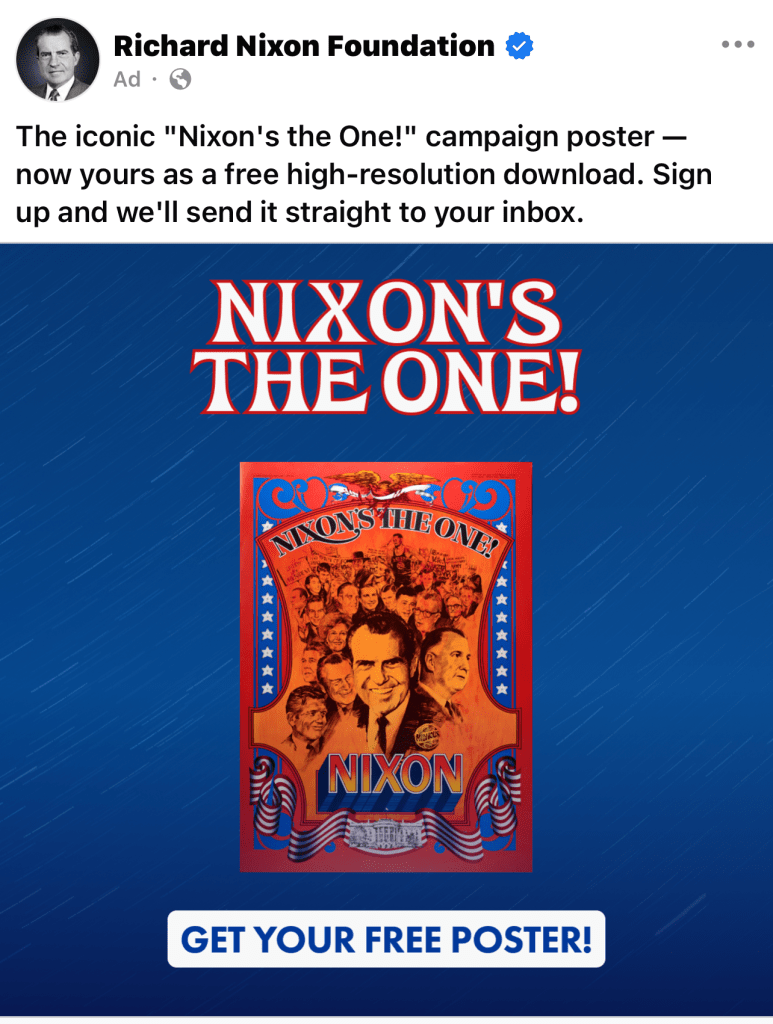
Richard Nixon was having a viral Instagram moment in the spring of 2026. We saw an alert from a story posted on LAMaterial.com. It warned: “Gen Z is Nixonmaxxing hard af.”
The Richard Nixon Foundation, a nonprofit that runs the Nixon Presidential Library in Yorba Linda jointly with the federal government, had been cranking out a steady stream of steamy viral content — sleek, sexy edits of archival footage set to trending music. It looked more like promo material for a hip-hop artist than a disgraced, long-deceased president.
“The Gen Z-coded videos show Nixon leading crowds of suited men to Biggie’s ‘Hypnotize,’ and delivering speeches in packed stadiums to ‘WE ON GO’ by the rapper BIA,” wrote Tomo Chien. “In the videos, Nixon projects what one commenter called ‘absolute aura,’ and the foundation has more than doubled its Instagram following to 105,000 in the last year.”
That led to a limited run of “Nixonmaxxing” hats quickly selling out to those who choose to sell out.
“Alternative histories of Watergate are as old as the scandal itself,” Chien added. “Theorists across the political spectrum have long suggested, without solid evidence, that the infamous burglary was staged by the CIA in an effort to oust Nixon, or that the ensuing scandal was largely the work of vindictive deep state actors who wanted him out. But the Gen Z-focused content by the Nixon Foundation epitomizes a new strain of Watergate revisionism that began around the start of Donald Trump’s first presidency.”
This came at a point in Americana when it it’s easier to manipulate facts and disguise it as “new truths.” When the oxymoron known as Artificial Intelligence can artfully spit out tropes that appear to fortune-cookie someone’s name, likeness and image into a palatable memory bank deposit.
Fifty years after Watergate, and all that word meant in the English language by this point, some were trying to twist the idea that it’s not really all that offensive in the pursuit of life and liberty for whatever we consider to be U.S. citizens. Look at it another way, in proportion to what else was going on, and this was simple misstep toward progress, as some with Oval Office-adjacent access might throw up in the spirit of being overaggressive and diligent in getting something done for the good of the masses.
If the Nixon Foundation needs more material to mine and remaster, check the files of all the sports-related things Richard Nixon leaned into. It wasn’t just a way to scratch his competitive itch. Wins, losses and Christian Dior ties from Bloomingdales is a framework for some, like Nixon, in how you move from the idea of “it’s how you play the game” to “if you’re not cheating you’re not trying.”
In the history of political arena, warriors had to eat or be eaten. Nixon’s days as a legislative gladiator on the grandest stage always had sports as its foundational drive. Even if it ultimately led to imperfect execution by someone who may have considered himself to be athletically driven to win at all costs.
If Nixon’s disdain for being labeled a loser led to his ultimate downfall, give the blame, or credit, the sporting live he grew up with in Southern California.
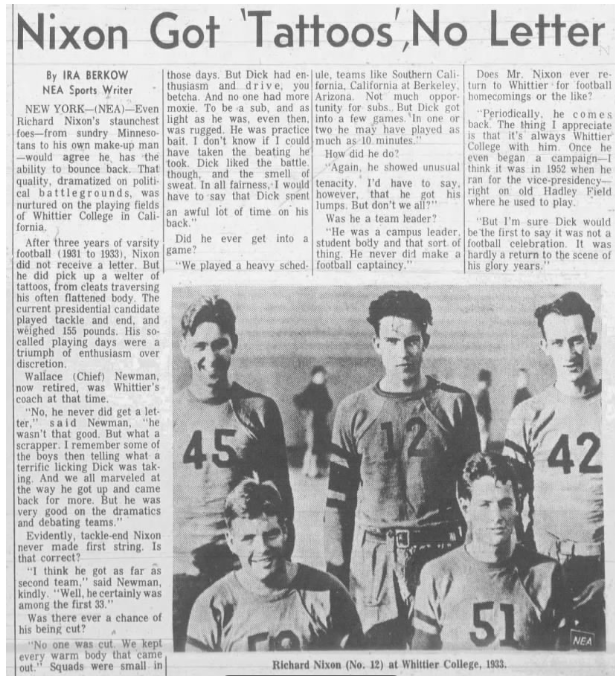
Victories were unimpeachable in Richard Milhous Nixon’s view of life and legacy.
The fact he lost the 1960 Presidential Election doesn’t always show that, according to the scoreboard, he lost by just a mere 0.17 points in the popular vote. There was no allegations of improprieties or fraud.
When he lost the 1962 California governor’s race, it was by five points. He just didn’t clock-manage apparently.
None of this would define him, Nixon decided. He once declared to the media after that gubernatorial defeat that “you won’t have Nixon to kick around anymore.” But then he made a comeback of epic proportions. If done strategically, wins could eradicate losses and rewrite the narrative.
Winning the 1968 election to become the 37th President of the United States meant Nixon could go into victory formation. Four years later, a landslide re-election in 1972, winning by nearly 18 million votes.
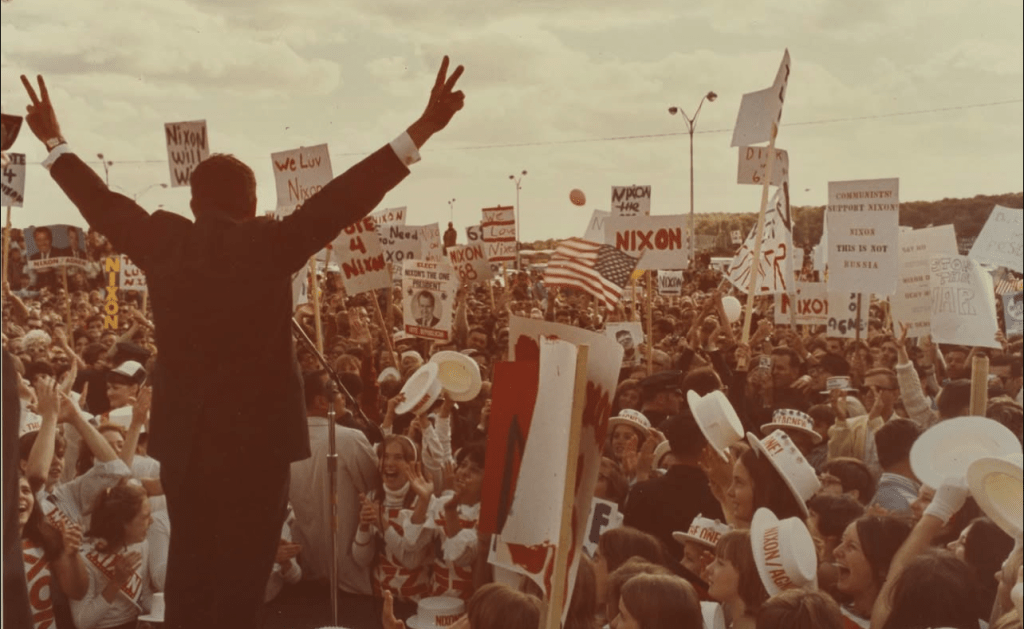
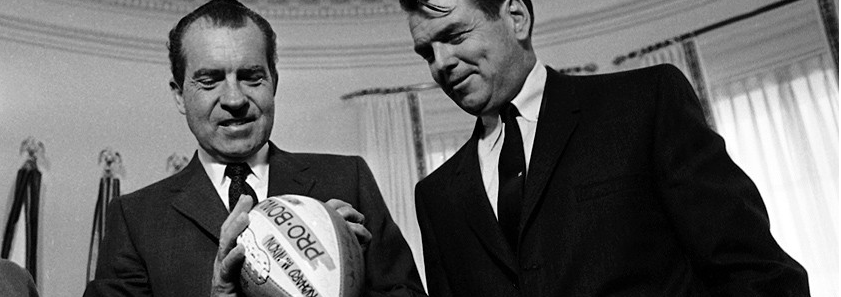
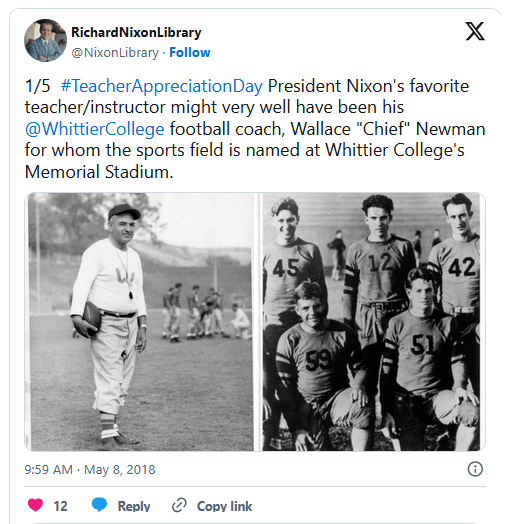
A win-at-all-costs mindset in the context of how to one-up the competition might be easiest to trace to a frustrated athletic career. That’s when he once wore No. 12 for the Whittier College football team, and had photos to back it up.
Born on a lemon ranch in Yorba Linda in 1913, Richard was a name given to him by his parents in honor of Richard the Lionheart. As the King of England, Richard’s 10-year run as a fearless military leader cemented his legacy during the Third Crusade. He was eventually imprisoned by his enemies, paid a ransom, returned home, went back into another battle and retreated into exile. He was also known to be a lyric poet and a hero of troubadours.
Nixon was 12 years old when a spot found on his lung caused doctors to discourage him from playing sports. There was a family history of tuberculosis — an older and younger brother died from it. Turned out, it was just scar tissue from an early bout of pneumonia.

Nixon grew up at a time he would later refer to as being surrounded by “forgotten Americans,” with those buried under a “silent majority” of hard-working church folks just chasing a dream.
He saw potential in his competitive nature to try out for JV football at Fullerton High. His claim to fame at that point in his life was being in the same circle as Arky Vaughn, the future Baseball Hall of Famer. Nixon claimed he and Vaughn played Pee Wee Football together. When Vaughn was posthumously voted into Cooperstown in 1985, Nixon was said to have sent a letter to his daughter explaining that while he was a backup tackle on the Fullerton JV team, Vaughn was the star halfback, someone who was “fast, hard-nosed and even then a real professional.”
After Nixon transferred closer to home at Whittier High to start his junior year, the best he could do was act as a student manager for the athletic teams.
At Whittier High, he ran for class president but lost to a candidate he would describe as “an athlete and personality boy.”
At the start of the Great Depression in 1930, Nixon wanted to go to Harvard or Yale, but stayed closer to home. Whittier College allowed him to pursue a history degree — and it was intimate enough to where he could not just play football, but also try out for basketball and track.
The NCAA Division III private school east of Los Angeles was founded in 1887. The teams nicknames, the Fighting Poets, came from Quaker poet John Greenleaf Whittier.
Nixon’s more celebrated victories would come on the Whittier debate team. Maybe that helped him form better arguments with his coaches about getting more playing time.
Continue reading “No. 12: Richard Nixon”
