No. 71: John Ferraro

This is the latest post for an ongoing media project — SoCal Sports History 101: The Prime Numbers from 00 to 99 that Uniformly, Uniquely and Unapologetically Reveal The Narrative of Our Region’s Athletic Heritage.  Pick a number and highlight an athlete — person, place or thing — most obviously connected to it by fame and fortune, someone who isn’t so obvious, and then take a deeper dive into the most interesting story tied to it. It’s a combination of star power, achievement, longevity, notoriety, and, above all, what makes that athlete so Southern California. Quirkiness and notoriety factor in. And it should open itself to more discussion and debate — which is what sports is best at doing.

The most obvious choices for No. 71:

= Brad Budde: USC football
= Tony Boselli: USC football
= Kris Farris: UCLA football
= Joe Schibelli: Los Angeles Rams

The not-so-obvious choices for No. 71:
= John Ferraro: USC football
= Randy Meadows: Downey High football

The most interesting story for No. 71:
John Ferraro: USC football offensive lineman (1943-1944, 1946-1947)
Southern California map pinpoints:
Cudahy, L.A. Coliseum, Los Angeles City Hall


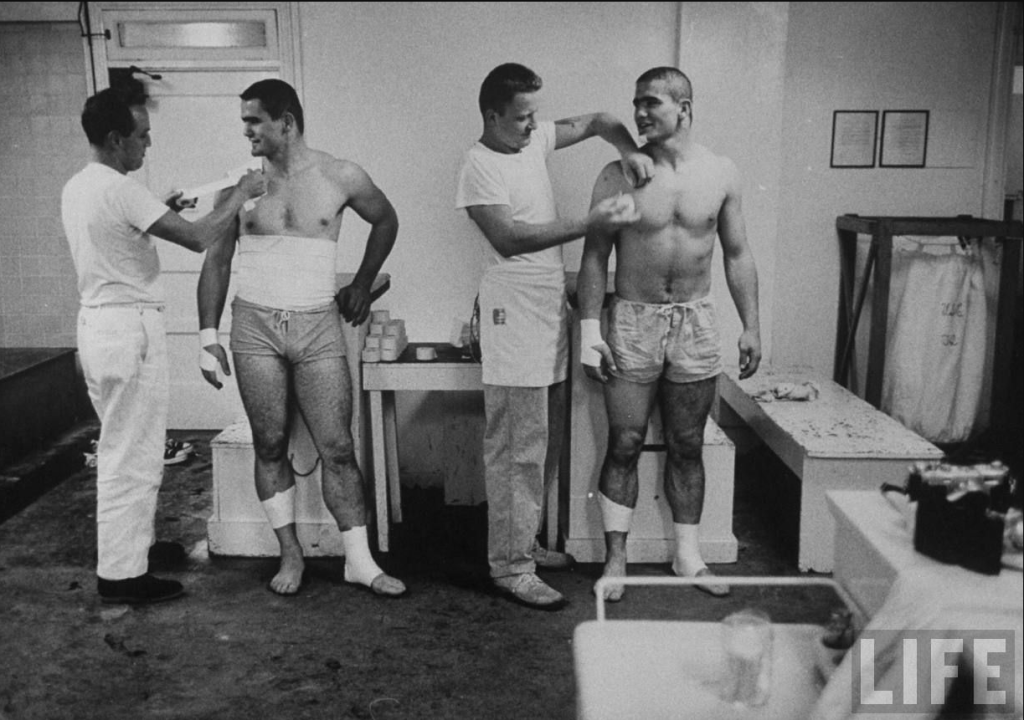
The cover of the 1946 Street & Smith’s Football Pictorial Yearbook asks readers to spend a quarter of a dollar for its preview the upcoming college football season. On this “national gridiron review,” John Ferraro offers a million-dollar glare.

The only hint on the cover that it’s him comes from a small caption off his right shoulder that reads “FERRARO U.S.C.” In the table of contents, his full name appears along with the photographer who took the special Kodachrome shot.

Ferraro had earned attention as a USC All-American tackle in ’43 and ’44. Now he was coming back to play after military duty during World War II in 1945. There were others to consider for the preview cover — Army’s Glenn Davis, “Mr. Outside” out of Bonita High in La Verne who had finished second in the Heisman Trophy in ’44 and ’45 would finally win it outright in ’46. Teammate Doc Blanchard, “Mr. Inside,” who won the Heisman award in ’45, and would finish fourth in ’46.

But the publishers picked Ferraro. Kodachome had that affect, apparently. And maybe the regional interest.

“If any tackle in this land of ours has ever played better ball, he must be Superman and Hercules rolled into one,” Braven Dyer bravely wrote for Los Angeles Times in 1944 after Ferraro pushed the Trojans to a 28-21 victory at the Coliseum over the San Diego Naval Training Station Bluejackets. “When Big John goes to work, he’s dynamite.”

That was part of the journalism superlative use in that time, and at the Times.

But the part that holds true today: If any Los Angeles civic leader is tenacious enough to accomplish something for the good of the town, he or she could be measured up to John Ferraro, a Rose Bowl legend and U.S. Navy vet rolled into one, and the one who started the heritage of USC standout linemen sporting the No. 71.

Continue reading “No. 71: John Ferraro”

No. 52: Keith Wilkes / Jamaal Wilkes

This is the latest post for an ongoing media project — SoCal Sports History 101: The Prime Numbers from 00 to 99 that Uniformly, Uniquely and Unapologetically Reveal The Narrative of Our Region’s Athletic Heritage.  Pick a number and highlight an athlete — person, place or thing — most obviously connected to it by fame and fortune, someone who isn’t so obvious, and then take a deeper dive into the most interesting story tied to it. It’s a combination of star power, achievement, longevity, notoriety, and, above all, what makes that athlete so Southern California. Quirkiness and notoriety factor in. And it should open itself to more discussion and debate — which is what sports is best at doing.

The most obvious choices for No. 52:
= Keith Wilkes: UCLA basketball
= Jamaal Wilkes: Los Angeles Lakers/Clippers
Marv Goux: USC football
Jack Del Rio: USC football
= Khalil Mack: Los Angeles Chargers

The not-so-obvious choices for No. 52:
Happy Hairston: Los Angeles Lakers
Burr Baldwin: Los Angeles Dons
= Eddie Piatkowski: Los Anglees Clippers

The most interesting story for No. 52:
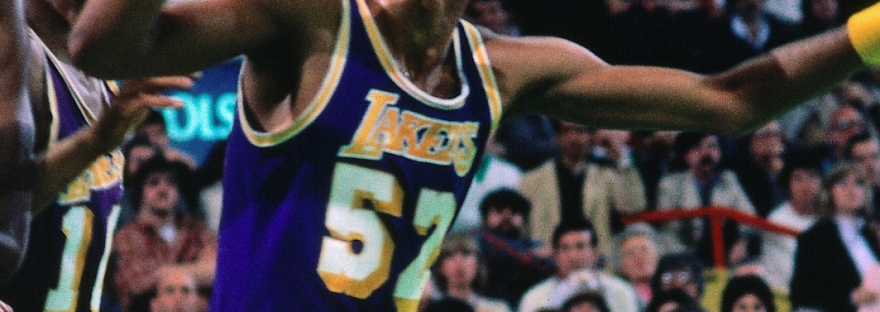
Keith Wilkes: UCLA basketball forward (1971-72 to 1973-74)
Jamaal Wilkes: Los Angeles Lakers forward (1977-78 to 1984-85); Los Angeles Clippers forward (1985-86)
Southern California map pinpoints:
= Santa Barbara; Westwood (UCLA); Inglewood (Forum)


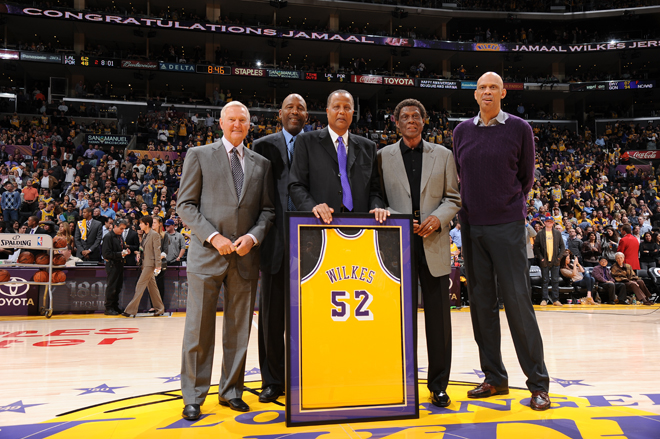
Jerry West, James Worthy, Jamaal Wilkes, Elgin Baylor, and Kareem Abdul-Jabbar pose during the jersey retirement ceremony of Jamaal Wilkes at Staples Center on December 28, 2012 (Photo by Andrew D. Bernstein/NBAE via Getty Images)

Before he was Jamaal, he was Keith. And before that, Jackie.

Before he was smooth as “Silk,” he was a little corny as  “Cornbread.”

Two weeks before Keith Wilkes’ UCLA No. 52 was retired at Pauley Pavilion in January 2013, Jamaal Wilkes’ Lakers’ No. 52 was put up on the wall at Crypto.com Arena in December of 2012. Somehow, the No. 52 he wore for the Clippers in the waning days before his retirement from the NBA isn’t worthy of retirement also.

It was 18 years before he was inducted into Springfield’s Basketball Hall of Fame in 2012 that he was already in Westwood’s UCLA Athletic Hall of Fame.

Most all of it, the deadly results of aside-winding shot that looked as if he was flyfishing made Lakers broadcaster Chick Hearn used to call it another “20-foot layup.”

Continue reading “No. 52: Keith Wilkes / Jamaal Wilkes”

No. 15: Ann Meyers Drysdale

This is the latest post for an ongoing media project — SoCal Sports History 101: The Prime Numbers from 00 to 99 that Uniformly, Uniquely and Unapologetically Reveal The Narrative of Our Region’s Athletic Heritage.  Pick a number and highlight an athlete — person, place or thing — most obviously connected to it by fame and fortune, someone who isn’t so obvious, and then take a deeper dive into the most interesting story tied to it. It’s a combination of star power, achievement, longevity, notoriety, and, above all, what makes that athlete so Southern California. Quirkiness and notoriety factor in. And it should open itself to more discussion and debate — which is what sports is best at doing.

The most obvious choices for No. 15:
Davey Lopes: Los Angeles Dodgers
= Shawn Green: Los Angeles Dodgers
= Ann Meyers: UCLA women’s basketball
= Tim Salmon: California/Anaheim/Los Angeles Angels
= John Sciarra: UCLA football
= Jack Kemp: Los Angeles Chargers

The not-so-obvious choices for No. 15:
= Vince Ferragamo: Los Angeles Rams
= Ryan Getzlaf: Anaheim Ducks
= Laiatu Latu: UCLA football
Darryl Evans: Los Angeles Kings
= Rich Allen: Los Angeles Dodgers

The most interesting story for No. 15:
Ann Meyers Drysdale: UCLA women’s basketball (1974 to 1978)
Southern California map pinpoints:
La Habra (Sonora High); Westwood (UCLA); Dodger Stadium


In a male-dominated, and often testosterone infested, sports coal mine, Ann Meyers accepted the ongoing challenge of being the female canary sent in to see if things were safe.

Time and time again, just give her a crack, and she’d find another way to kick it the door open.

She must have felt 15 feet tall when the Indiana Pacers had her hold up one of its jerseys with her name across the No. 15 in September of 1979. The number was special to her. It’s what she wore the four previous seasons as barrier-breaking All-American guard at UCLA, coming off a 27-2 season with a team that won the AIWA title under Billie Moore.

After college graduation, the pride of Sonora High of La Habra had already declined signing with the Women’s Professional Basketball League, wanting to keep her amateur status for the 1980 Olympics. But world events were changing fast.

Continue reading “No. 15: Ann Meyers Drysdale”

No. 2: Tommy Lasorda

This is the latest post for an ongoing media project — SoCal Sports History 101: The Prime Numbers from 00 to 99 that Uniformly, Uniquely and Unapologetically Reveal The Narrative of Our Region’s Athletic Heritage.  Pick a number and highlight an athlete — person, place or thing — most obviously connected to it by fame and fortune, someone who isn’t so obvious, and then take a deeper dive into the most interesting story tied to it. It’s a combination of star power, achievement, longevity, notoriety, and, above all, what makes that athlete so Southern California. Quirkiness and notoriety factor in. And it should open itself to more discussion and debate — which is what sports is best at doing.

The most obvious choices for No. 2:

Tommy Lasorda: Los Angeles Dodgers
Kawhi Leonard: Los Angeles Clippers
Derek Fisher: Los Angeles Lakers
= Morley Drury: USC football
= Darryl Henley: UCLA football

The not-so-obvious choices for No. 2:

Lonzo Ball: Chino Hills High basketball, UCLA basketball, Los Angeles Lakers
= Gianna Bryant: Mamba Academy basketball
Leo Durocher: Los Angeles Dodgers
Adam Kennedy: Anaheim/Los Angeles Angels
= Cobi Jones: UCLA soccer
= Shai Gilgeous-Alexander: Los Angeles Clippers

The most interesting story for No. 2:
Tommy Lasorda: Los Angeles Dodgers manager (1976 to 1996)
Southern California map pinpoints:
Fullerton, Los Angeles (Dodger Stadium)


Glendale, Arizona, 2010: Tom Hoffarth with Tommy Lasorda.

What’s your opinion of Tommy Lasorda?

Curses. We have quite a few to share.

He motivated and manipulated. He spoke in sound bites as deftly as he could unravel magnificent yarns of stories that seemed to good to be true.

But he always did better with an audience.

One day, at an event in downtown L.A., Lasorda grabbed me by the left forearm. There was urgency.

“We’re going to Paul’s Kitchen,” he said, leaning in. “You gotta go with us.”’

The invite to go to one of L.A.’s most historic Chinese restaurants seemed to mean — With Lasorda and six friends, you get extra egg rolls.

I couldn’t commit because of a deadline for a story to write. I had to take a Teriyaki rain check.

So, the Pied Piper that he was, Lasorda did the quick exit with and a group in tow, out the door of Sports Museum of L.A. — this was after a 2010 press conference that had to do with where Kirk Gibson’s 1988 Game 1 bat and uniform might end up going — and over to a familiar spot where he could hold court for the rest of the afternoon.

Continue reading “No. 2: Tommy Lasorda”

No. 33: Lew Alcindor / Kareem Abdul-Jabbar

This is the latest post for an ongoing media project — SoCal Sports History 101: The Prime Numbers from 00 to 99 that Uniformly, Uniquely and Unapologetically Reveal The Narrative of Our Region’s Athletic Heritage.  Pick a number and highlight an athlete — person, place or thing — most obviously connected to it by fame and fortune, someone who isn’t so obvious, and then take a deeper dive into the most interesting story tied to it. It’s a combination of star power, achievement, longevity, notoriety, and, above all, what makes that athlete so Southern California. Quirkiness and notoriety factor in. And it should open itself to more discussion and debate — which is what sports is best at doing.

The most obvious choices for No. 33:

= Lew Alcindor: UCLA basketball
= Kareem Abdul-Jabbar: Los Angeles Lakers
Marcus Allen: USC football
Kermit Alexander: UCLA football
Willie Naulls: UCLA basketball
Marty McSorley: Los Angeles Kings

The not-so-obvious choices for No. 33:
= Karim Abdul-Jabbar: UCLA football
= Lisa Leslie: Morningside High and UCLA basketball
Charles White: Los Angeles Rams
Ollie Matson: Los Angeles Rams
Eddie Murray: Los Angeles Dodgers/California Angels
= Hot Rod Hundley: Los Angeles Lakers

The most interesting story for No. 33:
Lew Alcindor: UCLA basketball center (1966-67 to 1968-69)
Kareem Abdul-Jabbar: Los Angeles Lakers center (1975-76 to 1988-89)

Southern California map pinpoints:
Westwood (UCLA); Los Angeles (Sports Arena); Inglewood (Forum)


Thirty-three years after his NBA retirement, Kareem Abdul-Jabbar unfolded himself from a court side seat at the Los Angeles Lakers’ Crypto.com Arena, adjusted the black Adidas jacket he was wearing with the words “Captain 33” stitched on the front, and walked over to an area where he was supposed to wait near center court until he was needed.

The 75-year-old had made it to Feb. 7, 2023 in an upright position — nothing guaranteed in a life that saw him battle leukemia as well as a recent diagnosis of atrial fibrillation. The all-time regular-season points total of 38,387 that Abdul-Jabbar amassed during 20 record-breaking seasons in the NBA, the last 14 of them as the Lakers’ center and captain, had just been eclipsed by LeBron James, a current Lakers’ employee.

After the rush of embracing teammates, friends and family on the other side of the court, James made his way over to Abdul-Jabbar, who patiently watched, and waited. He knew this drill.

Continue reading “No. 33: Lew Alcindor / Kareem Abdul-Jabbar”