

“Beisbol on the Air: Essays on
Major League Spanish-Language Broadcasters”

The editors:
Jorge Iber
Anthony R. Salazar
The publishing info:
McFarland; 172 pages
$39.95; released Oct. 17, 2023
The links:
The publishers website; the authors website; at Bookshop.org; at Powells.com;
at {pages a bookstore};
at BarnesAndNoble.com;
at Amazon.com
“Play-by-Play From the Minors: Profiles
of Baseball Broadcasters from Scranton to Yakima”
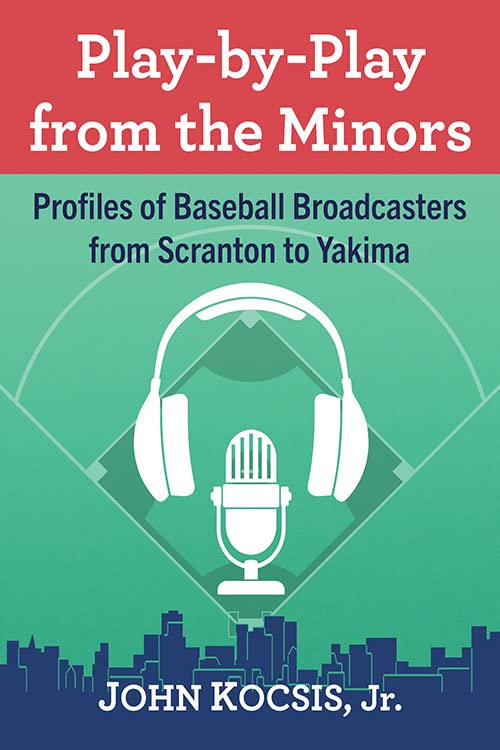
The author:
John Kocsis Jr.
The publishing info:
McFarland; 208 pages,
$35; released Oct. 13, 2023
The links:
The publishers website;
the authors website;
at Bookshop.org
at Powells.com;
at {pages a bookstore}; at BarnesAndNoble.com; at Amazon.com
The review in 90 feet or less

An essay posted in late August of 2023 found its way to the opinion section of The Hill, the media company based in Washington D.C. that focuses on “nonpartisan reporting on the inner workings of Government and the nexus of politics and business.”
This concerned the inner workings of how people were being informed about the local Major League Baseball team, which happens to be visiting Dodger Stadium this week.
In a piece with three bylines attached, it insisted the Washington Nationals deserved a Spanish-language broadcast of their games. The lack of one, at a time when the country was celebrating Hispanic Heritage Month, was somewhat problematic.
It pointed out that 22 of the 30 MLB teams have a least some games broadcast in Spanish, “an important way to market their teams in the growing Hispanic communities around the country.”
The one most obviously interested in this endeavor has been the Dodgers, along with markets with influencial Hispanic populations like San Diego, Texas, Houston, Miami, Arizona, both New York team and both Chicago teams. Also on board: Boston, Minnesota, Oakland, Seattle, Tampa Bay, Colorado, Milwaukee, Philadelphia, St. Louis and San Francisco. The last one to join was Detroit, starting in 2023.
Wait, that’s only 21 teams. The one missing is …
So, of the eight said to be not so invested: Cleveland, Kansas City, Atlanta, Cincinnati, Pittsburgh. And Toronto (which has its own French feed). Plus Washington, which, as The Hill story reports, has the largest number of Hispanic TV homes of any team not doing it.
By our count, there are nine teams abstaining.
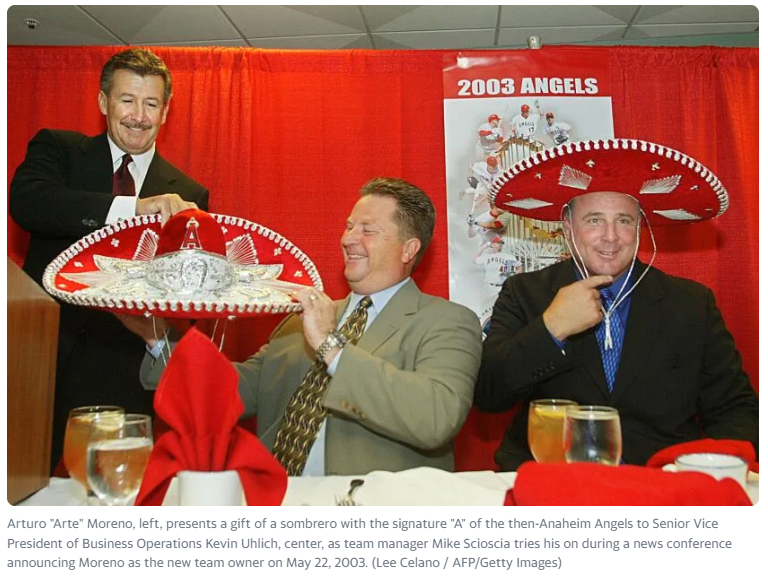
The Los Angeles Angels of Anaheim, a team owned by Arte Moreno, in a county where Latinos make up more than one-third the population, has been there in the past but continues to step back from any financial resources to bolstering this avenue of communication.
When Jose Mota left the Angels broadcasting team after 20 years to join the Dodgers two seasons ago, it was the most obvious example about the Angels’ apathy toward Spanish-language broadcasts. Mota was the first broadcaster in MLB history to do both Spanish and English on play by play and as an analyst.
Jose Tolenito had been doing games for 20 seasons with the Angels on Spanish radio, home and away. Then he wasn’t. The team also once had the well-known Bay Area Spanish-language broadcaster, Amaury Pi-Gonzalez, do a season for them (2007) as well as their Fox Sports West TV call from 2011 to ’17 (along with doing the Clippers in Spanish).
And now there are no Spanish-language broadcasters listed on their official roster.
The Dodgers, of course, have been invested in a Spanish-language broadcast since before 1958, the year they moved from Brooklyn to L.A. Buck Canel did about 40 selected Spanish games for the Los Esquivadores de Brooklyn over multi-language radio station WHOM, from 1954 to 1957.
Rene Cardinas, Miguel Alonso and Milt Nava were the first three Los Angeles Dodgers Spanish broadcasters in ’58. A year later, they were joined by Jaime Jarrin, the Ecuadorian-born gem of a man who came to the U.S. in 1955 having never seen a baseball game.
Jarrin was honored with the Ford C. Frick Award in 1998 for his work as a Spanish language broadcaster. He had put in 31 seasons at that point. He did 33 more to finish with 64 seasons in 2022. Jarirn was the second Spanish-language broadcaster so honored by the Baseball Hall of Fame following Canel, who went on to call Yankees and Mets games in New York in the 1970s, again for WHOM, also calling the World Series in Spanish from ’37 to ’79.
The Dodgers still have Pepe Yniguez, in his 27th season with the team for games on KTNQ-AM (1020). Fernando Valenzuela joined that broadcast 21 years ago for radio and TV — longer than the 17 years he spent as a big-league pitcher.
Steve Rosenthal, a Maryland-based consultant to labor unions and progressive organizations, Daniel Chavez, a longtime California Latino organizer and a Los Angeles Dodgers fan, and Albert Morales, another veteran politico, concluded in their piece for The Hill: “Today, the Dodgers report that 43 percent of their fan base this season was made up of Latinos. Twenty-eight percent speak English only, and 19 percent speak Spanish only. Granted, the Los Angeles media market has a larger Latino population than D.C., but shouldn’t the Nats be cultivating the relationship to scale?”
Shouldn’t Los Halos as well?
Maybe they’ll be guilted into it by Jorge Iber, a history professor at Texas Tech, and Anthony Salazar, chair of the Latino Baseball Research Committee of SABR. They pulled together 13 essays to tell the history of the game’s immersion into Spanish-language broadcasts through its most notable voices.
Baseball broadcast historian Curt Smith did the forward, including an endorsement recently outlined in the Sports Broadcast Journal website. Smith has also posted a second part of his series focused on Canel.
In Smith’s 2005 book, “Voice of Summer: Ranking Baseball’s 101 All-Time Best Announcers,” Jarrin is listed at No. 28. Jarrin is among the chapter’s first four “legend” essays, with Canel, Cardenas and Felo Ramirez, who made his name with the Miami franchise.

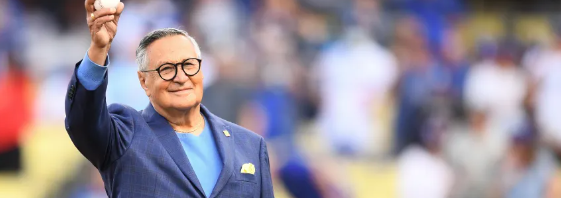
The Jarrin piece, written by Richard A. Santillan, a poli sci professor at East L.A. College who has done extensive research in Los Angeles Mexican-American baseball, starts with the El Maestro’s call of a home run: “Se va, se va, se va, despidala con un beso.”
But the essay also contains the opinion: Both the Dodgers and Major League Baseball have dropped the ball, struck out, and committed a major error by not taking full advantage of Jarrín’s immense popularity as a goodwill ambassador to Spanish- and English-speaking fans. The Dodgers continue to one-sidedly promote Vin Scully and Tommy Lasorda as the representational faces of the orga nization, while failing again to equally elevate Jaime Jarrín and Fernando Valenzuela, hardening the ongoing disillusionment among many Latino fans. … Jaime Jarrín is the patriarch of Major League Baseball’s expanding universe of Spanish-language broadcasters. Over the decades, he has mentored a profound lineage of broadcasting announcers, a baseball family tree that has locutores (broadcasters) branches in nearly every ballpark. It is impossible to imagine baseball today without Jaime Jarrín. Entering the ninth inning of his brilliant baseball career (hopefully, extra innings), baseball fans, regardless of language, should now, more than ever, revere his broadcasts before he takes off his headphones for the last time. He will depart wistfully but with the satisfaction and jubilation that he gave his all for the love of the game, always striving to reach the level of perfection. His depth and knowledge of baseball is second to none; he has captured the full scope of the transformation of baseball from a white American game to an international game of people of color as players and fans but not yet in management or ownership. He is the gold standard of baseball, earning the distinction to join the Mount Rushmore of baseball orators. There will never be another like El Maestro. Un brindis (a toast).
Jarrin’s son, Jorge, who joined his dad from 2015 to 2020 on the team’s radio broadcast and spent 17 seasons with the Dodgers as a broadcaster — following more than a quarter century as a famed radio helicopter traffic reporter — is also featured in an essay by Scott Melesky.
(We ourselves enjoyed doing a Father’s Day piece on Jaime and Jorge Jarrin in 2015).
Melesky also wrote about Pepe Yniguez, wrapping it up with: “The Latino community has always been very important to me,” Yñiguez said. “They have supported me in everything that I have done. I go into and live in the community a lot and I interact with the fans. They are very supportive, passionate, and excited and it makes me enjoy the games I call even more because of their support.”
The third section on “newer” voices ends the book focused on Jessica Mendoza, a current Dodgers’ TV analyst who launched her career at ESPN. In a piece by Roberto Avant-Mier and Patrick McDonnell, it includes: “Quite obviously, Jessica Mendoza appears to be an example of success through willpower, fortitude, and strength, as well as through her abilities and sheer talent. Yet we also hope that this chapter illuminating Mendoza’s story eventually contributes to the goal of empowering and supporting women in sports media. Likewise, as educators, researchers, and sports fans ourselves, the authors believe that the compelling story of Jessica Mendoza is a contribution to not only the enriching story of Latinos in broadcasting but also to the story of legendary women in sports media.”
We’ve admired Mendoza’s strides in this area, going back to her ESPN ascension in 2015, and then as a full-time “Sunday Night Baseball” contributor.
Progress is being made. Starting in 2022, the MLB Network aired exclusive Spanish-language broadcasts of American League post-season games.
But then, maybe it’s not making strides in obvious places.
In the conclusion, Iber writes about those documenting baseball’s iconic broadcasters: “Fortunately, the research agenda is changing, and this anthology is a further step in that direction. … As more Latinos play baseball at the highest levels and more of their countrymen come to the United States, it behooves franchises to examine ways to reach out to this booming fan base. It is certainly necessary for MLB to continue its work along these lines. Understanding the role and historical and current importance of locutores will only help to further strengthen the already deep-seated attachment between Spanish speakers and the various equipos of las grandes ligas.”
Hear that, Arte? Kinda bush league at this point in time …

In “Play-by-Play From the Minors,” a different dynamic is in play than what is often asked of an MLB team. In the minors, fans seem to just appreciate any sort of coverage of the team, in whatever language is available.
More profiles of those who’ve made interesting inroads into this genre are on display. It starts with the author/editor, Kocsis, who has been calling games for the Columbia Fireflies (the Kansas City Royals’ Single-A team in the South Atlantic League of South Carolina).
Josh Suchon, who has moved on from doing the Dodgers’ post-game shows to a career with the Pacific Coast League’s Albuquerque Isotopes, envelopes Chapter 10 here, and we’re pleased to see him recognized.
He relays a fantastic story about a 2016 road trip that ended with a flight intended to go from Oklahoma City to Albuquerque, rather than a 550-mile bus trip. The flight was off to a connection in Denver, and 30 minutes into that leg, it had to turn around with landing gear issues. It turned back to OKC. Once the plane was fixed, it headed back to Denver, but the connection to Albuquerque was already missed, so Southwest created a new flight for the team to get home. The Isotopes didn’t get to Albuquerque until 5:30 p.m. Their game that night started at 6:30 p.m. The team delayed the start just a half hour. The bus got the to the park, the players stretched, figured things out and took the field. They won that night and swept a four-game series. Suchon says “that was probably the most exciting homestand he has witnessed while in Minor Leauge Baseball — and it started with a wild plane trek.”
Suchon’s advice to young broadcasters: Don’t get caught up in trying too hard to be a professional and spent more time trying to enjoy what was occurring every day.
“I put a sticker next to my TV that says, ‘Let them hear you smiling.’ It’s impossible. They can’t hear you smiling — they can hear you laughing, but not smiling. The idea is that when you smile, you come across with more warmth and energy and hopefully that makes people enjoy the broadcast more.”
The other dozen covered here: Adam Marco (in his sixth year with the Scranton/Wilkes-Barre RailRiders); Joe Block (a former Dodgers post-game show host now in his 12th year of MLB broadcasting with Pittsburgh and Milwaukee, following a minor-league run); Jesse Goldberg-Strassler (15 seasons with the Lansing Lugnuts); Terry Byrom (19 years with the Harrisburg Senators); Robert Ford (now the lead voice of the Houston Astros after years in the minors); Josh Whetzel (Rochester Red Wings); Scott Kornberg (Jacksonville Jumbo Shrimp), Jay Burnham (the voice of UMass sports and Worchester Red Sox after a time with the Richmond Flying Squirrels); Zack Bayrouty (Stockton Ports), Alex Cohen (Iowa Cubs) and Emma Tiedemann (Portland SeaDogs).
How it goes in the scorebook
Call it like you want to hear it.
Here’s a place to find the lessons to be learned for anyone who wants to know history, and life, from the Spanish language front to the minor-league frontier. Chapter and verse. It’s as much perseverance as it is talent, as much entertainment as it fundamentals.
The call of the game is important on any platform. The language of baseball isn’t lost in translation, or on a transistor radio.
You can look it up: More to ponder
== Jaime Jarrin, Jessica Mendoza and Josh Suchon, all mentioned above, did chapters for our new book, “Perfect Eloquence: An Appreciation of Vin Scully.”
= Rene Cardenas, who trained Jaime Jarrin as the Dodgers’ Spanish-language broadcaster, still hasn’t been honored with a Ford C. Frick Award. He could/should be. He spent 21 of his 38 years working for the Dodgers. He made his TV play-by-play debut in 2008 with Houston on its Spanish-language telecast. In 2000, he was inducted into the Nicaraguan Sports Hall of Fame. Two years later, he was included in the Hispanic Heritage Baseball Museum Hall of Fame. He has been on the Frick Award ballot, twice, but didn’t get enough votes. “As the years pass by, new members are on the electing committee and they don’t know René and the history, or study it,” Jarrín said in a 2018 New York Times story. “I always voted for him on the list of candidates. It’d be a great pleasure to have him in Cooperstown with me. Undisputedly, I’d love that. But it’s out of my reach.”

 Tom Hoffarth's The Drill: More Farther Off the Wall
Hello Tom Hoffarth. Have you thought of syndicating these daily reviews to other news outlets? The Athletic, USA Today, big and small town newspapers.
On Tue, Apr 16, 2024 at 8:00 AM Tom Hoffarth’s The Drill: More Farther Off
LikeLiked by 1 person