

“The House Divided:
The Story of the First
Congressional Baseball Game”
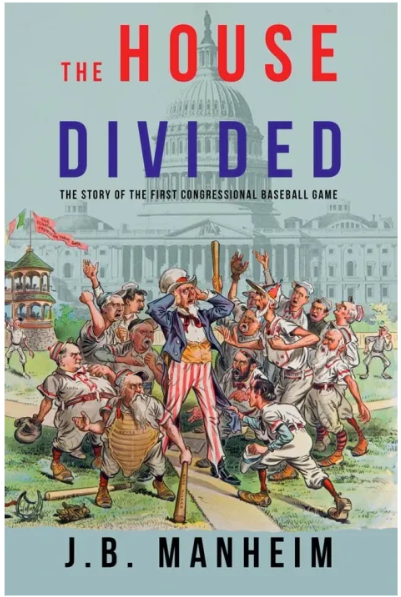
The author: J.B. Manheim
The details: Sunbury Press, $19.95, 182 pages, released April 22, 2025. Best available at the publisher’s website and the author’s website.
A review in 90 feet or less
Updated 6.12.25

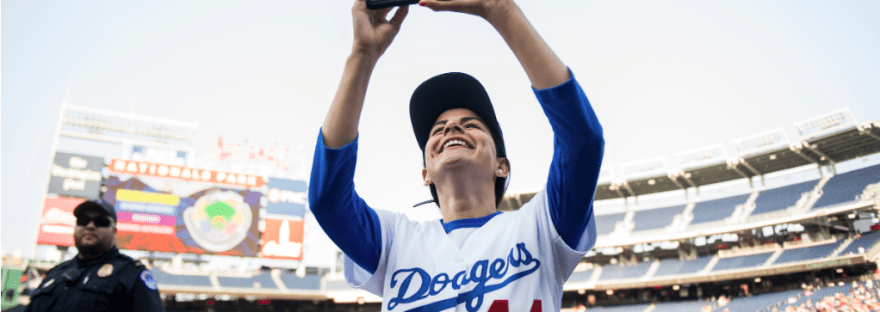
No, no. Nannette Diaz Barragán has earned her roster spot for the Congressional Baseball Game, next up on June 11 at Nationals Park in the District of Columbia.
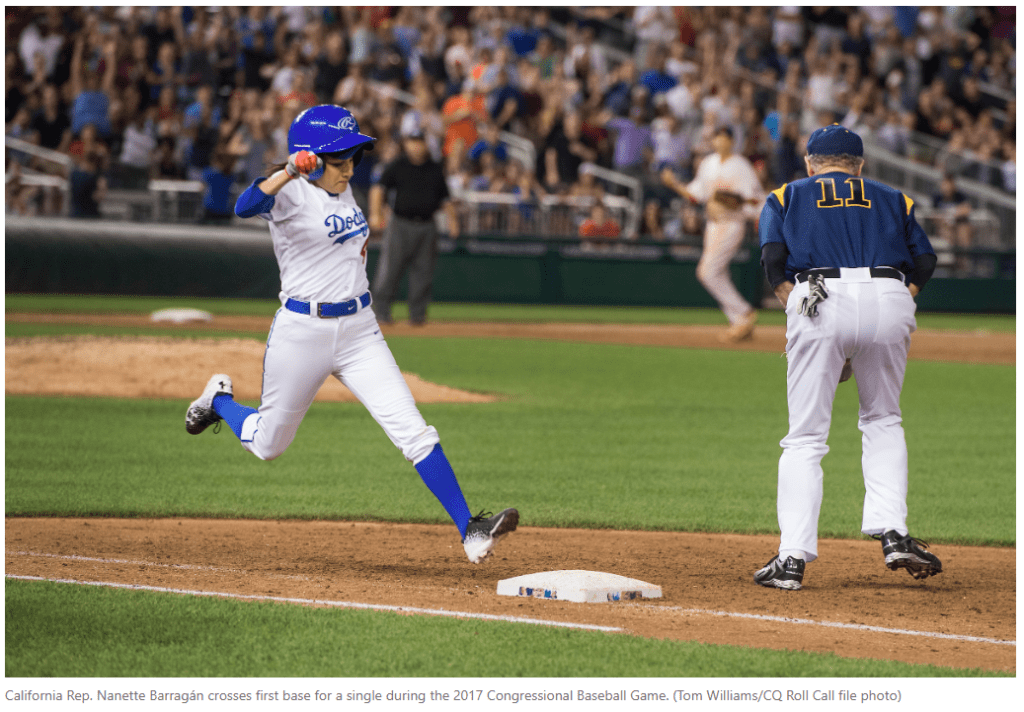
Since 2017 when the freshman House rep put on a Los Angeles Dodgers’ jersey, highlighted by a red No. 44 to represent her district, then ripped a pinch-hit, RBI-single in her first appearance before 25,000, Barragán continues to use baseball as a way of proving her worthiness.
This is no DEI seat filler. Her bio is pretty explicit in the ability to challenge and respond to situations.
Born in Harbor City as the youngest of 11, Nanette Diaz went to North Torrance High. While she played softball, she also petitioned the administration to be allowed to try out for the boys’ baseball team — and she made the JV squad.
With degrees in political science and public policy from UCLA and a doctorate in law from USC, she launched into a legal career. Involved in the Clinton White House in the Office of Public Liaison for African American outreach, Barragán eventually moved to Florida in 2012 to work on Barack Obama’s presidential re-election campaign and be part of the voter’s rights protection team.
By 2013, she circled back to the Hermosa Beach City Council, fighting against offshore oil drilling. Two years later, she was running for Congress after Janice Hahn vacated the seat.
After her debut in the Congressional Game in ’17, she was noted as one of three participants in the ’18 games — which marked the 25th anniversary of when Blanche Lambert Lincoln, Illena Ros-Lehtinen and Maria Cantwell were the first women played.

“A lot has changed in 25 years,” Barragán said, “but when it comes to this sort of thing, we need to acknowledge not much progress has been made.”
For the 2019 game, Barragán and good friend Linda Sanchez (CA-38) were the only two women players. Barragán invited the D.C. Girls Baseball Team as her special guest, taking pride int he fact her 44th District — Carson, Compton, Lynwood, North Long Beach, Rancho Dominguez, San Pedro, South Gate, Walnut Park, Watts, Willowbrook and Wilmington — includes the Compton Youth Baseball Academy, which hosts annual girls baseball tournaments.
With decisive victories in re-elections in ’18, ’20, ’22 and ’24, Barragán doesn’t hide her love of the Dodger blue, introduced to her by her father. She was at the Dodgers’ White House visits after their 2020 and ’24 World Series titles. Her official website has fashioned a branding for her that looks like the Dodgers’ logo.
With Sanchez as the captain of Team Democrat for the ’25 game, Barragán finds herself as the only woman on the roster. She is there with fellow Californian House members Pete Aguiliar (CA-33), Gil Cisneros (CA-31), Adam Gray (CA-13), Mike Levin (CA-49), Dave Min (CA-47), Kevin Mullin (CA-15), Raul Ruiz (CA-25), Eric Swalwell (CA-15), Derek Tran (CA-45), plus as U.S. senator Alex Padilla.
Four women are listed on the Republican roster — Lisa McClain (MI-09), Mariannette Miller-Meeks (IA-01), Kat Cammack (FL-03) and Iowa senator Joni Ernst.
Go back 108 years — there’s that number again associated with the number of stitches in a baseball — find the actual first female participant.
Jeanette Pickering Rankin, the first woman to hold federal office in the U.S., threw out the ceremonial first pitch and was recruited as a scorekeeper for the 1917 game. Rankin had been elected to the House as a Republican from Montana a year earlier and would serve just one term. She went back to doing important social work for the next 20 years — including to help found the ACLU. She was re-elected in 1940, and the significance of that for the suffragist and pacifist was she was on the record as voting twice against a declaration of war prior to WWI and WWII.
The first Congressional Game happened just eight years before Rankin’s appearance. And now we know much more about that we thought we ever might.
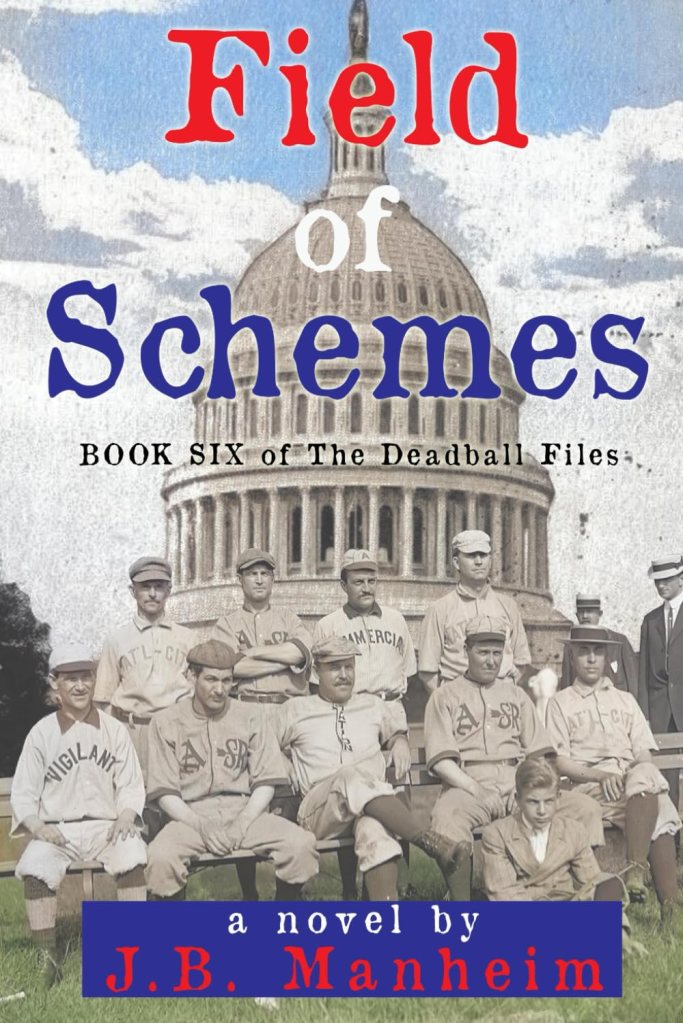
J.B. Manheim, researching background for “Field of Schemes,” the sixth book of his fictional series called “The Deadball Files” that came out in February, found himself with so much information that he concluded — again — to do a companion book which, if read in tandem, would give the reader a far better reference point with the facts behind the fiction.
The focal point of “Field of Schemes” involves Adam Wallace, Baseball Sleuth, as he is asked to find out more about that first Congressional Game in 1909, making Congressman John Tener the main protagonist — a former major-league pitcher/outfielder for the Baltimore Orioles of the American Association, the Chicago White Stockings of the National League and Pittsburgh Burghers of the Players League, who would be president of the National League at the time of the Black Sox Scandal and director of the Philadelphia Phillies before he died at 82 in 1946.
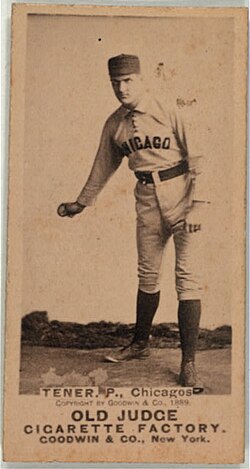
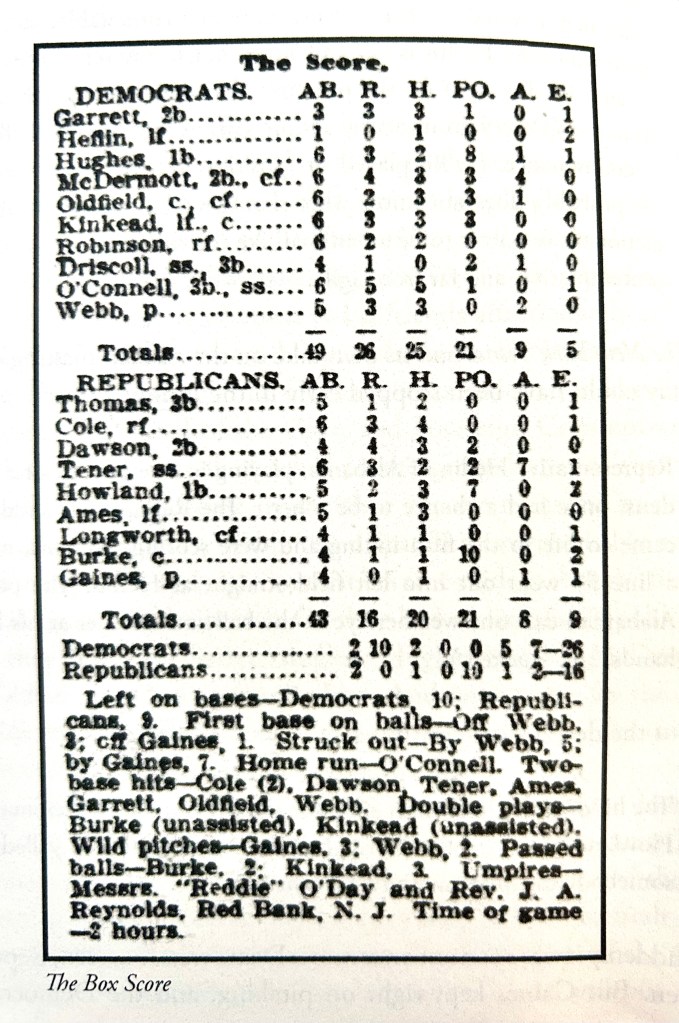
Tener was a 46-year-old Republican representing Pennsylvania’s 24th district in 1908 and gets plenty of ink in “The House Divided” as the prime fulcrum for the Congressional Baseball Game happening. As team captain and shortstop who hit cleanup, he went 3-for-6 in a 26-16 loss to the Dems, who were led by third-baseman/shortstop J.F. O’Connell (Mass-10). According to the box score, O’Connell went 5-for-6 with five runs and the game’s only homer as he hit in the No. 8 spot.
Tener, a Northern Ireland native was also the oldest participant in exhibition, only served one term before his party nominated him to run for governor of Pennsylvania, which he won. With that, he became the first in the state history to hold the seat since the American Revolution that was born outside the U.S. That term also lasted just four years, overlapping two years with his NL president role and had to fight off threats of the Federal League.
Manheim connects a fascinating parallel story to the first Congressional Baseball Game as the 65th Congress’ special session was deep into due diligence with President William Howard Taft’s push for his Tariff Reform Bill. It became the Sixteenth Amendment to the Constitution.
In the middle of the debates, Tener found neutral ground by arranging for a group of Congressmen, including New York Republican Sereno Payne, to attend a Baltimore Orioles’ game in late June. The so-called Payne-Aldrich Tariff income tax amendment legislation — S.J.R. 40 — has baseball as its background soundtrack. Just wait until the discussion years later of anti-trust rules.
President Taft addressed Congress on June 16 and proposed a two-percent federal income tax on corporations, which established Republicans pushed back against. Congress passed the resolution proposing the Sixteenth Amendment on July 12, and it went to the states for ratification. The Congressional Baseball Game happened on July 16. President Taft signed the Payne-Aldrich Tariff Act on Aug. 5.
The last state to ratify it was New Hampshire, in 1913, after rejecting it in 1911. Connecticut, Rhode Island, Utah and Virginia rejected it. Florida and Pennsylvania never considered it. California was several decades away from statehood.
As it turns out, the Congressional Baseball Game became a way for the legislators to blow off steam during the heated debates, news of other scandals and other general mayhem involved in the dirtiness of politics, while watching those getting their jerseys dirty playing a modified game of rounders.
The Congressional Game could have been a one-off event — there wasn’t one played in 1910. Dems won the first six, but there were no scores registered in 1915, 1919 or 1945-46. There was a gap after the 1957 game, but it picked up again in 1962 and has been every year since except for 2020 COVID.
Manheim, a Professor Emeritus at The George Washington University who was founding director of the School of Media & Public Affairs, is a man among boys in our annual book reviews in the baseball fiction genre, using the lives of Christy Mathewson, Ty Cobb, Abner Doubleday and Shoeless Joe Jackson as more-than-viable entry points, expanding upon what they did far beyond the field of play.
A member of the Society for American Baseball Research and the Internet Baseball Writers Association of America, Manheim should take pride in the progression of “The Deadball Files,” the last of which we reviewed in March of 2024 called “The Keystone Corner: Thomas Edison Turns Two,” also also produced an accompanying book of non-fiction, “What’s In Ted’s Wallet: The Newly Revealed T206 Baseball Card Collection of Thomas Edison’s Youngest Son.” That collection, by chance, also started in 1909. Manheim’s first work was on our radar in 2021.
It’s never lost time when Manheim comes up with another gem that blends history with baseball and a “what if” scenario. Manheim owns the scoreboard on baseball fiction, and these side trips into the real deal are a helpful crutch for his series, as well as standing alone for enlightenment and entertainment. It also helps to have a publisher backing this. Manheim notes that Sunbury Press CEO Lawrence Knorr, a “baseball historian, polymath, graphic artist and IT whiz,” not only edited this work but created the spectacular cover art.
So if you’re scoring at home, or just sitting alone, the Republicans have won 46, including the last four, and last year by a 31-11 count. The Democrats have tallied 42 wins. Heading into the 2025 Congressional Baseball Game, we wish everyone good luck in having the official box score certified no matter the outcome.
How it goes in the scorebook

Motion to recommit to additional pouring over old Congressional Records for potential story lines and hysterically historical malpractice. Especially when old stuff Congressmen’s photos can be converted into dashing baseball cards.
This latest Manheim creations almost lines up with the new Netflix series, “The Residence,” with Shonda Rhimes — at a Congressional hearing, the story of a mysterious White House death and the detective hired to investigate as the case unfolds. (Plus, it’s nice to see Al Franken back in a hearing setting, even if it’s pretend).
You can look it up: More to ponder
== Manheim did a version of the book for the SABR Deadball Era’s Committee’s February 2025 newsletter.
== The April 25, 2025 edition of Craig Calcaterra’s Cup of Coffee daily post, someone identified as “DC Ghostwriter,” which Calcaterra described as “someone with inside knowledge and expertise about this topic and, for obvious reasons related to our political moment, they are using a nom de guerre,” decided to give a “scouting report” for the “more notable” of the 64 Democrats and Republicans set for this 2025 game.
Barragán wasn’t included. Maybe that’s a good thing.
Those among the Dems picked out:
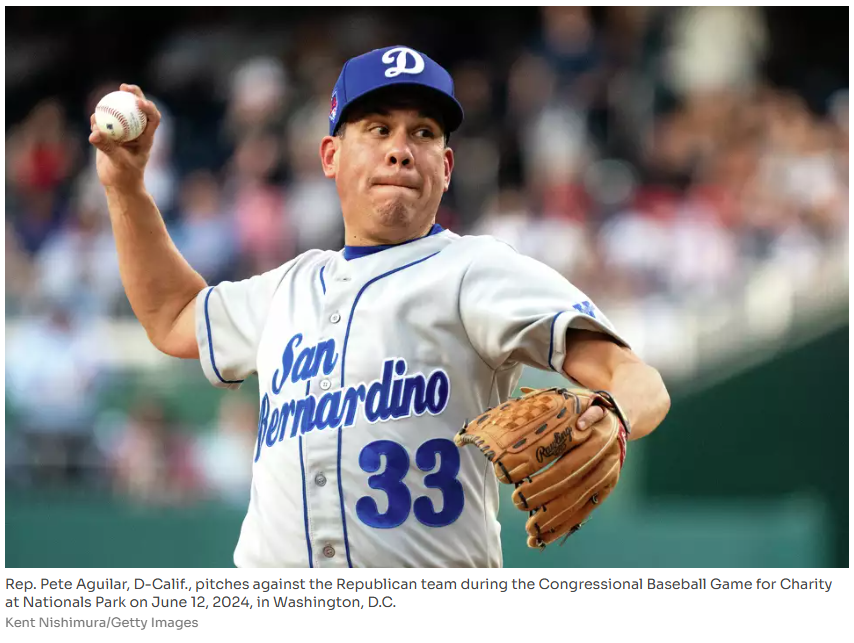
= Pete Aguilar (CA-33) – SP, SS: The Democratic Caucus Chair has taken over as the Starting Pitcher with the departure of Cedric Richmond. His mechanics are almost passable, up until he releases the ball. Player Analog: Jamie Moyer
= Alex Padilla (CA-Sen) – 1B, RP: An imposing 6’5” (who) pitched for a year at MIT. He struggles with his command but induces fly balls with his loopy curveball. Player Analog: Chris Young
(Note: Aguilar and Padilla gave up 19 runs combined when they pitched in the 2024 loss to the Republicans).
= Gil Cisneros (CA-31) – 1B: Making his return to Congress and to the Congressional Baseball Game, Rep. Cisneros has a smooth lefty swing and can pick the ball at first. Unfortunately he’s slow as molasses. Player Analog: James Loney
= Raul Ruiz (CA-25) – 2B: One of the longest-active players, Rep. Ruiz looks like he regularly takes ground balls in between votes. His stolen base days are behind him, but he’s one of the few players with visible fundamentals. Player Analog: Placido Polanco
Those among the Republicans rightfully singled out:
= Tim Burchett (TN-02) – 1B: You might recognize Rep. Burchett from his Carhartt jacket or his odd friendship with Rep. Alexandria Ocasio-Ortez. His swing is all arms, which makes it look like he’s swinging a wooden plank. Player Analog: Hunter Pence
= Byron Donalds (FL-19) – DH: One of the 19 Republicans who put former House Speaker Kevin McCarthy through his embarrassing ringer of 15 failed floor votes to become speaker. He has yet to hit it past the infield grass in his congressional baseball career and with his announced gubernatorial run, this is hopefully the last time we see this weirdo. Player Analog: Hee-seop Choi
= Chuck Fleischmann (TN-05) – 2B: Flew off the handle last year and seemed to advocate for wiping out Palestine. He also subscribes to Trump’s claim that the 2020 election was fraudulent. Somehow this guy won the MVP in 2023. Player Analog: Pete Rose (only the hair)
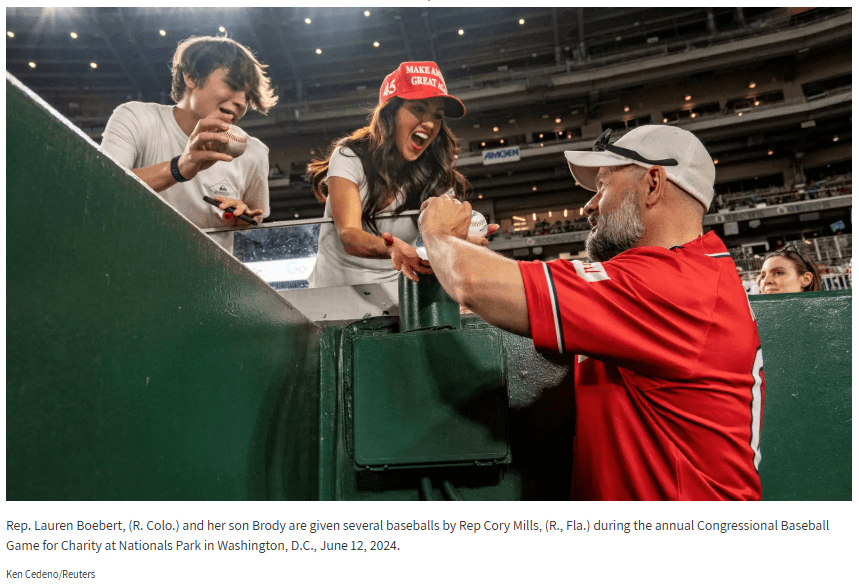
= Cory Mills (FL-07) – OF: Not enough attention has been made of an investigation by DC MPD into Rep. Mill’s alleged assault of a 27-year-old woman in DC, speculated to be his mistress. He’s also under investigation for lying on his financial disclosures and giving his campaign $1.8M. He’s probably bad at baseball. Player Analog: Trevor Bauer
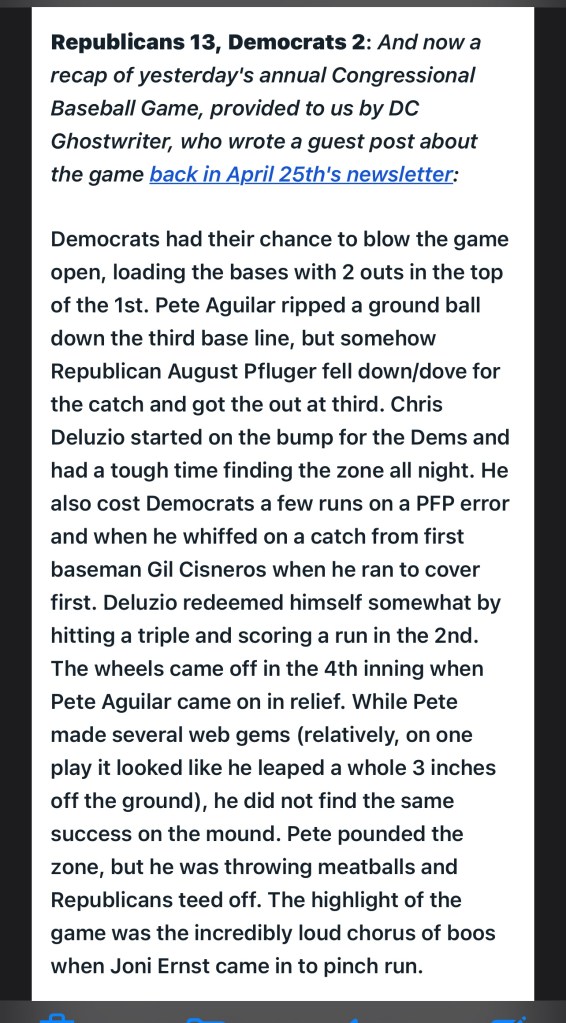
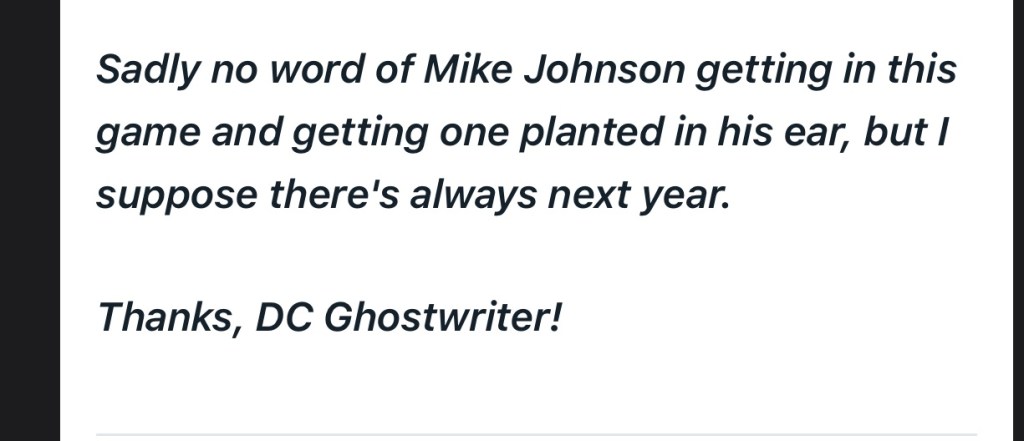
Update on the 2025 game from Calcaterra’s post:


 Tom Hoffarth's The Drill: More Farther Off the Wall
1 thought on “Day 21 of 2025 baseball book reviews: Who has the veto power on an overturned call in this game?”