Day 16 of 2026 baseball books: Fast, furious and fearless folklore, backed up by the facts

“Nolan: The Singular Life
of an American Original”
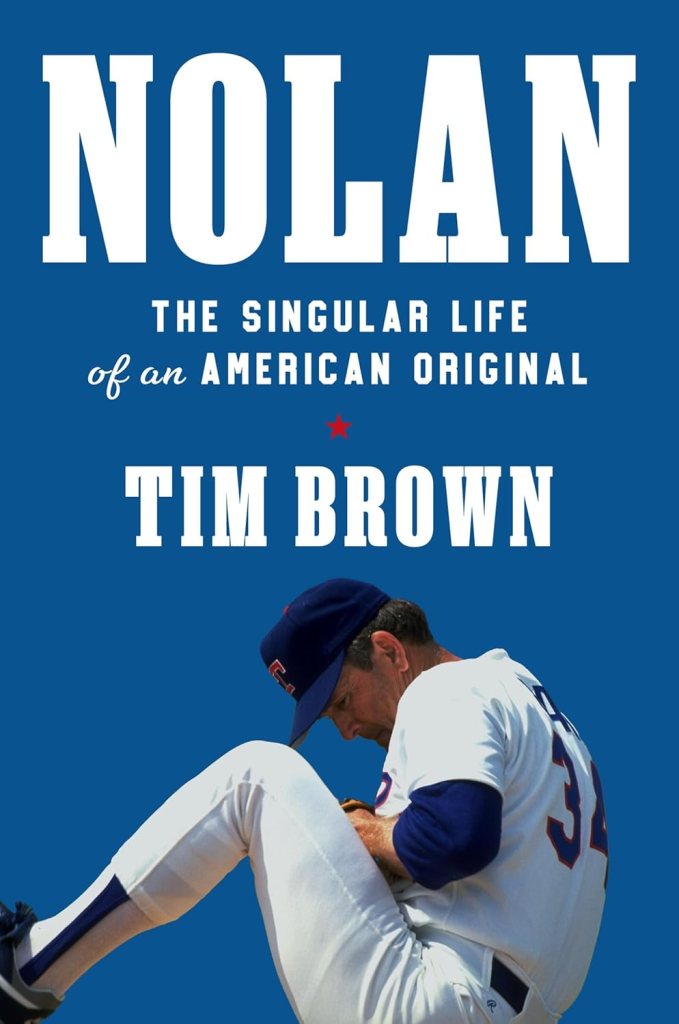
The author: Tim Brown
The details: Grand Central Publishing/Hachette, 352 pages, $30, released May 19, ’26
The links: The publisher, the author, Bookshop.org


So Young, So Great:
Bob Feller Electrifies
Baseball and America”
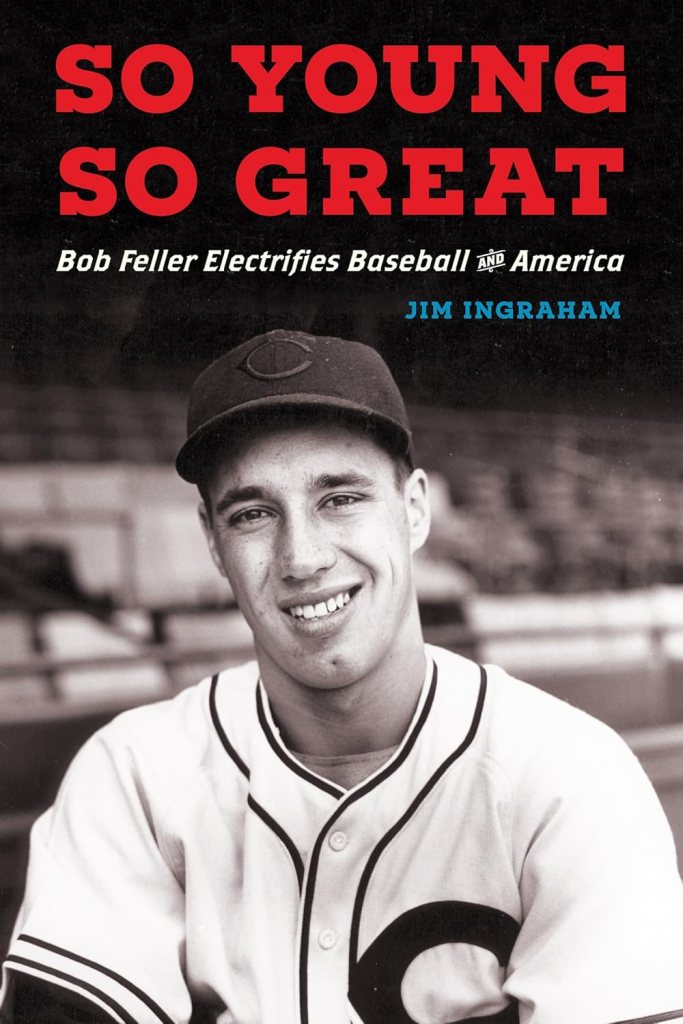
The author: Jim Ingraham
The details: University of Nebraska Press, 280 pages, $36.95, due for release June 1, ’26
The links: The publisher, the author, Bookshop.org


A review in 90 feet or less:

Jacob Misiorowski, so young and so … worrisome.

The Milwaukee Brewers’ 24-year-old seems to be on a fast-track for success just months into his second full season. We thought things were rushed a bit when they included him on the National League All Star team in July when he’d just made a few starts and started moving the needle on social media.

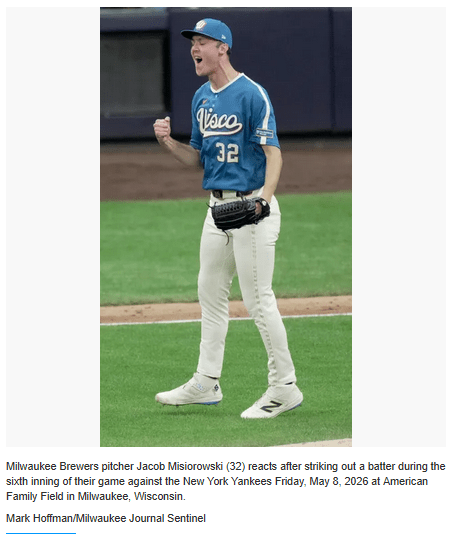
Let the record show that on May 8, 2026, the 6-foot-7 right-hander threw the seven fastest pitches ever recorded by a starting pitcher.

Some, in the same inning.

Taken out after 95 pitches, going long enough to be credited for the win in a 6-0 blanking of the New York Yankees, Misiorowski hit the 103 mile-per-hour mark 10 times. He topped out at 103.6 with the last pitch of the first inning — getting Aaron Judge to fly out to right, before striking him out twice in subsequent matchups).

“The Miz” did this all wearing a cringe-worthy, weird-blue “Wisco” Nike City Connect jersey that years from now will cause MLB historians, as well as Brewers fans, to be horrified.
According to data collected in the Statcast era that began in 2008, a starting pitcher in an MLB game had thrown a fastball clocked at 103 mph or greater just four times prior to that day. Included in that 18-year span was one previously delivered by Misiorowski — just seven days earlier. It came as he was in amidst throwing a no hitter, and had to come out after 5 1/3 innings against Washington because of a hamstring cramp.

Misiorowski, at this moment, has thrown 11 of the fastest 14 pitches ever by a starter. That’s a line of demarcation when compared to hired-gun relievers such as  Aroldis Chapman (105.8 mph in 2010 for Cincinnati, 105.7 mph in 2016 for the Yankees), Ben Joyce (105.5 mph in 2024 for the Angels) and Mason Miller (104.5 mph in the 2025 post-season for San Diego).
In throwing his fastball about two-thirds of the time, Misiorowski has what’s also called a “perceived velocity” of more than 105 mph. His extra-large frame and long arms drive down off the mound and toward the batter with a release point much closer to what they are used to seeing. “A gangly stick of dynamite who is exploding past previous notions of what is possible for starting pitchers,” is how one writer sized him up.

Misiorowski is just the latest unique metronome, keeping his own time, tempo and rhythm. He also has the cool, somewhat mythological back story. Pronounced miz-uh-ROW-skee, he went to of Grain Valley High just outside Kansas City. During the 2002 June MLB draft that took place at L.A. Live during the MLB All-Star festivities, Milwaukee took him at No. 63. Twenty-six pitchers were taken ahead of him. The Angels (taking shortstop Zach Neto at No. 13) and the Dodgers (taking catcher Dalton Rushing at No. 40) had their sights on other targets.

Misiorowski may have been stashed away at Crowder Junior College in Neosho, Missouri, about three hours south of K.C. — where Interstates 44 and 49 merge near by the Arkansas/Oklahoma/Kansas border on the western edge of the Ozarks — but the Brewers knew.

When some try to handicap the early markers of the 2026 NL Cy Young race, it’s easy to be marveled at how Misiorowski, who struck out a team-record 11 for an Opening Day appearance, has launched almost as many fastballs at 100 mph or swifter just in his last four starts (143) as every other starter in MLB combined has thrown all season (144). He is also on pace to roll up the greatest strikeout ratio (14.1 strikeouts per nine innings) of any starter in history.
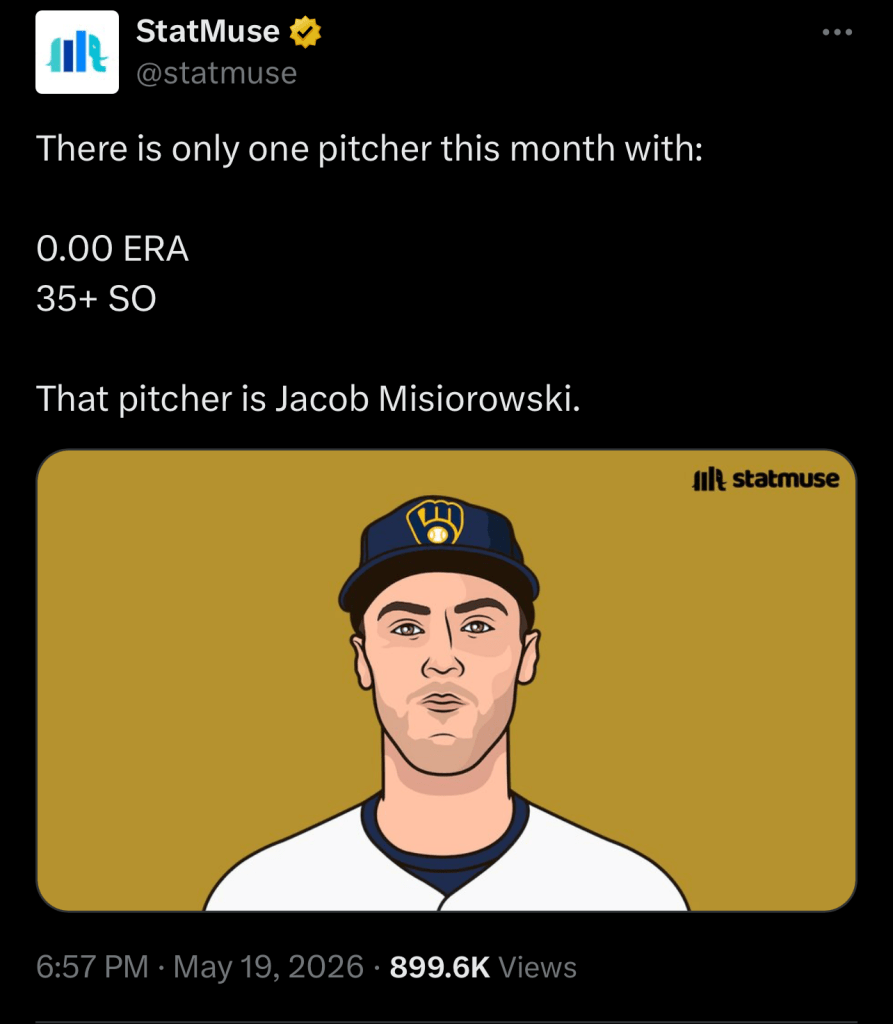
Assuming he makes it to enough innings.

Milwaukee Brewers manager Pat Murphy has compared Misiorowski to “a young prizefighter finding his way.” Others see him in line with contemporaries Paul Skenes or Hunter Greene. His age-to-production ratio so far is like Felix Hernandez.

Maybe, someday, the names Feller and Ryan will come into the conversation. As long as he isn’t a Mark Fidrych, Kerry Wood, Mark Pryor. Or Steve Dalkowski.
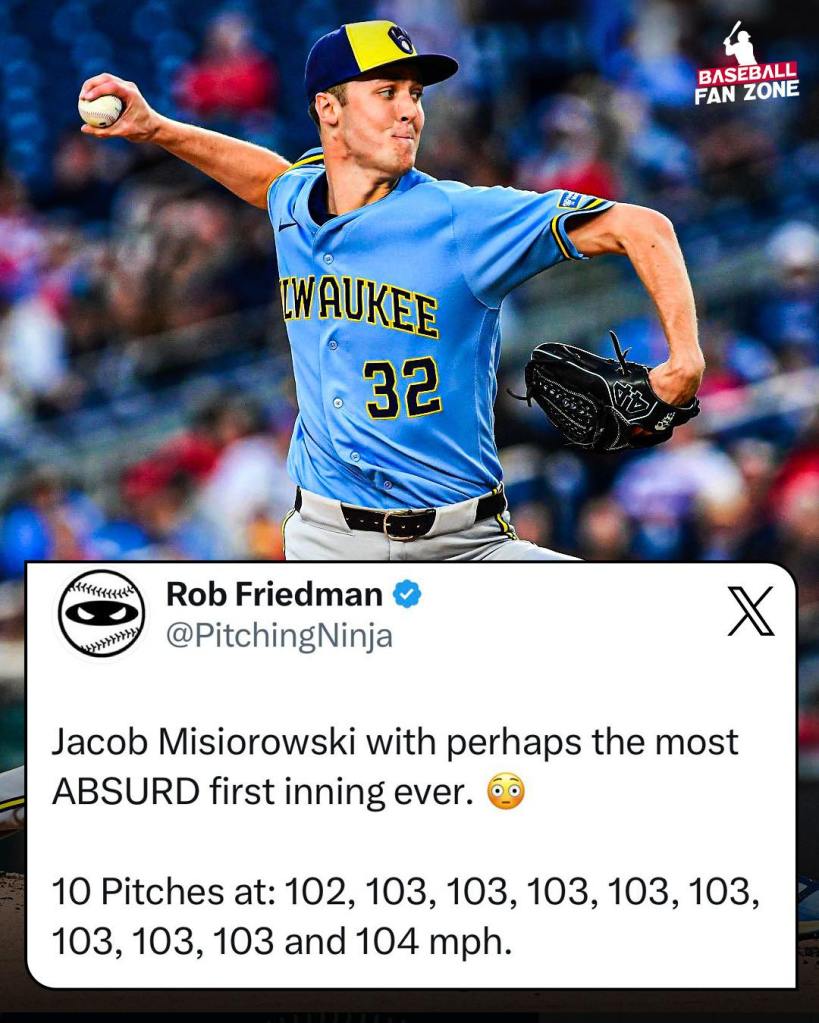
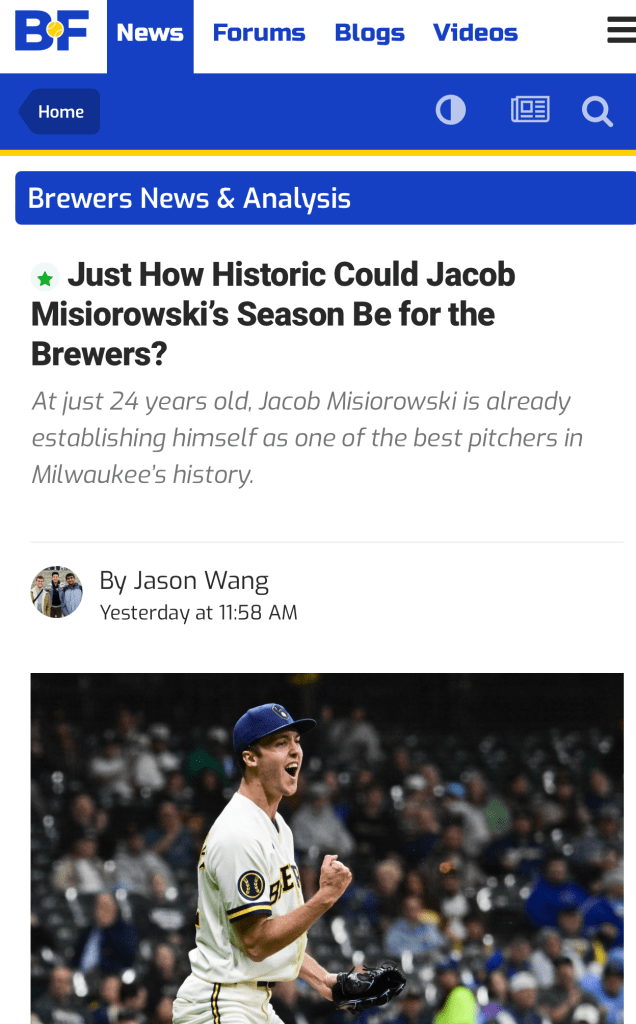
Joe Posnanski wrote in a May 15 Substack post:

I watch Jacob Misiorowski’s impossible feats of strength with anxiety and worry. I want to enjoy (his accomplishments) the way I enjoyed watching Nolan Ryan or Rob Dibble or Justin Verlander throwing blazing pitches.

Alas, when I watch Misiorowski pitch, I can’t help but see the “Misiorowski Feels Elbow Discomfort; Will Skip Next Start” headline, followed by, “Brewers Optimistic That Miz Will Not Need Surgery,” followed by “Misiorowski Hope For Quick Recovery from Tommy John.”

But what can you do? Ask The Miz to throw slower? I mean, that’s not viable.

I sometimes wonder: Would baseball be a better game if teams were allowed to use only two pitchers on any given day? This is not a serious suggestion — it’s obviously not going to happen — but more like a thought experiment. Pitchers used to maxing out for five innings would find it hard to adjust to their new reality.

But what would happen long term? I imaginevelocity would drop, pitchers would develop more secondary pitches, the knuckleball would return into the game, star pitchers who could throw 250 or 300 great innings would become the most valuable commodity in the game. I think, in time, pitchers would adjust because they’d have no choice but to adjust.

I’m not saying that’s a better brand of baseball — in many ways, it’s not — but for people my age, it’s a more familiar game.

Because we have reams of history to reference in this case.
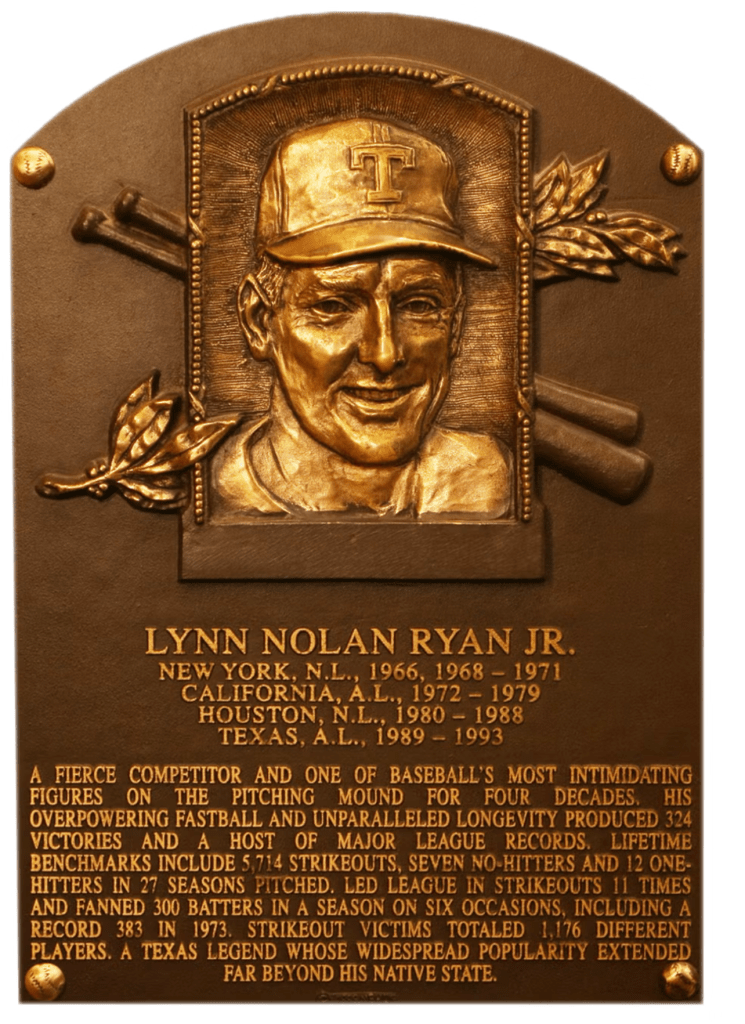
What was Nolan Ryan doing at age 24?

He had been with the New York Mets’ organization for six seasons, and was a 10-game winner at that point. But also a 14-game loser. With three complete games in 26 starts over 150-plus innings. The Mets didn’t really know what to do with him, so after that 1971 season, they shipped him to the California Angels. The eight-time All Star wasn’t done until 1993 when he was 46 — almost twice Misiorwoski’s current age.

When Bob Feller reached his 24rd birthday, he was a full-grown man wearing a U.S. Navy coveralls as a chief petty officer aboard the USS Alabama during the height of World War II. He had enlisted the day after the Pearl Harbor attacked in 1941.

By that point, it felt as if Feller had already has a lifetime of experiences in Major League Baseball. From 1936 to 1941, from the age 17 through 22, Feller had 117 complete games in 175 starts for the Cleveland Indians. He was top three in the AL MVP voting three times. At age 19 — the number he eventually wore on his jersey — he made his first of four All Star games in a row. He would have likely won four Cy Young Awards during that run had that had been a thing at that time.
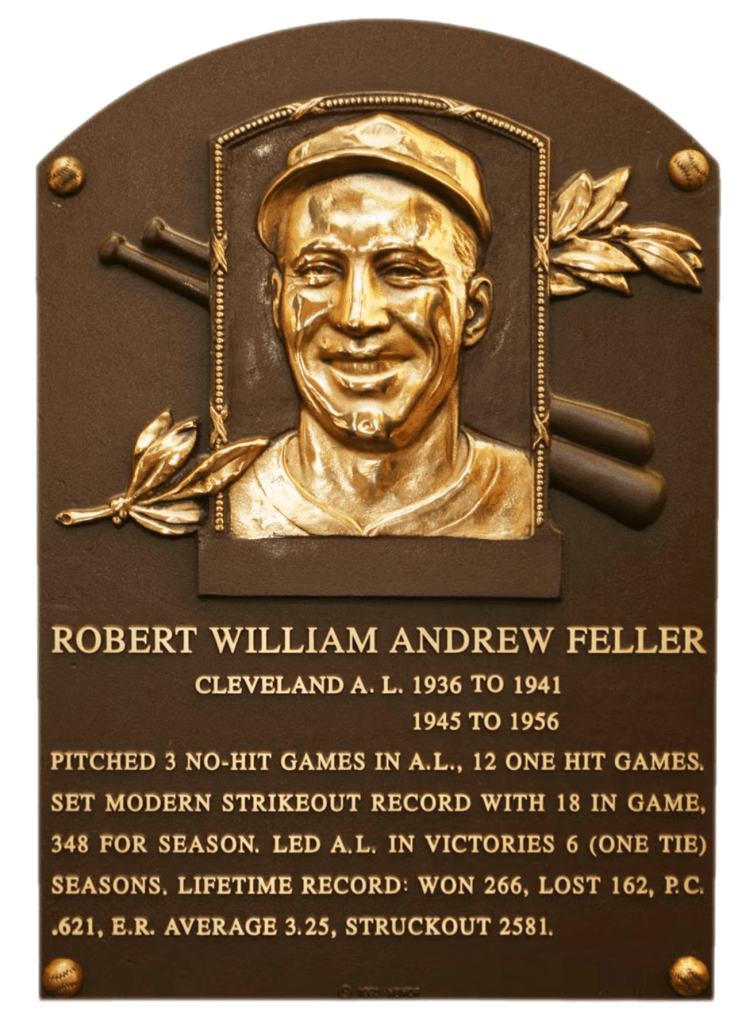
In 2024, Joe Posnanski did a Substack post called “Revisiting Greatness,” as he decided he wanted to examine all 270 Baseball Hall of Fame plaques and rank them, in order, of those that were in the most need of rewriting. Of Feller’s plaque, which came in at No.188 on his list, Posnanski noted how the stats just don’t jump off the plaque that maybe they once did. He wrote: “I’m not sure why the plaque doesn’t include Feller’s multiple awesome nicknames, “Rapid Robert” and “Heater from Van Meter.”
When awesome baseball records are set, there’s a strong temptation to believe that they will never be broken. And some probably never will be broken … I’m sure that when Bob Feller was elected to the Hall of Fame in 1962, nobody could imagine the great records on his plaque being surpassed. But then a guy named Nolan Ryan came along.”

Can’t recall anyone asking Ryan or Feller to throw slower and preserve their health. Different times, different mindsets.

Connecting Misiorowski to Ryan to Feller isn’t a fair real linear exercise at this moment. Nor will it really be years from now. But the way history will document any of this makes it all the more intriguing. Because the one thing we know they all shared: They all threw a baseball pretty damn fast. By whatever measurements were best available at the time, and whatever medium (radio, TV, social media) were best at conveying those stories.
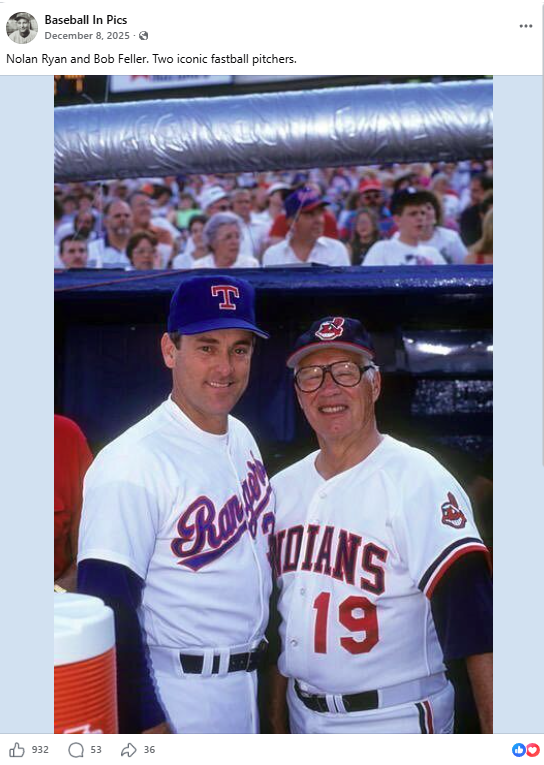

New York Newsday columnist Steve Jacobson started a piece in August of 1989 this way:

Every time the smoke of another of those showcase gems by Nolan Ryan, the baffling Old Man of fastball pitchers, reaches Cleveland, Bob Feller feels a twinge. Perhaps it can be interpreted as a twinge of jealousy; it’s a definite twinge.

Feller was the Strikeout King of the early days when radio and then television told us about the romance of the fastball. Feller accepts compliments as comfortably as he accepts paid autograph sessions. He won 266 games from 1936 to 1956 and missed almost all of four seasons during World War II. He won 25 the year before he left and 26 the full year he returned, so he might have won another 80 or 100 games.

“Ryan has us on longevity,” Feller said. “My wife says his arm must have been built on a Wednesday. I still say (Walter) Johnson must have been the fastest.”

Feller still owns the record for the fastest fastball in the semi-official clockings listed by the Hall of Fame. Ryan’s best is 100.8 mph. Feller’s was 107.9. He’ll stand up to defend that mark.

The strikeout records are subject to interpretation. When Ryan struck out 383 in 1973, it was during the era of the designated hitter and he didn’t get to throw to a single pitcher. But when Feller struck out 348 in 1946, a strikeout was still a strikeout.
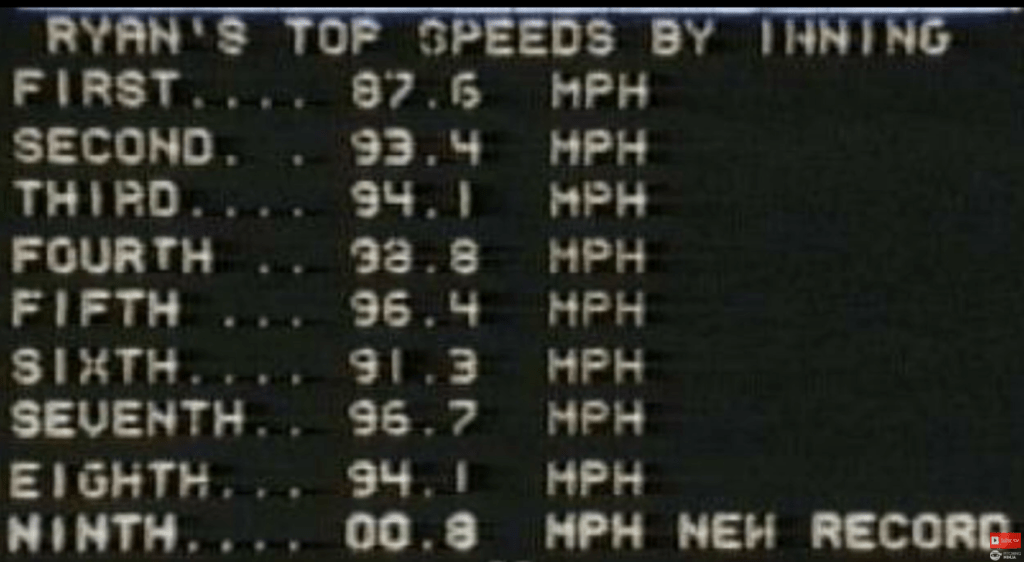
The Anaheim Stadium message board during the ninth inning of a game Nolan Ryan pitched when first measured by a speed gun in 1974.

If these are the hairs you choose to split, consider that on April 26, 1990, Ryan, at age 43, tied Feller for career one-hitters with 12, a masterful effort over the visiting Chicago White Sox in a 1-0 complete-game triumph. When Feller was 43, he had been retired for six seasons.
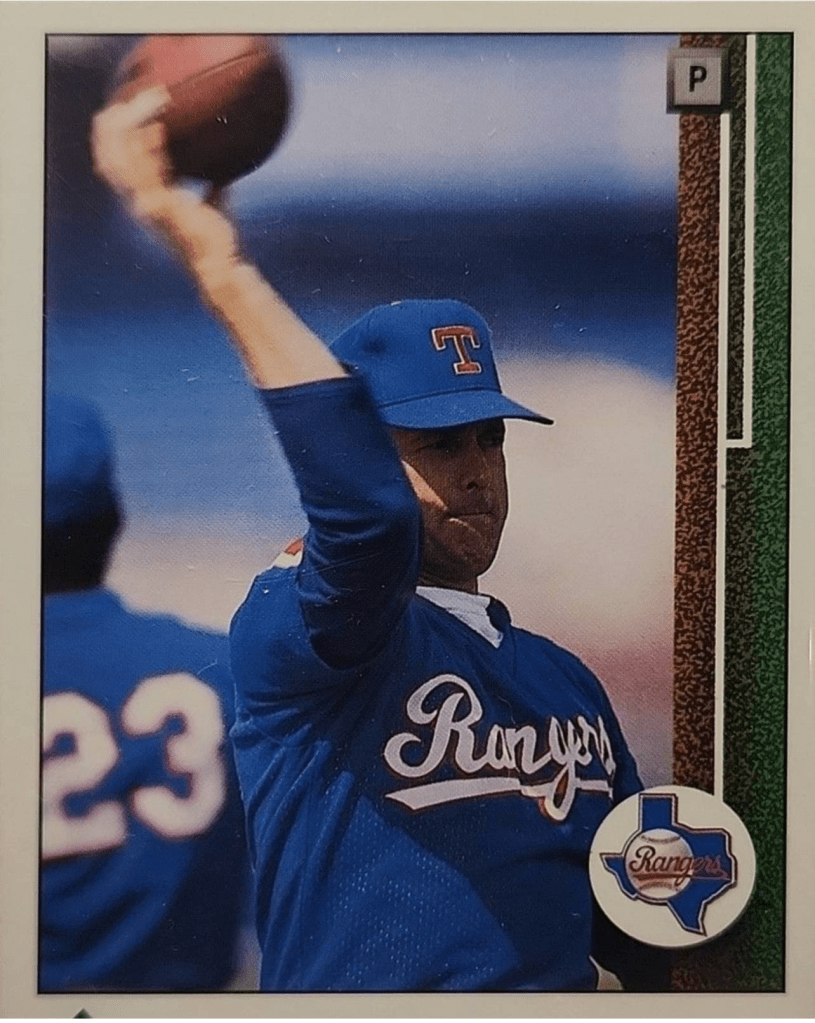
When Ryan threw his record-extending seventh no-hitter in 1991, he was 44, the oldest to achieve such a feat and the first to do it in three different decades. Of Feller’s three no-hitters, the most remarkable is the one on Opening Day 1940. He was just 21.

At some point during that 1990 season, the 71-year-old Feller chimed in again for the record:

“Ryan’s a good pitcher. He’s learned how to pace himself. He’s learned how to pitch. But he’s mad at me because I’ve said that I could throw harder than he can. I don’t know why that bothers him. When Walter Johnson said he could throw ‘a mite harder’ than me back when I was just coming up, it never bothered me.

“My fastball was once timed at 98.6 miles per hour by photo-electric cells at home plate, but by then it was losing speed, maybe as much as 15 miles per hour. That was long before the radar gun they use now. The radar gun gives you the average speed of a pitch from the mound to the plate. On a radar gun, I would’ve averaged 105 to 107 miles per hour.”

When Feller died in 2010 at age 92 of leukemia, columnist Joe Posnanski, a Cleveland native, wrote:

Continue reading “Day 16 of 2026 baseball books: Fast, furious and fearless folklore, backed up by the facts”

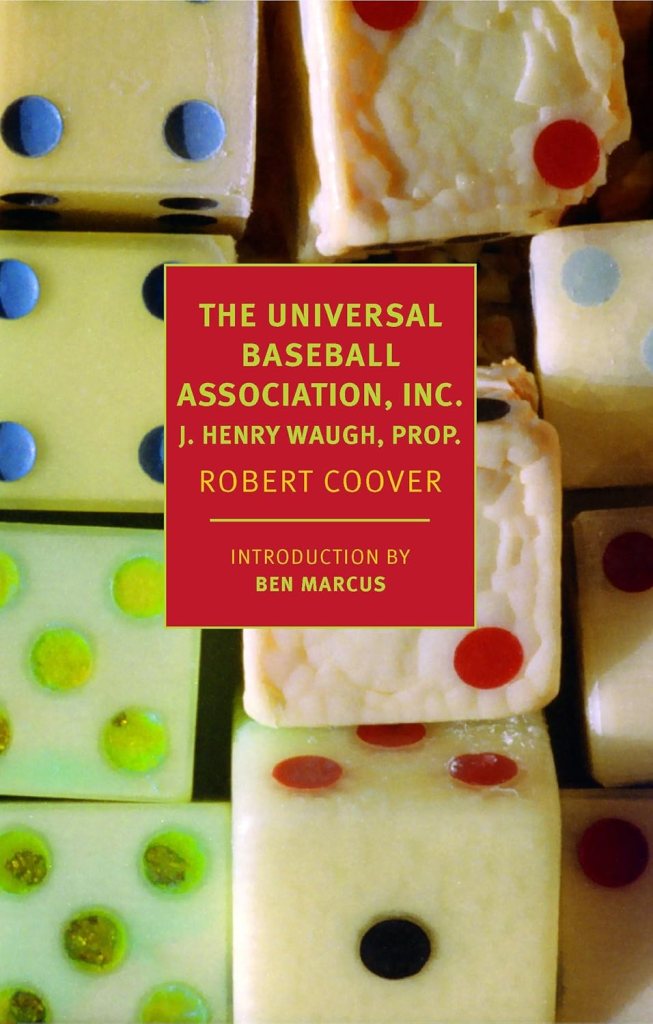
Day 12 of 2026 baseball books: Universally accepted abstract daydreaming

The Universal Baseball Association, Inc.,
J. Henry Waugh, Prop.

The author: Robert Coover, new introduction by Ben Marcus
The details: NYRB Classics, 264 pages, $18.95, originally released in 1968; newest re-release on March 17, ‘26
The links: The publisher, Bookshop.org


A review in 90 feet or less:

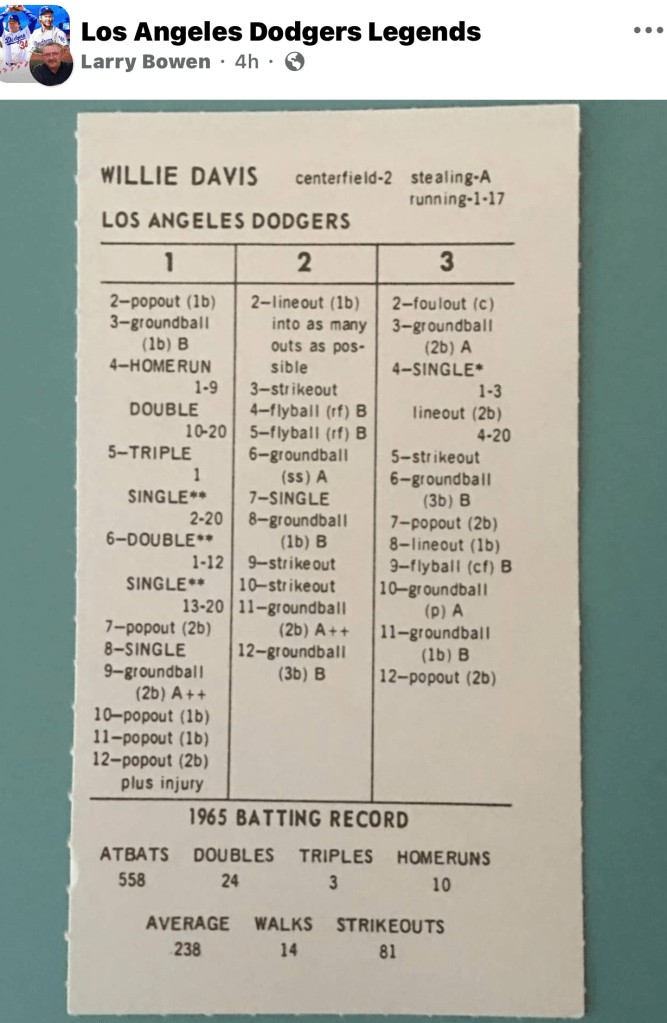
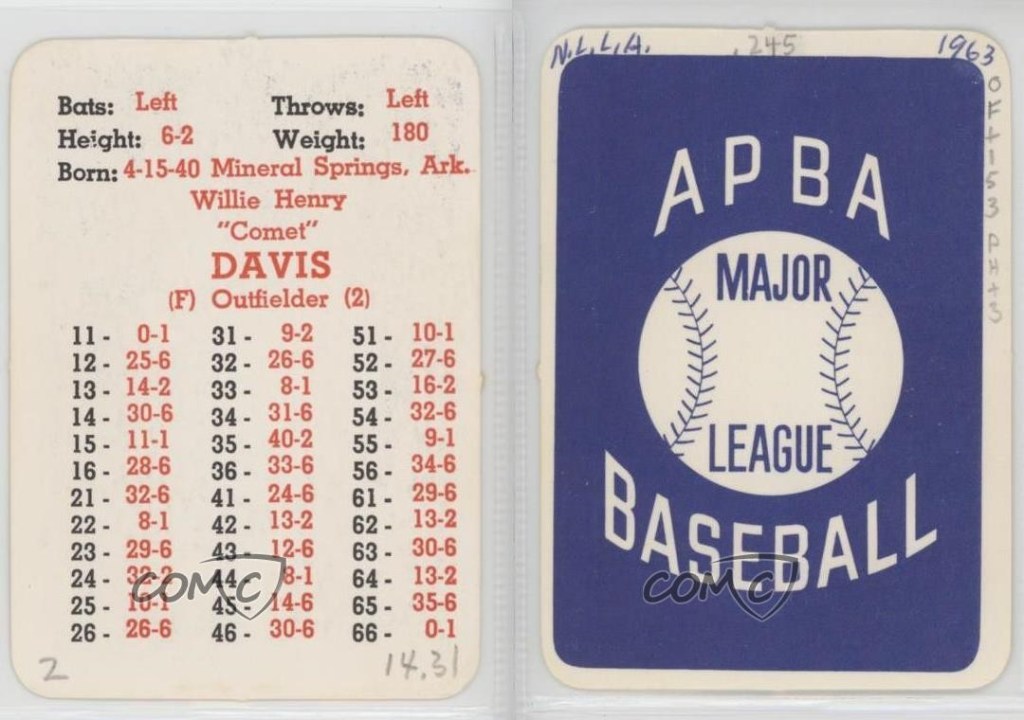
Based in reality, and fantasy: Willie Davis’ card from 1965 Strat-O-Matic (above) and 1963 APBA (below)

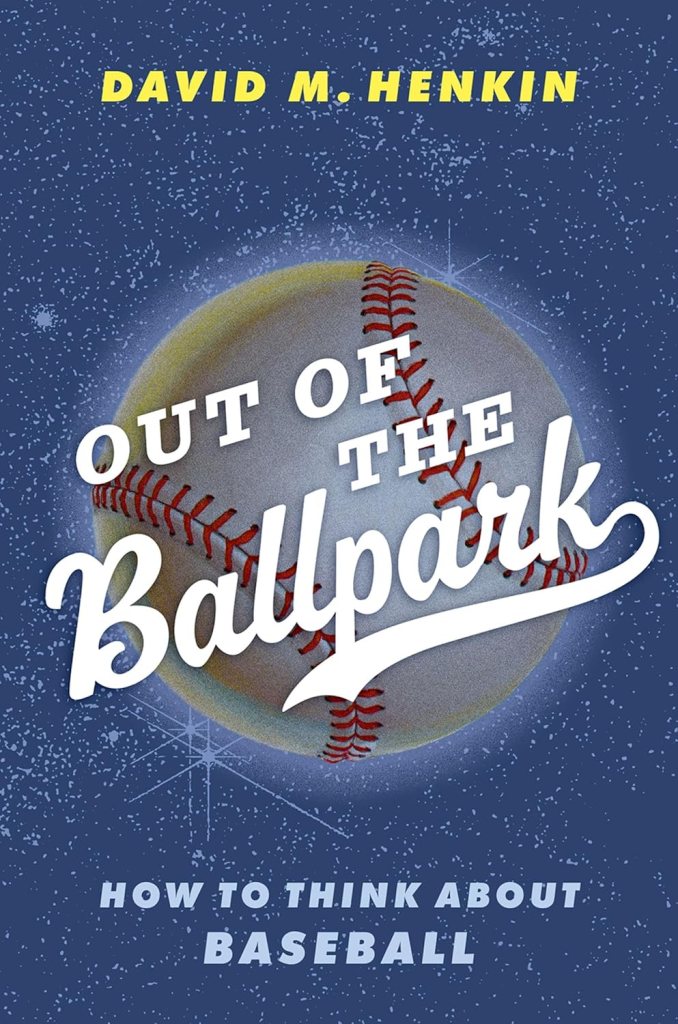
Cal Berkeley history professor David M. Henkin recently launched an efficiently written collection of essays into the universe under the title “Out of the Ballpark: How To Think About Baseball,” (Oxford University Press, $18.99, 152 pages, released March 16, ’26), dedicating a dozen chapters on enlightened questioning of philosophical and cultural issues surrounding the game.

Among other things — the obsession with statistics framing reality.

“The division between scientific and literary, quantitative and verbal, or left-brain and right-brain approaches to baseball are misleading,” Henkin declares. “They bear some resemblance to the inaccurate portrait peddled by recent Hollywood movies of baseball talent evaluators, which pits the number crunchers and bean counters against scouts who can hear the break of a curveball with their eyes closed and can foretell a player’s prospects by instincts.”

Hang on. Brad Pitt’s polished portrayal of Billy Beane in the 2011 “based on a true story” film “Moneyball” came more than seven years after we could digest the magnificence of Michael Lewis’ best-selling book, “Moneyball: The Art of Winning an Unfair Game.” After all, the book’s publishers continue to unflinching point out the book has company amidst “GQ’s 50 Best Books of Literary Journalism of the 21st Century.” It’s also blurbed as “the most influential book on sports ever written” by none other than People Magazine.

But go on, Professor Dave …

“Much as scouts have always combined intuitive judgment against statistical reckoning, the same writers and fans who revel in poetic description and conjure imagined worlds of play tend to be conversant with statistics and are aesthetically compelled by probability.”

Hmmm… Probably right there. So to what perils doth that lead?

“Robert Coover’s celebrated novel, ‘The Universal Baseball Association, Inc.’ published three years before the founding of the SABR and the dawn of sabermetrics, brought into public view baseball’s twin obsessions with both literary imagination and strict bookkeeping. The novel’s protagonist, J. Henry Waugh, is an accountant. He is also a literary creator who spins elaborate stories behind closed doors about fictional baseball players but constrains those stories with statistics and probability by methodically and scrupulously using dice to simulate athletic competition.”

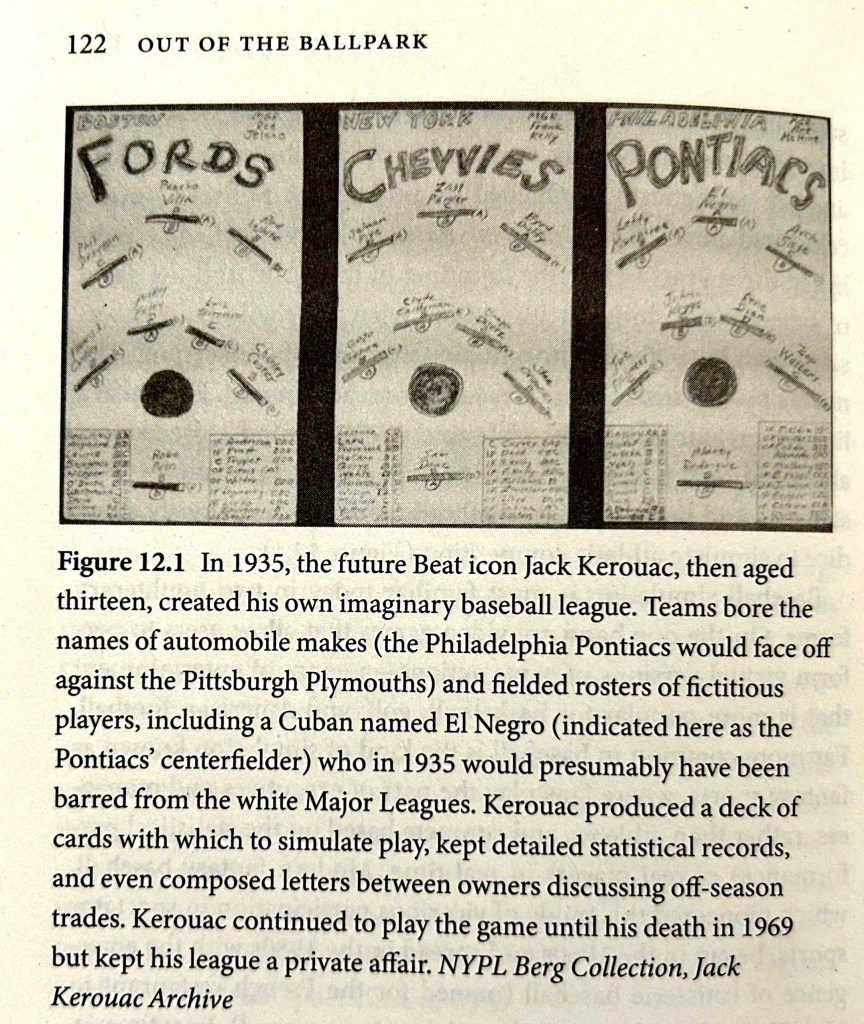
Henkin then presents to the court of public opinion Figure 12.1 as visual evidence, which kinda blows us away more than the Coover book reference.

How do you explain that off-beat existence? Henkin tries.

Continue reading “Day 12 of 2026 baseball books: Universally accepted abstract daydreaming”

Day 21 of 2025 baseball book reviews: Who has the veto power on an overturned call in this game?

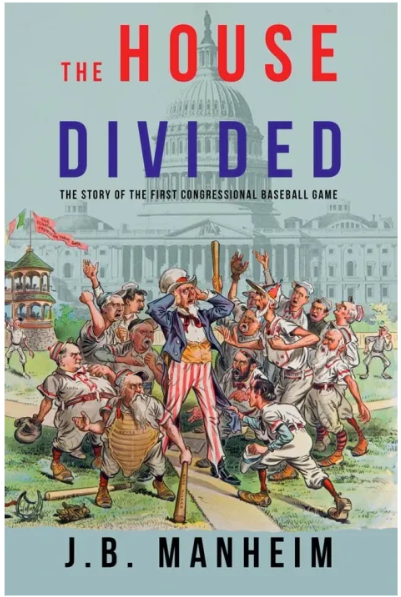
“The House Divided:
The Story of the First
Congressional Baseball Game”

The author: J.B. Manheim
The details: Sunbury Press, $19.95, 182 pages, released April 22, 2025. Best available at the publisher’s website and the author’s website.

A review in 90 feet or less

Updated 6.12.25

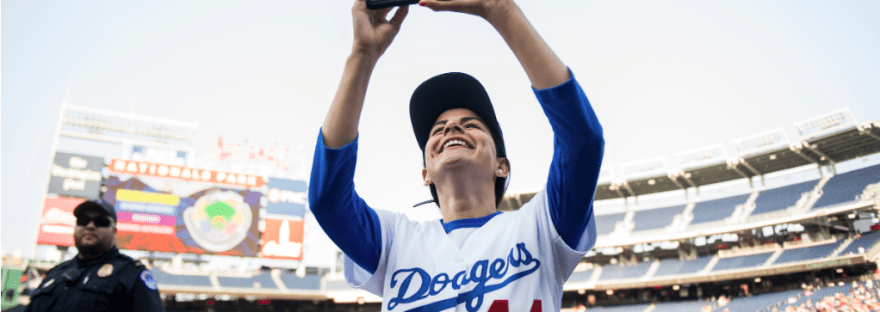
No, no. Nannette Diaz Barragán has earned her roster spot for the Congressional Baseball Game, next up on June 11 at Nationals Park in the District of Columbia.

Since 2017 when the freshman House rep put on a Los Angeles Dodgers’ jersey, highlighted by a red No. 44 to represent her district, then ripped a pinch-hit, RBI-single in her first appearance before 25,000, Barragán continues to use baseball as a way of proving her worthiness.

This is no DEI seat filler. Her bio is pretty explicit in the ability to challenge and respond to situations.

Born in Harbor City as the youngest of 11, Nanette Diaz went to North Torrance High. While she played softball, she also petitioned the administration to be allowed to try out for the boys’ baseball team — and she made the JV squad.

With degrees in political science and public policy from UCLA and a doctorate in law from USC, she launched into a legal career. Involved in the Clinton White House in the Office of Public Liaison for African American outreach, Barragán eventually moved to Florida in 2012 to work on Barack Obama’s presidential re-election campaign and be part of the voter’s rights protection team.

By 2013, she circled back to the Hermosa Beach City Council, fighting against offshore oil drilling. Two years later, she was running for Congress after Janice Hahn vacated the seat.

After her debut in the Congressional Game in ’17, she was noted as one of three participants in the ’18 games — which marked the 25th anniversary of when Blanche Lambert Lincoln, Illena Ros-Lehtinen and Maria Cantwell were the first women played.

“A lot has changed in 25 years,” Barragán said, “but when it comes to this sort of thing, we need to acknowledge not much progress has been made.”

For the 2019 game, Barragán and good friend Linda Sanchez (CA-38) were the only two women players. Barragán invited the D.C. Girls Baseball Team as her special guest, taking pride int he fact her 44th District — Carson, Compton, Lynwood, North Long Beach, Rancho Dominguez, San Pedro, South Gate, Walnut Park, Watts, Willowbrook and Wilmington — includes the Compton Youth Baseball Academy, which hosts annual girls baseball tournaments.

With decisive victories in re-elections in ’18, ’20, ’22 and ’24, Barragán doesn’t hide her love of the Dodger blue, introduced to her by her father. She was at the Dodgers’ White House visits after their 2020 and ’24 World Series titles. Her official website has fashioned a branding for her that looks like the Dodgers’ logo.

With Sanchez as the captain of Team Democrat for the ’25 game, Barragán finds herself as the only woman on the roster. She is there with fellow Californian House members Pete Aguiliar (CA-33), Gil Cisneros (CA-31), Adam Gray (CA-13), Mike Levin (CA-49), Dave Min (CA-47), Kevin Mullin (CA-15), Raul Ruiz (CA-25), Eric Swalwell (CA-15), Derek Tran (CA-45), plus as U.S. senator Alex Padilla.

Four women are listed on the Republican roster — Lisa McClain (MI-09), Mariannette Miller-Meeks (IA-01), Kat Cammack (FL-03) and Iowa senator Joni Ernst.

Continue reading “Day 21 of 2025 baseball book reviews: Who has the veto power on an overturned call in this game?”

Day 7 of 2025 baseball book reviews: Maybelle, Why Can’t You Be True

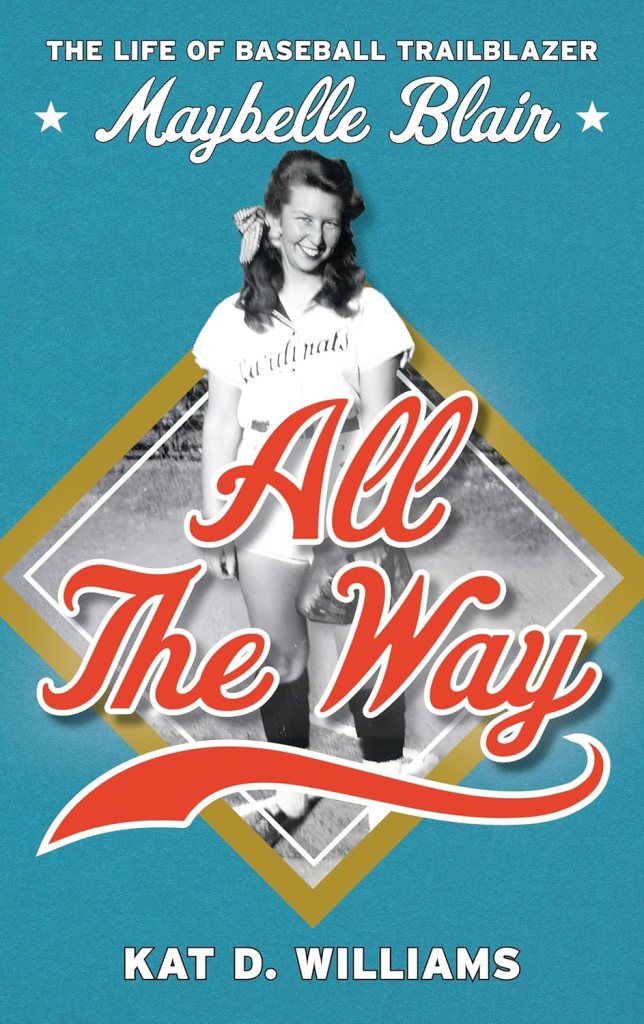
“All The Way: The Life of
Baseball Trailblazer Maybelle Blair”

The author: Kat D. Williams
The details: Rowman & Littlefield, $32, 192 pages, released March 18, 2025; best available at the publishers website and Bookshop.org.

A review in 90 feet or less

The Shrine of the Eternals’ 2025 official ballot allows nine names to be filled from 40 eligible candidates. The top three will draw induction later this year into the Shrine as per rules of The Baseball Reliquary, which has done this now since 1999 years.

Of the candidates, six-and-a-half are women.

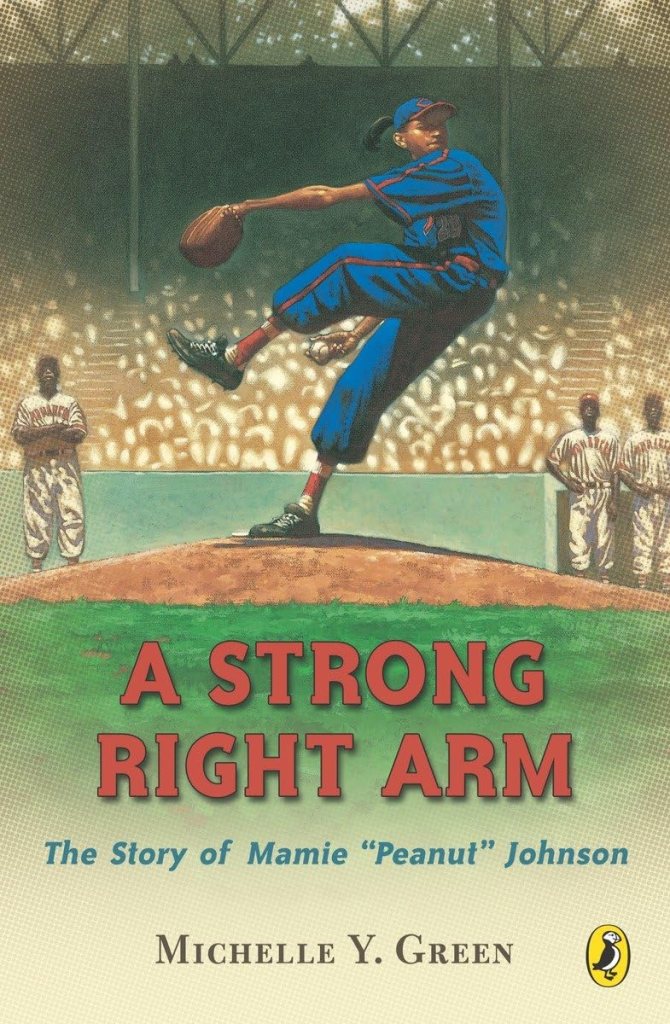
* Mamie “Peanut” Johnson is the only female pitcher in the Negro Leagues, after being rejected by the All-American Girls Professional Baseball League because of the color of her skin.

* Melissa Ludtke is a sports writer who just came out with “Room Talk: A Woman’s Struggle to Get Inside,” based on winning a lawsuit against Major League Baseball for locker room access going back to the 1977 World Series.

* Morganna Roberts was “The Kissing Bandit,” who turned a challenge by friends into a celebrity activity of running on to the field and planting a kiss on a player, manager, umpire or even the San Diego Chicken. It warranted numerous trespassing charges and even a stay in an Anaheim jail. She is still with us, at 78 years old, known as Morgana Cottrell. There should be a book on her … seems it would be rather robust.

* Annie Savoy is a piece of work.

Susan Sarandon shared top billing with Kevin Costner. Tim Robbins didn’t get that kind of attention — and Robbins and Sarandon married after this movie.

Fictitious work, that is, created by Ron Shelton for his 1988 movie “Bull Durham,” with the famous line: “Baseball is the only church that truly feeds the soul, day in and day out.” She gets her due in Shelton’s 2023 book, “The Church of Baseball.” Which we enjoyed reviewing and, in the process, creating a neat relationship with Ron.

* Janet Marie Smith is an architect and urban planner best known for Oriole Park at Camden Yards in Baltimore, but also for extensive upgrades done at Dodger Stadium over a 10-year period as the franchise’s executive vice president for planning and development. She should eventually write a story about her experiences. A title suggestion: “Built By Janet.”

* Helen Callaghan goes in as a co-entry with her son, Casey Candaele. They are the only mother-son combination to play professional baseball. Helen St. Aubuin was a star in the All-American Girls Professional League and the inspiration for “A League of Their Own” 1986 film. She had her son, Casey, at age 38 in 1961 in Lompoc, and he had a nine-year MLB career from1986 to 1997 in Montreal, Houston and Cleveland as an infielder and outfielder.

Alphabetically, Maybelle Blair is listed first among that female subset on the ballot.

Continue reading “Day 7 of 2025 baseball book reviews: Maybelle, Why Can’t You Be True”

The 2025 baseball book review automatic renewal service (this year aligned on Japan time)

Back by somewhat unpopular demand — maybe query a few authors whose books in the recent past I might have ended up splaying with an intent to de-boned, all in the name of honest criticism — the 2025 version of the newest spring/summer baseball book reviews returns for another attempt at education and entertainment.

It coincides with the start of the Dodgers-Cubs series leading off the ’25 MLB season in Japan. The clocks are being adjusted as we try to spin forward.

Here, as we have done since 2011*, reviews are more an exercise in empathy for those who open their veins to write these things in the first place, along with our attempt at explaining how the subject matter connects in our universe. Then, there’s an efficiency trying to cover more than a couple dozen new titles that have come into the marketplace since the end of the ’24 season.

This whole thing, initially focused on the insane premise of posting 30 reviews once day over the 30 days in a row in April, challenges us to stay current while also adding some context.

*Our memory is fading and we weren’t actually sure, but that’s the best guess, since we’ve got The Wayback Machine to find things we’ve posted going to the InsideSoCal.com platform that started in 2006.

This ’25 baseball book review project again deviates a bit from its original calisthenics stress test. We can’t do 30 in a row, but the target remains at least 30 reviews. All done by summer.

There’s also a new stipulation: No more links to purchasing books on the website named after a river in South America and empties into the Atlantic. Reviews are no longer posted on the social media site once known as Twitter.

Resistance isn’t futile. It’s long overdue.

Consider this: A book called “How To Resist Amazon And Why: Updated and Expanded — The Fight For Local Economies, Data Privacy, Fair Labor, Independent Bookstores and a People-Powered Future” by Danny Caine, owner of the Lawrence, Kansas-based Raven Book Store, sells for a reasonable $14.95 on the Microcosm Publishers’ website. As well as on Caine’s store site, a zine version for $3.

The website in question, meanwhile, not only offers this book that meticulously besmirches its existence, but has it at 40 percent off for those looking to prove everything the book points out.

From our storage unit, here’s what we plan to cover in ’25:

= Day 1 (March 17 is the early jumpoff point) focuses on books about baseball in Japan, including “JapanBall: Travel Guide to Japanese Baseball,” by Gabriel Lerman and “A Baseball Gaijin: Chasing A Dream to Japan and Back,” by Aaron Fischman

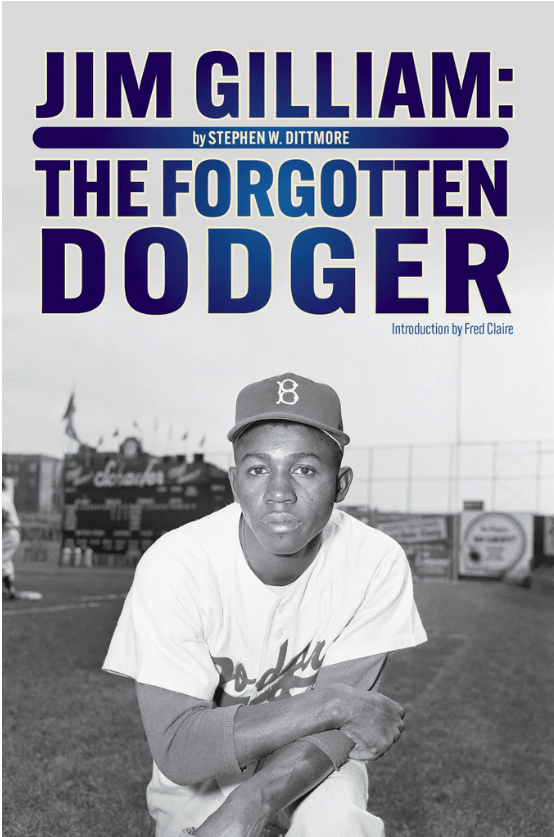
= April 15 Jack Robinson Day: “Jim Gilliam: The Forgotten Dodger” by Steve Dittmore, plus more related to the Robinson occasion.

= “L.A. Story: Shohei Ohtani, The Los Angeles Dodgers, and a Season for the Ages,” by Bill Plunkett, as well as “Baseball’s Two-Way Greats: Pitching/Batting Stars from Ruth to Rogan to Ohtani,” by Chris Jensen, arrives by April.

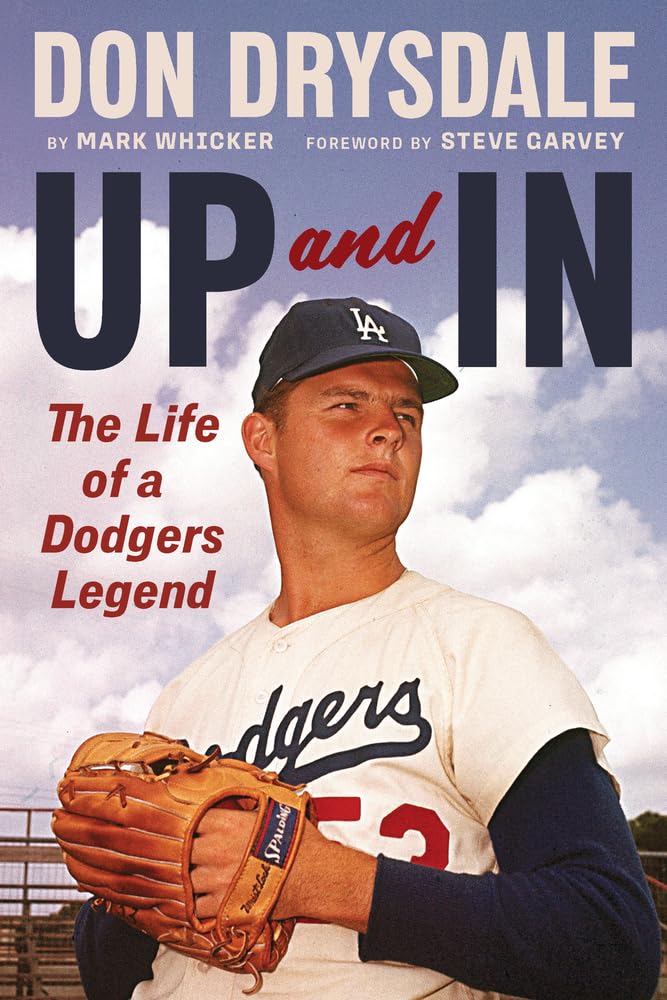
= “Don Drysdale: Up and In: The Life of a Dodgers Legend,” by Mark Whicker, is something we’ve been awaiting since last year.

= “I Felt the Cheers: The Remarkable Silent Life of Curtis Pride,” by the former Angels outfielder who also played for Montreal, Detroit, Atlanta, Boston and the Yankees, and was a coach at Gallaudet, the world’s leading university for deaf and hard of hearing students and was also named Major League Baseball’s Ambassador for Inclusion.

= “Bo Belinsky: The Rise, Fall and Rebound of a Playboy Pitcher,” by David Krell

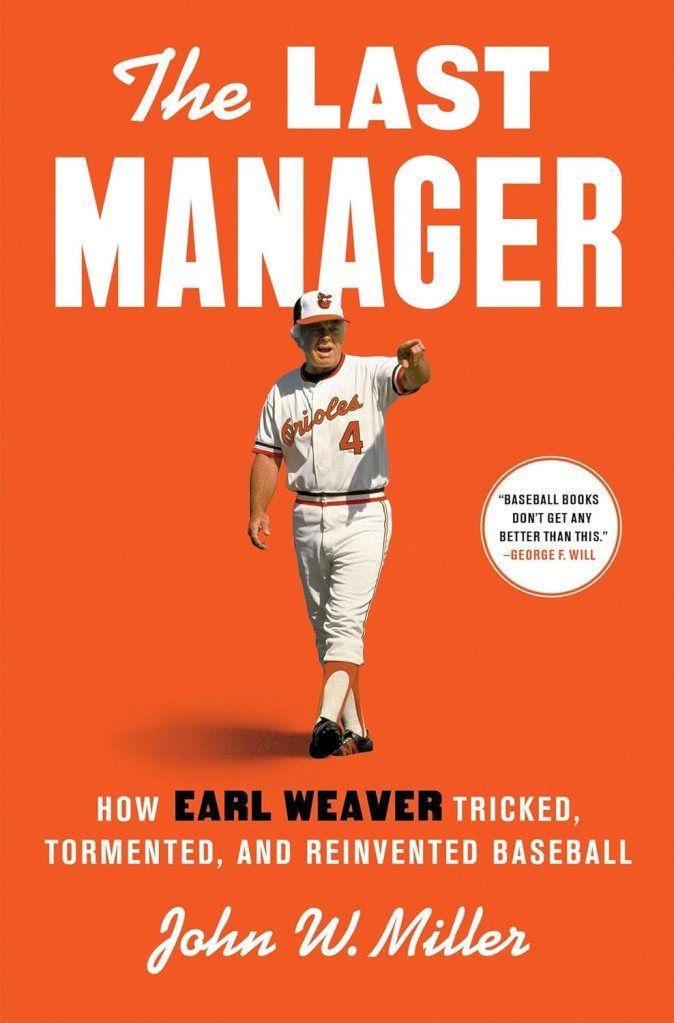
= “Skipper: Why Baseball Managers Matter and Always Will,” by Scott Miller, paired up with “The Last Manager: How Earl Weaver Tricked, Tormented, and Reinvented Baseball,” by John W. Miller

= “All the Way: The Life of Baseball Trailblazer Maybelle Blair,” by Kat D. Williams

= “Here Comes The Pizzer: The Found Poetry of Baseball Announcers,” by Eric Poulin — which takes lines of broadcasts and turns them into a poetic, nuanced presentation worthy of Shakespeare. In some ways.

We plan to get as many as 30 books checked out in ’25, same as we did in ’24 between mid-April and late May.

The point it to let readers know these works exist, should you be tempted to pick them up for purchase without knowing their caveats. It’s also a way to uncover projects that otherwise might be off the radar. No fees attached. Enjoy.

Before the first reviews, a short Q&A:

Seinäjoki Library in Seinäjoki, Finland.

Q: What happens to all the baseball books collected during the course of the year to review?

A: Pay it forward, if that’s still a phrase. As in, donate them to the local library.

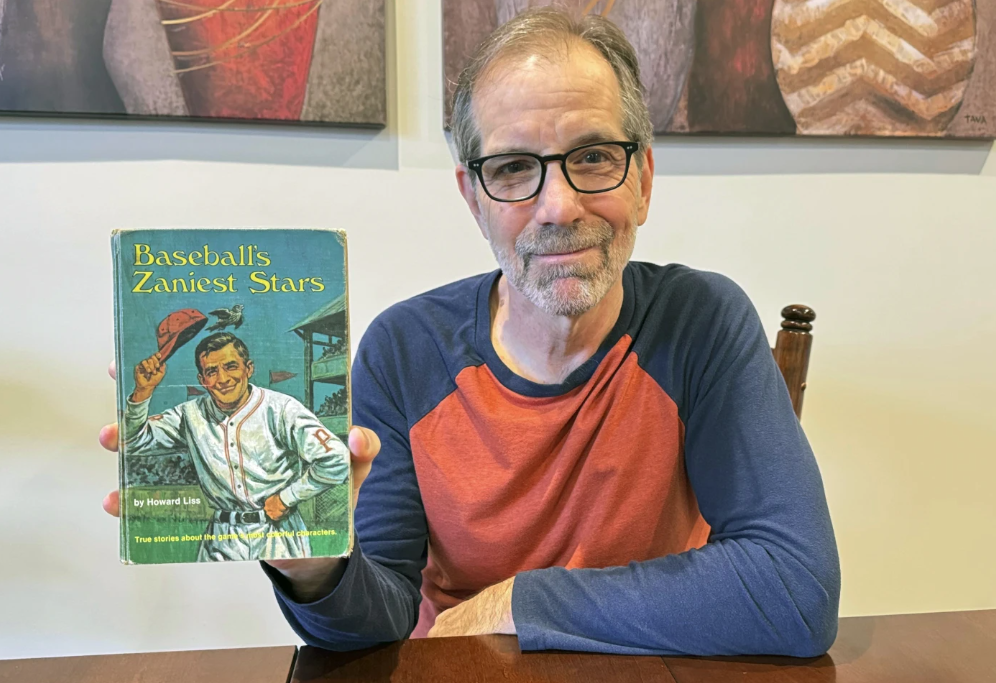
This took on a new meaning after coming across the zany story last December about the fate of a library book called “Baseball’s Zaniest Stars: True Stories of the Game’s Most Colorful Characters.”

The 144-page book by Howard Liss released by Random House aimed at school kids interested in sports-related bios was first published in 1971.

Chuck Hildebrandt, a 63-year-old retired digital marketing exec living in Chicago, explained to the Detroit Free Press that he purposefully visited the public library in the Detroit suburb of Warren, Mich., while in town visiting family for Thanksgiving. The reason was to bring back a copy of “Baseball’s Zaniest Stars,” which he recalls borrowing from the city’s Walt Whitman Branch on Dec. 4, 1974, when he was a 13-year-old.

He had forgotten to return it. Fifty years later, he sought some closure.

Hildebrant said he came across it on his bookshelf about five years ago, noticed the Dewey decimal library sticker on the spine, and figured out what happened.

In December of 2024, he tried to give it back. The library declined.

“Some people never come back to face the music,” said library director Oksana Urban. “But there was really no music to face, because he and the book were erased from our system.”

Still, what would the fine have been for a return this late? More than $4,500 according to Hildebrant’s math. To be precise, it was $4,563.75 to be precise, if he had been charged the normal fees.

“I am still somewhat embarrassed so I want to make good on it in some way,” Hildebrant wrote on a social media post.

Hildebrant decided to start a GoFundMe.com fundraiser to see if he could match that $4,564 projected fine, and then donate it to Reading Is Fundamental, the nation’s leading children’s literacy non-profit since the 1960s that so many of us Boomer-types remember from our childhood as well.

To date, the effort raised more than $5,300 with more than 100 donations.

Maybe we can keep contributing. Or …

This book looked familiar, and my recollection must have been finding it at my own library when I was in middle school. The cover illustration of Casey Stengel taking off his cap and having a sparrow he kept hidden in his suddenly fly out was something I wouldn’t have forgotten.

In the book, it explains how Stengel, just traded from Wilbert Robinson’s Brooklyn Robins (pre-Dodgers) to the Pittsburgh Pirates in 1918, was back for the first time at Ebbets Field in Brooklyn, playing right field. He noticed in the Brooklyn bullpen that former teammate Leon Cadore was able to scoop up a sparrow that landed. On his way to the dugout at the end of the inning, Stengel asked Cadore to give him the sparrow. When Stengel went to bat that inning, the fans gave him a rousing ovation. He stepped into the batter’s box, dropped his bat, bowed low and raised his cap — and the sparrow fluttered a moment and flew off.

“I always knew that Stengel had birds in his top story,” Robinson was reported to have said.

After reading the story about Hildebrandt — and realizing we are about the same age — I tracked down a New Jersey used book store called Between the Covers listed on AbeBooks.com (the one-stop used book store repository) and picked up a nice copy of “Baseball’s Zaniest Stars.”

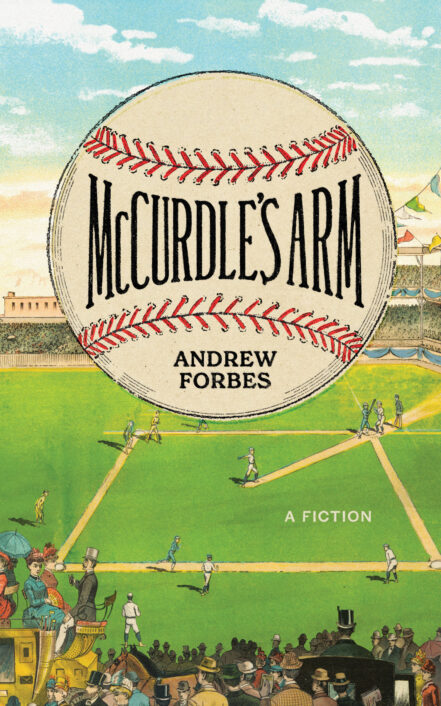
It went for $20 (plus $5 shipping). I really did enjoy re-reading it from cover to cover this past winter. Simultaneously, I had been reading Andrew Forbes’ latest piece of fiction, “McCurdle’s Arm,” a 108-page novella released in August of ’24 by Invisible Publishing, and the two seemed joined at the spine.

Forbes’ ultra-creative use of 1890s quirky baseball prose told the story of Robert James McCurdle, who could have been a character in “Baseball’s Zaniest Stars,” along with Stengel, Bobo Newsom, Dizzy Dean, Babe Herman and Rabbit Maranville.

Forbes’ previous books, “The Only Way is the Steady Way: Essays on Baseball, Ichiro and How We Watch The Game” from 2021 and “The Utility of Boredom,” more baseball essays from 2016, were something we reviewed as a tandem of life-affirming importance in ’21 during the COVID aftermath.

Re-reading that review recently was again somewhat as therapeutic as it was writing it four years ago. The cover illustrations were spectacular as well.

Armed with “McCurdle’s Arm” and star struck again by “Baseball’s Zaniest Stars,” I felt as if I was thrust back in time. No hurry for anyone to come to my emotional rescue.

So, with the start of this ’25 review, “McCurdle’s Arm” goes back on my shelf for safe keeping, and “Baseball’s Zaniest Stars” will go next to it, or I’ll deliver it to my local library with all the other books set to be donated this time around.

The hope is that everything will be fine, and there are no fines attached to anyone’s future enjoyment. And a RIF donation is forthcoming.