

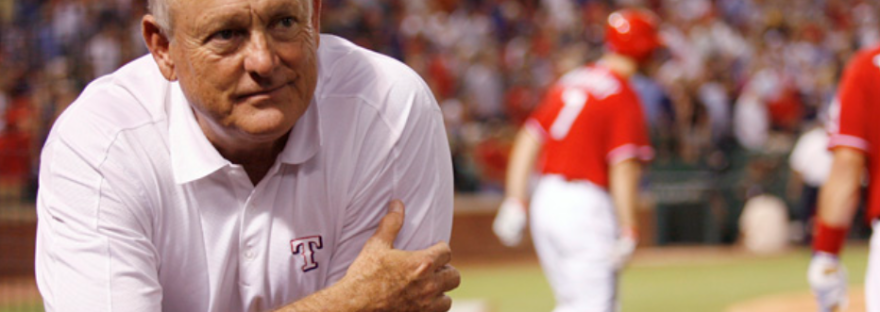
“Nolan: The Singular Life
of an American Original”
The author: Tim Brown
The details: Grand Central Publishing/Hachette, 352 pages, $30, released May 19, ’26
The links: The publisher, the author, Bookshop.org
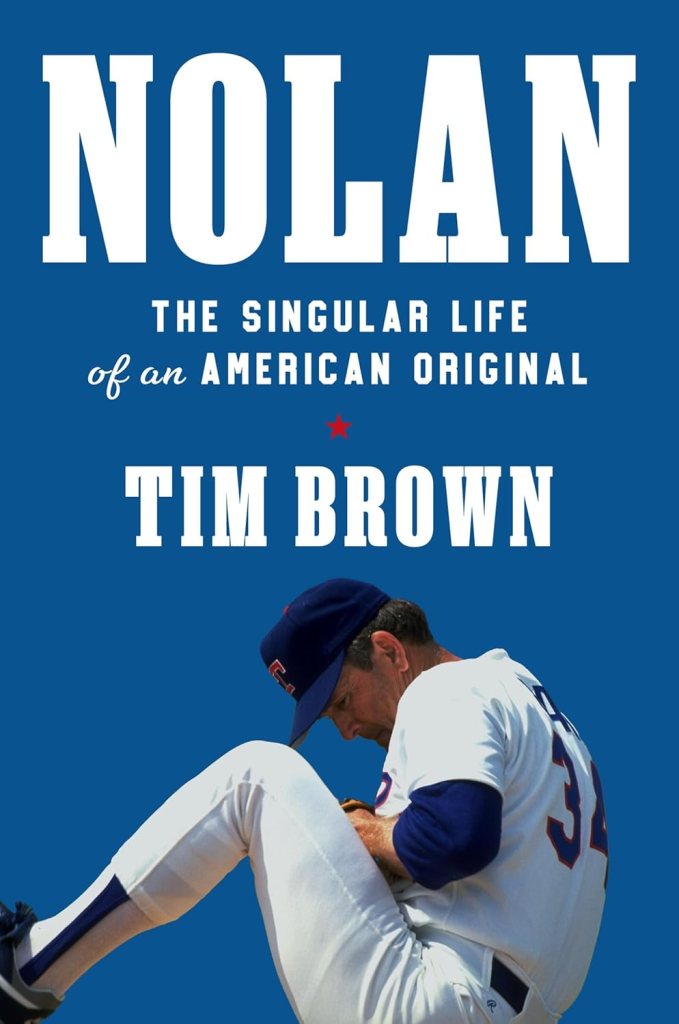
“So Young, So Great:
Bob Feller Electrifies
Baseball and America”
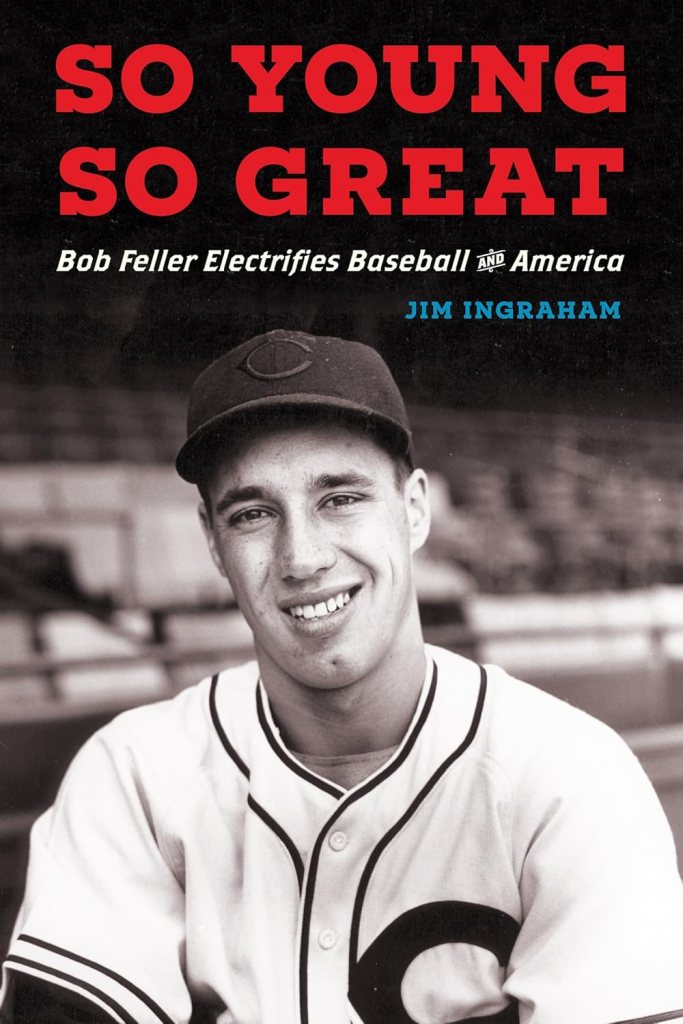
The author: Jim Ingraham
The details: University of Nebraska Press, 280 pages, $36.95, due for release June 1, ’26
The links: The publisher, the author, Bookshop.org
A review in 90 feet or less:
Jacob Misiorowski, so young and so … worrisome.
The Milwaukee Brewers’ 24-year-old seems to be on a fast-track for success just months into his second full season. We thought things were rushed a bit when they included him on the National League All Star team in July when he’d just made a few starts and started moving the needle on social media.
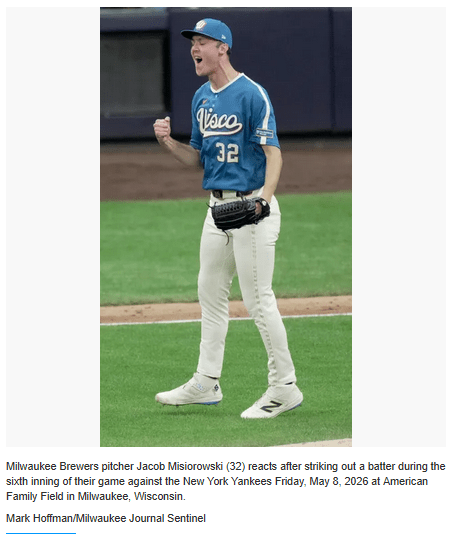
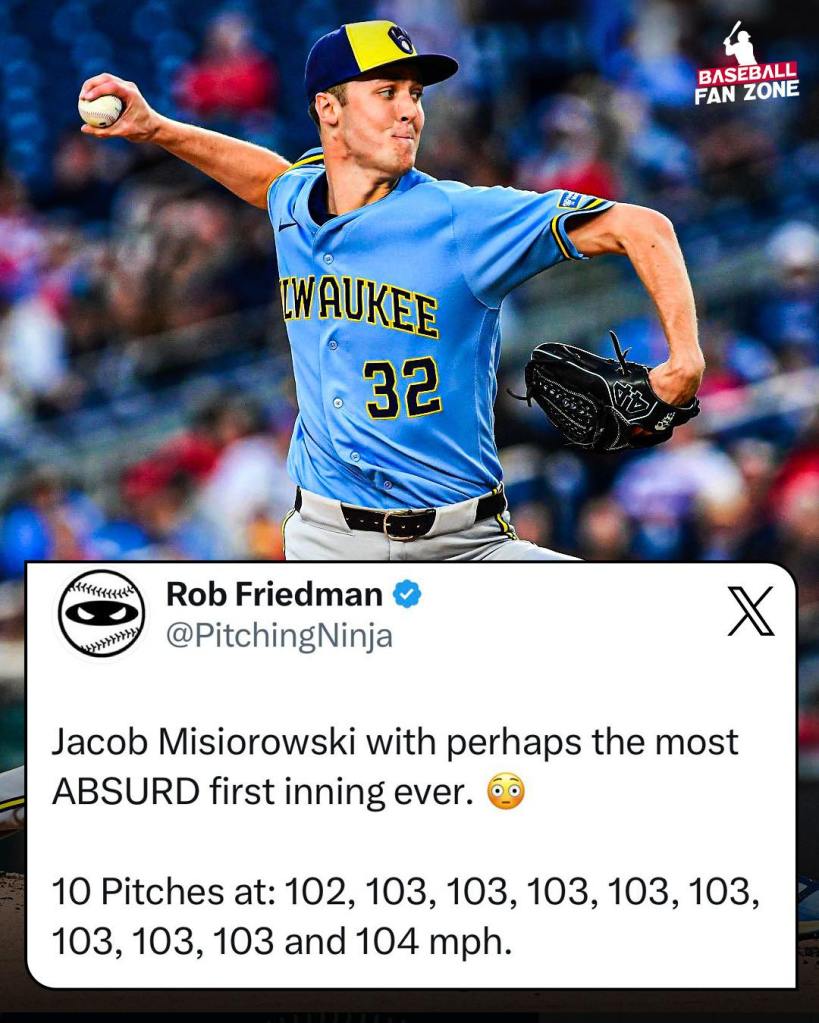
Let the record show that on May 8, 2026, the 6-foot-7 right-hander threw the seven fastest pitches ever recorded by a starting pitcher.
Some, in the same inning.
Taken out after 95 pitches, going long enough to be credited for the win in a 6-0 blanking of the New York Yankees, Misiorowski hit the 103 mile-per-hour mark 10 times. He topped out at 103.6 with the last pitch of the first inning — getting Aaron Judge to fly out to right, before striking him out twice in subsequent matchups).
“The Miz” did this all wearing a cringe-worthy, weird-blue “Wisco” Nike City Connect jersey that years from now will cause MLB historians, as well as Brewers fans, to be horrified.
According to data collected in the Statcast era that began in 2008, a starting pitcher in an MLB game had thrown a fastball clocked at 103 mph or greater just four times prior to that day. Included in that 18-year span was one previously delivered by Misiorowski — just seven days earlier. It came as he was in amidst throwing a no hitter, and had to come out after 5 1/3 innings against Washington because of a hamstring cramp.
Misiorowski, at this moment, has thrown 11 of the fastest 14 pitches ever by a starter. That’s a line of demarcation when compared to hired-gun relievers such as Aroldis Chapman (105.8 mph in 2010 for Cincinnati, 105.7 mph in 2016 for the Yankees), Ben Joyce (105.5 mph in 2024 for the Angels) and Mason Miller (104.5 mph in the 2025 post-season for San Diego).
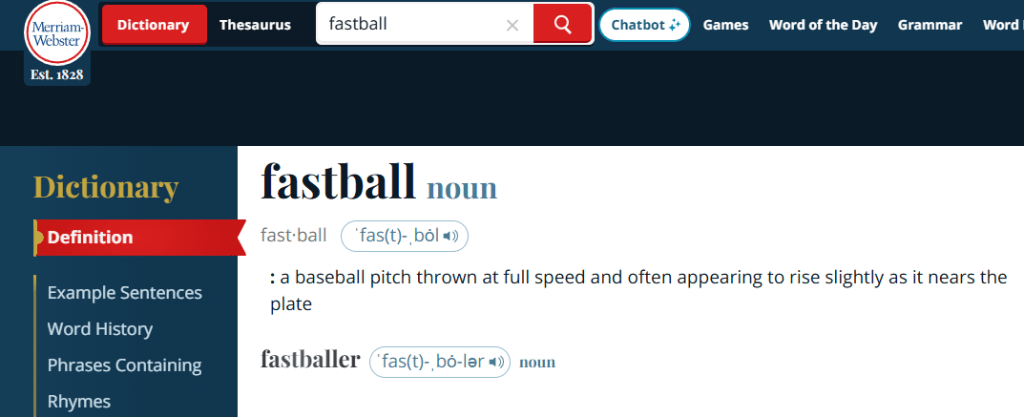
In throwing his fastball about two-thirds of the time, Misiorowski has what’s also called a “perceived velocity” of more than 105 mph. His extra-large frame and long arms drive down off the mound and toward the batter with a release point much closer to what they are used to seeing. “A gangly stick of dynamite who is exploding past previous notions of what is possible for starting pitchers,” is how one writer sized him up.
Misiorowski is just the latest unique metronome, keeping his own time, tempo and rhythm. He also has the cool, somewhat mythological back story. Pronounced miz-uh-ROW-skee, he went to of Grain Valley High just outside Kansas City. During the 2002 June MLB draft that took place at L.A. Live during the MLB All-Star festivities, Milwaukee took him at No. 63. Twenty-six pitchers were taken ahead of him. The Angels (taking shortstop Zach Neto at No. 13) and the Dodgers (taking catcher Dalton Rushing at No. 40) had their sights on other targets.
Misiorowski may have been stashed away at Crowder Junior College in Neosho, Missouri, about three hours south of K.C. — where Interstates 44 and 49 merge near by the Arkansas/Oklahoma/Kansas border on the western edge of the Ozarks — but the Brewers knew.
When some try to handicap the early markers of the 2026 NL Cy Young race, it’s easy to be marveled at how Misiorowski, who struck out a team-record 11 for an Opening Day appearance, has launched almost as many fastballs at 100 mph or swifter just in his last four starts (143) as every other starter in MLB combined has thrown all season (144). He is also on pace to roll up the greatest strikeout ratio (14.1 strikeouts per nine innings) of any starter in history.
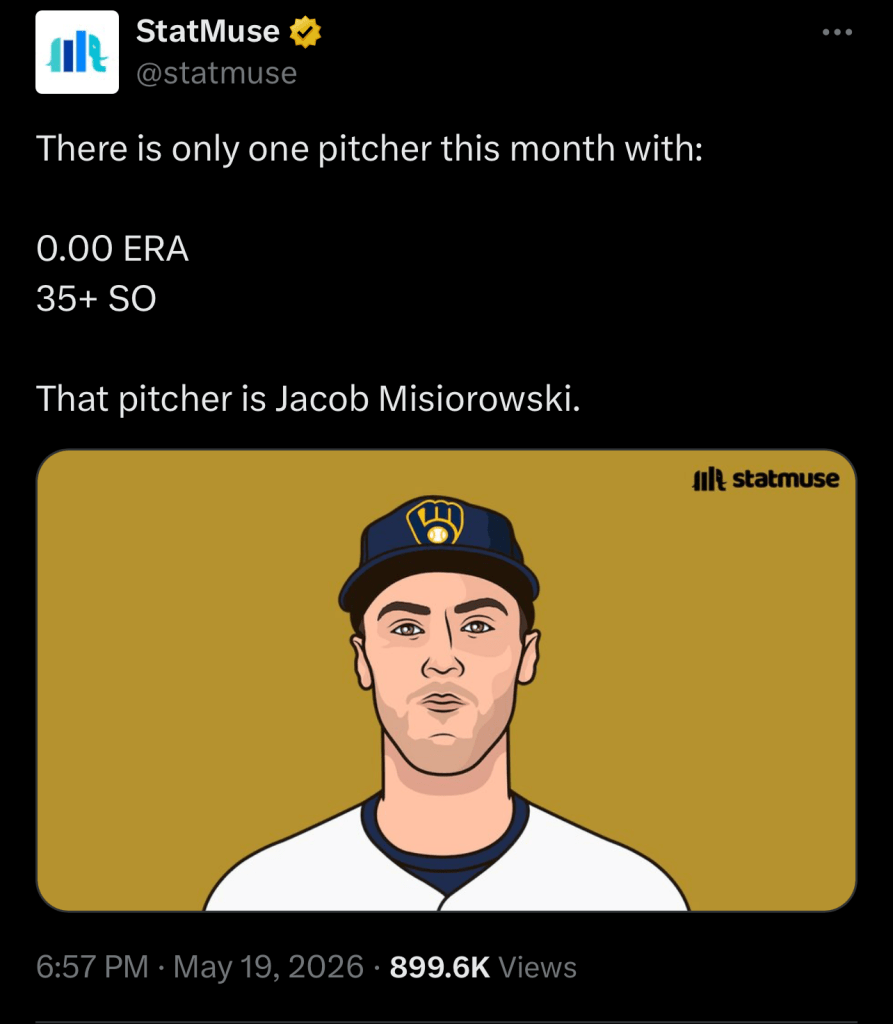
Assuming he makes it to enough innings.
Milwaukee Brewers manager Pat Murphy has compared Misiorowski to “a young prizefighter finding his way.” Others see him in line with contemporaries Paul Skenes or Hunter Greene. His age-to-production ratio so far is like Felix Hernandez.
Maybe, someday, the names Feller and Ryan will come into the conversation. As long as he isn’t a Mark Fidrych, Kerry Wood, Mark Pryor. Or Steve Dalkowski.

Joe Posnanski wrote in a May 15 Substack post:
I watch Jacob Misiorowski’s impossible feats of strength with anxiety and worry. … I want to enjoy (his accomplishments) the way I enjoyed watching Nolan Ryan or Rob Dibble or Justin Verlander throwing blazing pitches.
Alas, when I watch Misiorowski pitch, I can’t help but see the “Misiorowski Feels Elbow Discomfort; Will Skip Next Start” headline, followed by, “Brewers Optimistic That Miz Will Not Need Surgery,” followed by “Misiorowski Hope For Quick Recovery from Tommy John.”
But what can you do? Ask The Miz to throw slower? I mean, that’s not viable.
I sometimes wonder: Would baseball be a better game if teams were allowed to use only two pitchers on any given day? This is not a serious suggestion — it’s obviously not going to happen — but more like a thought experiment. … Pitchers used to maxing out for five innings would find it hard to adjust to their new reality.
But what would happen long term? I imagine … velocity would drop, pitchers would develop more secondary pitches, the knuckleball would return into the game, star pitchers who could throw 250 or 300 great innings would become the most valuable commodity in the game. I think, in time, pitchers would adjust because they’d have no choice but to adjust.
I’m not saying that’s a better brand of baseball — in many ways, it’s not — but for people my age, it’s a more familiar game.
Because we have reams of history to reference in this case.
What was Nolan Ryan doing at age 24?
He had been with the New York Mets’ organization for six seasons, and was a 10-game winner at that point. But also a 14-game loser. With three complete games in 26 starts over 150-plus innings. The Mets didn’t really know what to do with him, so after that 1971 season, they shipped him to the California Angels. The eight-time All Star wasn’t done until 1993 when he was 46 — almost twice Misiorwoski’s current age.
When Bob Feller reached his 24rd birthday, he was a full-grown man wearing a U.S. Navy coveralls as a chief petty officer aboard the USS Alabama during the height of World War II. He had enlisted the day after the Pearl Harbor attacked in 1941.
By that point, it felt as if Feller had already has a lifetime of experiences in Major League Baseball. From 1936 to 1941, from the age 17 through 22, Feller had 117 complete games in 175 starts for the Cleveland Indians. He was top three in the AL MVP voting three times. At age 19 — the number he eventually wore on his jersey — he made his first of four All Star games in a row. He would have likely won four Cy Young Awards during that run had that had been a thing at that time.
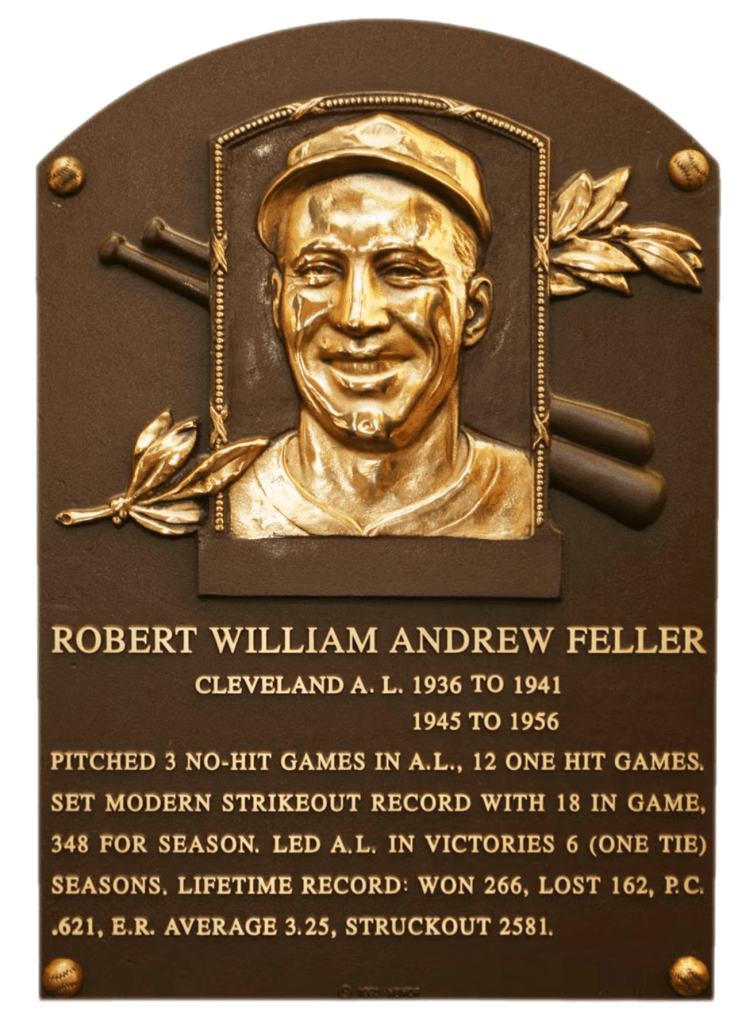
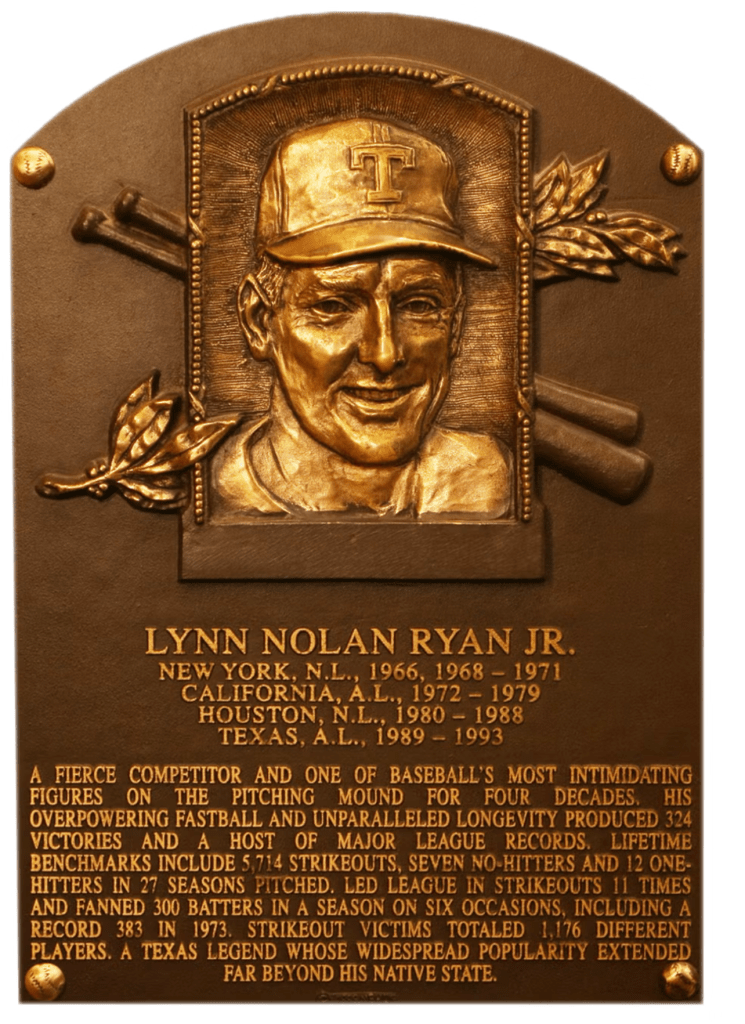
When awesome baseball records are set, there’s a strong temptation to believe that they will never be broken. And some probably never will be broken … I’m sure that when Bob Feller was elected to the Hall of Fame in 1962, nobody could imagine the great records on his plaque being surpassed. But then a guy named Nolan Ryan came along.”
Can’t recall anyone asking Ryan or Feller to throw slower and preserve their health. Different times, different mindsets.
Connecting Misiorowski to Ryan to Feller isn’t a fair real linear exercise at this moment. Nor will it really be years from now. But the way history will document any of this makes it all the more intriguing. Because the one thing we know they all shared: They all threw a baseball pretty damn fast. By whatever measurements were best available at the time, and whatever medium (radio, TV, social media) were best at conveying those stories.
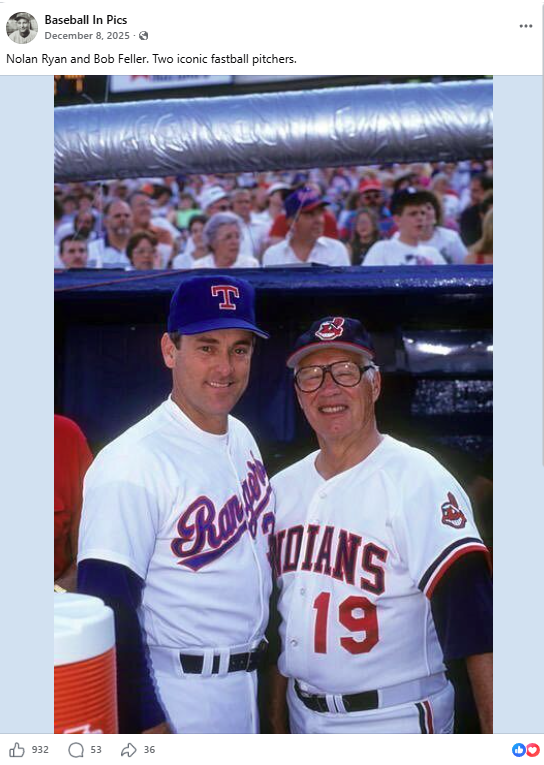
New York Newsday columnist Steve Jacobson started a piece in August of 1989 this way:
Every time the smoke of another of those showcase gems by Nolan Ryan, the baffling Old Man of fastball pitchers, reaches Cleveland, Bob Feller feels a twinge. Perhaps it can be interpreted as a twinge of jealousy; it’s a definite twinge.
Feller was the Strikeout King of the early days when radio and then television told us about the romance of the fastball. Feller accepts compliments as comfortably as he accepts paid autograph sessions. He won 266 games from 1936 to 1956 and missed almost all of four seasons during World War II. He won 25 the year before he left and 26 the full year he returned, so he might have won another 80 or 100 games. …
“Ryan has us on longevity,” Feller said. “My wife says his arm must have been built on a Wednesday. I still say (Walter) Johnson must have been the fastest.”
Feller still owns the record for the fastest fastball in the semi-official clockings listed by the Hall of Fame. Ryan’s best is 100.8 mph. Feller’s was 107.9. He’ll stand up to defend that mark.
The strikeout records are subject to interpretation. When Ryan struck out 383 in 1973, it was during the era of the designated hitter and he didn’t get to throw to a single pitcher. But when Feller struck out 348 in 1946, a strikeout was still a strikeout.
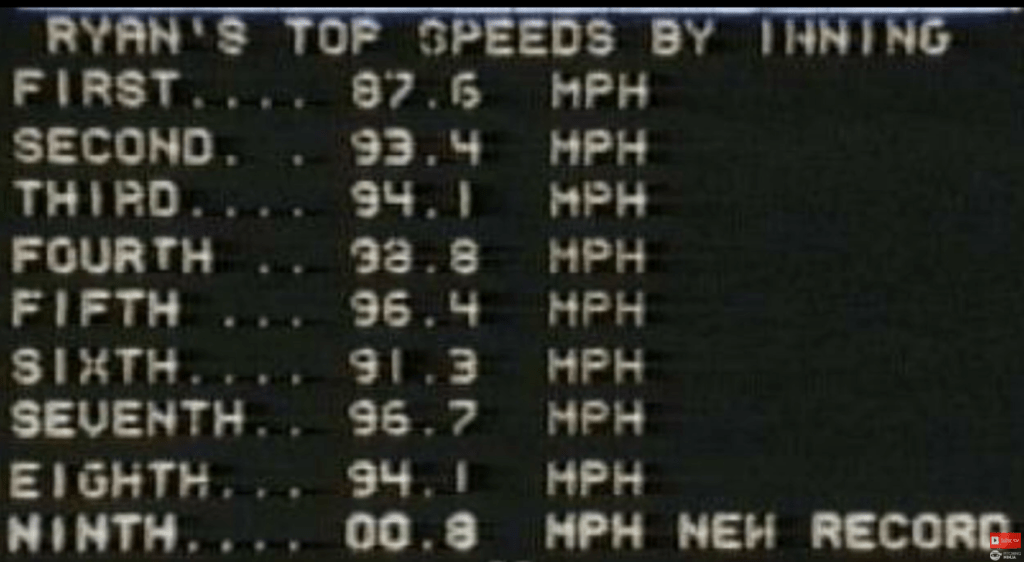
If these are the hairs you choose to split, consider that on April 26, 1990, Ryan, at age 43, tied Feller for career one-hitters with 12, a masterful effort over the visiting Chicago White Sox in a 1-0 complete-game triumph. When Feller was 43, he had been retired for six seasons.
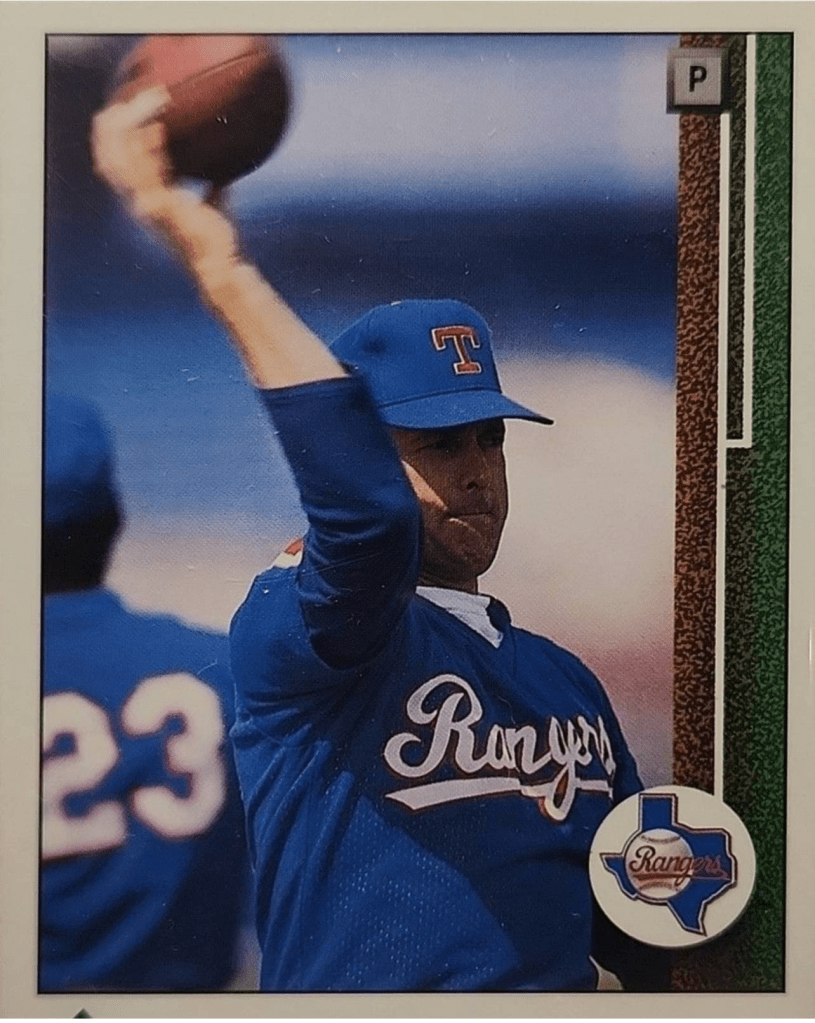
When Ryan threw his record-extending seventh no-hitter in 1991, he was 44, the oldest to achieve such a feat and the first to do it in three different decades. Of Feller’s three no-hitters, the most remarkable is the one on Opening Day 1940. He was just 21.
At some point during that 1990 season, the 71-year-old Feller chimed in again for the record:
“Ryan’s a good pitcher. He’s learned how to pace himself. He’s learned how to pitch. But he’s mad at me because I’ve said that I could throw harder than he can. I don’t know why that bothers him. When Walter Johnson said he could throw ‘a mite harder’ than me back when I was just coming up, it never bothered me.
“My fastball was once timed at 98.6 miles per hour by photo-electric cells at home plate, but by then it was losing speed, maybe as much as 15 miles per hour. That was long before the radar gun they use now. The radar gun gives you the average speed of a pitch from the mound to the plate. On a radar gun, I would’ve averaged 105 to 107 miles per hour.”
When Feller died in 2010 at age 92 of leukemia, columnist Joe Posnanski, a Cleveland native, wrote:
Continue reading “Day 16 of 2026 baseball books: Fast, furious and fearless folklore, backed up by the facts”
