


The Universal Baseball Association, Inc.,
J. Henry Waugh, Prop.
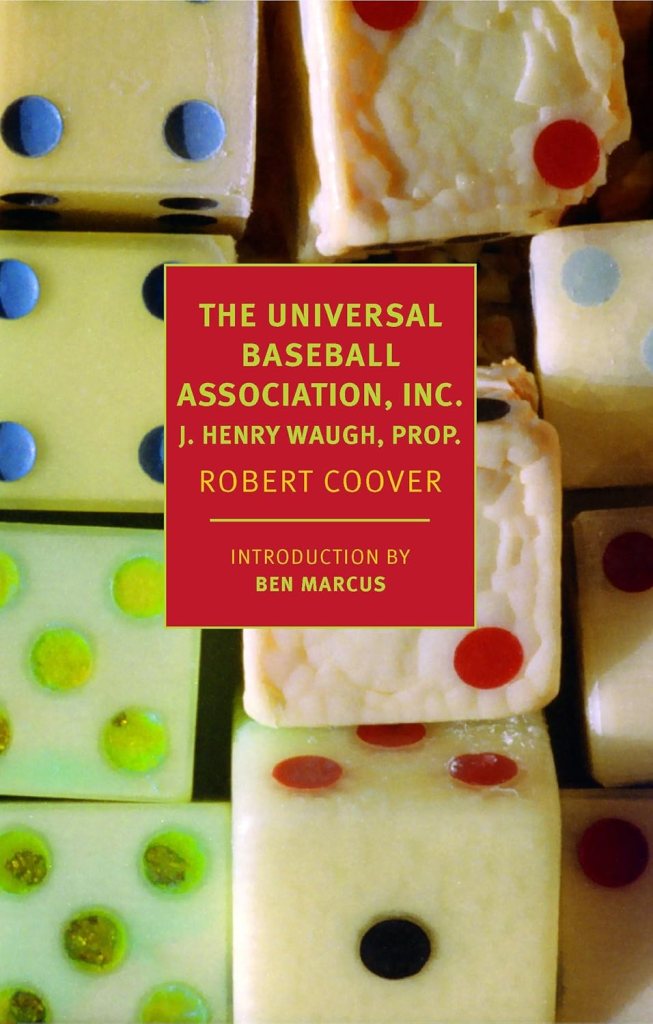
The author: Robert Coover, new introduction by Ben Marcus
The details: NYRB Classics, 264 pages, $18.95, originally released in 1968; newest re-release on March 17, ‘26
The links: The publisher, Bookshop.org
A review in 90 feet or less:
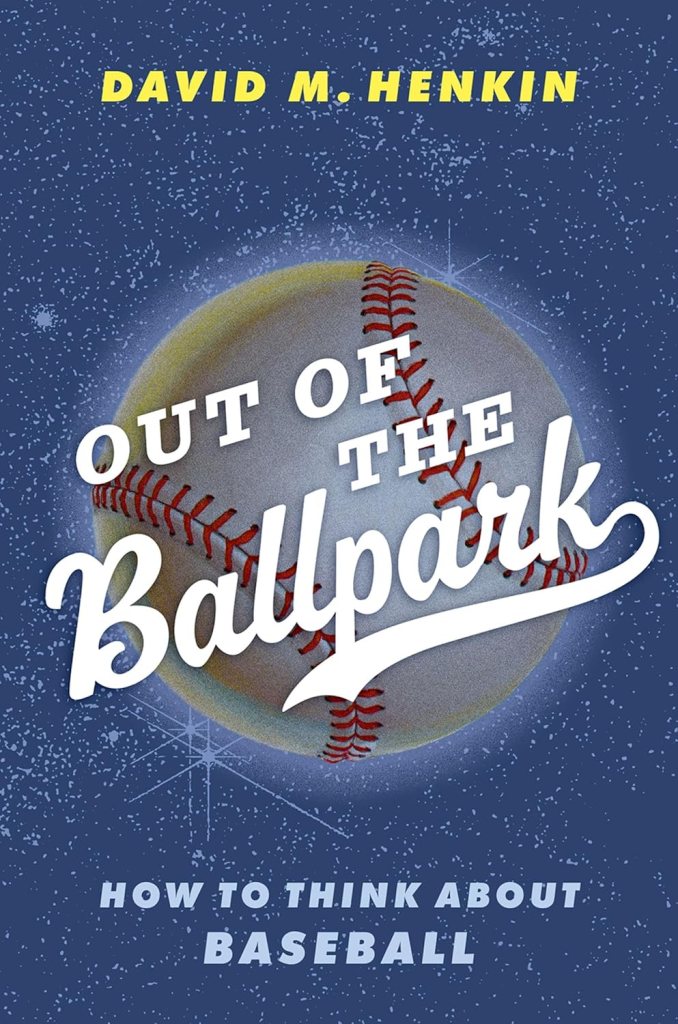
Cal Berkeley history professor David M. Henkin recently launched an efficiently written collection of essays into the universe under the title “Out of the Ballpark: How To Think About Baseball,” (Oxford University Press, $18.99, 152 pages, released March 16, ’26), dedicating a dozen chapters on enlightened questioning of philosophical and cultural issues surrounding the game.
Among other things — the obsession with statistics framing reality.
“The division between scientific and literary, quantitative and verbal, or left-brain and right-brain approaches to baseball are misleading,” Henkin declares. “They bear some resemblance to the inaccurate portrait peddled by recent Hollywood movies of baseball talent evaluators, which pits the number crunchers and bean counters against scouts who can hear the break of a curveball with their eyes closed and can foretell a player’s prospects by instincts.”
Hang on. Brad Pitt’s polished portrayal of Billy Beane in the 2011 “based on a true story” film “Moneyball” came more than seven years after we could digest the magnificence of Michael Lewis’ best-selling book, “Moneyball: The Art of Winning an Unfair Game.” After all, the book’s publishers continue to unflinching point out the book has company amidst “GQ’s 50 Best Books of Literary Journalism of the 21st Century.” It’s also blurbed as “the most influential book on sports ever written” by none other than People Magazine.
But go on, Professor Dave …
“Much as scouts have always combined intuitive judgment against statistical reckoning, the same writers and fans who revel in poetic description and conjure imagined worlds of play tend to be conversant with statistics and are aesthetically compelled by probability.”
Hmmm… Probably right there. So to what perils doth that lead?
“Robert Coover’s celebrated novel, ‘The Universal Baseball Association, Inc.’ published three years before the founding of the SABR and the dawn of sabermetrics, brought into public view baseball’s twin obsessions with both literary imagination and strict bookkeeping. The novel’s protagonist, J. Henry Waugh, is an accountant. He is also a literary creator who spins elaborate stories behind closed doors about fictional baseball players but constrains those stories with statistics and probability by methodically and scrupulously using dice to simulate athletic competition.”
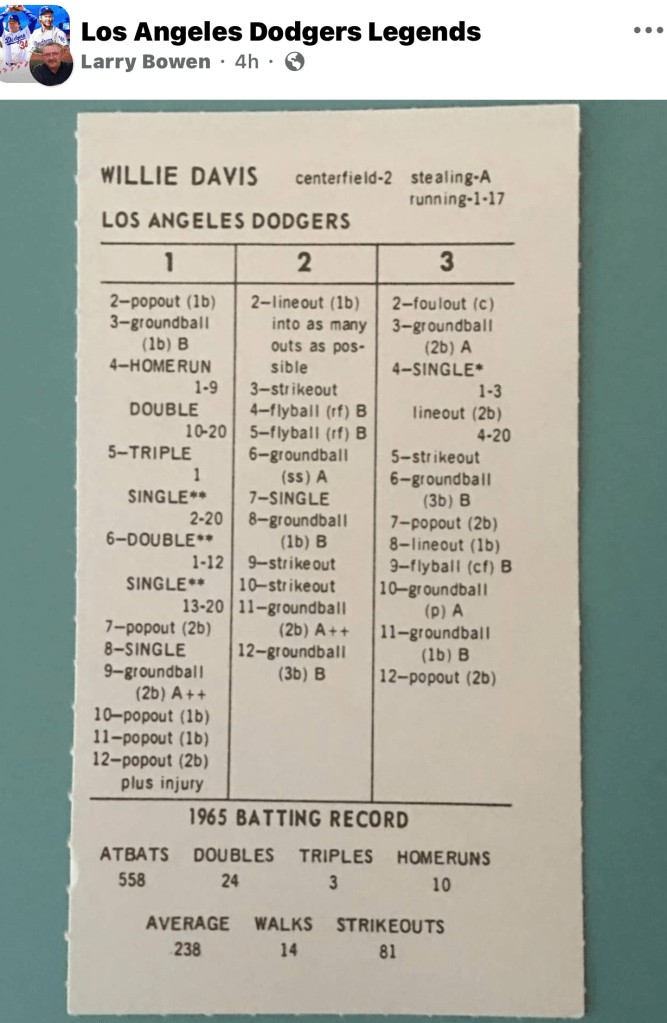
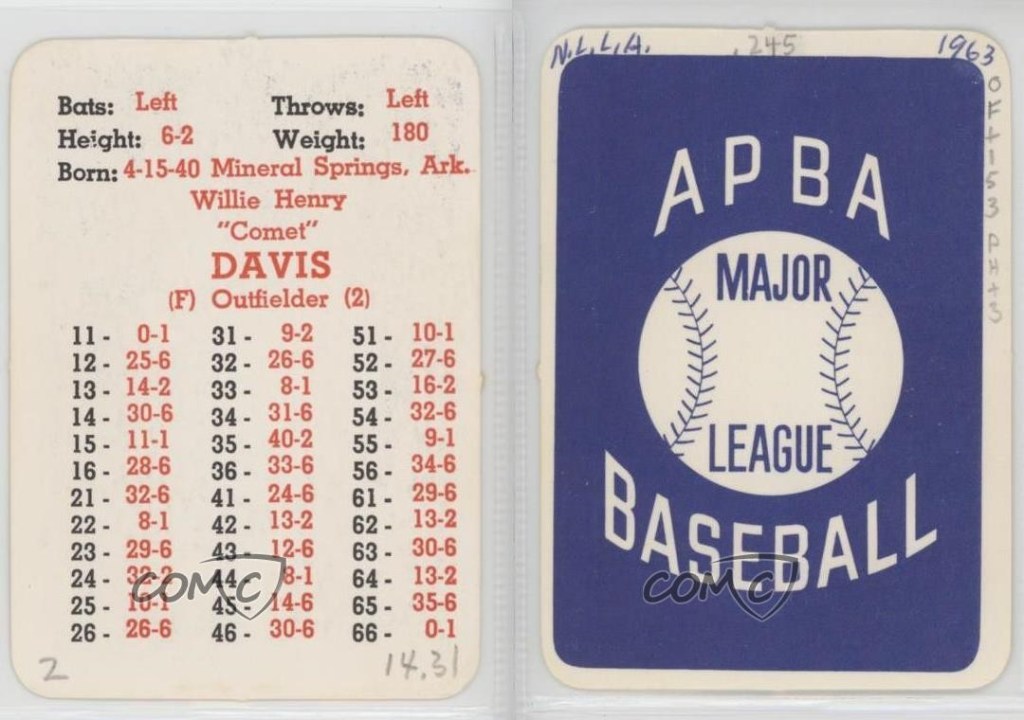
Henkin then presents to the court of public opinion Figure 12.1 as visual evidence, which kinda blows us away more than the Coover book reference.
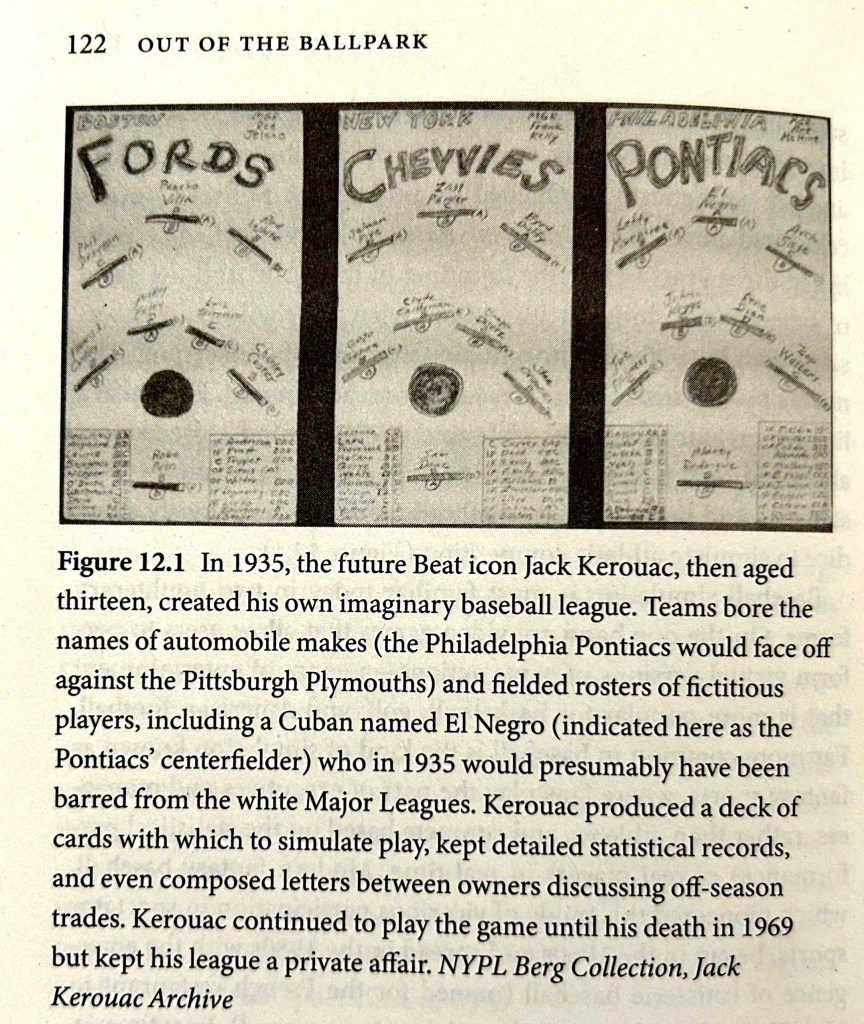
How do you explain that off-beat existence? Henkin tries.
“Traditionalists may bemoan the distortions that this introduces to the fan experience, but in many respects fantasy baseball extends projects that have long been central to the sport: attending to long-term statistical trends, apportioning credit and blame to individual players in a team sport and enlisting the spectator as an active, if vicarious, participant in some else’s athletic performance. All of these projects entail acts of radical imagination … fantasy seems only appropriate … fantasy baseball gratifies the longstanding literary impulse in baseball culture to imagine alternative universes … Baseball as we know it is at core commercial entertainment and projections of worker value have always been part of its discourse and spectacle … baseball has offered many people in various societies a complex and capacious space for thinking about such things as spectatorship, success, community, order and contingency in a modern world. And to the extent that baseball matters, that would be the reason why.”
Why, why, why …
And, no, that’s not a reference to the left-fielder in the Abbott and Costello routine.
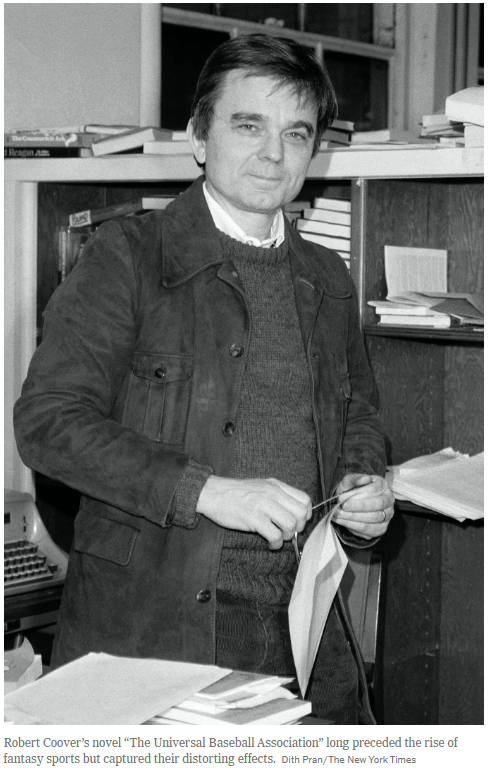
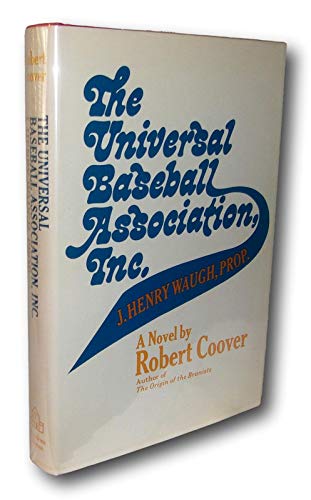
Those universally unfamiliar with Coover’s coveted and critically-held book are asked to invest in it during its latest incarnation as part of the New York Review Books’ Classic series, which is “dedicated to publishing an eclectic mix of fiction and nonfiction from different eras and times and of various sorts.”
To reinforce the book’s classical worthiness, the New York Times Book Review section’s Adam Dalva did a piece last March on this re-release, noting that Coover, “a sometimes difficult, always engaging writer” who published more than 20 books before he died in 2024, indeed foresaw the bizarre effects of Fantasy/Rotisserie Baseball, online gambling and insta-betting, but he somehow captured its distorting effect.
Update: Two letters to the book editor in the Times’ May 3 edition included:
“I read with glee Adam Dalva’s essay … I too was once greatly smitten playing a board game that simulated baseball and involved the tossing of dice. I even kept box scores of the games. No less than Jack Kerouac invented a fantasy baseball game that he toyed with well into his adulthood. If nothing else, it proves life’s full of screwballs, then and now.” — William Keller of South Amboy, N.J.
“Dalva’s interesting essay … sent me to my shelf to consult ‘Invitation to an Inquest’ (1965), a book about the Rosenberg case on which I was a co-author. I found the material I remembered on page 413: A quotation from Harry Gold, a key government witness in the trial of Julius and Ethel Rosenberg. Gold wrote that as a boy he had played simulated games of baseball. ‘I used a league of eight teams … which played a full schedule of games throughout the entire season.’ Each team had ‘pitching staffs with imaginary hurlers, whose records and mound characteristics I carefully noted.’ Given Coover’s fascination with the Rosenberg case (see: his 1977 novel, ‘The Public Burning’), I’ve often wondered whether this snipped fired his imagination.” — Miriam Schnier of Montclair, N.J.
The original review of Coover’s “Universal Baseball Association” in the New York Times from July of 1968 gave writer Wilfrid Sheed first crack at exposing how Coover’s main character had the initials JHWH — a shorthand for Jahweh, which in the Hebrew Bible is the creator and supreme being. Basically, God.
Sheed explained back then:
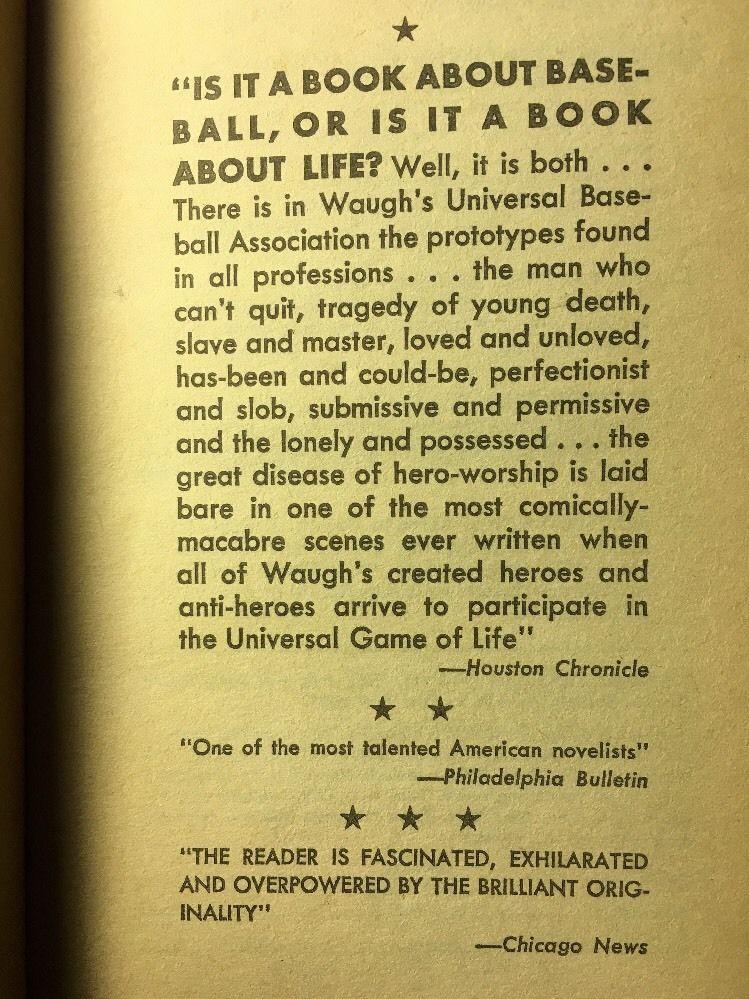
“Baseball and theology might seem to make strange bedfellows. But like a medieval schoolman who could make theology out of just about anything, Robert Coover has spliced the two together and produced a species of baseball scripture. His God is a lonely middle-aged accountant who has devised a dice-game that approximates the probabilities of baseball. That is all.
“Upon the void he projects the laws of chance, the percentages, what managers call, “the book.” … Waugh talks to himself in different voices as he plays, and these voices become independent people. God turns schizoid, giving up bits of himself that his creatures may live, and also that they may interest him.”
Baseball has created its creation monster. It’s alive.
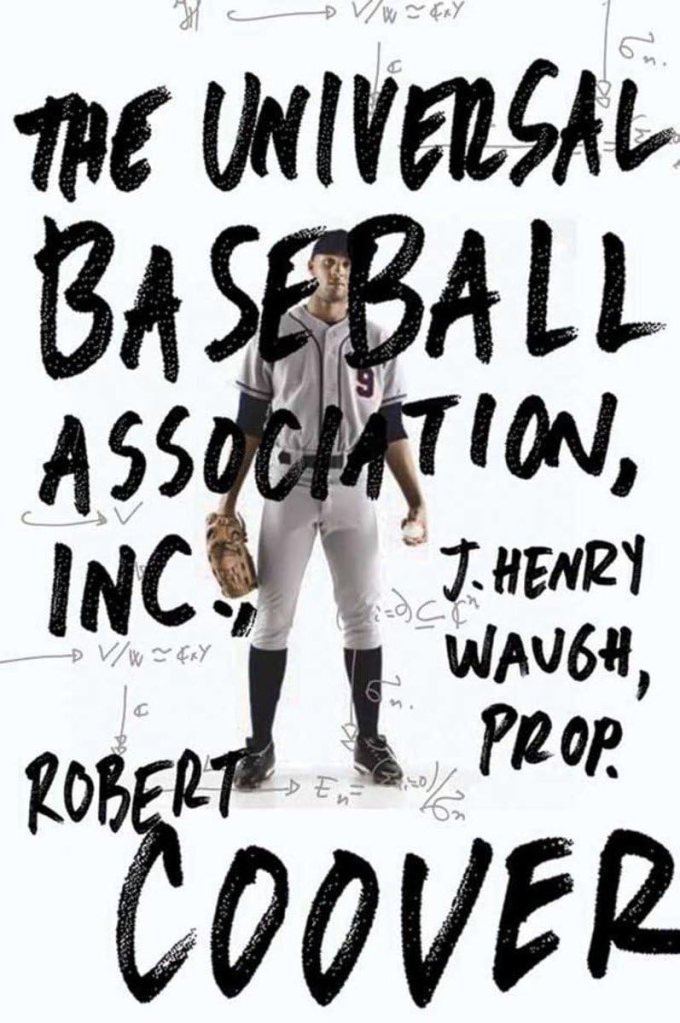
When new editions of “The Universal Baseball Association” cycled back into the publishing world — in 2011, it was from a company called Overlook Press — a New York Times book review essay by Matt Weiland couldn’t help but reference it as it was held up as an all-timer in baseball fiction just as a new Chad Harbaugh baseball novel, “The Art of Fielding,” was being sized up as the genre’s latest tour de force.
Weiland even referenced Kerouac in the Coover sense of writing:
“Right from the start the book nearly matches ‘On the Road’ for sheer electricity . . . Coover made baseball on the page seem three-dimensional, exulting in what he called the game’s ‘almost perfect balance between offense and defense.’ He captured what Philip Roth, in a 1973 New York Times essay on baseball, called ‘its longueurs and thrills, its spaciousness, its suspensefulness, its heroics, its nuances, its lingo, its ‘characters,’ its peculiarly hypnotic tedium’. . .
“The genius of the novel is in how Coover revels in the sun-bright vitality of the world Waugh has created, full of drink and lust and dirty limericks and doubles down the line – and yet brings Waugh face to face with its darkest truths.”
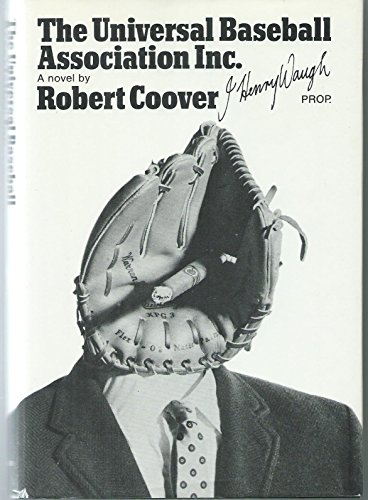
The Paris Review, in 2017, had its own take on the “oft-forgotten” baseball novel but declared, at that point in time, “the book is more relevant now than ever before. … The magic (and horror) of Coover’s novel is in how deeply Henry’s game envelopes him,” and there is little transition when Coover goes from Henry to the players Henry created.
“Henry’s fake baseball world and those early fantasy-sports board games elicited that pure exuberance far better than today’s money-focused smartphone contests,” the Review adds.
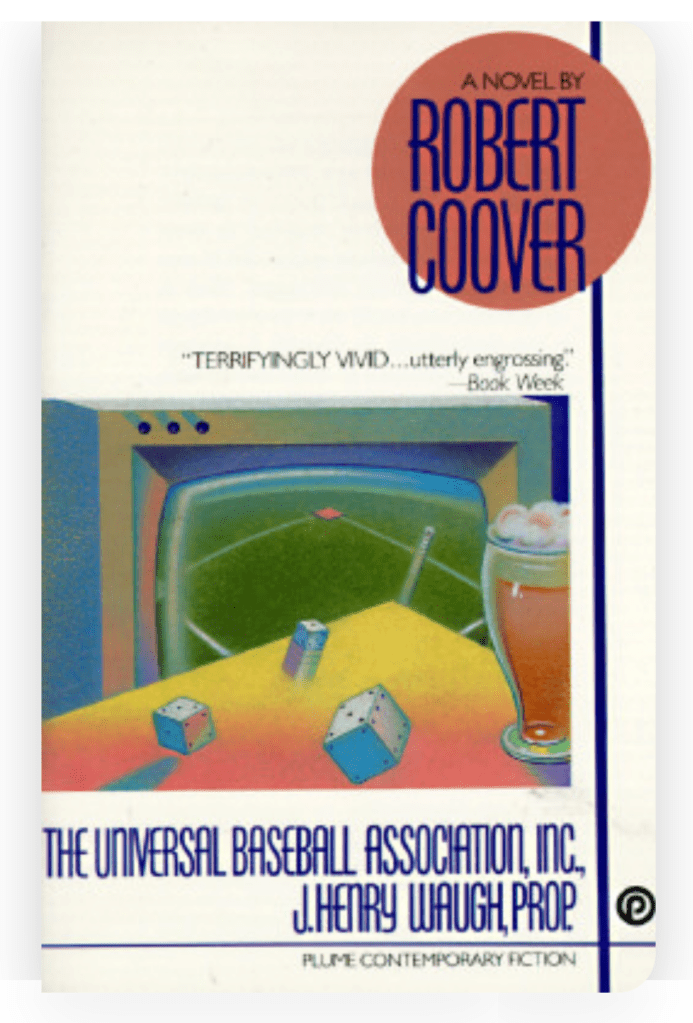
John Thorn referenced Coover’s book in his own 2006 New York Times essay about the game’s literary impact. This was five years before he assumed the title of Official Baseball Historian for Major League Baseball.
“What Coover may have viewed as a retreat to the womb we today, with our play space diminished from a ball field to a computer screen, call fantasy baseball. In his version of what has transformed a pastime into an obsession, the players generate statistics, a long season, a storybook finish, a game within a game, and a world within a world. Today, millions of desktop magnates preside over teams of their own construction — the statistics are what matter, no humans need apply. In its dark, unreal loneliness Coover’s baseball novel is, for 21st-century readers of fiction, the heights, or depths, of realism. He cuts deep into the cake.”
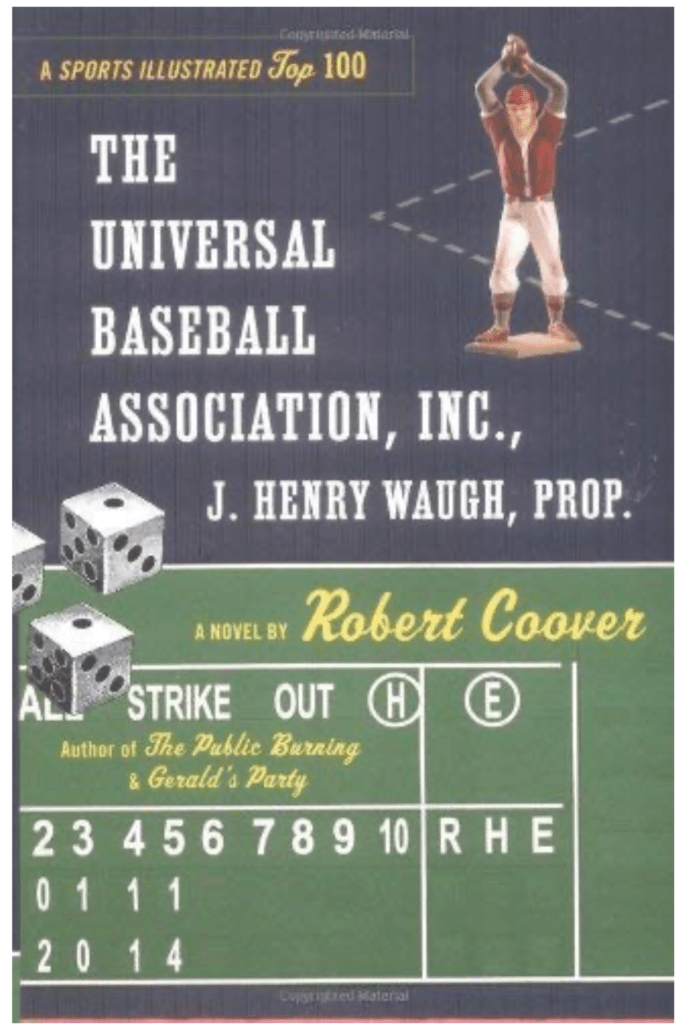
This is a book with its own Wikipedia page, its own Baseball-Reference BR Bullpen post, its own GoodReads page, and its own Encyclopedia Britannica entry.
In 2002, “The Universal Baseball Association Inc.” was given the No. 61 spot in a Sports Illustrated story declaring the 100 top sports books of all time — not just baseball, and another reason for a re-issue.
In 2021, Goodreads reviewers rated it amidst the “10 Greatest Baseball Novels of All Time,” and a current Goodreads list has it still tracking at No. 9.

It can feel like a roll the dice as to which printed version of “The Universal Baseball Association” to pick up and read either for the first time or the 31st time these days.
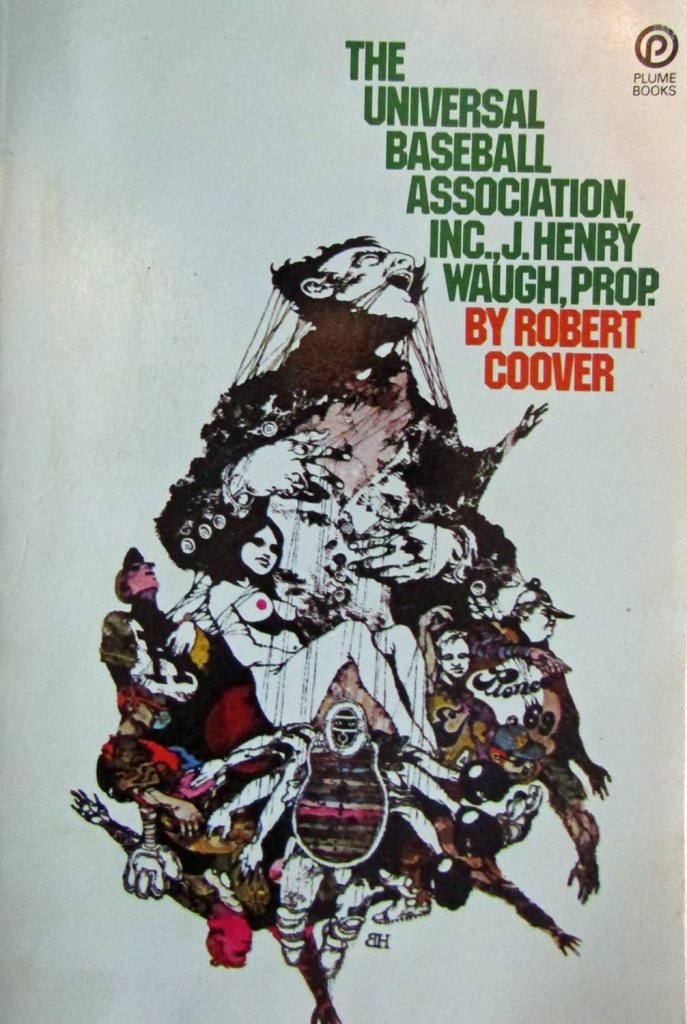
This newest one is just as swell as the others as it retains the originally muddy typeface without the musty overtones. The new cover artwork also frames it for this era as well as connecting it to the NYRB series — it has what look like dice created out of sugar cubes, each deteriorating at their its smudgy pace.
If we believe life itself is a daily dice throw, a game of craps, a series of chances, consider constructing your own Chart of Extraordinary Occurrences, as Coover does for Henry, which trigger a series of stress impulses in our heads.
Whether it’s 1-1-1 or 6-6-6, we’re aren’t literally going to die afterward. Right?
Well … In the UBA, yes, one can. And does, early on, without a spoiler alert.
What is fate? What is free will?
Is it OK to create escapism — a religion of baseball — from a chaotic reality? Can it then be bound up and preserved for future generations?
Embrace all that, and knowing what we do now about mental illness and ADHD and self-inflicted isolationism, you’re going page by page, game by game, into Henry’s weird world with at least the knowledge this isn’t you having to navigate this mind-bending lifestyle.
Hopefully.
Remember this is framed as a satire/black comedy by most reviewers. For context, it landed a year before the Baseball Encyclopedia came out to give everyone access to anyone who ever set foot on an MLB field.
Fantasy baseball games go back to the 1930s, so Cooper had some ramp-up time for this. Clifford Van Beek designed a board game back then called National Pastime, which contained customized baseball cards of player that took life upon a dice roll. More kids geeked out over APBA — the American Professional Baseball Association — when it came out in 1951. Again, dice included. The Strat-O-Matic board game emerged in the late 1950s, hit retail stores in 1961, and — maybe because of Coover’s book, maybe because of SABR launch, maybe because it saw a new future — supersized itself with an advanced strategy version in 1971.
But in those cases, the user had existing stats based on real players. Coover had a new spin, an almost sinister plan, to exploit.
With Coover’s UBA, Inc., it’s a grown man in some kind of mental illness spiral as his game gets too real for him. It’s unnerving. Even his work pal, Lou Engel, who looks out for his well being at the Offices of Dunkelmann, Zauber & Ziffenblatt, tries to hang in there with him and allows himself to come to Henry’s apartment to give the game a try amidst the beer cans and pastrami sandwiches. Turns out, it’s not Lou’s thing. He’d rather escape his own reality at a movie theater.
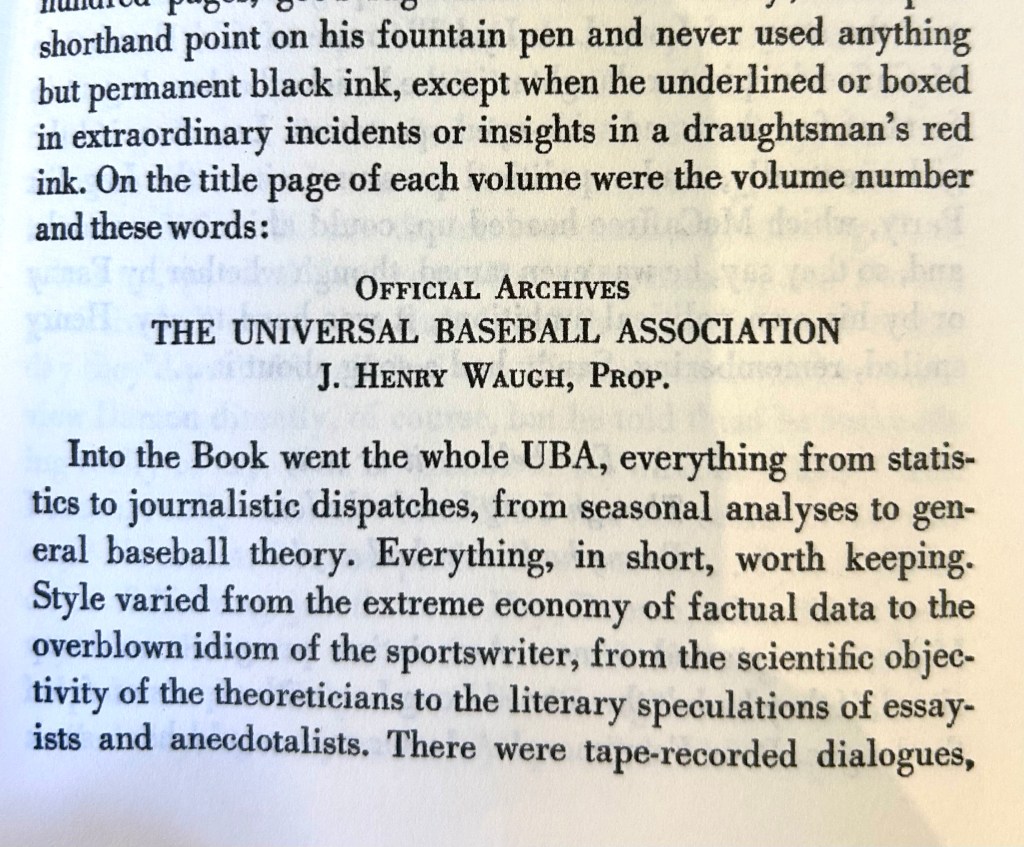
Understand how “real baseball bored” Henry. He loved patterns and data. Making up his own names “gave the league its sense of fulfillment and failure and emotion.” Henry would admit that a real game’s scorecard “were enough … I didn’t need the games.” The dice and Henry’s charts and journalistic documenting of events were only “the mechanics to the drama, not the drama itself.”
Henry understood how in his real job of accounting, as well as in this fantasy baseball world, the absence of numbers or measurements meant there was no recording of history. And once in a while, Henry would even give a glimpse of real history — a reference on page 189, for example, to the death of Jim Creighton in 1892 (see a review of a book about that circumstance).
If we did our own daydreaming, trying to imagine J. Henry Waugh, a baseball Walter Mitty, as he could be portrayed in a Hollywood film — whether or not Professor Dave might object.
If not Anthony Perkins reprising “Psycho,” there’s Robert De Niro from any one of three rolls — Gil Renard from “The Fan,” Max Cady in “Cape Fear,” or Rupert Pupkin from “The King of Comedy” We won’t even go as far as Travis Bickle in “Taxi Driver.”
In the hands a Wes Anderson, we might be better served with a Jason Schwartzman-Bill Murray pairing of Henry and Lou. Then we’d know it was OK to laugh at very dark places (plus it would be visually amazing).
It’s not out of the question to just get out an iPhone and make your own movie version:
Admittedly, we had some starts and stops to get into Coover’s parallel lanes of fiction and flow and confusion. Making it safely home to the end, our equilibrium was blown again. We were relieved to some point that, on page 125, Coover allows that Henry was “thinking that this was sure a helluva thing for a grown man to be doing at dawn on a working day.” It could also feel like it was a reflection of “a life misused, an old man playing with a child’s toy; he felt somehow like an adolescent caught masturbating.”
In the new introduction by New York author Ben Marcus, it justifies this latest release because “Coover could execute a perfect baseball story, sound every expected note — then use that perfection to detonate the form from within. … He showed he had literary genres down cold, which is possibly why he could trigger their collapse with such disruptive invention and glee …
“(Here) baseball is a fiction inside of fiction, doubly unreal. Henry … is a master of ceremonies but he’s helpless to control what these ceremonies unleash … Coover is clear about which world matters more, not just to Henry but inside the ontology of the book. The prose overflows with energy in description of the imaginary games, channeling the ghosts of old radio announcers. … The real world gets a prisoner’s ration of neutral language, prose deliberately drained of blood. It’s a trap, of course …

“By the end, we watch imaginary characters conduct their own weird ceremonies in some distant future, well after Henry himself presumably died. They’re still playing out the consequences of an unfortunate roll of the dice, turning into myth, unable to escape the history of their career set in motion. The game, if it is a game, continues without the man who invented it.”
If only we could get an AI Rod Serling to read Marcus’ intro aloud. Then we’d know for certain we’d all been allowed a true visit to “The Twilight Zone” of baseball lit.
How it goes in the scorebook:
Submitted for your approval: Classic truth telling and mind-messing.
Just give yourself some grace if, at first it seems disorientating, unsettling, confusing and just makes you uncomfortable and want to put it down. Stay with it.
Retro can be cool, we’ve discovered, when it’s not hung up so much on transactional nostalgia.
More to followup:

== The Universal Baseball Association is the name given to a YouTube.com channel that focuses on baseball dice games.
== Will Leitch has a review of the re-release for The Wall Street Journal.
== First-edition signed hardcover copy of Coover’s book can list for $359 at AbeBooks.com if so fanatically inclined. Or a $450 for rare softcover. Even a Mylar-wrapped dust jacket alone fetches $60 (and for $25, someone can create their own faux dust cover).
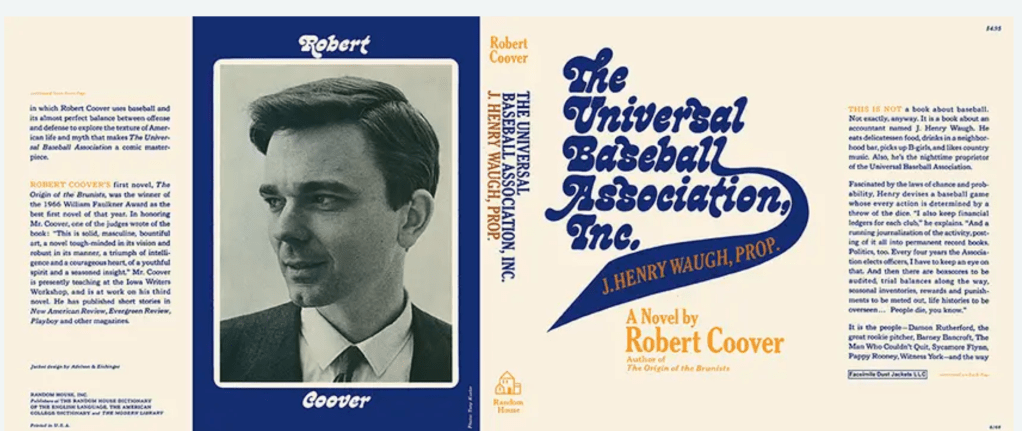
= The NYRB, open to suggestions of readers as to what they would like to see back in print, is already planning a reissue of Coover’s “The Orgin of Brunists,” last in paperback in 2015.
== A review of the book from Tabletop SportCast:


2 thoughts on “Day 12 of 2026 baseball books: Universally accepted abstract daydreaming”