

“How Retrosheet Saved Baseball”
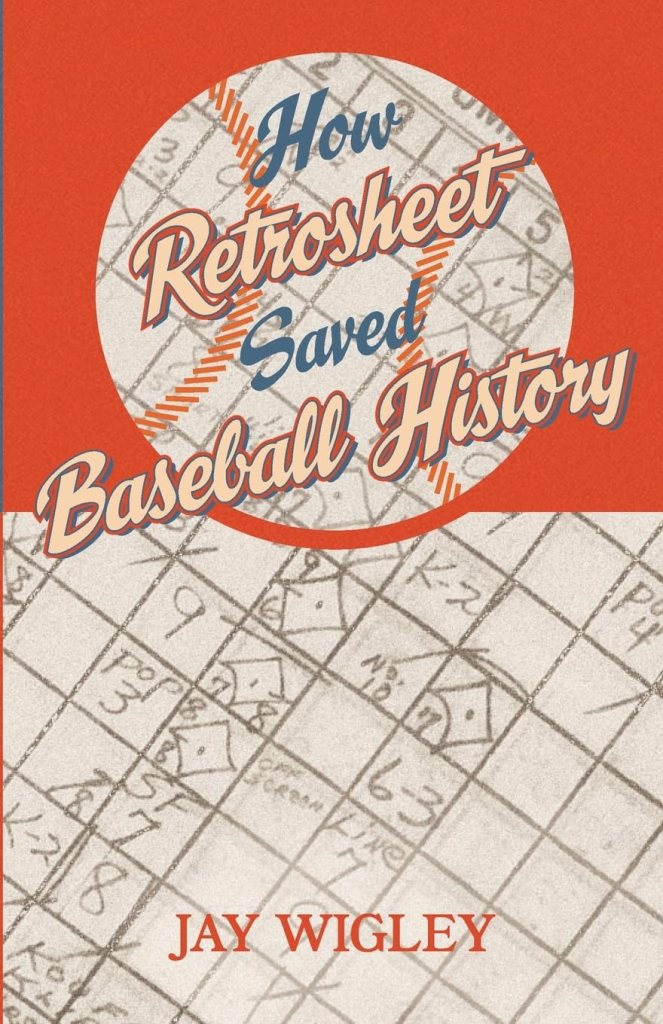
The author: Jay Wigley
The details: Wiglesius Press/self published, 228 pages, $27.99 hardcover, $19.99 paperback, released April 3, ‘26
The links: The author, Bookshop.org
A review in 90 feet or less:
Probably no surprise we again seek clarity on how baseball followers value statistical bookkeeping by referencing the work of David M. Henkin’s “Out of the Park: How to Think About Baseball.” Just as we did during Day 12 with sizing up the historical context of Robert Coover’s “The Universal Baseball Association, Inc.” in relation to how the game encourages fantasy and imagination.
From Chapter 11 of Henkin’s horsehide observations:
“Baseball’s culture of obsessive statistical reckoning combines several related elements (that) have been intensified in the case of baseball by the game’s structure and the sport’s history. First is an interest in evaluating and crediting the contributions of individual players to a team’s success or failure. Second is an extraordinary faith in the capacity of numbers to precisely and reliably summarize important events. And third is a need to tell stories about the game in a language that allows for comparing events spread across time.
“The careful recording and tabulating of events within a baseball game, including events that don’t directly determine or explain the game’s outcome, has been around ever since the game became a subject of news coverage.”
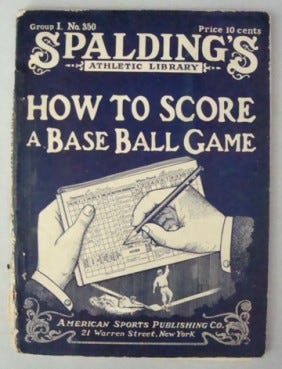
And much of that were from seeds planted by Henry Chadwick, a cricket reporter from England who moved to New York in 1830, watched this odd game of baseball being played in the 1850s, reported on it for New York newspapers, and knew it needed some structure when he fleshed out what’s generally accepted as the box score and scoresheet.
A note-taking grid with codes and slashes and numbers and letters that could be a universal language was to everyone’s best interest. We find out that Chadwick’s reliance on this fact came from learning how his older half-brother, a commissioner of the board of health in Britain, saw the collected data as a scientific approach to create social order and accountability.
“It is remarkable how well documented baseball games were,” Henkin writes. “We have more detailed, exhaustive and reliable information about what happened on baseball fields over a century ago than about any other aspect of leisure culture, popular entertainment or daily life in the United States from that era.”
For better, or worse? For better, of course.
History also needs checks and double-checks on accuracy to avoid narrative pitfalls. In baseball, there is a human element that determines hits and errors, writing rules about how a pitcher is credited with a win or a loss or save on his ledger. Humans make mistakes and stand to be corrected. Numbers should have auditing.
Box scores provide that data record, transmission and storage.
And in the 21st Century, thank goodness for Retrosheet.
A service we would happily pay a subscription fee to access — just as we do for newspapers.com or once did for The Sporting News — Retrosheet has made sites such as Baseball Reference and Fangraphs all the more legit, a constantly evolving process of getting information as accurate and accessible as possible for those who love crunching numbers.
Also, thanks to Jay Wigley, who joined SABR in 1999 after discovering Retrosheet in 1996. The Knoxville, Tenn.-based quality professional in the medical device industry has shown he has the mindset to position him properly in researching and organizing the incredible history of Retrosheet for those who can appreciate such an excavation, and some of whom were fortunate to be in on the ground floor.
People, it turns out, we know well and had no idea they were so deep into putting their handprints into the wet foundation.
Wigley’s research for the book can be traced somewhat to a 2020 contribution he made to The National Pastime magazine that started: “We baseball fans want the truth.”
Truth be told, we now have it as far as Retrosheet’s monumental mission statement is presented.

Launched in 1989, Retrosheet has had 501(c)3 non-profit status since 2000 — meaning one can make financial contributions as they see fit, like NPR or PBS, get a tax write off, and feel the satisfaction that they’re not at the mercy of a corporate board manipulation of how this information can be used and dispersed. It’s a purpose-driven volunteer exercise for the good of the game, and good of the soul.
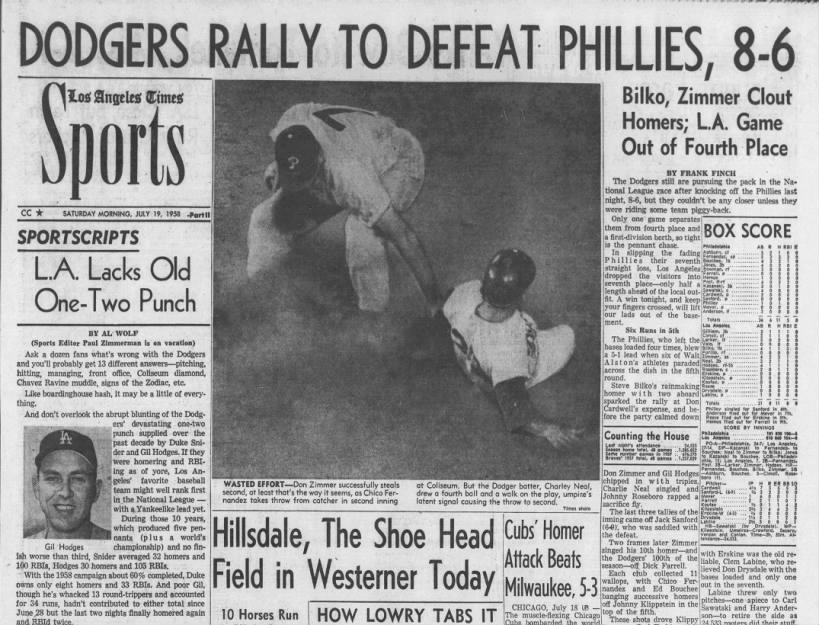
We discover the inspiration for this quest of all the MLB box scores from the start through 1983 — those since then had been a curation project by SABR master Bill James — starts with Dave Smith’s curiosity as to what really happened on July 18, 1958.
He was 10 when his dad took him to the Los Angeles Coliseum to see a Dodgers-Phillies game where Sandy Koufax got the start. The Dodgers, just fresh from their move from Brooklyn, would finish next-to-last in the National League that season (before winning the World Series the next year).
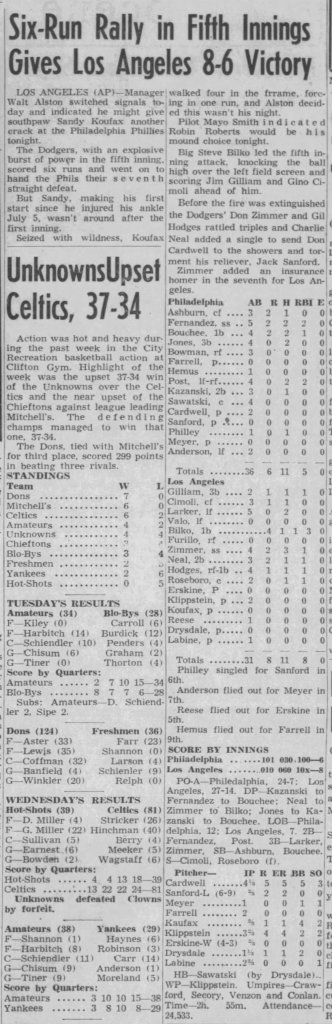
As we see from newspaper accounts, Koufax had been rested the previous 13 days with an “injury-induced layoff.” He gave up four walks in the first amidst the six batters he faced (he struck out the other two), which forced in a run and he was lifted for someone named Johnny Klippstein. Don Drysdale later came in relief. Carl Erskine got the win and Clem Labine the save. Pee Wee Reese came off the bench as a pinch hitter. A three-run homer from Steve Bilko, the starting first baseman (Gil Hodges was in right field and actually hit a first-inning triple) helped rally the Dodgers to the 8-6 win and somewhat erase Koufax’s clumsiness.
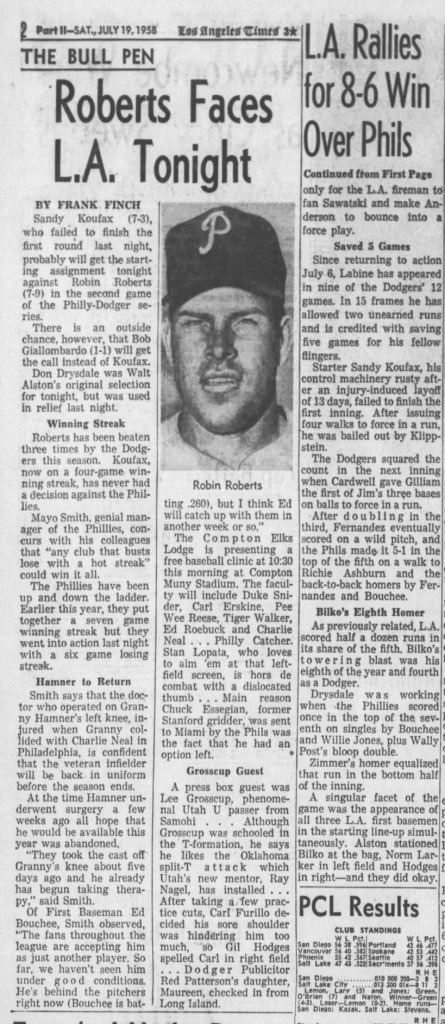
Koufax’s start was so brief it was discussed that he’d start the next night against the Phillies against Robin Roberts.
If we check Retrosheet.org, we find our answer. He did, lasting 7 1/3 innings, facing 34 batters, walking six and striking out three in taking a 6-2 loss. Roberts went all the way for the win, striking out eight, walking none, and evening his record to 9-9 in a season where the eventual Hall of Famer would finish 17-14 with 21 complete games. Koufax, falling to 7-4 in that loss, would end up 11-11 and a 4.48 ERA with a league-high 17 wild pitches to go with 131 strike outs in 158 2/3 innings matched up with a career-worse 105 walks. Hall of Famer? Far from it at this juncture (but just five seasons away from making 40 starts, with 20 complete games, a 25-5 mark and 1.88 ERA with 306 strike outs and 13 shutouts for the World Champs of ’63).
Again, with Retrosheet, we can contrast and compare the Koufax career, game by game, dismal to dominating, and create an arch of triumph far more contextual than just a bunch of season-ending digits on the back of a baseball card (that hopefully was spoken for and never made it into a bike spoke).
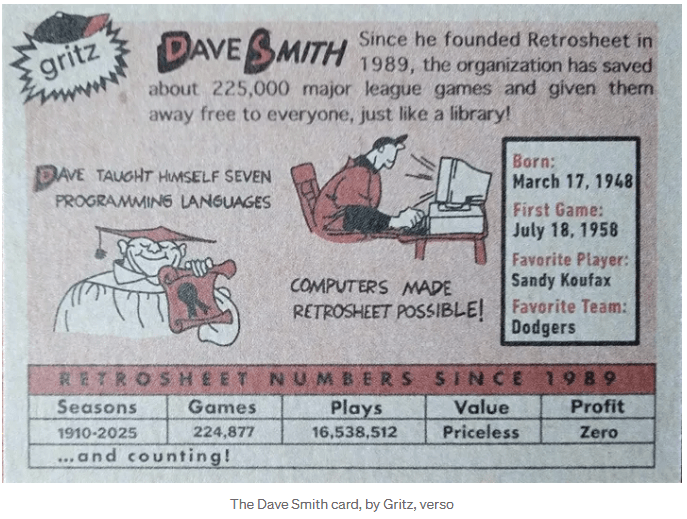

With Wigley’s book we find out how Smith, 15 years after that Dodgers-Phillies game he attended, was given the chance to obtain four seasons of scorebooks from Los Angeles Times’ Dodger reporter Frank Finch from Goody Goldfaden’s Adco Sports Book Exchange on Santa Monica Blvd., in West Hollywood, when Smith, then a student at UCLA, was just looking for back issues of The Sporting News to find long-ago box scores. Smith was also more interested in how Maury Wills’ presence in the Dodgers’ lineup produced victories and made other hitters in the lineup better — fresh SABR-type investigation curiosity he wanted to quantify with his new membership card and certification.
By 1991, Smith was leading the charge to find box scores to the 137,793 games that took place in the big leagues (not yet Negro Leagues) from 1871 through 1983. Smith already had 7,000 box scores based on his own research tucked away in his basemen in Delaware.
Just 130,000 to go. And who’d pay for all this?
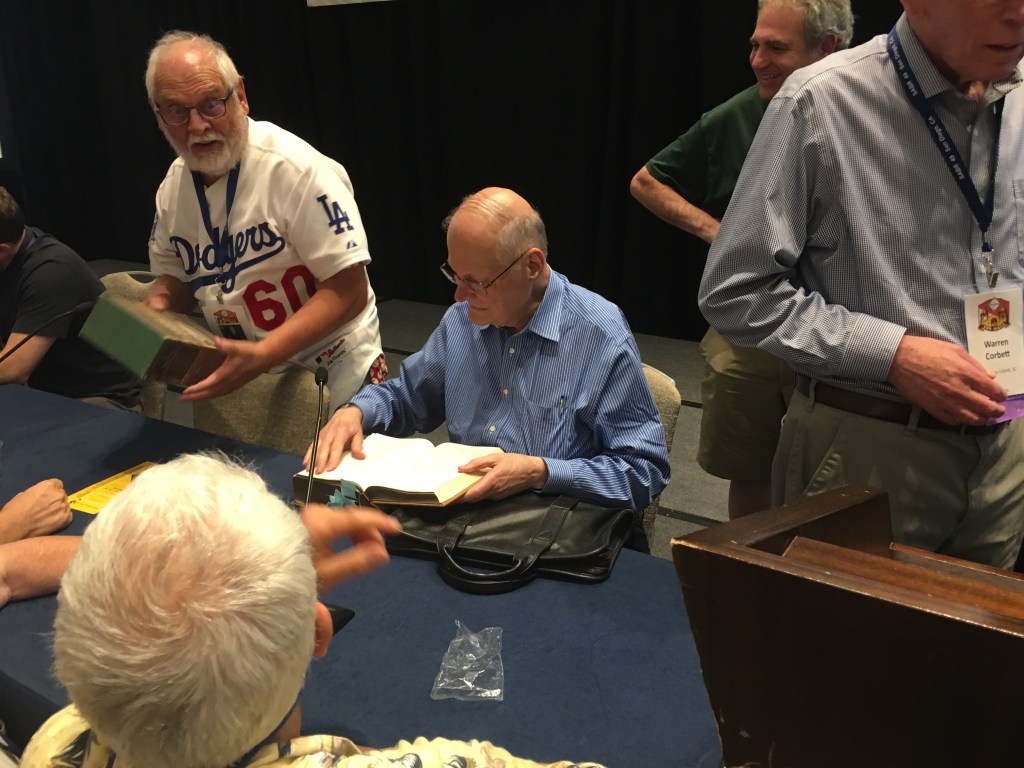
This is where Wigley takes on in remarkable detail to the offices of each individual MLB team, convincing them his project was a win-win for everyone. It started with the Baltimore Orioles’ archives.
The California Angels were next, thanks to PR director Tim Mead, who knew of Red Patterson’s stash. Smith’s “Big Bang” was accessing the record books of famed Dodgers’ scorekeeper Allan Roth, and the Dodgers’ John Olguin, through PR director Jay Lucas, going into the Dodger Stadium third-floor storage area in 1992 and sorting through hundreds of boxes of materials that would be the start of team achieves officially catalogued for then-owner Peter O’Malley’s delight. More Red Patterson scorebooks were discovered there, and Xeroxed copies were made.
The scorecards of another Dodgers’ beat writer, Bob Hunter, were accessed. More sportswriters were networked into the search before their records were either tossed in the trash or gave way to mold, termites or general deterioration — like some of their baseball cards.
It snowballed until the avalanche of Manilla folders, floppy discs and primitive binary software wasn’t burying history, but uncovering more of it.
“The Dodgers’ acquisition showed what was possible when everything aligned: personal connections, perfect timing and someone relentless enough to navigate the logistics,” Wigley writes.
MLB official historian John Thorn believes “Retrosheet is the greatest human endeavor since someone convinced 40,000 Jews to build a pyramid.”
We have absolutely no reason to argue that point. Religiously, culturally, or from any historical standpoint of good faith.
How it goes in the scorebook:
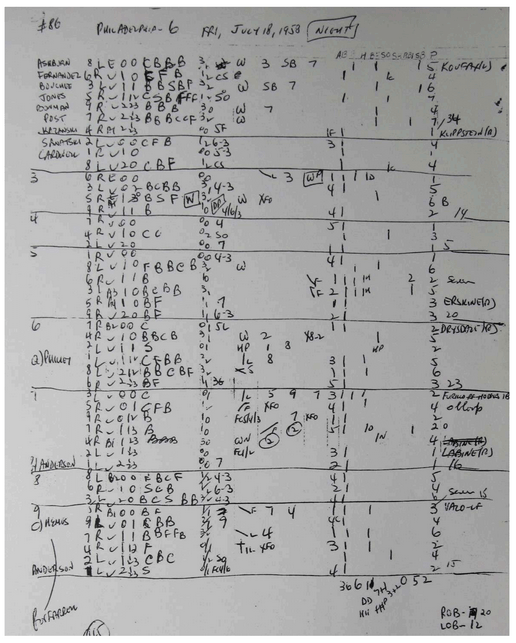
Whatever coded icons, slashes and dashes the estate of Allan Roth decides best to covey the value of this book.
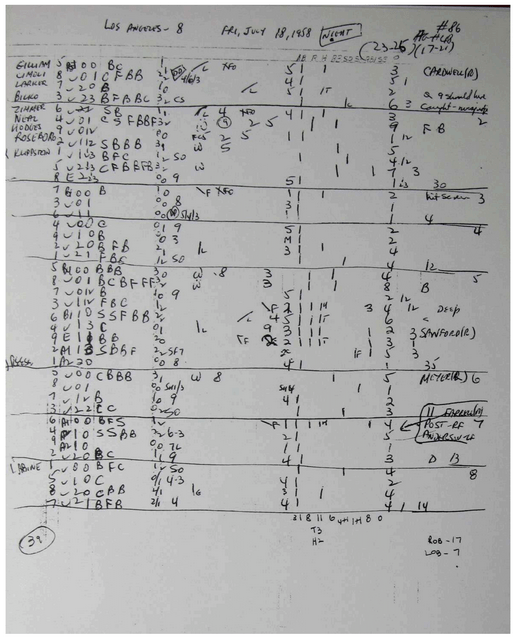
And from Wigley’s official site for the book, which includes things he wasn’t able to include in the manuscript for are still rather useful, we have Roth’s sheet for the July 18, 1958 Dodgers-Phillies game, above and below.
More to followup:
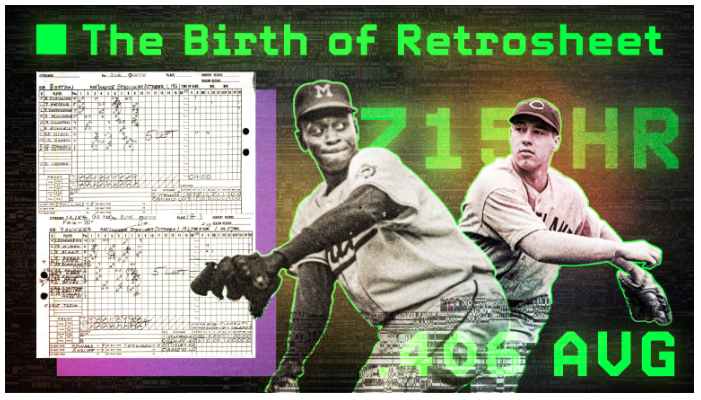
== A 2023 story on Retrosheet’s historic pursuit of unearthing box scores via Brian Murphy for MLB.com includes info on how author Jane Leavy was able to use Smith’s work to flesh out more on her Sandy Koufax biography — to Smith’s delight.
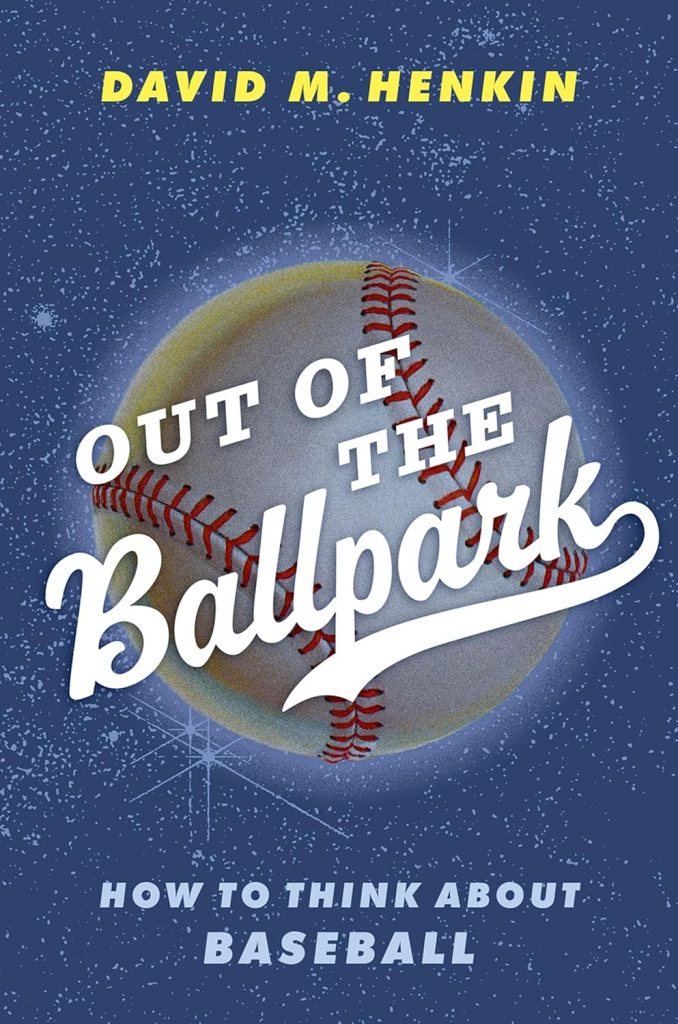
== At some point, are we remiss from offering a complete review of “Out of the Ballpark?” Here’s a snappy review by New Books Network from its CEO and publisher.
= MLB historian John Thorn has an excerpt posted at Our Game.MLBlogs.com, and the post has Thorn’s profile once of Smith.
== Smith’s piece for SABR in 2004 about how research could help figure out why a protest happened, but an odd decision on why to preserve the statistics from a Dodgers-Cardinals game in Ebbets Field in 1947.
== Did Satchel Paige throw more no-hitters in his career than Nolan Ryan? That’s a job for Retrosheet.
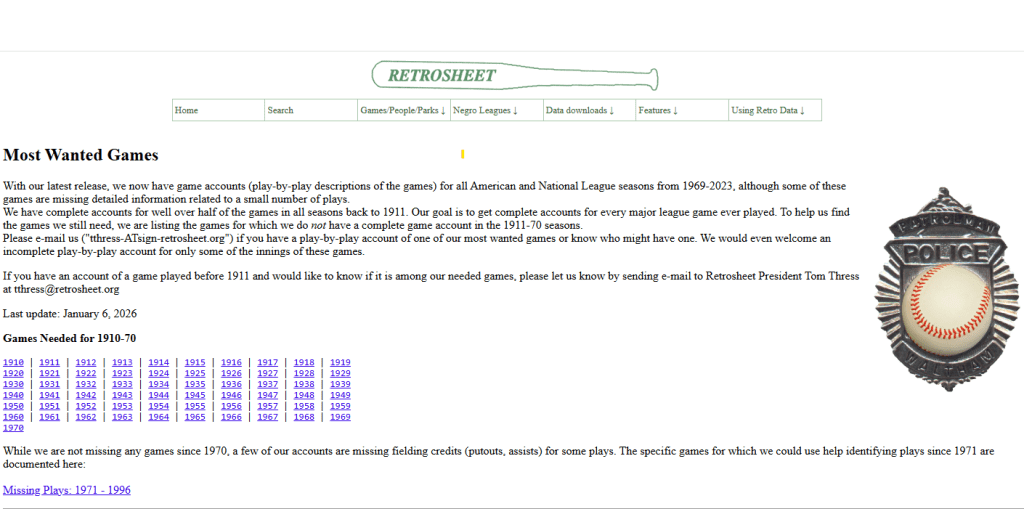
== Retrosheet’s work is not only ongoing, but it’s in need of help with many more recent logs of games. See this link for its latest “Most Wanted Games”:
== Tiffany Babb of The Fan Files profiles Chalk and Ink, a premium, archival-quality scorebook with a sleek design. As the website calls it: “An heirloom-quality baseball scorebook. Designed to bottle the memory of a Sunday afternoon and be rediscovered fifty years from now.”



1 thought on “Day 13 of 2026 baseball book reviews: Retro’s right for pursuit of ‘the truth’”