
This post is part of a media project called SoCal Sports History 101: The Prime Numbers from 00 to 99 that Uniformly, Uniquely and Unapologetically Reveal The Narrative of Our Region’s Athletic Heritage. Pick a number, and consider the list of athletes attached to it. Who wore it best? Or, what’s the most compelling story linked to it? Any person, place or thing is in play with Southern California connections. Star power, transformational achievement, longevity, notoriety and quirkiness all factor in. Whatever leads to a lively discussion and interpretation.
The most obvious choices for No. 53:

Don Drysdale, Los Angeles Dodgers
Keith Erickson, UCLA basketball
Rod Martin, Los Angeles Raiders
The not-so-obvious choices for No. 53:
Jim Youngblood, Los Angeles Rams
Lynn Shackleford, UCLA basketball
The most interesting story for No. 53:
Don Drysdale, Los Angeles Dodgers pitcher (1958 to 1969), California Angels broadcaster (1973 to 1981), Los Angeles Rams broadcaster (1973 to 1976), Los Angeles Dodgers broadcaster (1988 to 1993)
Southern California map pinpoints:
Van Nuys, Bakersfield, Hollywood, Los Angeles (Coliseum, Dodger Stadium), Anaheim
Reference books on the subject:
“Once A Bum, Always A Dodger,” by Don Drysdale, 1990
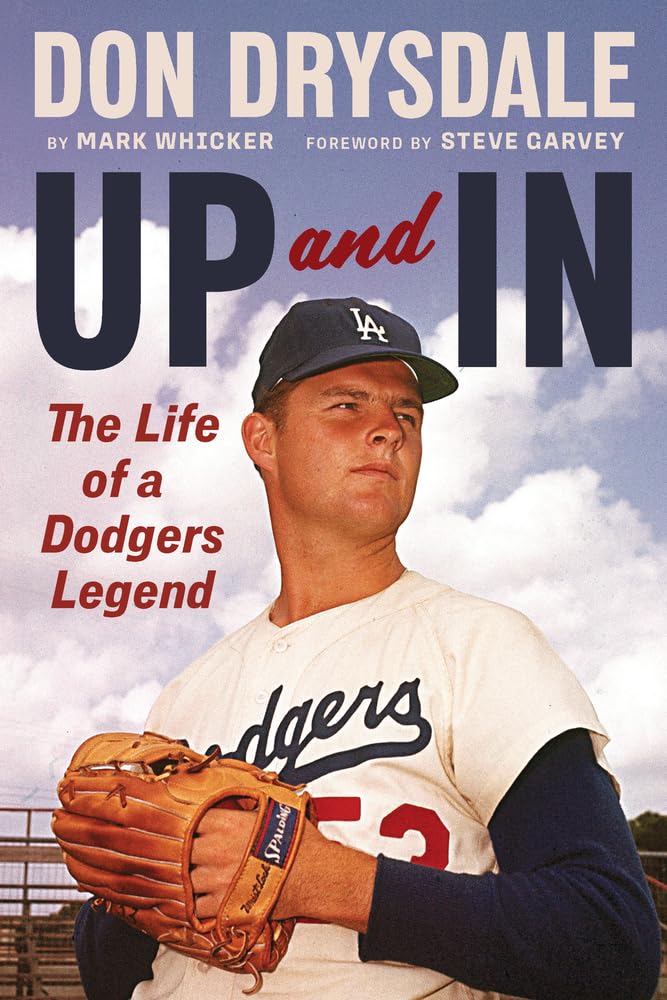
“Don Drysdale: Up and In — The Life of a Dodgers Legend,” by Mark Whicker, 2025
To tell the truth, the dogma of Don Drysdale is worth a deeper dive. Lots to discover with “Big D” beyond his 6-foot-5 statue.
The San Fernando Valley-reared kid who spent all 14 years of his big-league career with the Dodgers organization made a move back to Los Angeles with the team when he left Brooklyn, and then gave them last six years of his life as a broadcaster.
Here’s how it happened … or did it?
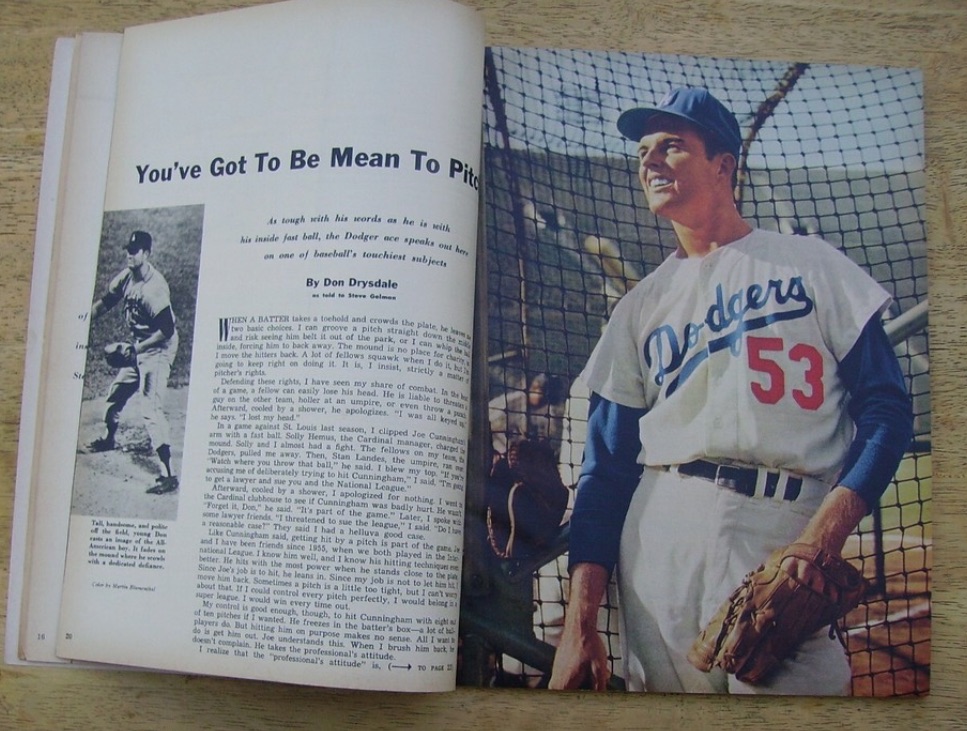
Truth that has been told: Don Drysdale led the league in putting the “mean” in a meaningful pitch.
Dare to discover: There has to be some SABR-cat researcher who could verify Drysdale threw more brushback/purpose pitches than anyone else in his era. Four times, as a residual effect, he led the majors in plunking batters — 154 HBP in all, more than 10 a season, all of it a National League record at the time of his retirement in 1969. Yet that just played into his personal conviction: You knock down one of my guys, I knock down two of yours. If one of ’em is hit in the process, well …

Research by Fangraphs on the essence of the “Two For One Special,” aka the “Drysdale Revenge Factor,”‘ shows that 18 times in his career, Drysdale hit two or more batters in a game. Where did that mindset come from? Likely his one-time veteran Brooklyn teammate Sal “The Barber” Maglie, teaching him big-league survival techniques. Properly stated, put the idea in a batter’s mind that while the pitcher can claim ownership to half of the 17-inch home plate, let them figure out which half you’re going to pick on a pitch-by-pitch case. Eventually, the ones holding the bat in this one-on-one conflict knew the drill, they got drilled.
“Batting against him is the same as making a date with the dentist,” Pittsburgh’s Dick Groat once said about Drysdale. San Francisco’s Orlando Cepeda also said: “The trick against Drysdale is to hit him before he hits you.”
In a 1979 interview with the New York Times’ Dave Anderson, Drysdale, who was 10 years into leaving the field, explained how delivering the inside pitch was a “lost art.”
Anderson wrote:
“I just feel,” he was saying now, his right forefinger swirling the ice in his Scotch, “that when you’re pitching, part of the plate has to be yours. … The pitcher has to find out if the hitter is timid. And if the hitter is timid, he has to remind the hitter he’s timid.”
How can you not love that imagery.

Yet, go back to a June 1960 Sport magazine story, Drysdale insisted he never deliberately threw at anyone. Maybe he had to state his case for the record.
“The mound is no place for charity, so I move the hitters back,” he said. “A lot of fellows squawk when I do this, but I’m going to keep right on doing it. It is strictly a matter of a pitcher’s right. My control is good enough (to hit a batter) with eight out of 10 pitches if I wanted. … But hitting him on purpose makes no sense. … All I want to do is get him out. (It) takes a professional’s attitude.”
A year later, Drysdale was handed a five-game suspension and fined $100 by National League president Warren Giles for hitting Cincinnati’s Frank Robinson on the right forearm.
Drysdale admitted in his 1990 autobiography “Once A Bum, Always A Dodger” that he had already been warned by umpire Dusty Boggess for pitching too tight to all the Reds hitters prior to his ejection.

So the next time the Dodgers were in Cincinnati, where Giles had his office, Drysdale said he stopped at a bank and got $100 worth of pennies, walked to Giles’ office, and placed the bag of coins on the desk of Giles’ secretary. He walked back to his hotel room, feeling proud of himself.
Giles’ office phoned him. Please come back, Giles said.
That conversation ended with Giles saying: “And by the way, I want you to take those pennies of yours and roll them back up for me.”
Drysdale spent the next few hours cursing and pitching pennies back into the casings.

Truth that’s been told: His 1984 Hall of Fame induction was based on him being not just a nine-time National League All Star, but also a perennial Cy Young Award candidate.
Dare to discover: Drysdale won the Cy Young Award just once, in 1962. This was the Dodgers’ first season at Dodger Stadium. He showed it to be a pitcher’s paradise as he posted an MLB-best 25 wins, 232 strike outs and 314 1/3 innings over 41 starts. He also had 19 complete games and a 2.83 ERA. It didn’t hurt that teammate Sandy Koufax was a modest 14-7 despite a league-best 2.54 ERA. That season, Drysdale had 14 of the 20 MLB Cy Young votes (a 70 percent share, with all four who garnished votes also from the National League). He was also fifth in the NL MVP voting.
Yet 1962 was the only season Drysdale received any Cy Young votes.
From its creation in 1956 and over the next 11 years, the Cy Young Award was given to the best pitcher in all of baseball. Koufax won it three times in that span. It was 20 voters with one vote, without the weighted first-, second- or third-place ballot that had been in place for each league’s MVP award. It changed in 1970, the year after Drysdale retired, and since 2010 the Cy Young ballot now has room for five players to be ranked.

Consider that 1968 season, where Drysdale started the July 9 MLB All Star game a month after he set the MLB record of consecutive scoreless innings of 58 2/3 innings by throwing six straight shutouts. That season, all 20 NL Cy Young votes unanimously went to Bob Gibson with his ridiculous 1.12 ERA and 13 shutouts, five more total than Drysdale. The Year of the Pitcher was not an easy one to claim Cy Young superiority. Even the AL winner, Denny McLain, won unanimously.

Drysdale had the congratulatory backing of Democratic presidential hopeful Robert F. Kennedy, who, after winning the California primary on June 4, ’68 made mention of Drysdale’s 5-0 win over Pittsburgh at Dodger Stadium that evening, which elevated his scoreless inning streak to 64 innings. It was Drysdale’s sixth complete-game shutout in a row. Kennedy’s victory speech was just a few miles away at the Ambassador Hotel in Los Angeles, moments before he would be assassinated. Drysdale was said to have cherished a cassette tape of Kennedy’s remarks that he kept with him.
Four days later on June 8 against Philadelphia, on the day of Kennedy’s funeral, Drysdale extended the record with four more scoreless innings. Photos on that day show Drysdale and his teammates wearing black armbands on their sleeves in Kennedy’s honor.
In 1965, Drysdale went 23-12 with a 2.77 ERA, but Koufax was the unanimous 20-vote Cy Young winner (26-8, 2.04 ERA and an MLB record 382 strikeouts). The best Drysdale could do was muster a fifth-place finish in the NL MVP race, where Koufax was second to Willie Mays.
This reveals another quirk in how awards were tabulated: Turns out, Drysdale garnished more attention on the NL MVP ballots over his career than on Cy Young Award ballots.


Truth that’s been told: Don Drysdale was the most feared Dodgers’ hitter in the lineup during their 1965 World Series title run.
Dare to discover: Sure, on the days he also pitched. Do-it-yourself Drysdale was often the only Dodger in the starting nine that had a batting average of .300 or better during that 97-65 regular season. During a 2-1 loss to San Francisco, Drysdale’s batting average went as high as .356 on June 15 after he went 2-for-3. At times, Drysdale was placed as high as sixth in the Dodgers’ lineup based on the law of diminishing returns, with the probability he’d likely be there the entire nine innings — or more.
Drysdale hit seven homers in the 1958 season, the Dodgers’ first one in Los Angeles. One of them was a two-homer game on an August Saturday afternoon against visiting Milwaukee during a 10-1 complete-game win.

In ’65, Drysdale matched that career-best seven homer mark, starting with a two-run shot on Opening Day at Shea Stadium during his 6-1 complete-game win over the Mets. That was the second time Drysdale homered on Opening Day — in 1959 he homered at Wrigley Field, providing all the Dodgers’ offense in a 6-1 loss to the Chicago Cubs.
In ’65, Drysdale hit an even-.300 (39 for 130). His seventh and last homer of the season came off Houston’s Robin Roberts, a two-run shot in the third that gave the Dodgers a 2-0 lead en route to a 5-2 win. That helped Drysdale post his 19th win.
On that Dodgers’ 1965 team, Rookie-of-the-Year winner Jim Lefebvre and outfielder Lou Johnson led everyone with a mere 12 homers each. Drysdale’s seven accrued in fewer than half as many plate appearances gave him a better HR-per-AB mark. Of course, manager Walter Alston could use Drysdale as a pinch hitter on the three games between his starts — he even 3-for-12 in that role with a couple of RBIs.
Drysdale should have won a Silver Slugger Award, but that wasn’t a thing then. He had a.508 slugging percentage and .839 OPS, far greater than the Dodgers’ offensive team averages of .245/.335/.657. His 2.2 offensive WAR was better than all but four of the Dodger’s day-to-day hitters.
Drysdale posted a 5.8 career WAR as a hitter — 29 homers, 113 RBIs, and .186 average in more than 1,300 plate appearances. Those 29 homers as a pitcher stood as a Dodgers’ franchise-best and were No. 6 all-time in MLB history until Shohei Ohtani rewrote the definition of what a home-run hitting pitcher looked like.

Truth that’s been told: Don Drysdale was the reason why a Volkswagen Beetle nicknamed “Herbie” in the 1968 Disney film “The Love Bug” sported a No. 53 sticker on the hood, the doors and on the engine hatch in the back.
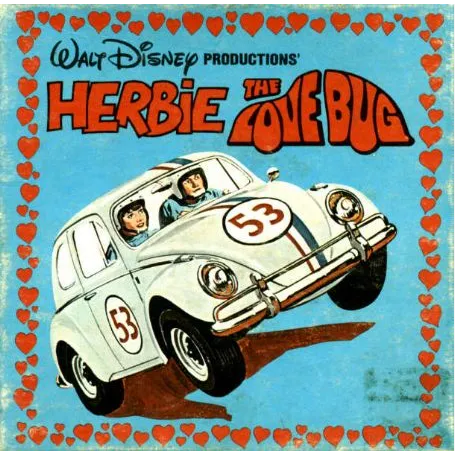
Dare to discover: Bill Walsh, a longtime Disney employee who produced the “Love Bug,” was also a Dodgers’ fan. It was said Walsh made that creative decision for the film, made during the time Drysdale set his MLB consecutive scoreless innings run.
As a side note: In 1986, pitcher Greg Matthews came up with the St. Louis Cardinals, and wanted to wear No. 53. Was it to honor Drysdale? Nope. The left-hander out of Savanna High in Anaheim, who had just pitched for Cal State Fullerton in the 1984 College World Series, admitted he was simply a fan of Herbie. “We’re both used to getting out of a lot of tough jams,” Matthews is quoted in the 2006 book, “Best By Numbers: Who Wore What … with Distinction” by The Sporting News.

Truth that’s been told: Don Drysdale and Robert Redford were Van Nuys High baseball teammates in the 1950s.
Dare to discover: Well, not really. But Drysdale loved the idea of it. Even if Drysdale was far more “The Natural” in baseball lore than Redford would become dressed up as Roy Hobbs.
“We were in the same grade, though I can’t lie to you and say that he and I were bosom buddies,” Drysdale said of Redford in his 1990 autobiography. “I don’t remember him ever expressing an interesting in being a movie star any more than I was focused on being a baseball player.”
When Drysdale’s died in 1993, the Los Angeles Times’ Steve Henson’s tribute recalled how friends remember Drysdale going along with the story and saying: “Oh, you mean Bobby; he was a pretty good first basemen.”
Jim Heffer, a classmate of Drysdale and Redford, said: “As far as I know, Redford never picked up a glove. I think Don covered for him, which showed the kind of gentleman he was.”
Redford was born in Santa Monica and actually played tennis at Van Nuys High. He walked on the University of Colorado baseball team based on him passing a tryout and a promise of getting a part-scholarship if he made the team. But Redford soon dropped out of school and went into acting. Which, all in all, seemed to pay off and give him enough experience to pull off a Hobbsian portrayal.
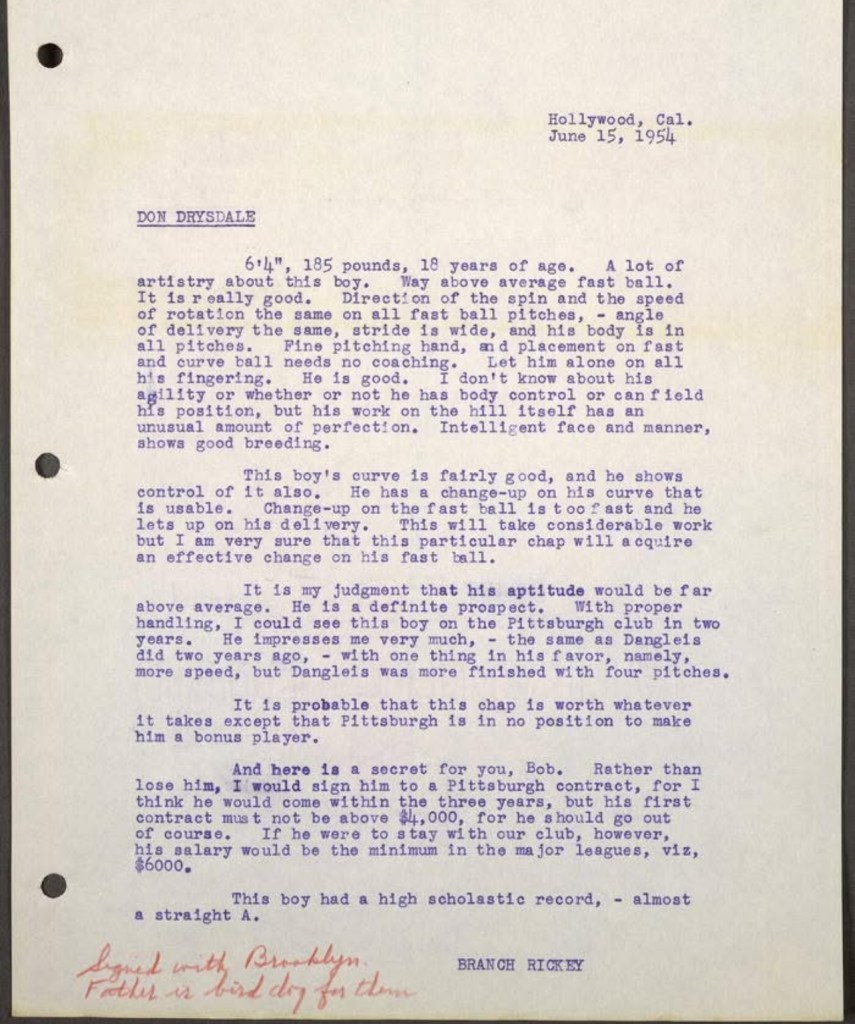
Truth that’s been told: Branch Rickey signed Drysdale to his first Dodgers’ contract.
Dare to discover: No. But Rickey did try to pirate him.
The cigar-comping GM, most famous for signing Jackie Robinson to his historic 1947 contract with Brooklyn’s Dodgers, was by that point banished to Pittsburgh as the team’s GM when he personally scouted Drysdale at Van Nuys High. Rickey’s type-written report on Drysdale included a suggestion of a $6,000 signing deal. At this point, everyone else, including the Dodgers, were only willing to give up $2,000 for Drysdale in the open bidding process.
Rickey’s plan for Drysdale was to start him right away at with Pittsburgh’s Triple-A Pacific Coast League affiliate, the Hollywood Stars. The money offered Drysdale would put him in the “bonus baby” framework, and require the team to promote him faster. Rickey’s thought would be to have Drysdale drop down to a lower minor-league team to develop before coming back up to the majors.
“If you’re not going to get a lot of money — and $2,000 isn’t a lot of money — then why not go where you have the best chance to learn?” Drysdale remembers his dad telling him. That meant not only going to Brooklyn, but it was beneficially that the Dodgers could have him start at their Class-C Bakersfield team not all that far from Drysdale’s home.
By 1956, Drysdale was in the big leagues pitching in a World Series after having just turned 19.

Truth that’s been told: Don Drysdale is in the Labor Movement Hall of Fame.
Dare to discover: There is no such a thing. But if there was, this essay by Pete Dreier in The Nation could convince anyone there should be, with Drysdale’s inclusion.
In order to form a more perfect MLB labor union, Drysdale and Koufax staged a high-profile 32-day contract holdout prior to the start of the 1966 season. Don’s wife, Ginger, was a member of the Screen Actors Guild and suggested they join forces to get more attention. She proposed: “If (Dodgers GM) Buzzie (Bavasi) is going to compare the two of you (with his contract offers), why don’t you just walk in there together?”
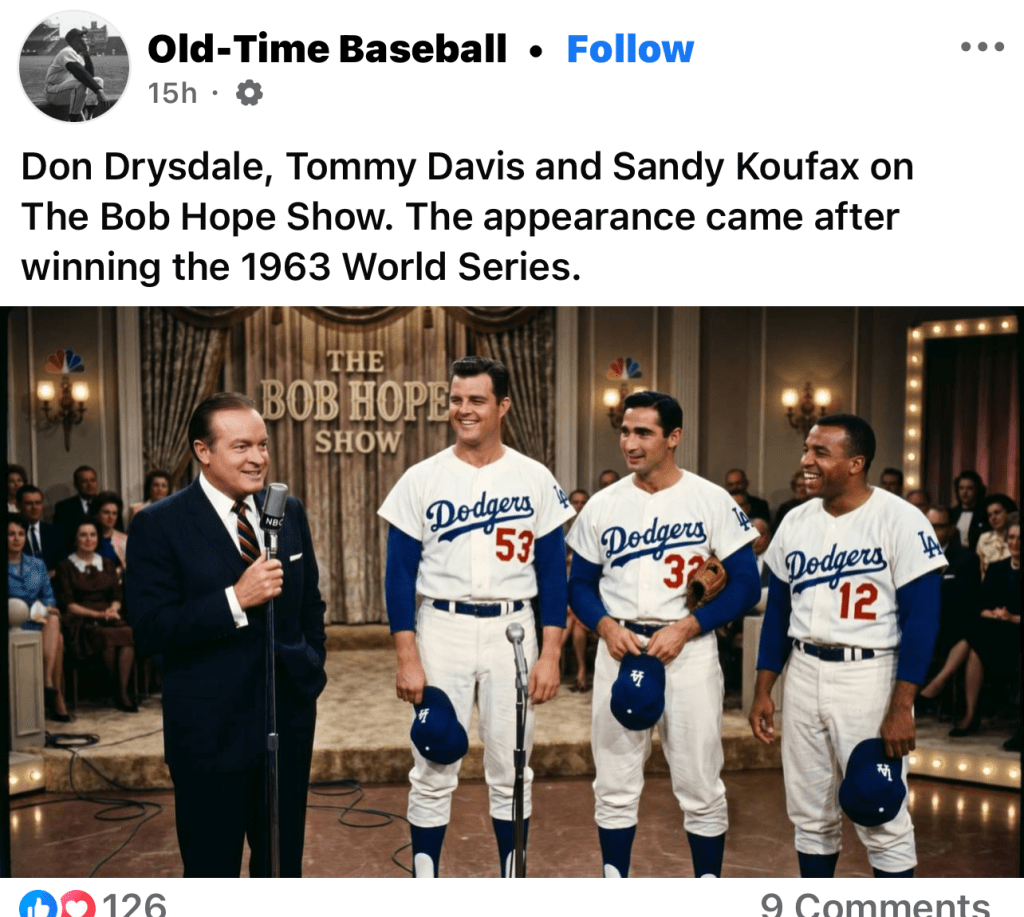
At one point, Drysdale made $32,000 in 1961, which made him the game’s best-paid pitcher at age 24. To Koufax, who didn’t really command much contract value on the mound until after the 1961 season when he made his first All Star team at age 25, that meant Drysdale must be a better poker player at the negotiation table. Koufax allowed Drysdale to talk for both of them.
Each wanted a three-year deal, and it would cost the Dodgers more than $1 million for the two, equally divided. The Dodgers first offered to pay $125,000 for Koufax and $110,000 for Drysdale. Koufax objected. “I thought we’re supposed to get the same thing,” he said.
Drysdale, with a wife and daughter to support, wasn’t sure he could hold out indefinitely. He was willing to take less.. So while the “Great Holdout of 1966” didn’t net what they had sought, it still meant they were the first to get a six-figure deal. It showed other players that the owners weren’t invincible in the face of collective action. Even more interesting, neither Koufax nor Drysdale would be around much longer in their careers — that was Koufax’s final season because of elbow issues, and Drysdale’s shoulder gave out four seasons later.
To help make their case, Drysdale and Koufax seemed to enjoy more time honing their entertainment skills in Hollywood. They provided some comic TV material for Milton Berle and Perry Como where the put on a tux and sang at The Hollywood Palace on Saturday night, April 9, 1966, three days before the season opener (a game where Claude Osteen would pitch a complete-game win, Koufax would start Game 2, Don Sutton was in Game 3 and Drysdale came in for Game 4):
Truth that’s been told: Don Drysdale could carry a tune so well, he could have made it a professional recording artist.
Dare to discover: You be the judge.

Truth that’s been told: When Don Drysdale married Ann Meyers on the first day of November in 1986, they became the first couple who were members of their respective sports’ Hall of Fame.
Dare to discover: It’s true, but Meyers got their first. After 10 years of falling short of the 75 percent of writers’ votes needed, Drysdale finally got enough support to be voted into Cooperstown.

Meyers, our link to No. 15 in our SoCal Sports History 101 project, was a 1985 inductee into the International Women’s Sports Hall of Fame. She was later inducted into the Naismith Basketball Hall of Fame in 1993 as the first woman honored.
She met Drysdale in December of 1979 as she appeared as a competitor and he was a broadcaster on ABC’s “The Superstars” made-for-TV competition, taking place in the Bahamas.
She admitted that she thought he was Don Meredith, the former NFL quarterback part of ABC’s “Monday Night Football” team. Her Midwestern mother was at the show’s taping and was more enamored with meeting Bob Uecker, another part of the ABC telecast, since she was familiar with him as the Milwaukee Brewers’ broadcaster.
“The one thing I always remember when I first met Don is that he was such a gentleman,” Meyers said. “And the one thing that I always loved, because I was from a big family, was just how these other guys responded to Donnie. You can go down the list with Duke Snider and Sandy Koufax and Bob Uecker and Pee Wee Reese and Ted Williams and Mickey Mantle — they were his brothers. But there was something that set Donnie apart. He was like this beacon. They were just all attracted to him. And believe me, all of those men were great in their own right. But there was something special about Donnie.”
Don Drysdale had just turned 50 and Annie was 31 when they married. Don had divorced Ginger two months after his 1969 retirement.
Don and Annie had three children — Don Jr., born on his father’s birthday in 1987 as Don was broadcasting for the Chicago White Sox. Son Darren came two years later after Don joined the Dodgers’ broadcast team. Daughter Drew arrived in March of 1993.
Don Drysdale died four months later, while on a road trip with the Dodgers in Montreal. He was 56.
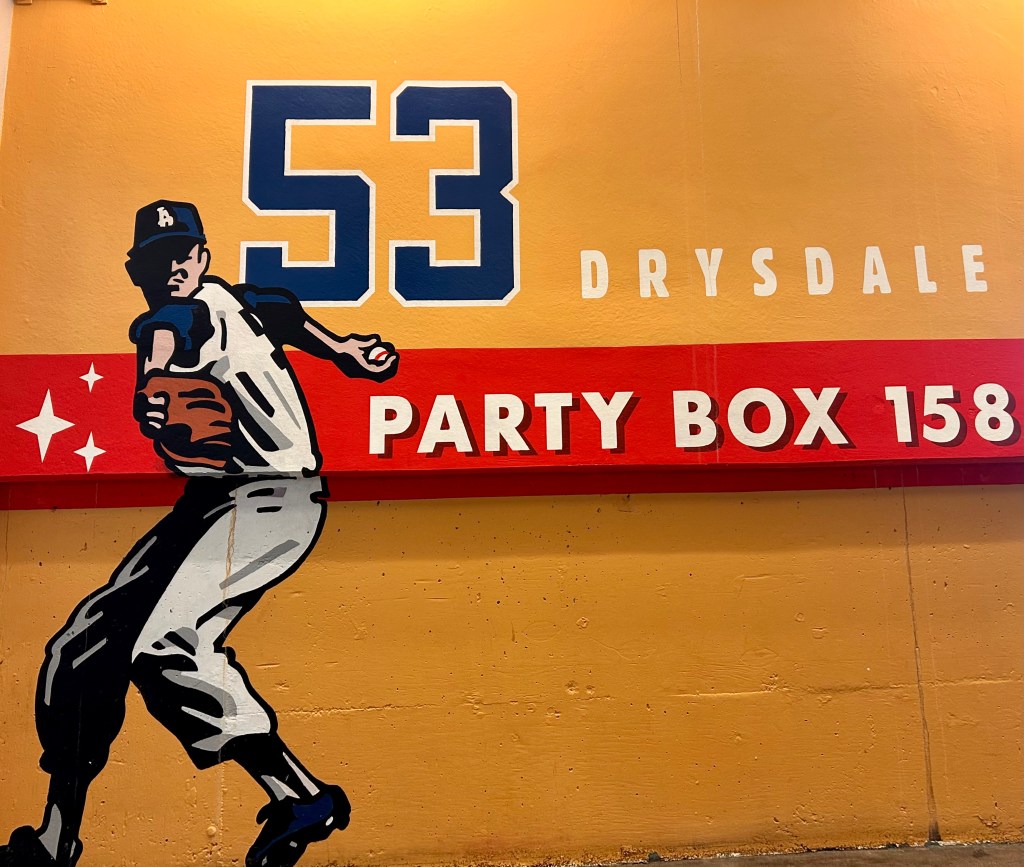
In Mark Whicker’s 2025 book, “Up And In: The Life of a Dodgers Legend,” time and time again Drysdale was referred to by family and friends as “a man’s man.” During an appearance on Larry Mantle’s “Air Talk” on LAist/KPCC 89.3 FM, Whicker surmised that Drysdale was drawn to people like him who didn’t take themselves seriously, but were very serious about particular things that they saw not up to standards.
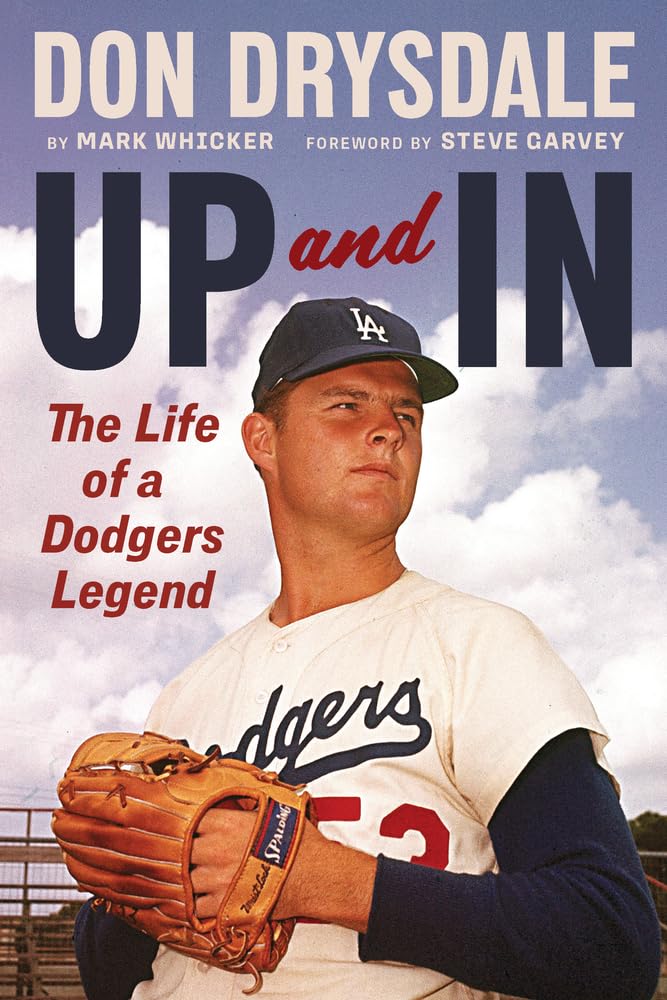
“I think he was a unique personality and all those who were with him saw him as a great leader,” said Whicker. “They may have respected and appreciated Koufax, but Don was more connected to how the team functioned, grabbing a six-pack, sitting on the team bus and telling stories. Very opinionated on and off the air. A strong ethic about how the game was played.”
During an appearance on the TV show “To The Tell The Truth” in November of 1959 — a month after after he had pitched for the Dodgers in the World Series — Drysdale’s “affidavit” as the camera spanned the three men went this way:
“I, Don Drysdale, am a pitcher for the Los Angeles Dodgers baseball team. This past season in which the Dodgers won both the National League pennant and the World Series, I led both leagues in strike outs and was voted the Most Valuable Player in the first All Star game. Last month, I started my career as a cowboy actor when I played a top feature role in the Western series, ‘Lawman.’ Signed, Don Drysdale.”
The panel easily picked him out of a lineup. He was there next to an encyclopedia salesman and in-coming U.S. service man who decided to wear a cowboy hat. The two imposters were just men the show’s producers rounded up mostly because they were also tall.
The fact Drysdale himself wore a Dodgers’ uniform and cap also seemed to make it easier to make a visual ID.
Just months before that ’59 season, Drysdale appeared with his new wife of 2 ½ months, Ginger, on Groucho Marx’s “You Bet Your Life” show taped in Hollywood. Ginger Dubberly, 19, of Pasadena, had been a 1958 Tournament of Roses princess.
“You’re a local boy, aren’t cha, Don?” Groucho asked.
“That’s right, Groucho, was born and raised in Van Nuys,” he replied.
“Where’s that?” Groucho followed up.
“That’s across the hills,” Drysdale responded, tilting his head back to the left, “over there in the San Fernando Valley.”
Asked if Drysdale if had any plans after his playing days were over, he seemed to have already figured it out: “Well, Groucho, I’d like to get into some sort of phase of radio or television work having to do with sports. I like talking … a sports program or something like that.”
“Tell me about Ginger, is she a good cook?” asked Groucho.
Long pause.
“No,” says Drysdale, pursing his lips and shaking his head with a smile.
Ginger almost snaps.
“Well, that’s Drysdale for you — another wild pitch,” says Groucho as the audience laughed.
The fact that Drysdale didn’t take himself too seriously and made him relatable could be found in all sorts of TV appearances.
Like the commercial for Vitalis hair tonic, playing off the suspicions that he loaded baseballs with greasy fingers.
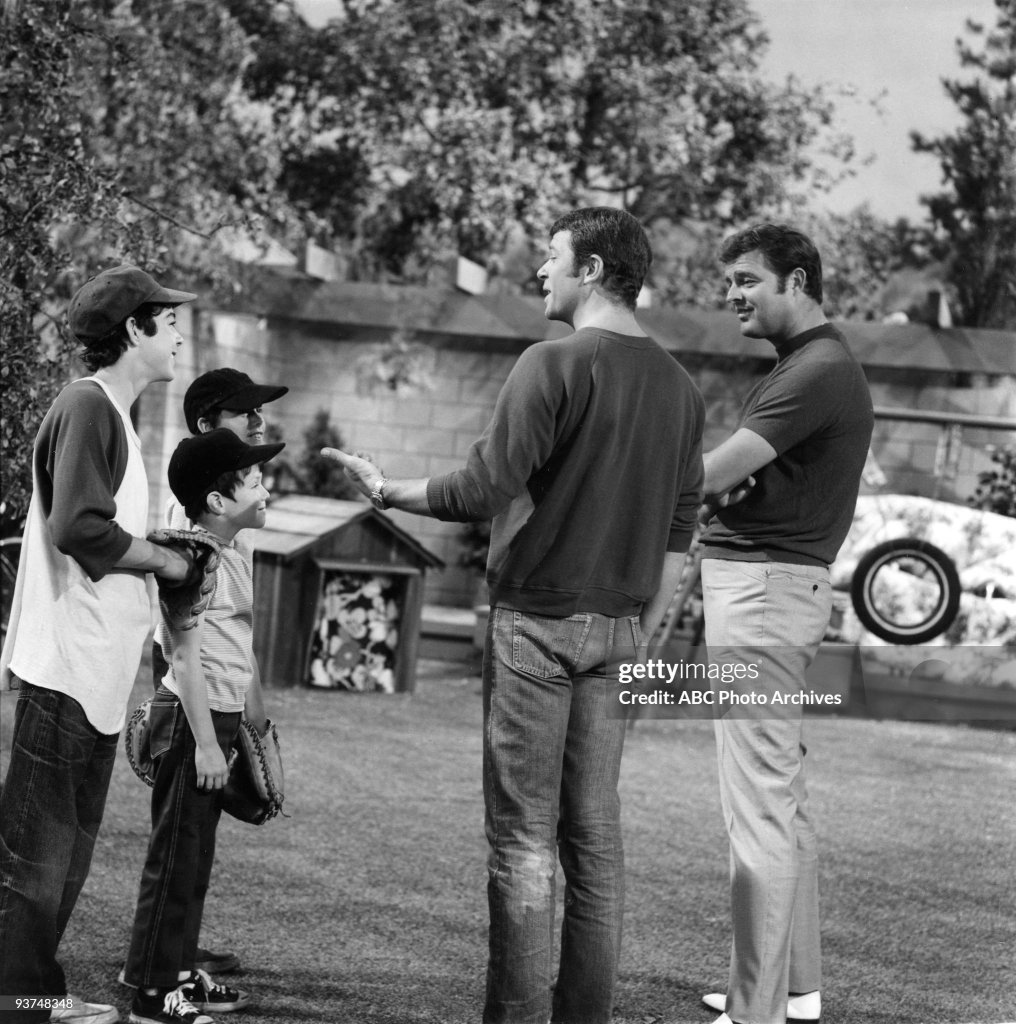
Kids in the ’60s held out a chance they might actually see Drysdale at their friends’ house. He appeared as himself on “Leave It To Beaver” — the Beaver just called him up in the Dodgers’ clubhouse. He was on “The Donna Reed Show” (her son had him as a coach) and, after his pitching days were over, he came on “The Brady Bunch” (just showing up at the house with lessons to pass on).

His acting chops were put to a test in TV roles he also had on “The Rifleman,” “The Millionaire,” “The Flying Nun,” and “Then Came Bronson.”
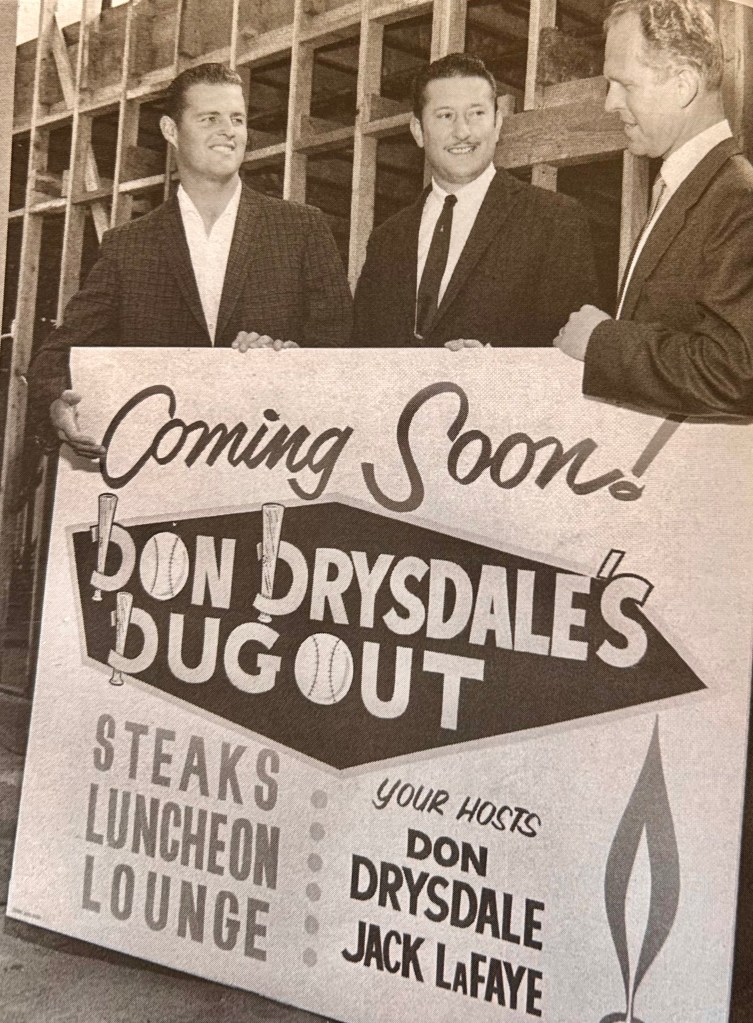
Drysdale’s popularity spread with the creation of his own “Dugout” restaurant in Van Nuys on Oxnard Street, near his childhood home, with another one in Anaheim. There was also his place in Hawaii called “Club 53,” on the Big Island of Kona, and “The Whalers Pub” in Lahaina in Maui.
He owned race horses, and Willie Shoemaker won aboard one of his thoroughbreds.
All in all, Drysdale never thought of himself as much of a baseball player, let alone a pitcher, growing up. Between his junior and senior years of high school, Drysdale was more about playing second base, first base and emergency catcher on the Van Nuys Post 193 American Legion team.
That squad was coached by his dad, Scotty — who had a brief career as a pitcher in the Pacific Coast League’s Los Angeles Angels’ system in the 1930s. He was now a repair supervisor for Pacific Telephone.
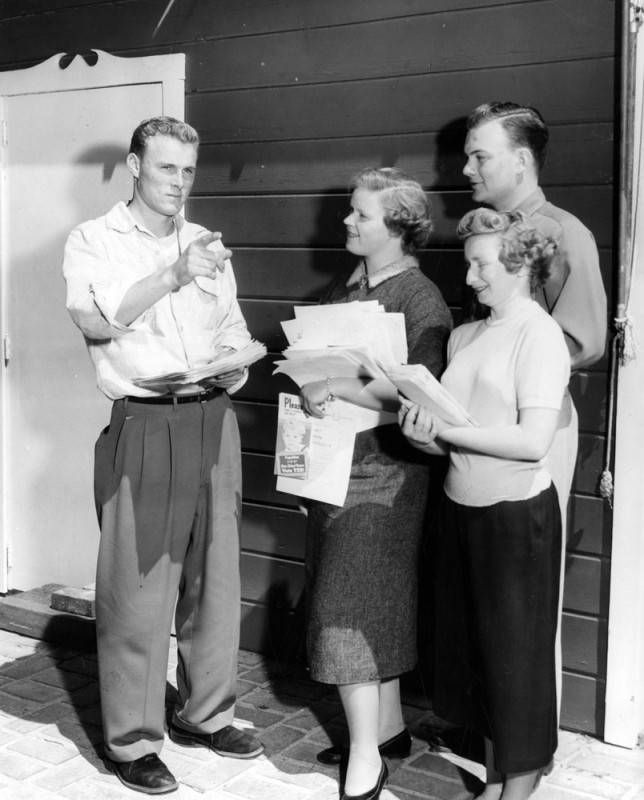
Roger Grabenstein, president of the Valley Ephebians high school honor society, is joined by classmates in a door-to-door campaign for passage of a school bond proposal on April 4, 1955. (Valley Times photo collection of the Los Angeles Public Libary archives)
One day, the team’s best pitcher, Roger Grabenstein, didn’t show up to a game.
“I never gave pitching a thought,” Drysdale wrote in his autobiography. “My dad must have seen something in me. I remember him telling me that I wasn’t fast enough to play any position in the field other than catcher, and I don’t think he was too excited about me playing there. Dad had seen me throw casually during batting practice or playing catch, so he gave me the ball. All he told me was, ‘Don’t get cute and throw strikes.’”
Drysdale threw a complete game against the North Hollywood team and won.
It happened that Scott Drysdale saw Goldie Holt, a Dodgers scout sitting in the stands, and introduced them.
Holt asked if he could see Don pitch for him a couple days later.
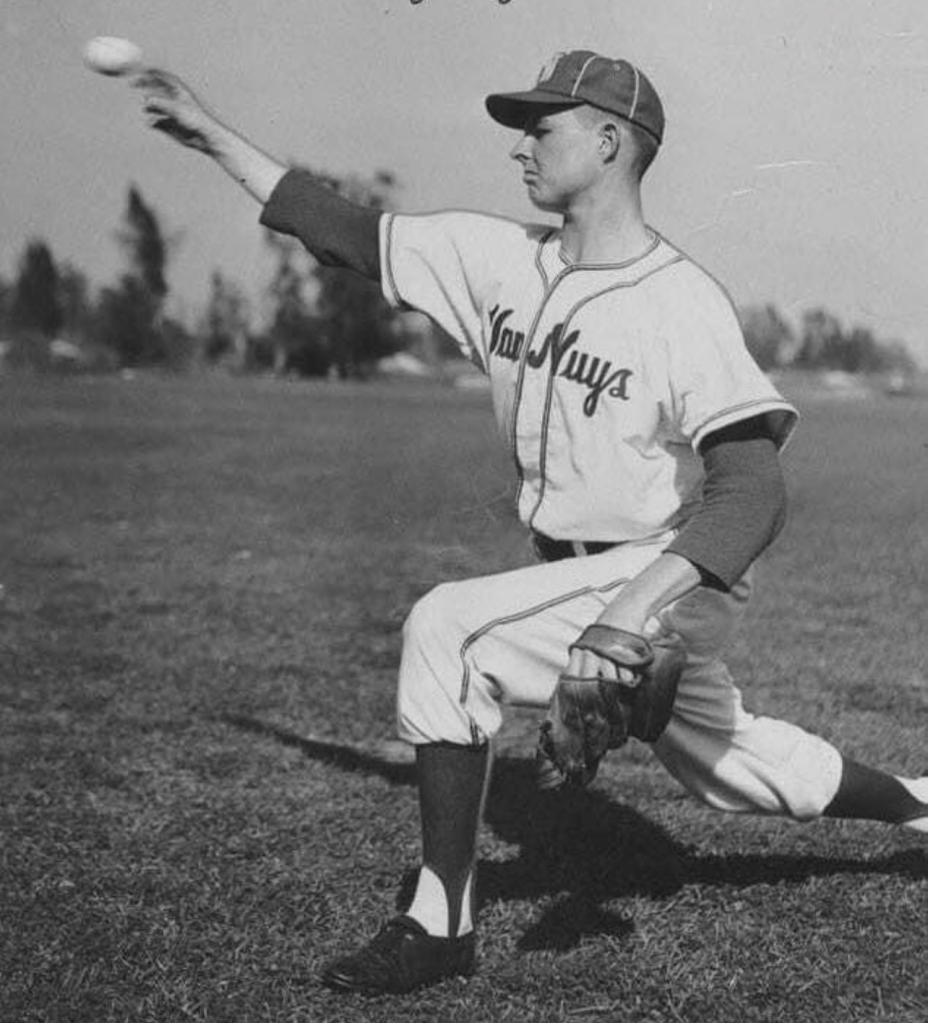
“If I threw 100 pitches, there must have been 85 strikes,” Drysdale recalled. “Everything clicked. I had no idea what was going on.”
That led him to joining what was called a Brooklyn Dodgers Junior team, which at that time included future Dodgers pitcher Larry Sherry and his brother Norm, a catcher. There was also a scrapping infielder named George Anderson, better known as Sparky. Those three came from Fairfax High in L.A. and would make it to the Dodgers’ Class-C team in Santa Barbara as teenagers.
Drysdale, who also played football but sat out his senior season because a growth spurt affected his progress, emerged as an All-L.A. City pitcher as a senior with a 10-1 record, throwing a no-hitter against North Hollywood with 12 strikeouts in a 7-0 win — one walk away from a perfect game.

As the season ended and his high school graduation neared, Drysdale met with Babe Herman, the former Dodgers star representing the New York Yankees. Scouts for the Milwaukee Braves and Chicago White Sox also came for a visit. Before the smoke cleared, Rickey chomped on his unlit cigar, trying to get Pittsburgh in the conversation.

Drysdale’s loyalty to the Holt and the Dodgers led him to signing with Brooklyn. Having him start at their Class-C Bakersfield was part of the deal, made the week before his high school graduation at Otto’s Pink Pig on Van Nuys Blvd., in Sherman Oaks.
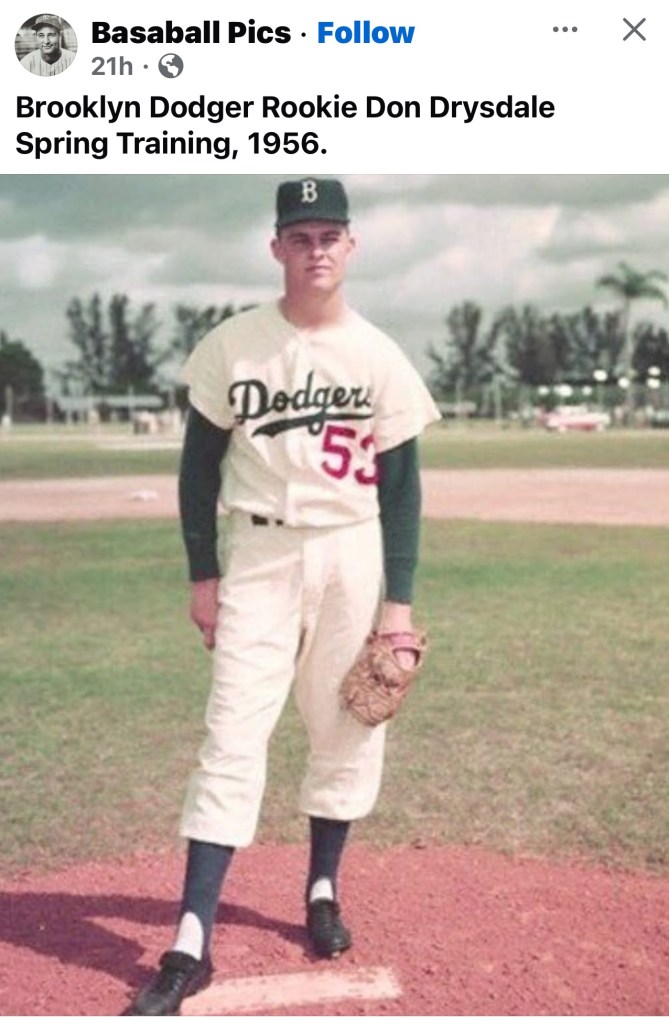
After spending a year at Triple-A Montreal, Drysdale made it to the big leagues as a 19-year-old in April of 1956. In his first start, he pitched a complete-game 6-1 win in Philadelphia, with Roy Campanella as his catcher, and he got his first big-league hit.
The next year, he had a 17-win season during the Dodgers’ final year in Brooklyn.
On April 15, 1958, the Los Angeles Dodgers’ first game went to Drysdale — but it was an 8-0 loss in San Francisco where he gave up six runs in 3 2/3 innings at Seals Stadium.
Four years trying to figure out the confines of the L.A. Coliseum produced mixed results for Drysdale — he played in three All-Star Games, had 13 shutouts and 57 wins against 50 losses and would average more than 40 starts in the 154-game seasons.
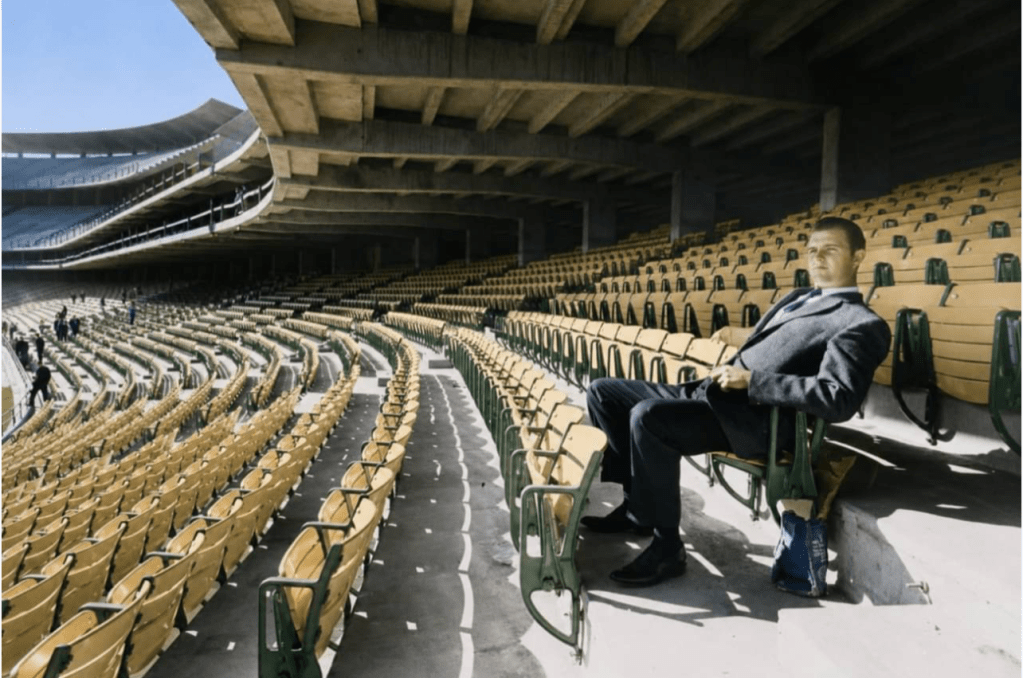
The Dodgers’ move to the new Dodger Stadium was a much better fit for Drysdale. An August 1962 cover story on him in Sports Illustrated with the headline: “Pitcher On the Spot” revealed more about his career at that point in time. The story titled “Ex-Bad Boy’s Big Year” noted:

“Last week Drysdale’s throwing arm was as sound as his $35,000 paycheck (the most ever paid a Dodger pitcher). … Maturity and a fine opportunity to be the man of the hour have apparently hit Drysdale together. …
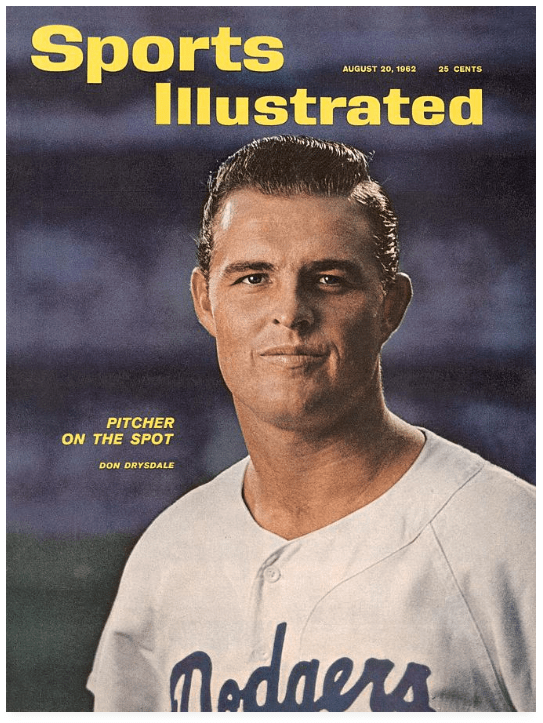
“Females make appreciative noises when observing his creamy good looks and his hair-tonic hairdo, and he is a made-in-Hollywood version of the boy next door. When not pitching, he is polite, relaxed and easygoing to a fare-thee-well, nurses no grudges and finds questions about his fabled temper tiresome in the extreme.
“ ‘I wish,’ he has said, ‘I could be like a milkman and be myself once in a while.’
“As himself, Drysdale is free of extravagant ideas and habits, and his tastes (Mexican food and western music) and pleasures (swimming and the sports page) are run of the mine. His only true interest, it appears, is playing baseball or capitalizing upon his fame in that game by endorsing male toilet articles and accepting bit parts in TV oaters. Well-fixed, you may believe, he lives in a $50,000 house and pool in Van Nuys with his wife and 3-year-old daughter, and his off-season work as a public relations man for an ice cream plant is well suited to him, since he tends to talk in slogans.
” ‘I give 100% when I pitch, and that’s all I can give,’ he may say, or ‘Baseball has been good to me,’ or, of course, ‘I couldn’t win without the other eight guys behind me.’
“The overall impression is that Drysdale is just barely three-dimensional, but as any Dodger will tell you, ‘He’s the nicest boy on the club’.”

In three of the next four seasons, the Dodgers would be in the World Series. Drysdale, who pitched the last two innings of a Game 4 loss in the 1956 World Series at Yankee Stadium, won Game 3 of the ’63 Series against New York (a 1-0 complete game victory) at Dodger Stadium. He also had a Game 4 win against Minnesota in the ’65 Series. He lost a 1-0 game to Baltimore in Game 4 of the ’66 Series.
After Koufax’s departure, the Dodgers dropped off significantly in 1967 to a 73-89 finish, eighth in the National League.
Drysdale was the 30-year-old veteran with 27-year-old Claude Osteen at the top of the rotation. Filling it out was 22-year-old Don Sutton, 23-year-old Bill Singer and 20-year-old Alan Foster. Drysdale and Osteen were the only two Dodgers in the ’67 All Star Game.

Then came ’68. The Dodgers’ seventh-place standing in the National League at 76-86 was reflected in the fact that Drysdale would only post just a 14-12 mark despite a 2.15 ERA and his consecutive-scoreless inning streak.
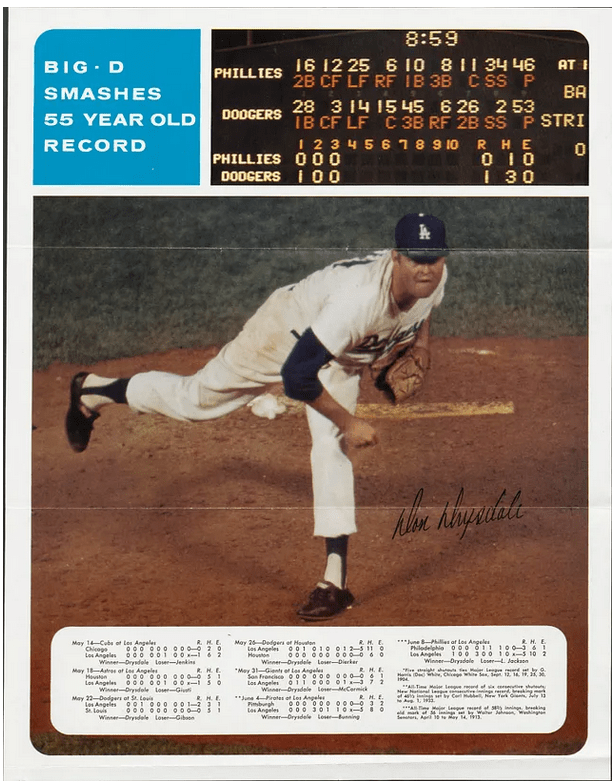
The footnote to Drysdale’s record — it included games where he out-dueled Chicago’s Ferguson Jenkins, St. Louis’ Bob Gibson, Houston’s Larry Dierker, San Francisco’s Mike McCormick and Pittsburgh’s Jim Bunning. He improve his record from 1-3 to eventually 8-3. Ironically, it was a dispute over a hit batter with the bases loaded that appeared to have ended the streak at 44 innings, but a judgment call of an umpire, Harry Wendlestdt, ultimately keep it going. Again, before replays could have been demanded.
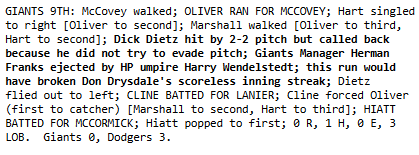
It was on May 31 in the ninth inning of a game at Dodger Stadium against the rival San Francisco Giants, Drysdale was nursing a 3–0 lead when the Giants loaded the bases with no outs. On a 2-2 count to Dick Dietz, catcher Jeff Torborg called for a slider. Drysdale’s pitch sailed inside and grazed Dietz’s elbow.
As Dietz started to make his way to first, Wendlestedt called him back. He said Dietz hadn’t tried to get out of the way of the pitch. The game was delayed some 25 minutes. Giants manager Herman Franks and third base coach Peanuts Lowery argued. Dietz, returning to the plate now with a 3-2 count, filed out to left in the next pitch — not deep enough for a sacrifice fly. Drysdale got the next two hitters, including a play at the plate to cut down a scoring attempt.
On July 28,1969, just one season after that streak, Drysdale recorded hiss final career victory. It was a complete-game, 19-0 shutout over the expansion Padres in San Diego. It was also his 49th career shutout. Drysdale would drive in the final run of that game with a seventh-inning double. He also had an RBI single in the fifth inning.
Four starts later, Drysdale gave up eight hits in the first six innings against Pittsburgh and came out for a pinch hitter when the Dodgers trailing, 3-0, on Aug. 5.
Dan Berger, an Associated Press reporter, left the press box and snuck into to the Dodgers’ clubhouse in the eighth inning to see Drysdale taking off his spikes. Drysdale confirmed to Berger that was it. He would be retiring. Berger had the scoop.
(Footnote: Alan Foster came in to relieve Drysdale in the seventh inning. He would give up an historic homer to the Pirates’ Willie Stargell — it cleared the roof in right field, more than 500 feet away, and was the first ball ever hit out of Dodger Stadium).
“If you had told me in 1968, while I was throwing all those shutout innings, that I’d have been forced to retire a year later, I would have lost my house and my lot and everything else I owned on that bet,” Drysdale wrote in his autobiography.
“I was only thirty-three, and I surely thought I’d be able to pitch for a couple more years. But there’s an old saying about pitchers having so many pitches in their arm and when you use that up, it’s over. I sort of believed that. There’s no way to trace the wheres and whens of an injury like mine.
“Was it the wear-and-tear of the scoreless streak? Nah, no way. I was young enough to keep going, but age means nothing if you can’t get it done, and the hitters were the first to let me know. They always are.”
A torn rotator cuff in his right shoulder left Drysdale as the Dodgers’ franchise leader in innings, shutouts and strikeouts. He posted one shutout for every four wins. On the current all-time Dodgers’ franchise record ledger, Drysdale remains second in innings pitched (3,432), games started (465) and shutouts (49); third in WAR for pitchers (61.4), wins (209), games pitched (518) and strike outs (2,486); and sixth in complete games (167).
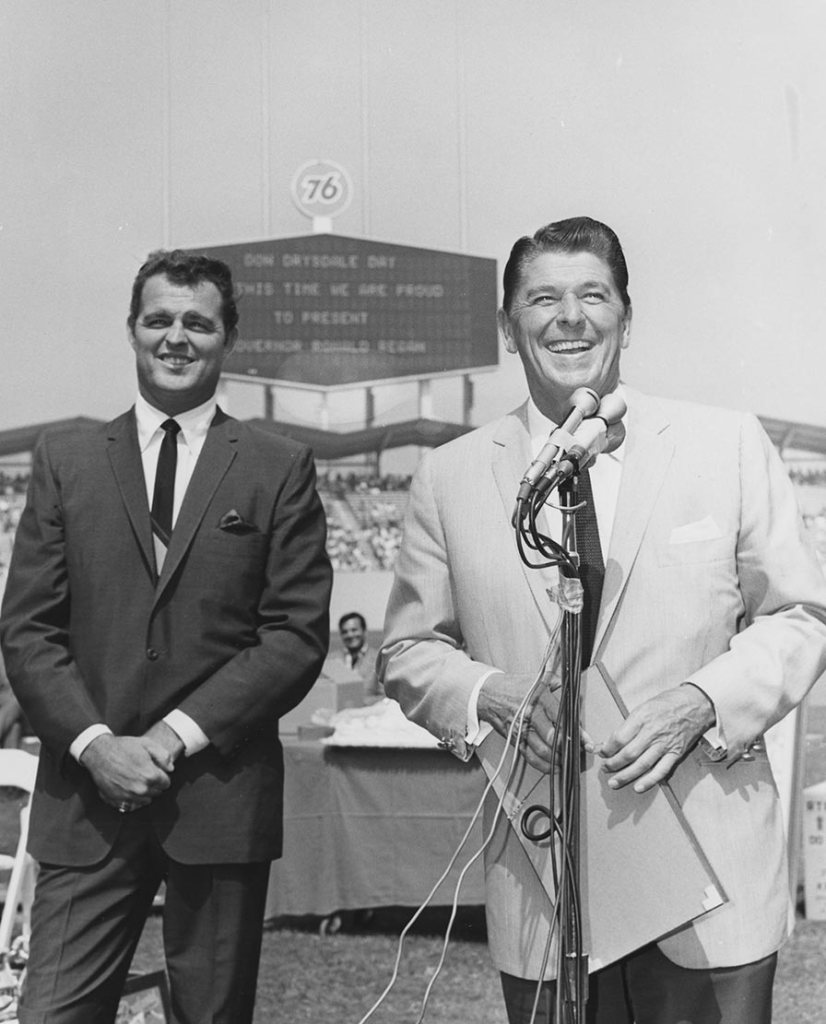
Drysdale’s departure also meant he was the last link to the Brooklyn Dodger players.
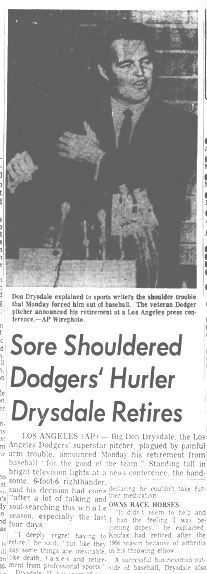
Dodgers owner and president Walter O’Malley said: “It is a bit of a nostalgic wrench to finally see the last of the old Brooklyn Dodgers retire. Don is one of the all-time greats. We wish him all future success. Now we will just have to go on and do it the hard way.”
Alston, who managed Drysdale in his entire career, said at Drysdale’s retirement press conference with tears in his eyes: “If the Dodgers have been successful during the years I managed, then Don Drysdale is one of the reasons, one of the big reasons. I’d like to say thank you to Don Drysdale and I will always be in his corner.”
A career in broadcasting that Drysdale alluded to with Grouch Marx was finally going to take its course.
He spent three seasons with Montreal and Texas before a spot opened with the California Angels in 1973, pairing him up with Dick Enberg. The relationship was so smooth, Drysdale moved over and did Los Angeles Rams’ radio games for three seasons. He also worked for ABC while with the Angels.
During a salary dispute with the Angels, he left in 1980, working exclusively for ABC. He returned to the Angels in 1981.
In the span of 20-plus years as a broadcaster, Drysdale spent nine with the Angels as Enberg’s partner and his last seven with the Dodgers on TV radio with Vin Scully and Ross Porter.
Enberg, who died in 2017, once told me: “Every day was a good day when you were with Don Drysdale,” and then threw in some classic off-color stories that wouldn’t be fit to print, comments Drysdale could make to him after he muted his mic and cause him to have uncontrollable laughter.
After five seasons broadcasting with the Chicago White Sox, Drysdale was convinced to join the Dodgers’ broadcasting crew by owner Peter O’Malley in 1988. As fate would have it, Drysdale was pulled into Orel Hershiser’s orbit as Dodger No. 53 gave way to Dodger No. 55 with a new record of 59 consecutive scoreless innings.
Drysdale was in the Dodgers’ visiting dugout in San Diego when Hershiser came off the field following 10 scoreless innings to break the mark. They shared a hug and did an interview live for radio and TV as the game continued.

“I really didn’t want to break it,” Hershiser said. “I wanted to stop at 58. I wanted me and Don to be together at the top. But the higher sources (manager Tommy Lasorda and pitching coach Ron Perranoski) told me they weren’t taking me out of the game, so I figured, what the heck, I might as well get the guy out.”
Drysdale laughed when told of Hershiser’s statement.
“I’d have kicked him right in the rear if I’d have known that,” Drysdale said. “I’d have told him to get his buns out there and get them.”

Later that month, Drysdale made the call on the Dodgers’ radio coverage of Kirk Gibson’s 1988 World Series Game 1 walk-off homer. It is remembered by some as classic as Vin Scully’s description for NBC TV and Jack Buck’s call on CBS Radio, both to national audiences. Gibson later told Drysdale his call is what gave him incentive to come back from injury years later.
“Well, the crowd is on its feet and if there was ever a preface to ‘Casey at the Bat’ it would have to be the ninth inning. Two outs. The tying run aboard, the winning run at the plate, and Kirk Gibson, standing at the plate. Eckersley working out of the stretch, here’s the three-two pitch … and a drive hit to right field … way back! This ball is gone!”
After nearly two minutes of pure crowd noise, Drysdale resumes:
“This crowd will not stop. They can’t believe the ending! And this time, the Mighty Casey did not strike out! … The Dodges waiting for Gibson to limp around the bases were very careful as if they were touching a Rembrandt at home plate.”
The last call for Drysdale came on a 1993 road trip to Montreal, the city where he played Triple A for the Dodgers, and the place where his heart gave out on him. Los Angeles’ heart was broken as well.
More Drysdale truths:
When Drysdale retired after the 1969 season, his No. 53 was given to young outfielder Tom Paciorek to wear for eight games in September of 1970.
The next year, Paciorek was re-issued No. 17. And No. 53 was never seen again. It was finally and officially retired in 1984 when Drysdale went into the Baseball Hall of Fame.
They are the only two to have ever worn 53 in the franchise’s history.

Growing up in Bakersfield in the ’50s and ’60s, George Culver wanted to be like Don Drysdale. He wrote in his autobiography, “The Earl of Oildale,” Culver explains how as a Little Leaguer, he first saw Drysdale play in his hometown for the Class-C Bakersfield Indians.
Drysdale managed an 8-5 mark and 3.45 ERA in 14 starts there, including 11 complete games. Culver, a star athlete at North High in Bakersfield and then at Bakersfield College, could not only see him there, but also drive down to watch Drysdale in person at the L.A. Coliseum and then at Dodger Stadium.
By 1966, Culver reached the big leagues himself as a 22-year-old with Cleveland. In 1968, Culver was in the Cincinnati Reds’ rotation, en route to a career-high 226 innings in 35 starts.
Just a month after Drysdale set his MLB record streak with six straight shutouts, the Dodgers and Reds faced off on a Friday night in early July at Dodger Stadium.
It was Drysdale vs. Culver.
“I was about to get a chance to not only pitch against him, but hit against him and that nasty side-arm deliver,” Culver wrote. “What a thrill (why me?)”
The game was scoreless through 10 innings. Drysdale and Culver were still pitching.
The Dodgers caved first. Ken Boyer pinch hit for Drysdale in the bottom of the 10th and ended it by striking out. It was the last batter Culver faced. Her came out for a pinch hitter in the top of the 11th-inning. Sutton came on in relief of Drysdale. The Reds won, 2-0, on Lee May’s run-run double in the 12th inning. Neither Culver nor Drysdale got a decision.
“This was, without a doubt, the best game I ever pitched in the major leagues,” wrote Culver. Consider that four starts later, he tossed a no-hitter against the Phillies at Connie Mack Stadium.

In 1998, a CBS “60 Minutes” crew was about to do a profile on Ila Borders, the Whittier native who became the first female to start a game as a pitcher in a men’s professional baseball league. Cameras tried to follow her every move as she was preparing for her start with the Duluth-Super Dukes of the Northern League.
In the prologue of her 2017 book, “Making My Pitch: A Woman’s Baseball Odyssey,” Borders wrote about the indignity of having to retreat to the women’s restroom at the ballpark and put her feet up so no one could detect she was in the stall.
She wasn’t all about just smiling and being cute for the cameras.
“I’m an athlete here to win,” she wrote. “Now get the hell out of my face. Would you tell a guy to smile? Growing up I heard about Don Drysdale … I was crazy about Drysdale, who everyone said was the nicest guy around — except for the days he pitched. Then no one went near him. … I’ve been fighting for this since I was ten years old.”
By the time Mike Wallace had the chance to sit down with her, Borders couldn’t really fight her way out of the whole thing. She told Wallace: “I’ve always had this fierce spirit to do what I want to do.”
Borders was born six years after Drysdale retired.
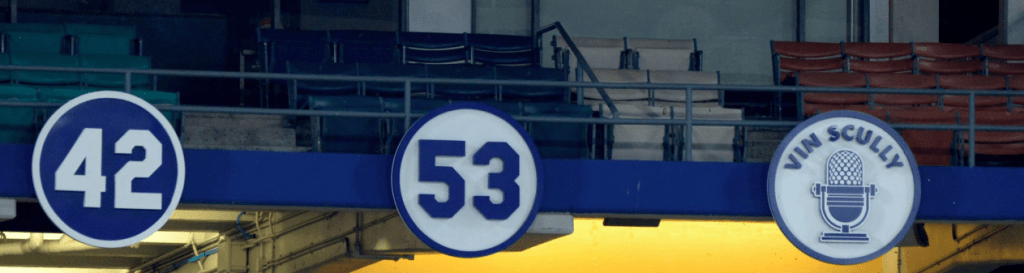
The last words
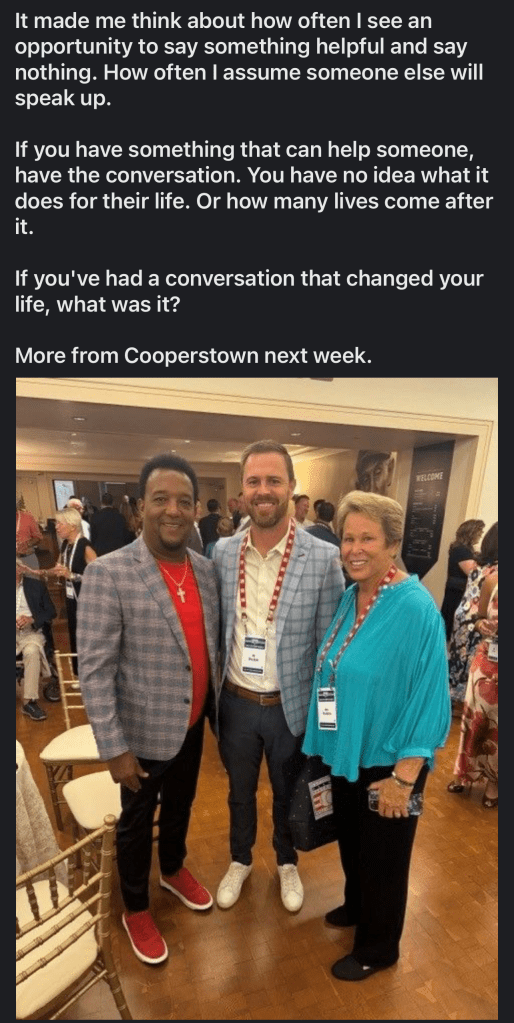
Via DJ Drysdale’s LinkedIn posts:
== At the 2026 Baseball Hall of Fame Ceremonies in Cooperstown, N.Y.:
== From another post on LinkedIn:
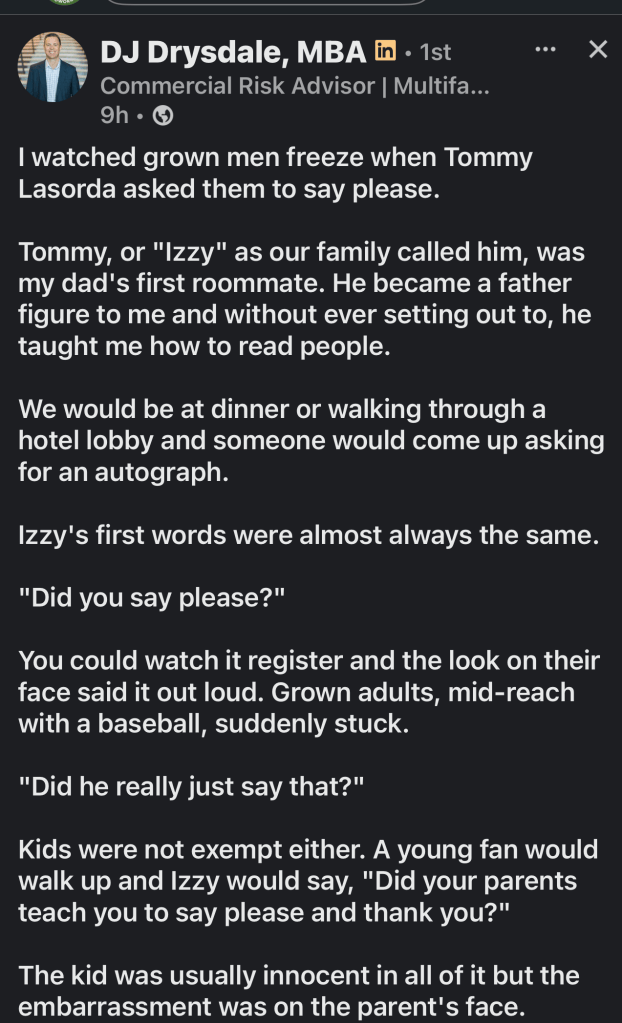
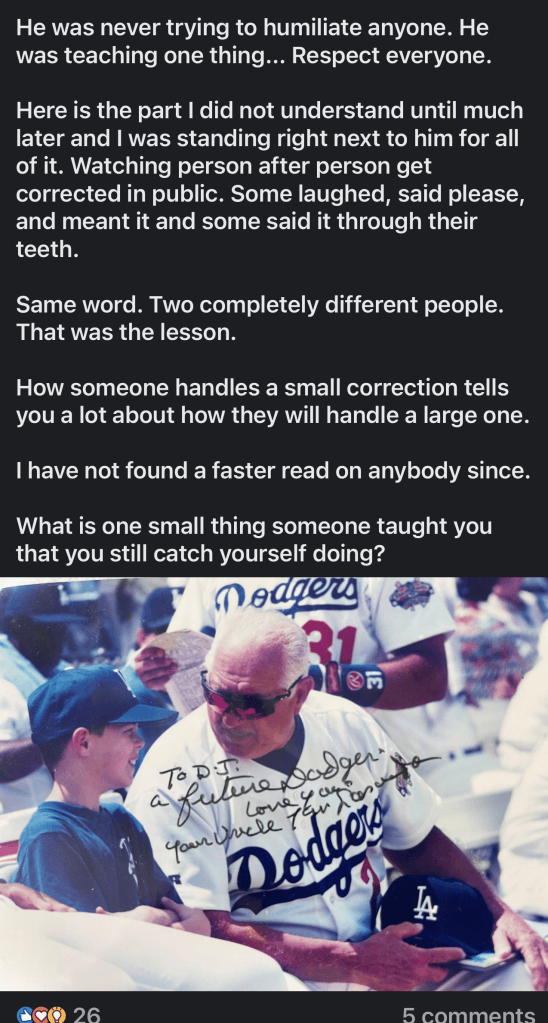
Who else wore No. 53 in SoCal sports history? Make a case for:
Rod Martin, Los Angeles Raiders linebacker (1982 to 1988):

Best known: Out of L.A.’s Hamilton High and two years of playing at L.A. City College, Martin wore No. 52 for two years USC. Oakland, because of USC coach John Robinson’s suggestion to Raiders coach John Madden, made him a 12th-round pick, No. 317 overall, in the 1977 draft since most considered him, at 6-foot-2 and 218 pounds, too small for a linebacker and too slow for a safety. Did they know he’d make two Pro Bowls and be a key on two Super Bowl teams? He set a record with three interceptions in Super Bowl XV and made the cover of Sports Illustrated. He broke up a key third-down pass on the Raiders 7 yard line in the second quarter in Super Bowl XVIII, sacked Joe Theismann once, and tackled John Riggins for no gain on a fourth-and-one conversion on the last play of the third quarter, and then recovered a fumble in the fourth quarter.
Not well remembered: After his retirement in 1988, Martin returned to his alma mater and took a job as a programmer in USC’s Information Sciences Institute.
Lynn Shackleford, UCLA basketball forward (1966-67 to 1968-69):

Best known: Out of Burroughs High in Burbank, where the 1965 CIF Southern Section Player of the Year averaged 25.6 points a game and also earned varsity letters in baseball and golf, the 6-foot-5 Shackelford started on three of coach John Wooden’s NCAA title teams that went 88-2 during his three varsity seasons in Westwood on a roster with Lew Alcindor and Lucius Allen. After a year in the ABA, he got into broadcasting and became Chick Hearn’s analyst for seven seasons on Los Angeles Lakers’ radio and TV. He was also the sports anchor on KHJ-TV Channel 9 in L.A. for five years. UCLA inducted him into its Athletic Hall of Fame in 2023.
Jim Youngblood, Los Angeles Rams linebacker (1973 to 1984): His only Pro Bowl year was during the Rams’ 1979 season and their run to Super Bowl XIV, when Youngblood had a career-best five interceptions, returning two for touchdowns. He had 14 picks (four returned for TDs) in his 12 seasons with the Rams, who took him in the second round of the 1973 NFL draft out of Tennessee Tech. He started 98 of his 152 games with the Rams.
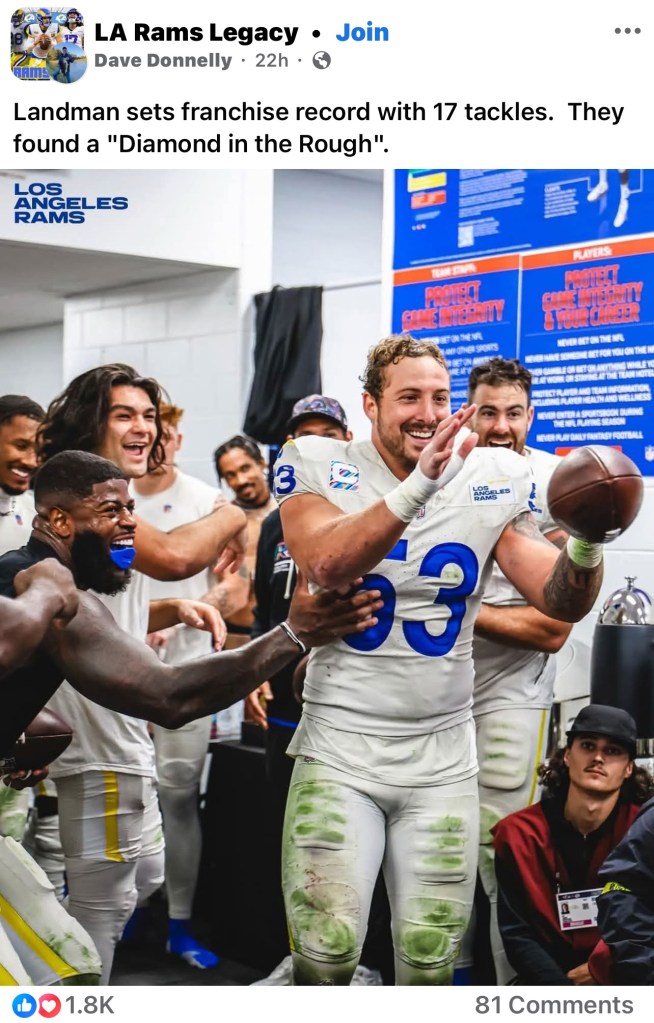
Nate Landman, Los Angeles Rams linebacker (2025): The mike linebacker and on-field signal-caller set a franchise record with 17 total tackles in the Rams’ 17-3 win at Baltimore in Week 6 of the 2025 season. Born in Zimbabwea where his father played rugby, the All-Pac-12 Conference linebacker from Colorado signed a one-year, $1.1 million deal with the Rams before the 2025 season after three years in Atlanta. He was named a team captain and was the NFC Defensive Player of the Week in Week 10 with a 10-tackle game in a win over Houston. The Rams gave him a three-year, $22.5 million contract extension in the middle of the ’25 season.
Have you heard this story:
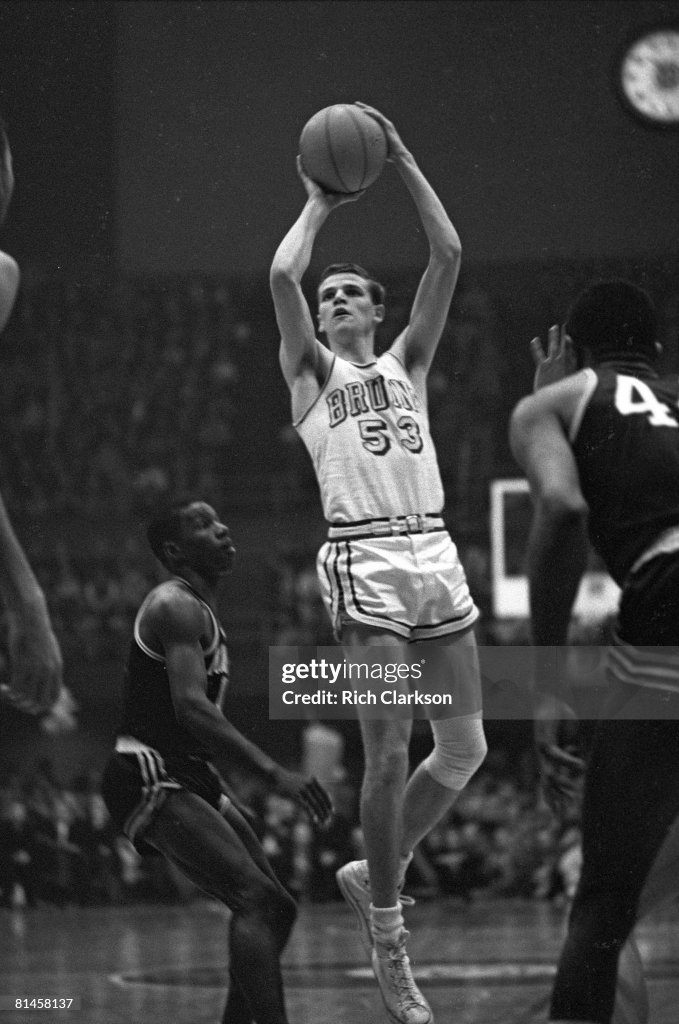
Keith Erickson: UCLA basketball forward (1962-63 to 1964-65):
The player who Bruins basketball coach John Wooden would call the finest athlete he ever coach emerged from El Segundo High and El Camino Junior College without a primary sport to attract any sort of recruitment. During his one year at ECC (1961-62), it helped that his coach was George Stanich, Wooden’s first All-American recruit who was also a multi-sport athlete. It also helped that the ECC team faced the UCLA freshman squad as part of its schedule.

Stanich and UCLA basketball assistant/chief recruiter Jerry Norman created a plan for Erickson in Westwood: Wooden would provide a half scholarship for him to be on the basketball team as a shooting forward and Art Reichle could have another half-scholarship for him to play baseball as a shortstop or center fielder. If Erickson didn’t make it in either sport, neither coach wouldn’t have spent a full scholarship spot on the proposition. But there was also a third choice: Volleyball. UCLA coach Al Scates wanted to at least see what the 6-foot-5 hitter could do, so he snuck Erickson onto his team for a tournament that took place during basketball season — despite a warning from Wooden that it would compromise Erickson’s status. While Erickson helped Wooden win his first two NCAA titles at UCLA in ’64 and ’65, most importantly as a defensive specialist in the full-court zone press and as a senior captain who made the All-Pac-12 team, he also helped Scates win his first title, the ’65 U.S. Volleyball Association championship. Turns out, Erickson played one season of baseball and made basketball his priority (with a fulltime scholarship), and volleyball second — which included his time on the U.S. Olympic volleyball team that in 1964 competed in Rome and then on the beach playing in pro tournaments.
Although he was drafted by the NBA’s San Francisco Warriors at age 21 in 1965, Erickson got to come back to Los Angeles and play for the Lakers from 1968-69 to 1972-73, including on their ’72 title team, wearing No. 24. His top game as a Lakers: 30 points, five rebounds and six assists in a win at Atlanta in January of 1969.
He was inducted into the UCLA Athletic Hall of Fame in 1986, the Pac-12 Hall of Fame in 2016, and the Beach Volleyball Hall of Fame in 1993.
Wade Meckler, Los Angeles Angels outfielder (2026):
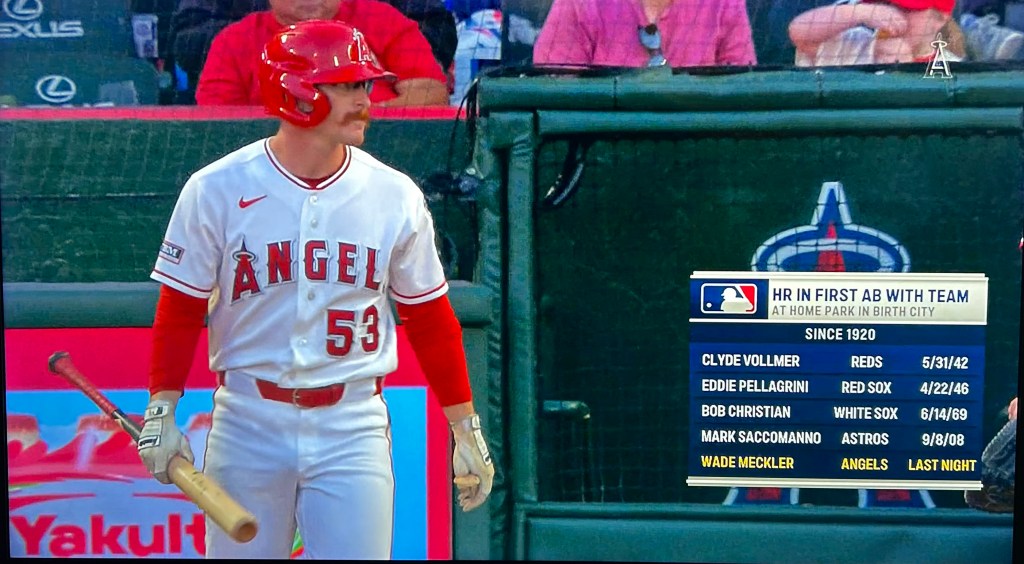
There was nothing really trivial with the fact that Meckler homered in his first MLB at-bat — a three run shot in the bottom of the first off former Cy Young winner Jacob deGrom to spark the Angels’ 9-6 win over Texas at Angel Stadium on May 22, 2026. The TV crew figured out a way to give it some context the next day the next day when he came up to hit. Still, putting him in the company with Vollmer, Pellagrini, Ciristian and Saccomanno was supposed to make Meckler’s feat feel more historic? It was far more unlikely that Mecker was even in a major-league uniform at this point, at age 26. Mecker, born in Anaheim and growing up in Yorba Linda, attended Esparanza High in Anaheim and checked in at 4-foot-10 and 75 pounds when he was on the freshman baseball team. By the time he was a senior, he shot up to 5-foot-8 and 145 pounds. After hitting .375 as an infielder, he walked on at at Oregon State but didn’t get to play until he was a junior. He hit .303 in 2021 and .347 as a senior in 2022 to made All-Pac-12 first team. After playing briefly in San Francisco for 20 games in 2023, Meckler was claimed off waivers by the Angels in early 2026.
We also have:
Bobby Abreu, Los Angeles Angels of Anaheim (2009 to 2012)
Brendan Donnelly, Anaheim Angels/Los Angeles Angels of Anaheim (2002 to 2006)
James Edwards, Los Angeles Clippers center (1991-92); Los Angeles Lakers center (1992-93 to 1993-94). Also wore No. 42 for Lakers in 1977-78.
Carlos Estevez, Los Angeles Angels pitcher (2023 to 2024)
Anyone else worth adding?