


“Unhittable: How Technology, Mavericks and Innovators Engineered Baseball’s New Era of
Pitching Dominance”
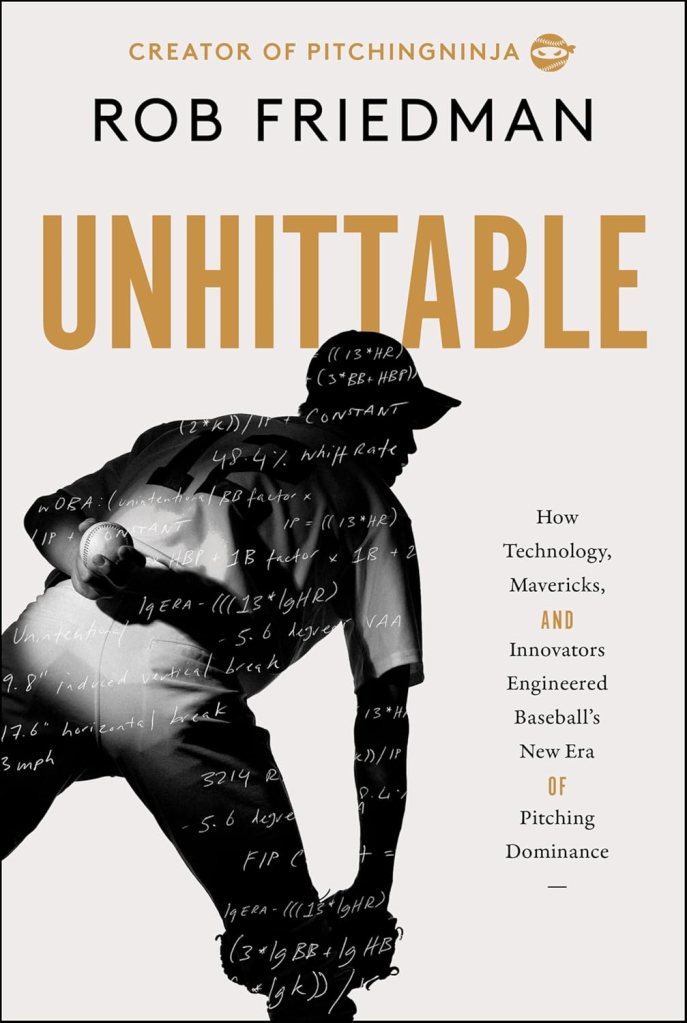
The author: Rob Freidman/aka PitchingNinja
The details: HarperCollins, 288 pages, $32, released March 24, ‘26
The links: The publisher, the author, Bookshop.org
A review in 90 feet or less:
Technically, it was an illogical technological clustermess. It nearly short-circuited the ebbs and flow and safety of all concerned in a recent Dodgers-Mets contest.
Fourth inning: Mets reliever Craig Kimbrel does his crab-like glare into catcher Francisco Alvarez for a sign — even though we assume he’s hearing it through a small speaker in his cap with the new-fangled PitchCom device. That was put into the game to speed it up and prevent sign stealing. Now we see some unintended consequences.
As Alvarez realizes the pitch clock is winding down to the final two seconds, has a panic attack. Rather than allow Kimbrel to be flagged as a violator, and the count to the Dodgers’ Shohei Ohtani to go to 3-2, the catcher leaps out from behind the plate, sidesteps Ohtani (just as he’s coiling to what he anticipates is a ball coming at him), seems to ask for a timeout amidst his arm flailing, lurches toward the mound and plants himself in front of the plate on the grass like a school crossing guard trying to stop an oncoming e-bike.
Kimbrel, head down, doesn’t notice all this happening. So when he leaps into his jerky windup, he suddenly realizes Alvarez is an object in his peripheral vision closer than he actually appears.
And Ohtani freaks out.
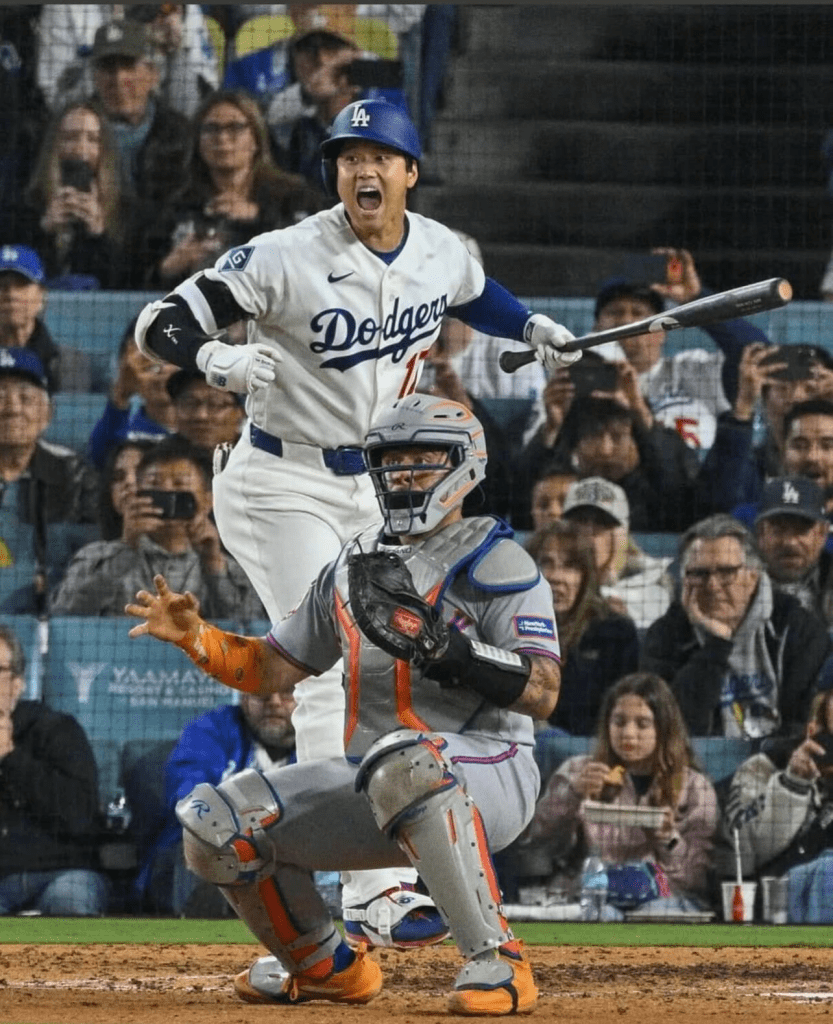
Already been hit by a pitch in his first at-bat and still feeling its affect, and already startled by Alvarez moments earlier when the catcher tried to make a back-pick of Dodgers runner Miguel Rojas at first base, Ohtani spins away to his right in some kind of self preservation mode.
Homeplate umpire Nic Lentz does his own ballet leap to his left. Did he agree to Alvarez’s time-out call? We’re not all that sure as Lentz is still trying to keep some integrity of the game.
Kimbrel almost falls down.
The Dodgers’ broadcasters gasp as well. What just happened?
Unbelievable.
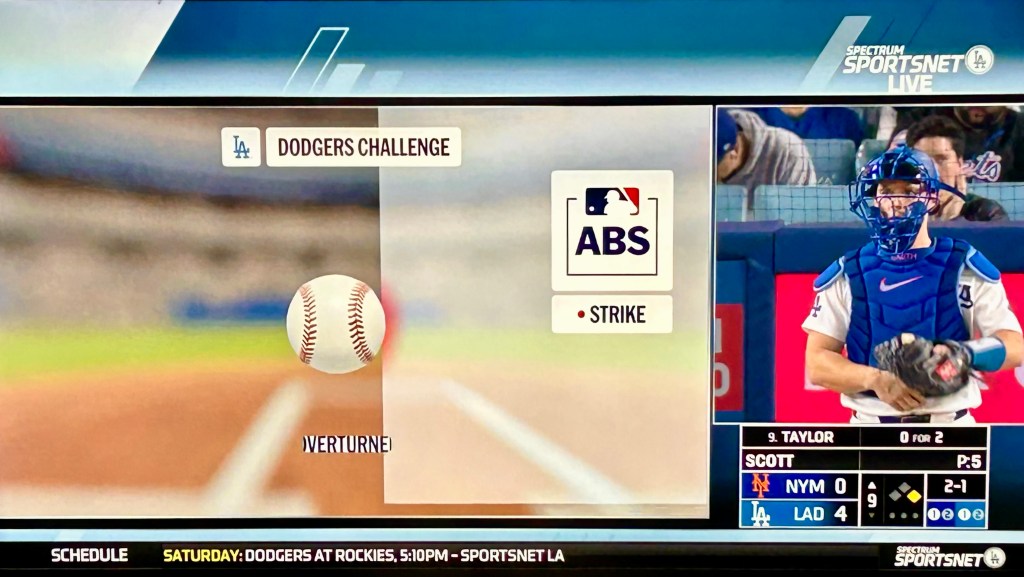
Ninth inning: We’re being technologically challenged again with the Dodgers putting the final touches on a 4-0 victory. Gotta use those unused Automated Ball-Strike Challenge System head-taps, because they don’t carry over to extra innings. Or to tomorrow. Use ’em or lose ’em.
Dodgers reliever Tanner Scott pitches to Mets’ No 9 hitter Tyrone Taylor with a 1-1 count. It is called a ball by Lentz. Dodgers catcher Will Smith wants a review.
The ABS graphic shows that a sliver of the ball hit the side of the gray screen box graphic. The call is overturned. It’s a 1-2 count now instead of 2-1.
“That’s ridiculous,” says Dodgers TV analyst Eric Karros. “You gotta give me more than a seam on that part of the plate (to change it from a ball to a strike). I mean … you gotta give me half a ball or something.”
Undeniable.
And all there for the fans left in the expensive seats to capture on their iPhones to share later.
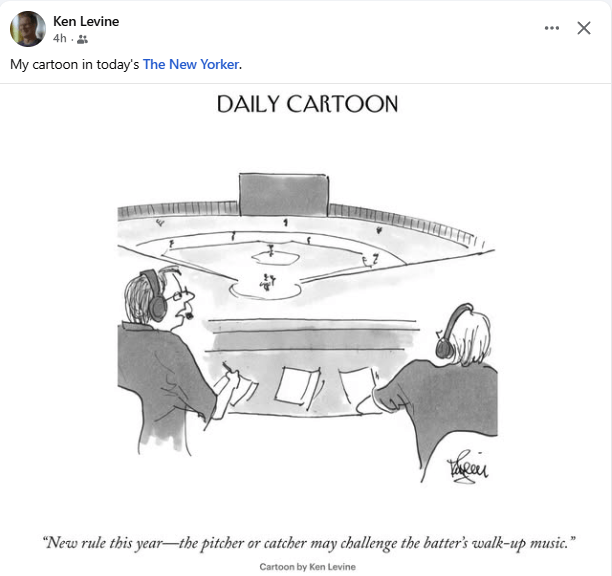
For all of today’s umpires — including C.B. Bucknor — are already flinching on calling runners safe or out on the basepaths, since instant replay continues to add more nuanced layers of challenge-able calls but also refuses others like a foul tip that make it seem rather arbitrary — this technology seems to add to this pursuit of perfection that will never be attained.
“MLB doesn’t really know in what direction they want the game to go,” Joe Posnanski has written about this on an almost daily basis since the 2026 season started, and before. “They know — they HAVE to know — that the Day of the Umpire has passed, and that the game will be officiated very differently in the years ahead. And I have been saying for a while now that ABS for every pitch is coming.”
Unacceptable.
Amidst CNN’s March 25 broadcasting day, there was Phil Mattingly, the network’s chief domestic correspondent filling in for Jake Tapper on “The Lead” (and apparently no relation to Don Mattingly), trying to navigate that hour’s worth of more bizzaro news coverage. He found a way to segue from the Strait of Hormuz straight to Friedman toward the end of the show so Friedman’s new book could be discussed completely out of context before “Erin Burnett Outfront” comes on.
Mattingly: I do want to start with ABS. What do you think of this? What does this change?
Friedman: So, it changes a lot. It’s going to change things like framing. It’s going to change what you’re seeing on the on the screen because some pitches, you know, you see those curve balls that barely clip the zone that umpires give up on, hitters give up on, and now they can be challenged and be a strike. There’s a whole level of strategy that comes to be now with robo umps.
Mattingly: Does this benefit pitchers?
Friedman: That’s a great question. I think that’s heavily debated. … There are hitters that say it favors them because the strike zone will be smaller and they can’t expand the zone. But there are pitchers that say they’re just going to clip the zone with breaking stuff, east to west, north to south. And hitters are going to be helpless against it. So, I’m curious to see what happens.
Mattingly: Yeah, it’s going to be fascinating to watch it play out.
How unseemly. Unsuitable. Unbefitting for all.
And wait’ll next year when the automated check-swing review process is introduced.
We’re trying to get a grip on some of this, so we’re asked to turn to a guy who calls himself the Pitching Ninja — aka, Friedman — with a new explanation of how he, and many others, have entangled technology with the national pastime that allows those who throw a baseball from 60-feet, 6-inches away into an electrified strike zone box have become more and more efficient at their craft.
And all of this getting ahead of the curve for game-strategy freaks, geeks and technique-tweekers excite them to no end. Just look at how amped MLB Network host Brian Kenny is during his conversation with frequent network contributor Friedman:
As Friedman demonstrated as well back in his CNN plug, getting caught up in this so-called pitching renaissance of nastiness is tough to tamp down for the common consumer.
Mattingly: The dominance of pitchers right now, it’s a fascinating story. Short- handed for normal people.
Friedman: So, what — what — what’s happened is pitchers have been engineered to throw harder. It used to be you were taught that either throw harder. You don’t, you throw strikes. You don’t. You can spin it or you can’t. And now, we’ve taught been able to teach pitchers through a bunch of different things. Biomechanics, weight training things like Rapsodo, things that slowed down pitchers as they leave your hands so you can see exactly how it’s leaving your hand and you can design different pitches, you know how it’s going to move, and you can now attack hitters whole different ways.
From Driveline using particle image velocimetry to Seam-Shifted Wake to the Magus Effect to AI-powered analytics, we’ve been misdirected into a CalTech advanced physics class when we were hoping for a 101-intro-level “For Dummys” sherpa-led excursion.
Friedman does use the first five chapters to soft-toss how the art of pitching know-how has ebbed and flowed through gurus like Tom House. But then it becomes a rather untenable ask for the casual reader to keep things straight.
Chapter 6 lures you in by explaining how the Dodgers benefited from using biomechanics to protect their investments — resulting in World Series titles in 2020 and 2024 (the book’s deadline must have missed 2025).
“Their ability to stay ahead of the competition stems from a forward-thinking approach that leverages biomechanics, advanced analytics and cutting-edge technology to optimize player development,” Friedman writes on page 45.
Now, be careful what more you want to know behind the curtain. It may take the fun out of knowing how the illusion is created. Its far more technical and less enjoyable than Tyler Kempner’s 2019 gem: “K: A History of Baseball in 10 Pitches.” This is more textbook than travelogue.
If this begat that, and spin seams is a result of velo, and Trevor Bauer is somehow mixed into this scholastic advancement, we’re hoping to be automatically told to go to first base on an intentional walk rather than fast four wide ones — again, to speed things up.
How about slowing things down at some point?
To the end, Friedman’s premise is that, considering the game’s history, technology will allow hitters to catch up. It doesn’t seem plausible. They’re not in control of the pitch. They can only try to see it first, then react, then realize it has spin far past their piece of wood. Unless more rules are changed — whether it’s to influence the time-of-game experience or not — there’ll be the inclination to use up to six throwers a game, generating spin and speed at the peak of their abilities, giving hitters fewer and fewer chances to succeed.
They can’t lower the mound any more, can they? Or elevate the batter’s box?
How it goes in the scorebook: WP.
Not to indicate there’s a winning pitcher after all this whiteboard hijinx, but the wild pitch will be marked to reflect the nature of this beast.
Bordering on unbearable. Unlikable. Maybe, in some ways, a bit unnecessary.
How Friedman became this Pitching Ninja is a cool story unto itself. Unanimously.
How he became linked to FanDuel in the action of betting on pitching props is a problematic crossover promotion. Unbearable.
So this book is definitely best for the brand, the next step past the podcast. A nice sign-able item/business card for his Ninja clients already merched up with T-shirts and other gear on his website. Understandable.
Until we’re all caught with our underwear down.
More to followup:
== Joe Eisenmann writes on his Ironman Performance substack why he plans to plow through this book quicker than usual. Hint: He’s energized.
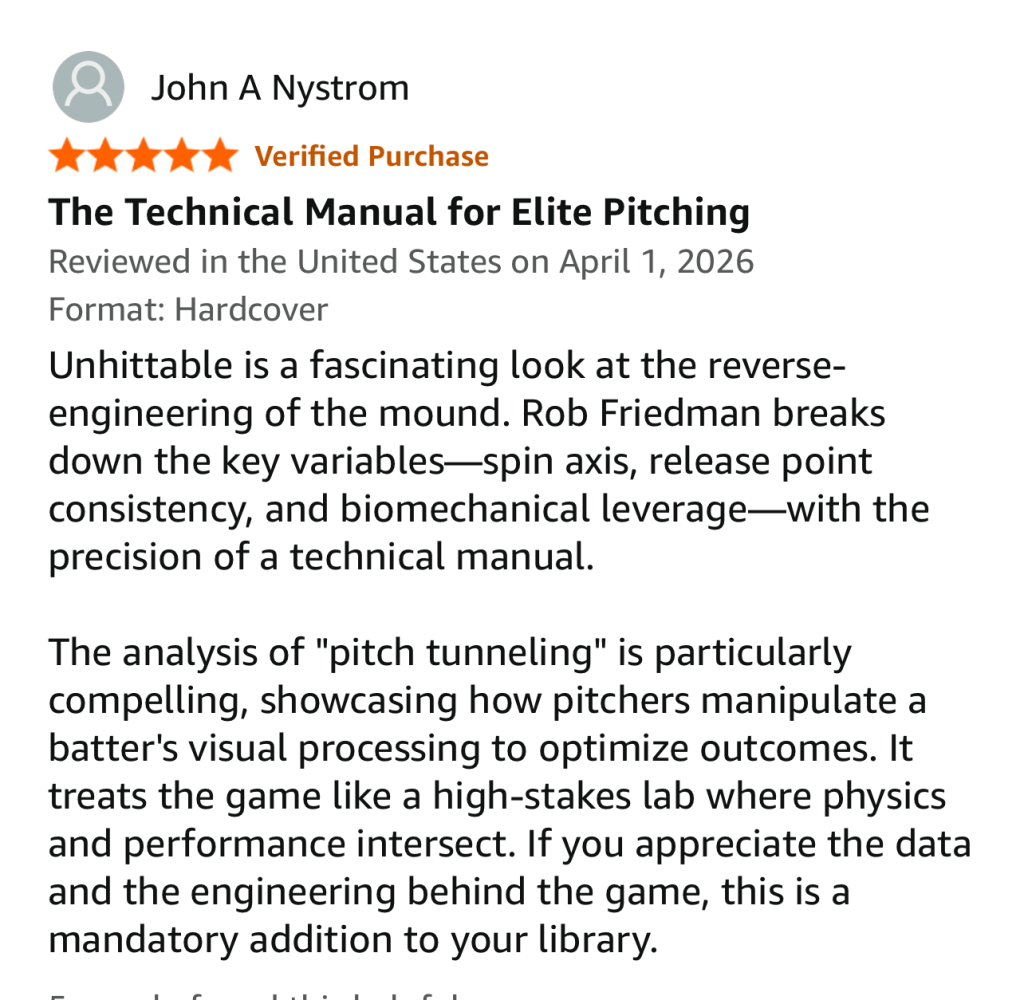
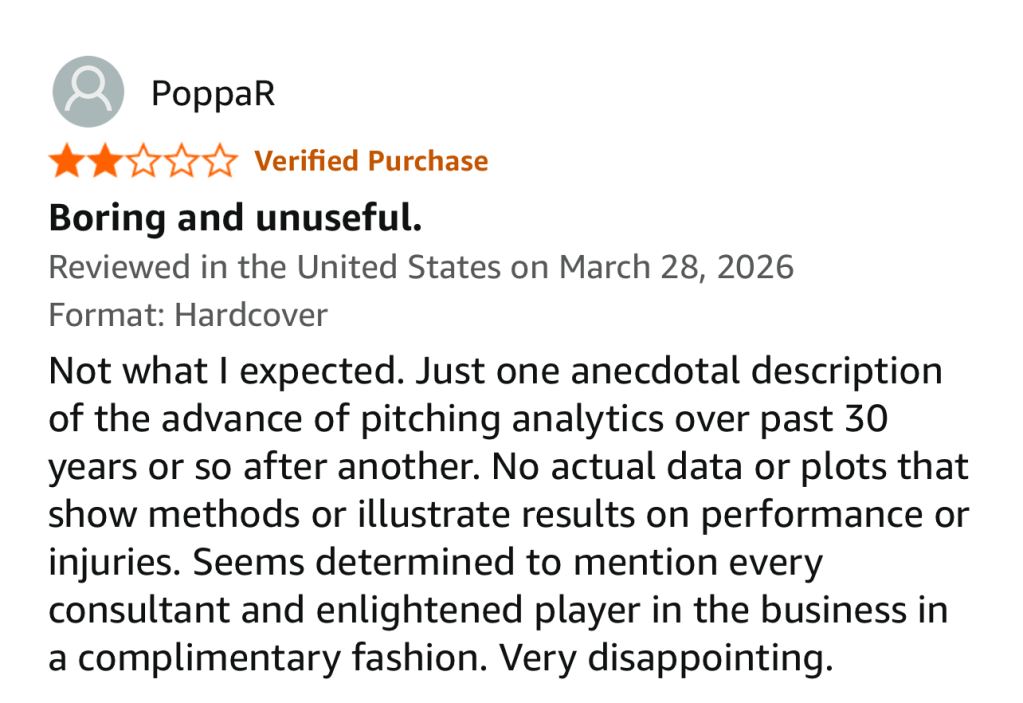
== Random Amazon reviews, anyone?


1 thought on “Day 7 of 2026 baseball book reviews: Under-handed promises, over-our-heads delivery”