
“Baseballisms: A Murders’ Row
of Metaphors and Idioms”
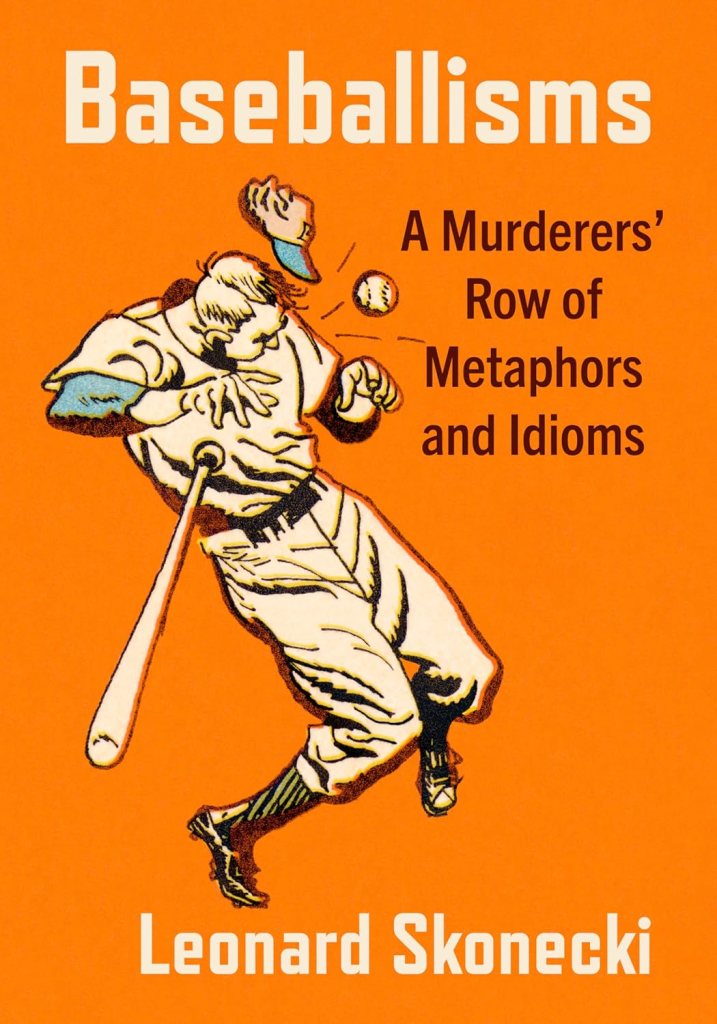
The author: Leonard Skonecki
The details: McFarland, 334 pages, $59.95/$49.95
The links: The publisher, Bookshop.org
The slight confusion: The publisher lists it at $49.95 in stock. Amazon (please don’t buy it there) also has it for that price, as of March 19, ’26. Bookshop has it for $59.94, available as of May 22, ’26. Target also offers it at $49.99 starting in May.
A review in 90 feet or less:
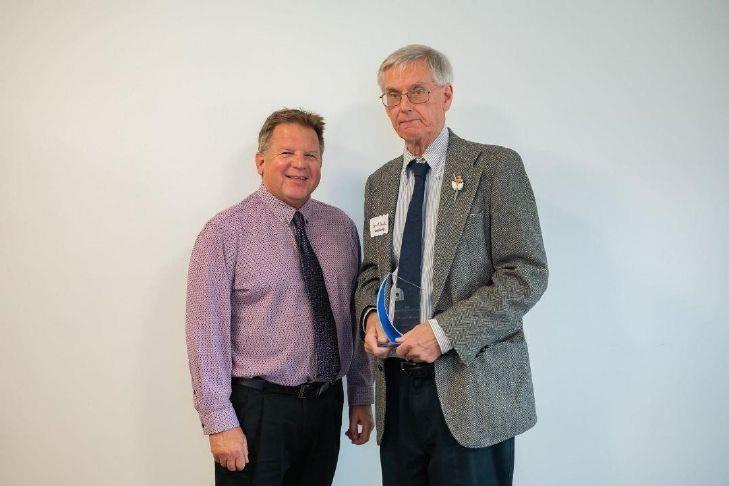
Bless you, Leonard Skonecki.
While not a renowned linguist but a dedicated and curious reader/researcher finding something meaningful and purposeful in retirement, Skonecki is best described as “well-known in Fostoria.” That’s from our own research in the matter.
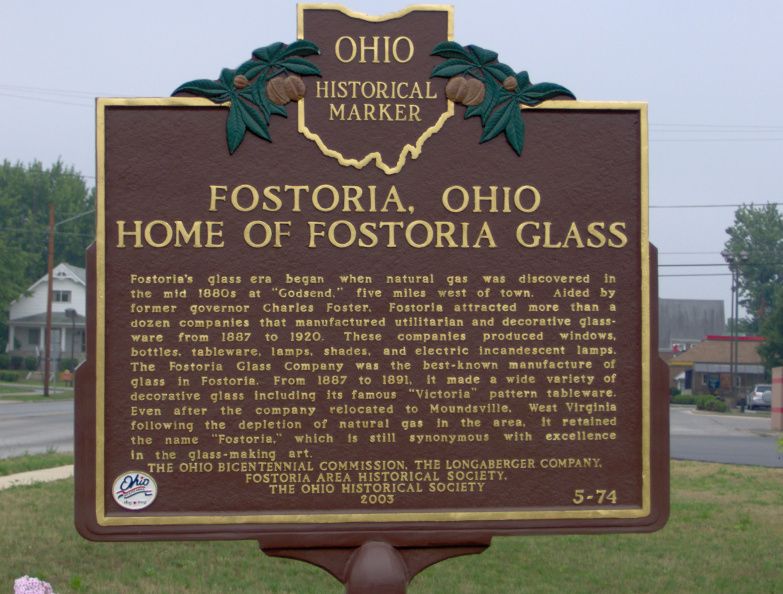
Through a parallel search, we find Fostoria is “a city located at the convergence of Hancock, Seneca and Wood counties in the northwestern part of the U.S. state of Ohio. The population was 13,046 in the 2020 Census, slightly down from 13,441 at the 2010 Census. It is approximately 40 miles south of Toledo and 90 miles north of Columbus.”
It was named after Charles W. Foster, a local businessman. His son, also named Charles, became governor of Ohio and U.S. Secretary of the Treasury under Benjamin Harrison.
It is also was once famous for making glass.
Now we have a visual.
Skonecki’s author bio notes he once wrote for the weekly Fostoria Focus newspaper, which had a bold run between 1994 until 2014. He also worked in the reference department of the Kaubisch Memorial Public Library.
“Now retired, he lives in Fostoria, Ohio,” the bio wraps up.
We also learned from another source Skonecki “was born and raised in Fostoria and graduated from St. Wendelin High School in 1968. He then lived in Toledo and Dayton and returned to Fostoria in 1995. He has served as the president of the Fostoria Area Historical Society, and also worked for WFOB where he hosted the Friday edition of the Talk@10 interview show.”
Now, we have context.
His body of work includes an appearance in the 2013 documentary “History of Fostoria (Vol. 1),” and, because you can’t stop the flow of important material but you can only hope to contain it, Skonecki reprized his role in the 2014 update “History of Fostoria (Vol. 2).”
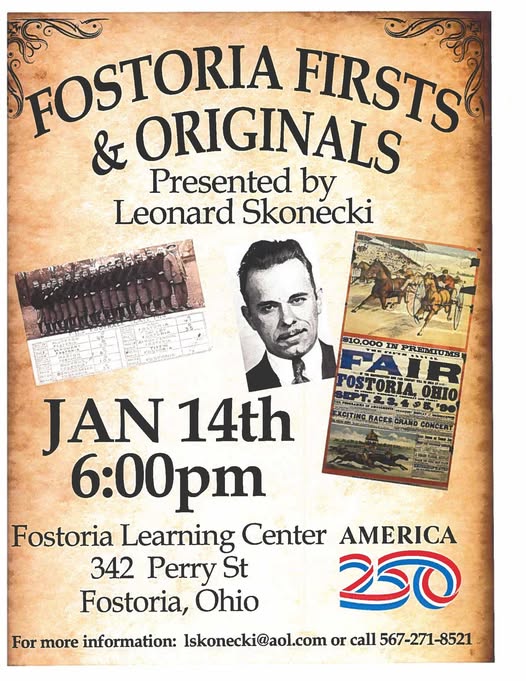
Last January, Skonecki was the guest presenter for “Fostoria First & Originals” at the Fostoria Learning Center as part of its “America 250” celebration. Flyers were distributed as the city noted on its Facebook post that it was a moment in time where “Fostoria history comes to life.”
This follows up from a time in April of 2024 when the Seneca County Museum started a “speaker series” where Skonecki presented a program on the robbery of the First National Bank of Fostoria. On May 3, 1934, John Dillinger and one of his gang, Homer Van Meter, robbed the bank of $17,299. In the course of the robbery, nine persons were shot, including Fostoria Police Chief Franklin Culp. In order to make a safe getaway, Dillinger and Van Meter took two bank employees hostage.
“Leonard will be sharing information about the robbery, related events, and how it affected the persons most directly involved,” the information noted. “He will also allow time for questions.”
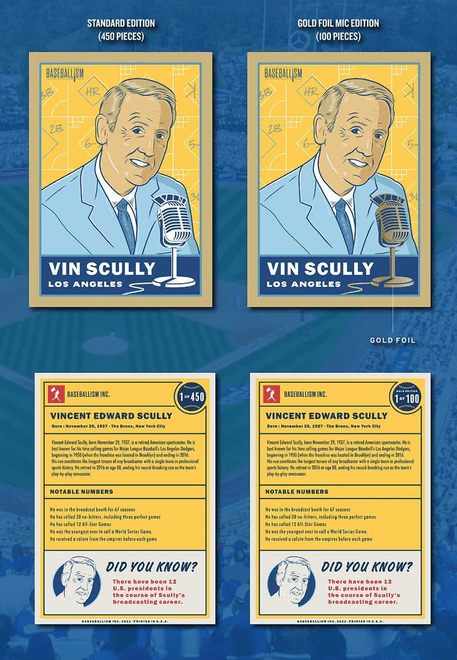
Our contentment relatable to anything called “Baseballism” is the swell set of gear that can be purchased online and, near us, in stores at The Shops in Mission Viejo and the Ontario Mills Mall. Check out the Vin Scully collection if you can.
Its origin story from its website: Baseballism originated as a youth baseball camp, founded by four former college teammates dedicated to teaching the game with integrity. After the camp ended and the founders followed diverse career paths, they reunited to transform their passion into a premium lifestyle brand. Today, Baseballism is more than apparel—it’s a symbol of dedication to baseball, with each item reflecting the sport’s core values. This is Baseballism: For love of the game.
Thank you to Jonathan Jwayad, Travis Chock, Jonathan Loomis and Kalin Boodman.
It gave baseball a voice through the language of contemporary, smart and creative apparel.
In the acknowledgements for his version of “Baseballisms,” (with the added “s”), Skonecki explains how his research took him to distant corners of the immediate area: The Muncie Public Library, Bowling Green State University Jerome Library, Toledo Lucas County Public Library, Cleveland Public Library, University of Toledo William S. Carlson Library and the Ohio History Connection archives and library in Columbus. He, of course, already had unique access to the Kaubisch Memorial Public Library in his hometown.
Skonecki includes mention of how Matt Erman, the documentarian responsible for the “History of Fostoria” series, was helpful in being able to “rescue almost all my files when my old computer crashed and burned.”
Still, he preserved 58 figures of speech, idioms, metaphors, sayings, terms, expressions and phrases from the Mother Tongue to present and examine in perfectly aligned alphabetic order. From “Alibi Ike,” “Annie Oakley” and “Asterisk,” all the way to “Trade Winds” and “Two O’Clock Hitter.” Anything starting with the letters “U,” “V,” “W” and the rest of ‘em did not make the final cut.
These were all things that Skonecki, in his preface, said “caught my fancy.” All the stuff he feels “influenced how we communicate” and have been “enriched by the language of baseball.”
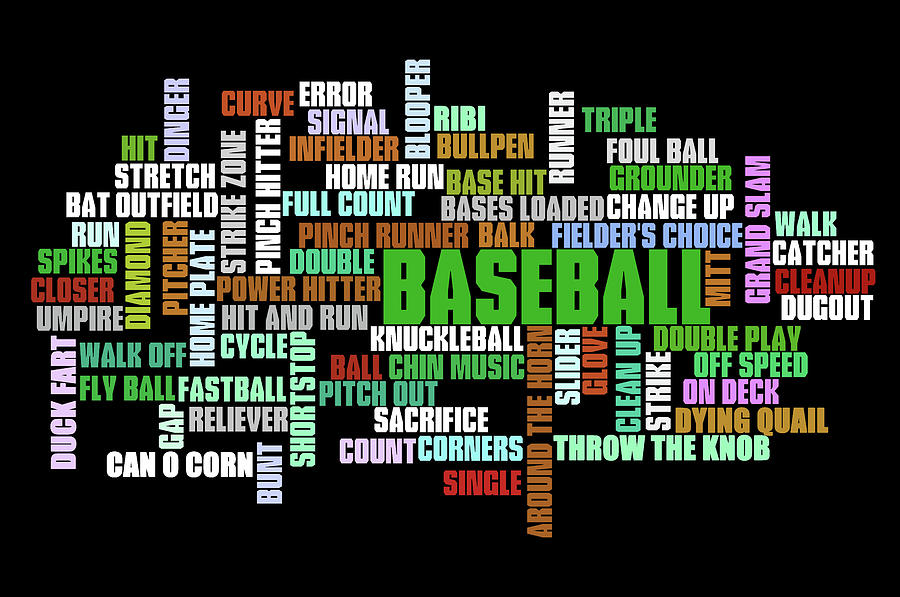
The list is fun to scan. Some are even used in the game today: Pinch hitter, Big League, Circus Catch, On Deck, and Play Ball.
The research is even better in explaining their origin stories, usage and extended evolution.
Under what can now be cited as a gruesome the entry for “Kill the Umpire” — would anyone really do that these days? — the phrase that came into play long before the Ernest Lawrence Thayer poem about Casey has a better reference point now. Skonecki comes up with an interesting citation about another Casey — Patrick Casey — and a June, 1911 Sporting Life report that this old-time ball player, in a Carson City, Nev., state pen serving time for a murder, had asked the warden if he could serve as umpire for a game involving two convict teams. He was granted the privilege. A month later, Casey was hanged.
“So that time they really did kill the umpire,” Skonecki notes.
Most of the phrases, if a broadcaster or writer threw them into a description or a paragraph today, might elicit a groan, or get flagged by an editor as being too cliché.
That’s the beauty of the language’s velo evolution and its new entrance torque.
So be it.
When the The Findlay Courier had a Facebook post on March 15 that Skonecki’s new book, “Baseballisms” had been published, one of the first responses, from Kat Steams, was “Well, now I need the audio book in Leonard’s voice.”
Seems like we got that through just reading it.
How it goes in the scorebook:
Whether it’s listed at $49.95 or $59.95, that a big ask.
For the consumer, really, it’s some chin music. That’s discussed on page 112.
“It seems that it wasn’t until the 1970s that ‘chin music’ came to refer as a brushback pitch,” Sknoecki writes. “In September 1973, John Hall of the L.A. Times was musinc on the ‘ever changing’ world of baseball slang. He said, ‘To some, the duster (you hit the dust when it comes) is ‘chin music.’ Like, Juan Marichal has always played beautiful chin music.'”
Hey, I’ll still call ’em as I see ’em. That’s a phrase discussed on page 192.
“Foolishly, baseball is having computers call the game,” Skonecki adds to his essay when discussing how the phrase’s point of origin pertains to umpiring. “Any sensible person who wants to see a computer run a game should go buy a Nintendo.”
Nice zinger.
Also, I’ll take a rain check on further criticism. That’s discussed on page 251.
“Before the unfortunate advent of online and mobile device ticketing, everyone knew that part of the ticket you kept with you was called a rain check,” Skonecki explains.
He also brings up a story:
“Once, someone figured Rain Check made a nice sounding nom de plume. In the 1920s, the editor of the Fostoria Daily Times, a gent named Roscoe Carle, had a sense of humor. He wrote regular newsy stuff, but also took a whimsical look at issues like public toilets. He once suggested building a vast one beneath the town’s main intersection. But in the spring of ’25, he wrote about the city’s indoor baseball (i.e., softball) league. Sometimes, he bylined his articles ‘Rain Check’ and occasionally referred to himself that way in articles. Ball games need umpires and on April 25, 1925, Carle said, ‘The umpires for the season are Ross Woessner, Gene Stafford, Tim McFadden and Rain Check’.” There’s a footnote to the “Moose-Y.M.C.A To Open League” story in the aforementioned newspaper.
The stuff you won’t find that among the 10,000 terms and 18,000 entries of the “Dickson Baseball Dictionary,” no matter what editions is out these days. You can look it up.
Or find other sources that love to play with the language and definitions:
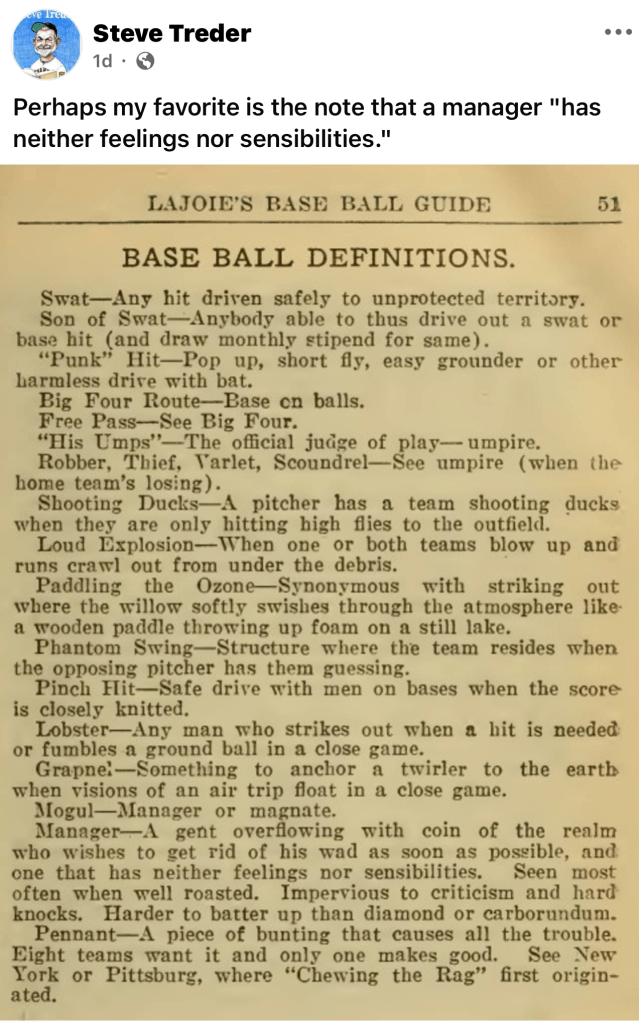
And here as well:
You can also look it up:
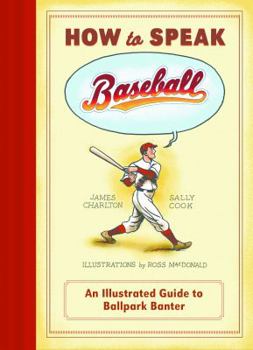
“How to Speak Baseball: An Illustrated Guide to Ballpark Banter,” by James Charlton and Sally Cook (2014, Chronicle Books, 128 pages) also has laid the groundwork in whimsy with more baseballistic jargon research into words and phrases such as “duster,” “golden sombrero,” and “up the elevator shaft.”

 Tom Hoffarth's The Drill: More Farther Off the Wall
1 thought on “Day 8 of 2026 baseball book reviews: Word up”