

This post is part of a media project called SoCal Sports History 101: The Prime Numbers from 00 to 99 that Uniformly, Uniquely and Unapologetically Reveal The Narrative of Our Region’s Athletic Heritage. Pick a number, and consider the list of athletes attached to it. Who wore it best? Or, what’s the most compelling story linked to it? Any person, place or thing is in play with Southern California connections. Star power, transformational achievement, longevity, notoriety and quirkiness all factor in. Whatever leads to a lively discussion and interpretation.
The most obvious choices for No. 56:
Gary Zimmermann, Los Angeles Express
Jarrod Washburn, Anaheim Angels/Los Angeles Angels of Anaheim
Doug Smith, Los Angeles Rams
The not-so-obvious choices for No. 56:
Hong-Chih Kuo, Los Angeles Dodgers
Pedro Astacio, Los Angeles Dodgers
The most interesting story for No. 56:
Rick Dempsey, Los Angeles Dodgers catcher (1988 to 1990), via Crespi High of Encino
Southern California map pinpoints:
Woodland Hills, Canoga Park, Encino, Los Angeles (Dodger Stadium)
Reference books on the subject:
“If These Walls Could Talk: Stories from the Baltimore Orioles Dugout, Locker Room and Press Box,” by Rick Dempsey with Dave Ginsburg, 2017
“The Counterfeit Legend: Respected Pony League Manager Lives Double Life Robbing Banks” by Victoria Summers, 2025
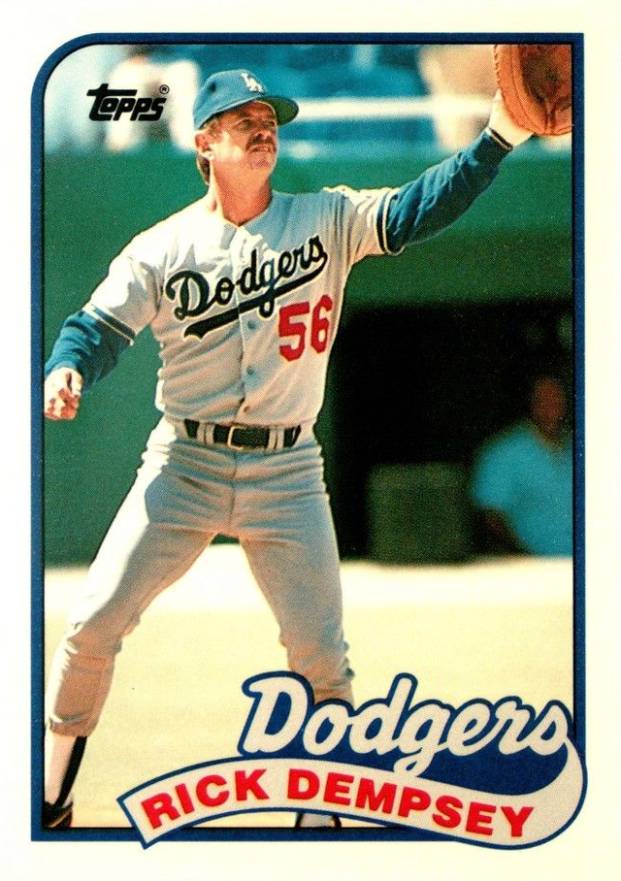
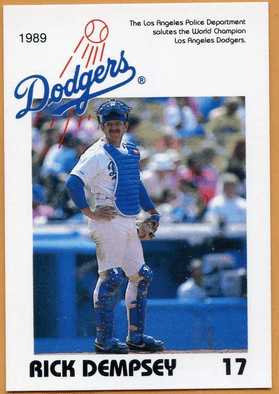
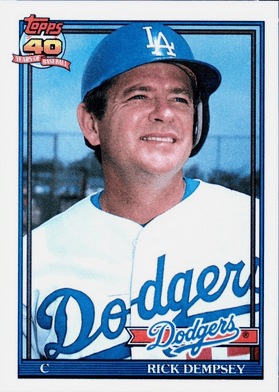
Topps Baseball Cards was guilty of some kind of crime — identify theft? — when it came to printing up Rick Dempsey’s cardboard resume prior to the 1989 season.
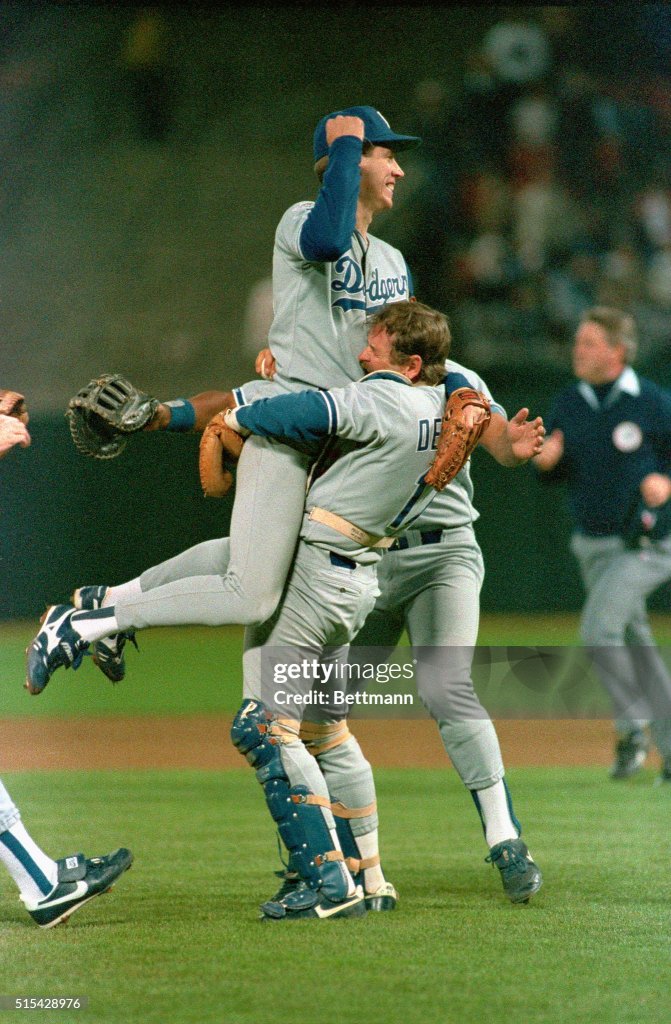
Above is Exhibit A. The Dipper, wearing No. 56.
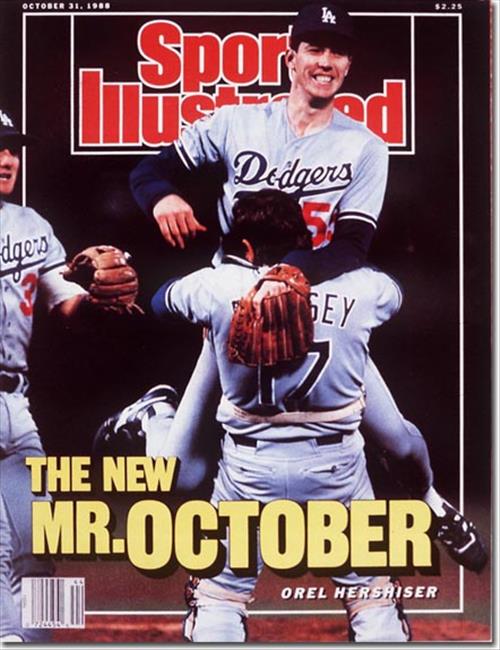
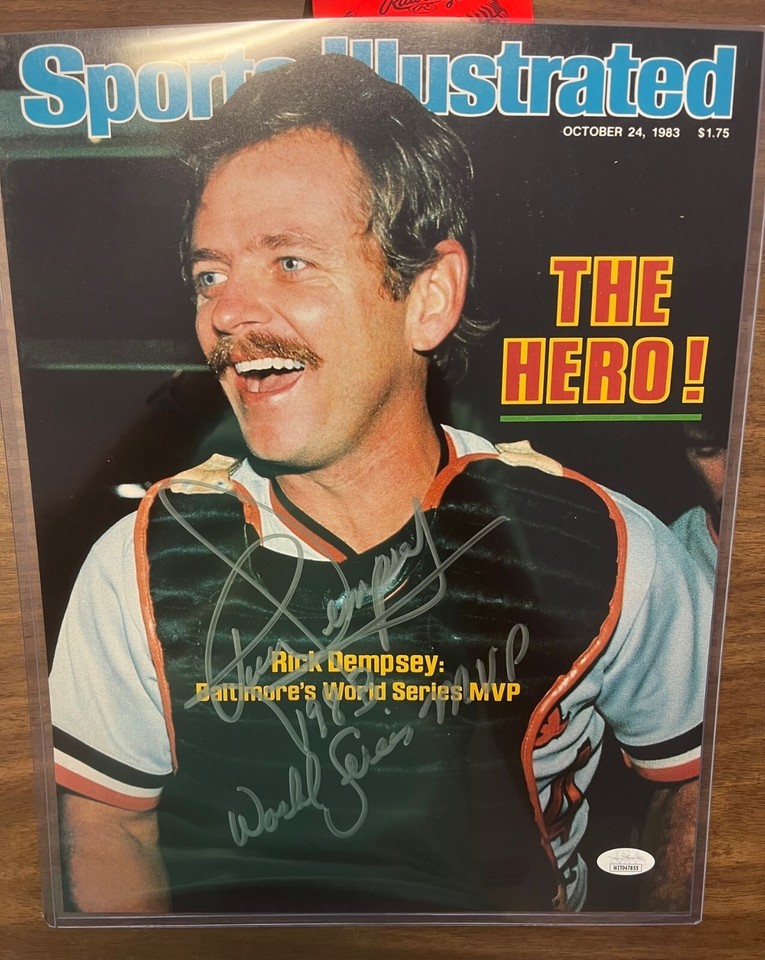
Dempsey had just played his 21st MLB season at this point. He was on the cover of Sports Illustrated, acting as a human pedestal for Orel Hershiser after the Los Angeles Dodgers’ improbable 1988 World Series win. Dempsey is wearing his familiar No. 17.
That No. 56 Dempsey character looks more as if he’s in adult fantasy camp. Sure, he wore it, but just a brief few weeks at spring training in Vero Beach, Fla., as a non-roster player. Trying to catch on. Dempsey beat out Alex Trevino for the backup catcher job, despite Trevino’s guaranteed $300,000 salary.
But when the ’89 season started, Topps had a season’s worth of action photos with Dempsey wearing No. 17. It somehow failed.
He has been wearing an MLB uniform since age 19 in 1969, just two years out of Crespi Carmelite High in Encino.
Five seasons earlier, he was the World Series MVP for his performance with the champion Baltimore Orioles over the Pittsburgh Pirates. Already forgotten?
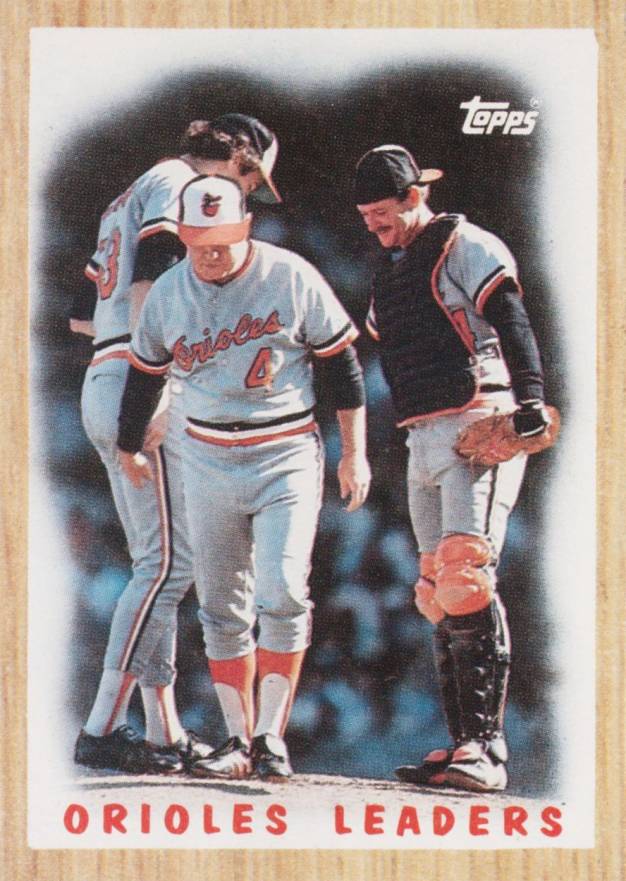
Once groomed as Thurman Munson’s backup with the New York Yankees in the 1970s, Dempsey went full-time with Baltimore in ’77 and on a nightly basis corralled one of the best starting pitching rotations in the game.
Coming back to Southern California, Dempsey would posted a career best 129 OPS+ with 13 doubles and seven homers in a modest 198 plate appearances in 1988.
The Dodgers saw value in his experience, his his sense of humor, and his presence.
Because, as crazy as it sounds, Dempsey had seen plenty by the time he was back in L.A. He could re-tell the story with a new set of listeners about the time he was a kid growing up in the San Fernando Valley and it turned out his baseball coach was a certified bank robber.
It was never a wise idea to try to steal when Rick Dempsey was behind the plate.
In the 1,765 games that Dempsey played in his big-league career, 1,277 runners attempted to swipe a base on him. He threw out 507. That’s almost 40 percent, well above the average success rate for catchers in his day. In 1977, he nailed a league-best 58 percent of would-be stealers in 1977. Three years earlier when he was with the Yankees, Dempsey threw out runners 73 percent of the time — 16 out of 22.
Orioles manager Earl Weaver once said about Dempsey: “He’s the best throwing catcher I’ve ever had. He gets rid of the ball so quick and he’s accurate … also amazing on pickoffs. … I’ve never seen anybody throw better.”
And Dempsey could play it cool.
Watch the MLB.com clip of Kirk Gibson’s 1988 World Series Game 1 homer. About 2:20 into the YouTube sequence, the camera shows Gibson fidgeting at the plate with a no-ball, two-strike count. There are two outs. The Dodgers are down to their last strike. The camera spots Tommy Lasorda in the dugout. The manager nervously handles this critical gamble he just made.
In the background, notice Dempsey. Almost casually sitting on the bench, his right arm stretched out. No pressure.
Maybe by this point in his baseball life, Dempsey had seen it all. Watching Gibson steal a win for the Dodgers wasn’t the most bizarre thing he’d ever seen.
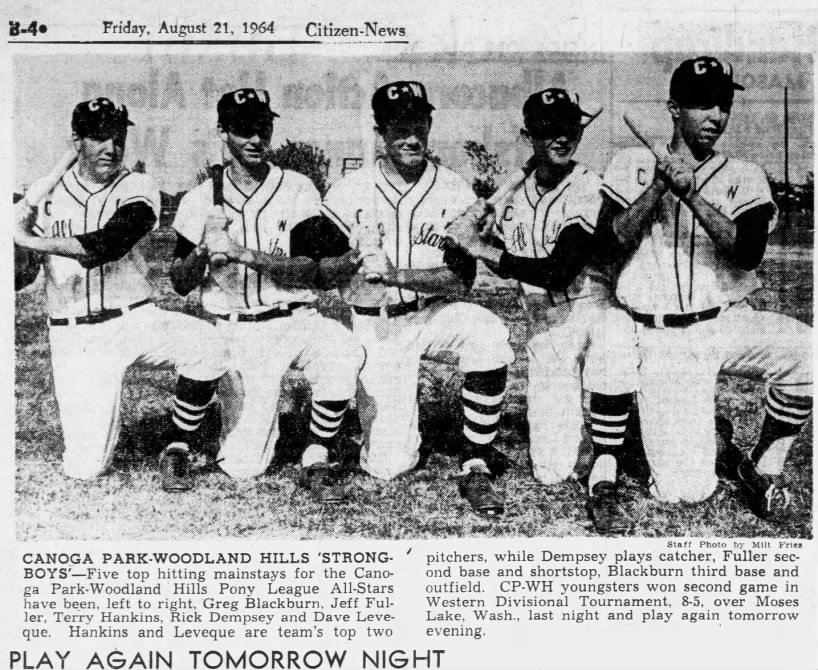
Ever hear about the time when Dempsey, a year out of Little League, a couple years before he went to Crespi High, he was playing on a Pony League team with his friends and their world turned upside down?
The November 3, 2013 front page of the Los Angeles Daily News had the headline: “Caught stealing: 50 years later, the story of the Valley’s ‘Mutt and Jeff Bandits’ is a perfect pitch for Hollywood“
The news editors tossed this story at me in the sports department to research and write up. There was a humorous slant to something so preposterous that Hollywood screenwriters had been trying to sell it as a something of a buddy comedy and so far hadn’t made it work.
This was a cross between “Bad News Bars” and “Catch Me if You Can” with a touch of “Bad Santa,” someone suggested. Or maybe there was a darker angle to pursue.
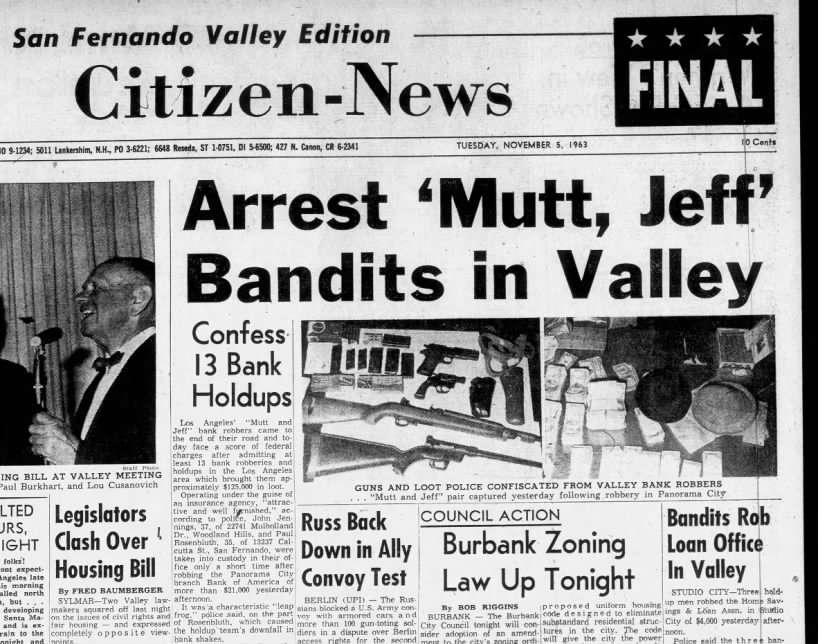
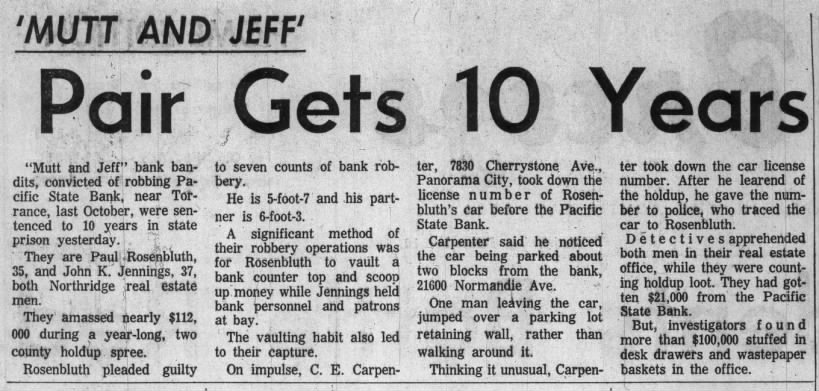
It’s 1963, early November. It’s all over the local TV news — John Jennings, age 37, of Woodland Hills, had been arrested with his business partner, Paul Rosenbluth, age 35, of Sylmar. Hours earlier, they heisted nearly $21,000 from a Bank of America in Panorama City.
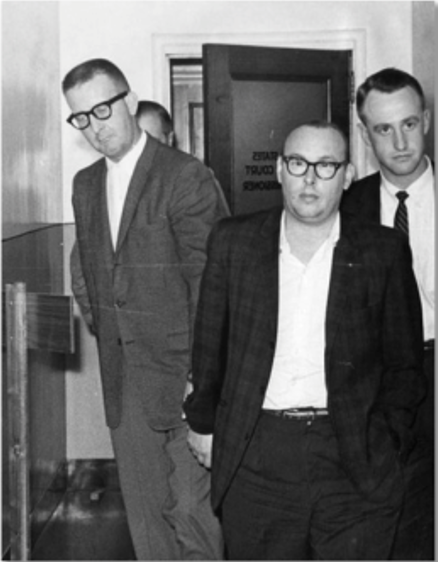
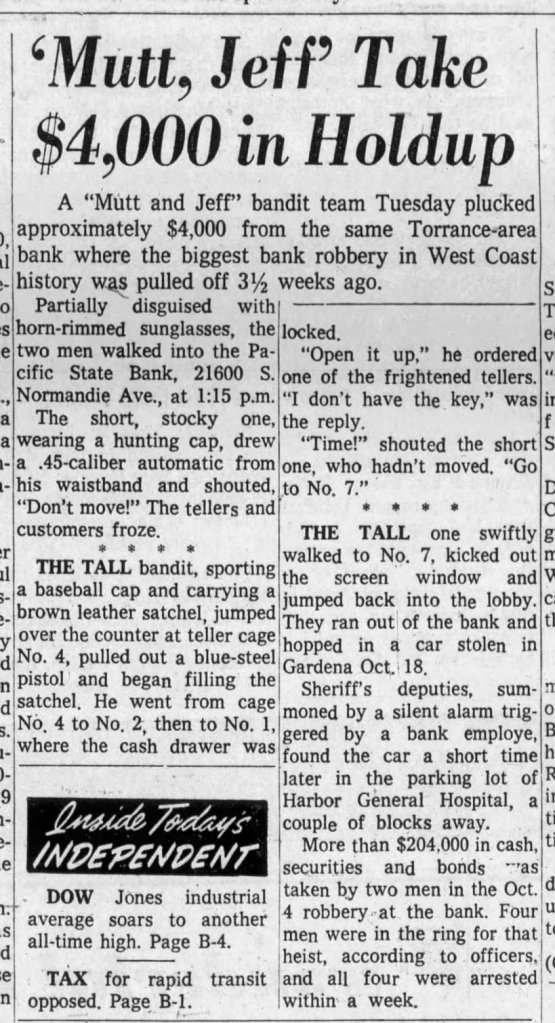
The “Mutt and Jeff Bandits,” as the police called them — a reference to the longtime comic strip that featured an odd couple of one tall man and his shorter friend — sized Jennings up as a 6-foot-3 man with a military crew cut, dressed in an Ivy League business suit with black-rimmed sunglasses. Rosenblooth, the stocky one at 5-foot-7, did all the work of leaping over the bank counter, cleaning out the money drawer with a white canvas sack, and walking out with no shots fired. They had also been called the “Countertop Jumpers” in other media reports.
The two walked back out, found their getaway car parked right in front, and quietly left before many in the building even know what’s going on. No video cameras to worry about at that time.
By the time they were arrested, Jennings and Rosenblooth had methodically knocked over 13 banks in less than 11 months and collected what court records showed to be more than $150,000.
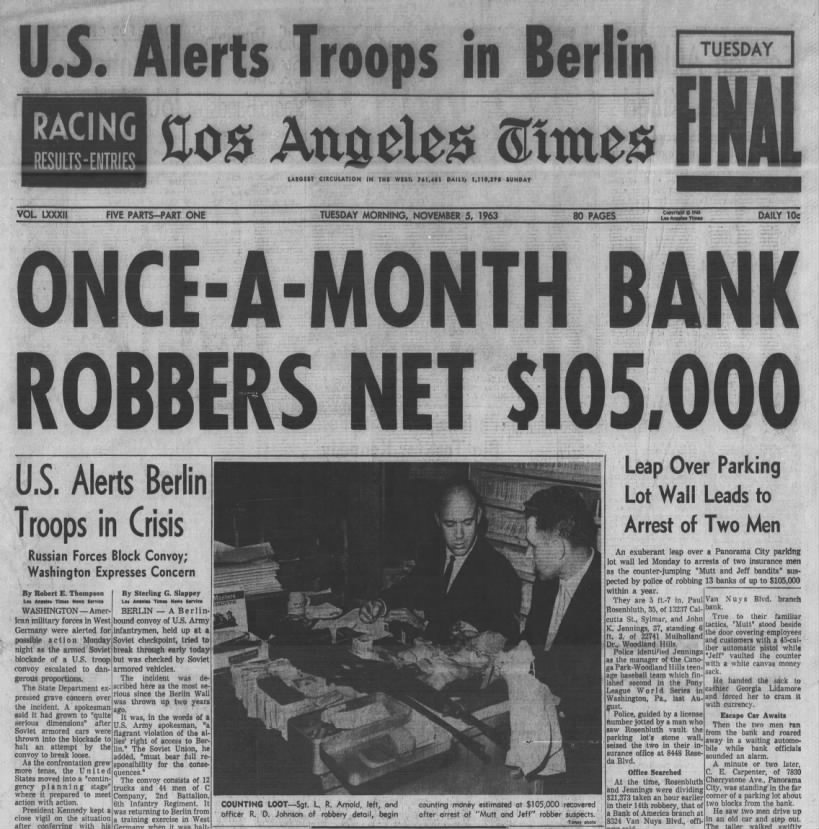
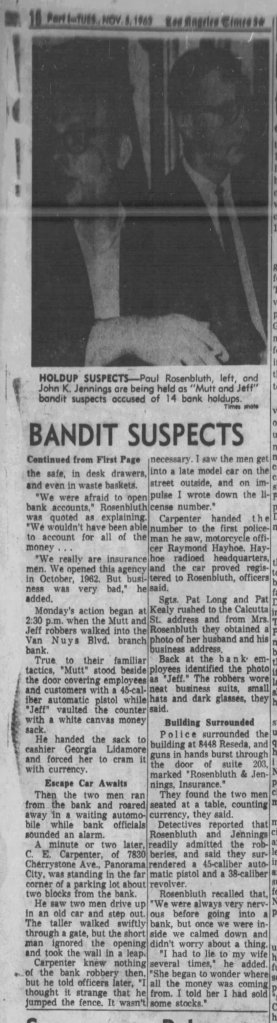
Once caught, they readily admitted to their crime. They were sentenced to 10 years in federal prison.
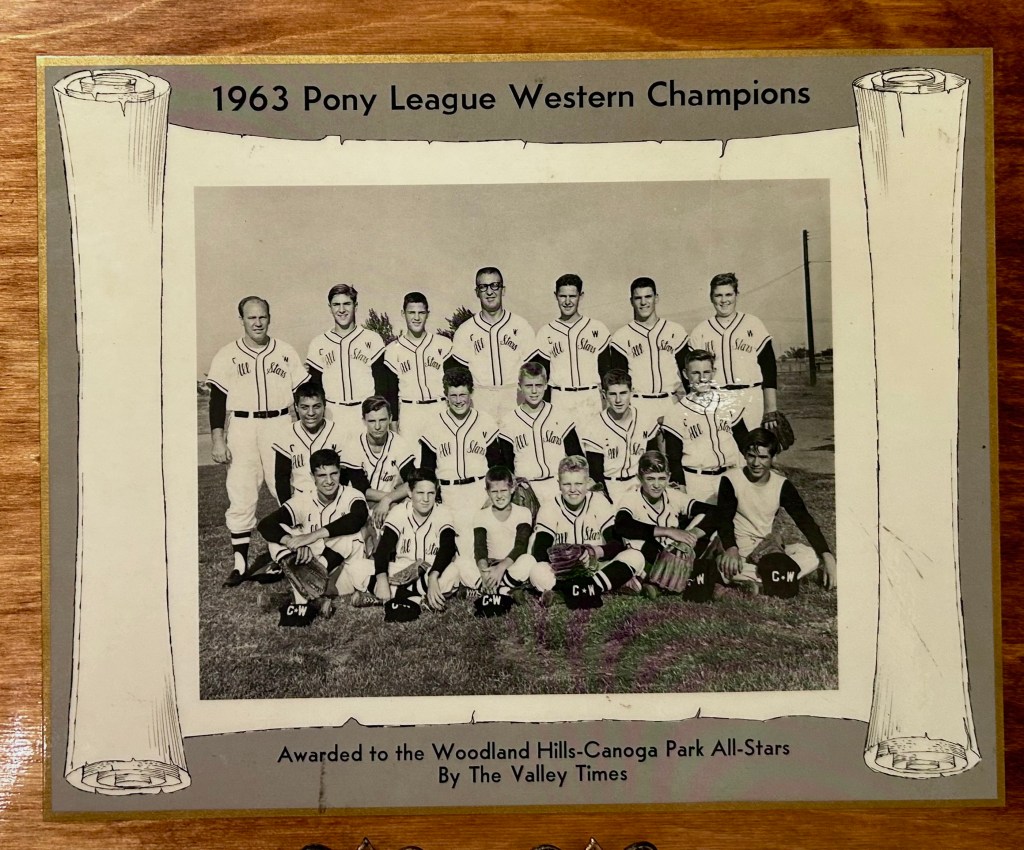
But all that summer of ’63, as Jennings managed the Woodland Hills-Canoga Park Pony League All-Star team — 15 players aged 13-and-14-year olds, including his son, Steve — the group was so talented it went to the national championship game in Washington, Penn.
Jennings was known as a successful agent working for the Beneficial Standard Insurance Agency on Van Nuys Boulevard in Northridge. Rosenbluth, who had no connection to the baseball side of things, was his business partner.
Dempsey was the youngest player on that Pony League All-Star team, the last one voted onto the roster as a shortstop, pitcher and first baseman.
The team played game all summer long around the San Fernando Valley. Not coincidentally, as it turned out, a series of bank robberies made the news not far from Jennings’ office — Sylmar, Northridge, Encino, Reseda and Van Nuys.
The robberies, in retrospect, seemed to align with the Pony League All Star team’s game locations.
Dempsey referred to that Pony League All Star team “a tight-knit group; we had pool parties, cookouts, all that. We had a lot of respect for (Jennings). He had a soft spot for players who didn’t have enough money to make road trips, and he was always paying motel bills.
“I can’t believe he lived less than a mile from our house.”
From Dempsey’s recollection and perspective, there were several bizarre element of the story.
“The parents used to play poker together,” he said, “and Mr. Jennings would use the money he got from the banks. Our shortstop’s father was a detective assigned to the ‘Mutt and Jeff’ robberies. How coincidental is that? He was assigned to catch them, never knowing one of them was the manager of his kid’s all-star team.”
Dempsey also saw the irony in the fact that Jennings “successfully robbed 12 banks, and we won 12 games. We lost the 13th, and he got caught on the 13th robbery. When we lost, he lost.”
Dempsey became the most successful of six players on the team who went onto play pro baseball at one level or another. Larry Yount, the older brother of future Hall of Famer Robin Yount, was one of them, a fifth-round pick by Houston out of Taft High in Woodland Hills. He ended up having his own bizarre start-and-finish as an MLB pitcher.
“It was kind of funny to revisit that whole story,” Dempsey said. “Maybe it wasn’t funny to some, but I still laugh about it. It just seemed like another crazy thing that happened around me.”
Decades later, Dempsey was part of a group with a couple of former teammates who tried to shop a script about the story to Hollywood. In 2009, Columbia Pictures and Adam Sandler’s Happy Madison production company bought it from Jonathan Schaech, Josh Wolf and Richard Chizmar. Having Dempsey attached to it provided credibility. But a deadline to act on the project expired.
Prior to that, Warner Brothers had the rights to it. Over time, Barry Levinson, Kurt Russell and Jim Belushi were somehow attached to it. A treatment filed with the Writers Guild of America expired in 2017.
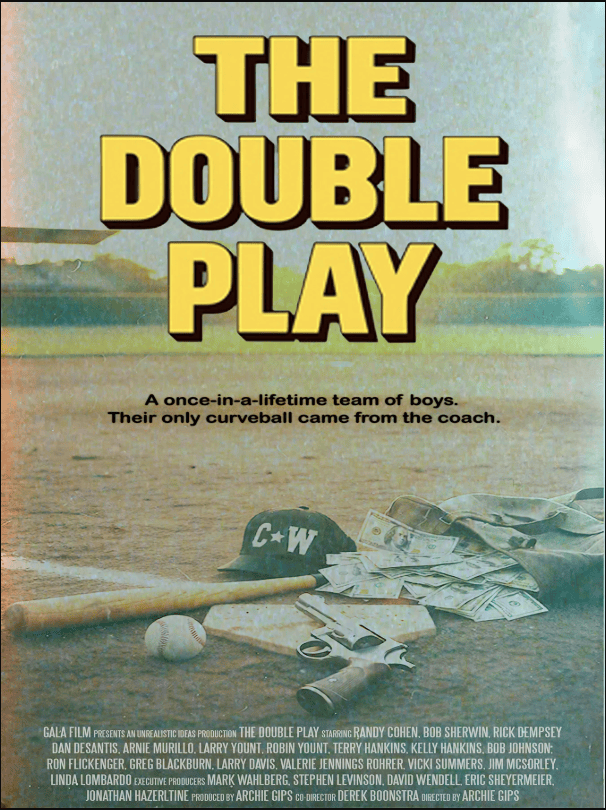
Dempsey and his friends decided to try to have this made in a documentary style format. Gala Films, connected with An Unrealistic Ideas Production house, created “Double Play: A Once-In-A-Lifetime Team of Boys … Their Only Curveball Came from their Coach,” with Mark Walhberg connected as an executive producer. Archie Gips took over as producer and director to help to shape the story to preview at film festivals in 2025.
Pulling together people to tell what they recalled needed some vetting. More elements to the story would pop up. Dempsey, for exampled, said he recalled hearing the last bank robbery took place in Pennsylvania, when the team was in the World Series and eventually lost.
“From what I was told, they came out of the bank, and kind of knocked a little old lady over,” said Dempsey. “In a small town like that, people know everyone, and she didn’t recognize them. So when she was looking in the Gazette sports pages at all the photos of the teams playing in the tournament, she spotted Mr. Jennings. The FBI flew to L.A. and caught him.”
That wasn’t accurate, but it made for another crazy element.
Steve Jennings eventually committed suicide, years after his life was derailed from the shame of his father’s crime. As it turned out, Jennings was not Steve’s biological father, but adopted him and his two sisters when he married their mother.
The Daily News story reported that Jennings had served his time at Terminal Island Prison in L.A. and also in McNeil Island, Wash., before he was granted parole after 7 ½ years. He died of esophageal cancer in 1986.
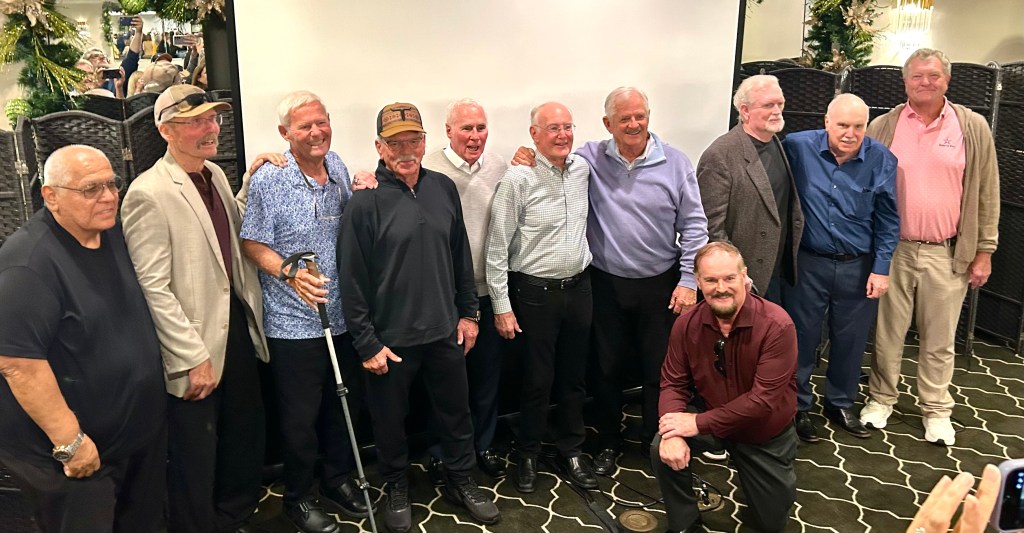
As the opening-night presentation for the NINE Spring Training academic conference of baseball historians in 2024 in Scottsdale, Ariz., Dempsey was part of a panel discussion with Gips, as well as Larry and Robin Yount and teammate Randy Cohen, to talk about their journey in having the film made.
But when a 2025 screening of “Double Play” in the San Fernando Valley took place, and the release of a new book called “The Counterfeit Legend: Respected Pony League Manager Lives Double Life Robbing Banks” by one of Jennings’ daughter, Victoria Summers, the whole story took an unexpected turn.
Summers revealed stories about Jenning’s abusive nature. He had another double life after prison, living on Catalina Island. He wasn’t dead, as it was assumed.
“Everyone spoke so highly of him and his contributions to society,” Summers wrote about being present at her father’s funeral services. “One of my friends stood at the pulpit and shared about his achievements as the Canoga Park-Woodland Hills Pony League baseball team manager … His friend told us about an awards banquet that was given in the team’s honor, including a presentation from the Bank of America, where they gave him an award plaque for Outstanding Contribution to the Community.
“It was difficult hearing all the praise about this man who had lived a double life, reinventing himself over and over again in order to hide his criminal past and abuse behavior. Not one person at that ceremony knew the truth about John Jennings like I did … not even my mother knew who he really was.”
The post script
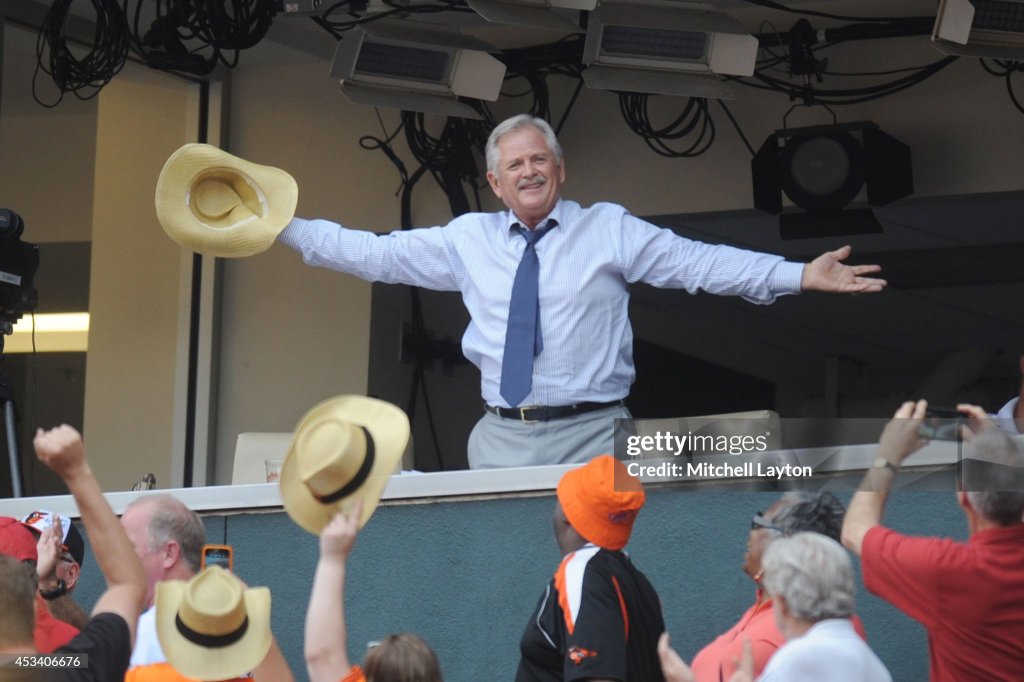
Rick Dempsey’s rugged run as a rare four-decade MLB player succeeding as the game’s most demanding position and playing on some of the game’s most celebrated teams is remarkable in itself.
In a piece by Joe Posnanski about Dempsey’s career, it’s also interesting that Dempsey had longest of any MLB player never to make an All-Star team.
Through it all, Dempsey showed his grit:
Dempsey had plenty of fun times to create:
Especially during rain delays:
Dempsey had his share of disagreements with opposing players:
And there was even a time when hes fined $1,000 and given a one-game suspension:
Dempsey also had a flare for the dramatic:
In that 1989 game at Montreal — a 1-0 victory after 22 innings, his solo homer was the 20th hit by the Dodgers that night. He came in for Mike Scioscia and caught the last 14 innings. He threw out the Expos’ Red Hudler trying to steal second base for the final out. Previously, the 21st inning, when the Expos had the winning run on second base, the Dodgers decided to intentionally walk Tim Raines with two out. Dempsey then picked Raines off with a back throw down to first to end the threat.
During the 1988 World Series run, in the first game of a July 26 double header against San Francisco, Dempsey had a game where he reached base four times — a homer, a double and two walks — in a 7-3 win. His home run was a two-run shot off Terry Mullholland that broke a 1-1 tie in the seventh inning and helped Hershiser to his 14th win.
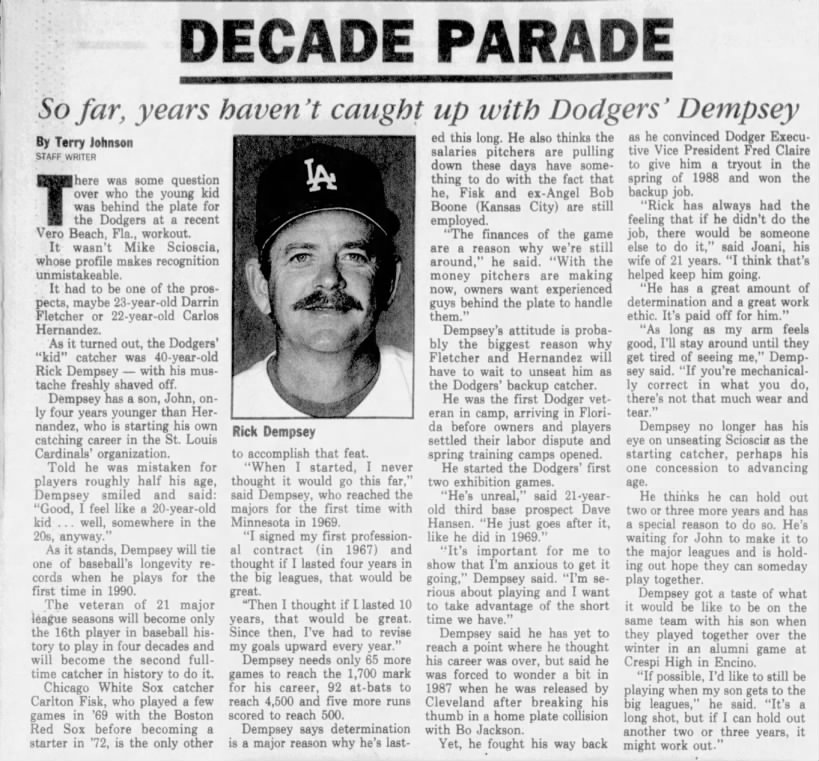
In the 1988 National League Championship Series, Dempsey went 2-for-5 with 2 RBIs against the Mets and had a 1.300 OPS. In the 1988 World Series, he had an RBI double in the Game 5 clincher. He had a batting average of .308 in three World Series (’79 and ’83 in Baltimore, ’89 for the Dodgers).
After he caught the last strikeout from Hershiser, Dempsey shoved the ball in his back pocket and rushed to the mound. He later gave it to Dodgers general manager Fred Claire as a thank-you for signing him. Claire eventually donated it to the Baseball Hall of Fame.
“I obviously didn’t impress Fred enough when I first talked to him on the phone (because) I never heard back from him, so I came in to see him,” Dempsey told the Los Angeles Times during spring training in 1988 about why he was there.
“The most nerve-wracking part was sitting in his office after everybody had left and not knowing what (Claire) was thinking. I had to convince myself not to give up and go home.”
Dempsey stuck around for three seasons with the Dodgers. There was also the game on May 18, 1990 at Dodger Stadium when Dempsey, at age 40, hit home runs to lead off the third and fifth innings against Philadelphia in a 4-2 Dodgers’ victory. They were the only two homers he hit that season.
Dempsey was never one to even consider retiring.
When he moved onto Milwaukee at age 412, the Brewers used him to pitch in two games. He has a career 4.50 ERA.
Dempsey, who met his future wife, Joani, in the sixth grade at St. Mel’s Catholic School in Woodland Hills, had two boys also played baseball at Crespi.
He has never been one to distance himself from the “Mutt and Jeff Bandits” story as he remembered it playing out, but always trying to find what the lesson to be learned was from it:
Dempsey dedicated a chapter to it in his 2017 book, “If These Walls Could Talk: Stories from the Baltimore Orioles Dugout, Locker Room and Press Box.” Dempsey wrote that he believed Jennings was in prison “watching me become the Most Valuable Player of the 1983 World Series.”
In his 2008 Crespi High Hall of Fame induction speech that was included in his official biography by the Society for American Baseball Research, Dempsey said: “I went off to work when I was 17 years old and I focused on professional sports … and I knew that if I got hurt, or that if I didn’t make it, it was going to be a long hard trail for me to get anywhere in life.
“So that’s what motivated me more than anything else. … I wasn’t afraid of hard work.”
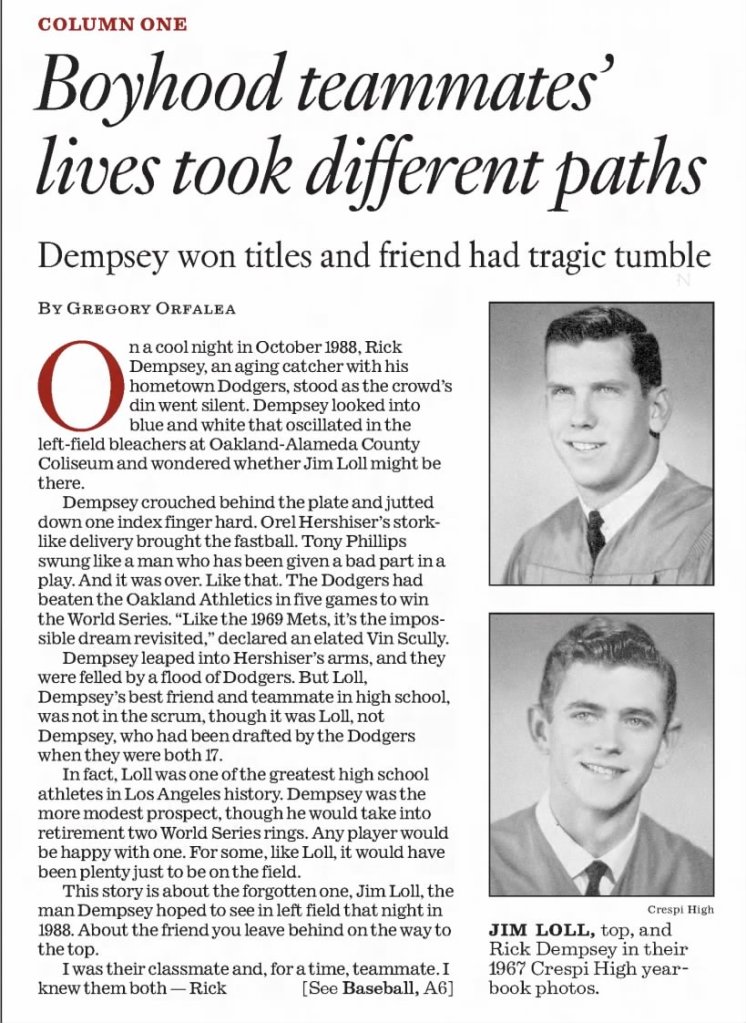
Gregory Orfalea did a piece for the Los Angeles Times in 2019 as a way to reconnect and reminisce about the time when he, Dempsey and teammate Jim Loll played baseball back at Crespi.
“I was their classmate and, for a time, a teammate. I knew them both — Rick and Jim — was awed by them both,” Orfalea wrote.
Orfalea called Loll “was one of the greatest high school athletes in Los Angeles history. Dempsey was the more modest prospect.”
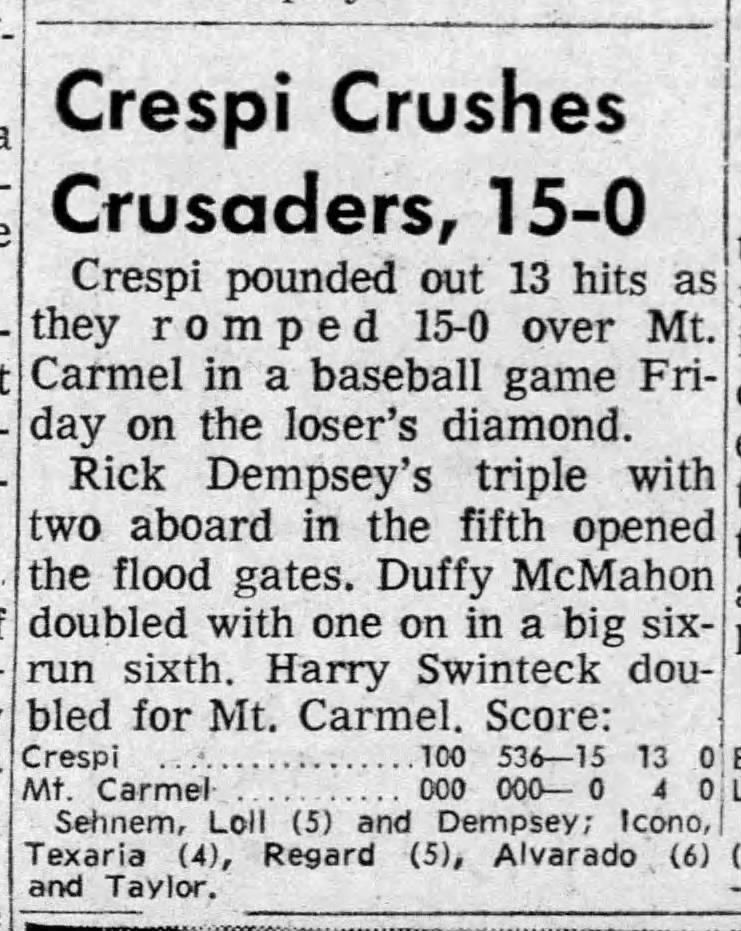
Nicknamed “The Bear,” Loll was almost 6-foot-3 and 188 pounds when he won two Camino Real League batting titles and also had a 0.98 earned-run average as a pitcher.
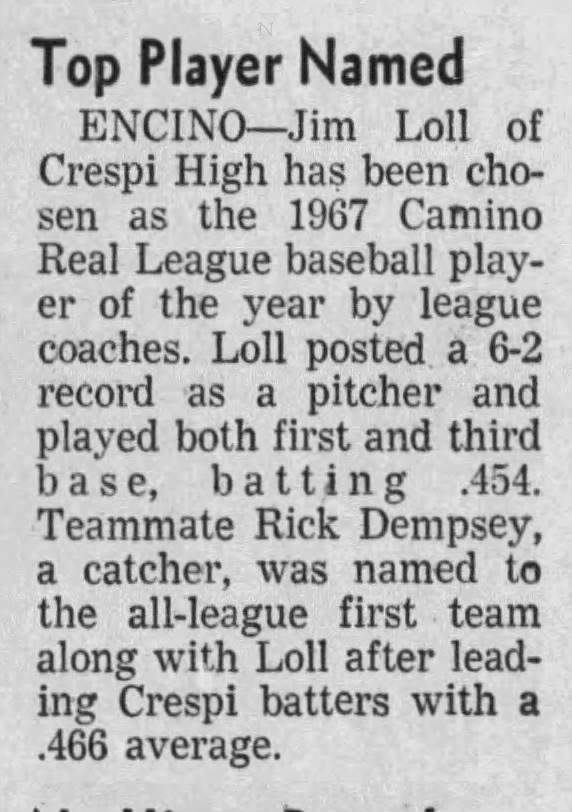
Loll and Dempsey hit .454 and .466, respectively, during their senior year at Crespi.
Loll was the Camino Real League MVP and was second-team All-CIF-2A division at first base; Dempsey was CRL first-team catcher.
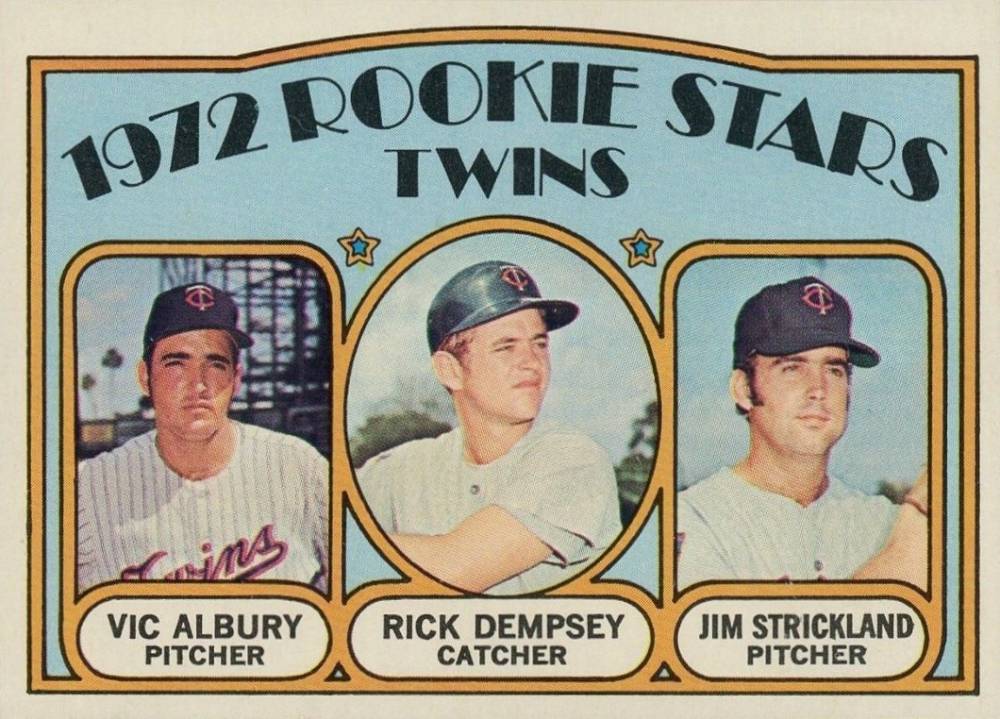
In the 1967 MLB Draft that included future Hall of Fame catchers Carlton Fisk and Ted Simmons, as well as All Stars Vida Blue, Bobby Grich, Steve Yeager, Dave Kingman, Jerry Reuss and Don Baylor, the Dodgers took Loll in the 14th round; the Minnesota Twins took Rick in the 15th.
Both were offered a paltry $6,000 signing bonus. Dempsey signed and went to work. Loll balked at the offer and went to L.A. Pierce College.
The Dodgers drafted Loll again in the eighth round of the secondary phase of the January 1968 draft. Loll passed again, went back to Pierce and was was Metropolitan Conference Player of the Year as a sophomore.
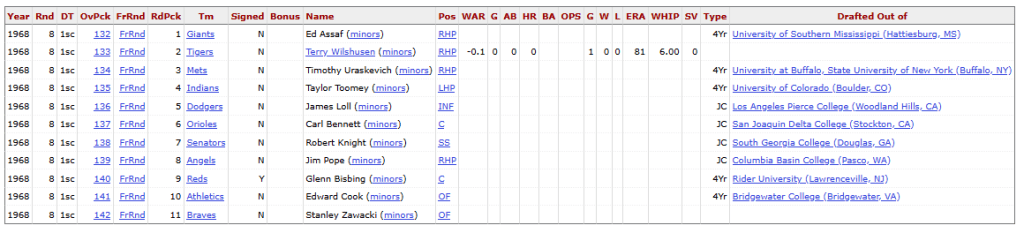
An invitation for Loll to play at USC by coach Rod Dedeaux never panned out. Loll went to Valley State (Cal State Northridge), hooked onto a semi-pro team affiliated with the Angels and caught the eye of a scout for the Kansas City Royals. Loll hit only .109 in 33 games for the Kingsport Royals in Kingsport, Tenn. And that was that.
Dempsey tried to get Loll a tryout with the Twins’ Double-A Charlotte, N.C., team he was part of in 1970 and ’71. That didn’t work.
Loll started taking heroin. Then, as Dempsey said, Loll just disappeared.
Orfalea describes a night game at Angel Stadium when the Orioles’ Dempsey threw out four Angels runners “to the delight of us high school friends.” After the game, an old man walked from the shadows of the parking lot with a couple of his cronies. It was Dempsey’s father.
“Where do you stay now, Dad?” Rick asked, forlorn.
Two miles from the son’s house, in a broken-down trailer parked near a restaurant off Kanan Road in Agoura.
Rick’s father was found dead in 1987.
“I miss my father today,” Dempsey admitted to Orfalea. “‘I hated him, yes, for a long time, and protected my family from him. But I wish he could have seen (my sons) John and Christian grow up.”
In Dempsey’s 2017 book, he writes that his father had been an opera singer on Broadway.
“(My love for baseball) began even if it meant standing up to my father, who was 6-foot-4 and 260 pounds with hands three times the size of mine. If you got in trouble, he wouldn’t be afraid to knock you around a little bit. But he was a great guy and probably brought the energy of the game out in me as I played Little League.”
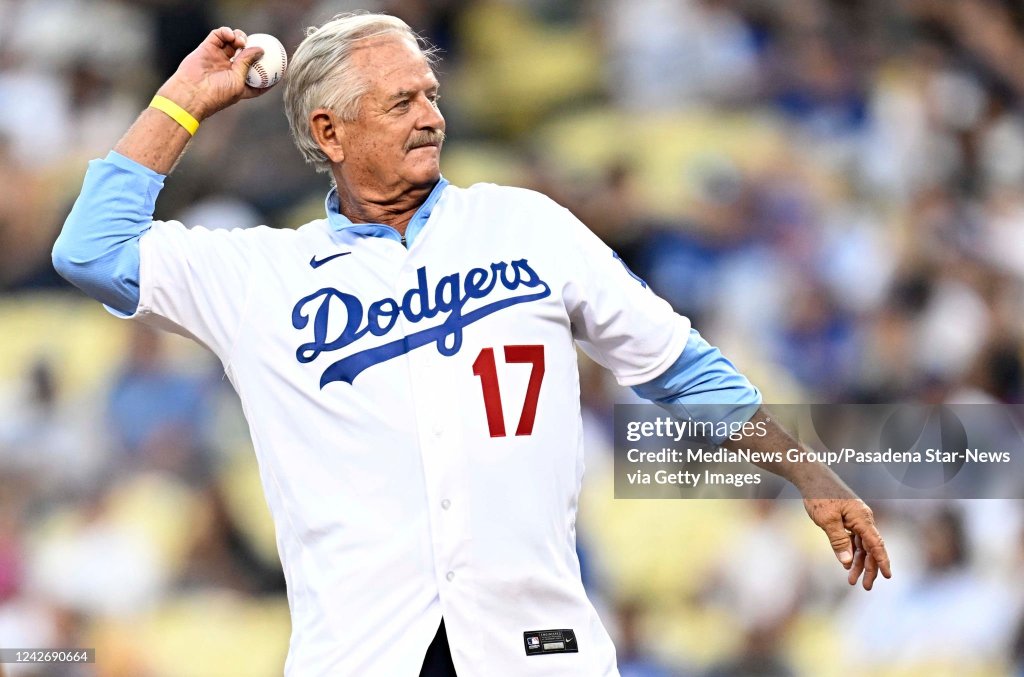
On Nov. 21, 2001, Jim Loll died of an overdose. He would be inducted into the Crespi Athletic Hall of Fame in 2012. Dempsey was part of the Crespi Hall’s Class of 2008.
Dempsey longed to be a major-league manager after his MLB playing days and spent two seasons in the Dodgers organization, guiding the 1994 Albuquerque Dukes to the Pacific Coast League championship. He also spent time as the Dodgers’ third-base coach and bullpen coach, hoping that would lead to a big-league manager job.
Eventually, Dempsey got into broadcasting for the Orioles and now is heading Rick Dempsey Sports, a baseball training facility in Maryland.
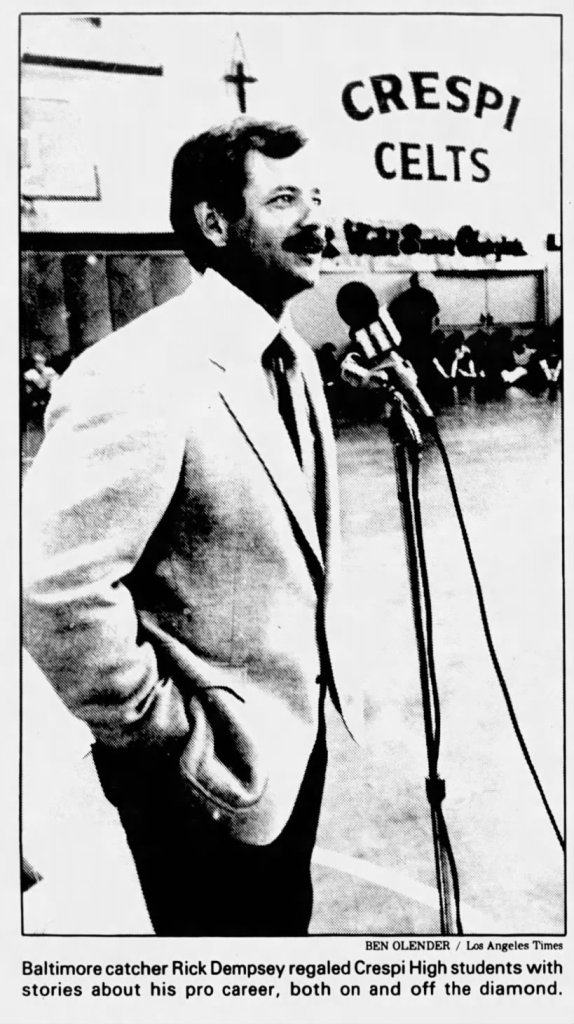
“Ultimately, we all get taken down a peg, maybe many,” Dempsey admitted to Orfalea. “We’re stripped naked, really. It’s at those times you’re held up by those who truly know you and love you. By the same token, we’re all given a choice — to crawl up and die, to be like the guy who goes to the market, gets his dinner, goes back to his apartment and crawls in bed. A hermit. But is that living? Avoiding conflict?
“You have the choice, to live or not. And if you choose to live, you may as well go all out.”
Dempsey added: “None of us have an idea what is in the mind of God. There’s absolutely no way we can get a true focus on the reason for all that happens in our lives or others’. We just don’t have the scope. But, of course, all of us judge and get judged — but how much, really, can we, compared to God?
“The vision of God is so much larger than the huge set of rules we were brought up with. Think of it. We are all so human and weak. No one, I don’t care how strong he is, is perfect or able to get by without failing many times. And you do things oftentimes knowing they’re wrong, even saying to yourself you can’t help yourself. And the truth is — you can’t.”
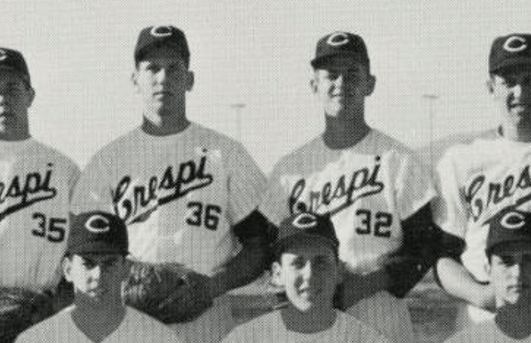
In a complementary piece to his L.A. Times story, Orfalea came to the realization: “For various reasons, Loll never made it the way his buddy Dempsey did.” He could also look at, for another example, the story of Steve Chilcott, a player Dempsey would be measured up against during his high school days who became the No. 1 overall draft choice by the New York Mets out of Antelope Valley High in Lancaster and never made it past a few games in Triple A. Chilcott was on the All-CIF 2A team with Loll.
Orfalea reflected on what Dempsey had told him for the story: “I thought of Dempsey’s notion of super-empathy, not only that we are in others, and others in us, despite our different fates, but they are us. And that’s why we never really let them go.”
Who else wore No. 56 in SoCal sports history? Make a case for:
Gary Zimmerman, Los Angeles Express offensive lineman (1984 to 1985) via Walnut High:


Best known: Born in Fullerton and a standout at Walnut High, Zimmerman risked future NFL earnings by agreeing to go from the University of Oregon straight to the rebel United States Football League and watch the blindside of Los Angeles Express star quarterback Steve Young. Enduing up with a bronze bust in the Pro Football Hall of Fame seems to have proven Zimmerman’s decision wasn’t a bust for him at all as much as it was for others.
The United States Football League had a name that seemed to demand a sense of duty to country and capitalism for any able-body college player wanting to serve a greater purpose. Games were played between Presidents Day and the Fourth of July, but also meant some heavy lifting on Easter Sunday.
The Express was one of its original dozen teams when the USFL sprung up in 1983. It would go away ingloriously in 1985, buried in court documents. While the USFL may seem like a branding opportunity missing a few vowels of being really useful, it actually was an interesting entry point to professional life for someone like Zimmerman.
The Express tried to make itself/themself — we’re still unclear of a plural possessive for a noncount noun serving as a sports team name — as NFL-ready as possible. Maybe there would be a day when the USFL could migrated the best of its talents under contract to a September-to-Super Bowl schedule. There were a few rouge owners who had similar ideas (see: Trump, Donald; New Jersey Generals). Still, L.A. was always a place where things could happen and it could weather any stormy business matters.
Plenty of local talent at USC and UCLA were available for the Express — its first two headliner quarterbacks were Mike Rae and Tom Ramsey. Yet ownership pushed for bigger and louder. Bill Oldenberg, who came out of seemingly nowhere with bags of money, allowed team general manager Don Klosterman to go after the greatest haul of college prospects to start the 1984 season, at a time the city was ramping up for the Summer Olympics.
That started with the pursuit of Young, whose career at Brigham Young University had offensive coordinators as worried as excited about what he could bring. Before Young was brave enough to sign what was called the richest deal in pro sports history — $40 million over 43 years, which, in all practicality, was $5 million over the first four seasons, and a $37 million annuity — he and his advisors requested as much physical protection in front of him on the field as possible.
That’s how the 6-foot-6 and 264 pound Zimmerman became part of a package deal, a mass signing of massive men for this experiment.
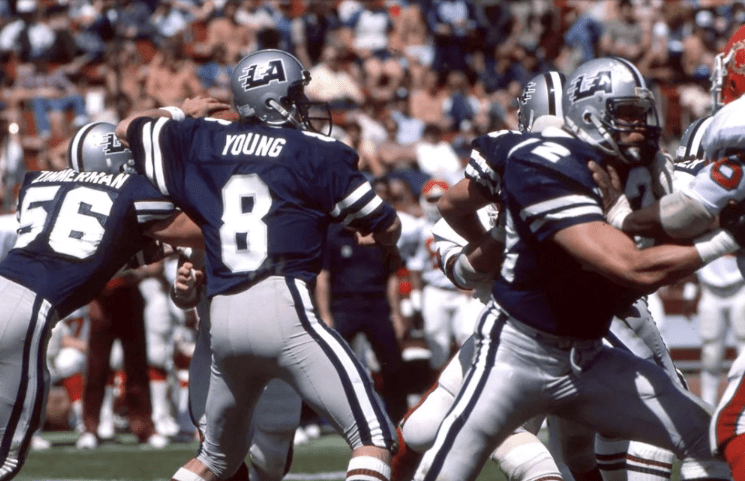
Oregon head coach Rich Brooks called Zimmerman the best lineman he had ever had. The 1983 Morris Trophy winner as most outstanding lineman in the Pac-10 was third-team All-American by AP and UPI. He made the University of Oregon Sports Hall of Fame in 2002. Zimmerman wore No. 56 as a Duck, and that would be the number he kept for his Express wardrobe.
At the time of the January ’84 draft, football experts said the Express had six players who could have been consensus first-round NFL picks if they just waited. Aside from Young and Zimmerman, there was offensive tackle Mark Adickes of Baylor, center Mike Ruether of Texas, defensive tackle James Robinson of Clemson, defensive end Lee Williams of Bethune-Cookman and defensive back Allanda Smith of Texas Christian.

Zimmerman was a second-round pick in the ‘84 USFL open-school draft. Adickes and Ruether came in a trade from the USFL’s Houston’s Gamblers for “future considerations,” even if no one know what the future of the USFL held. The Express also dipped into the NFL free-agent pool, signing Jeff Hart, a five-year starter on the offensive line for the Baltimore Colts who once protected quarterback Bert Jones.
By mid-February, the Express signed Zimmerman, Adickes and Ruether to what was reported to be a four-year, $5.9 million deal for each of them.
“I have no second thoughts at all,” said Zimmer of passing on the NFL to sign with the Express. “I heard I could have gone anywhere from the first 10 to the end of the first round, but the way I calculate that, I would have ended up on the East Coast. That’s not where I wanted to be. I still think about my buddies who are waiting for the (NFL) draft. They’re still looking for a job. But I’m glad I already have one.”
The team headquarters, originally at Long Beach State, moved to a converted elementary school campus in Manhattan Beach. Zimmerman started all 17 games for an ’84 Express team that could only generate a 10-8 record. The team, coached by former Los Angeles Rams’ starting quarterback John Hadl, tied Arizona for the Pacific Division lead in the Western Conference. With Zimmerman’s protection, Young threw for 2,361 yards and 10 TDs versus nine interceptions. He also rushed for 515 yards on 79 carries (6.5 yards a carry, among the league leaders) and seven touchdowns. The team was fifth in the USFL with just 38 sacks allowed. During the playoffs, the Express outlasted Michigan, 27-21, in a three-overtime thriller at the Coliseum in the first round. The Express lost at Arizona 35-23 in the conference championship.
That offseason, the greedy USFL owners voted to move to a fall schedule by 1986.
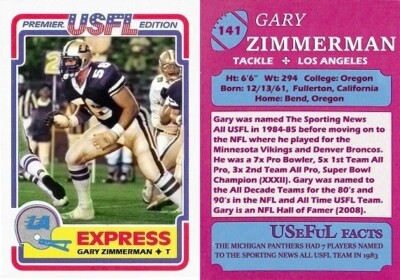
Before that could even be considered, several teams folded, merged and relocated for the 1985 season. The Express seemed to do all three and shriveled to a 3-15 record, with Zimmerman starting all 18 games. Young even moved from quarterback to fullback in the team’s final game, which was switched from the usual L.A. Coliseum to L.A. Valley college. Young completed 137 of 250 passes for 1,741 yards and six touchdowns against 13 picks. The Express averaged a league-low 14.1 points a contest.
As the wheels were coming off the gravy train, Zimmerman decided at one point in that ’85 season to walk out of training camp for a day and half because he said the Express had not put up an annuity payment on his contract. He had to take a number.
The Express disappeared before the ’86 season, with the USFL not far behind.
Zimmerman’s league rights at first became property of the USFL Memphis Showboats. But in May of 1986, Zimmerman sued the league, contending he was free to negotiate with the team of his choice — particularly the NFL’s Minnesota Vikings, who had his rights after the New York Giants traded him there for two second-round picks. The suit contended Zimmerman was entitled to $675,000 for the final two years of the contract he signed with the Express, as well as 30 years of deferred payments totaling $3.095 million.
There were previous teams, long before the Express, who had flashes of football drawing power but not a long shelf life. The Los Angeles Dons of the All-American Football Conference (1946-to’49, where Klosterman once played), the Hollywood Bears, the Los Angeles Wolves and Los Angeles Bulldogs of the Pacific Coast Professional Football League (1940 to ’47), the Long Beach Admirals of the Continental Football League (1967) and the Los Angeles Xtreme of the XFL (2001).
As an NFL mainstay back at left tackle for the last dozen of his 14 professional seasons, Zimmerman started 184 games, including 169 in a row. The first seven years were in Minnesota (1986 to ’92) and the last five in Denver (’93 to ’97, finishing off with a Super Bowl XXXII title for the Broncos in San Diego). It covered seven Pro Bowls, three times as first-team All-Pro. He also bridged decades enough to where he was on the Pro Football Hall of Fame’s first-team All-1990s after he was second-team All-1980s.
He did all that wearing No. 65 — and, in some lists that ranked such thing, he could be considered the greatest No. 65 in NFL history. In Minnesota, he opened holes for Herschel Walker. In Denver, he protected John Elway.
In the Pro Football Hall of Fame, five players whose careers shined in the USFL are included — with Young, Reggie White, Sam Mills and Jim Kelly, there is Zimmerman. In his 2008 induction speech, Zimmerman recognized the coaching he received at Walnut High and the L.A. Express as part of his journey. He also said when he agreed to go to the University of Oregon, thought he was going to be a middle linebacker, but he was handed jersey No. 75.
“Nobody starts out wanting to play the offensive line position, it’s just where we end up,” he said. “Offensive linemen conform to the herd principle. It’s not good to be singled out for good or bad, and that’s why it’s difficult for me to stand up here alone getting this incredible honor. There should be a stage full of guys up here standing here receiving this honor with me.”

As he wrote his 2018 book, “Football For A Buck: The Crazy Rise and Crazier Demise of the USFL,” Jeff Pearlman listed Zimmerman as No. 13 on his list of the 25 greatest players in USFL history.
Why not higher up, considering his Pro Football Hall status?
“While he was terrific, Zimmerman could look left and right on the Express offensive line and see a conga of stars … paid big bucks to also block for quarterback Steve Young and his merry band of weapons,” wrote Pearlman. “Ultimately, Zimmerman’s greatness developed as he went along.”
Jarrod Washburn, Anaheim Angels/Los Angeles Angels of Anaheim pitcher (1998 to 2005):
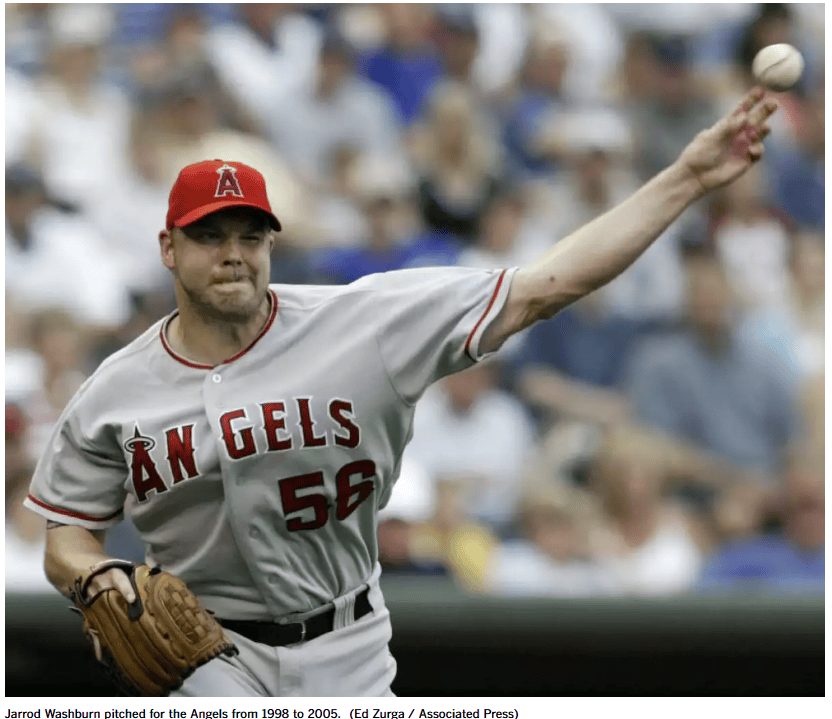
Best known: His 18-win season and 3.15 ERA during the Angels’ World Series title run of 2002 led to a fourth-place finish in the AL Cy Young voting. He finished the year winning four of his final five stars with an ERA of 1.93 in September. Washburn also got the win in the decisive Game 4 of the ALDS over the Yankees. His eight-year run with the Angels resulted in a 75-57 record and 3.93 ERA.
Doug Smith, Los Angeles Rams center (1978 to 1991):

Best known: A six-time Pro Bowl center out of Bowling Green started 160 of 187 games over his career, settling into the position after he played previous seasons early on as a right guard and right tackle. But that wasn’t anticipated at all when he went undrafted in the NFL after his college career ended. While Cleveland and Philadelphia wanted to sign him as a free agent, “the Rams offered me a little bit more money because I didn’t know that the cost of living was higher in L.A. than it was in the other places,” Smith once said. “They needed a long snapper, and I long-snapped since I was 10, so I thought that may be my way into the NFL.” A change in coaches from George Allen to Ray Malavasi to John Robinson made Smith’s career last even longer. Starting at right guard in 1980, and at right tackle the following season, Smith became the Rams’ first-team center in 1982. Two seasons later, his seventh in the league, he was chosen to play in his first Pro Bowl. “I guess part of it was proving people that didn’t think I was going to make it wrong,” he said of his career. “When I left on the plane (after signing with the Rams as an undrafted free agent), there weren’t too many people not expecting me to be back home in a few weeks,” Smith said.
Hong-Chih Kuo, Los Angeles Dodgers pitcher (2005 to 2011):

Best known: The Taiwan-born left-hander made it into 218 games over seven seasons (13-17, 3.73 ERA) with 14 starts — as well as an All-Star appearance in 2010, a season where he had a 1.20 ERA in 60 innings with 72 strike outs, 12 saves and a .211 opponent batting average. He got the first two outs in the fifth inning and gave up an unearned run, the only run the AL squad could muster as the NL posted a 3-1 win at Angel Stadium of Anaheim (as it was called) as Kuo’s Dodgers teammate Jonathan Broxton got the save.
Pedro Astacio, Los Angeles Dodgers pitcher (1992 to 1997): The Dominican wore No. 59 for his first season and changed to No. 56 as he had a 14-9 record and 3.57 ERA in 31 starts the next year.
Kole Calhoun, Los Angeles Angels outfielder (2012 to 2019): A Gold Glove winner in 2015, Calhoun had a 2019 season with 33 homers and 74 RBIs.
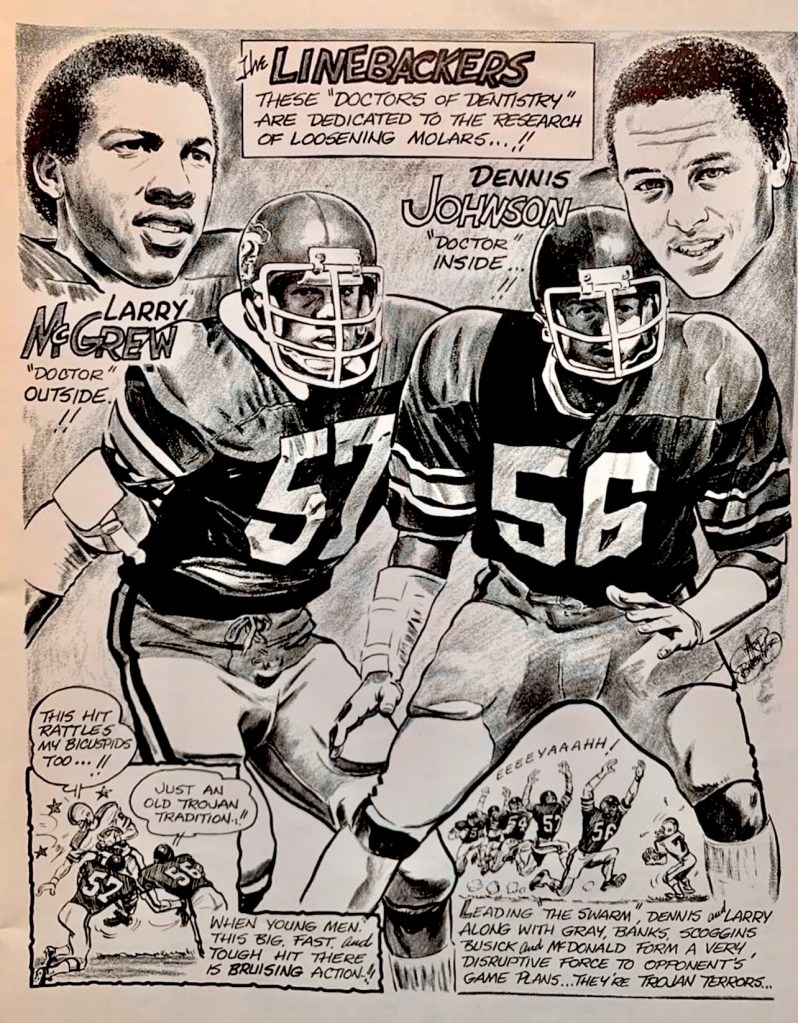
Dennis Johnson, USC football inside linebacker (1977 to 1979): A three-year starter and first-team All-American as a senior and part of the Trojans’ 1978 national championship team, he was also first-team All-Pac 10 as a junior and senior.
We also have:
Morgan Fox, Los Angeles Chargers defensive lineman (2022 to 2024) (started wearing No. 70 and No. 97 for the Los Angeles Rams from 2016 to 2020).
Anyone else worth nominating?


