Extra inning baseball book reviews for 2020: How a ball baptized in a Cooperstown creek soaks up, and rebirths, some vital Hall history

Robinson Hall Ball
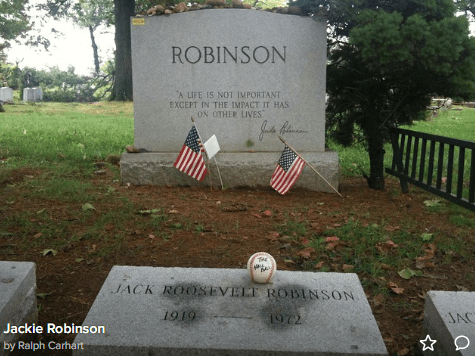
Jackie Robinson’s final resting place at Cypress Hills Cemetery in Brooklyn, N.Y., along with with “The Hall Ball” in the foreground, taken by Ralph Carhart on Sept. 17, 2010.

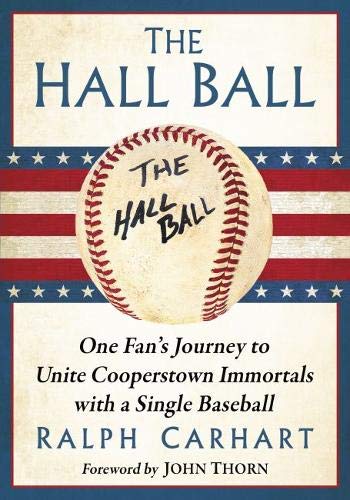
The Hall Ball: One Fan’s Journey to Unite
Cooperstown Immortals with a Single Baseball
51zTYMhUa0L
The author:

Ralph Carhart

The publishing info:
McFarland & Company
$29.95
175 pages
Released June 24, 2020

The links:
At the publisher’s website
At Bookshop.org
At Amazon.com
At BarnesAndNoble.com
At Powells.com
At Indiebound.org
At the author’s website

The review in 90 feet or less

A pilgrimage to the Baseball Hall of Fame in Cooperstown, N.Y., shouldn’t be just on some bucket “wish list,” but a must-commit adventure, preferably if you can do it with family in various generations and factor in the travel navigation that will likely take you through New York to Syracuse to a rental car that could easily be a horse and buggy.

You step back in time. You see a city that’s far more an oasis that you’d imagine in Field of Dreams. And, it has its own dream field — Doubleday Field, where you can compare photos of the grandstands and how everything looks the same today as it did some 80 years ago when the shrine was created to honor the giants of the sport.

It’s been about 10 years now since our first and only visit. A great friend of mine had the idea to take our sons there for a Father’s Day trip – his son actually worked in Cooperstown at the time, at the nearby Ommegang Brewery. It was too perfect. The gang arrived, and that weekend included having a catch on the Doubleday Field, then watching a bunch of former MLB players participate in an exhibition game of sorts. We ended up connecting with Tim Leary, the former Dodgers pitcher, and have stayed in contact ever since. We even had a special basement tour of the Hall to handle some items not accessible to the public, thanks to Brad Horn, who spent nearly 15 years as the facility’s director and VP of communications and education and now teaches at Syracuse.

Whether or not we actually noticed of a small creek that ran next to Doubleday Field as we explored the grounds, we can’t recall. But considering to absorb in that surrounding area of walking trails and quaint neighborhood strolls, we could see plenty of hiding spots for stray foul balls from the field.

We weren’t on a real fishing expedition and didn’t bother trolling it for any treasures.

But one time, Ralph Carhart did.

And this became his brilliant idea for a story.

As it turned out, we were in Cooperstown during the same summer – 2010. Ralph was there with his wife, Anna. During their time, she pulled a ball out of that creek. It was a Diamond brand, intended for high school games, not real major league caliber. But it became eventually “The Hall Ball” (after it was temporarily lost in the car for a couple of days) and a major-league adventure.

NYT
Ralph Carhart, from a 2017 New York Times story on his Hall Ball quest, taken at Calvary Cemetery in Queens, N.Y, as he tried to find an unmarked graves for Bryan Thomas for The New York Times)

Carhart, a Brooklyn-based theater director and manager, decided to fashion his own script – what if this ball was taken to every member of the Baseball Hall of Fame, dead and alive, to connect with it? What if the Baseball Hall of Fame eventually took possession of it and displayed it to share with others?

Of course, with most of the Hall of Famers no longer living at this point, it would take a lot of cemetery visits. Carhart would end up in 34 states, plus Cuba, spread over several years, funded as best he could.

(Maybe to no surprise, the journey left Carhart as the lead for the Society for American Baseball Research’s 19th Century Baseball Grave Marker Project.)

Finding those who have passed was one element. Tracking down the living members would be a feat unto itself. As he explains on page 79:

Lasorda hall
Tommy Lasorda doesn’t seem to know what to make of “The Hall Ball,” where he photographed on April 22, 2012.

“Soon enough, I developed a ‘rap,’ a quick four-sentence version of the project I told the players to give them maximum information in minimal time. Specifically, ‘My name is Ralph Carhart and I have been taking this baseball to all the members of the Baseball Hall of Fame, living and deceased. If they are alive, I take a picture of them holding the ball, and if not, I take a photo of the ball at their grave. Once I have photographed all of them, it is my intention to donate the ball to the Hall of Fame. As of today, I have photographed X members. I am hoping you will be number Y.’

“When I gave the rap to Tommy Lasorda, he looked at me incredulously and asked me to repeat myself. I did, and he let me take the photo, but the look of bewilderment you see on Lasorda’s face is genuine. He was the first who made it clear that he thought the project strange.”

Those who know Lasorda, maybe not a surprise, eh?

The encounters along the way are part of the story, of course, as you find out those who couldn’t be reached, remained elusive (think Sandy Koufax) and could be added in future updated editions?

Having MLB official historian John Thorn do a fantastic piece for the book’s forward gives this project a blessing as what he calls “strangely moving … part travelogue, part baseball history, part photo journal.” He also equates the project to flagpole sitting – “all of us who deeply care about some one thing – beyond how they might feel about some one or more persons – will understand” this attempt and “a lucky few of us do get to share that unrequited love in print.” Continue reading “Extra inning baseball book reviews for 2020: How a ball baptized in a Cooperstown creek soaks up, and rebirths, some vital Hall history”
Extra inning baseball book reviews for 2020: The sequel to ‘My Three Sons’ in a non-major way … and it isn’t their first Cowboy Monkey Rodeo

A13l2gqllkL._SX800_
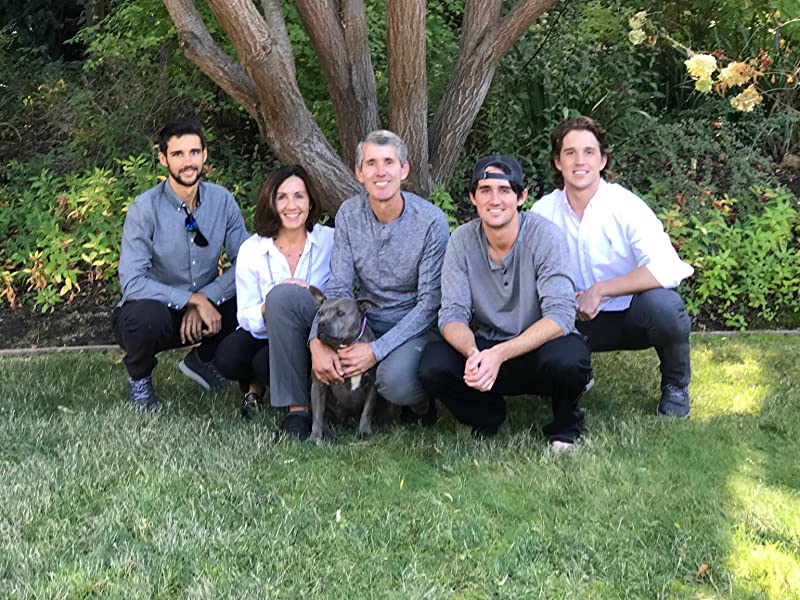
The Diekroeger family, with book author Kathy second from left.

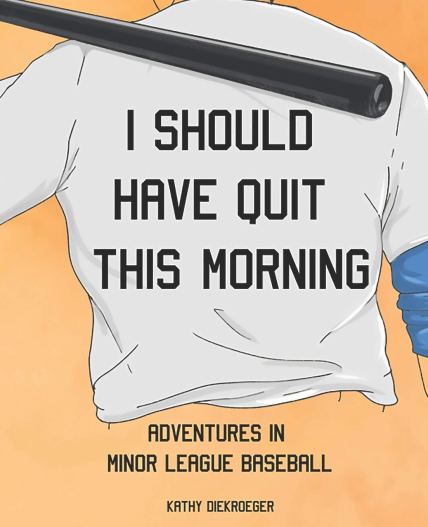
I Should Have Quit This Morning:
Adventures in Minor League Baseball

61Eeddig2wLThe author:
Kathy Diekroeger

The publishing info:
Independently published
319 pages
$14.99
Released April 8, 2019

The links:
At Amazon.com
At Indiebound.org

The review in 90 feet or less

Reaching back to a review a baseball book more than a year old usually strays from our mission to just review “new” publications. Yet having stumbled upon this during research for another project, we couldn’t help but fish it out of the stream, dry it off, and hold it up to the sunlight.

It’s a beauty.

Here’s the mother of three boys who played baseball at Stanford, which means, in her lifetime, she watched “more than 2,100 baseball games – and stopped counting when two of them made it into the professional ranks.”

For the next four years, she kept hearing their stories – humorous, heartbreaking, soul-searching. Capturing the stories of 28 players she knew based on their time with her sons – a couple who went onto some MLB notoriety – Diekroeger said she decided it was the right time to “document and share those experiences with anyone who considers themselves a fan of baseball.”

Bring it on.

Diekroeger, who degrees from Dartmouth and Stanford, lives with her husband in the small San Francisco Peninsula town of Woodside.

Her offspring/social science experiments:

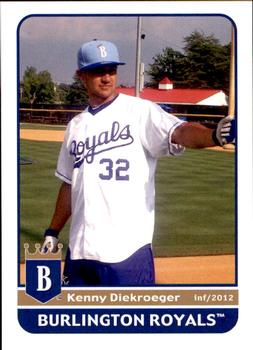
179370-11486102Fr== Kenny, 29, who has his own Stanford BA and MBA in management science and engineering, works in the financial world these days after logging four seasons in the minor leagues as a second baseman. The Kansas City Royals’ fourth-round pick in 2012 – he was also a second-round pick by Tampa Bay in 2009 but passed on a $2 million bonus, opting for college – reached Triple A Omaha in 2015.

At Stanford, the 2010 Pac-10 Freshman of the Year was once considered a No. 1 overall draft prospect during his high school days.

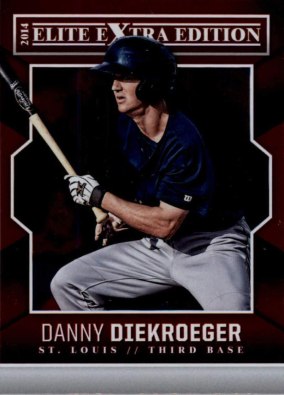
61gC6OgTmTL._AC_SL1114_== Danny, 28, became the Stanford shortstop and was the double-play combo with his older brother for awhile. Danny was a 10th round pick by St. Louis in 2014. His three-year, four-team trip through the minors ended in 2017, getting as high as Double-A level. With a computer science BA and Masters, his LinkedIn bio has him as a software engineer with a cryptocurrency firm.

== Mikey, 24, followed his brothers to Stanford and played third base from 2015-17. He may have been the wisest, never going into a pro attempt.

All and all, the kids were all right, enjoyed playing, then were smart enough to see a greater future in the money-making world elsewhere.

But the stories they, and their teammates, could tell. About the draft, their first contracts, getting moved up the chain, getting moved down, what bizarre things they ate, weather delays, playing through injuries, crazy in-game promotions, how they traveled, where they slept …

Yup, first-hand accounts, no holding back. Continue reading “Extra inning baseball book reviews for 2020: The sequel to ‘My Three Sons’ in a non-major way … and it isn’t their first Cowboy Monkey Rodeo”

Extra inning baseball book reviews for 2020: Viola: Two tricks you’d never expect to look for, thanks to a whizkid at Purdue and a cable tech guy in Tacoma

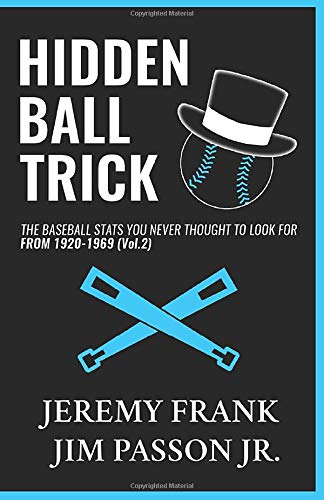
Hidden Ball Trick
The Baseball Stats You Never Thought To Look For
Vol 1: 1876-1919 and Vol 2: 1920-1969

41ZuVk04h-L

The authors:
Jeremy Frank and
Jim Passon Jr.

The publishing info:
Independently published
Vol. 1:
$11.99
232 pages
Released May, 2019
Vol 2:
$14.95
274 pages
Rreleased May 2, 2020

The links: At Amazon.com: Volume 1 and Volume 2


The review in 90 feet or less

4149fNCdi9LConsider the independent sources of this dependent material.

Jeremy Frank is a 19-year-old from Illinois studying data science at Purdue. He began his Twitter account, MLBRandomStats, in October 2015 as a freshman at Stevenson High School, near his hometown of Buffalo Grove, Illinois.

The Purdue school paper caught up with him for a story last April, and since then, the Lafayette (Indiana) Journal & Courier tracked him down as well to work something up.

It goes back to how this Twitter account seemed to blow up in July, 2018 after Frank posted something rather randomly interesting about Joey Votto’s pop-up rate. It now has 13,000 retweets and 33,000-plus likes.

In May 2019, the CBS affiliate in Chicago also did a piece on “the phenom” who admits he’s “just really good at math.” He’s got more than 56,000 followers now – still rather modest by some measures. Jayson Stark, for example, has 596,000-plus. But …

5b97567e-4d64-4647-915e-30bf063b76f2-IMG_8173

“I’ve used quite a few Jeremy Frank notes in my Useless Information column over the last couple of years,” said Stark, who currently works with MLB Network and is senior baseball writer for The Athletic. “One I remember is a note about how Yu Darvish had struck out 24 hitters in his last nine innings pitched, with a breakdown of how many strikeouts he stuffed into each inning. I then used his note to do more investigating, and it turned out no starting pitcher had ever struck out 24 hitters in any nine-inning span. That’s amazing, but I would have missed that if Jeremy hadn’t noticed and tweeted about it. So I think I need to tell him: Thanks!”

Frank now has a podcast at Purdue.

passonpngPasson is a passionate 42-year-old cable tech from Montana, now in Tacoma, Wash. His podcast, “Romantic About Baseball,” with Adam MacKinnon (who recently did a book for Rockridge Press called “Baseball For Kids” release last April).

Frank and Passon are  no doubt discombobulated at this point with no 2020 MLB data to process or road trips to pursue.

Yet they put their heads together a few years back and decided, from the blurb on the back cover of these two books, “One doesn’t have to be a statistics professor to appreciate the game from a numerical perspective.”

A format that’s deceivingly simplistic ends up speaking volumes about what you can discover and precociously slip into any record-keeping book about the history of Major League Baseball.

Frank and Passon have now put together two of three volumes of material on, well, stuff they’ve found and, as the cover suggests, never thought to look for.

As the first volume handles the game’s dead-ball era going back to its 1876 roots (actually, it precedes that with a discussion of how The National Association of Professional Base Ball from 1871-75 laid the groundwork) and ending with the eventful season of 1919 – The Black Sox Scandal, a national pandemic that shortened the season, and the emergence of Babe Ruth, the newest edition that is now out takes on a 50-year stretch from 1920 to 1969, which in itself was another noteworthy season – the divisions split into West and East, the league adds on four new teams and it’s a huge adjustment of the rules after a pitcher-dominated ’68 season.

The plan for a third volume will likely cover 1970-2020 – should that last season even happen.

“While it may be a little bit annoying to someone who would need to get all three, trust us, the quality of the content inside each book is greatly enhanced thanks to this decision,” they say in the intro to the first book. Continue reading “Extra inning baseball book reviews for 2020: Viola: Two tricks you’d never expect to look for, thanks to a whizkid at Purdue and a cable tech guy in Tacoma”

Extra inning baseball book reviews for 2020: History, as you cut-and-paste it to serve your hysterical purpose

IMG_1003
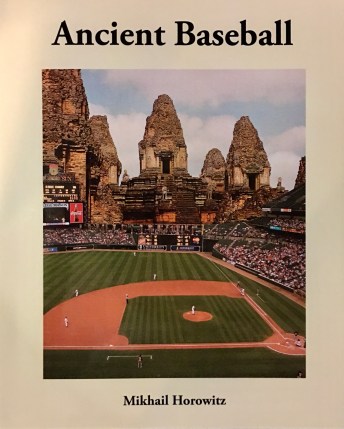
The scoreboard that survived the eruption of Mount Vesuvius in 79 CE still stands in the ruins of Pompeii Stadium. It says right there on page 23.

Ancient Baseball

IMG_1006

The author:
Mikhail Horowitz

The publishing info:
Alte Books; $15; 38 pages; released recently-ish (with a vague copyright of 2019)

The links:
At the publisher’s website, and no where else on Amazon.com, BarnesAndNoble.com, Powells.com, or Indiebound.org. But the author does have an official site.

The review in 90 feet or less

It arrived in a Manilla envelope, carefully stuck between two pieces of cardboard. The envelope was hand addressed, from a post-office box in Accord, New York. There was one “two ounce” stamp affixed to it, along with four “Earth Day” forever stamps, all upside down.

It came from a random recommendation from the Twitter account of  John Thorn, the official historian of Major League Baseball.

He also has a back-cover blurb: “Who knew baseball history could be so much fun? No more archive trawling for me – Horowitz sees baseball everywhere in the ancient world. Gorgeous, erudite, laugh-out-loud funny.”

It came, as well, with a stamp of approval by Tim Wiles, the former director of research for the National Baseball Hall of Fame: “Many have tried to explain baseball’s mysterious connections to time, eternity, mythology and human spirituality, but most such attempts leave us empty-handed. Mikhail Horowitz has caught lightning flashes of insight over and over again in this slim volume … Read it and reap.”

It came with these words, perhaps by the author, or publisher, or another who dared to decipher its true meaning: Continue reading “Extra inning baseball book reviews for 2020: History, as you cut-and-paste it to serve your hysterical purpose”

Extra inning baseball book reviews for 2020: Miss baseball? Miscellaneously speaking, this could get you caught up

games too long
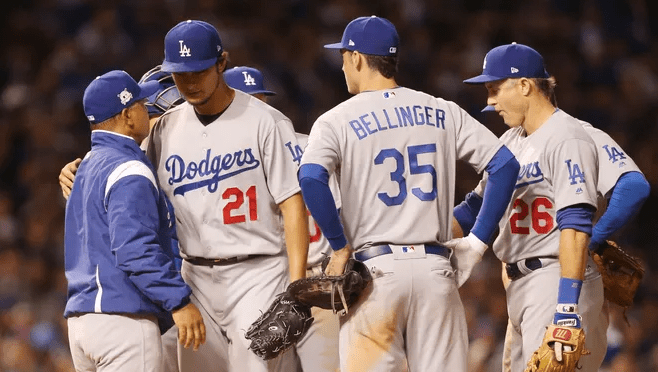
Do baseball playoff games take too long? It’s a question tackled in a 2017 USA Today story (using this Dodgers’ mound photo of manager Dave Roberts taking Yu Darvish out of a contest). It’s also discussed in Chapter 27 of this book. Photo by Dennis Wierzbicki/USA Today

Baseball Miscellany
Everything You Ever Wanted to Know About Baseball

baseball-miscellany-9781683583738_xlg
The author:

Matthew Silverman

The publishing info:
Sports Publishing/Skyhorse
205 pages
$14.99
Released May 19

The links:
At the publisher’s website
At the SimonAndSchuster site
At BarnesAndNoble.com
At Powells.com
At Target
At Indiebound.org
At the author’s website

The review in 90 feet or less

After all we poured through in our previous review of the Sports Publishing/Skyhorse refresh of “The New Baseball Bible,” this update of “Baseball Miscellany” by the same publishing house measures in at half the size, half the number of pages, far more colorful and graphically bent, printed on much better paper stock, a much tighter binding and, all in all, likely far more easier for a reader to navigate. (And it’s five bucks cheaper).

Smaller can be more useful, depending on the reader’s attention span.

Still, you’re at the mercy of the author’s construction and content decisions.

mattMatthew Silverman – not to be confused with the 44-year-old Harvard-educated President of Baseball Ops for the Tampa Bay Rays – has done plenty of other baseball books that involve collecting material, specifically with his work on New York Mets history.

Unlike the Dan Schlossberg “Bible” format of 20-plus chapters that break down the game historically and every other which way, Silverman’s approach is to pose 30 questions – the last three, in a category of “Extra Innings” – and then meander from from there.

Most chapters are filled in by quips, quotes and antidotes, enough that don’t directly  relate at all the chapter’s original focus, but none-the-less serve a purpose of continued educations.

Continue reading “Extra inning baseball book reviews for 2020: Miss baseball? Miscellaneously speaking, this could get you caught up”