Day 15 of 2025 baseball book reviews: The mystery, the science and the theater of reaching 3,000

“3,000: Baseballs Elite Clubs
for Hits and Strikeouts”

The author: Douglas J. Jordan
The details: McFarland, $35, 232 pages, released Nov. 20, 2024; best available at the publishers website and Bookshop.org.

A review in 90 feet or less
The latest Clayton Kershaw Challenge is upon us.

It compares far less to the Hollywood portrait of Stan Ross. It’s much more up on easel with Bob Ross. If you think about thing that way.

But, why would you?

In the Bernie Mac movie from some 20 years ago, “Mr. 3,000,” Stan Ross is the prima donna designated hitter for the Milwaukee Brewers who retired in 1995 just as his team was amidst the playoff race because he reached the fabled career hit milestone, which he assumed would guarantee him Baseball Hall of Fame immortality, and that was all it seemed he was playing for.

Then came the nasty “clerical error” — three hits were taken away from him because of a rain-canceled game where the stats didn’t count. All his post-retirement “Mr. 3,000” branded endorsement deals backed out, and he couldn’t get voters to get him into Cooperstown. So at age 46, he makes a comeback. He goes hitless in his first 27 at-bats. Then, in the last at-bat of the last game of the season, he’s one hit short, but the team needs him to lay down a sacrifice bunt that could help them clinch a win that would get them a surprise third-place spot in their division.

Sacrifice himself for the good of the team? You can’t make up these scripts. Except, here, they did.

And then, some baseball scholars tried to see how he really measured up — why would he not make it in with “merely” 2,999 hits? Steroids?

(See a Harvard sports analysis on this that may make you think twice about its entitlement to public funding).

When Kershaw’s 2024 season started late and ended early — it was a -0.3 WAR performance of seven starts while the team was fully geared up for their World Series run — he found himself 32 strikeouts short of 3,000 for his career, having racked up just 24 in 30 innings over seven starts.

He was 36 years old, held out on the 60-day IL at the beginning as he recovered from a surgically repaired left shoulder, started with a four-inning game on July 25, and ended it after the first inning of a game on August 30 in Arizona because the big toe on his left foot was acting up.

The offseason seemed 50/50 on whether he’d just retire. His Hall of Fame status was already pretty well locked in. On Baseball-Reference.com, the average Hall of Famer’s “black ink” is 40 (Kershaw has 65), the “gray ink” is 185 (he has 188) and the Bill James’ Hall of Fame monitor of 100 shows Kershaw blown past that at 211. By “Hall of Fame Standards,” the average is 50, and he had 62, with a 79.2 career war, 21st all time by a starting pitcher. His season-by-season stats compared, from age 26 to 36, to either Tom Seaver or Pedro Martinez, as well as Roy Halladay, Chief Bender, Whitey Ford and Randy Johnson. All HOFs.

(Also, we didn’t realize that on that website, it notes Kershaw’s nicknames have been “The Claw, “Kid K,” “The Minotaur,” and, of course, “Kersh.”)

Three times he led the NL in strikeouts — 248 in 2011, 232 in 2013 and a career-best 301 in 2015. Yet the last time he had a season of 200 or more Ks was 2017. A resume with three NL Cy Youngs, 10 All Star appearances and an NL MVP, already the Dodgers’ franchise leader in strikeouts …

Why bother coming back? What’s left to gain through more pain?

Continue reading “Day 15 of 2025 baseball book reviews: The mystery, the science and the theater of reaching 3,000”

Day 14 of 2025 baseball book reviews: Before a superstar smelled his (or her) armpits for validation

“Selling Baseball: How Superstars
George Wright and Albert Spalding
Impacted Sports in America”

The author: Jeffrey Orens
The details: Rowman & Littlefield, $35, 274 pages, released Feb. 4, 2025; best available at the publisher’s website and Bookshop.org

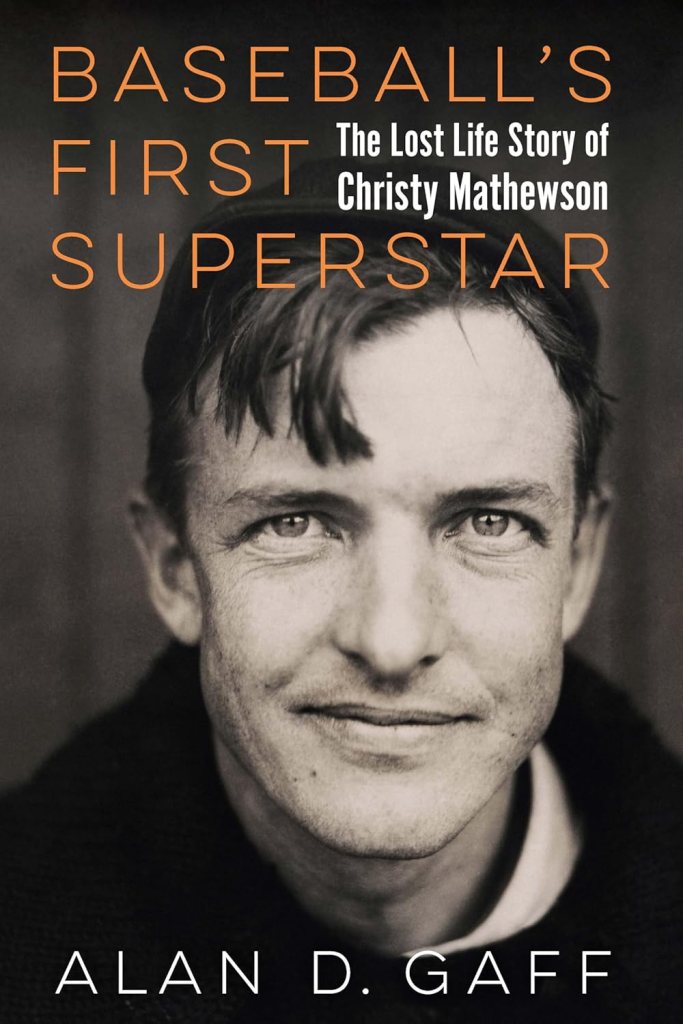
“Baseball’s First Superstar:
The Lost Life Story of Christy Mathewson”

The author: Alan D. Gaff
The details: University of Nebraska Press, $32.95, 240 pages, released in May, 2025; best available at the publishers website, the author’s website and Bookshop.org.

A review in 90 feet or less

Focus just on baseball’s language, with all its over-modulated adjectives and supercilious discussions. From that, how does one decide when a player moves ahead of the line from a “star” to a “superstar”?

Preferably, a superstar without a capital “S,” which seems to be treading far too close to Superman territory.

A year ago, Joe Reuter of the Bleacher Report listed his “Definitive List of MLB Players Who Deserve to Be Called a ‘Superstar’,” and established the guideline: “Being a superstar athlete is about more than just on-field performance, as major market exposure, marketability and highlight-reel skills can all help elevate a talented player to that next tier of stardom.”

They are trend setters and stop-and-watch performers, heightened by social media and all the other applicable influencers of the day.

Continue reading “Day 14 of 2025 baseball book reviews: Before a superstar smelled his (or her) armpits for validation”

Day 13 of 2025 baseball book reviews: When old news is new news, who knows if that’s the historiography speaking

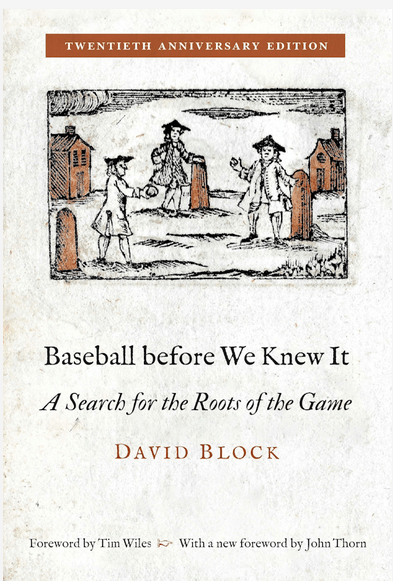
“Baseball before We Knew It:
A Search for the Roots of the Game”

The author: David Block
The details: University of Nebraska Press, 416 pages, $29.95, released April 20, 2025; best available at the publishers website and Bookshop.org

A review in 90 feet or less

We’ve been around the block with David Block on this subject before.

The 2005 edition cover.

In June of 2019, before we knew it, Block did “Pastime Lost: The Humble, Original and Now Completely Forgotten Game of English Baseball.” We pounded out a review that started out about trying to know more about another book he did in 2005 as a first-time author called … well … see above.

By his own accounts, Block was a retired systems analyst and amateur baseball historian. But he had produced a book that Tom Shieber, the senior curator at the Baseball Hall of Fame, called “to me probably the single most important baseball research of the last 50 years, if not more.” It crushed the whole Doubleday creationist story. It supported the claim that a 1791 ordinance in Pittsfield, Mass., banned the playing of “base-ball” near its town’s new meetinghouse. It brought to light the 1744 English kids book, “A Little Pretty Pocket-Book,” that revealed another earlier usage of the word “base-ball.”

So important was Block’s initial publication, it garnished its own Wikipedia page (which still has not noted the nuance of the second “b” lacking capitalization).

Back to the future, Block’s updated, revised and dusted-off  version of “Baseball before We Knew It” 20 years later because just as stimulating as another visit to the La Brea Tar Pits and its sticky-finger museum store.

Continue reading “Day 13 of 2025 baseball book reviews: When old news is new news, who knows if that’s the historiography speaking”

Day 12 of 2025 baseball book reviews: Effective skippering

“Skipper: Why Baseball Managers
Matter and Always Will”

Updated: 6.25.25

The author: Scott Miller
The details: Grand Central Publishing/Hatchette Book Group, $30, 400 pages, released May 13, 2025; best available at the publishers website and Bookshop.org.

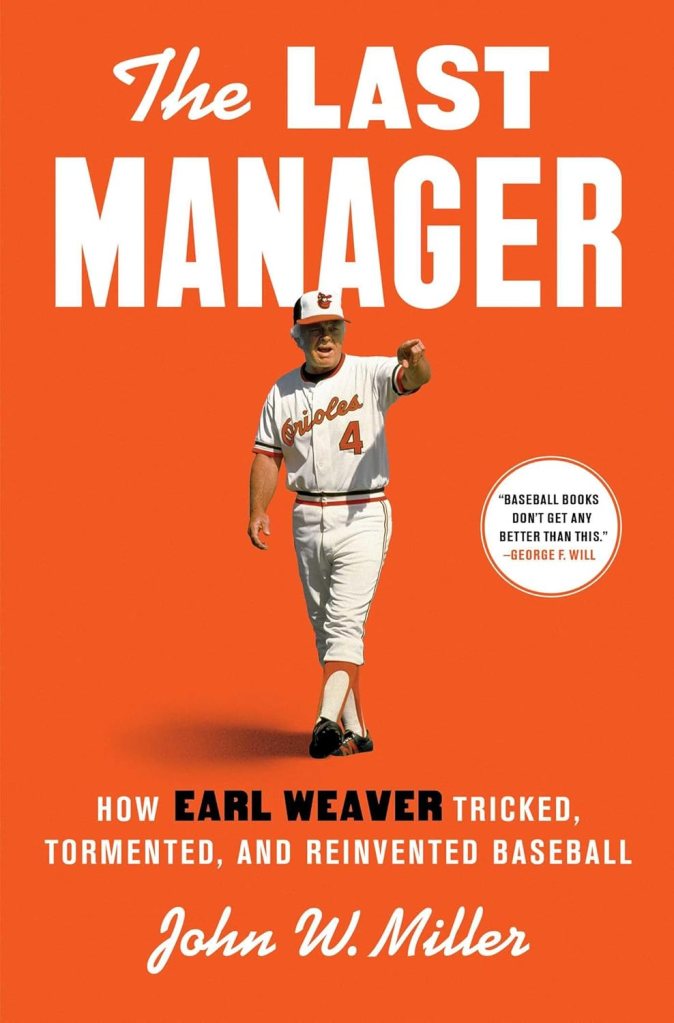
“The Last Manager:
How Earl Weaver Tricked, Tormented
& Reinvented Baseball”

The author: John W. Miller
The details: Avid Reader Press/Simon & Schuster; $30, 368 pages, released March 4, 2025; best available at the publishers website and Bookshop.org.

A review in 90 feet or less

Joe Maddon had a burr in his saddle. The former Angels’ skipper felt tossed overboard with a flimsy life preserver that, for the moment, provided him with nothing to preserve much of his patience or self-worth.

As once the manager of the successful Tampa Bay Rays when the organization was at the forefront of the analytics revolution in the 2000s, Maddon rode the Chicago Cubs to 103 wins and the 2016 World Series title, despite arm-wrestling the front office over lineup decision and then exposing himself at various times in the championship series against Cleveland.

Maddon’s return to the Los Angeles Angels starting in 2000 (he had interim managerial stints in 1996 and ’99) was once again too short to properly size up. It should have been a victory lap after all the years he spent as a team’s bench coach and fact-checker of managerial decisions on the fly. Instead it was more internal combustion of old school-new school thinking — at least that’s one way of thinking about it.

Jason Jenks from The Athletic reached out to Maddon recently for a Q&A that started this way:

Continue reading “Day 12 of 2025 baseball book reviews: Effective skippering”

Day 11 of 2025 baseball book reviews: You outta be in pictures

“The Baseball Stadium Guide”

The author: Ian McArthur
The illustrator: Daniel Brawn
The details: Aspen Books/Pilar Box Red Publishing,112 pages, $28.99, re-released March 11, 2025; best available at the publishers website.

“The Modern Baseball:
History of MLB Through the
Art of the Logoball”

The author: Tyler Burton
The details: Self published, 220 pages, $49.99 softbound, $99.99 hardbound, released June 2024; best available at the author’s website.

“Movies With Balls:
The Greatest Sports Films
of All Time, Analyzed and Illustrated”

The illustrators/authors: Rick Bryson and Kyle Bandujo
The details: Penguin/Random House, 256 pages, $24.99, released September of 2024;  best available at the publishers’ website, Bookshop.org and the book’s official site.

“Movies and the Church
of Baseball: Religion in the
Cinema of the National Pastime”

The author: Jonathan Plummer
The details: McFarland, 198 pages, $55, released Feb. 6, 2025;  best available at the publishers website and Bookshop.org


A review in 90 feet or less

One major transactional aspect of the Art of the Game’s exhibits you hopefully encounter at Dodger Stadium or Angel Stadium (as well as one at formerly named Staples Center) centers on the art of a deal.

Sales tax included. It can be pricey quickly. Check yourself.

Once you sign your name on the credit card statement, the exchange rate is you get something with someone else’s signature on it, perhaps far-more-famous (but not necessarily in Southern California). It adds to the composition of a nifty limited-edition portrait or other piece that brings lifetime admiration.

Justify it as an investment. A Jackson Pollock-meets-Reggie Jackson-meets-A.J. Pollock moment. But don’t stuff it away in a safe deposit vault. Show it off.

This monetized artwork goes in a place where as many as possible can see, admire it, maybe even envy it. Here’s where you, as a patron of the arts, have chance to express your allegiance to the game, bold and beautifully, through a framed painting, photograph, mixed-media… all with the most intoxicating element that you’ve again become a representation of nostalgia’s powerful lure.

You have purchased a memory.

Continue reading “Day 11 of 2025 baseball book reviews: You outta be in pictures”