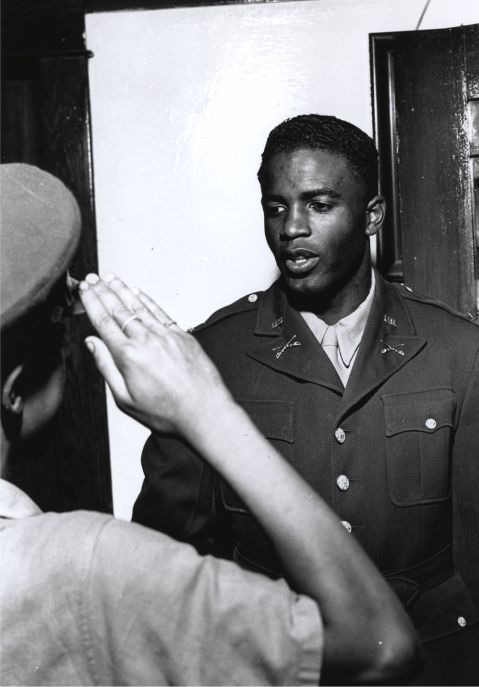

“Ballparks Then And Now”
 The author:
Eric Enders
The publishing info:
Pavilion Books/Rizzoli
160 pages
$22.50
Published in July, 2019
The links:
At the publisher’s website
At Amazon.com
At BarnesAndNoble.com
At Powells.com
At IndieBound.org
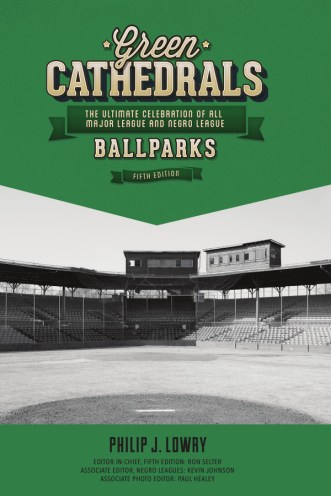
“Green Cathedrals: The Ultimate Celebration
of all Major League & Negro League Ballparks”
 The author:
Philip J. Lowery
Fifth edition editors:
Ron Selter, Kevin Johnson, Paul Healey
The publishing info:
Society for American Baseball Research (SABR)
29.95
330 pages
Released March 12
The links:
At the publishers website
At Amazon.com
At Barnes&Noble.com
The reviews in 90 feet or less
Where on Earth might you rather be, on this 50th Earth Day, than outside enjoying the sensory overload of a ballpark experience this afternoon?
The Dodgers would have been in our nation’s capital in the middle of a six-game road trip. The Angels would have been playing host to the Orioles, ending a six-game homestand.
 The ballpark has always been one of the great American public spaces, as Paul Goldberger figured out when he did his magnificent book last year, “Ballpark: Baseball in the American City,” which allowed the New York Times architect writer to explain how and why the ballpark is the perfect example of a Hamiltonian/Jeffersonian compromise in urban and rural values embedded in the American experience. Alexander Hamilton could see a commerce-driven city within the city. Thomas Jefferson could enjoy a lush, Technicolor-green field, even if there’s a wall bordering it.
“In the baseball park, the two need each other,” Goldberger writes. “The structure of the grandstand exists to allow people to watch what is happening on the field, while the field exists to give the grandstand its purpose.” Our extended Q&A with Goldberger last year also brings out how he felt Dodger Stadium was a metaphor for the city that wants movement and privacy. It’s difficult to often move into the stadium but once you’re there it does feel very secluded.
“In spite of the fact it’s too big, or entirely automobile dependent – which is the worst possible model – Dodger Stadium is nevertheless one of the nicest places in America to watch a ballgame. It’s just horrible to get to and horrible to get out of. But it’s just nice when you’re there.”
As for the current Angel Stadium, Goldberger says: “I’m a great believer in the idea that ballparks should all be different and do things that identify their places. I really thought the Big A scoreboard (a 230-foot tall, 210-ton red metal structure with a halo on the top created in 1966 behind the left-field fence but is relegated to the parking lot off first base) was a sort of funnier and cooler and nicer and more endearing weight than the whole center field water thing they have now.”
(Thanks for the excuse to revisit this exquisite book about the how and why of ballparks as we can weld it into today’s reviews).
On a day that also marks the 144th anniversary of the first Major League Baseball game, featuring the Boston Red Caps and Philadelphia Athletics played at Athletic Grounds in Philadelphia long before naming rights were wrong, let’s get a ballpark figure on some numbers we have going around in our heads now: Continue reading “Day 22 of (at least) 30 baseball book reviews for spring/summer 2020: What’s the ballpark figure on how many connect Earth Day with a fond baseball green cathedral memory? Let’s read (at least) two”

 The author:
 The author:
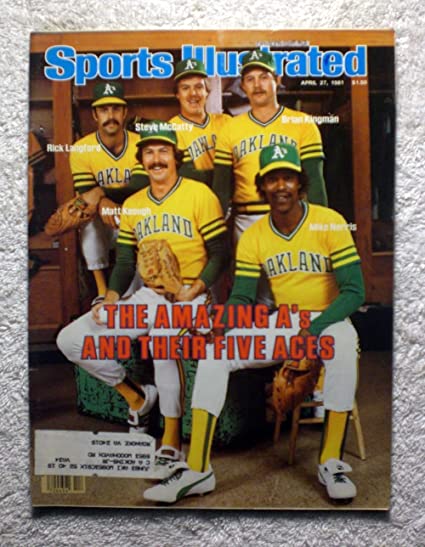 As the cultural phenomenon known as “Fernandomania” was in an upsurge in Los Angeles early in the season, an April 27 issue of Sports Illustrated landed with a cover proclaiming: “The Amazing A’s and their Five Aces.”
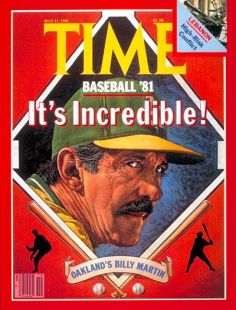 But then in May, Time magazine decided to Billy Martin on its cover – an artistic rendition, with the headline “Baseball ’81: It’s Incredible!” and a B.J. Phillips-authored piece that included: “Oakland’s record would be impressive if it belonged to the 1927 Yankees. The astonishing truth is that it is held by virtually the same team that, two seasons ago, was the worst in baseball. But there is one huge difference, a stormy, unpredictable figure with fire in his eyes and victory on his mind, Alfred Manuel (“Billy”) Martin.”
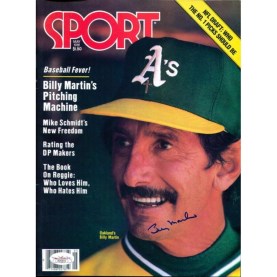 Also that month: The cover of Sport Magazine, with “Billy Martin’s Pitching Machine.”



 The author: