
Day 5 of (at least) 30 baseball book reviews for spring/summer 2020: Chavez Ravine’s newest reveal, without dodging ancient interpretation (and note what’s intentionally missing from the title)

5274917444_5ffc5ab24b_b

feat-chavez-top-1
From the website WalterOMalley.com, a timeline of how “Chavez Ravine” came to happen, then get changed: https://www.walteromalley.com/en/features/chavez-ravine/Overview

“Stealing Home: Los Angeles, the Dodgers,
and the Lives Caught in Between”

51zzmJQGyDL

The author:
Eric Nusbaum

The publishing info:
PublicAffairs/Hatchette
352 pages
$18.99
Released March 24

The links:
At the publisher’s website
At Amazon.com
At BarnesAndNoble.com
At Powells.com
At Indiebound.org
At the authors website

The review in 90 feet or less

We can reach out and grab this book that came out 20 years ago by photographer Don Normark, who had walked the hills of Los Angeles 50 years prior to that, in the late ’40s, and said he had discovered this place he called a “poor man’s Shangri-la.”

When musician Ry Cooder did a 2005 concept album called “Chavez Ravine,” he used that phrase as the title of one song.

That’s in Chapter 67 of “Stealing Home.” But before we get there, today, we have to acknowledge these truths to be self evident:

Chavez Ravine is a different kind of Shangri-la.

Chavez Ravine may have a Wikipedia page, but it isn’t marked on any L.A. map. Chavez Ravine has no geographic boundary.

Chavez Ravine is “a place, but it isn’t,” Eric Nusbaum writes in the intro. “It is really a code word for the mysteries and pleasures of baseball. It is the metaphysical plane upon which Dodger Stadium exists, slightly outside the realm of daily life in the city. It is a state of mind. It is a vibe. …

“The real history is less like a fable and more like the story of a crime that Los Angeles perpetuated on itself.”

Let that soak in like a long, muddy rain delay.

malvina

What is on a Google map, however, is a nub of Malvina Avenue that still exists going up into the Los Angeles Police Department Academy, right off Academy Road. It’s like an appendage.

There are things we know, and things we think we know about this area. There’s the famous array of photographs showing Abrana Archiga’s family being physically taken away from 1771 Malvina Avenue, a home she and her late husband had built in 1922. Online photo archives are full of these shots taken by newspaper photographers at the time.
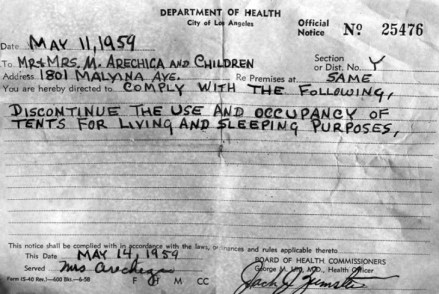
5bbcd665d217300008df6da1-eightAnd now that house is “buried somewhere underneath the distant parking lots of what is now Dodger Stadium,” writes Nusbaum. “It wasn’t supposed to be this way. But it is.”

This is one of several entry points Nusbaum uses to re-introduce many of us to a story that’s been told in various ways, on various platforms, but perhaps not so much from this narrative.

As we have been conditioned, Chavez Ravine can sound like a great place that Vin Scully and others have described to us “in a sort of sweet, folksy way … when Vin Scully says something, it is like God speaking. His voice is ambient in the Southern California air. It is the voice inside your head.”

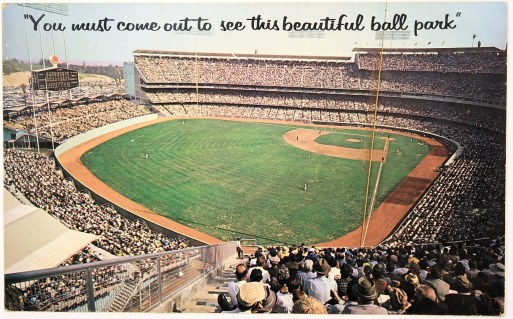
Perhaps Dodger Stadium is really “a heightened sense of being that you achieve when you visit,” complete with palm trees, and great sunsets and the San Gabriel Mountains … It’s not much different from the game itself, created from mythology by Abner Doubleday and Albert Spaulding, conjuring patriotism and capitalism into ingenuity.

But in L.A., the nasty history shouldn’t be covered over by dirt. And Nusbaum excavates it in a distinct, proficient and prolific manner.

Officially, we learn again that Chavez Ravine, named after a developer Julian Chavez (who didn’t even own that piece of land, but some others by the nearby Los Angeles River), came from an area assigned by the Stone Quarry Hills back in the early 1900s that was actually parts of five sections. It was never a community, per se. It now is something to generically covering what was once the neighborhoods of Palo Verde, La Loma and Bishop.

Neighborhoods that are long gone. Under asphalt, through many people’s faults.

f7b5c642021f146834b8fc605d31257a-800
A 1960s overhead view of Dodger Stadium: https://www.hippostcard.com/listing/1960s-aerial-viiew-dodger-stadium-los-angeles-california-mitock-postcard-1242/10705697

“They were erased,” Nusbaum adds. “First, they were physically erased by powerful forces beyond the control of their residents. Then they lost their names: They became part of Chavez Ravine.”

And in those first few paces, the history lesson begins. Far from an academic lecture forcing the reader to trip over footnotes, citations and other pebbles in the way. It’s a non-fiction story as accurately portrayed as research allows and human empathy preserves.

Why was it this parcel of land used for the stadium, which opened in 1962? What was it originally intended to be? Why didn’t that happen? Each chapter is important in laying the concrete foundation for what came next.

72f86e7a-b6a3-42ad-8c0a-ff83f761938d.__CR0,0,1037,1037_PT0_SX300_V1___To Nusbaum,  it circles back to the importance of a man named Frank Wilkinson – someone who spoke to Nusbaum’s Culver City High School in 2002 at an assembly and flat-out said: “Dodger Stadium should not exist.”

Nusbaum adds: “There are a million reasons why, yet all those reasons are precisely what give the stadium its power.”

The heroic work of this victim of the Red Scare that who died at 91 in 2006 is the real prize find and personal link in this path, as Nusbaum says his intent is to “provide an intimate look at the journeys and motivations of its principal characters and a sweeping impression of a city and the two countries to which is belonged.”

EPiTGWYU8AAoGj3He feels, and really is, uniquely qualified as a journalist who has worked in the U.S. and Mexico, a native Angelino who believes the story of my city “has too often been told through the gaze of writers perched firmly on the East Coast and peering west as if through a pair of binoculars,” and his desire to work on this ever since that day Wilkinson visited his school.

“The story broke my heart. I struggled to reconcile that Dodger Stadium … which was a source of pain to so many people. … For all its magic, Frank Wilkinson was right: Dodger Stadium should not exist. This book is my attempt to tell the story9f2a3376-5786-452b-ab4a-69a45499a674.__CR0,0,1036,1036_PT0_SX300_V1___ of why it does.”

It breaks your heart and opens your eyes in the same organic time frame, moved along as well by the fabulous black-and-white dot illustrations by Adam Villacin add to the grit and soul. No photographs are needed as these add to feel of a novel and create an emotional attachment.

As Nusbaum reveals, if this all was creating a plotline for a script to be written about what really happened, we’d need to fill roles for people like Walter O’ Malley, the Arechiga family, Willie Davis, Duke Snider, the Cabral family, Norman Chandler, Clifford Clinton (who started Clifton’s Cafeteria), Ed Davenport, Victoria “Tolina” Augustain, Councilmen John Holland, Ed Roybal and Roz Wyman, Howard Holtzendorff, Joseph McCarthy, Monsignor Thomas O’Dwyer,  Jorge Pasquel, Emil Praeger, Antonio Lopez de Santa Anna and maybe even a lawyer named Phill Silver.

It will also make you think more than twice next time you enter or exit the ballpark when things get back to playing the 2020 season. As you cut through traffic and head down Bishops Road to get to Broadway and escape through the gates of Chinatown. As you maneuver through Boyston Street to enter through Gate C. As you cruise Solano Avenue or Solano Canyon Drive to find a parking spot near the Police Academy. As you go down the Golden State Freeway and look north to the L.A. River. It’s all still there. Echoing.

175787-full

A Q&A with the author

From his home in Tacoma, Wash., the L.A. native — born in West Hollywood, grew up in Culver City, came back to live here when his wife went to grad school at UCLA — Nusbaum explained how difficult it was to get any publisher on board with this project.
“They thought it was too esoteric, no one would care outside of L.A., but that’s what a book like this faces from those who decide things on the East Coast,” said Nusbaum. “I had been working on a different project, about the history of Los Angeles freeways and did a proposal. The editor liked it but wasn’t sure, but it happened to be they were looking for a ‘Dodger book’ at the time, so I had this one.”

As Dodger Stadium continues a reconstruction project to expand the pavilion seating and create a “front door” to the place, Nusbaum thought the timing was also perfect for the city leaders and team owners to reconcile this history. He explains more:phpThumb_generated_thumbnail

QQQQQAs you kept pulling out information about on this mountainside, did that compel you to keep digging deeper and deeper? What caused you to stop and then start on this story?

AAAAIt was hard to stop digging, to be honest. I was researching up until the very end of writing. I don’t think you ever reach a point where you know everything about a subject. But you also make choices when you’re writing a book — and I think a lot of the toughest choices are about what not to include. Continue reading “Day 5 of (at least) 30 baseball book reviews for spring/summer 2020: Chavez Ravine’s newest reveal, without dodging ancient interpretation (and note what’s intentionally missing from the title)” →

Day 4 of (at least) 30 baseball book reviews for spring/summer 2020: Not to be a buzz kill, but need a new read on the Dodgers’ 2019 collapse? It’s more than ‘Baby Shark’ attacks and strategy gaffs

Howie-Kendrick_s-grand-slam-gives-Nationals-shocking-NLDS-upset-over-Dodgers

“Buzz Saw: The Improbable Story of How
the Washington Nationals Won the World Series”

71WbrzbXv8L

The author:
Jesse Dougherty

The publishing info:
Simon & Schuster
$28
308 pages
Released March 24

The links:
At the publisher’s website
At Amazon.com
At BarnesAndNoble.com
At Powells.com
At IndieBound.org
At the author’s internet home.

The review in 90 feet or less

There’s value in deconstruction.

Especially in the aftermath of what rubble Los Angeles may think it’s still under, and whether it falls under the recovery benefits defined by a National emergency.

We’re in a state of grace at the moment, right? Able to look at history and wonder: What if?

What happened last October blew in to Southern California was an act of the Baseball Gods, a force of nature with crazed momentum, leveling the Dodgers’ scheme of finally winning a World Series after its failed attempts in ’17 and ’18, giving the city its first MLB title (in L.A. at least, not counting the Angels’ 2002 trip) since that 1988 magic.

Yet, if you can appreciate the nature of the game, and unpredictable beauty of it, there are endearing parallels to draw between these fresh-brewed ’19 Nationals and that ’88 Dodgers vintage.

Why revisit any of this? Why not.

There are things to learn, appreciate and reinforce, and for the record, make sure our facts are straight versus what our emotions tend to define. In the compelling way Dougherty does it, there’s added enjoyment to show step by step how the Nationals achieved something that readers can’t help but admire and applaud. Especially since the seven game World Series tour included four wins in Houston. Harrumph.

BP-10.10-1200x788

D.C.’s run may have looked superhero “improbable” – another word we recall Vin Scully pulling out of the sky 32 years ago, and used correctly in the book’s title. But wasn’t impossible,  considering what was already in place, how the current pieces really did fit, the psychology and balanced thought behind everything, and the methods used to achieve a championship that seemed to be going against the 21st Century grain.

Dougherty, the Nationals’ beat reporters for the Washington Post and a former L.A. Times guy who covered the NHL’s Kings, has all the proper power tools to chip away at how and why it happened, then yank off the white cloth and let us gaze upon what we see now to have a better understanding.

He writes that this was a seven-week project after the last out of the World Series, and it took 35 additional interviews to weave in more context during this short window of interpretation. This isn’t cutting and pasting daily stories together like some scrapbooking project some may take in this to capitalize on a moment. Nor is it done by someone who can’t turn a phrase or define a consequence when it’s needed. Continue reading “Day 4 of (at least) 30 baseball book reviews for spring/summer 2020: Not to be a buzz kill, but need a new read on the Dodgers’ 2019 collapse? It’s more than ‘Baby Shark’ attacks and strategy gaffs” →

Day 3 of (at least) 30 baseball book reviews for spring/summer 2020: What’s so hidden about sign stealing if it’s so out in the open? A Dickson dissertation

CheatingGoodForMLB_Ringer.0
From TheRinger.com: “The Astros Sign-Stealing Scandal is Actually Good for Baseball,” by Rodger Sherman: https://www.theringer.com/mlb/2020/2/26/21153495/houston-astros-sign-stealing-scandal-baseball-fan-interest

“The Hidden Language of Baseball:
How Signs and Sign-Stealing Have Influenced the Course of Our National Pastime”

81ziTeJx+yL

The author:
Paul Dickson

The publishing info:
University of Nebraska Press
$19.95
200 pages
Revised edition published in July, 2019 (updated from 2005 and 2003,from Waller Books)

The links:
At the publisher’s website
At Amazon.com
At BarnesAndNoble.com
At Powells.com
At IndieBound.org
At the author’s website

The review in 90 feet or less

It’s a sign of our times, and a symbol of what we don’t want to be.

Dickson’s latest edition of “Hidden Language” went out of print in 2017. The prolific baseball historian had the good sense to know it needed to be refreshed. For many reasons. But even then, he couldn’t have realized that this reboot would have overlapped with the fact the Houston Astros were about to claim their first World Series title that winter, against the Dodgers, and two years later, become the most anguished-about controversy clouding the game’s credibility.

bookcover(Hey, did you happen to notice: There’s a publication by Easton Press, a tricked-up commemorative book with the splashy title: “History Earned!” still available for sale. Too rich for our tastes — four monthly installments of $35 to have this cool leather-bound, hubbed-spined edition accented with 22kt gold and gilded page ends … There’s also Ben Reiter’s “AstroBall: The New Way to Win It All” that came out in July, 2018, and has demanded a reprint)

Revisionist history aside …

Dickson’s decision to rejoin the conversation and update all he knew through 2018 all came before the summer of ’19, when the banging of trash cans would take down the managers of the Boston Red Sox, Houston Astros and New York Mets before the 2020 season even began. Whenever that will be.

Dickson was more focused on what was latest controversy at that time — the infamous Apple Watch sign-sealing incident of 2017 — the Red Sox were fined for using technology to swipe information from the Yankees. In the 14 pages he dedicates to this new Chapter 9 entitled “Devious Digital Devices – from TV Camera to Apple Watch,” the foundation and context of what the Astros are now accused of doing should provide a better understanding when one would rightly be engaged as to the ethical pros and cons of what went down.

Meanwhile, there’s a lot of history to go through:

But then there’s what Dickson lays out what’s happened in just this recent century: Continue reading “Day 3 of (at least) 30 baseball book reviews for spring/summer 2020: What’s so hidden about sign stealing if it’s so out in the open? A Dickson dissertation” →

Day 2 of (at least) 30 baseball book reviews for spring/summer 2020: The girls still got game, or do we need to draw you a picture?

FeaturedImage-e1584036384303

“The Incredible Women of the All-American
Girls Professional Baseball League”

xe4uGf6Q

The author/illustrator:
Anika Orrock

The publishing info:
Chronicle Books
$19.95
160 pages
Released March 10, 2020

The links:
At the publisher’s website
At Amazon.com
At BarnesAndNoble.com
At Powells.com
At Indiebound.opg
A the author’s website

The review in 90 feet or less

I asked my soon-to-be 80-year-old mom recently: So what do you remember about watching All-American Girls Professional Baseball League games when you were growing up in South Bend, Ind., back in the 1940s?

Didn’t you say you have a photo of yourself with a player named Lou Arnold?

She did. It’s still framed. Here it is:

Mom w Lou Arnold

Louise Veronica “Lou” Arnold was a pitcher for the South Bend Blue Sox for five seasons, posting a 23-16 record with a 3.02 ERA in 72 games. At 5-foot-3 and 125 pounds, the Pawtucket, R.I. native debuted in 1948 — my mom was 7, going on 8, and living in the city made famous as the home for the University of Notre Dame.

Arnold attended to a league tryout in ’48 with no baseball position. The league was desperate for overhand pitchers – when it started five years earlier, it was a fast-pitched underarmed style. It moved to sidearm in ’47 and finally evolved to overhand. Arnold she seemed like a good pitching prospect based on her high school athletic ability.

So while Arnold was there for ’48 and ’49, she did quit in 1950 for “undisclosed reasons,” according to the bio. She came back in ’51 (a 10-2 record, a no-hitter and 32 straight scoreless innings and nine complete games). Then she quit after ’52, deciding to live in South Bend the rest of her life working on brake lines at the Bendix Corporation.

The youngest of 13 kids, she wore No. 13. She died in 2010.

arnold sign

snapshots
My mom has photos and autographs inside a leather-bound small scrapbook that Arnold once gave her. It’s all still preserved in pristine condition. We can still make out the inscription: “To My Friend Theresa, Lou Arnold, 1949.”

More team photos and individual shots of the players are now all over mom’s coffee table. She’s holding them up with a magnifying glass, studying it all again.

Like this new book.

On page 47 of “The Incredible Women of the All-American Girls Baseball League,” a quote from Arnold appears:

“Wonderful umpire, Barney Ross … but I was pitching to this girl who wasn’t the best hitter and he called a strike a ball. Of course my catcher was yelling at him and I said, ‘Barney, I want to tell you something,’ and he said, ‘Yes, Lou?’ And I said, ‘You are going blind!’ He said, ‘Lou, I want to tell you something. You go back to that mound and I’ll show you how blind I’m getting.’”

Arguing+over+the+plate_PrintIt makes mom smile.

The quote is accompanied by an illustration of a woman in a catcher’s mask going face-to-face with a home plate umpire with his mask on.

That’s all due to our new favorite artist — Orrock, an Oakland native now in Nashville who characterizes herself as an illustrator above all – writer, designer, cartoonist, humorist and baseball devotee. But with all her talents, she figures out a way to piece together vignettes about the league with style and grace to reflect the sense of importance, excitement, competition and fun that was going on by those who were there.

Nothing gets skirted here. Continue reading “Day 2 of (at least) 30 baseball book reviews for spring/summer 2020: The girls still got game, or do we need to draw you a picture?” →

Day 1 of (at least) 30 baseball book reviews for spring/summer 2020: State your purpose, Ripken … Ah, well played

Bill_fielding_large
From RipkenBaseball.com: “Bill has been an integral part of the MLB Network since its beginning in 2009.  He has been nominated for an Emmy Award three times in the Outstanding Sports Personality – studio analyst category, winning the coveted national honor in 2016. His regular “Bill’s Blackboard” studio segments on the network are regarded as must see TV for baseball fans everywhere”

“State of Play: The Old School Guide to
New School Baseball”

9781635766608_FC-400x618

The author:
Bill Ripken

The publishing info:
Diversion Books
$24.99
240 pages
Released February 18

The links:
At the publisher’s website
At Amazon.com
At BarnesAndNoble.com
At Powells.com
At IndieBound.org
At his personal link

The review in 90 feet or less

Thanks, Diversion books, for this diversion. And going cleats up into a topic that needs some smarts behind it.

There is no Utley Rule to stop this one.

Here’s Bill Ripken, no longer Billy Ripken Younger Brother of Cal Ripken, a former MLB infielder and current MLB Network studio analyst, with his own public service announcement.

Let’s get united instead of divided on the national pastime as it is in 2020.

It’s a refreshing take considering how the game now may offend some who value its tradition, yet inspire those who see ways of modernizing it to a new audience.

Can he achieve such a thing? It depends on how open your mind is to constructive criticism, trusting someone who has been around the game for more years than you and isn’t trying to keep his name fresh, and someone engaged in how the game played today has been subject to all sorts of attacks and backlash.

SI COVER ureThe son of former Baltimore Orioles’ longtime minor league and brief major league manager Cal Ripken Sr., we know Bill has the genetics and phonetics to make this credible, having already co-authored “Play Baseball The Ripken Way: A Complete Illustrated Guide to the Fundamentals” and doing more than noteworthy work on the MLB-infused 24/7 channel.

(To note: In 1987, rookie Billy Ripken hit .308 in 58 games and in 1990, actually led the Orioles in hitting with a .290 average and a league best 17 sacrifice bunts. Cal hit .250. On a team that went 76-86 and had a 23-year-old Curt Schilling, in his first full season, making 35 relief appearances, unable to break into a rotation that had Pete Harnisch, Dave Johnson, Bib Milacki, Ben McDonald and John Mitchell. Schilling was dealt the next year to Houston for Jason Grimsley. Sorry for the sidetrack.)

Old school doesn’t mean outdated. New school doesn’t mean the way things must adjust and modify. Scoresheet vs. spreadsheet can be tallied simultaneously. Continue reading “Day 1 of (at least) 30 baseball book reviews for spring/summer 2020: State your purpose, Ripken … Ah, well played” →