04.22.19: Five things you should plan for the week ahead based on unscientific evidence of guaranteed importance

black 1We come not to mock the mock-jock drafts, but to concoct our own sense of interest in how the NFL has moved its annual shindig to Nashville, Tenn., and invited ABC to make it a prime-time event.
ABC’s plan, by the way, is to have Robin Roberts at the controls in sort of a “remember me from ESPN?” meets “Good Morning America” vibes. Joining her are the College GameDay crew of Rece Davis, Kirk Herbstreit, Lee Corso, Desmond Howard, David Pollack, Tom Rinaldi and Maria Taylor, plus Jesse Palmer and special guest Patrick Mahomes. Country singer Luke Bryan is also involved somehow. That leaves ESPN’s coverage with the crew of Trey Wingo, Mel Kiper Jr., Todd McShay, Louis Riddick, Booger McFarland, Chris Mortensen, Adam Schefter and Suzy Kolber.
It’s not quite all hands on deck, but it sure smells like it.
Meanwhile, the NFL Network has its own burst of boys in the 15th year of operation with Rich Eisen and his gang of merry men.
The Rams pick next-to-last in the first round based on winning the NFC (31st pick) with the Chargers locked in at No. 28. Arizona chooses first, most expecting it to take Heisman winning quarterback Kyler Murray — but that’s the drama of it. San Francisco, N.Y. Jets, Oakland, Tampa Bay and the N.Y. Giants are next in line as the prime movers and shakers. No one from USC or UCLA are expected to sniff first-round territory or even rank in the Top 100 of prospects.
How it happens:
* Thursday: First round, 5 p.m., Channel 7, ESPN, NFL Network
* Friday: Rounds two and three, 4 p.m., Channel 7,  ESPN/ESPN2 and NFL Network
* Saturday: Rounds four through seven, 9 a.m., Channel 7, ESPN and NFL Network

****************

black 2Considering the Angels had a game snowed out recently at Wrigley Field, the Dodgers can’t take anything for granted with a starting pitching staff that seems to be bordering on the snowflake flexibility range. Continue reading “04.22.19: Five things you should plan for the week ahead based on unscientific evidence of guaranteed importance”
Day 21 of 30 baseball book reviews for April 2019: The urban and rural co-existence of ballparks, from the architectural critic view

91wiqBL3m9LThe book:

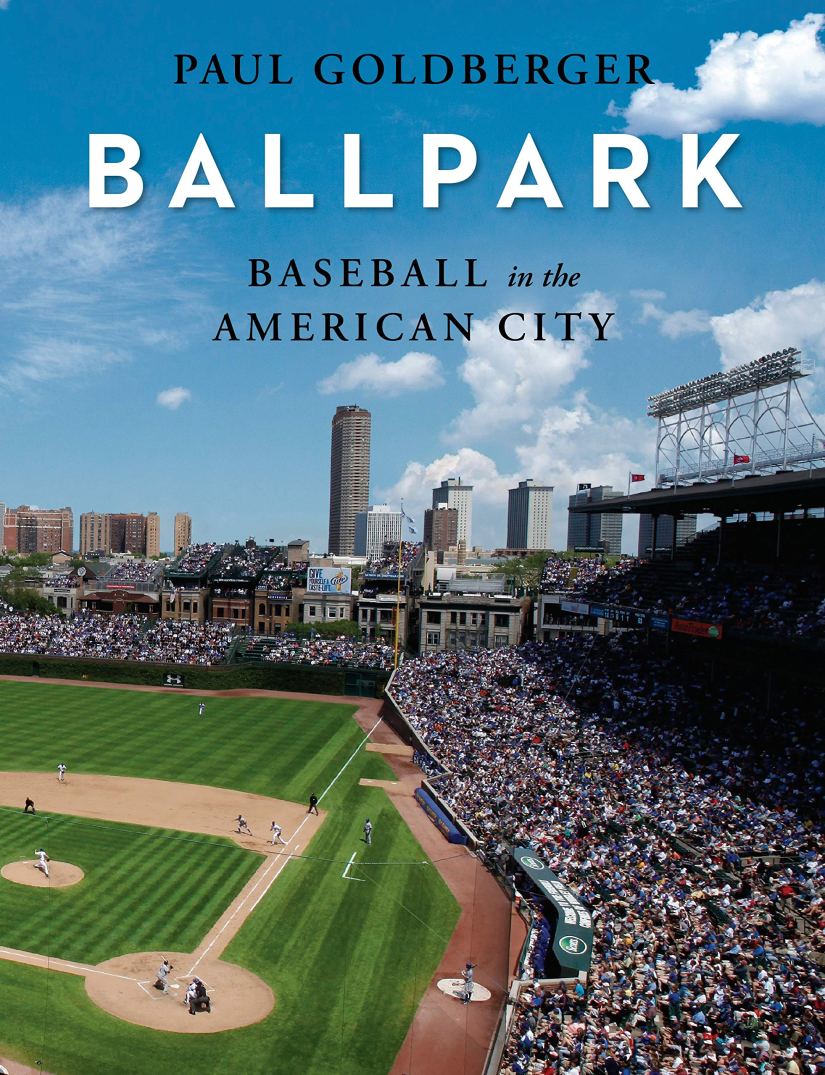
“Ballpark: Baseball in the American City”

The author: Paul Goldberger
The publishing info: Knopf (Doubleday/Penguin Random House), $35, 384 pages, to be released May 14
The links: At the publisher’s website, at Amazon.com, at BarnesAndNoble.com. Also at the author’s website.

The review in 90 feet or less

We bring two points of reference here:

0214_SPO_LDN-L-MEDIA-DCFirst, in 2016, Dr. Chris Kimball, the president and CEO of Cal Lutheran, invited us to a special history class he carved out to teach that spring semester. “U.S. History Through Baseball” was his passion for a 30-session class. On the day we attended, the lesson plan focused on William Cammeyer, a businessman who, in 1862, bought a six-acre vacant lot in Brooklyn and converted it from an outdoor ice-skating pond into a baseball field called Union Grounds. It was a residue of how business was starting to spring up in that New York borough – the predecessor to Brooklyn’s Ebbets Field, which was the predecessor to the Dodgers moving to L.A. after trying to get a domed stadium approved.
Kimball had an entire class do a term paper about on stadiums –  a way for them to relate to a ballpark from whatever part of the country they grew up and may have been attached, and then do more research more about it. Kimball, a Boston native, had an affinity for Fenway Park but also talked about his interest in reading more about the old Shibe Park in Philadelphia, where an urban historian described how that section of the city grew and then declined around the life of the ballpark.

51ujxNuE5ULA year later, we came across a book by Jerald E. Podair called “City of Dreams: Dodger Stadium and the Birth of Modern Los Angeles,” and included it high up in our annual book reviews.

Podair, a professor of history and American studies at Lawrence University in Appleton, Wisc., devoted all sorts of research into declaring: “Dodger Stadium made downtown Los Angeles possible. Downtown Los Angeles in turn made modern Los Angeles possible.” This, after the construction of the L.A. Aqueduct (1913), City Hall (1928), the Coliseum (1923) and Union Station (1939) gave that central core specific definition, Dodger Stadium’s opening on April 10. 1962, with its modernistic form and accessibility, “began the process of change … the gateway that transformed downtown.”

In beginning work on this unique project, Goldberger, a 68-year-old Pulitzer Prize–winning architecture critic from Yale and contributing editor to Vanity Fair, admits he drew much insight from Podair’s book when it came to the part where he would discuss the evolution of Dodger Stadium.


In much of his Chapter 6 titled “Leaving The City,” Goldberger gets into how ballparks built or rebuilt in the twentieth century were “dense, lively, curious mixes of the eccentric and the grand. They were disheveled, scrappy and for the most part good natured places, constructed on the premise that there was something valuable in the notion of even so expansive a public space as a baseball park being tightly woven into the urban environment. Baseball parks were a part of the urban fabric because, up until the middle of the twentieth century, everything was part of the urban fabric.”

While Goldberger recounts the motives behind the O’Malleys moving to Los Angeles, buying Wrigley Field in L.A., deciding to use the Coliseum as a home stadium in ’58 while allowing the A.L. expansion Angels to use it as their home field in ’61 as both awaited the construction of Dodger Stadium, we are more enamored with his professional assessments of the Southern California-based landmarks that have undergone several remodels but remain true to their usefulness. Continue reading “Day 21 of 30 baseball book reviews for April 2019: The urban and rural co-existence of ballparks, from the architectural critic view”

Day 20 of 30 baseball book reviews for April 2019: It pays to save your transcripts

81XDVvbuAtL.jpgThe book:

“They Played The Game: Memories from 47 Major Leaguers”

The author:
Norman L. Macht

The publishing info:
University of Nebraska Press, $29.95, 328 pages, to be released June 1.

The links:
At the publisher’s website, at Amazon.com, at BarnesAndNoble.com, at Powells.com


The review in 90 feet or less

We’re not only grateful Macht transcribed his interviews over the years, spanning the early 1980s all the way to just a couple years ago. But he also kept them in a safe place until this point to where we now can read some wonderful exchanges come to light that otherwise might just be in someone’s file drawer.
In the process of writing his epic three-volume biography of Connie Mack for Nebraska Press that came out between 2007 and ’15, Macht logged dozens of interviews with players who first-hand accounts of the Hall of Fame manager and owner. But he also had many more encounters with former MLB players to where, as Macht says:
“We hear truths that resided in their minds when they talked with me in their later years. If you wish to do the research to verify or question their facts or versions of events, do so. I didn’t … What you read is what they said.”

Such as Mike Marshall. Continue reading “Day 20 of 30 baseball book reviews for April 2019: It pays to save your transcripts”

Day 19 of 30 baseball book reviews for April 2019: Semiliterate recluses, syphilitic dementia, Harlem Hellfighters and blind shoe shines

51biS4hqVaLThe book:

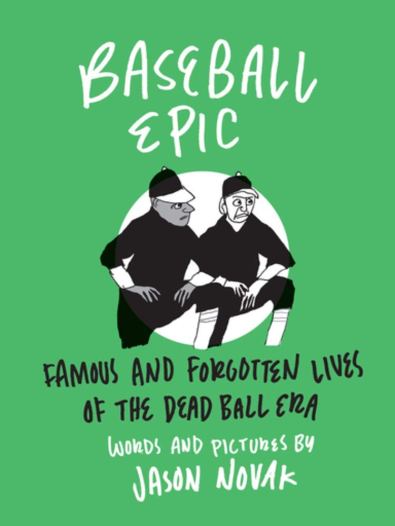
“Baseball Epic: Famous and Forgotten Lives of the Dead Ball Era”

The author and illustrator:
Jason Novak (who would rather take credit on the cover, right, for doing “words and pictures”)

The publishing info:
Coffee House Press/Hachette Books, $16.95, 240 pages, released April 2

The links: At the publisher’s website, at Amazon.com, at BarnesAndNoble.com, at Powells.com

The review in 90 feet or less

Is it true that Ping Bodie, once a Yankees teammate of Babe Ruth, “once won a spaghetti-eating contest against an ostrich” and “was also kicked out of a movie theater for disruptive laughter during a drama”?
Draw your own conclusions.
Novak, a cartoonist based on Oakland whose work has appeared in the Paris Review and New Yorker, was inspired to put this project to paper a when he came across Jimmy Claxton’s story while reading about the Oakland Oaks of the old Pacific Coast League.
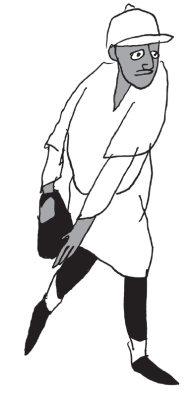
claxtonFor the book, Novak’s mini-bio about Claxton (illustration left) says that he “broke the color line by registering as an ‘American Indian’ … but was booted when a spectator in the bleachers recognized him as a black player.”
“It made me wonder how many other forgotten milestones there were from the early days of baseball,” Novak continued.
Novak also related to a nugget about Albert “Chief” Bender, “whose family — like mine in his day — was a mix of European immigrants and American Indians. But while my great-grandfather was raised to be reticent about his heritage, Albert Bender was proudly and defiantly rubbing it in the faces of his detractors.”
So the Bender entry explains that Bender, “who was Chippewa, endured relentless taunts, insults and war whoops from the bleachers, but would circle the stadium following a victory and yell, ‘Foreigners! Foreigners!”
“I admire him for taking the hard and dangerous path at a time when many American Indians were denied rights as basic as citizenship,” adds Novak.
Very interesting. But is any of this accurate? Continue reading “Day 19 of 30 baseball book reviews for April 2019: Semiliterate recluses, syphilitic dementia, Harlem Hellfighters and blind shoe shines”

Day 18 of 30 baseball book reviews for April 2019: Edgar Martinez passes the eye test: He’s had a Hall of Fame life

61ysO7o49dLThe book:

“Edgar: An Autobiography”

The author:
Edgar Martinez, with Larry Stone

The publishing info:
Triumph Books, $28, 352 pages, due to be released June 11

The links:
At the publisher’s website, at Amazon.com, at BarnesAndNoble.com, at Powells.com

The review in 90 feet or less

The Angels’ series against the Mariners starts tonight in Anaheim – they’ve already played two in Seattle to start the month, losing both.
The Mariners’ signature to this season has been the home-run ball — they had one of ’em in their first 20 games to set an MLB record until they endured a 1-0 loss to at home Cleveland on Wednesday.
In his 18 year major league career, between the ages of 24 and 41, Edgar Martinez hit 309 long balls, with a high of 37 in 2000, when he also led the league with 145 RBIs to go with a .324 average.

edgar_martinez_autographHe won two AL batting titles — .343 in ’92 and .356 in ’95, the later one that also included a league best 1.107 OPS, 52 doubles and 121 runs to go with a career best 182 hits. He was third in the AL MVP selection, the closest he ever got to winning it.
A seven-time AL All Star who came up as a third baseman, filled in at DH as needed and then became an All-Star designated hitter, also as needed.
We knew the numbers, more or less. Yet Baseball’s Hall of Fame didn’t have him on speed dial when he retired after the 2004 season.
s-l640It took until his final year of eligibility – five years past retirement, plus 10 years — for him to get enough votes (85.4 percent) from the Baseball Writers Association of America after initially getting 36.2 percent and actually falling to 27.0 percent as late as his sixth year of eligibility.
Martinez will go to Cooperstown this summer as the fifth Puerto Rican native, after his idol, Roberto Clemente, as well as Orlando Cepeda, Roberto Alomar and Ivan Rodriguez.
It’s time to tell his story, his way, with the help of the long-time Seattle Times columnist, so we know what we’re really getting here aside from a handful of very good statistics – even he knows he didn’t reach milestones like 3,000 hits or even 400 homers, but having five Silver Sluggers and five times winning the award as the league’s top designated hitter – an honor now named for him. Continue reading “Day 18 of 30 baseball book reviews for April 2019: Edgar Martinez passes the eye test: He’s had a Hall of Fame life”