A.C. Green, Los Angeles Lakers Pedro Martinez, Los Angeles Dodgers Henry Bibby, UCLA basketball Tyler Skaggs, Los Angeles Angels
The not-so-obvious choices for No. 45:
Andre McCarter, UCLA basketball Noelle Quinn, UCLA women’s basketball Jim McGlothlin, California Angels pitcher
The most interesting story for No. 45: Tyler Skaggs, Los Angeles Angels pitcher (2014 to 2019) via Santa Monica High Southern California map pinpoints: Woodland Hills, Santa Monica, Anaheim
Angels players laid down their jerseys on the pitchers mound after they won a combined no-hitter against the Seattle Mariners at Angel Stadium on July 12, 2019. (Photo by John McCoy/Getty Images)
The jerseys became a stack of 45s. The Angel Stadium pitcher’s mound turned into an enormous turntable.
The sound of silence was painful.
One by one, the Los Angeles Angels’ players wearing special Tyler Skaggs tribute jerseys during a 13-0 win on July 12, 2019 against the Seattle Mariners took them off and laid them on the dirt, surrounding a large “45” already been painted behind the pitching rubber.
This was a place Skaggs started every time it was his turn in the rotation for the previous five seasons. A place where, a few hours earlier, his mother, wearing her own Skaggs 45 jersey, threw a perfect strike in a first-pitch ceremony amidst tears.
Debbie Hetman, mother of Tyler Skaggs, looks to the sky after throwing the ceremonial pitch with stepfather Danny Hetman, left and stepson Garret Hetman, wearing Skaggs’ No. 11 Santa Monica High jersey, right, before the July 12, 2019 game at Angel Stadium. (Keith Birmingham/Pasadena Star-News via Getty Images)
The fact that on this night, Angels pitchers Taylor Cole and Felix Pena combined on an improbable no-hit performance against the Mainers, and close Skaggs friend Mike Trout drove in six runs with a homer and two doubles, only amplified the emotions.
What was otherwise a time to celebrate tapped into deeper emotional pain.
Players from the Angels and Mariners line up during a tribute for pitcher Tyler Skaggs before their game on July 12, 2019 at Angels Stadium. (Keith Birmingham/Pasadena Star-News via Getty Images)
It was the Angels’ first game in five days. They finished a road trip in Texas and Houston that ended abruptly, and that created a longer time span including the All-Star game.
The game scheduled for July 1 in Arlington, Tex., had been postponed. Earlier that afternoon, Skaggs was found dead in his hotel room. The cause was determined to be directly related to a reliance on opioids, attacking the pain that had been ongoing from an injury recovery but also becoming predictably addictive.
Consuming a mix of alcohol, oxycodone and fentanyl ended Skaggs’ life just a few weeks before his 28th birthday.
This mound of jerseys would have to be disassembled — there was a game to play the next night — but the impromptu gesture, inside the stadium and at another mound outside the main entrance amidst stuff Rally Monkeys, flower arrangements and hand-made cards from fans, had served its purpose.
Karl Arriola of Santa Ana looks over a memorial for Tyler Skaggs outside Angels Stadium on July 12, 2019. (Keith Birmingham/Pasadena Star-News via Getty Images)
The Angels had been through this kind of mourning process before related to the sudden tragic death of players — Lyman Bostock, Nick Adenhart, Donnie Moore, Mike Miley — yet there was nothing different about Skaggs’ passing. It was a reminder about a bigger issue in society that had been taking down too many people far too early.
The background
Santa Monica Daily Press photo.
Growing up in Santa Monica, Tyler Skaggs was already into full T-ball mode at age 5 after trying to play basketball, football and soccer. By the seventh grade, he was already throwing in the mid- to-upper 80s fastball.
His mom, Debbie Hetman, knew the power of sports. She was a Cal State Northridge athlete and a longtime softball and volleyball coach at Santa Monica High, later a valued phys ed teacher when her son started attending. Hetman’s twin sister coached as well at various Southern California high schools.
“If you grew up in Santa Monica, you knew who my mom is,” Skaggs said.
Sam Cunningham: USC football via Santa Barbara Mike Witt: California Angels via Anaheim Servite
The not-so-obvious choices for No. 39:
Milt Davis: UCLA football Willie Strode: Los Angeles Rams via UCLA Chris Kluwe: UCLA football
The most interesting story for No. 39: Jim Hill: Los Angeles sports TV anchor (1976 to present) via San Diego Chargers Southern California map pinpoints: Hollywood, every major sports venue in Southern California
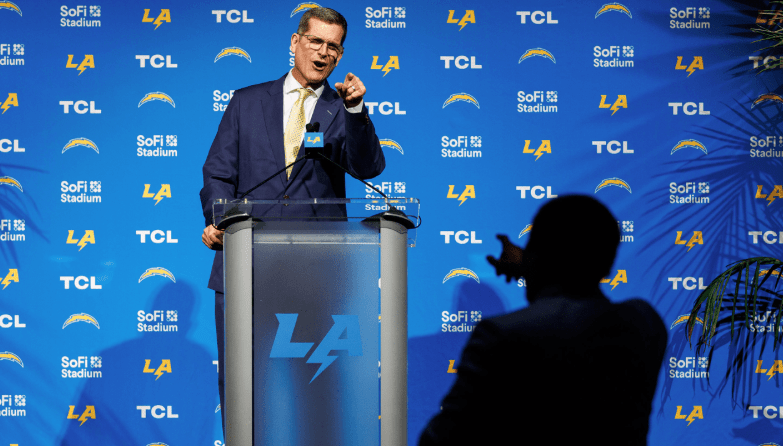
As by protocol for any sports televised press conference in Southern California over the last several decades, Jim Hill was dutifully called upon to ask the first question when the Los Angeles Chargers reeled in the media for a Feb. 1, 2024 announcement, moving it from their Costa Mesa headquarters to the YouTube Theater in Inglewood next to SoFi Stadium.
Jim Harbaugh, who had just won a national championship at the University of Michigan, was introduced as the Chargers newest head coach.
“Coach, I’m Jim Hill, KCAL-9 news … congratu …” is how Hill began.
“The legend,” Harbaugh interrupts. “Of course I know who you are.”
“No, no, no, you’re the legend,” Hill responds.
Jim Hill attends a Kobe and Vanessa Bryant Family Foundation press conference on September 12, 2012 in Hollywood. (Photo by Brian To/WireImage)
“You’re the legend,” Harbaugh repeats.
Hill continued by congratulating Harbaugh, wishing him good luck and noted that by seeing “all of us here today, what does this tell you about how popular this choice is by the Chargers to make you as a the head coach, and, the great expectations that come?”
“Well, thank you for that question, Jim,” Harbaugh replied. “And you are a legend.”
Harbaugh got in the last word.
As the Chargers began honored players from its past during Black History Month in that same February of 2024, Hill was a natural to profile. It started “Before legendary sports anchor Jim Hill got his start in television and became one of the well-known faces in Los Angeles and around the country, he was the one being interviewed.”
There’s that “legend” thing tossed around. And the Chargers have the rights to Hill’s No. 39 origin story, how it launched his sports broadcast career –a byproduct of the work ethic he established as an NFL player — and how he became a role model of African-American success in the community, setting him apart more than any other in Southern California local TV history.
Charlie Hough: Los Angeles Dodgers Tom Niedenfuer: Los Angeles Dodgers Dennis Smith: USC football Charles Phillips: USC football Carson Schwesinger: UCLA football
The not-so-obvious choices for No. 49:
Marvcus Patton: UCLA football
The most interesting story for No. 49: Marvcus Patton, UCLA football linebacker (1985 to 1989) via Leuzinger High of Lawndale (1980 to 1984) Southern California map pinpoints: Inglewood, Lawndale, Westwood
on the day UCLA’s football program accepted him as a relatively undersized walk-on linebacker in the fall of 1985, Marvcus Patton could only imagine how proud his father might have been.
His dad specifically gave him the name Marvcus, with the extra “V.” Pronounced MARV-cuss. It was in honor of the Roman emperor and warrior Marcus Aurelius. Marcus comes from the name Mars, the god of war.
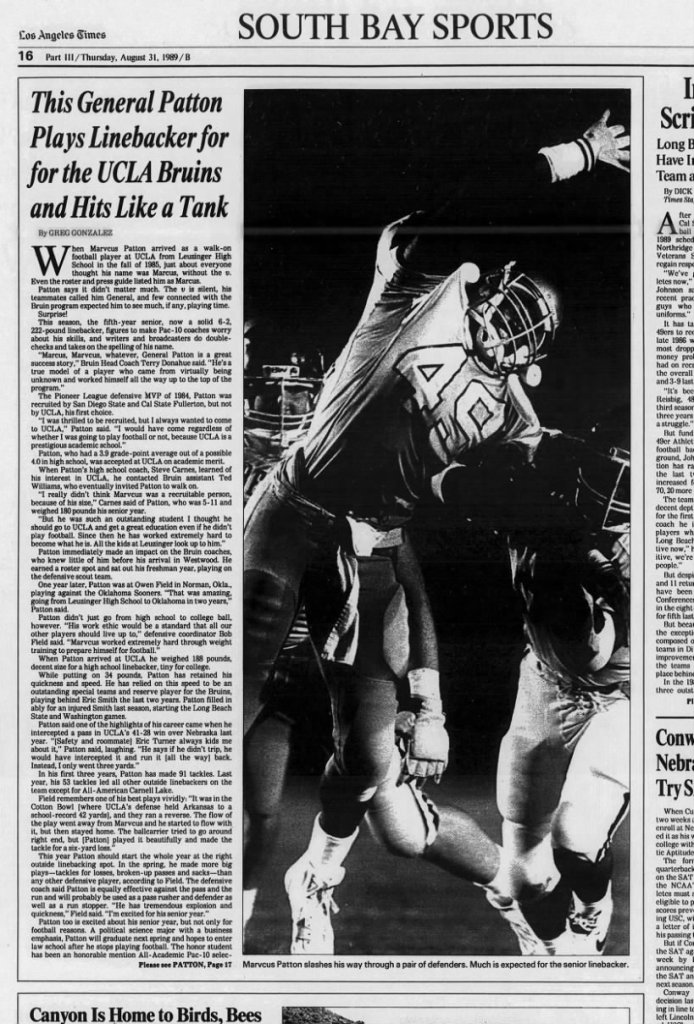
“As it turns out, he turned into a warrior on the football field,” his mother, Barbara, told the Los Angeles Times in a 1989 story as her son was about to enter his final collegiate season and consider what kind of future he might have as a professional.
As it also turns out, Barbara was far more influential in Marvcus’ ascent into a football life than anyone else.
She played the game. And very well at that.
Marvcus’ father, Raymond Hicks, never saw him play. Hicks was a Los Angeles Police undercover detective shot and killed in the line of duty during a drug bust when Marvcus was 9. Raymond Hicks had been separated from Barbara for some time at that point, eventually remarried and started another family.
Barbara managed as a single mom of two children, working as a PBX operation for the federal government’s General Services Administration in L.A. That was her Monday-to-Friday job. On weeknights and Saturdays, she operated full tilt as a linebacker for the Los Angeles Dandelions of the National Women’s Football League.
No flag-grabbing here. Helmets, shoulder pads, extra-thick padding up front. Full on contact. For $25 a day, which sometimes happened, sometimes not.
Like mother, like son. A unique dynamic that likely hasn’t happened anywhere else except here.
“I thought it was really cool to tell my friends that my mom was a linebacker,” Marvus Patton once shared. “My mom’s love for the game definitely influenced me. I always watched football on television and collected football cards, but seeing my mom play really made me want to be in the NFL.”
The son’s story
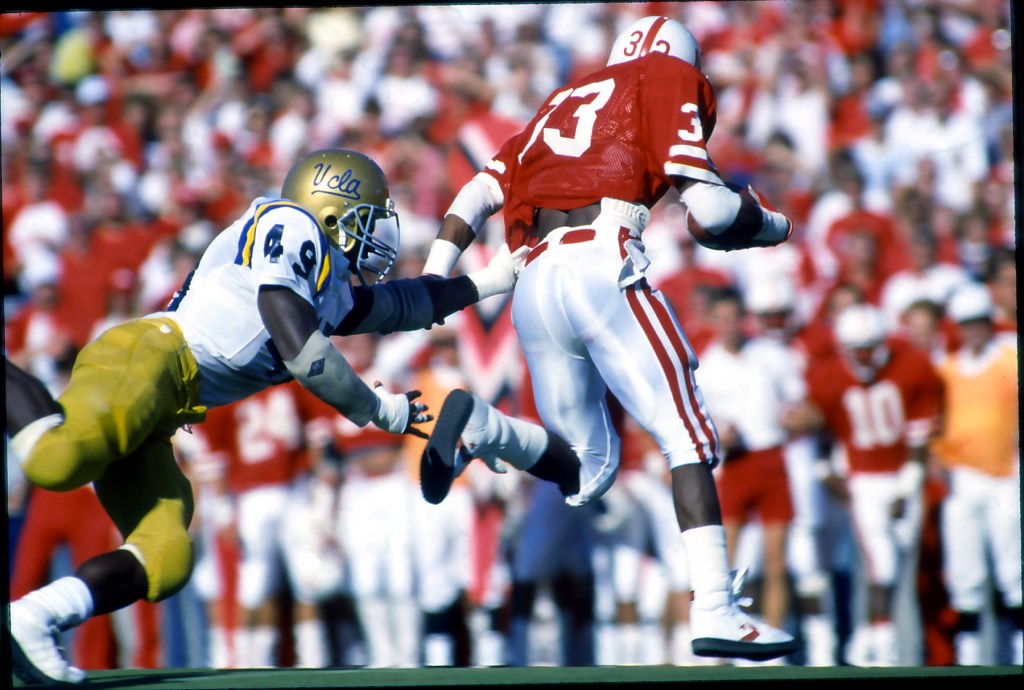
UCLA Athletic Department file photo.
As the Pioneer League defensive MVP at Leuzinger High in Lawndale in 1984, Marvcus Patton had only one college scholarship offer, from San Diego State. Cal State Fullerton, which had a program on its last legs, seemed to have interest. It didn’t matter. Patton’s first choice was UCLA.
As a high school junior, Patton stood 5-foot-11 and just 133 pounds. By his senior year, he got up to 165 via the weight room. Even if his college choices were were limited, academics mattered most.
“I would have come regardless of whether I was going to play football or not, because UCLA is a prestigious academic school,” said Patton, who had a 3.9 grade-point average and made it into on scholastic merit. At Leuzinger, he had already completed upper-division classes as a freshman and sophomore and was practically able to graduate before his senior season.
Steve Carnes, Patton’s coach at Leuzinger, connected with UCLA assistant Ted Williams and arranged for Patton to get an invite to walk on.
“I really didn’t think Marvcus was recruitable,” Carnes said. “But he was such an outstanding student I thought he should go to UCLA and get a great education even if he didn’t play football. Since then he has worked extremely hard to become what he is. All the kids at Leuzinger look up to him.”
After participating on the freshman scout team, Patton made it into the Bruins’ lineup by his sophomore year. He had put on more than 30 pounds but maintained his speed that set him apart on special teams.
UCLA Athletic Department file photo
Patton said a career highlight was intercepting a pass in UCLA’s 41-28 win over Nebraska in 1988.
By the time he hit his fifth-year senior season, at 6-foot-2 and 222 pounds, Patton earned the nickname “General” from his teammates. Maybe because they couldn’t get past the Marcus-Marvcus hurdle.
“Marcus, Marvcus, whatever, General Patton is a great success story,” UCLA head coach Terry Donahue would say. “He’s a true model of a player who came from virtually being unknown and worked himself all the way up to the top of the program.”
Marc Dellins, the longtime UCLA senior associate athletic director heading the sports information office, recalled the time when the Bruins played in the 1989 Cotton Bowl at the end of Patton’s junior season. All the players received bolo ties with a replica of the Cotton Bowl logo. The name spelled on Patton’s tie was “Marvcus.” Dellins noticed it and quickly told Patton he could get that fixed.
“That’s when he tells me it was spelled correctly,” said Dellins. “I realized for almost two seasons we had been spelling his first name wrong. I asked him why he didn’t say anything, and he said he didn’t want to make a big deal out of it. I said: ‘That’s your name, you can make a big deal out of it’.”
Consequently, whenever his mother ever got annoyed with him, she said she might call him “MAR-cus.” Normally, it was just “Marc.”
UCLA stumbled through a 3-7-1 record in 1989, starting the year ranked No. 6 but falling out of the Top 25 by mid season. Four of their losses were by three points or less. They salvaged some dignity by earning a 10-10 tie against No. 8 USC in the season finale. The Bruins, who went winless the last six weeks of the season, had their worst performance in 10 seasons. Patton’s final year still was an individual accomplishment — he set a school record with 22 tackles behind the line of scrimmage and was third in the conference with 11 sacks.
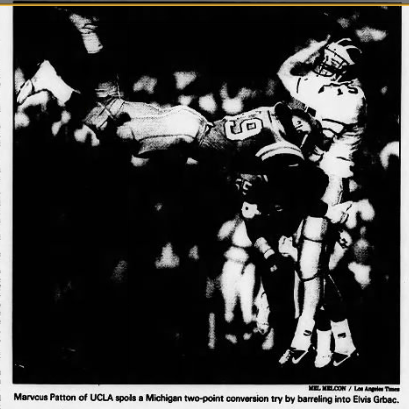
Los Angeles Times Sept. 24, 1989: No. 24 UCLA falls to No. 5 Michigan, 24-23, at the Rose Bowl.
Donahue noted Patton “played with great heart and competitiveness. He’s really had a good year despite the fact the team has not. I certainly think on a different team and a different set of circumstances, he’d really receive a tremendous amount of recognition and notoriety for his play.”
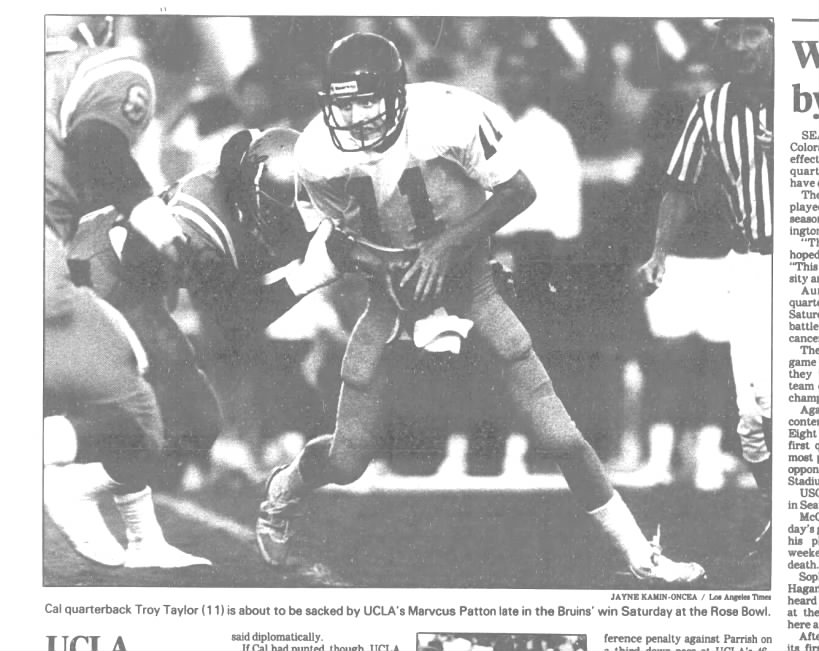
Los Angeles Times Oct. 1, 1989: UCLA defeats Cal, 24-6, at the Rose Bowl.
Patton was as proud of the fact teammates named him the co-MVP as he was having a political science degree on his resume.
It wasn’t until the eighth round of the 1990 NFL draft before Buffalo took a chance on taking Patton, making him the 208th pick overall. Patton said he felt like he was a walk-on all over again.
“When you have that feeling that everyone’s against you and they don’t think you can get it done, it gives you a little extra drive,” Patton said. “I’ve always felt that I had to prove myself.”
Patton not only earned a Bills’ roster spot but played in all 16 games. But he suffered a broken leg on the opening kickoff of the AFC Divisional playoff game against Miami and ended his rookie season.
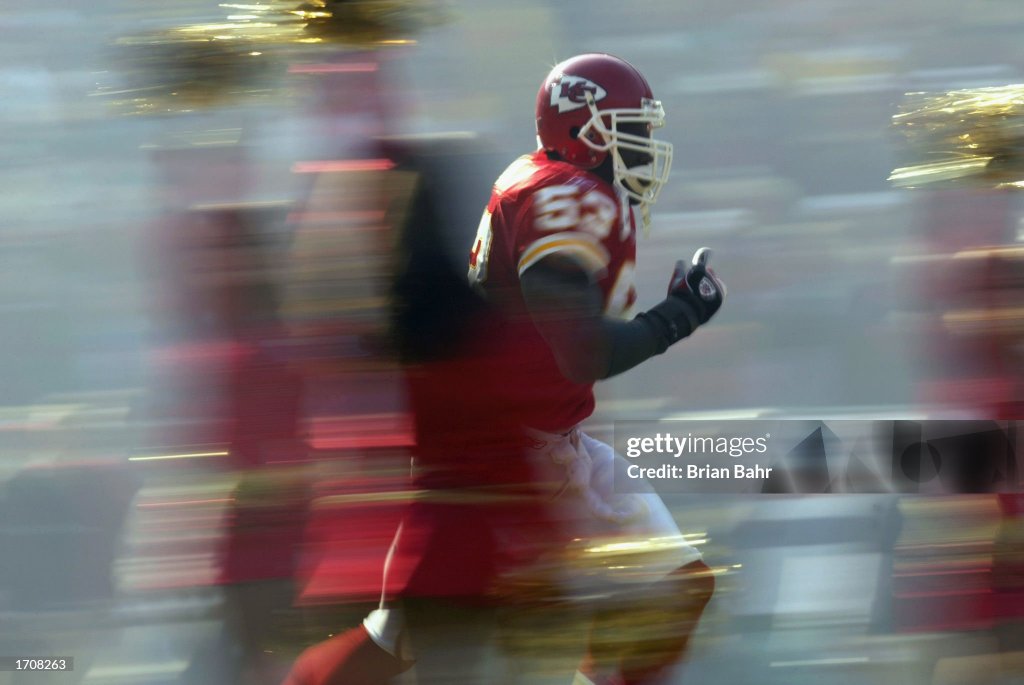
Kansas City Chiefs middle Linebacker Marvcus Patton runs onto the field during introductions before a game against Buffalo at Arrowhead Stadium in Kansas City. (Brian Bahr/Getty Images)
A full-time starter by his fourth season as a left inside linebacker, Patton put in five productive seasons in Buffalo, including four straight AFC titles and Super Bowl trips. When the Bills played in Super Bowl XXVII against Dallas and former UCLA teammate Troy Aikman in 1993, Patton was back on the Rose Bowl field.
Traded to Washington and moved to middle linebacker, Patton led the team in tackles three times and had a career best 143 with 115 solo tackles in 1998. After a Redskins’ 14-point loss to Tampa Bay in 1996, Patton was quoted as saying: “We played like babies. We didn’t tackle. We didn’t chase down people. We let it slip away.”
His final four seasons in Kansas City was him named a team MVP in his first season when he had 135 tackles, after landing a six-year contract said to be worth $10.1 million. At age 35 in his final season with the Chiefs, Patton had two interceptions (giving him 17 for his career) and two fumble recoveries (giving him 12). He scored his only NFL touchdown on a 24-yard interception return in 2000.
An NFL career that spanned 204 games over 13 seasons also is noteworthy in that Patton never missed a regular season game. Only one other defensive player picked in that 1990 NFL draft — Hall of Famer Junior Seau out of USC, No. 5 overall — played more than the 208 NFL games that Patton did in their careers.
Buffalo linebackers Marvcus Patton (53) and Shane Conlan (56) converge on Dallas tight end Jay Novacek (84) at midfield during Super Bowl XXVII at the Rose Bowl on January 31, 1993. (Gin Ellis/Getty Images)
Patton was done from pro football right about the same age as his mom did back in her playing days.
The mom’s story
The Daily Breeze, from the People section, Oct. 7, 1974.
Running back is the position that Barbara Patton always thought her son Marvcus would shine in Pop Warner football.
“You’ve got the speed, the moves … running back is the right place for you son,” she would say.
“No, mom,” Marvcus would answer. “I want to play defense … just like you.”
Barbara Patton knew what he meant. She took all of her 5-foot-4 and 130-pound statue to play outside linebacker for the women’s professional Los Angeles Dandelions. She was on the roster for their 1973 debut season and stayed around until 1976. A dandy role model.
“I was so little that I don’t remember much about her playing,” Marvcus would say. “All I remember is that she was always really excited on game day.”
Marvcus was 7 when he posed with his 11-year-old sister Debbie for a 1974 Daily Breeze feature story in the People section — not the Sports section — on the life of a 32-year-old single working mom living in Inglewood who had this weekend hobby that gave her an outlet for her athletic abilities.
Barbara heard about the Dandelions tryouts on the radio and talked her two sisters into joining her among the 350 candidates. Barbara was one of the 30 who made the cut.
Donn Moomaw, UCLA football Henry Ellard, Los Angeles Rams Johnnie Morton, USC football
The not-so obvious choices for No. 80:
Bob Klein, USC football, Los Angeles Rams Duane Bickett, USC football
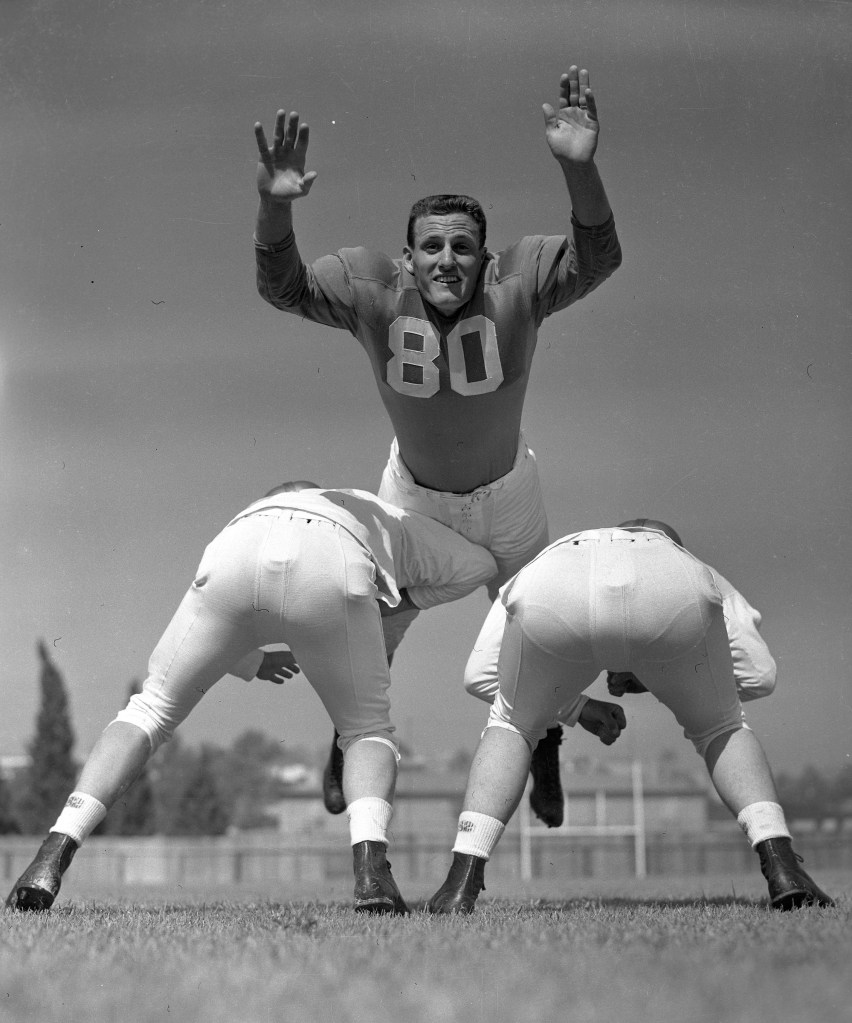
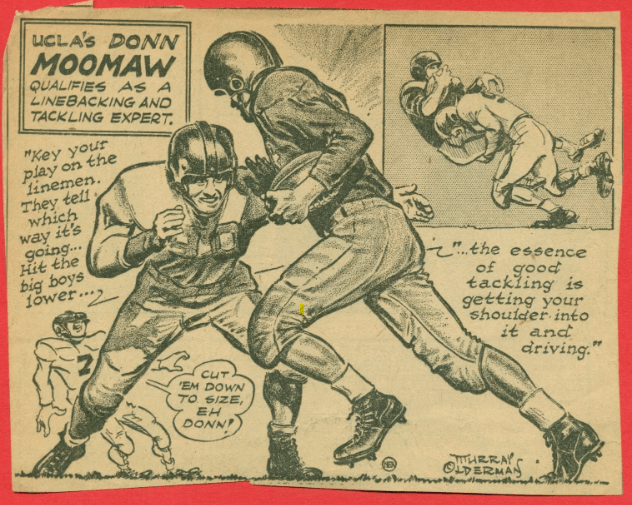
The most interesting story for No. 80: Donn Moomaw, UCLA football center and linebacker (1950 to 1952) via Santa Ana High Southern California map pinpoints: Santa Ana, Westwood, Los Angeles (Coliseum), Hollywood, Bel Air, Pasadena
UCLA athletic department archives
With their first pick in the 1953 NFL Draft — the ninth-overall choice — the Los Angeles Rams selected center/linebacker Donn Moomaw, the first two-time All-American in UCLA program history and a local hero out of Santa Ana High.
Moomaw prayed on it.
Then he politely declined.
The NFL played Sunday games, which was Moomaw’s day for the Lord. It did not need any potential Hail Mary pass plays intercepting his focus.
As an end around, Moomaw could deflect to Canada, play for the Toronto Argonauts and the Ottawa Rough Riders in the CFL, and do more mid-week and Saturday engagements.
But soon enough, his rough ride of long-term pro football fame came with a change in heart. Moomaw became one of the most well-known preachers in the country. The fresh Presbyterian minister of Bel Air became a personal confidant of Ronald Reagan and his family, starting with his time as the California governor, and going all the way to the White House.
But then, the headlines that Moomaw made later in life were a cause to pause and pray some more.
The story
Don Moomaw’s time at UCLA was a glorious one. They weren’t booing him. When the 6-foot-4, 220-pound linebacker made a tackle, the UCLA cheerleaders would lead the crowd in “MooooooMAW!” He was known as “the Mighty Moo.”
Fred Dryer: Los Angeles Rams Ron Brown: Los Angeles Rams Charles Young: USC football
The not so obvious choice for No. 89:
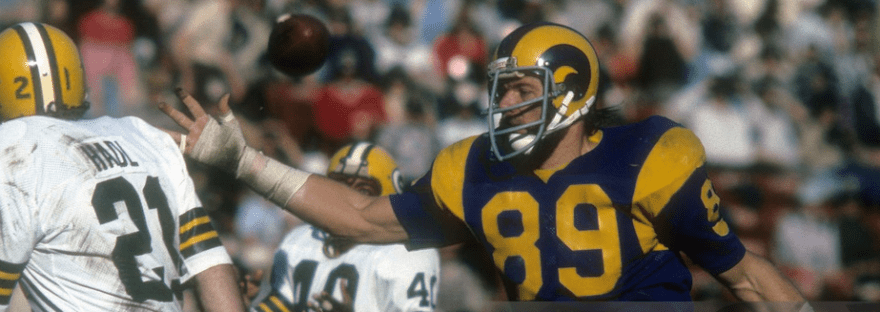
Jack Bighead: Pepperdine football Bobby Jenks: Los Angeles Angels The most interesting story for No. 89: Fred Dryer: Los Angeles Rams defensive end (1972 to 1981) via Lawndale High and El Camino College Southern California map pinpoints: Hawthorne, Lawndale, Torrance, Los Angeles (Coliseum), Long Beach, Hollywood
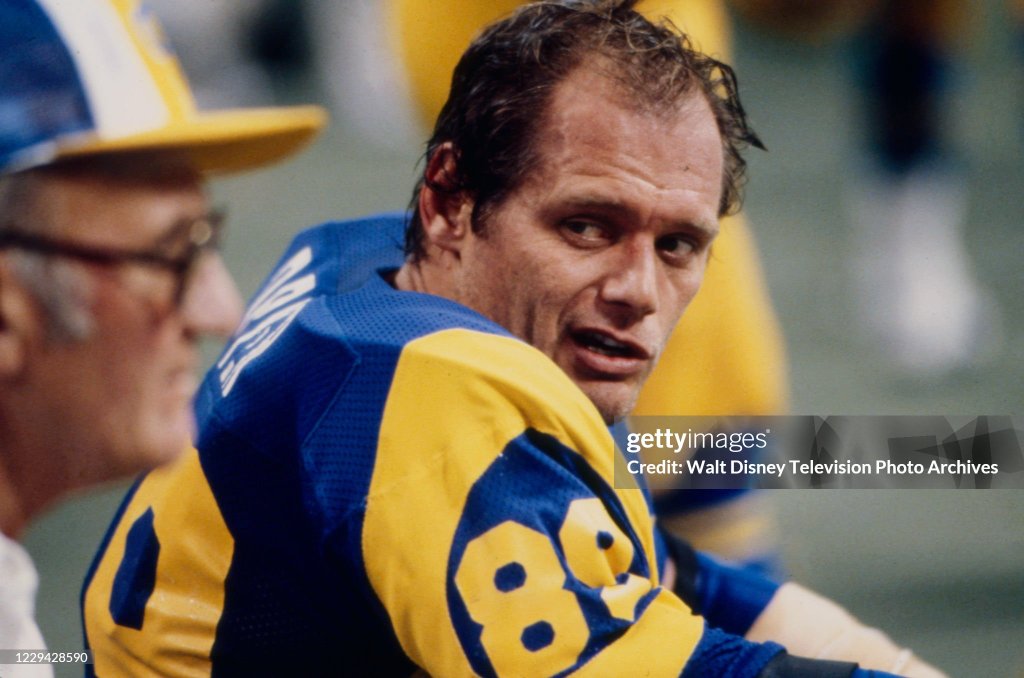
The Rams’ Fred Dryer during an ABC’s “Monday Night Football” broadcast in 1979 against Dallas. (ABC via Getty Images)
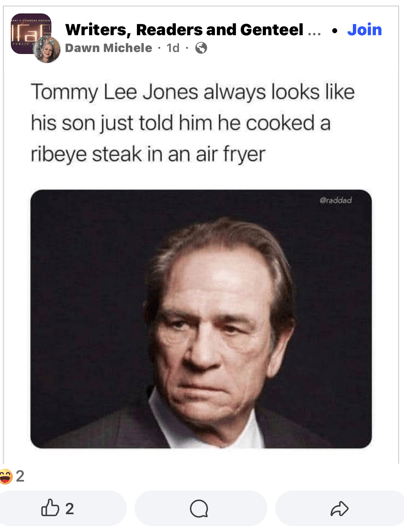
Came across a social media post once that observed actor Tommy Lee Jones “always looks like his son just told him he cooked a ribeye steak in an air fryer.”
Fred Dryer could deliver the resting-face scowl no matter what role he was playing.
Two distinct versions of Dryer come to mind — the agitated, swift-moving Los Angeles Rams’ defensive end sideswiping an offensive tackle en rout to hunting down another quarterback, and the pretend LAPD private eye named “Hunter” who bent the rules when necessary. In each of those was an underpinning of “Dirty Harry” in motion. Or even of Tommy Lee Jones, either as Warden Dwight McClusky in “Natural Born Killers” or the villainous Two Face in “Batman Forever.”
Dryer had a job and a duty to perform it. In both cases. Vengeance could be a motivational tactic. He cleaned up messes, no matter how dirty or harry it became.
A day in court never seemed to bother him, either. Justice had to be serviced, whether Dryer was pushing back on a contract dispute as either a professional athlete or a popular thespian. Dryer pulled those levers of justice, his modus operandi, with or without a legal need to produce a habeas corpus.
There was a point at the height of his TV fame, almost a decade since the official end of his NFL career, when Dryer found himself in a huddle of entertainment industry writers. They soft-tossed him questions about how, as he was about to turn 42, he best self-identified at this point in his life.
“As the hard-boiled Rick Hunter, a Los Angeles homicide detective, Dryer projects an image that combines Steve McQueen’s rough sexiness with Clint Eastwood’s stoic demeanor. And Hunter shows just about as much respect for his suspects Constitutional rights as Eastwood’s Dirty Harry does.
“Dryer has a theory about why his acting career took off when so many of his colleagues’ fizzled.
“ ‘Most athletes fail at it because they don`t understand that when you come from a success in another area like sports, you have to leave the sports world behind. You have to kill the guy that made you a sports star and start over completely.
“Fred Dryer, football player, is dead. I put him away and started with this other guy.
“That means you don’t bring the ego you had in football with you. Without mentioning names, I see ex-football players who are just not willing to let go of (their athlete image), because if they lose that, who are they? You have to let go of your past before you gain something else.”
Dryer was just staying in character.
Considering he almost had the role of Sam Malone when the iconic TV series “Cheers” launched years earlier — imagine him as a happy ex-drunk? — the thought of hanging around a bar known as an ex-jock just wasn’t his idea of being pro active.