No. 93: Ndamukong Suh

This post is part of a media project called SoCal Sports History 101: The Prime Numbers from 00 to 99 that Uniformly, Uniquely and Unapologetically Reveal The Narrative of Our Region’s Athletic Heritage. Pick a number, and consider the list of athletes attached to it. Who wore it best? Or, what’s the most compelling story linked to it? Any person, place or thing is in play with Southern California connections. Star power, transformational achievement, longevity, notoriety and quirkiness all factor in. Whatever leads to a lively discussion and interpretation.

The most obvious choices for No. 93:

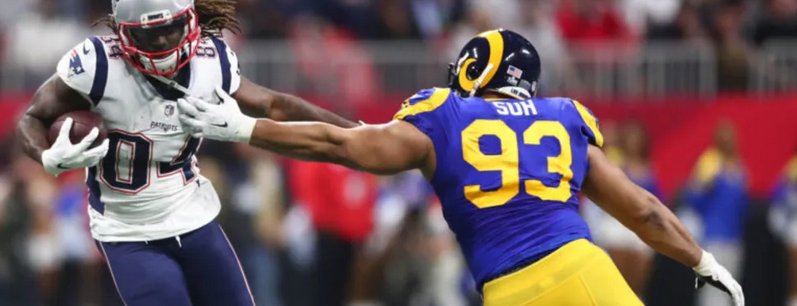
Ndamukong Suh, Los Angeles Rams
Greg Townsend, Los Angeles Raiders

The most interesting story for No. 93:

Ndamukong Suh, Los Angeles Rams nose tackle (2018)
Southern California map pinpoints:
Inglewood (SoFi Stadium)


For all the unnecessary roughness during a 13-year NFL career — the down-low, scandalized way he treated opposing players — Ndamukong Suh never got sued.

Maybe the league’s witness protection program wasn’t all that great. Or, maybe because, deep down, he was really a super nice guy whose actions off the field spoke louder than his red-flag existence on the gridiron of employment?

In nearly 200 regular season games, including three Super Bowls, another handful of playoff appearances, five times added to a Pro Bowl squad, and a handful of exhibition games where rules still applied, the 6-foot-4, 313-pound Suh leveraged his abilities to earn about $163 million in salary. That included $14 million that the Los Angeles Rams gave him to join their organization in 2018, a strategic move to free up the often double-teamed All Pro defensive end Aaron Donald.

Now subtract more than $400,000 for all the fines and lost pay checks Suh incurred.

“Some may say (his penalty payments were) a bargain to pay in light of what he had earned — all the intimidation that came from his reputation,” USA Today columnist Mike Freeman wrote when Suh, in a rather poignant social media post, announced in July of 2025 he was officially retired from the NFL at age 38.

Continue reading “No. 93: Ndamukong Suh” →
No. 80: Donn Moomaw

This post is part of a media project called SoCal Sports History 101: The Prime Numbers from 00 to 99 that Uniformly, Uniquely and Unapologetically Reveal The Narrative of Our Region’s Athletic Heritage. Pick a number, and consider the list of athletes attached to it. Who wore it best? Or, what’s the most compelling story linked to it? Any person, place or thing is in play with Southern California connections. Star power, transformational achievement, longevity, notoriety and quirkiness all factor in. Whatever leads to a lively discussion and interpretation.

The most obvious choices for No. 80:

Donn Moomaw, UCLA football
Henry Ellard, Los Angeles Rams
Johnnie Morton, USC football

The not-so obvious choices for No. 80:

Bob Klein, USC football, Los Angeles Rams
Duane Bickett, USC football

The most interesting story for No. 80:
Donn Moomaw, UCLA football center and linebacker (1950 to 1952) via Santa Ana High
Southern California map pinpoints:
Santa Ana, Westwood, Los Angeles (Coliseum), Hollywood, Bel Air, Pasadena


UCLA athletic department archives

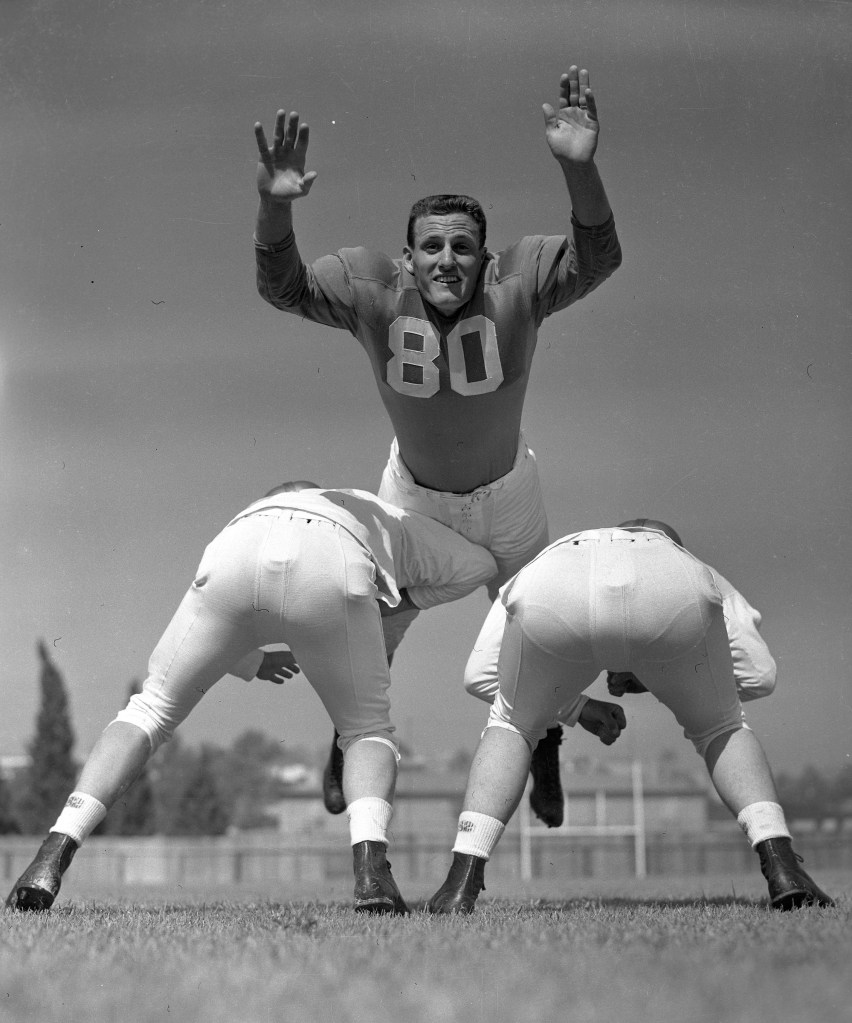
With their first pick in the 1953 NFL Draft — the ninth-overall choice — the Los Angeles Rams selected center/linebacker Donn Moomaw, the first two-time All-American in UCLA program history and a local hero out of Santa Ana High.

Moomaw prayed on it.

Then he politely declined.

The NFL played Sunday games, which was Moomaw’s day for the Lord. It did not need any potential Hail Mary pass plays intercepting his focus.

As an end around, Moomaw could deflect to Canada, play for the Toronto Argonauts and the Ottawa Rough Riders in the CFL, and do more mid-week and Saturday engagements.

But soon enough, his rough ride of long-term pro football fame came with a change in heart. Moomaw became one of the most well-known preachers in the country. The fresh Presbyterian minister of Bel Air became a personal confidant of Ronald Reagan and his family, starting with his time as the California governor, and going all the way to the White House.

But then, the headlines that Moomaw made later in life were a cause to pause and pray some more.

The story

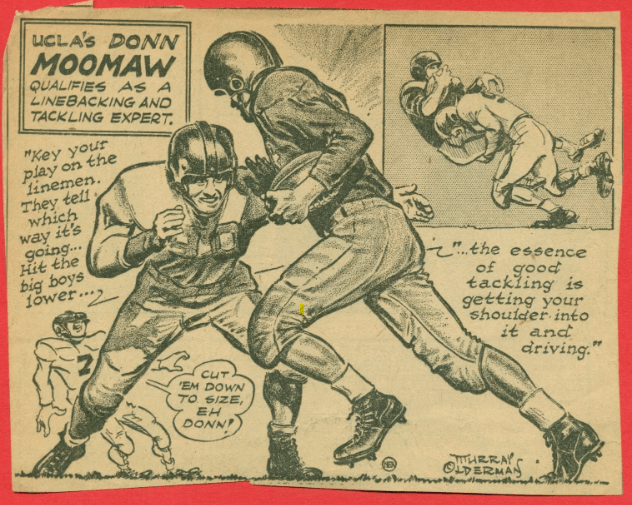
Don Moomaw’s time at UCLA was a glorious one. They weren’t booing him. When the 6-foot-4, 220-pound linebacker made a tackle, the UCLA cheerleaders would lead the crowd in “MooooooMAW!” He was known as “the Mighty Moo.”

He came just as advertised out of Santa Ana High.

Continue reading “No. 80: Donn Moomaw” →

No. 89: Fred Dryer

This post is part of a media project called SoCal Sports History 101: The Prime Numbers from 00 to 99 that Uniformly, Uniquely and Unapologetically Reveal The Narrative of Our Region’s Athletic Heritage. Pick a number, and consider the list of athletes attached to it. Who wore it best? Or, what’s the most compelling story linked to it? Any person, place or thing is in play with Southern California connections. Star power, transformational achievement, longevity, notoriety and quirkiness all factor in. Whatever leads to a lively discussion and interpretation.

The most obvious choices for No. 89:

Fred Dryer: Los Angeles Rams
Ron Brown: Los Angeles Rams
Charles Young: USC football

The not so obvious choice for No. 89:

Jack Bighead: Pepperdine football
Bobby Jenks: Los Angeles Angels

The most interesting story for No. 89:

Fred Dryer: Los Angeles Rams defensive end (1972 to 1981) via Lawndale High and El Camino College
Southern California map pinpoints:
Hawthorne, Lawndale, Torrance, Los Angeles (Coliseum), Long Beach, Hollywood


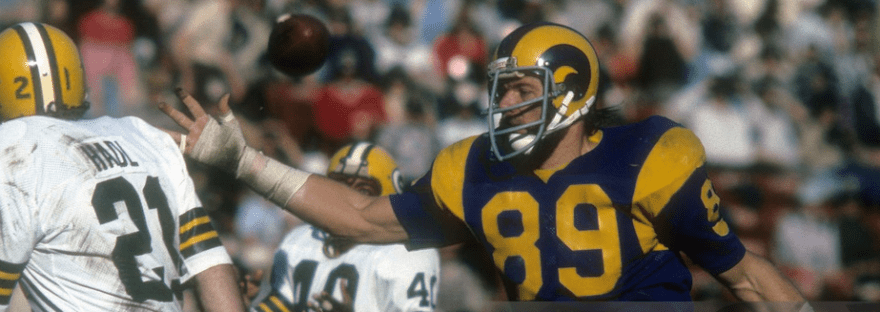
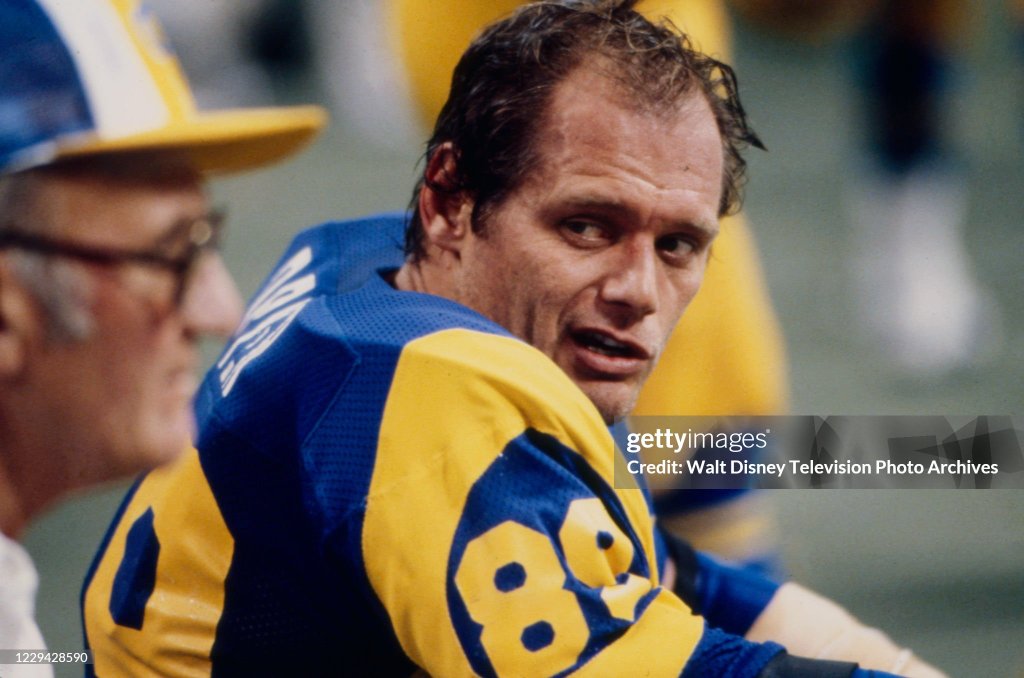
The Rams’ Fred Dryer during an ABC’s “Monday Night Football” broadcast in 1979 against Dallas. (ABC via Getty Images)

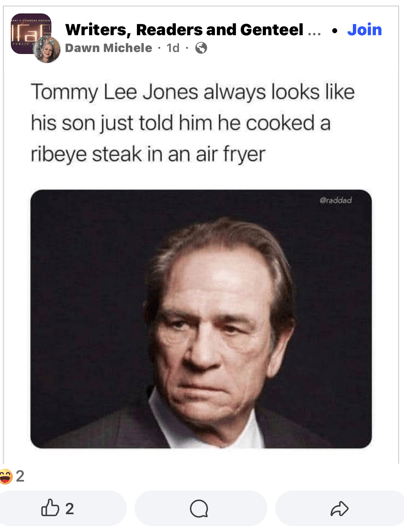
Came across a social media post once that observed actor Tommy Lee Jones “always looks like his son just told him he cooked a ribeye steak in an air fryer.”

Fred Dryer could deliver the resting-face scowl no matter what role he was playing.

Two distinct versions of Dryer come to mind — the agitated, swift-moving Los Angeles Rams’ defensive end sideswiping an offensive tackle en rout to hunting down another quarterback, and the pretend LAPD private eye named “Hunter” who bent the rules when necessary. In each of those was an underpinning of “Dirty Harry” in motion. Or even of Tommy Lee Jones, either as Warden Dwight McClusky in “Natural Born Killers” or the villainous Two Face in “Batman Forever.”

Dryer had a job and a duty to perform it. In both cases. Vengeance could be a motivational tactic. He cleaned up messes, no matter how dirty or harry it became.

A day in court never seemed to bother him, either. Justice had to be serviced, whether Dryer was pushing back on a contract dispute as either a professional athlete or a popular thespian. Dryer pulled those levers of justice, his modus operandi, with or without a legal need to produce a habeas corpus.

There was a point at the height of his TV fame, almost a decade since the official end of his NFL career, when Dryer found himself in a huddle of entertainment industry writers. They soft-tossed him questions about how, as he was about to turn 42, he best self-identified at this point in his life.

Dryer tackled it all head on.

A headline in the Chicago Tribune seemed to make it clear: “Fred Dryer, Actor, Gives His Past A Punt.” It went on to explain:

“As the hard-boiled Rick Hunter, a Los Angeles homicide detective, Dryer projects an image that combines Steve McQueen’s rough sexiness with Clint Eastwood’s stoic demeanor. And Hunter shows just about as much respect for his suspects Constitutional rights as Eastwood’s Dirty Harry does.

“Dryer has a theory about why his acting career took off when so many of his colleagues’ fizzled.

“ ‘Most athletes fail at it because they don`t understand that when you come from a success in another area like sports, you have to leave the sports world behind. You have to kill the guy that made you a sports star and start over completely.

“Fred Dryer, football player, is dead. I put him away and started with this other guy.

“That means you don’t bring the ego you had in football with you. Without mentioning names, I see ex-football players who are just not willing to let go of (their athlete image), because if they lose that, who are they? You have to let go of your past before you gain something else.”

Dryer was just staying in character.

Considering he almost had the role of Sam Malone when the iconic TV series “Cheers” launched years earlier — imagine him as a happy ex-drunk? — the thought of hanging around a bar known as an ex-jock just wasn’t his idea of being pro active.

Continue reading “No. 89: Fred Dryer” →

No. 41: Glenn Davis

This post is part of a media project called SoCal Sports History 101: The Prime Numbers from 00 to 99 that Uniformly, Uniquely and Unapologetically Reveal The Narrative of Our Region’s Athletic Heritage. Pick a number, and consider the list of athletes attached to it. Who wore it best? Or, what’s the most compelling story linked to it? Any person, place or thing is in play with Southern California connections. Star power, transformational achievement, longevity, notoriety and quirkiness all factor in. Whatever leads to a lively discussion and interpretation.

The most obvious choices for No. 41:

Jerry Reuss, Los Angeles Dodgers
John Lackey, Anaheim Angels
Elden Campbell, Los Angeles Lakers
Glen Rice, Los Angeles Lakers and Clippers

The not-so-obvious choices for No. 41:

Glenn Davis, Los Angeles Rams
Ken Norton Jr., UCLA football
Jeff Shaw, Los Angeles Dodgers

The most interesting story for No. 41:
Glenn Davis, Los Angeles Rams running back (1950 to 1951)
via Bonita High
Southern California map pinpoints:
Claremont, La Verne, Pomona, Los Angeles Coliseum, La Quinta

Reference books on the subject:
“Mr. Inside and Mr. Outside: World War II, Army’s Undefeated Teams, and College Football’s Greatest Backfield Duo,” by Jack Cavanaugh, 2014


In the main office at Bonita High School in La Verne, Glenn Davis’ 1946 Heisman Trophy sits somewhat unassuming in a glass case. There are all sorts of newspaper clippings behind it. Next to it is the Smudgepot Game Trophy — which, to some, carries more importance as far as school bragging rights.

Davis, the Army tailback known as “Mr. Outside,” became just the 12th recipient in the award’s history after his senior season of college football, given to the most “outstanding college football player in the United States” as designated by the Downtown Athletic Club of New York City. He actually was the award runner-up as both a sophomore and a junior.

On this Heisman plaque, however, there’s a small, noteworthy addition. Check the bottom left corner. Someone added: “Bonita High School 1940-1943.”

To the “Claremont Comet,” as he was called in the local newspapers, that footnote mattered most to him.

“I don’t think there’s too many high schools in the country with a Heisman Trophy in their possession,” said then-Principal Bob Ketterling in 2004. “People walk by and do a double-take.”

Davis, the first Heisman Trophy winner who came from the California Interscholastic Federation’s Southern Section, eventually was a member of the Los Angeles Rams and played in two NFL championship games during his only two professional seasons. And to think he could have had USC on his resume instead of Army, but something odd happened along the way.

Continue reading “No. 41: Glenn Davis” →