
Blog

Day 13 of 2024 baseball books: Pete, repeat, rinse … and why does it feel we’re just getting hustled again?

“Charlie Hustle: The Rise and Fall of
Pete Rose, and the Last Glory Days of Baseball”

The author:
Keith O’Brien

The publishing info:
Pantheon Publishing
464 pages, $35
Released March 26, 2024

The links:
The publishers website; the authors website; at Bookshop.org; at Powells.com; at {pages}; at Walmart.com; at BarnesAndNoble.com; at Amazon.com

The review in 90 feet or less

The stories wedged into our data stream with the non-latest on Shohei Ohtani’s curious plight of paying off someone’s gambling debts — his own, his interpreter, or something else we’ve lost in translation — essentially hits on the same few notes.

A) Major League Betting … er, Baseball … in bed with gambling websites is hypocritical going back to 2018;

B) Sports wagering isn’t legal in California and maybe should never be;

C) A story of this magnitude was bound to blow up some day and “you’d be insane to think there isn’t going to be a scandal,” and;

D) didn’t we already cover this with The Life and Times and Bad Bets and No Remorse of Pete Rose?

Pull up a bench, Johnny. The story isn’t over til it’s been done over and over.

Continue reading “Day 13 of 2024 baseball books: Pete, repeat, rinse … and why does it feel we’re just getting hustled again?”

Day 12 of 2024 baseball book reviews: The unintended consequences of hope vs. hype

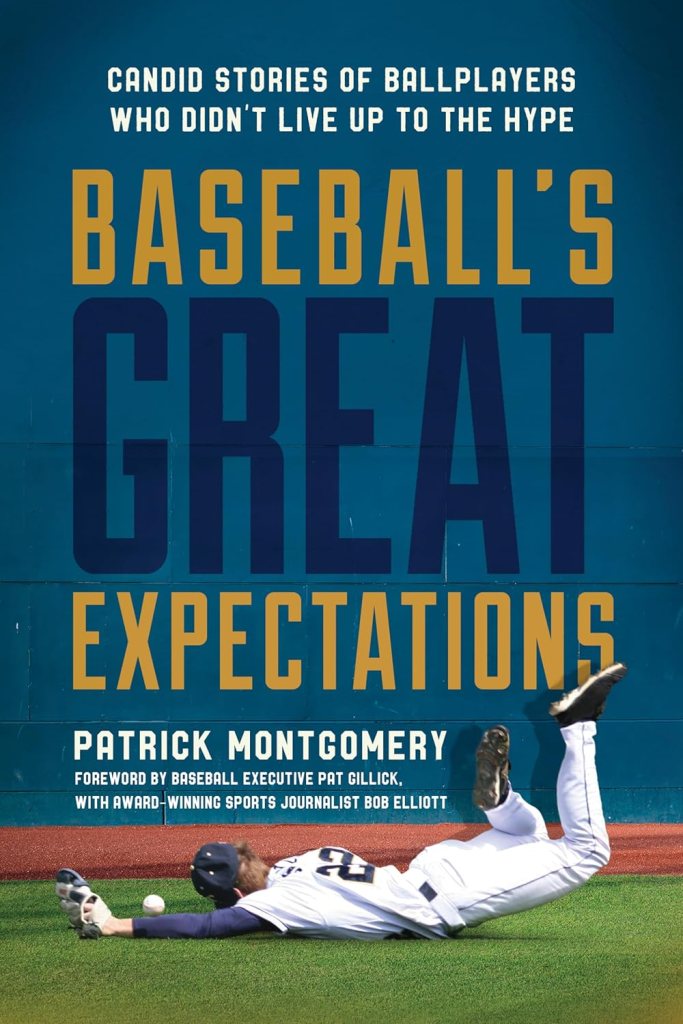
“Baseball’s Great Expectations:
Candid Stories of Ballplayers Who Didn’t Live up to the Hype”
The author:
Patrick Montgomery

The publishing info:
Rowman & Littlefield
214 pages; $35
Released March 5, 2024

The links:
The publishers website
at Bookshop.org; at Powells.com; at {pages}; at Vromans; at Walmart; at BarnesAndNoble.com; at Amazon.com

The review in 90 feet or less

The headline in the New York Post on March 21 screamed bloody murder. Because, really, what else would you expect from Ye Old Post of Newish Yorkshire Pudding:
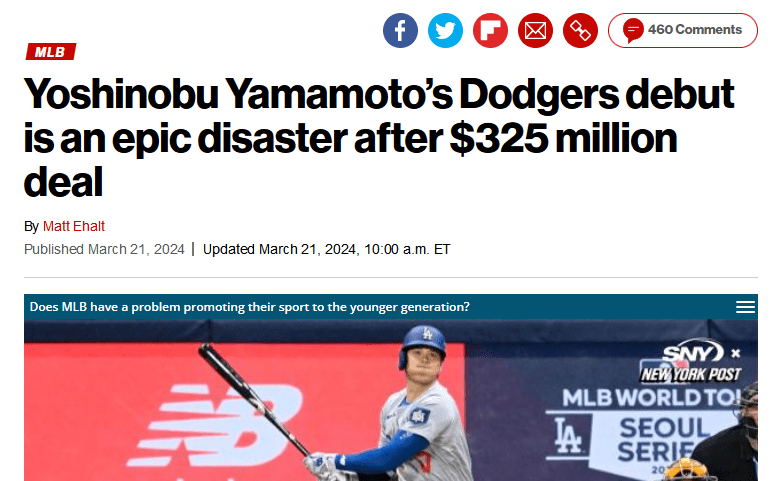
The story contained the fact: “As part of their historic off season spending frenzy, the Dodgers rewarded Yamamoto the largest pitching contract in MLB history this past off season.”

Hey, maybe go easy on dousing the words “off season” into the recipe of one meager sentence. We got it the first time … OK, go on …

“To beat out the Yankees, Mets and Phillies, among others, Los Angeles gave Yamamoto $325 million over 12 years, beating Yankees ace Gerrit Cole’s previous record by $1 million. With such a contract comes expectations to be among the league’s best.”

Missing fact from that paragraph: Cole, the former UCLA star entering the fifth year of a $324 million contract, is now projected to remain sidelined until at least June 1, forcing the Yankees to find more pitching depth elsewhere and never likely to get full value from their investment.

Also buried in the last paragraph of that Yamamoto story: “While his outing stood out, the Dodgers had pitching problems throughout the game as six other pitchers combined to allow 10 runs in eight innings.” He wasn’t the only one looking shaky on the mound that day in South Korea.

So as epic a meltdown for the ages of anyone making their MLB debut as it was Yamamoto … We are happier for his self worth that he was not a member of the Yankees or Mets, or else the black-page, block-letter headlines would have been made into a T-shirt and NYC Library Book Bag.

Oh, quick followup: When Yamamoto made his second start of the season, on March 30 at Dodger Stadium, posting five shutout innings on both ends of an eventual rain-delay — who does that any more — the Dodgers’ extra-inning loss to the Cardinals was framed this way in the N.Y. Post:
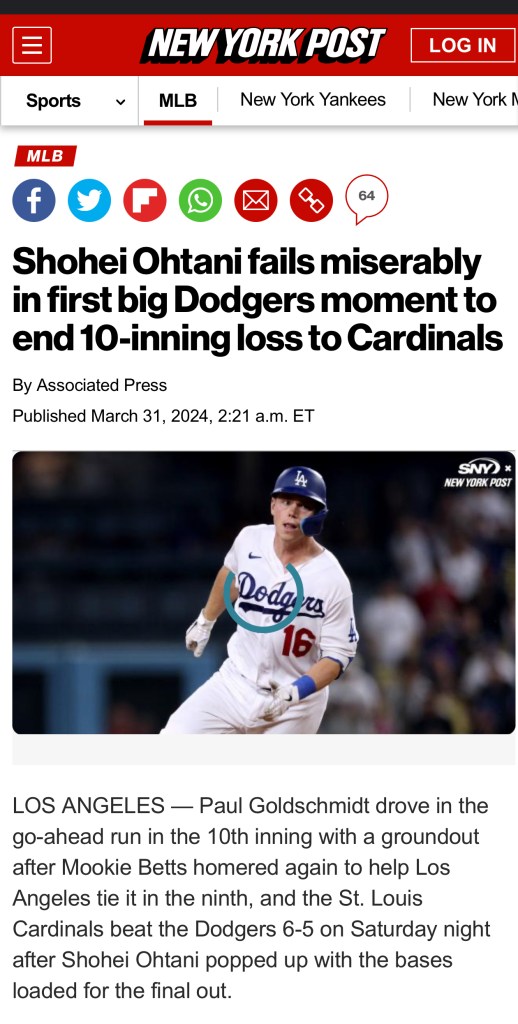
As this AP story includes, Yamamoto “bounced back from his dismal MLB debut on March 21 … ” And taking that further, L.A. Times’ Dylan Hernandez followed up with a column headlined: “Forget the loss. Dodgers starter Yoshinobu Yamamoto proves he can pitch in MLB.”

Yamamoto, 25 years old, with several years of fame in Japan, has made two MLB starts. Two. His next is Saturday at Wrigley Field.

Get a grip.

Maybe come back with your trumpet solo in 2036, when Yamamoto hopefully reaches the age of 37 as his Dodgers deal ends. At that point, there will be no more newspapers to even be around covering things so vital to our survival.

Continue reading “Day 12 of 2024 baseball book reviews: The unintended consequences of hope vs. hype”
Day 11 of 2024 baseball book reviews: We’re all card-carrying members

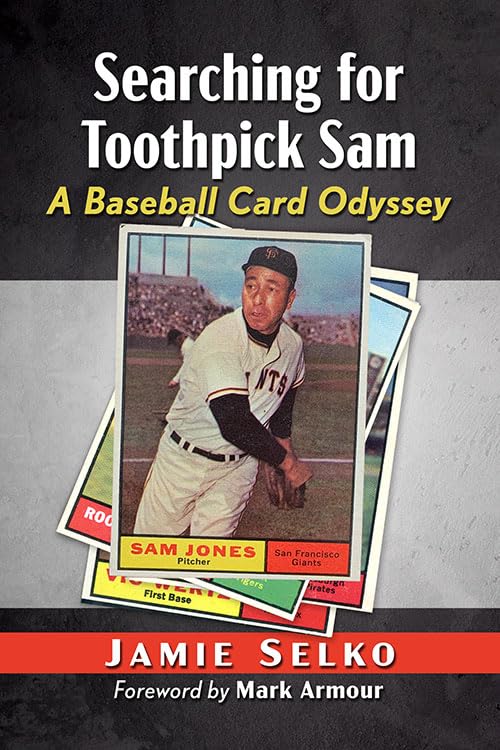
Searching for Toothpick Sam: A Baseball Card Odyssey”

The author:
Jamie Selko

The publishing info:
McFarland
216 pages
$29.95; released Dec. 17, 2023

The links:
The publishers website
At Bookshop.org
At Target.com
At Powells.com; at BarnesAndNoble.com; at Amazon.com

“When Baseball Was Still Topps:
Portraits of the Game in 1959, Card by Card”

The author:
Phil Coffin

The publishing info:
McFarland
243 pages
$39.95; released December 5, 2023

The links:
The publishers website
At Bookshop.org
At Powells.com
At BarnesAndNoble.com; at Amazon.com

“Cramer’s Choice: Memoir of a
Baseball Card Collector Turned Manufacturer”

The author:
Mike Cramer

The publishing info:
McFarland
253 pages
$29.95; released Oct. 17, 2023

The links:
The publishers website; at Bookshop.org
At Powells.com
At BarnesAndNoble.com
At Amazon.com

The reviews in 90 feet or less

The stories stack up like a pile of baseball cards. The residual effects of the COVID-19 pandemic lock-down has resulted in, for some reason, baseball cards becoming a ring-a-ding thing again.

We had some time to go through, sort, re-evaluate, and find like-minded, lonely people who believed in this idea. In September of 2020, as we extended our annual baseball book review series, Axios sports examined the trading card boom over the prior months. As well as exposing the dark side of forgeries. In July, Bill Shea of The Athletic had a piece under the headline “State of the sports card boom: After sky-high surge, is the market still healthy?” The conclusion was: Yeah, kinda.

In September of 2022, The Wall Street Journal produced: “The Most In-Demand Investment Might Be Your Baseball Card Collection.” Then in March 2023, Ian Thomas of CNBC posted the real push moving this forward: “How Fanatics and MLB are planning to keep the trading card boom going.” Fanatics was the company that pried the rights to making MLB trading cards from Topps in August, 2021, ending a partnership that went back to 1952. Fanatics then acquired Topps outright in early 2023 for $500 million.

And if you’re wondering: The nine most valuable baseball cards in history are pretty much a) the ones you think they are and b) the ones you’ll never own.

Our personal cardboard collection during the pandemic wasn’t so much to revisit all the book binders, shoe boxes and plastic cases we’ve stashed away in various rooms and closets. It was renovating a home office that resulted in re configuring closet space — and actually gave the card collection a higher place of honor within the home structure. The space gained allowed us to display more book shelves. So binders with “Topps 1970-71,” and “Hall of Famers” and “Future Hall of Famers” (which was horribly in need of an update — sorry Chris Sabo) could be addressed.

Now there was also another shelf to hold our lineup of baseball card-related books:

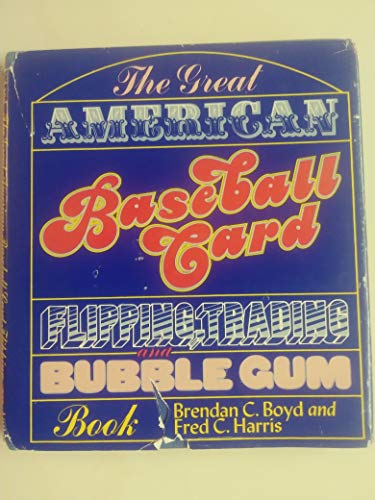
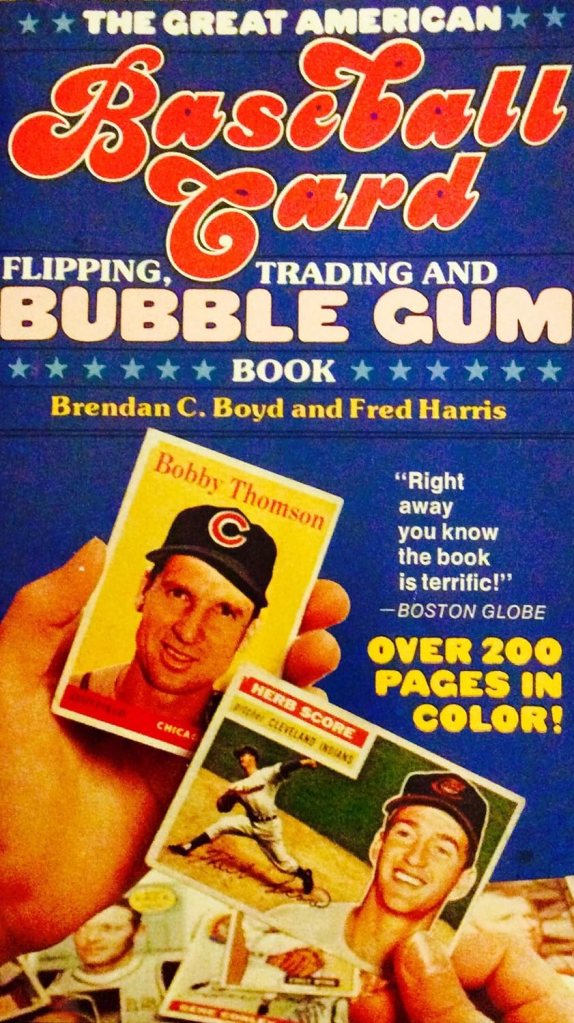
== “The Great American Baseball Card Flipping, Trading And Bubblegum Book,” by Brendan Boyd and Fred Harris (1973).

We saw recently how the e-book (right) is advertised as “The Spinal Tap of Baseball Books.” It’s still best described by people like Jeff Katz for the SABR Baseball Cards Research Committee: “For Hannukah that year I got (the book). It’s impossible to overstate the impact of this book on me, and every other card collector of the era, from 10 years old and up. Again, I’ll give it a shot. First, there were cards. Pages and pages of cards, nearly all from the 1950’s and 1960’s. I had never seen these before! How could I? The catalogs didn’t have many pictures, if they had them at all. What a gift. It made my head spin. Second, there was the writing. It was beyond funny: sharp, but warm, silly, but deep, nostalgic, but not maudlin. Harris and Boyd had a ‘60’s sense of irreverence and impudence, and even for a kid like me it resonated. There was a love for the game and the cards that was genuine, but not too serious. This was a life lesson I could take to heart. Third, there was a sense of shared community. Most of my friends were card collectors, but they were children. Harris and Boyd were grown men, seemingly in their late-20’s. They looked pretty cool too. What were these guys doing in the baseball card world? That looked like a future I could embrace.”

Continue reading “Day 11 of 2024 baseball book reviews: We’re all card-carrying members”

Day 10 of 2024 baseball book reviews: Updating the spin rate on Ring Lardner’s slider

“Frank Chance’s Diamond:
The Baseball Journalism of Ring Lardner”

The author/editor:
Ron Rapoport

The publishing info:
Globe Pequot/Lyons Press; Rowman & Littlefield; 264 pages; $24.95; released Feb. 6, 2024

The links:
The publishers website; the author’s website; at Bookshop.org; at {pages}; at Powells.com; at BarnesAndNoble.com; at Amazon.com

The review in 90 feet or less

The name Ringgold Wilmer Lardner still rings a bell.

For us, it started with a USC journalism class syllabus in the early 1980s that required reading “Sports and the Spirit of Play in American Fiction: Hawthorne to Faulkner,” by Christian Messenger.

Chapter Five — “Lardner: The Popular Sports Hero” – started this way:

“The most talented sportswriter was Ring Lardner, the innovative chronicler of American games, comic players and their foibles. He allied himself to popular sport and the realist tradition while irrevocably fixing the stereotype of the professional athlete for modern fiction. Lardner stands at the center of any discussion of popular sport in modern American literature.”

Our education continued with Ron Rapoport, our former colleague at the Los Angeles Daily News who we are grateful in that he created the forward to our new Vin Scully appreciation book.

Rapoport, a recipient of the Ring Lardner Award for Excellence in Sports Journalism, has a deep appreciation for the man who, in 1963, was the Baseball Writers Association of America career excellence recipient as acknowledged by the Baseball Hall of Fame. The honor came 30 years after his death.

Rapoport, a one-time Chicago Sun Times columnist competing with the likes of Lardner’s former employer, the Chicago Tribune, has a connection to Lardner’s work that goes deepest in his cultivation of a nearly 600-page book, “The Lost Journalism of Ring Lardner,” in 2017 for University of Nebraska Press. Rapoport mined the archives to find his earliest work in the South Bend Times and Chicago Tribune, where it was just sports but also politics, war, Prohibition and other essays about life in America. Rapoport had the support of Lardner’s grandson and New York Times writer James, plus his cousin Susan.

This “Frank Chance’s Diamond” is a condensed version of that, based only on baseball shaped his vernacular.

When Rapoport appeared recently at the NINE convention of baseball writers and enthusiasts in Tempe, Ariz., he did about a 15- minute presentation about how and why he came to do this manuscript.

Somewhere, Lardner’s ears must be ringing. Rapoport talked about:

Continue reading “Day 10 of 2024 baseball book reviews: Updating the spin rate on Ring Lardner’s slider”

Day 9 of 2024 baseball book reviews: Waite, waite, do tell me

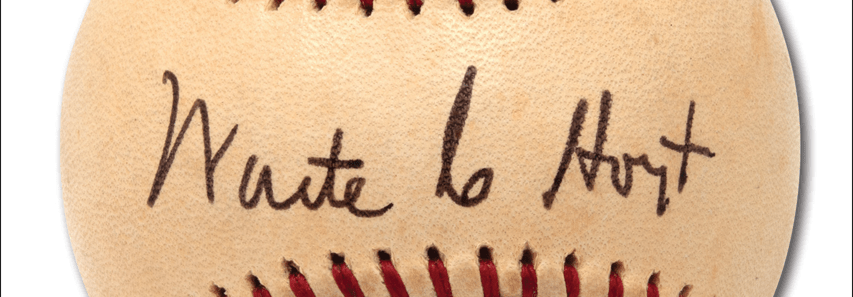
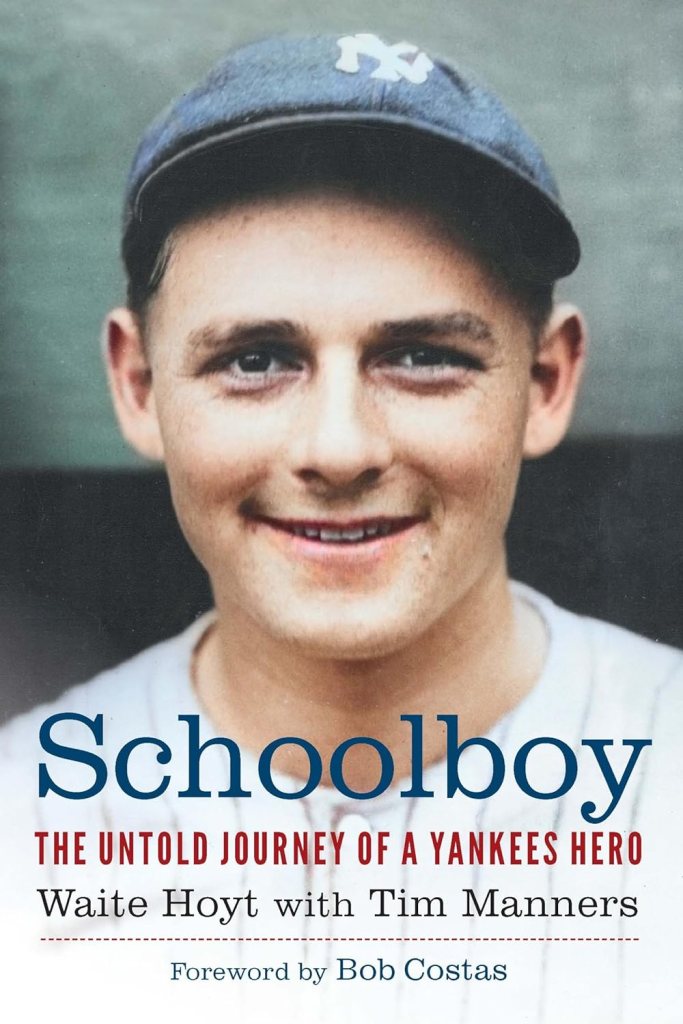
“Schoolboy: The Untold Journey of a Yankees Hero”

The author:
Waite Hoyt
Tim Manners

The publishing info:
University of Nebraska Press; 260 pages; $34.95; released April 1, 2024

The links:
The publishers website; the authors website; at Bookshop.org; at Powells.com; at BarnesAndNoble.com; at Amazon.com

The review in 90 feet or less

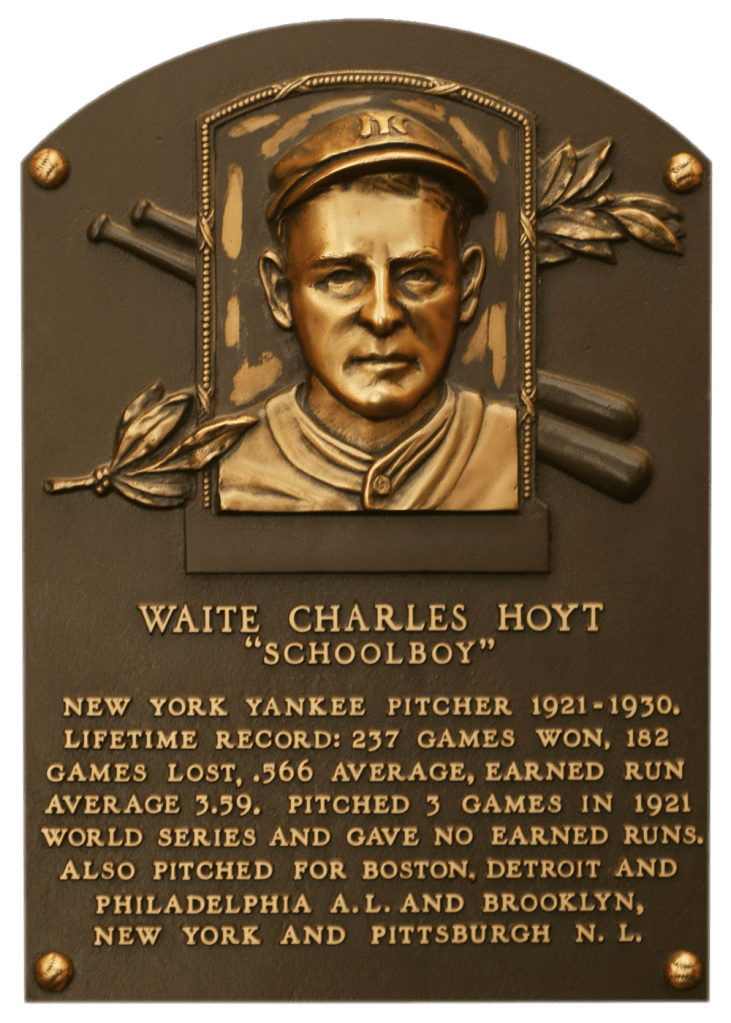
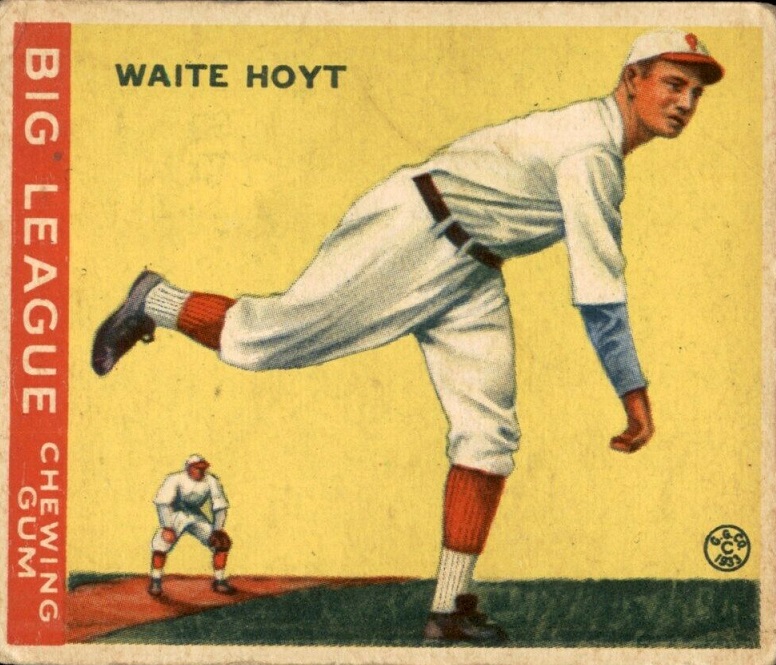
Wait a second … “Schoolboy” Waite Hoyt has finally come out with his story? What have we been missing here?

Who’s the fool of this April 1 prank?

For all intents and purposes, this certified Baseball Hall of Famer, and one of the most well-known baseball broadcasters of his day, has just been waiting for his close-up.

It got done, nearly 40 years after his death.

Hoyt may seem like an ancillary part to the 1920s-era New York Yankees’ dynasty. Sure he went 22-7 and 23-7 in back-to-back seasons – but these were the ’27 and ’28 Yankees. Aside from that he won 19 games in back-to-back years with the Yankees in the ’21 and ’22 seasons. And 18 more in ’24. And 17 to boot in ’23.

That’s 157 total in his 10 years. When he retired, that was fourth all-time in franchise history (and now sits ninth, as well as ninth for pitching WAR at 36.4 and eighth in innings pitched and games started).

Yet for 14 of the 15 years Hoyt mingled with six other franchises, he had a sub-.500 record. The exception was a 10-5 stretch for the Philadelphia Athletics for half a season of 1931, when he was selected off waivers from Detroit in July. But then the A’s released in the ’32 off season, he signed with his hometown Brooklyn Dodgers as a free agent, and then he was released in June of ’32.

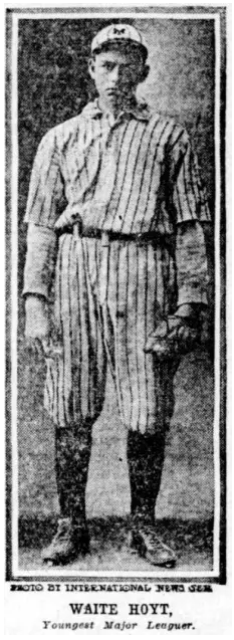
It’s tough to think of him as a young man, but his claim to fame for many years was that he was a teenage player, under contract with the New York Giants, thanks to manager John McGraw.

Yes, just a school boy.

But in the end, he circled back to Brooklyn and was sadly discarded as a 38 year old by the Dodgers in 1938 after an 0-3 start in six games and only one start.

Because of the nickname, Hoyt may even be confused in baseball lore with Schoolboy Rowe, who overlapped Hoyt’s career for six seasons (two of them as an All Star with three World Series Detroit Tiers teams).

Now, we’ve been set straight.

By Waite Hoyt himself.

And mostly by his son, who kept a box of his stuff and gave it up to someone who could finally craft this quasi-autobiography at a time when he was perhaps best known for his decades of work broadcasting Cincinnati Reds game.

Continue reading “Day 9 of 2024 baseball book reviews: Waite, waite, do tell me”