
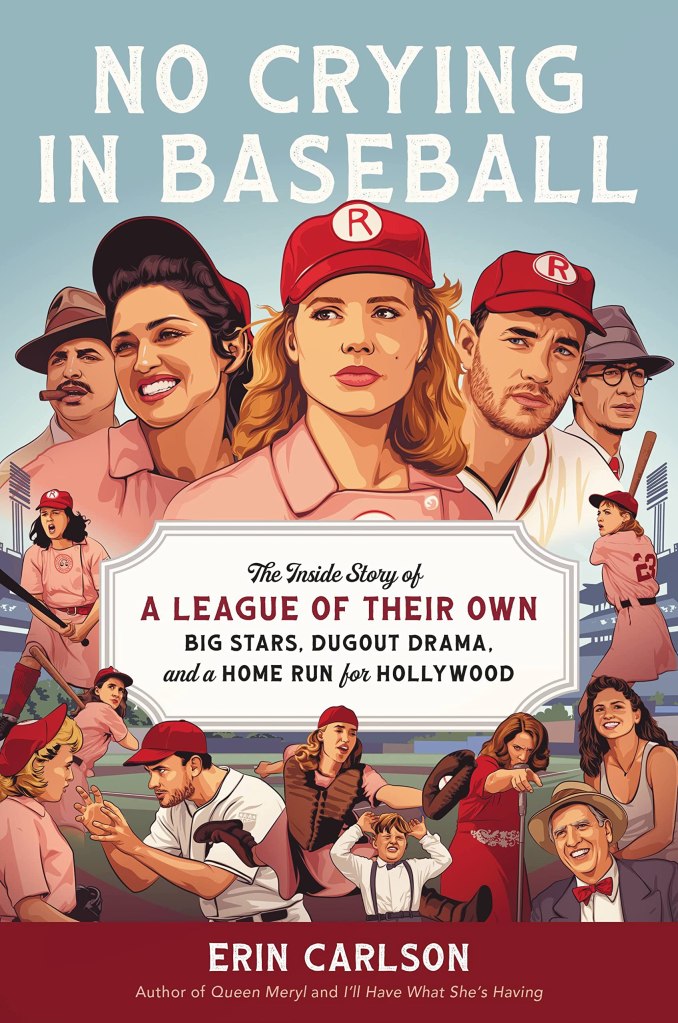
“No Crying in Baseball:
The Inside Story of ‘A League Of Their Own’:
Big Stars, Dugout Drama and
a Home Run for Hollywood”
The author:
Erin Carlson
The publishing info:
Hachette Books
320 pages; $29
Scheduled for release: Sept. 5, 2023
The links:
The publishers website
The authors website
At Bookshop.org
At Powells.com
At Vromans.com
At TheLastBookStoreLA
At Skylight Books
At Diesel Books
At PagesABookstore.com
At BarnesAndNoble.com
At Amazon.com
The review in 90 feet or less
For cryin’ out loud, there’s plenty of crying in baseball.
And in Hollywood.
From who’s in and who didn’t make the cut in a blockbuster casting call. From studio bickering about who’ll head up the project and why it’s worth nearly killing it. To what it might even take to remove a scene in the editing department because it isn’t resonating with the test audiences.
In 1992, the same year when the British-made “The Crying Game” with its shocking plot twist was one of the Academy Award nominees for Best Picture, the Penny Marshall-made “A League of Their Own” may really be best remembered for, well, crying.
Because of this:
The dialogue Tom Hanks spit out during “A League of their Own” – he’s all puffed up as Rockford Peaches manager Jimmy Dugan, beyond frustrated with his right fielder, Evelyn Gardner (played by Bitty Schram) – has become so identified with the film as its pop and sports culture reference point that, in 2005, when the American Film Institute’s 100 Movie Quotes in cinema came out, “There’s no crying in baseball” is locked in via the popular vote at No. 54.
Also no surprise it’s the eye-dabbing, heart-pulling title that the publishers attached to Erin Carlson’s new book about how this whole movie came about, why its worthy of being included in the Library of Congress’ National Film Registry, and how it’s been revived as an Amazon streaming series with a modern update/enlightenment character development that its original screenplay didn’t have the gumption to dive into nearly 30 years ago.
Different times, different audiences. Different threshold for what was considered tear-jerking.
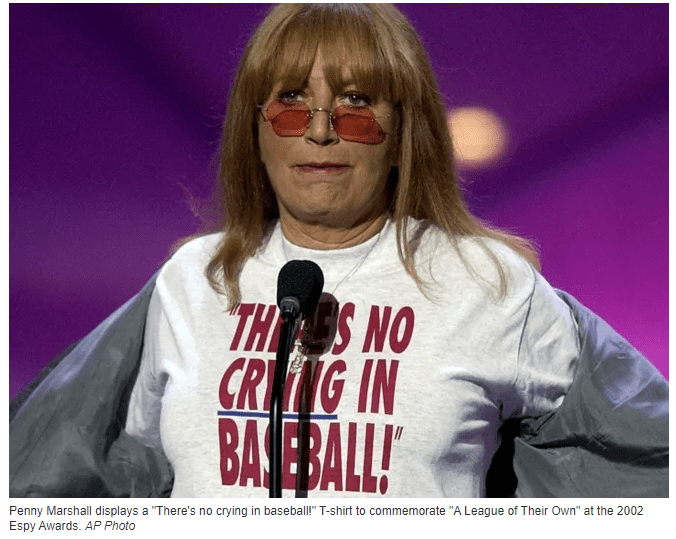
On page 70, getting into the fourth chapter of Carlson’s well-crafted research on the film, we see how screenwriters Lowell Ganz and Babaloo Mandell pulled out that line, again maybe not surprising, based on a true Hollywood story.

Carlson, a culture and entertainment journalist who has previously done two Hollywood-based film books on Nora Ephron and Meryl Streep, first explains how Ganz and Mandell established their chemistry by collaborating on scripts for TV that included Marshall the actress (“The Odd Couple” and “Laverne and Shirley”) and then went into movies with familiar cohorts (the Ron Howard-directed “Night Shift” in 1982, followed by the Tom Hanks-Daryl Hannah “Splash” in 1984, Steve Martin in “Parenthood” in 1989 and Billy Crystal in “City Slickers” in 1991).
So, that rant they pulled together for Dugan came from a moment when Ganz and Mandel were included in a studio’s story development meeting. A woman director (whose identity isn’t revealed) shed tears at some point during the discussion. The writers remembered hearing a producer in the room mutter under his breath: ‘What is this crying? Did Howard Hawks ever cry at a meeting?’”
Continue reading “Day 29 of 2023 baseball books: Penny for your thoughts about ‘League’s’ lasting power, and our two-cents worth”








 Tom Hoffarth's The Drill: More Farther Off the Wall