


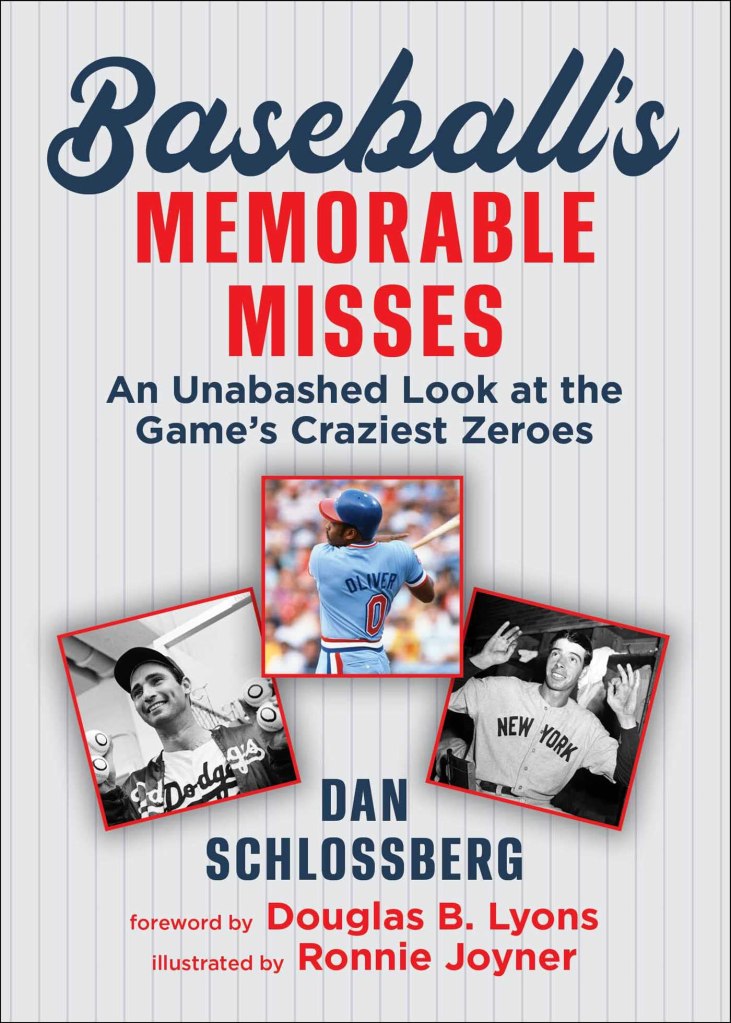
“Baseball’s Memorable Misses:
An Unabashed Look at the Game’s Craziest Zeroes”
The author:
Dan Schlossberg
The publishing info:
Sports Publishing/Skyhorse
208 pages; $15
Released February, 2023
The links:
The publishers website
The authors website
At Bookshop.org
At Target
At BarnesAndNoble.com
At Amazon.com
“The Baseball Maniac’s Almanac:
The Absolutely, Positively and Without Question
Greatest Book of Facts, Figures and
Astonishing Lists Ever Compiled”

The editor:
Bert Randolph Sugar
With Ken Samelson
The publishing info:
Sports Publishing/Skyhorse
480 pages, $19.99
Released April 18, 2023
The links:
The publishers website
At Bookshop.org
At Powells.com
At Vromans.com
At TheLastBookStoreLA
At Skylight Books
At Diesel Books
At Target
At Barnes and Noble.com
At Amazon.com
The review in 90 feet or less
This may be our first baseball book intervention.
When we saw prolific author Dan Schlossberg (with a forward from Doug Lyons) was fleshing out a project of “Famous Zeros” of baseball lore, our attention immediately zeroed into all the opportunities.
The premise is along these lines:

- Nolan Ryan has an MLB record seven no-hitters – in addition to a career-best strikeout total and a Hall of Fame induction. How many Cy Youngs did he win? Zero.
- Roger Clemens has an MLB record seven Cy Young Awards. How many no-hitters did he throw? Zero.
- Kirk Gibson, the 1984 AL MVP and 1988 NL MVP, made how many MLB All-Star teams? Zero.
- How many times did Willie Mays lead the league in RBIs, or Stan Musial lead the league in home runs, despite their prolific career stats in each category? Zero.
- Total World Series appearances for Hall of Famers Ernie Banks, Billy Williams, Ron Santo, Rod Carew, Andrew Dawson, Phil Niekro, Gaylord Perry, Frank Thomas, Ryne Sandberg, Ralph Kiner, Ken Griffey Jr., Roy Halladay, Ferguson Jenkins, Lee Smith … Nap Lajoie … do we go on? Zero.
It’s all marketed as the “Almost But Not Quite” account of intrigue.
As we plowed through it, we found ourselves jotting notes:
Amount of fun and enjoyment gained past the first few pages: Let’s go with almost zero.
Whatever value and worth this pitch had from author to publisher, it was lacking context. It needed more stories. It needed less a string of zeros that, at some point, zeroed themselves out and were becoming a rounding error.
We came to that conclusion after we hit these shortly into the book:
- 0: Number of Cy Youngs won by Cleveland Indians star pitcher Bob Feller (1936-’41 and ’45-‘56). Because the award wasn’t created until 1957. And then it was just for one pitcher in all of baseball.
- 0: Appearances by Carl Erskine in the Bobby Thomson game. The explanation: “Normally a starter, Erskine was a prospective ninth-inning reliever before he bounced a curve while warming up in the bullpen – convincing Dodgers manager Charlie Dressen to summon Ralph Branca instead. Thomson’s three-run homer gave the Giants a 5-4 victory and the NL pennant.” Over the Brooklyn Dodgers, we might add. Just for fact’s sake.
- 0: Houston major-league teams before 1962. Because the Houston Colt .45s, a National League expansion team, began play in 1962.
Then this one put us over the edge, at page 11:
- 0: “Runs allowed by Orel Hershiser during record scoreless inning streak. The star right-hander of the Los Angeles Dodgers worked a record 59 consecutive scoreless innings in 1988. Later that year, he was selected Most Valuable Player of both the NL Championship Series and World Series and winner of a World Series ring and both the NL’s Cy Young and Gold Glove awards. Hershiser was a later MVP in an American League Championship Series.” He won that award, for what it’s worth, while with the Cleveland Indians in 1995, just again for fact’s sake, which really isn’t that important to this entry. If you need a real zero for Hershiser, try this one: With a career .201 batting average included a .356 average in 73 at bats (34 games) during the 1993 season (winning a Silver Slugger Award), how many home runs did he hit in 949 plate appearances over 18 years? Zero. But who really cares?
This was the one that had us throw the book across the room, on page 27:
- 0: “Openers for Lou Gehrig after 1939. He started for the Yankees, had no hits and made an error. On July 4 of that year, he told Yankee Stadium fans he was ‘the luckiest man on the face of the earth.’ He died two years later of ALS.’
That’s how you want to remember Lou Gehrig. Attached to a zero?
If this is “unabashed,” you might try bashing it up.
Still, we saw potential in this. Not to do the proverbial reinvention of the wheel, but what might we have done to make this more enjoyable learning and less a list of “Famous Zeroes” that fizzled out?

Especially when it seemed that, after a certain point, it was just twisting semantics to make it fit something that kind of quickly exhausted itself.

One of our favorite ways to kill time and scatter our brains over the years has been “Baseball Maniac’s Almanac,” which, according to the information stored on the inside pages, started in 2005, reloaded in 2010, 2012, 2016, 2019 and now is back – and by Skyhorse Publishing, which owns Sports Publishing. The price has also jumped $3 since it’s last two issues, so there’s value in that.
Why is “Baseball Maniac’s Almanac,” launched by Bert Randolph Sugar, such a non-trivial pursuit and worthy of a sixth edition (with presumably more to come)? As Bob Costas writes in one of his many book blurb activities: “Being a baseball maniac is a condition which cannot be cured – it can only be treated. So take two chapters of Bert Sugar’s book and then call him in the morning.”
That’s a pretty sick review. Considering Sugar died more than a decade ago.
Continue reading “Day 19 of 2023 baseball books: Trying to win a zero-sum game”






 Tom Hoffarth's The Drill: More Farther Off the Wall