Day 20 of 30 baseball book reviews for 2018: The Hawk, in full flight, ready for a final approach

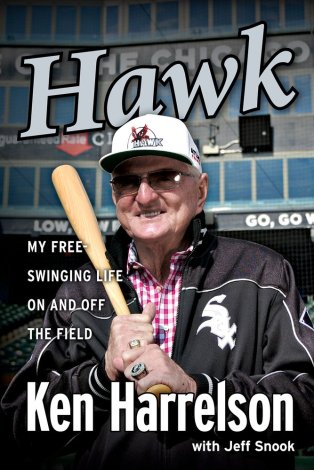
The book: “Hawk: I Did It My Way”
The author: Ken Harrelson, with Jeff Snook
How to find it: Triumph Books, 384 pages, $27.95, due out May 29
The links: At Amazon.com, at the publisher’s website.
1a71Ui505WEmLA review in 90-feet or less: Ken Harrelson is the guy you wish was a teammate of Jim Bouton when the later was in the process of writing “Ball Four” in 1969.
As Bouton was starting that season in Seattle, then getting traded to Houston, Harrelson was in … let’s see. He started in Kansas City, just had a great ’68 season with the Red Sox, but then they sent him to … Oh, right, Cleveland.
By page 176, this happens:

“Baseball always has had its superstitions, more than any other sport. I didn’t create them, but I believed in many of them. Some are too crude to detail. (Some struggling ballplayers would try anything to get out of a funk.) Another was, “If you are going badly at the plate, get into a fight to change your luck.”
We were in Oakland and I was in a major funk at the plate. Lew Krausse Jr., my old buddy from the Athletics, was still playing for the A’s and we had made arrangements to meet after the game. I told him I was going to look for the biggest guy I could find and start a fight.
“Lew and I headed to a nightclub and it wasn’t long before he spotted one for me. The guy was about 6-foot-5 and walked right by our table. Lew elbowed me, saying, “There he is.”
“I noticed the big guy went out to dance with his girl, so I grabbed another girl and headed to the dance floor. I bumped into the big guy “accidentally.”
” ‘Don’t do that again!’ he screamed at me.
” ‘Well, let’s go!’ I shot back.
b86b3f0bb98a1b2284956c352fbd4c70“I happened to be wearing a new pair of cowboy boots. We headed out of the club and as I walked down three steps toward the street, I turned around to swing at him when my feet came out from under me. I hadn’t broken in those boots and it was as if I was standing on ice. He landed a good shot to my eye and I swung again and missed. We started to fight before the police arrived to break it up.
“The police recognized him as soon as they arrived, cuffed his hands behind his back, and loaded him up in the back of a paddy wagon. I noticed he had blood all over his shirt.
Just before they closed the door, he looked at me and said, ‘I know who you are!’
“That was unsettling to hear, to say the least.
“I headed back to the Edgewater Inn and went to Sam (McDowell’s) room. Sam always carried a gun in his bag. Back then, you could stick one right in your luggage wherever you traveled. I explained what happened and asked him if I could borrow his gun. Sam went over to his bed and reached underneath his pillow. He pulled out his pistol and handed it to me. He was sleeping with a gun under his pillow!
“Before we left Oakland, the other guy’s lawyer came over to the Edgewater Inn to see me. After I told him there was no way I would be pressing charges, he said his client’s clothes were ruined in the fight and he wanted to be reimbursed to the tune of $700.
I couldn’t get $700 out of my pocket fast enough. I paid the lawyer, gave Sam back his gun, and that was the end of it.” Continue reading “Day 20 of 30 baseball book reviews for 2018: The Hawk, in full flight, ready for a final approach”

Day 19 of 30 baseball book reviews for 2018: Poetry in motion — A chance this trio deserves Hall of Fame treatment depends on how you tinker with their impact on history

IMG_2670The book: “Tinker to Evers to Chance: The Chicago Cubs and the Dawn of Modern America”
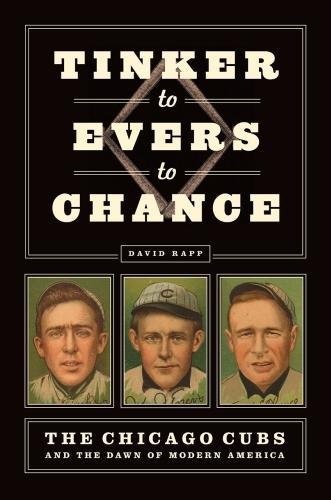
The author: David Rapp
How to find it: University of Chicago Press, 336 pages, $27.50, released April 2
The links: At Amazon.com, at the publisher’s website.

1a51q70uhubELA review in 90-feet or less: Using the ironic eight-line poem about an infield that anchored a team to the World Series 100 years ago as a starting point, Rapp goes around the horn to make a case that they were not only justified by their stanza super powers, but makes a case they carried the game during that era with an extensive background check that’s a surprisingly thorough in what could otherwise be a rehash of previous works on the subject.
The preface thankfully explains how “Baseball’s Sad Lexicon” came into being in 1910 – a printing error, where the New York Evening Mail came up short on F.P. Adams’ column and had to dream up six more lines to fill it out.
If only journalism history was that glamorous.
And thanks for teaching us the word “gonfalon.”
Unlike “Casey at the Bat,” this “terse ditty used a different kind of irony to celebrate three living ballplayers and their sport’s newfound status as the ‘national pastime’.” So there.

Now consider that from 1906 to 1910, manager Frank Chance’s team won 530 games – a major-league record to this day – plus two World Series titles and four NL pennants. The threesome became a threesome in 1903 and didn’t split up until eight seasons later when Chance retired. Without that, there’s no foundation and context for what the Dodgers’ infield of Garvey, Lopes, Russell and Cey did in the 1970s and early ‘80s — a feat that didn’t even warrent a clever haiku about them.
The timing of the Tinker-Evers-Chance chance gathering — and let’s go ahead and answer now the Abbott and Costello-like trivia question about who was the third baseman, a pretty good player himself in Harry Steinfeldt — happened at a time when baseball needed a post-King Kelly push into credibility. The game was starting to get shoved into the deplorable category of prize fighting and horse racing as corrupt and unsavory.
It needed family values. Continue reading “Day 19 of 30 baseball book reviews for 2018: Poetry in motion — A chance this trio deserves Hall of Fame treatment depends on how you tinker with their impact on history”

Day 18 of 30 baseball book reviews for 2018: Sixty years later, this is what we have to show for L.A. Dodgers’ baseball? One may not collapse with excitement

LAplay
On April 18, 1958, it was the editorial illustration in the Los Angeles Times.

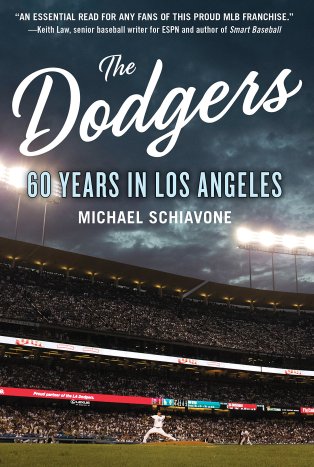
The book: “The Dodgers: 60 Years in Los Angeles”
The author: Michael Schiavone
How to find it: Sports Publishing, 356 pages, $24.95, due out April 17
The links: At Amazon.com, at the publishers website.

91Rsn-x-njLA review in 90-feet or less: The collection we have amassed of more than 100 Dodgers-related books — by historians diving in about certain periods, by players reflecting on their careers, and even a couple unauthorized pieces on Vin Scully — you’re never short of material for finding a way to frame the existence of this franchise.
Sixty years in L.A.? Sure, it’s a milestone.
But what’s news?
Unfortunately, nothing much here.
In what reads like a high school term paper without the proper footnotes, regurgitated from publications by a writer in Australia who admits to being a fan of the team since the 1988 World Series, we’re left with something that fans of the franchise may quickly want to pour through, but again, what’s fresh about it?
With all that’s available, here is how Schiavone lays out the events of April 18, 1958, on pages 18 and 19 (shouldn’t this be the first page?) after the Dodgers played a three-game series in San Francisco for their first West Coast games,  leading up to this moment for their arrival in L.A.: Continue reading “Day 18 of 30 baseball book reviews for 2018: Sixty years later, this is what we have to show for L.A. Dodgers’ baseball? One may not collapse with excitement”

The Drill E7: All in all, another brick in the wall on the boxer’s shorts, plus Kap to Rams, Chosen Rosen’s choices, ‘Brockmire’ in person and … an NHL minute

Fifth one minutes and 59 seconds is a personal best — for longest show in “The Drill” history. Worthy if nearly a full hour?
Well, it’s chock full of nuts. Aside from the panelists.

Here’s how we break it down for those who need some help:

*Two minutes in: The new business card to take to the CAA Sports Congress at LA Live:

*Four minutes in: The Mahoney Valley Scrappers, a real Single-A short-season team
*Five minutes in: Introducing the “Heberts” — Guy Hebert vs. Bobby Hebert
And more about Beyonce at Coachella while noting Kendrick has won a Pulitzer before any of us journalists.

*THE DRILL:
*Eight minutes in: Clippers have missed their LA chance and we’ve been there with the Lakers. More on the Lakers’ offseason.
* 13 minutes in comes “The NHL minute” with Eric: Drew Doughty’s “questionable” suspension and the Ducks give up 8. Anddddd, we’re done.
* 15 minutes in: Shhhhhhhh … Ohtani needs quiet time?
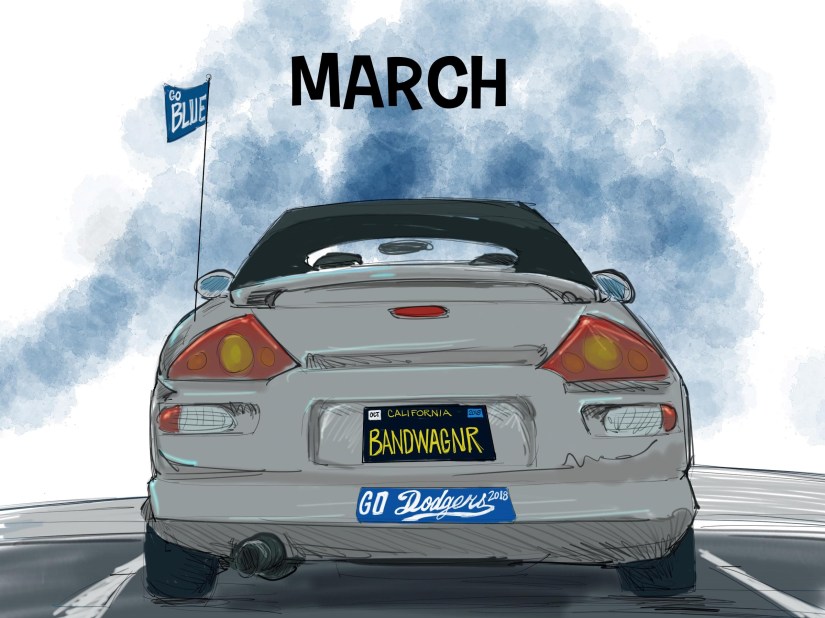
* 16 minutes in: The Jim Thompson illustration on Angels vs. Dodgers bandwagon fans who are image consciousness, exclusive to viewers of “The Drill”:
march

april

* 20 minutes in: Beto’s incredible first-hand account of watching and reporting on how “Lightning” Rod Salka’s “America First” trunks didn’t do him any favors against Francisco Vargas and only made it a national story.

* Which leads to Jon’s reference to Tommy Z’s KO once upon a bad-strategy time:

*THE BUSINESS (at the 36 minute mark)
* The ESPN Magazine cover story on Josh Rosen, along with the Washington Post story that uses “Jewish” and “millennial” in the headline.
(And with our new feature, “Drill Bits,” we can isolate that discussion (eight minutes long) right here (also noting that 42 minutes in, John uses the first F-bomb in “The Drill” history. A few times. In context …)

* 45 minutes in: More about our time spent with Hank Azaria as “Jim Brockmire” leads to this clip of “The Meltdown”:

* And we have this exclusive four-minute interview with Azaria after we visited him and his appearances Monday on “The Rich Eisen Show” (DirecTV’s Audience Network) and “Mason and Ireland” at 710-AM ESPN:

THE ENDING:
* More on the Los Angeles Azules and we’ll take you out with cuts from The Bronx:

And Mariachi El Bronx (which we believe could be our new bumper music):

Day 17 of 30 baseball book reviews for 2018: No patronizing the Red Sox patriarch, but there’s lots of explaining to do

green-black-red-brand
It’s as good a time as any to show off some of the orange crate-style artwork from Pasadena’s Ben Sakoguchi (https://www.sakoguchi.info/segregation-desegregation/)

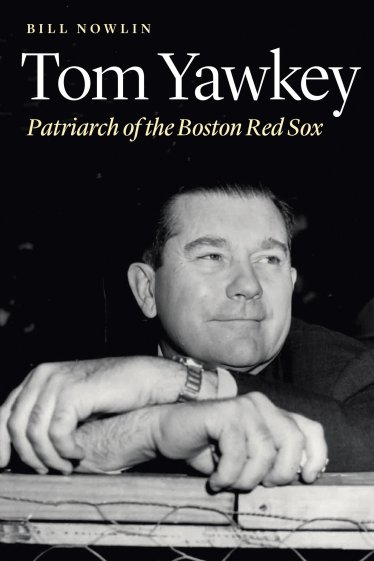
The book: “Tom Yawkey: Patriarch of the Boston Red Sox”
The author: Bill Nowlin
How to find it: University of Nebraska Press, 560 pages, $36.95, release Feb. 1.
The links: At Amazon.com, at the publisher’s website.

DTZAcsAUQAAXAam.jpg largeA review in 90-feet or less: Today’s Boston Red Sox, who visit Anaheim for a three-game series starting tonight facing Shohei Ohtani, have been owned by a group led by John Henry, Tom Werner and Larry Lucchino since 2002. They made a  then-record $700 million purchase of the franchise from the Jean R. Yawkey Trust.
Mrs. Yawkey actually died in 1992 and held a majority ownership of the franchise since 1976.
Before that, her husband, Tom Yawkey was in charge.
So the story goes …
His run started in 1933, when he bought the team for $1.2 million. The Red Sox never won a World Series during his reign, but that’s not why so many pages here are devoted to him.
Nowlin, whom we mentioned earlier this month as the co-editor of the SABR publication about baseball players who made it to Hollywood, isn’t saber-rattling here. We also recognize from many books he has done about Red Sox history, he spares no trees to make his very deep dive in to the Yawkey reign.
But 560 pages worth? It’s 434 pages of chapter reads, plus the epilogue, acknowledgements, notes and index bring up the final 100-plus pages. Because on a project like this, everything must be accounted for.
And, after all, this is the first book ever done on the man, as Nowlin says.
While a lot of this book reminds us of the job Andy McCue did on the Walter O’Malley bio from 2014 — 480 pages deep, also from University of Nebraska Press — it’s needed to help clear the air about some possible false narratives.

Continue reading “Day 17 of 30 baseball book reviews for 2018: No patronizing the Red Sox patriarch, but there’s lots of explaining to do”