Workshop this idea in a press box near you: The job of anyone writing about the game of baseball today is to make sure the contest below remains imperfectly perfect.
Baseball’s imperfections are what makes it most relatable to its fan base. It’s all a work of failures and resolutions, a work in progress. Yet we seem to define progress oddly in a time of mandated pitch clocks, video reviews by detached persons in New York and the potential of robotic ball-strike calls from a digital platform, all of which looks like a video game, trying to size up an imprecise boundary idea of a strike zone because we aim to get things as right as possible.
Baseball doesn’t even get the definition right of a perfect game.
For years, it’s assumed a contest in which the pitcher (or in today’s game, a bullpen strung along like Christmas lights) gets 27 straight outs without allow a batter to reach base by any sort of feat or accident. I’ve told the story before about being at a game in the ballpark, and a young couple sitting behind me was reduced to boyfriend-splaining.
The guy pointed out to his gal pal that, at the moment, the pitcher had no-hitter going.
“Too bad it’s not a perfect game,” he added.
“What’s that?” she replied.
“A perfect game,” he started, hesitated, and continued, “is when the pitcher strikes everyone out on three pitches.”
I pondered turning around to perhaps tighten up that response, but I resisted because, upon further review in my frontal lobe, he was more right than wrong. Someone in a press box likely called the first one of these things “perfect” — a “perfecto” if they were of another language enabler — and it stuck.
Even then, if someone actually achieved a perfect game as this lad described it, someone would modify the feat and raise the bar to defining it as an Immaculate Game, and then we’d get all the religious zealots involved in hijacking their bibles.
Where does all this brain-wave baseball philosophy come from?
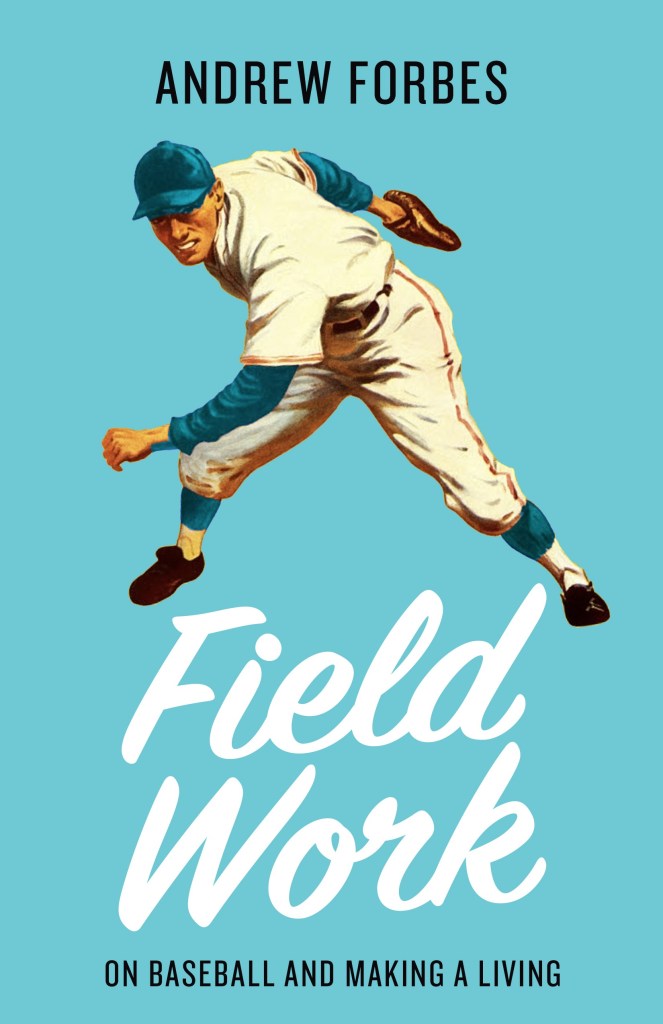
For me, it’s from reading another Andrew Forbes book. And not possible able to match his output but only try to keep pace.
Since 2017 when the freshman House rep put on a Los Angeles Dodgers’ jersey, highlighted by a red No. 44 to represent her district, then ripped a pinch-hit, RBI-single in her first appearance before 25,000, Barragán continues to use baseball as a way of proving her worthiness.
This is no DEI seat filler. Her bio is pretty explicit in the ability to challenge and respond to situations.
Born in Harbor City as the youngest of 11, Nanette Diaz went to North Torrance High. While she played softball, she also petitioned the administration to be allowed to try out for the boys’ baseball team — and she made the JV squad.
With degrees in political science and public policy from UCLA and a doctorate in law from USC, she launched into a legal career. Involved in the Clinton White House in the Office of Public Liaison for African American outreach, Barragán eventually moved to Florida in 2012 to work on Barack Obama’s presidential re-election campaign and be part of the voter’s rights protection team.
By 2013, she circled back to the Hermosa Beach City Council, fighting against offshore oil drilling. Two years later, she was running for Congress after Janice Hahn vacated the seat.
After her debut in the Congressional Game in ’17, she was noted as one of three participants in the ’18 games — which marked the 25th anniversary of when Blanche Lambert Lincoln, Illena Ros-Lehtinen and Maria Cantwell were the first women played.
“A lot has changed in 25 years,” Barragán said, “but when it comes to this sort of thing, we need to acknowledge not much progress has been made.”
For the 2019 game, Barragán and good friend Linda Sanchez (CA-38) were the only two women players. Barragán invited the D.C. Girls Baseball Team as her special guest, taking pride int he fact her 44th District — Carson, Compton, Lynwood, North Long Beach, Rancho Dominguez, San Pedro, South Gate, Walnut Park, Watts, Willowbrook and Wilmington — includes the Compton Youth Baseball Academy, which hosts annual girls baseball tournaments.
With decisive victories in re-elections in ’18, ’20, ’22 and ’24, Barragán doesn’t hide her love of the Dodger blue, introduced to her by her father. She was at the Dodgers’ White House visits after their 2020 and ’24 World Series titles. Her official website has fashioned a branding for her that looks like the Dodgers’ logo.
With Sanchez as the captain of Team Democrat for the ’25 game, Barragán finds herself as the only woman on the roster. She is there with fellow Californian House members Pete Aguiliar (CA-33), Gil Cisneros (CA-31), Adam Gray (CA-13), Mike Levin (CA-49), Dave Min (CA-47), Kevin Mullin (CA-15), Raul Ruiz (CA-25), Eric Swalwell (CA-15), Derek Tran (CA-45), plus as U.S. senator Alex Padilla.
Four women are listed on the Republican roster — Lisa McClain (MI-09), Mariannette Miller-Meeks (IA-01), Kat Cammack (FL-03) and Iowa senator Joni Ernst.
There oughta be a clear path for someone like Lauren Thiesen to write a piece for Defector.com under the headline: “The Savannah Bananas Make Baseball Boring” and not be weary of getting crapped on for it. Especially when she framed it as coming “the perspective of a baseball nut and ‘sports entertainment’ obsessive.”
Read it for yourself. Good points are made.
She followed it up with a Facebook post: “I was a tiny bit miffed by the handful of ‘this reads like an old man wrote it’ responses … You can disagree with my (nuanced!) thoughts, but idk why it would ever be inconceivable that a 30 yr old woman produced them.”
Especially from a target audience member for the traveling hardball show.
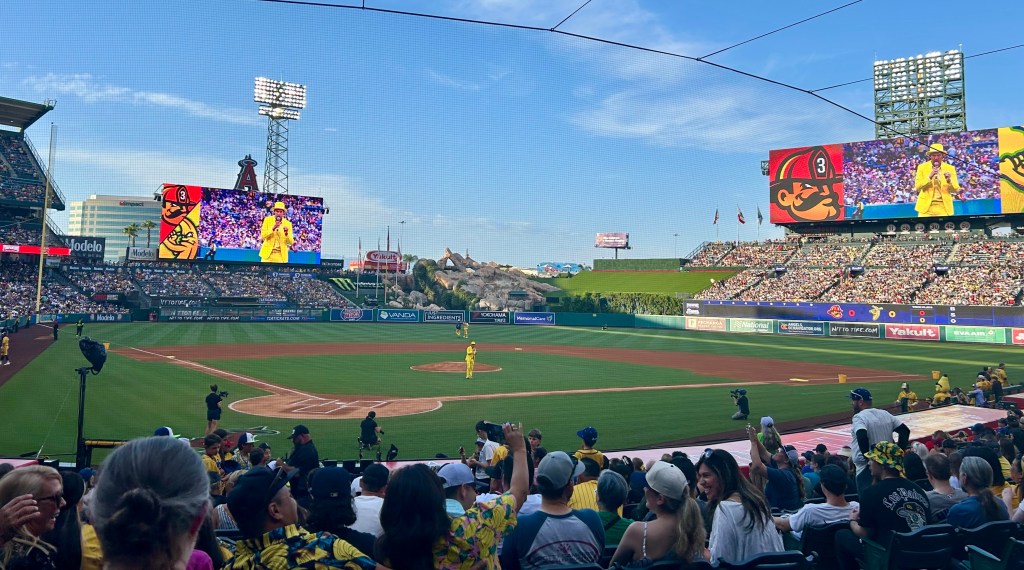
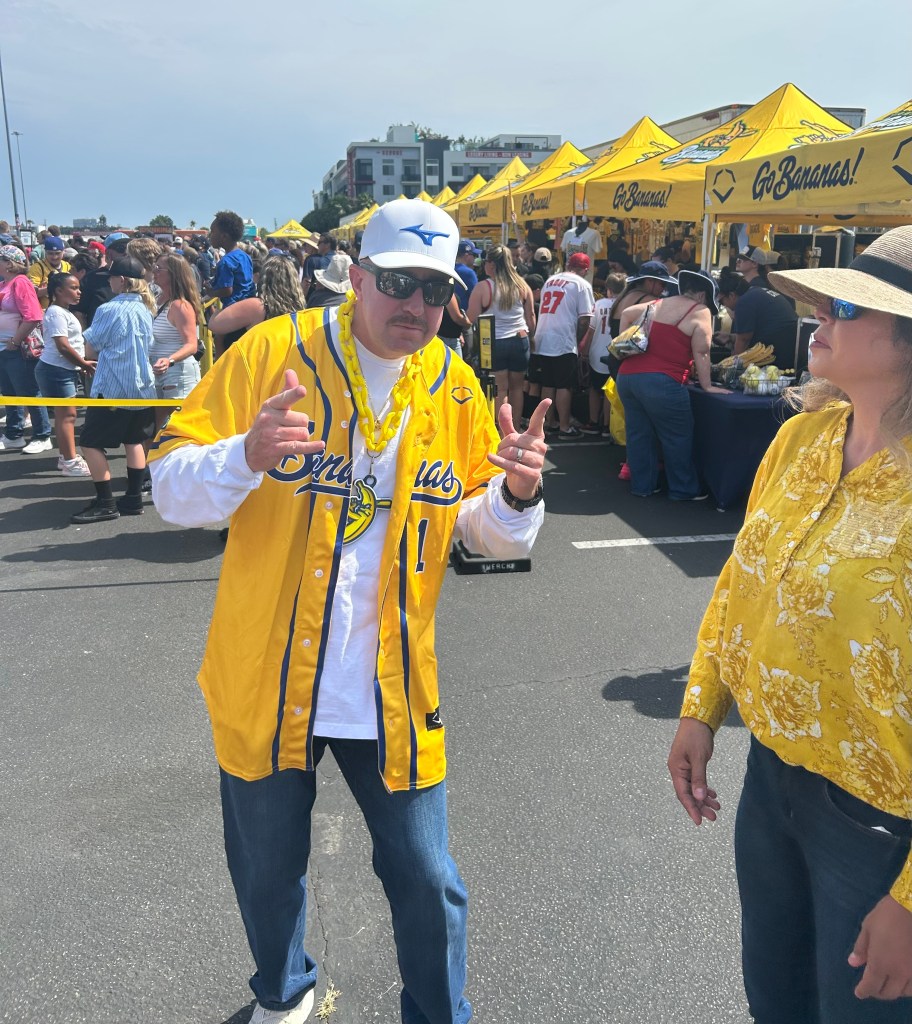
When we visited the Bananas’ second game of a two-day appearance at Angels Stadium in Anaheim this week — perhaps the only two sellouts at the place this 2025 calendar year, coming off a three-game series against the Yankees — we had Thiesen’s words in our head as a frame of reference, as well as local media coverage from the Day 1 game, but otherwise, we tried to be open-minded.
Our take on the whole idea of the Savannah Bannanas and the comparison to the Harlem Globetrotters:
It’s more more “High School Musical” meshed with Horsehide Cirque du Soleil, a wedding reception with a baseball theme wrapped around an activity that looks like a game played at the pace of a batting-practice pitcher grab-and-throw-and-grove. The between-innings experiences of corny planned contests, honoring veterans and first responders, and even a shout out to a non-profit Foster kids program doesn’t drag anything down but allows for catching one’s breath.
And it works.
A DJ-stage gathering to amp up the noise and energy before, then the “show” starts, then the after-party. Perhaps an exhausting pace for some, but it’s taking the elements of action of a “regular” baseball game and heightening it, expanding it, and amping it up. It takes advantage of incorporating local entertainment nods (Disneyland, for sure) and really knows how to read the room. It works in a baseball stadium best (because of the setup with scoreboards, wifi and capacity seating depth) but wedging it as well into a football stadium or other venue will add to its quirkiness.
It’s scripted schizophrenia, pumped up performance art, wonky scorekeeping and incredible talent on display surrounding the unplanned elements of game that has to be a communal stadium experience in person instead of judging it by a Tik Tok video clip or another high light reel. There are surprise guests. There’s a mascot, “Split,” that, at least in Anaheim, dared go up into the batters’ eye area beyond center field and do what every kid has wanted to do: Roll down the green hill.
Sensory overload, but not in a toxic way. Baseball remains the framework amidst all the improve and sketch comedy. The organizers do all they can to prevent the sale of $75 going for $1,000 or more on the open market, but that’s the world we live in — those taking advantage of a situation. Hopefully, you have karma lottery and get the best seats possible (another key to the experience) and bring in as many friends who otherwise might not enjoy a “real” baseball game to see this thing under the circus tent.
Back to how Thiesen ended her essay: “So what does someone want to see in a Savannah Bananas game? I guess they want to see the players dance. But they saw that already online. There’s no need to go to the stadium and catch it again with a worse view. Just give your minor-league boys a shot this summer. They’re probably doing something almost as weird.”
That’s where Tom Alesia starts making his case for the Madison Mallards.
The book is not just on what this college summer-league team has done, continue to do, and likely will do for years to come, but why it resonates in the community, and why it doesn’t need to try to out-gimmick anyone else by trying to be a national attraction, and how it can be content in how it has kept the game relevant in a non-MLB sphere.
It has a formula. It works.
Comparing Mallards to Bananas is more like Granny Smith apples to Cara Cara oranges. They’re each sweet and special in their own fruity way. (And that’s aside from the fact the forward to Alesia’s book is written by John Kovalic, the creator of the fantastic “Apples To Apples” card game.)
“Big Loosh: The Unruly Life of Umpire Ron Luciano”
The author:Jim Leeke The details: University of Nebraska Publishing, $32.95, 216 pages, to be released in July 1, 2025; best available at the publishers website and bookshop.org.
A review in 90 feet or less
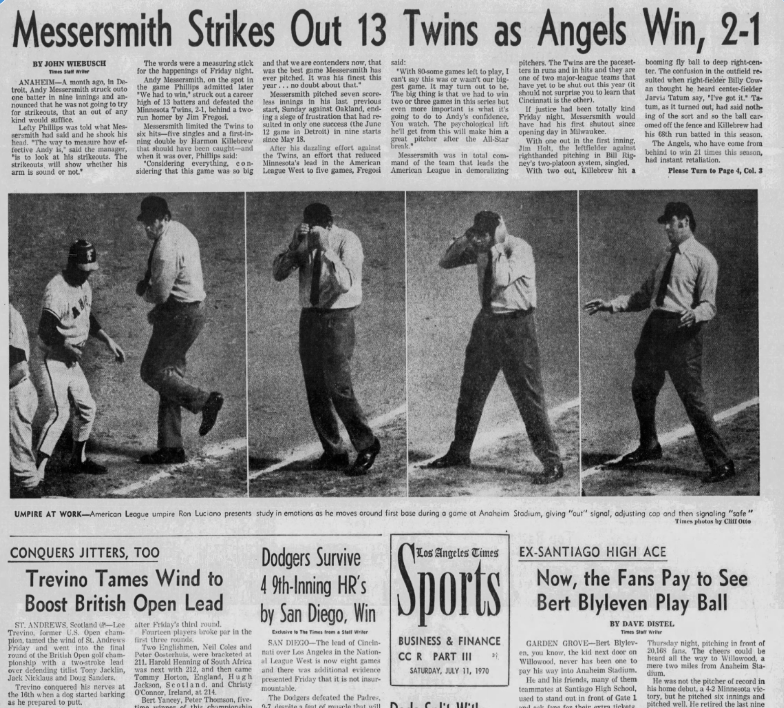
The Los Angeles Times sports section of July 11, 1970 features a series of Ron Luciano photos, showing the second-year AL umpire in all “study of emotions” on the first-base line during a game at Anaheim Stadium.
In the 1980s, the baseball media world could count on three things:
= A movie that directors insisted “was not a baseball film at all but really one about (fill in the blank)” made it as a big box-office draw. The lineup included “The Natural” (1984), “Bull Durham” (1988), “Eight Men Out” (1988), “Field of Dreams” (1988) and “Major League (1989);
= Hearing John Fogerty’s song, “Centerfield,” meant whatever you were watching needed a sound track, over track or background score to clue you in that it had something to do with the game;
= Ron Luciano, retired umpire, wrote another self-deprecating book. While pitching Miller Lite beer. After trying to become a national baseball TV analyst. He needed to be heard, seen and, if possible, felt, and hope you were entertained.
If Fernando Valenzuela and Pete Rose generated the most baseball relatable headlines in the ‘80s, Luciano created the most commentary about it and much more.
The 6-foot-4, 240-pound former All-American Syracuse offensive/defensive lineman who bridged the Orangemen teams in the late ‘50s of Jim Brown and Ernie Davis was drafted in 1959 as the last pick in the third round, No. 36 overall, by the NFL’s Detroit Lions. He wasn’t healthy enough to pursue that, or to teaching, so he turned to umpiring school in Florida, thought he was decent at it, and that’s where his path took him.
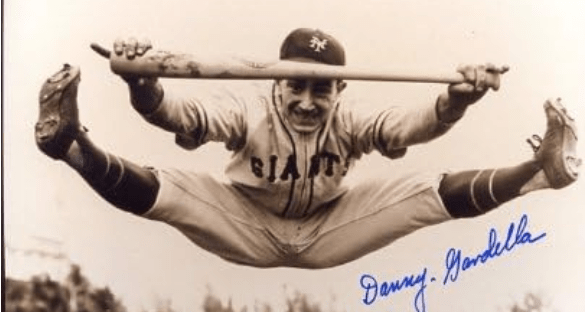
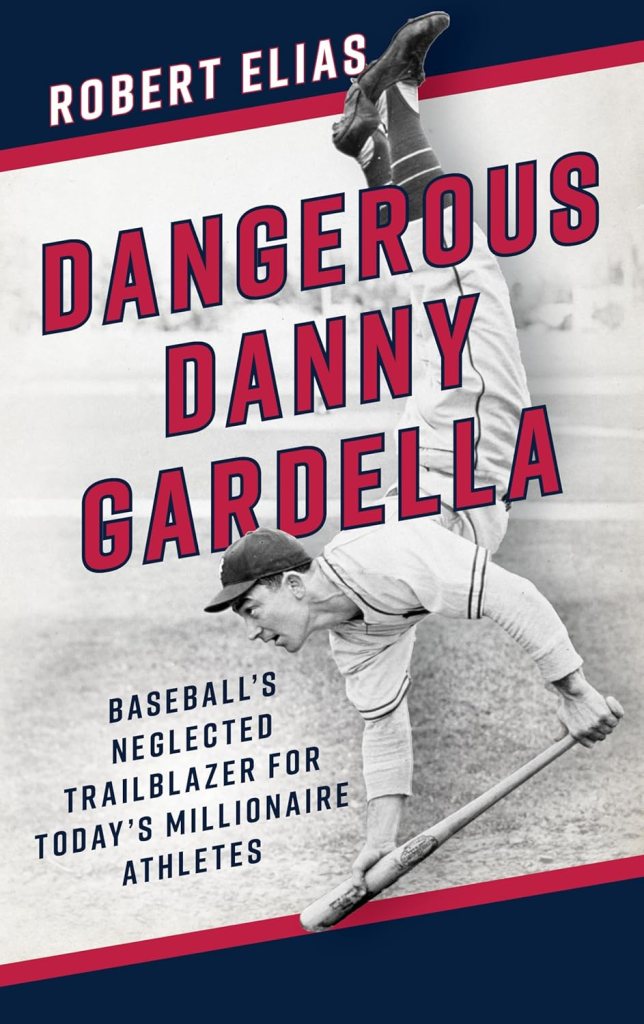
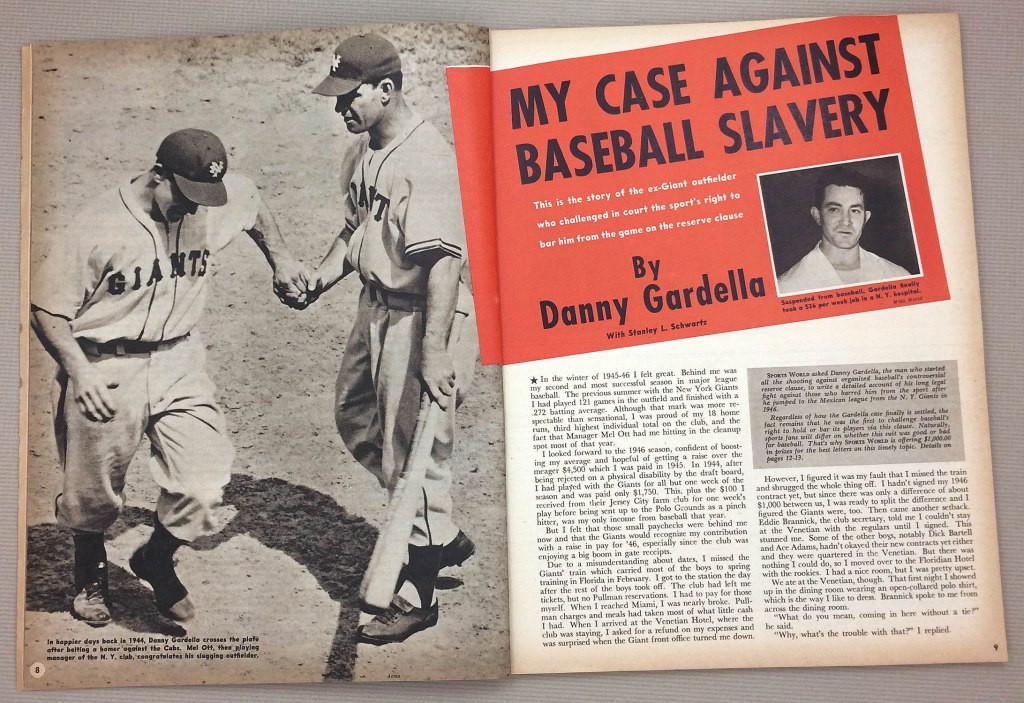
All trails seem to lead back to this Gardella character.
Not by accident.
“In those books one person kept popping up: Danny Gardella,” Elias writes in the preface of this bio. “Apparently an obscure figure, he nevertheless appeared over and over.”











 Tom Hoffarth's The Drill: More Farther Off the Wall