No. 12: Richard Nixon

This is the latest post for an ongoing media project — SoCal Sports History 101: The Prime Numbers from 00 to 99 that Uniformly, Uniquely and Unapologetically Reveal The Narrative of Our Region’s Athletic Heritage.  Pick a number and highlight an athlete — person, place or thing — most obviously connected to it by fame and fortune, someone who isn’t so obvious, and then take a deeper dive into the most interesting story tied to it. It’s a combination of star power, achievement, longevity, notoriety, and, above all, what makes that athlete so Southern California. Quirkiness and notoriety factor in. And it should open itself to more discussion and debate — which is what sports is best at doing.

The most obvious choices for No. 12:

= Vlade Divac, Los Angeles Lakers
Charles White: USC football
Dusty Baker: Los Angeles Dodgers
Tommy Davis: Los Angeles Dodgers
James Harris: Los Angeles Rams
Juju Watkins: USC women’s basketball
Dwight Howard: Los Angeles Lakers
= Todd Marinovich: Los Angeles Raiders, Los Angeles Avengers

The not-so-obvious choices for No. 12:
Pat Riley: Los Angeles Lakers
= Gerrit Cole: UCLA baseball
Denise Curry: UCLA women’s basketball
= Joe Namath: Los Angeles Rams
Randall Cunningham: Santa Barbara High football
= Jeff Kent: Los Angeles Dodgers

The most interesting story for No. 12:
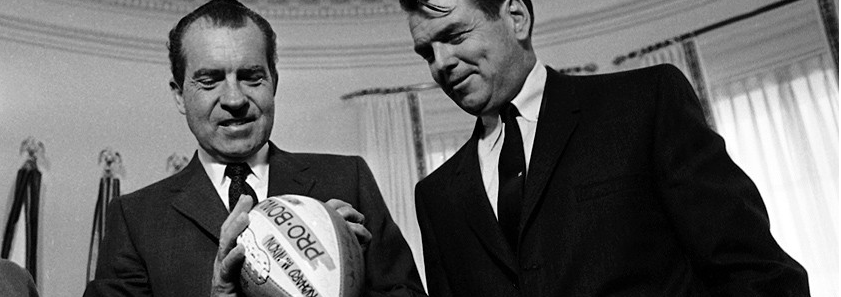
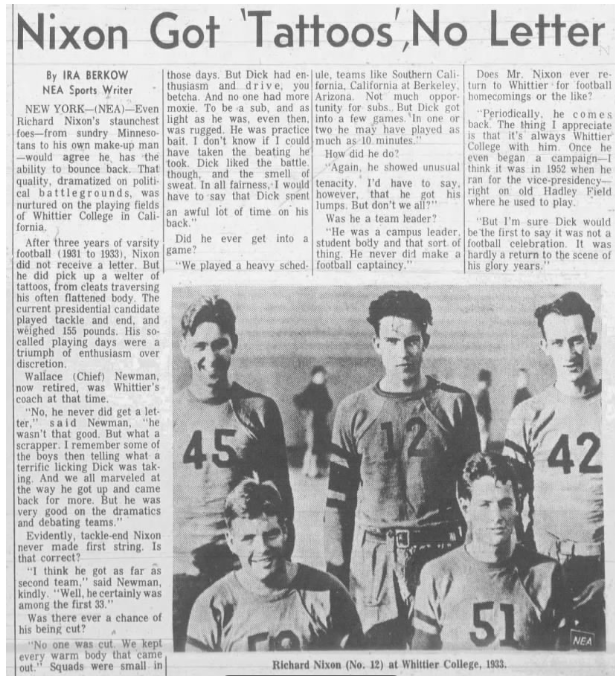
Richard Nixon: Whittier College football offensive tackle (1930 to 1933)
Southern California map pinpoints:
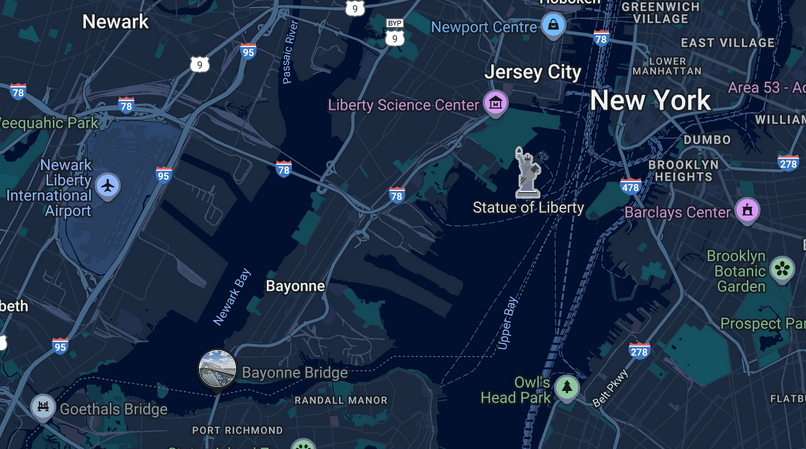
Yorba Linda, Fullerton, Whittier, San Clemente


In Richard Milhous Nixon’s view of his life and legacy, victories were unimpeachable.

History notes he did lose the 1960 Presidential Election. And the 1962 California governor’s race. But then there was his greatest comeback — the 1968 election to become the 37th President of the United States. It was followed up by a landslide re-election in 1972, whipping George McGovern by nearly 18 million votes.

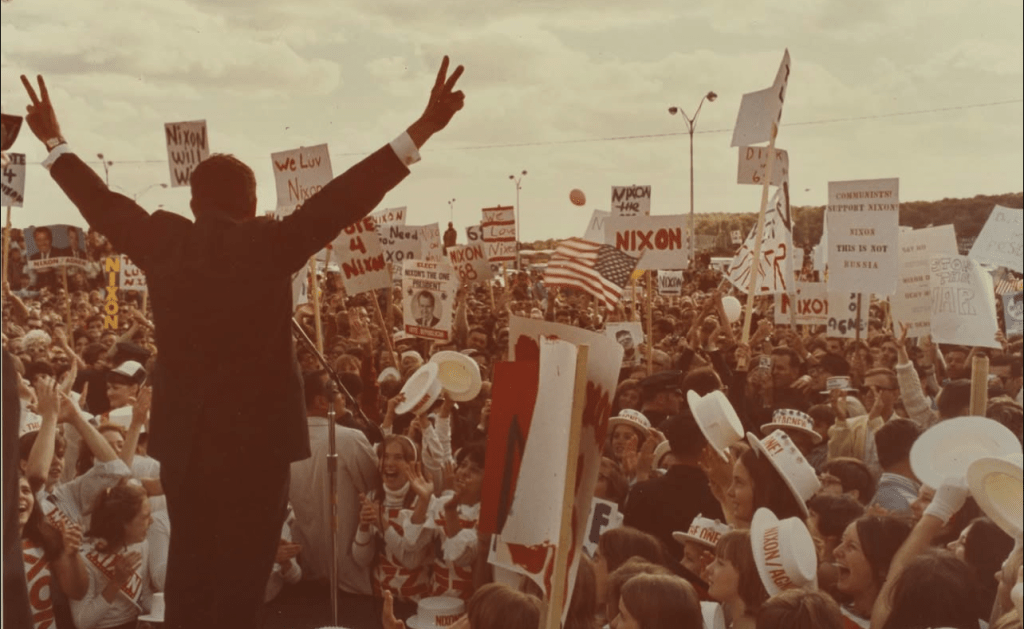
It allowed Nixon to go into his “V” formation, both hands flashing triumph all it was worth.

In his four-plus years as the commander in chief, Nixon was also obsessed with not being the one pinned with losing the Vietnam War.

But then there’s the old sports adage: If you’re not cheating, you’re not trying. That line of sportsmanship led to him eventually forfeiting the most powerful position in the world.

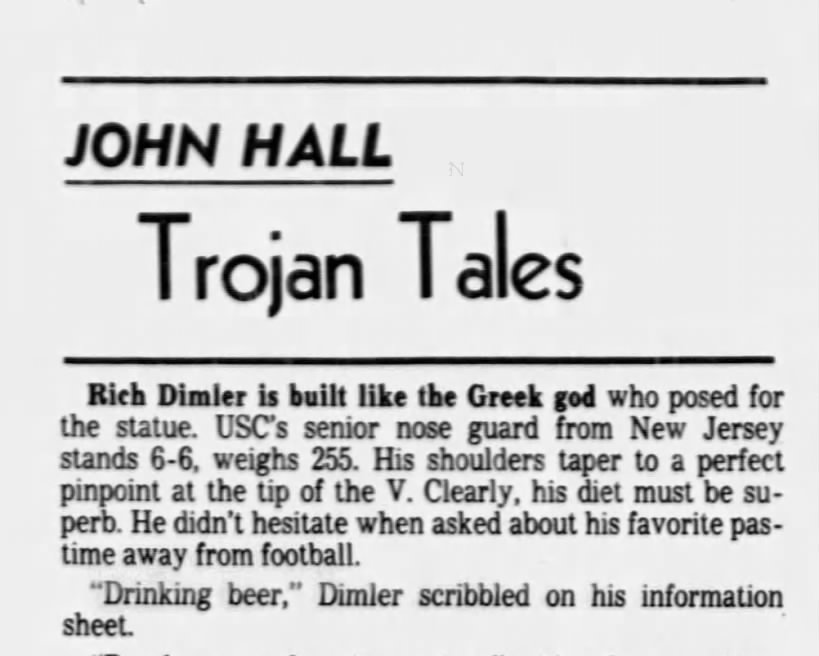
Where did the win-at-all-costs philosophy come from? Perhaps it was his frustrated athletic career at Fullerton High and Whittier High, leading into a memorable time on the Whittier College football team, wearing No. 12 his senior year.

Nixon was heavily influenced by a Poets football coach known as “Chief,” who taught him all about the importance of how the games are played, how to win, and also how to lose.

And he hated losing. Perhaps, to his determent.

Born on a lemon ranch in Yorba Linda in 1913, Richard (given the name by his parents after Richard the Lionheart) was 12 years old when a spot was found on his lung and there was a family history of tuberculosis — an older and younger brother died from it.

Richard Nixon was told not to play sports. Even thought the spot turned out to be scar tissue from an early bout of pneumonia.

Growing up among those Nixon would eventually refer to as “forgotten Americans” and the “silent majority” of hard-working church folks just chasing a dream, he was drawn to try out for JV football at Fullerton High. When he then transferred closer to home at Whittier High at the start of his junior year, he ended up as a student manager for the athletic teams. At Whittier High, he ran for class president but lost to a candidate he would describe as “an athlete and personality boy.”

With the start of the Great Depression in 1930, Nixon didn’t pursue college at Harvard or Yale, but stayed closer to home at Whittier College, pursing a history degree. While he played basketball and football, and also tried out for track and baseball, his victories were celebrated on the debate team.

Continue reading “No. 12: Richard Nixon”

No. 7: Todd Marinovich

This is the latest post for an ongoing media project — SoCal Sports History 101: The Prime Numbers from 00 to 99 that Uniformly, Uniquely and Unapologetically Reveal The Narrative of Our Region’s Athletic Heritage.  Pick a number and highlight an athlete — person, place or thing — most obviously connected to it by fame and fortune, someone who isn’t so obvious, and then take a deeper dive into the most interesting story tied to it. It’s a combination of star power, achievement, longevity, notoriety, and, above all, what makes that athlete so Southern California. Quirkiness factor sin. And it should open itself to more discussion and debate — which is what sports is best at doing.

The most obvious choices for No. 7:

= Bob Waterfield: UCLA football; Los Angeles Rams
= Lamar Odom:
Los Angeles Clippers; Los Angeles Lakers
= Matt Barkley: USC football
= Julio Urias: Los Angeles Dodgers
= Don Rogers: UCLA football
= Steve Yeager:
Los Angeles Dodgers
= Mark Carrier, USC football

The not-so-obvious choices for No. 7:

= Todd Marinovich: Mater Dei High football, Capistrano Valley High football
= Mark Harmon: UCLA football
= Jay Schroeder: UCLA football
= Frankie Kelleher:
Hollywood Stars baseball
= Dennis Thurman: USC football

The most interesting story for No. 7:
Todd Marinovich, Santa Ana Mater Dei High School and Capistrano Valley High football quarterback (1985 to 1989), USC football quarterback (1988 to 1990), Los Angeles Raiders quarterback (1991 to 1992), Los Angeles Avengers quarterback (2000 to 2001)
Southern California map pinpoints:
Mission Viejo, Santa Ana, Los Angeles (Coliseum, Staples Center), Newport Beach, Irvine, Indio


Proceed with caution if you decide to use Todd Marinovich as sports’ poster boy for the ultimate “cautionary tale.” It’s old news in this case.

The label can still a bit addicting for journalists who think they’ve accurately reported on his creation story, going back to his time as a high school quarterback in Orange County setting California state high school passing records. They then observed his personal and playing career arch reveal extreme highs and lows at USC, the NFL’s Los Angeles Raiders, circling back to Los Angeles for a run with an Arena League team to support a drug habit, and eventually landing on a Palm Springs football field near the age of 50 still trying to find himself.

Tale as old as time, but one that needs a fresh angle every now and then.

In a 2019 piece for the Chicago Tribune by Rick Telander, the “cautionary tale” reference got its latest rewind when dissecting Team Marinovich and the mess it seemed to make in the public eye:

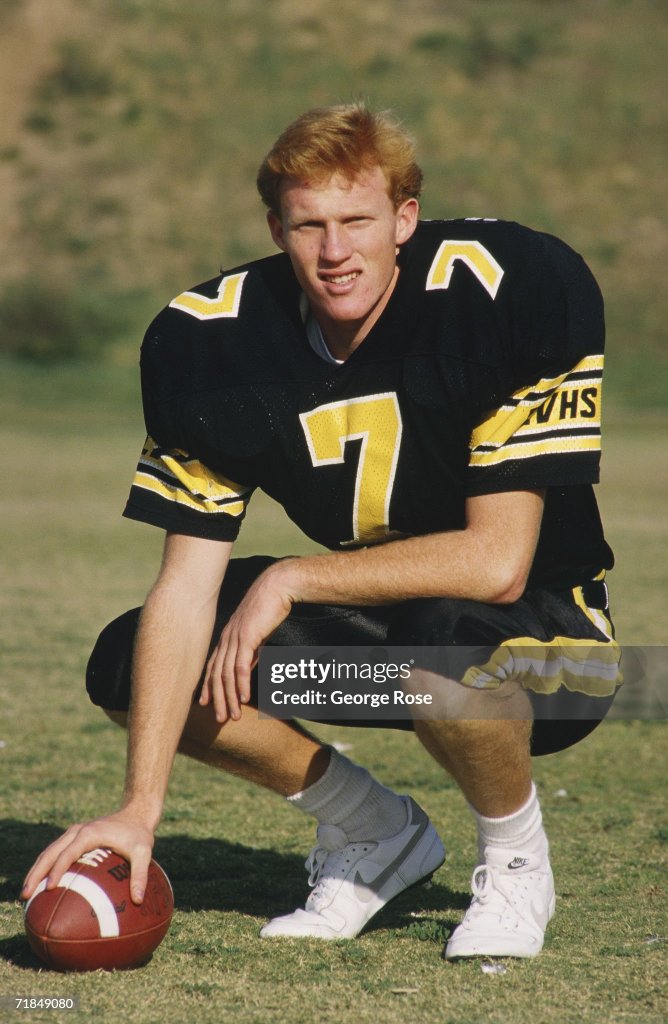
Todd Marinovich at Capistrano Valley High School in 1987. (George Rose/Getty Images)

You’ll recall that Todd was the young man manipulated from birth (actually pre-birth) by his father to be the best, purist, greatest quarterback the world had ever seen. Marv had played football at USC, and he wanted, for reasons buried deep within his own inadequacies, to create a boy who would have the sporting genetics for quarterbacking and be trained incessantly, focused unfailingly and driven like a sled dog toward the apex of the country’s most popular game.”

Telander dragged that trope out because he just read something in Sports Illustrated by Michael Rosenberg, titled “Learning To Be Human Again.” As if Marinovich was emancipated from some reverse metamorphic process.

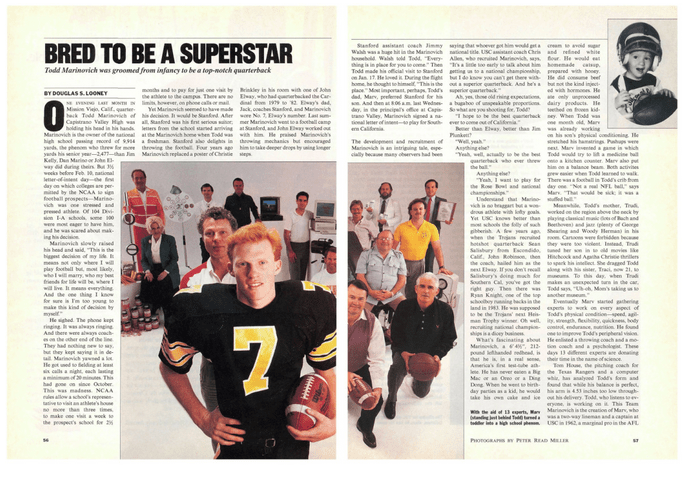
Rosenberg’s launching point was actually a purposeful revisit of that 1988 Sports Illustrated spread Doug Looney laid out titled “Bred to be a Superstar” that likely started the whole social science shebang on judging the Marinovich Parental Method and its doomed-to-fail, real-world predictions.

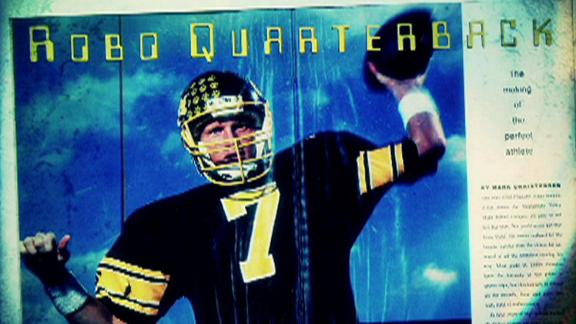
Before that piece, California magazine dropped one with the headline “Robo QB: The Making of the Perfect Athlete.” Then came a People magazine profile in 1987.

That was the fragile framework created for Todd Marinovich, no matter where he went from there. The poor kid, readers could easily conclude. Talented, kind-hearted, fun-loving, well mannered. Able bodied.

Call Child Protective Services.

We seem to have the idea that one who is abused and manipulated as a kid is set up to abuse himself later in life and continue a genetic pattern of human frailty. Unless that person figures things out with help, counseling and avoiding some sort of tragic ending.

Maybe the “worst sports father” adjective just won’t go away years later. Even if his father literally went away.

But Todd Marinovich can explain better how it happened with him as a willing participant, trying to navigate the life of a high school kid in full media spotlight, and how it really turned out.

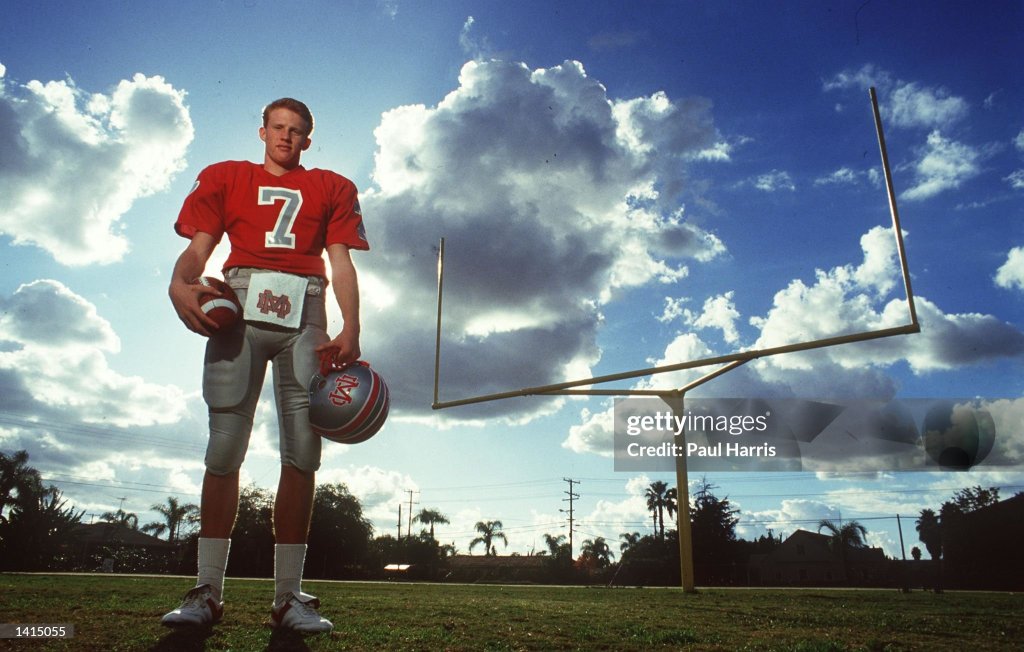
Todd Marinovich as a Mater Dei High School quarterback in 1986 in San Juan Capistrano. (Paul Harris/Getty Images)

That Todd Marinovich was born on the Fourth of July in 1969 may have added to the storyline that started with him on a All-American pathway.

He played a lot of sports, perhaps exceeding most in basketball, but football would be the real test. First were the years at Mater Dei High in Santa Ana, a football factory that had produced Heisman Trophy winners before and after Marinovich’s brief appearance there. That was followed by a surprise transfer to Capistrano Valley in Mission Viejo.

The switch to Capo Valley by his father Marv would be one of things listed on his parents’ separation filing in the courts. Todd has no say in it. He would live with his dad an an in-law quarters at the house of head coach Dick Enright, likely a CIF violation.

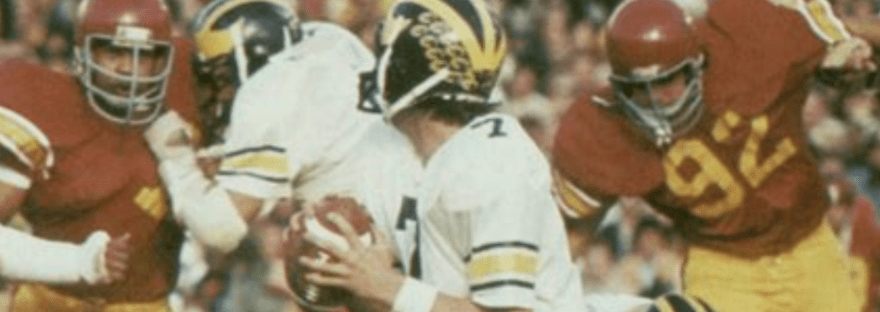
While wearing No. 7, Marinovich went up against rival quarterback Bret Johnson in 1987 when ESPN televised its first-ever high school game, between Capo Valley and El Toro.

Continue reading “No. 7: Todd Marinovich”

No. 35: Petros Papadakis

This is the latest post for an ongoing media project — SoCal Sports History 101: The Prime Numbers from 00 to 99 that Uniformly, Uniquely and Unapologetically Reveal The Narrative of Our Region’s Athletic Heritage.  Pick a number and highlight an athlete — person, place or thing — most obviously connected to it by fame and fortune, someone who isn’t so obvious, and then take a deeper dive into the most interesting story tied to it. It’s a combination of star power, achievement, longevity, notoriety, and, above all, what makes that athlete so Southern California. Quirkiness and notoriety factor in. And it should open itself to more discussion and debate — which is what sports is best at doing.

The most obvious choices for No. 35:

= Sidney Wicks, UCLA basketball
= Bob Welch, Los Angeles Dodgers
= Cody Bellinger, Los Angeles Dodgers
= Jean-Sebastien Giguere, Anaheim Mighty Ducks
= Christian Okoye, Azusa Pacific College football

The not-so-obvious choices for No. 35:

= Tank Younger, Los Angeles Rams
= Loy Vaught, Los Angeles Clippers
= Rudy LaRusso, Los Angeles Lakers
= Ron Settles, Long Beach State football

The most interesting story for No. 35:
Petros Papadakis, USC football tailback (1996  to 2000)
Southern California map pinpoints:
San Pedro, Palos Verdes, Hollywood, Los Angeles (Coliseum, Sports Arena)


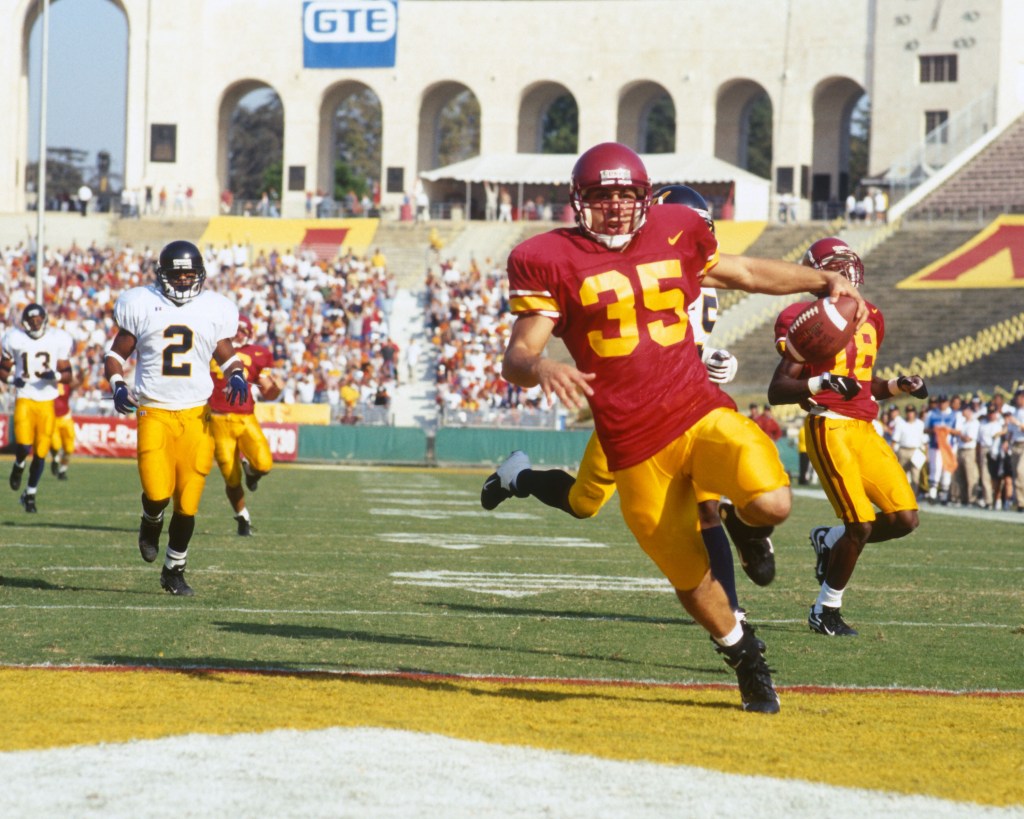
Oct. 15, 1998: On USC’s third play from scrimmage in the first quarter, Trojans junior tailback Petros Papadakis finishes off a 65-yard touchdown run against Cal at the Coliseum (top, and below). Papadakis had 13 carries for 158 yards in his greatest statistical performance of his USC career in a 32-31 Week 6 loss. (Photos by Jon Soohoo/USC)

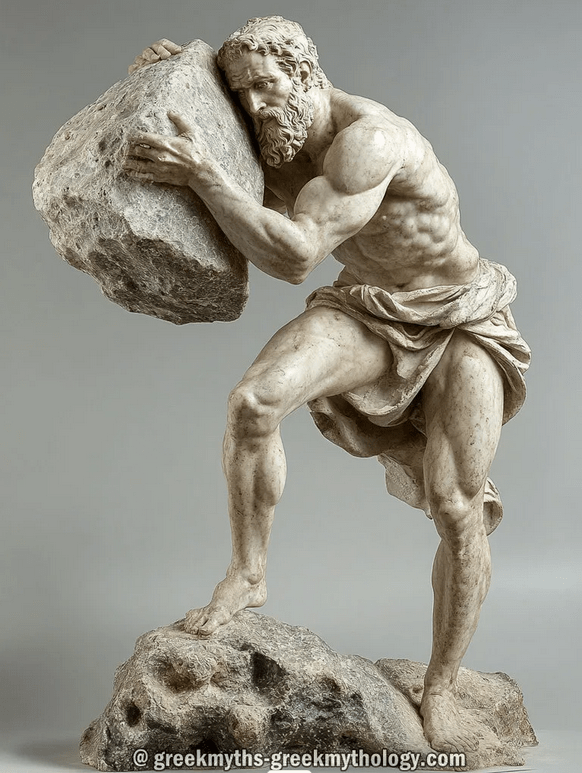
Any sort of perfunctory profile of Petros Papadakis becomes the proverbial Sisyphean pursuit. Hopefully we don’t have to Greek-splain too much here.

Sisyphus, the first king of Ephyra, found his eternal fate in Hades rolling a huge boulder endlessly up a hill, only to see it come back down at him. Every time he made progress and got on a roll, it reversed on him like a Looney Tunes cartoon. The whole thing seemed so Kafkaesque that French philosopher Albert Camus, writing “The Myth of Sisyphus” in 1942, elevated him to some absurd hero status in Greek mythology.

Something that Papadakis might find relatable.

When Papadakis gets on his own a roll, cutting it up on KLAC-AM (570)’s afternoon sports-talk drive-time “Petros and Money Show,” there is far less sports and much more drive to just being a voice for “la raza.” It’s a focus on a feeling of being in “la ciudad” with Papadakis, as familiar as he is bombastic, just the person in the passenger seat making observational conversation to it real.

He is part of USC football legacy, a linage of Cardinal and Gold athletes whose performance has been documented in Los Angeles’ grand Coliseum. Papadakis’ work ethic formed at his family’s famously iconic San Pedro Taverna, as he went from dishwasher to waiter to spending all his earnings for the night back on his guests to make sure they went home happy.

Maybe Papadakis became an accidental broadcaster, but it’s a career that likely defines him as much if not more than anything else. Once a Trojan workhorse in the USC backfield, he is the sometimes-hoarse former Trojan on the dashboard radio. A Red Bull in a china shop of hot topics. The connoisseurs of SoCal sports who enjoy conquering as much as consuming any kind of history lesson are better for it.

Fox Sports’ Petros Papadakis, left, with USC head football coach Lane Kiffin in 2011.

Back to the profile: Papadakis has provided quips along the way to make his story even more cohesive:

Continue reading “No. 35: Petros Papadakis”

No. 93: Ndamukong Suh

This is the latest post for an ongoing media project — SoCal Sports History 101: The Prime Numbers from 00 to 99 that Uniformly, Uniquely and Unapologetically Reveal The Narrative of Our Region’s Athletic Heritage.  Pick a number and highlight an athlete — person, place or thing — most obviously connected to it by fame and fortune, someone who isn’t so obvious, and then take a deeper dive into the most interesting story tied to it. It’s a combination of star power, achievement, longevity, notoriety, and, above all, what makes that athlete so Southern California. Quirkiness and notoriety factor in. And it should open itself to more discussion and debate — which is what sports is best at doing.

The most obvious choices for No. 93:
= Ndamukong Suh, Los Angeles Rams
= Greg Townsend, Los Angeles Raiders

The most interesting story for No. 93:
Ndamukong Suh, Los Angeles Rams nose tackle (2018)
Southern California map pinpoints:
Inglewood (SoFi Stadium)


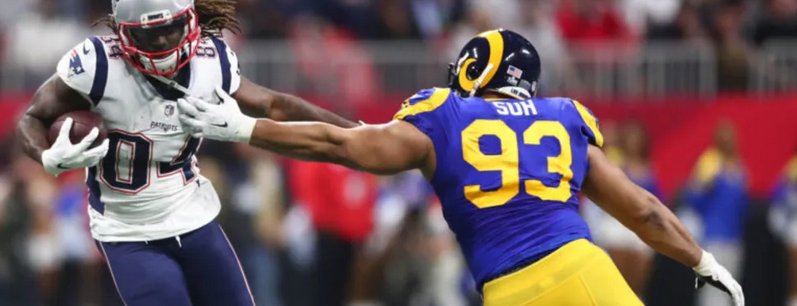
For all the unnecessary roughness during a 13-year NFL career — the down-low, scandalized way he treated opposing players — Ndamukong Suh never got sued.

Maybe the league’s witness protection program wasn’t all that great. Or, maybe because, deep down, he was really a super nice guy whose actions off the field spoke louder than his red-flag existence on the gridiron of employment?

In nearly 200 regular season games, including three Super Bowls, another handful of playoff appearances, five times added to a Pro Bowl squad, and a handful of exhibition games where rules still applied, the 6-foot-4, 313-pound Suh leveraged his abilities to earn about $163 million in salary. That included $14 million that the Los Angeles Rams gave him to join their organization in 2018, a strategic move to free up the often double-teamed All Pro defensive end Aaron Donald.

Now subtract more than $400,000 for all the fines and lost pay checks Suh incurred.

“Some may say (his penalty payments were) a bargain to pay in light of what he had earned — all the intimidation that came from his reputation,” USA Today columnist Mike Freeman wrote when Suh, in a rather poignant social media post, announced in July of 2025 he was officially retired from the NFL at age 38.

Continue reading “No. 93: Ndamukong Suh”

No. 80: Donn Moomaw

This is the latest post for an ongoing media project — SoCal Sports History 101: The Prime Numbers from 00 to 99 that Uniformly, Uniquely and Unapologetically Reveal The Narrative of Our Region’s Athletic Heritage.  Pick a number and highlight an athlete — person, place or thing — most obviously connected to it by fame and fortune, someone who isn’t so obvious, and then take a deeper dive into the most interesting story tied to it. It’s a combination of star power, achievement, longevity, notoriety, and, above all, what makes that athlete so Southern California. Quirkiness factors in. And it should open itself to more discussion and debate — which is what sports is best at doing.

The most obvious choices for No. 80:
= Donn Moomaw, UCLA football
= Henry Ellard, Los Angeles Rams
= Johnnie Morton, USC football

The not-so obvious choices for No. 80:
= Bob Klein, USC football, Los Angeles Rams
= Duane Bickett, USC football

The most interesting story for No. 80:
Donn Moomaw, UCLA football center and linebacker (1950 to 1952)
Southern California map pinpoints:
Santa Ana, Westwood, Los Angeles (Coliseum), Hollywood, Bel Air, Pasadena


UCLA athletic department archives

With their first pick in the 1953 NFL Draft — the ninth-overall choice — the Los Angeles Rams selected center/linebacker Donn Moomaw, the first two-time All-American in UCLA program history and a local hero out of Santa Ana High.

Moomaw prayed on it.

Then he politely declined.

The NFL played Sunday games, which was Moomaw’s day for the Lord. It did not need any potential Hail Mary pass plays intercepting his focus.

As an end around, Moomaw could deflect to Canada, play for the Toronto Argonauts and the Ottawa Rough Riders in the CFL, and do more mid-week and Saturday engagements.

But soon enough, his rough ride of long-term pro football fame came with a change in heart. Moomaw became one of the most well-known preachers in the country. The fresh Presbyterian minister of Bel Air became a personal confidant of Ronald Reagan and his family, starting with his time as the California governor, and going all the way to the White House.

But then, the headlines that Moomaw made later in life were a cause to pause and pray some more.

The story

Don Moomaw’s time at UCLA was a glorious one. They weren’t booing him. When the 6-foot-4, 220-pound linebacker made a tackle, the UCLA cheerleaders would lead the crowd in “MooooooMAW!” He was known as “the Mighty Moo.”

He came just as advertised out of Santa Ana High.

Continue reading “No. 80: Donn Moomaw”