


“The Complete Book of
Baseball Trivia:
Test Your Knowledge
with 750 Questions”
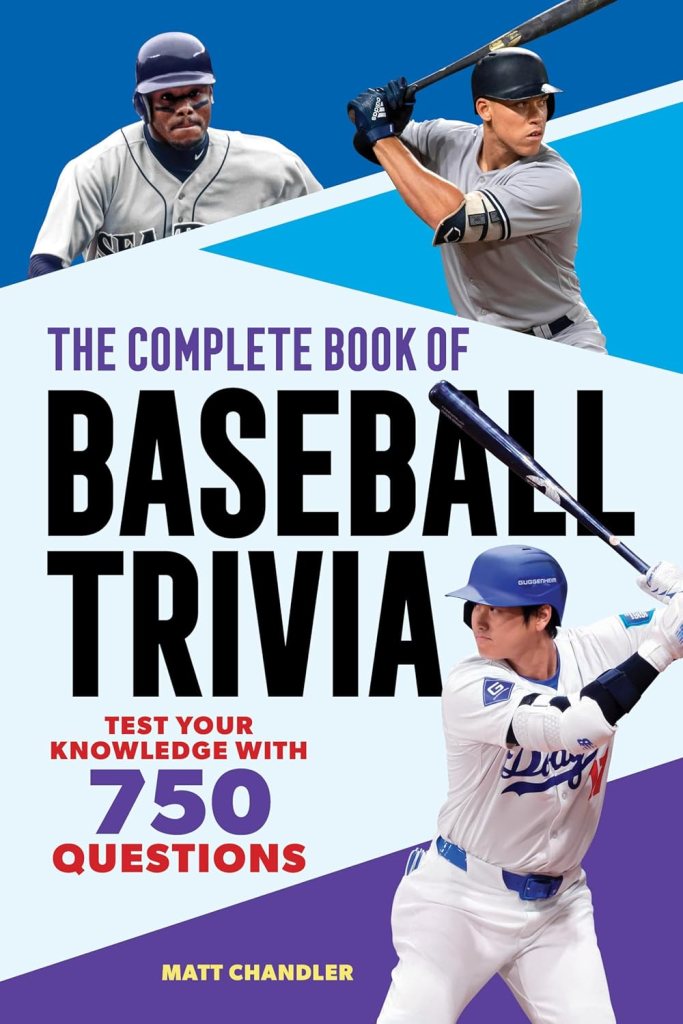
The author: Matt Chandler
The details: Sourcebooks/Callisto publishing, 208 pages, $12.99, released March 3, ‘26
The links: The publisher, the author, Bookshop.org
A review in 90 feet or less:
Something here just wasn’t lining up right. Even for someone like me who has to think a second — are the Atlanta Braves in the National League West, East, or American League Central with Houston’s Colt .45s?
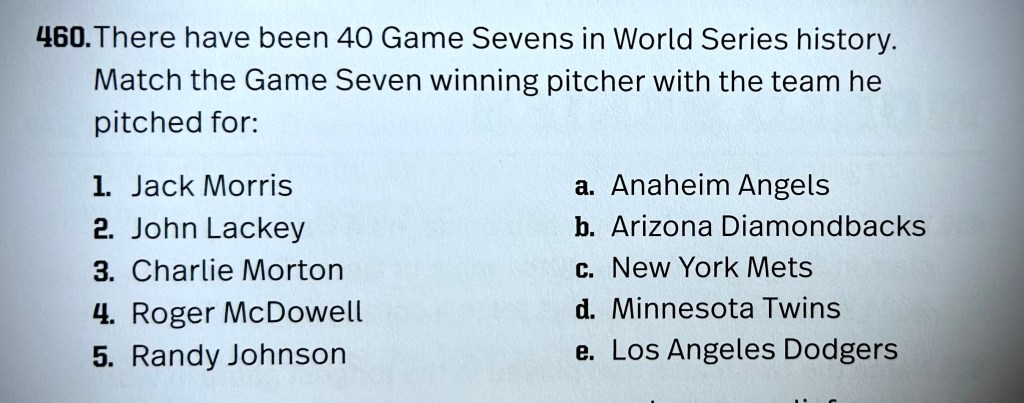
Charging down the backstretch of a dopamine-demanding 750-question baseball trivia quiz, Question No. 460 seized up my cerebral cortex where reasoning and uncommon sense are stored.
The left side of the menu wasn’t matching up with the right side.
Jack Morris — grinded out the 10-inning, 1-0 Game 7 win for Minnesota (not Detroit) over Atlanta in 1991, earning him Series MVP and, whether deserving or not, an eventual spot in the Baseball Hall of Fame. Knew that.
John Lackey — a rookie called on to start Game 7 of the Angels’ 2002 World Series against San Francisco at Angel Stadium. I was there. They even got the name right: Anaheim Angels.
Randy Johnson — dominated the 2001 World Series for Arizona over the heavy (and emotionally) favored New York Yankees. After a complete-game 3-0 shutout in Game 3, five more shutout innings to start and win a lopsided, survive-or-die Game 6, and then, the next day, loping out of the bullpen for Game 7 with two out in the top of the eighth to wrap things up as Luis Gonzalez delivered the bloop-slap dagger in the bottom of the ninth.
So, that makes it 1d, 2a, 5b.
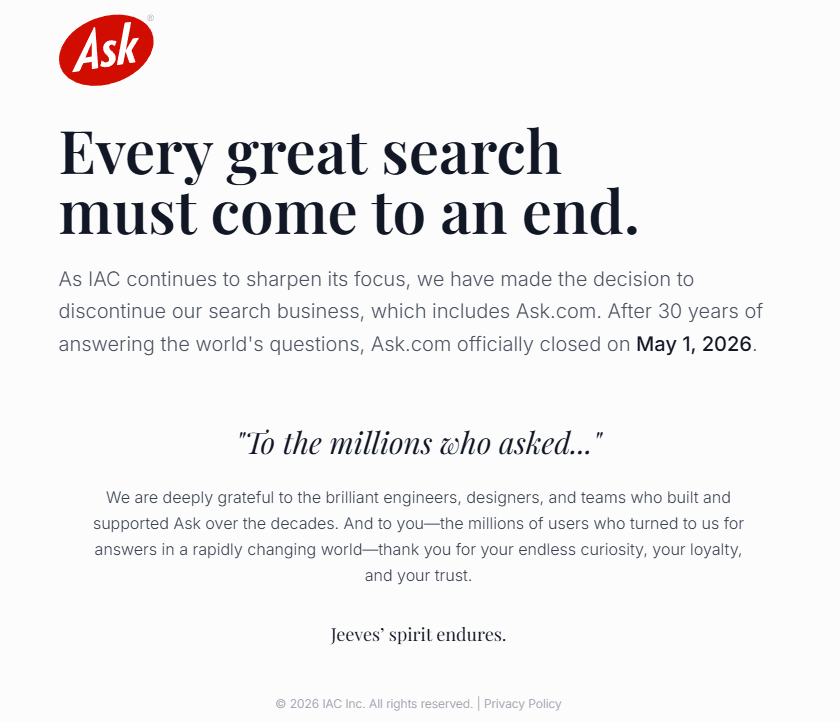
According to how we were taught to take the SAT some 50 years ago, how do we resolve the last two possibilities? Is this where we pull out phone and Ask Jeeves?
(That’s rhetorical, of course. It is with some nostalgic regret that we discovered the unbeloved search engine ran out of gas just recently. It was said to be a quiet, peaceful death. No next of kin to notify. Someone, however, still has possession of the domain name “ask.com” Here is the official obit):
For the good of society and our own mental health, we can’t just give in to the urge to search engine everything when our brain pauses for a second to gather itself.
If needed, we’ve constructed a few healthy guidelines.
First, don’t default to Google. It’s become Garbage.
Google man control some 85 percent of the search-engine market, but this cesspool of misguided algorithms, paid-sponsored AI inserts, unhelpful suggestions and outdated references is why Corey Doctorow has included it as Exhibit A in hiss book, “Enshittification: Why Everything Suddenly Got Worse and What To Do About It.” Get the book, of course, just not on Amazon, which is another tech giant/digital platform that, as Doctorow writes, “systematically degrades user experience for profit.” That description is even on the Amazon book listing, luring you to still buy it.
If you can also override whatever is causing your software to default to Bing — aka, Microsoft Revenge — because that powers Yahoo Search and AOL. Lycos is as relevant as MySpace. ChatGPT, You.com, Waldo, Ecosia, Yep.com, Perplexity AI … maybe technically in the search engine family, but we still can’t trust what’s being loaded into the front end of its wood chipper. . We smell musty oak that pines for accuracy.
DuckDuckGo is our go-to. There’s first a feeling like entering a changing room at Nordstrom, feeling you’ve got far more privacy than what security cameras are pointed at you in your local Ross Dress for Less.
That said, back to this five-part puzzle.
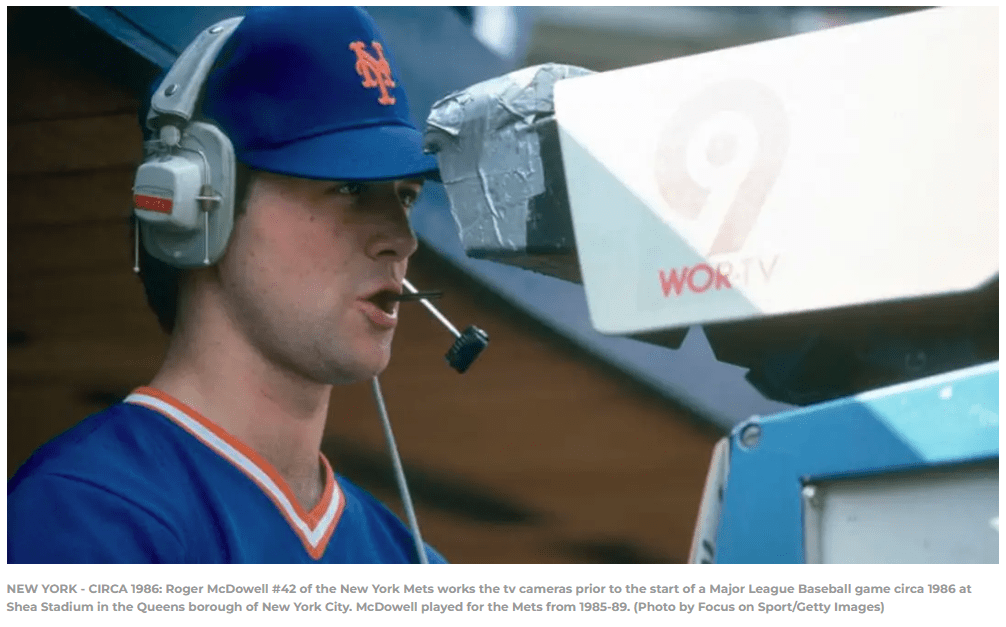
Roger Alan McDowell — in no history book is he any kind of Game 7 hero. He pitched for both the Mets and Dodgers. During his Los Angeles residency, the Dodgers never got into a Game 7 of anything. One of those teams even lost 99 games in the regular season. McDowell was with the Mets when they lost a NLCS Game 7 to the Dodgers in 1988.
Charles Alfred “Charlie” Morton — pitched for seven teams over 18 seasons, retired after one ceremonial comeback start at the end of September with Atlanta. That was last season, as he was 41. He was never employed by the Dodgers or Mets.
So if by default we pair McDowell to the Mets — most likely their ’86 World Series win over Boston — there’s no way Morton pairs up with the Dodgers. Although we do recall Morton on the Houston Astros’ tainted 2017 team that took down the Dodgers in seven games.
DuckDuckGo buckshot is now warranted to clear the air in the name of truth.
McDowell (whose new book we mentioned in passing recently in the Day 5 collection) came into ’86 World Series Game 7 during a 3-3 tie in the top of the seventh. The Mets went ahead in the bottom of the seventh, 6-3. In the top of the eight, McDowell gave up a two-run double to Dwight Evans to cut the Mets’ lead to 6-5, so Davey Johnson yanked him, tossed in Jesse Orosco, saw him actually get an RBI single in the bottom of the eighth when he had to hit for himself (a fake sacrifice bunt/swing-away chop at a pitch that drove in Ray Knight for the nightcapper) and finished off the Red Sox in the ninth. So McDowell got the win for that? Only because of how the rule book is written.
Morton made it to three World Series over a five-year span — for Houston against the Dodgers (’17), for Tampa Bay against the Dodgers (2020) and for Atlanta against Houston (2021). In 2017 Game 7 at Dodger Stadium, Morton, who did well as the Game 4 starter, came on in relief in the fifth inning after the Astros built a 5-0 cushion. Starter Lance McCullers Jr., and relievers Brad Peacock, Francisco Liriano and Chris Devenski had pieced together five shutout innings before Morton, who gave up an RBI single to Andre Ethier and then set down the last 11 Dodgers hitters. Because he did most of the heavy lifting in that game 4 IP, 4 Ks, 15 batters faced — the scorekeeper gave him the win by default since McCullers didn’t go long enough as a starter.
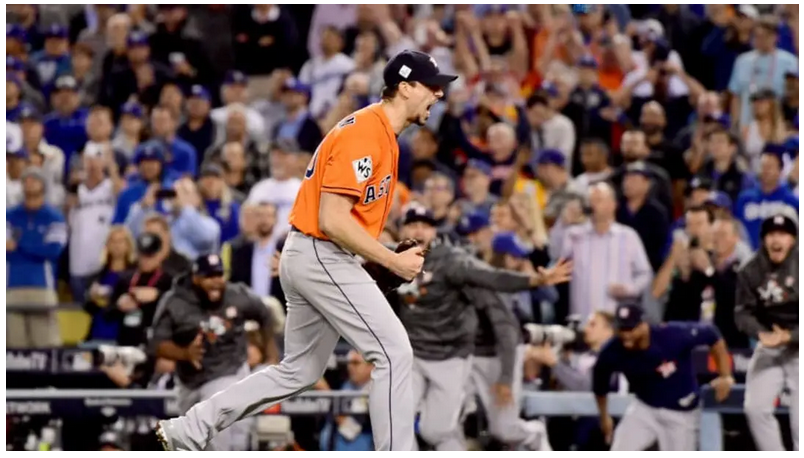
(Looking now at the box score, it’s somewhat ridiculous to see the Dodgers’ starting second baseman for a Game 7 was Logan Forsythe, and Chase Utley was a utility player asked to pinch hit).
So where does that all leave us?
Matt Chandler is a marketing/PR man in the Buffalo area of New York who teaches writing at Buffalo State. In the sports publishing world, his focus has been on dozens of children’s books that include several Sports Illustrated for Kids titles like “Wacky Baseball Trivia” and “Baseball’s Most Controversial Plays.”
It’s tough to focus on a bad-hop error that somehow passed by the editors in this book — that may in itself seem trivial — but maybe, for anyone who does a project like this, it’s a teachable moment. Pay whatever it takes to employ at least a dozen editors who know baseball to check your work. Have them take the test themselves. Reveal things that can be obvious and correctable instead of somewhat embarrassing.
Sure, Morton matches up with Houston, the team that defeated the Dodgers. But there’s that, plus listing Bobby “Thompson” as an answer in a couple of spots. We’ve misspelled his name enough times to know it’s “Thomson.” In this quiz, the participant is actually asked to spell the name out rather than pick it off a menu.
Trivia comes from the Latin word trivium: tri means “three” and via is “road.” So a trivium is a “place where three roads meet,” meaning a crossroads — just something ordinary. So something that is trivial is not worth remembering; it just isn’t important. The proof of satisfaction from being asked to partake in a trivia quiz isn’t so much that it’s not worth remembering — it feels there is value in that — but that it’s also important when keeping other pieces of baseball information in context.
As we are not of the mindset that baseball information is trivial — it’s simply an assortment of facts to be interpreted for their value and clarity in describing the sport — we aren’t often bothered to see how useless data we can pull out on demand to fulfill a long, blind test.
As part of the publishers’ series called “The Greatest Trivia Challenge” that includes a volume of football and soccer tests, we treat this baseball edition with some care and importance. Stuff that you might be asked as a contestant on “Sports Jeopardy!”
For our taste, far too many of the questions put forth here aren’t enjoyable to know or answer.
Too many questions are in an obscure deep dive of managerial history. Others are pigeon-holed to fit into a break down of the six MLB divisions — again, is Milwaukee AL, NL or AWOL?
In spending a good amount of time and brain cells on this, we decided we can be credited with 507 1/2 correct answers versus 242 1/2 incorrect. We gave ourselves some credit for having at least half of a multi-fill-in-the-blank question. If any of the matches during a List A to List B were wrong, we counted it as all wrong. But we can’t live with marking down No. 460 as wrong.
In the end, is getting two-thirds of these things right mean I get a free scoop of ice cream? What’s the curve bell say?
A couple of other quibbles:
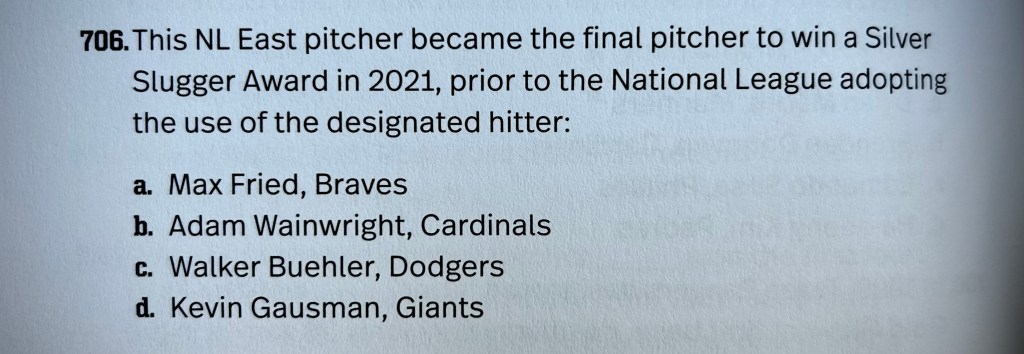
= Read that one above again. Fried is the only of the four choices to have been linked to an NL East team.
= It wasn’t ESPN’s Chris Berman who made the call “back! back! back!” home-run famous in Question 636. He was pulling it from a classic Red Barber description from a Dodgers-Yankees World Series.
= On Question 258, both Nolan Ryan and Bob Feller have the MLB record for one-hitters with 12 (not just Ryan). Didn’t we just cover all that here?
= For Question 561 — C’mon, that’s Harmon Killebrew in the MLB logo. We’re going with this story.
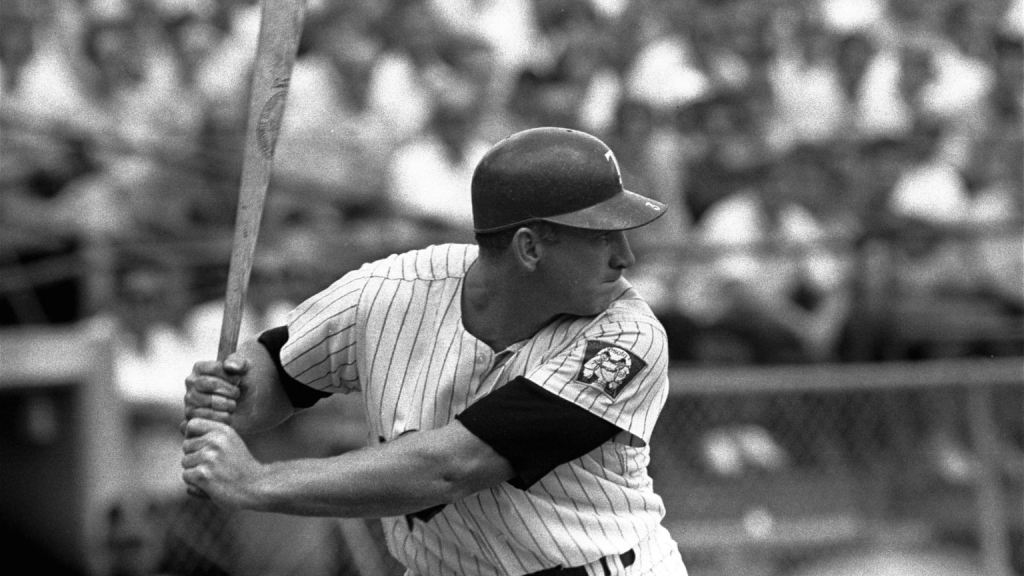
Or, you can lean into this:
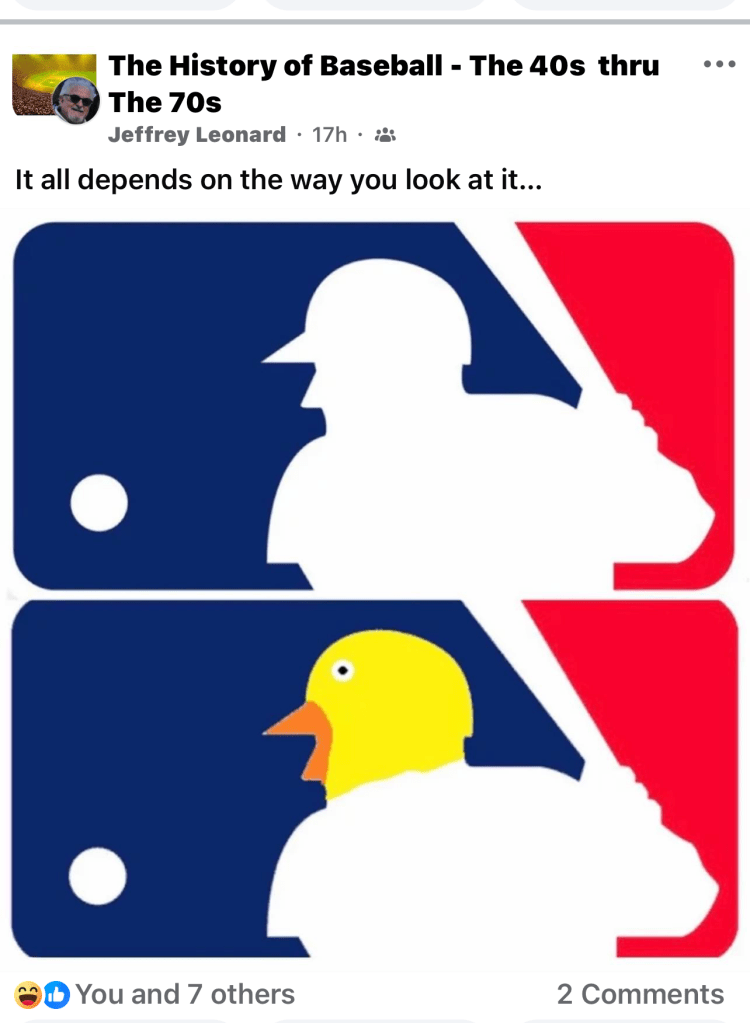
= Question No. 741 needs an update: Carlos Beltran is now in the Hall of Fame (or will be soon).
All that said, we could agree with the answer given for question No. 505 concerning Dave Roberts’ decision to bring in Clayton Kershaw for a relief appearance during the 2019 NLCS “in an unfamiliar role” as something that “haunts Dodgers fans to this day.”
One question did send us off into an interesting tangent: In a simple true/false ask for No. 683, you’re asked to assess the statement: “Less than half of all players who win a single MVP Award make it to the Hall of Fame.”
It is true. But why? Chandler states: “Three MVP winners never even made it onto the ballot for consideration because their careers did not warrant it.”
There’s something to really research now.
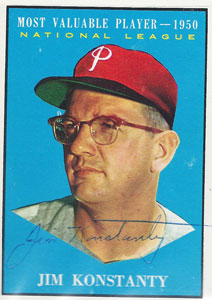
= Jim Konstanty, the nerdish, bespectacled Philadelphia relief pitcher who won the 1950 NL MVP Award with the first name of Casimir, had his only All Star season with a 16-7 record and league-high 74 appearances, 62 games finished and 22 saves for a 4.7 WAR. As the Phillies were swept by the Yankees in the ’50 Series, only using six total pitchers, Konstanty actually started (and lost) Game 1, 1-0, at home. He blew a save coming in relief for Game 3, and was called on to relieve starter Bob Miller with one out in the first, going 6 2/3 in relief, in the Game 4 loss. Konstantly was consistently average before an after. He died at 59, having pitched for five teams over 11 seasons. Could he have also won the Cy Young had it been given that year? It’s a reasonable guess, but that honor was still six seasons away.
= Al Rosen, the Cleveland Indians third baseman who won the 1953 AL MVP (a league-best 43 homers and 145 RBIs with a .336 average and 10.2 WAR), made four All Star teams but barely had 10 years on his resume, playing just 35 games his first three seasons. His eight full seasons came up short of the 10-season standard by Hall of Fame requirements.
= Zolio Versalles, the Minnesota Twins’ Cuban-born shortstop who faced off against the Dodgers in the 1965 World Series after winning the AL MVP award (a league-best 126 runs, 45 doubles and 12 triples for 308 total bases to go with a Gold Glove), may have had a league-best 7.2 WAR, but it was never above 2.6 before and barely above 1.3 after. It was 12.6 for a 12-year run, including 1968 spent with the Dodgers. Versalles, whose middle name was Casanova, died at age 55.
Let’s take that further: How many Cy Young Award winners never got their names on a Hall of Fame ballot? Three more:
= Bob Turley, the 1958 winner when he was 21-7 with 19 complete games for the New York Yankees, finishing runner-up for AL MVP at age 27, plus a 2-1 record in the Yankees’ ’58 World Series win over Milwaukee, never had more than a nine-win season after that, collecting 101 over a 12-year career, despite three All-Star appearances and pitching in five World Series, winning four games in two title runs. His career WAR was 13.2. The average Hall of Fame pitcher is 73.0. He was most similar statistically to Sad Sam Jones or Blue Moon Odom.
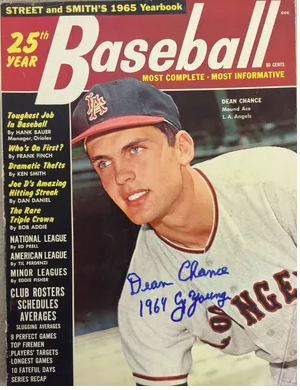
= Dean Chance, whose ridiculous 1.65 ERA produced just a 20-9 season and AL best 9.4 WAR for the Los Angeles Angeles in 1964, won the Cy Young that year over Sandy Koufax (third in the voting, 19-5, 1.74 ERA). Chance, 23 at the time, led the AL as well in innings, 15 complete games and 11 shutouts and was the AL starting pitcher in the All-Star Game. His 29.9 career WAR as a starter with five teams over 11 seasons included another 20-win All Star year in Minnesota in 1967 (when he also threw a no-hitter) but he didn’t garnish a single Cy Young vote. His career is most comparable to an Andy Messersmith or Sonny Siebert.
= Mike McCormick, out of Alhambra High in Pasadena, did win the 1967 NL Cy Young Award (the first time it was one for each league instead of just one overall) with a 22-10 mark and 2.85 ERA, but wasn’t on the NL All Star team. His stats weren’t all that better than Jim Bunning, who led the NL with a 7.8 WAR, innings pitched, six shutouts and strikeouts but suffered from a 17-15 record. McCormick’s 18.6 career starting pitcher WAR is more aligned with a Joe Nuxhall or Chris Short.
See how this can work? Bring in a few other brains to the party, and now you’ve got some real non-trivialize pursuing.
How it goes in the scorebook:
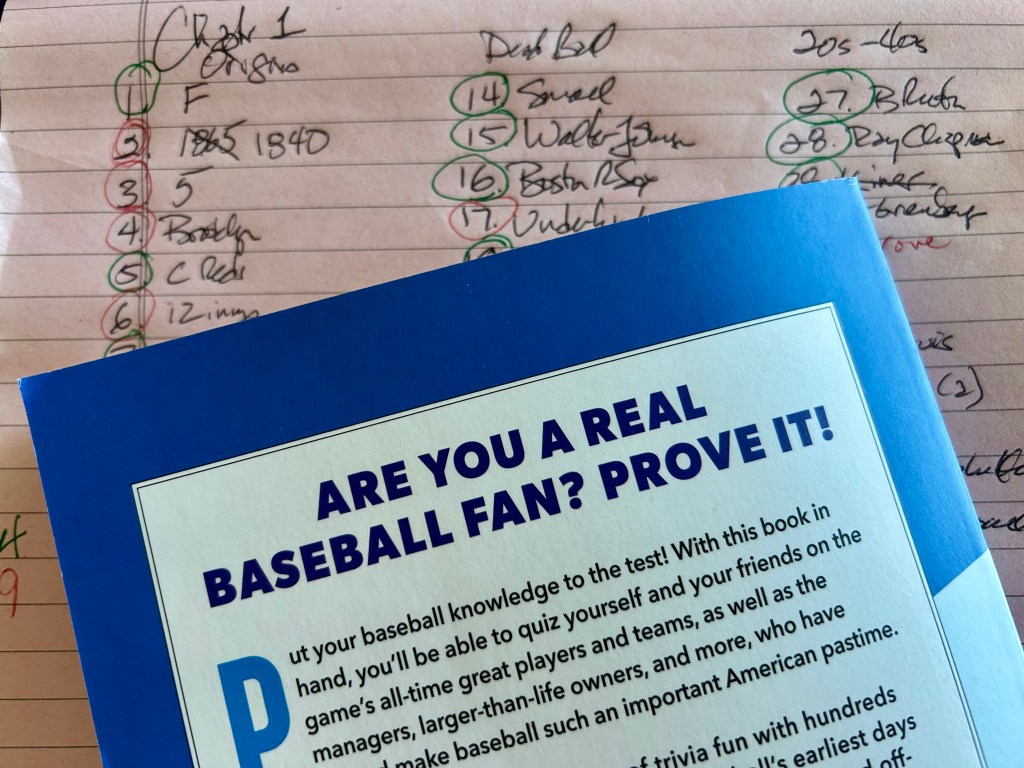
If there is true pursuit of finding out whether someone has “real” baseball fandom, this isn’t the proving grounds. Four hours of commitment to this should have a greater payoff.
Maybe, like a Wordl puzzle, we need to be able to access ways to share and compare with others. How can that be achieved? Is there some sort of author-based grading curve we could find a little satisfaction?
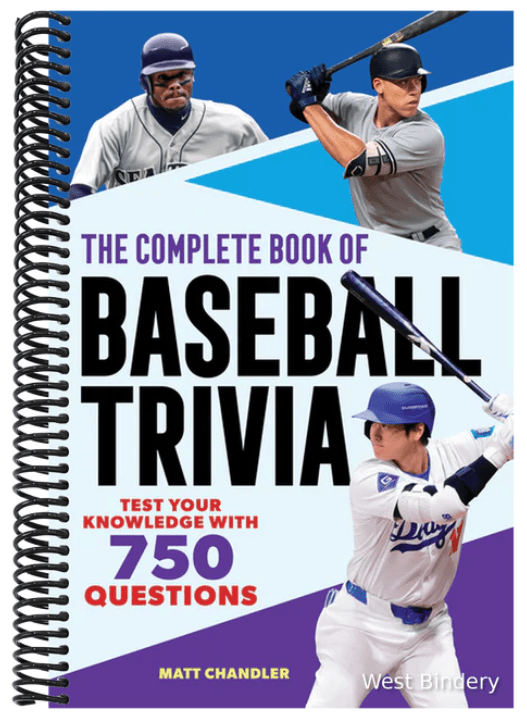
Next time, maybe more about stuff about Coco Crisp and Danny Litwhiler and less about Max and Will Venable.
More to followup:
== If possible, spring for the spiral-bound version of this at $22.99 and life will be a bit easier. A suggestion found after the fact. C’mon, grow a spine.


1 thought on “Day 17 of 2026 baseball books: More than a pursuit of triviosity”