"Everything comes to him who hustles while he waits." — Tommy Edison
Author: fartheroffthewall
Tom Hoffarth is a sports journalist in Los Angeles, born and raised (reared is the correct phrase, but it just sounds wrong) and specializing in the sports media business. A USC graduate from the School of Journalism (it still exists, somewhat) in 1984, he is also available for service at https://www.linkedin.com/in/tomhoffarth/
This is the latest post for an ongoing media project — SoCal Sports History 101: The Prime Numbers from 00 to 99 that Uniformly, Uniquely and Unapologetically Reveal The Narrative of Our Region’s Athletic Heritage. Pick a number and highlight an athlete — person, place or thing — most obviously connected to it by fame and fortune, someone who isn’t so obvious, and then take a deeper dive into the most interesting story tied to it. It’s a combination of star power, achievement, longevity, notoriety, and, above all, what makes that athlete so Southern California. Quirkiness and notoriety factor in. And it should open itself to more discussion and debate — which is what sports is best at doing.
The most obvious choices for No. 39:
= Roy Campanella: Not-quite-Los Angeles Dodgers = Sam Cunningham: USC football via Santa Barbara = Mike Witt: California Angels via Anaheim Servite
The not-so-obvious choices for No. 39:
= Milt Davis: UCLA football = Willie Strode: Los Angeles Rams via UCLA = Chris Kluwe: UCLA football
The most interesting story for No. 39: Jim Hill: Los Angeles sports TV anchor (1976 to present) Southern California map pinpoints: Hollywood, every major sports venue in Southern California
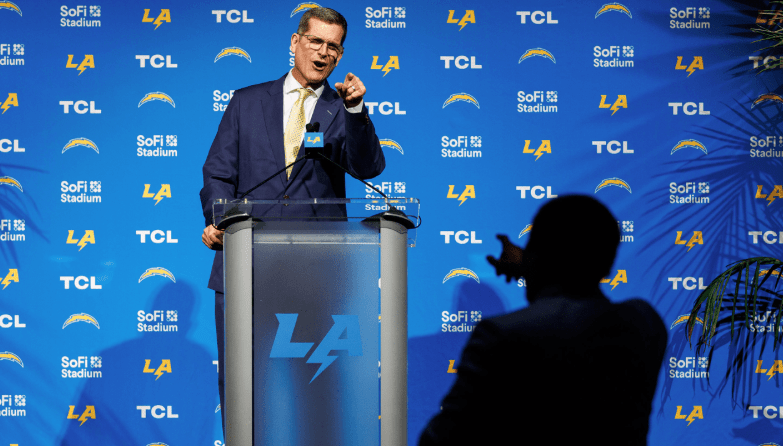
As by protocol for any sports televised press conference in Southern California over the last several decades, Jim Hill was dutifully called upon to ask the first question when the Los Angeles Chargers reeled in the media for a Feb. 1, 2024 announcement, moving it from their Costa Mesa headquarters to the YouTube Theater in Inglewood next to SoFi Stadium.
Jim Harbaugh, who had just won a national championship at the University of Michigan, was introduced as the Chargers newest head coach.
“Coach, I’m Jim Hill, KCAL-9 news … congratu …” is how Hill began.
“The legend,” Harbaugh interrupts. “Of course I know who you are.”
“No, no, no, you’re the legend,” Hill responds.
Jim Hill attends a Kobe and Vanessa Bryant Family Foundation press conference on September 12, 2012 in Hollywood. (Photo by Brian To/WireImage)
“You’re the legend,” Harbaugh repeats.
Hill continued by congratulating Harbaugh, wishing him good luck and noted that by seeing “all of us here today, what does this tell you about how popular this choice is by the Chargers to make you as a the head coach, and, the great expectations that come?”
“Well, thank you for that question, Jim,” Harbaugh replied. “And you are a legend.”
Harbaugh got in the last word.
As the Chargers began honored players from its past during Black History Month in that same February of 2024, Hill was a natural to profile. It started “Before legendary sports anchor Jim Hill got his start in television and became one of the well-known faces in Los Angeles and around the country, he was the one being interviewed.”
There’s that “legend” thing tossed around. And the Chargers have the rights to Hill’s No. 39 origin story, how it launched his sports broadcast career –a byproduct of the work ethic he established as an NFL player — and how he became a role model of African-American success in the community, setting him apart more than any other in Southern California local TV history.
This is the latest post for an ongoing media project — SoCal Sports History 101: The Prime Numbers from 00 to 99 that Uniformly, Uniquely and Unapologetically Reveal The Narrative of Our Region’s Athletic Heritage. Pick a number and highlight an athlete — person, place or thing — most obviously connected to it by fame and fortune, someone who isn’t so obvious, and then take a deeper dive into the most interesting story tied to it. It’s a combination of star power, achievement, longevity, notoriety, and, above all, what makes that athlete so Southern California. Quirkiness and notoriety factor in. And it should open itself to more discussion and debate — which is what sports is best at doing.
The most obvious choices for No. 49:
= Charlie Hough: Los Angeles Dodgers = Tom Niedenfuer: Los Angeles Dodgers = Dennis Smith: USC football = Charles Phillips: USC football = Carson Schwesinger: UCLA football
The not-so-obvious choices for No. 49:
= Marvcus Patton: UCLA football
The most interesting story for No. 49: Marvcus Patton, UCLA football linebacker (1985 to 1989) via Leuzinger High of Lawndale Southern California map pinpoints: Inglewood, Lawndale, Westwood
Marvcus Patton had no idea how proud his father might have been, the day UCLA’s football program accepted him as a relatively undersized walk-on linebacker in the fall of 1985.
It was his dad who gave him the name Marvcus, with the extra “v.” Pronounced MARV-cuss, in honor of the Roman emperor and warrior Marcus Aurelius. Marcus comes from the name Mars, the god of war.
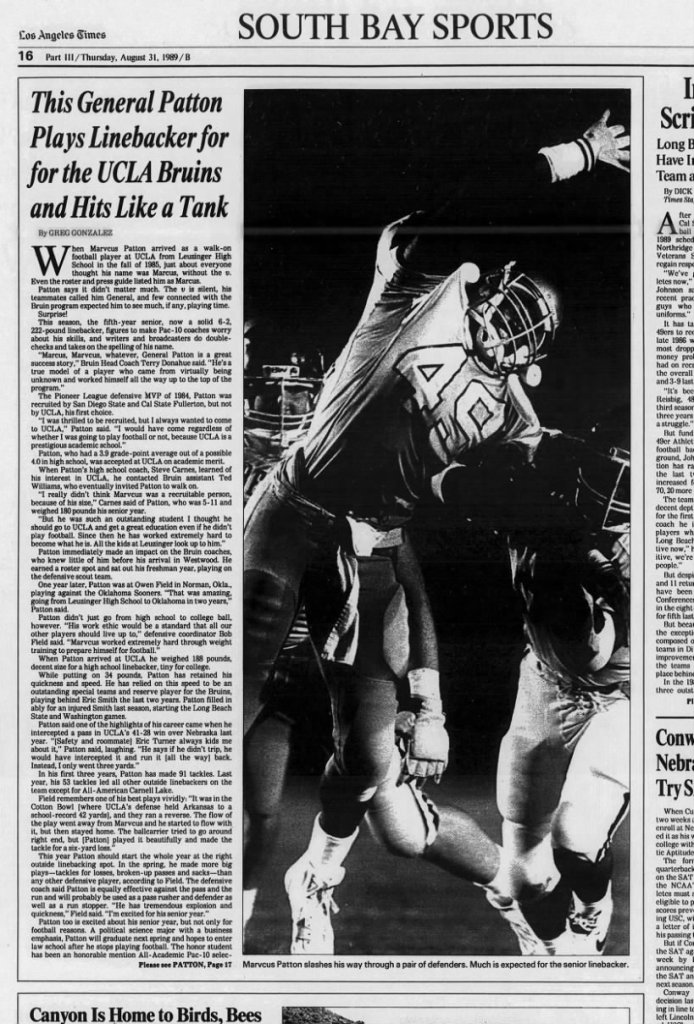
“As it turns out, he turned into a warrior on the football field,” his mother, Barbara, told the Los Angeles Times in a 1989 story as her son was about to enter his final collegiate season.
As it also turns out, Barbara was far more influential in Marvcus’ ascent into a football life.
Marvcus’ father, Raymond Hicks, never saw him play. Hicks was a Los Angeles Police undercover detective shot and killed in the line of duty during a drug bust when Marvcus was 9. Hicks had been separated from Barbara for some time at that point, eventually remarried and started another family.
Barbara was a single mom of two children, working as a PBX operation for the federal government’s General Services Administration in L.A. That was her Monday-to-Friday job. On weeknights and on Saturdays, she slugged it out as a linebacker for the Los Angeles Dandelions of the National Women’s Football League.
No flag-grabbing here. Helmets, shoulder pads, extra-thick padding up front. Full on contact. For $25 a day, which sometimes happened, sometimes not.
Like mother, like son. Kind of.
“I thought it was really cool to tell my friends that my mom was a linebacker,” Marvus Patton once shared. “My mom’s love for the game definitely influenced me. I always watched football on television and collected football cards, but seeing my mom play really made me want to be in the NFL.”
The son’s story
UCLA Athletic Department file photo.
As the Pioneer League defensive MVP at Leuzinger High in Lawndale in 1984, Patton had only one college scholarship offer, from San Diego State. Cal State Fullerton was interested, but it couldn’t commit too much. It didn’t matter. Patton’s first choice was UCLA.
At 5-foot-11 and 133 pounds as a high school junior, he got up to 165 as a senior as he hit the weight room. But college choices were were limited. Academics mattered.
“I would have come regardless of whether I was going to play football or not, because UCLA is a prestigious academic school,” said Patton, who had a 3.9 grade-point average and made it into on scholastic merit. At Leuzinger, he had already completed upper-division classes as a freshman and sophomore and was practically able to graduate before his senior season.
Steve Carnes, Patton’s coach at Leuzinger, connected him with UCLA assistant Ted Williams. Patton was invited to walk on.
“I really didn’t think Marvcus was recruitable,” Carnes said. “But he was such an outstanding student I thought he should go to UCLA and get a great education even if he didn’t play football. Since then he has worked extremely hard to become what he is. All the kids at Leuzinger look up to him.”
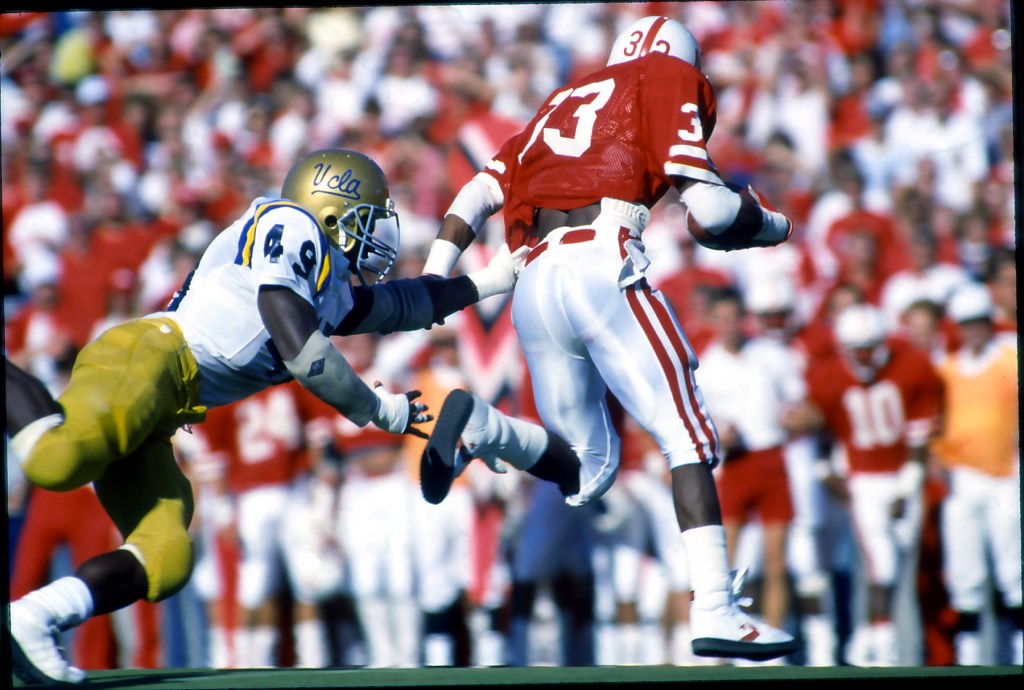
After participating on the freshman scout team, Patton made it into the Bruins’ lineup by his sophomore year. He had put on more than 30 pounds but maintained his speed that set him apart on special teams.
UCLA Athletic Department file photo
Patton said a career highlight was intercepting a pass in UCLA’s 41-28 win over Nebraska in 1988.
By the time Patton hit his fifth-year senior season, at 6-foot-2 and 222 pounds, teammates nicknamed him “General.” Maybe because they couldn’t get past the Marcus-Marvcus hurdle.
“Marcus, Marvcus, whatever, General Patton is a great success story,” UCLA head coach Terry Donahue would say. “He’s a true model of a player who came from virtually being unknown and worked himself all the way up to the top of the program.”
Marc Dellins, the longtime UCLA senior associate athletic director heading the sports information office, recalled the time when the Bruins played in the 1989 Cotton Bowl at the end of Patton’s junior season. All the players received bolo ties with a plastic replica of the bowl logo. The name spelled on Patton’s tie was “Marvcus,” and Dellins, notcing it, said he could get that fixed and have his name spelled right.
“That’s when he tells me it was spelled correctly,” said Dellins. “I realized for almost two seasons we had been spelling it wrong. I asked him why he didn’t say anything, and he said he didn’t want to make a big deal out of it. I said: ‘That’s your name, you can make a big deal out of it’.”
Actually, when his mother every got annoyed with him, she said she she might call him “MAR-cus.” Normally, it was “Marc.”
During Patton’s senior season, as UCLA stumbled to a 3-7-1 record in 1989 (next-to-last in the Pac-10 and the Bruins’ worst performance in 10 seasons), Donahue noted that Patton “played with great heart and competitiveness. He’s really had a good year despite the fact the team has not. I certainly think on a different team and a different set of circumstances, he’d really receive a tremendous amount of recognition and notoriety for his play.”
Patton set a school record with 22 tackles behind the line of scrimmage. He was third in the Pac-10 in sacks with 11. Teammates named him the co-MVP to go with his political science degree on his resume.
Patton fell to the eighth round of the 1990 NFL draft before Buffalo took a chance on him with the 208th pick overall. Patton said he felt like he was a walk-on all over again.
“When you have that feeling that everyone’s against you and they don’t think you can get it done, it gives you a little extra drive,” Patton said. “I’ve always felt that I had to prove myself.”
Patton not only earned a earned a roster spot but played in all 16 games, then suffered a broken leg on the opening kickoff of the AFC Divisional playoff game against Miami.
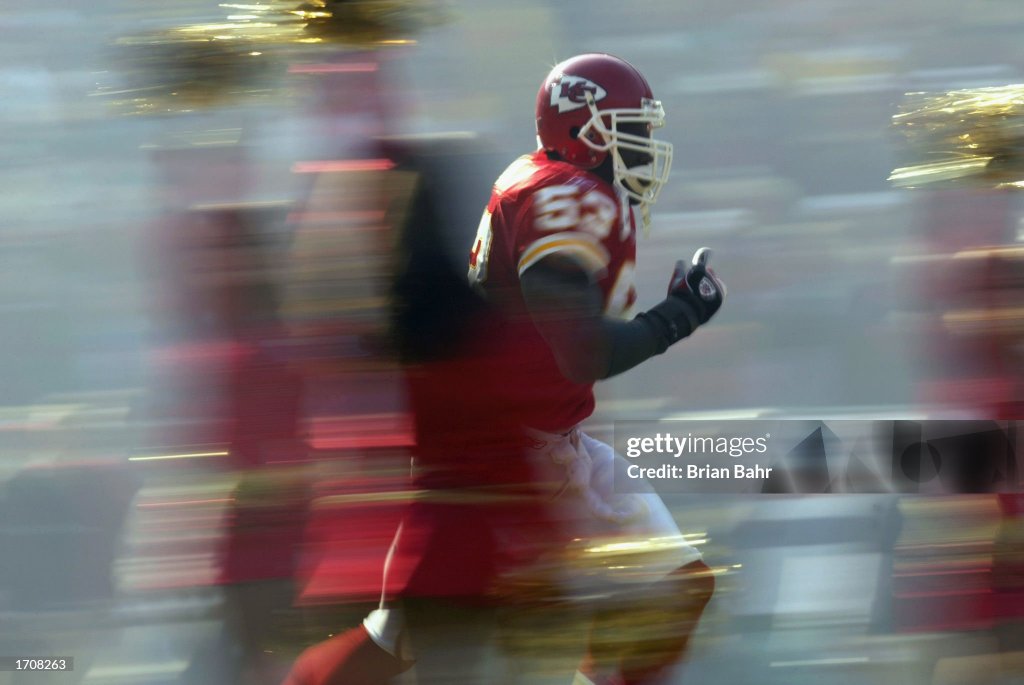
Kansas City Chiefs middle Linebacker Marvcus Patton runs onto the field during introductions before a game against Buffalo at Arrowhead Stadium in Kansas City. (Brian Bahr/Getty Images)
A full-time starter by his fourth season as a left inside linebacker, Patton had five seasons in Buffalo, including Super Bowl trips in four straight seasons. Patton got to return to the Rose Bowl as a professional when the Bills played in the Super Bowl XXVII against Dallas and former UCLA teammate Troy Aikman in 1993.
Traded to Washington and moving to middle linebacker, he led the team in tackles three times. He had a career best 143 with 115 solo tackles in 1998. After a Redskins’ 14-point loss to Tampa Bay in 1996, Patton was quoted as saying: “We played like babies. We didn’t tackle. We didn’t chase down people. We let it slip away.”
His final four seasons were in Kansas City, named a team MVP in his first season when he had 135 tackles, after landing a six-year contract said to be worth $10.1 million.
Having an NFL career that spanned 204 games over 13 seasons, Patton never missed a regular season game. Only one other defensive player picked in that 1990 NFL draft — Hall of Famer Junior Seau out of USC, No. 5 overall — played more than the 208 NFL games that Patton did in their career.
Buffalo linebackers Marvcus Patton (53) and Shane Conlan (56) converge on Dallas tight end Jay Novacek (84) at midfield during Super Bowl XXVII at the Rose Bowl on January 31, 1993. (Gin Ellis/Getty Images)
At age 35 in his final season with the Chiefs, Patton had two interceptions (giving him 17 for his career) and two fumble recoveries (giving him 12). His scored his only NFL touchdown on a 24-yard interception return in 2000.
He was walking away from pro football right about the same age as his mom did back in her playing days.
The mom’s story
Running back is where Barbara Patton always thought Marvcus would shine in Pop Warner football.
“You’ve got the speed, the moves … running back is the right place for you son,” she would say.
“No, mom,” Marvcus would answer. “I want to play defense … just like you.”
Barbara Patton knew what she was talking about. As 5-foot-4, 130-pound outside linebacker for the women’s professional Los Angeles Dandelions, starting with their debut season in 1973 and going until 1976, she was no shrinking violet. She was a dandy role model.
This is the latest post for an ongoing media project — SoCal Sports History 101: The Prime Numbers from 00 to 99 that Uniformly, Uniquely and Unapologetically Reveal The Narrative of Our Region’s Athletic Heritage. Pick a number and highlight an athlete — person, place or thing — most obviously connected to it by fame and fortune, someone who isn’t so obvious, and then take a deeper dive into the most interesting story tied to it. It’s a combination of star power, achievement, longevity, notoriety, and, above all, what makes that athlete so Southern California. Quirkiness factors in. And it should open itself to more discussion and debate — which is what sports is best at doing.
The most obvious choices for No. 80: = Donn Moomaw, UCLA football = Henry Ellard, Los Angeles Rams = Johnnie Morton, USC football
The not-so obvious choices for No. 80: = Bob Klein, USC football, Los Angeles Rams = Duane Bickett, USC football
The most interesting story for No. 80: Donn Moomaw, UCLA football center and linebacker (1950 to 1952) Southern California map pinpoints: Santa Ana, Westwood, Los Angeles (Coliseum), Hollywood, Bel Air, Pasadena
UCLA athletic department archives
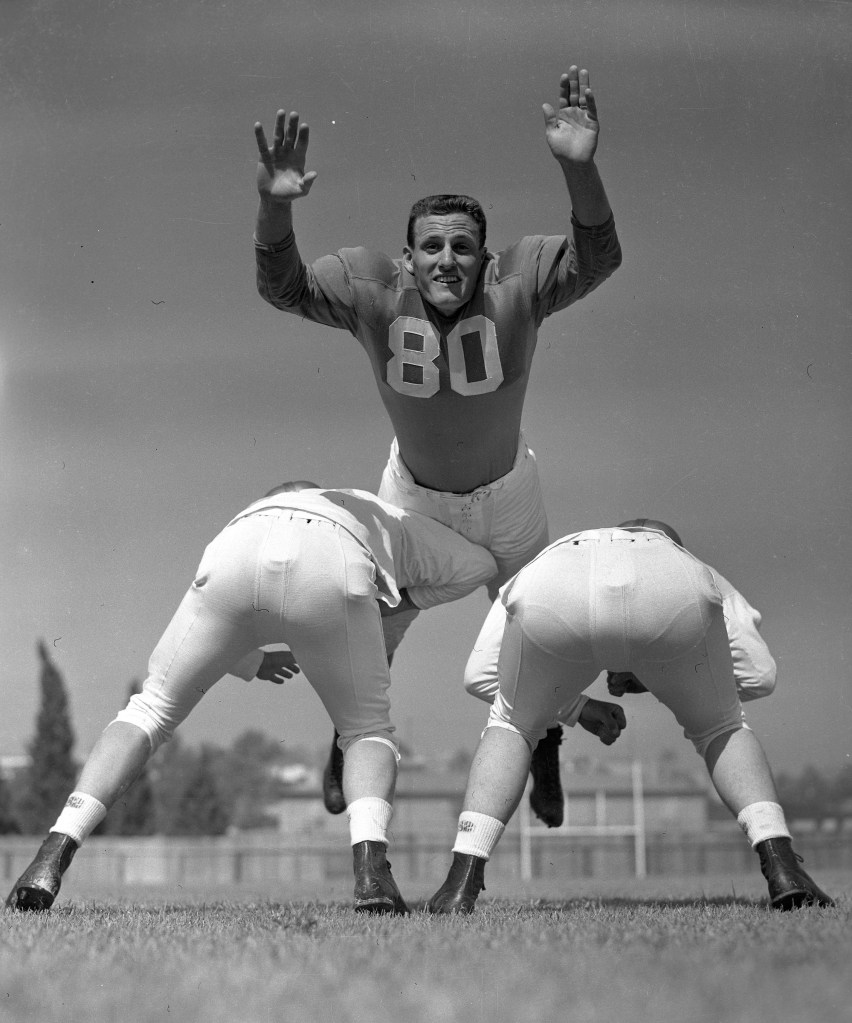
With their first pick in the 1953 NFL Draft — the ninth-overall choice — the Los Angeles Rams selected center/linebacker Donn Moomaw, the first two-time All-American in UCLA program history and a local hero out of Santa Ana High.
Moomaw prayed on it.
Then he politely declined.
The NFL played Sunday games, which was Moomaw’s day for the Lord. It did not need any potential Hail Mary pass plays intercepting his focus.
As an end around, Moomaw could deflect to Canada, play for the Toronto Argonauts and the Ottawa Rough Riders in the CFL, and do more mid-week and Saturday engagements.
But soon enough, his rough ride of long-term pro football fame came with a change in heart. Moomaw became one of the most well-known preachers in the country. The fresh Presbyterian minister of Bel Air became a personal confidant of Ronald Reagan and his family, starting with his time as the California governor, and going all the way to the White House.
But then, the headlines that Moomaw made later in life were a cause to pause and pray some more.
The story
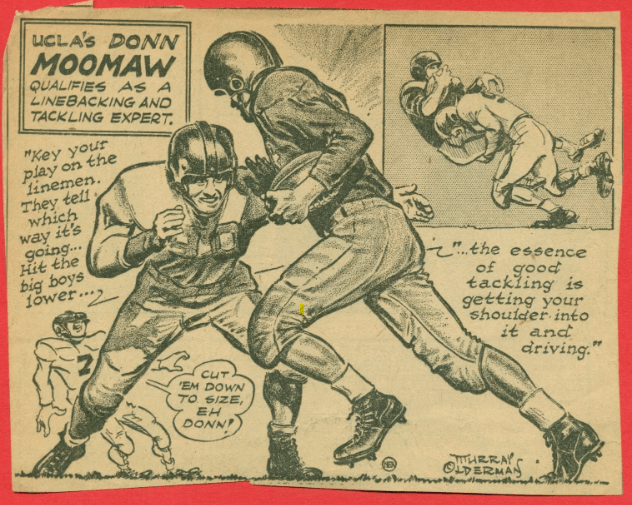
Don Moomaw’s time at UCLA was a glorious one. They weren’t booing him. When the 6-foot-4, 220-pound linebacker made a tackle, the UCLA cheerleaders would lead the crowd in “MooooooMAW!” He was known as “the Mighty Moo.”
This is the latest post for an ongoing media project — SoCal Sports History 101: The Prime Numbers from 00 to 99 that Uniformly, Uniquely and Unapologetically Reveal The Narrative of Our Region’s Athletic Heritage. Pick a number and highlight an athlete — person, place or thing — most obviously connected to it by fame and fortune, someone who isn’t so obvious, and then take a deeper dive into the most interesting story tied to it. It’s a combination of star power, achievement, longevity, notoriety, and, above all, what makes that athlete so Southern California. Quirkiness and notoriety factor in. And it should open itself to more discussion and debate — which is what sports is best at doing.
The most obvious choices for No. 89:
= Fred Dryer, Los Angeles Rams = Ron Brown, Los Angeles Rams = Charles Young, USC football
The not so obvious choice for No. 89:
= Jack Bighead, Pepperdine football = Bobby Jenks, Los Angeles Angels The most interesting story for No. 89: Fred Dryer: Los Angeles Rams defensive end (1972 to 1981) via Lawndale High and El Camino College Southern California map pinpoints: Hawthorne, Lawndale, Torrance, L.A. Coliseum, Long Beach, Hollywood
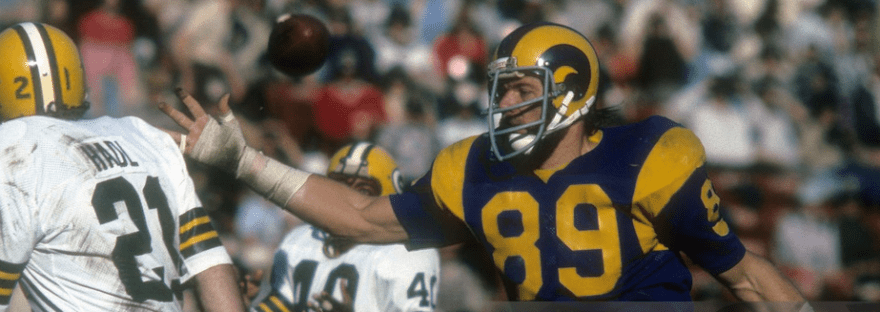
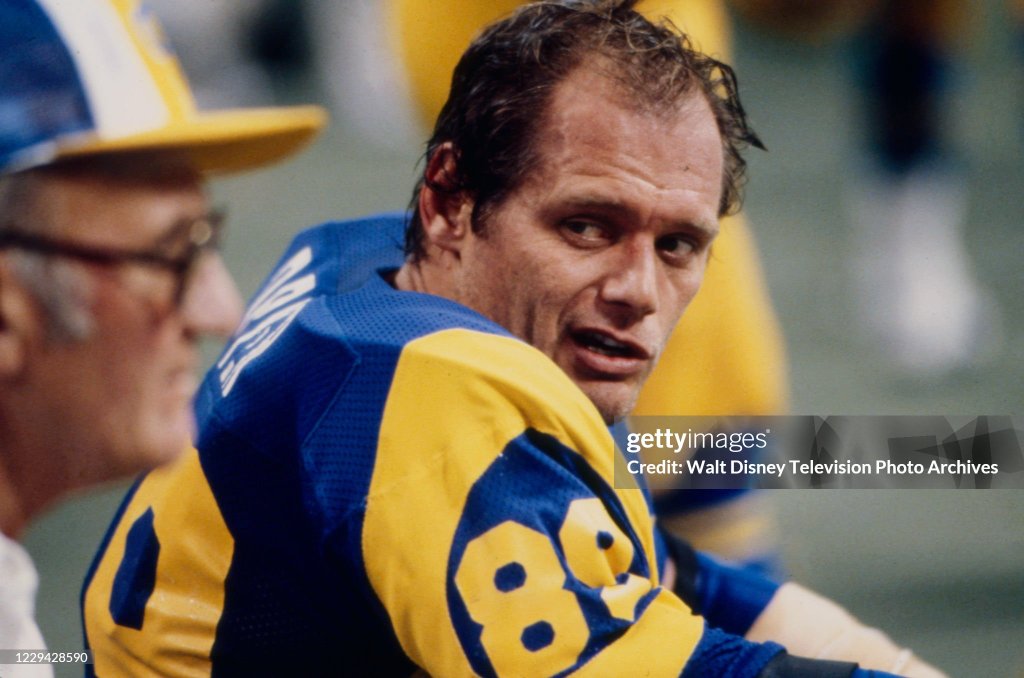
The Rams’ Fred Dryer during an ABC’s “Monday Night Football” broadcast in 1979 against Dallas. (ABC via Getty Images)
Whatever version of Fred Dryer first comes to mind — the swift-moving Los Angeles Rams’ defensive end sideswiping an offensive tackle en rout to hunting down another quarterback, or a guy named “Hunter,” a fearless LAPD private who bent the rules when necessary as a TV character — there was always that underpinning of “Dirty Harry” in motion.
Dryer had a job and a duty to perform it. In both cases. Vengeance could be a motivational tactic. He cleaned up messes, no matter how dirty or harry it became.
A day in court never seemed to bother him, either. Justice had to be serviced, whether Dryer was pushing back on a contract dispute as either a professional athlete or a popular thespian. Dryer pulled those levers of justice, his modus operandi, with or without a legal need to produce a habeas corpus.
There was a point at the height of his TV fame, almost a decade since the official end of his NFL career, when Dryer found himself in a huddle of entertainment industry writers. They soft-tossed him questions about how, as he was about to turn 42, he best self-identified at this point in his life.
“As the hard-boiled Rick Hunter, a Los Angeles homicide detective, Dryer projects an image that combines Steve McQueen’s rough sexiness with Clint Eastwood’s stoic demeanor. And Hunter shows just about as much respect for his suspects Constitutional rights as Eastwood’s Dirty Harry does.
“Dryer has a theory about why his acting career took off when so many of his colleagues’ fizzled.
“ ‘Most athletes fail at it because they don`t understand that when you come from a success in another area like sports, you have to leave the sports world behind. You have to kill the guy that made you a sports star and start over completely.
“Fred Dryer, football player, is dead. I put him away and started with this other guy.
“That means you don’t bring the ego you had in football with you. Without mentioning names, I see ex-football players who are just not willing to let go of (their athlete image), because if they lose that, who are they? You have to let go of your past before you gain something else.”
Dryer was just staying in character. And considering he almost had the role of Sam Malone when the iconic TV series “Cheers” launched years earlier, the thought of hanging around a bar known as an ex-jock just wasn’t his idea of being pro active.
This is the latest post for an ongoing media project — SoCal Sports History 101: The Prime Numbers from 00 to 99 that Uniformly, Uniquely and Unapologetically Reveal The Narrative of Our Region’s Athletic Heritage. Pick a number and highlight an athlete — person, place or thing — most obviously connected to it by fame and fortune, someone who isn’t so obvious, and then take a deeper dive into the most interesting story tied to it. It’s a combination of star power, achievement, longevity, notoriety, and, above all, what makes that athlete so Southern California. Quirkiness and notoriety factor in. And it should open itself to more discussion and debate — which is what sports is best at doing.
The most obvious choices for No. 97:
= Joey Bosa, Los Angeles Chargers = JeremyRoenick, Los Angeles Kings = Joe Beimel, Los Angeles Dodgers
The most interesting story for No. 97: Joe Beimel, Los Angeles Dodgers relief pitcher (2006 to 2008) Southern California map pinpoints: Los Angeles (Dodger Stadium bullpen), Torrance
What a relief it was in 2008 — Joe Beimel bamboozled the burgeoning business of baseball bobbleheads and brought it upon himself to rebrand his name, image and likeness to his liking.
Boom …
As something of a left-over in a world of left-handed middle relievers, Beimel had found a place in the Los Angeles Dodgers bullpen during the 2006 and ’07 season primarily as the guy who could be called upon to bind up NL West rival Barry Bonds when he came to the plate in a key situation. With that, Beimel somehow converted an under-the-radar, cool surfer vibe into ceramic folk-lore status.
His faithful followers actually forced the Dodgers to make good on a promotional campaign promise and create a bobble replica of him — free, for those who bought a ticket to a promoted game. That’s what the people wanted. Allegedly.
With all due respect, did everyone respect the process by which this happened, and can still live with its consequences?
Nod yes if you are in the affirmative.
The context
Once upon a time, a kitschy paper-mache souvenir that represented the game’s innocence in the 1960s began showing up. It often had a generic cherub face with a disturbing grin that kids could put on their shelves and be haunted by as its head bounced up and down on coils, brandishing the team’s colors and uniform.
By the late 1990s, the nostalgic craze for baseball of yesteryear was ignited when the San Francisco Giants tested out a Willie Mays bobble figurine, and 35,000 were given away in a 1999 game.
The Dodgers, of course, couldn’t watch the giant promotional opportunity pass them by.
By 2001, the Dodgers ramped up their first offerings as a fan giveaway — Tommy Lasorda, Kirk Gibson and Fernando Valenzuela were the first three created. Dodgers broadcaster Vin Scully quipped the Gibson bobblehead looked more like actor Stacy Keach.
From there, the Dodgers and their China-made bobbleheads came as a steady flow. When they expanded to four giveaways in 2007, fans were allowed to pick one to create through an Internet vote. Catcher Russell Martin was the first “winner.”
In spring training of 2008, the team announced plans for bobblehead nights recognizing incoming manager Joe Torre and All-Star pitcher Takashi Saito. Now there were two spots up for grabs for the voters. The likely candidates were Matt Kemp and Andre Ethier. Maybe Nomar Garciaparra or newly acquired Andruw Jones. Clayton Kershaw was just a 20-year-old unproven rookie. Manny Ramirez wouldn’t barge into the spotlight until months later.
Beimel, a 6-foot-3, scruffy long-haired guy from Pennsylvania came into town a couple years earlier with baggy pants to go with a baggy uniform. Given No. 97, it was, at the time, the highest number ever used by a Dodger going back to the 1930s. Beimel said 97 represented the birth year of his son Drew, his first child.










 Tom Hoffarth's The Drill: More Farther Off the Wall