No. 79: Forest Whitaker

This is the latest post for an ongoing media project — SoCal Sports History 101: The Prime Numbers from 00 to 99 that Uniformly, Uniquely and Unapologetically Reveal The Narrative of Our Region’s Athletic Heritage.  Pick a number and highlight an athlete — person, place or thing — most obviously connected to it by fame and fortune, someone who isn’t so obvious, and then take a deeper dive into the most interesting story tied to it. It’s a combination of star power, achievement, longevity, notoriety, and, above all, what makes that athlete so Southern California. Quirkiness and notoriety factor in. And it should open itself to more discussion and debate — which is what sports is best at doing.

The most obvious choices for No. 79:
= Jonathan Ogden, UCLA football
= Bob Golic, Los Angeles Raiders
= Rob Havenstein, Los Angeles Rams
= Jeff Bregel, USC football

The not-so-obvious choices for No. 79:

= Gary Jeter, USC football
= Coy Bacon, Los Angeles Rams

The most interesting story for No. 79:
Forest Whitaker, Palisades High football defensive tackle (1976 to 1978)
Southern California map pinpoints:
Pacific Palisades, Carson, Hollywood


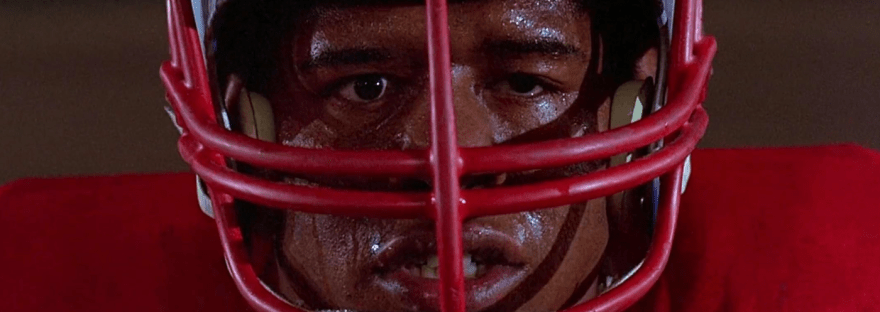
There’s five minutes of mayhem in the iconic 1982 teen flick “Fast Times at Ridgemont High” where Forest Whitaker is allowed to show a full range of acting — and athletic — skills, something he would eventually harness decades later with an Oscar-worthy resume.

As Ridgemont High’s star linebacker Charles Jefferson, wearing No. 33 on his jersey and lettermen’s jacket, Whitaker goes from mild-mannered to maniacal mayhem during a fast-and-furious turn of events.

It wasn’t a real stretch for Whitaker to take on that role.

Just a few years earlier, he was an All-L.A. City defensive tackle at Palisades High, wearing No. 79. He would go off to Cal Poly Pomona on a football scholarship.
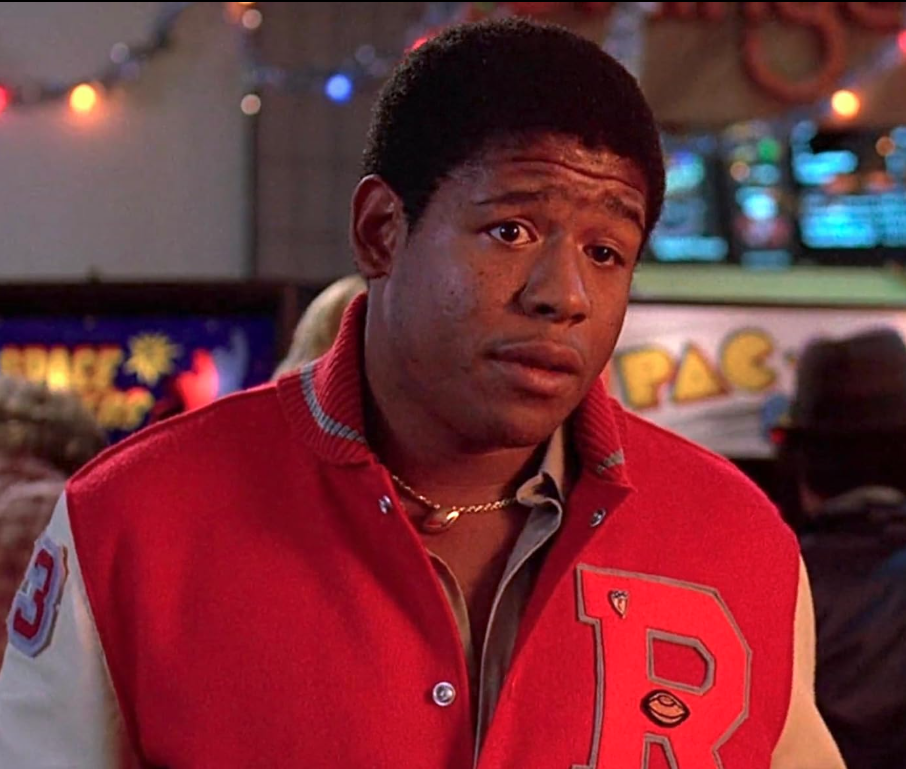
Maybe some special effects are used during the movie’s football game scene, allowing Jefferson to launch himself in slow motion over the Lincoln High offensive line and tackle the entire backfield.

One by one, Jefferson knocked out the opposing team to the delight of the Ridgemont student section, many wearing buttons that read “Assassinate Lincoln.”

There were more cinematic knockouts to come for Whitaker.
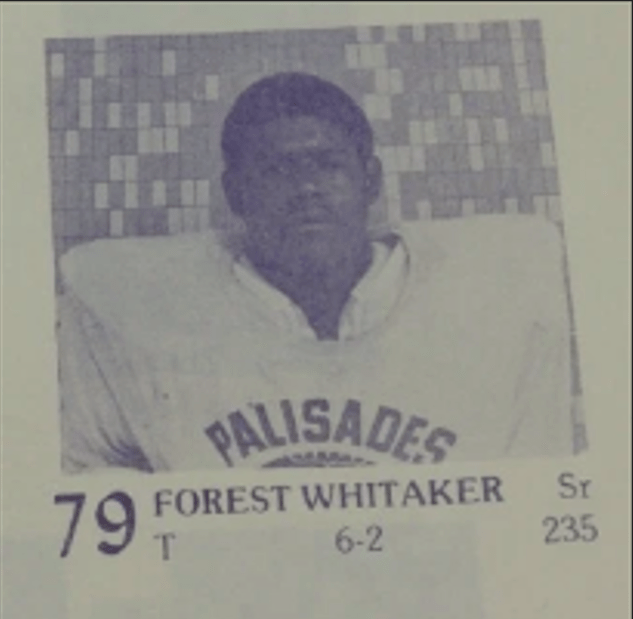
Forest Steven Whitaker, born on July 15, 1961 in Longview, Texas, moved with his family to Carson at age 4. His mom, Laura, was a special ed teacher and his father, Forest, sold insurance.

Rather than have him attend a school in L.A.’s tougher inner city, Whitaker’s parents figured out a way to have him go to Palisades High in Malibu, which could be an hour-long ride in traffic one way.

Whitaker once said his parents’ decision may have saved his life.

Continue reading “No. 79: Forest Whitaker”
No. 95: Jamir Miller

This is the latest post for an ongoing media project — SoCal Sports History 101: The Prime Numbers from 00 to 99 that Uniformly, Uniquely and Unapologetically Reveal The Narrative of Our Region’s Athletic Heritage.  Pick a number and highlight an athlete — person, place or thing — most obviously connected to it by fame and fortune, someone who isn’t so obvious, and then take a deeper dive into the most interesting story tied to it. It’s a combination of star power, achievement, longevity, notoriety, and, above all, what makes that athlete so Southern California. Quirkiness factors in. And it should open itself to more discussion and debate — which is what sports is best at doing.

The most obvious choices for No. 95:

= Jamir Miller, UCLA football

The not-so-obvious choices for No. 95:
= Roger McQueen, Anaheim Ducks

The most interesting story for No. 95:
Jamir Miller, UCLA football outside linebacker (1991 to 1993)
Southern California map pinpoints:
Westwood, Pasadena


Jamir Miller’s jam at UCLA, aside from chasing down quarterbacks, seemed to be a persistent pursuit of parties. That didn’t stop until he was well into a career in pro football.

An All-American linebacker who, in just three seasons with the Bruins would lead the team in sacks each year, rack up a then-school record 23 ½ total, added 35 tackles for a loss, and was a Butkus Award finalist by the time he was done with college football, Miller said he once assessed that by his sophomore year in Westwood, “I embarked on the wild phase of my life that lasted through my second year in the NFL,” according to the Cleveland Plain Dealer in August of 2000.

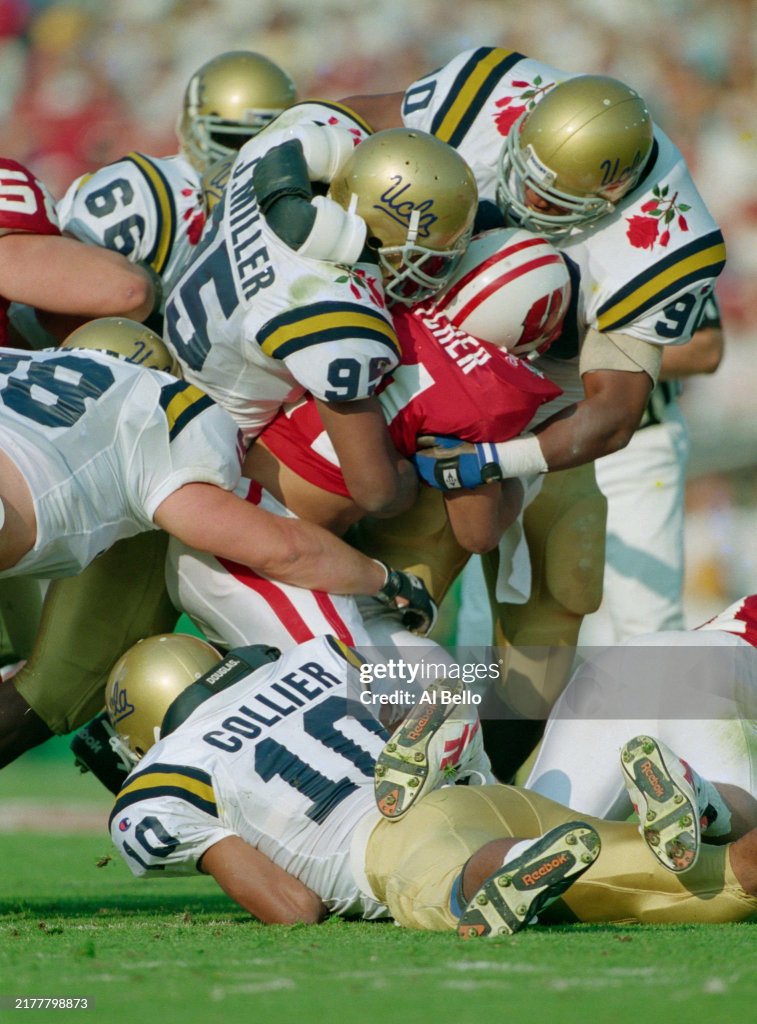
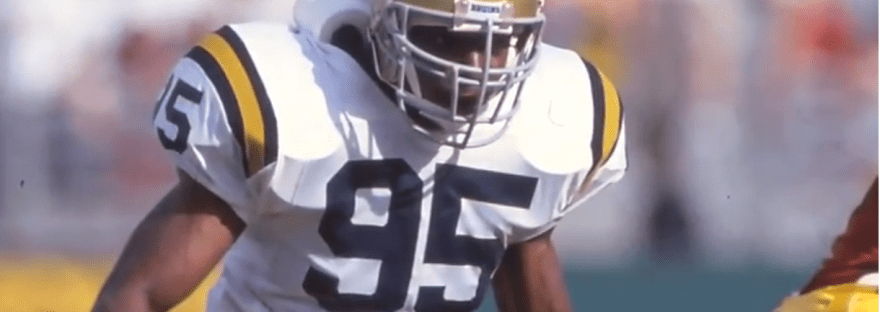
UCLA’s Jamir Miller (95, center) teams up with Shane Jasper (90, right) to wrap up Wisconsin running back Terrell Fletcher (41) in the Rose Bowl on Jan. 1, 1994. (Al Bello/Allsport/Getty Images)

That didn’t include a senior year of college in that time frame.

The 6-foot-5, 252-pounder was arrested twice at UCLA — once for possessing a loaded firearm and once for accepting stolen stereo and computer equipment. He pleaded no contest to both charges, was placed on three years probation and required to perform 100 hours of community service.

Miller also was suspended for the 1993 season opener by head coach Terry Donahue, a person who Miller credits for being most responsible for recruiting him to come to UCLA and tell his mother that her son would be taken care of. UCLA not only lost that first game of the season, 27-25, to Cal, but also the second game, 14-13, at the Rose Bowl against Nebraska, to started 0-2. That would be the last season for Miller at the school.

Miller’s missteps followed a bit of a pattern he developed as a kid growing up with a single mom in the Oakland area, trying to figure out his identity.

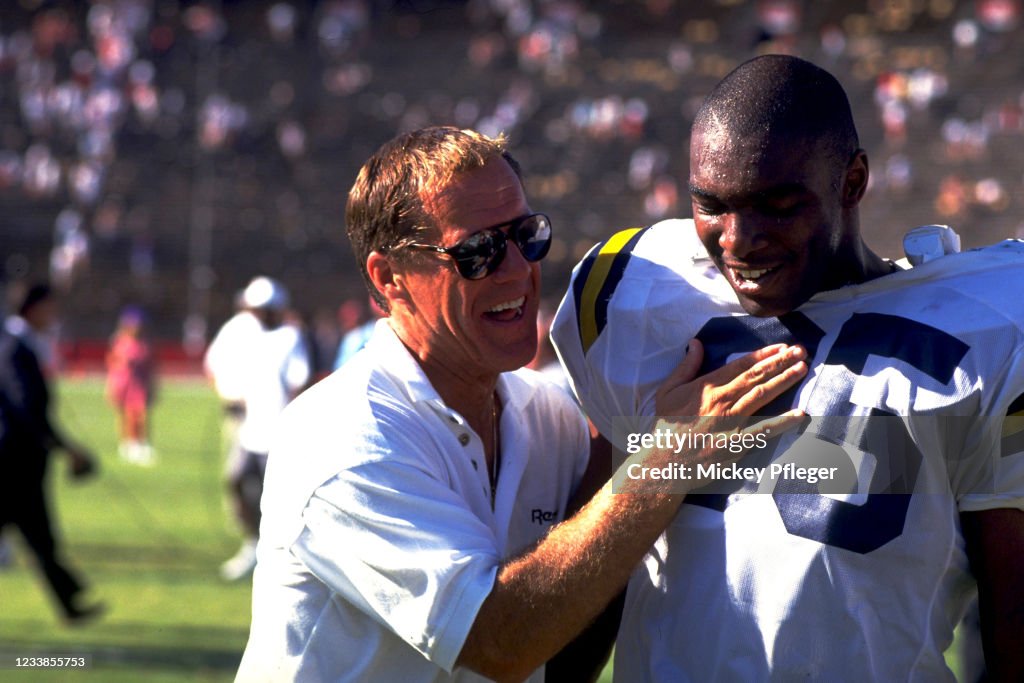
UCLA coach Terry Donahue jokes with linebacker Jamir Miller (95) before a game at Stanford on Sept. 25, 1993. (Mickey Pfleger/Sports Illustrated via Getty Images)

Jamir Malik Miller — his first and middle names mean royal warrior in Swahili — said he didn’t feel much like a warrior growing up.

“When I was younger I didn’t really like my name because it was different and a lot of people couldn’t pronounce it,” Miller told the Los Angeles Times in 1992. “They mess it up and say ‘Jamal’ and I’d go, ‘No, it’s Jamir .’

“I was in the fourth or fifth grade and I’d come home and say, ‘Mom I hate my name because no one can pronounce it.’ She told me not to worry, that I’d understand it when I grew older.

“I wanted to change my name to something like John. I wish my mother had named me something normal. But I decided to stick with it because that’s my identity. And now I’m glad she didn’t name me something normal.”

John Miller was the name of Jamir’s father. A hardened intravenous drug addict, John’s actions forced Jamir’s mother, Rhonda Hardy, to take him as a 3-month old out of their home in Philadelphia and move in with her mother and sisters in the Bay Area.

Continue reading “No. 95: Jamir Miller”

No. 94: Don Yi

This is the latest post for an ongoing media project — SoCal Sports History 101: The Prime Numbers from 00 to 99 that Uniformly, Uniquely and Unapologetically Reveal The Narrative of Our Region’s Athletic Heritage.  Pick a number and highlight an athlete — person, place or thing — most obviously connected to it by fame and fortune, someone who isn’t so obvious, and then take a deeper dive into the most interesting story tied to it. It’s a combination of star power, achievement, longevity, notoriety, and, above all, what makes that athlete so Southern California. Quirkiness factors in. And it should open itself to more discussion and debate — which is what sports is best at doing.

The most obvious choices for No. 94:

= Kenechi Udeze, USC football
= Paul Bergmann, UCLA football
= Mateen Bhaghani, UCLA football

The not-so-obvious choices for No. 94:

= Terry Crews, Los Angeles Rams

The most interesting story for No. 94:
Don Yi, Korean language interpreter for Chan Ho Park (1994)
Southern California map pinpoints:
Lakewood, Glendale, Los Angeles (Dodger Stadium)


The 1994 Major League Baseball season started with Don Yi wearing the No. 94 jersey for the Los Angeles Dodgers.

It wasn’t necessarily the Year of Yi in Dodgertown that particular season, but numerically, it made sense.

While Yi was neither bat boy, ball dude nor clubhouse attendant, the 31-year-old UCLA graduate and computer programmer spoke South Korean. The Dodgers in general, and Chan Ho Park, more specifically, could use Yi’s skill set.

As an important part of a contract stipulation when the Dodgers signed a $1.2 million landmark deal with the 20-year-old pitcher, announced at a press conference at a hotel in Koreatown, the team would provide an interpreter.

Where Yi came into the picture, it’s somewhat a mystery.

Park, as the first MLB player brought in from South Korean player, needed to acclimate and assimilate. Yi was there to accomodate. This new-fangled job would evolve, or go sideways, on a daily basis.

It started with this: What is Park’s name?

The first time Yi was in full uniform as the team arrived its Vero Beach, Fla., training camp in March of ’94, reporters and teammates wanted to know what to call him.

“Some people are calling him Mr. Ho,” said Yi.

Dodgers broadcaster Ross Porter called him “Park Chan-ho,” as per Korean custom to use the family’s given surname first. Park asked if Yi could help him get the media covering him to “Americanize” his name.

Once that box was checked, what else might get found in translation?                         

Continue reading “No. 94: Don Yi”

No. 92: Rich Dimler

This is the latest post for an ongoing media project — SoCal Sports History 101: The Prime Numbers from 00 to 99 that Uniformly, Uniquely and Unapologetically Reveal The Narrative of Our Region’s Athletic Heritage.  Pick a number and highlight an athlete — person, place or thing — most obviously connected to it by fame and fortune, someone who isn’t so obvious, and then take a deeper dive into the most interesting story tied to it. It’s a combination of star power, achievement, longevity, notoriety, and, above all, what makes that athlete so Southern California. Quirkiness factors in. And it should open itself to more discussion and debate — which is what sports is best at doing.

The most obvious choices for No. 92:

= Rich Dimler, USC football, Los Angeles Express

The not-so-obvious choices for No. 92:

= Harrison Mevis, Los Angeles Rams
= Rick Tocchet, Los Angeles Kings
= Don Gibson, USC football

The most interesting story for No. 92:
Rich Dimler, USC football nose guard (1975 to 1978), Los Angeles Express defensive tackle (1983 to 1984)
Southern California map pinpoints:
Los Angeles, Glendale, Inglewood, Hawthorne, Torrance, Rancho Palos Verdes


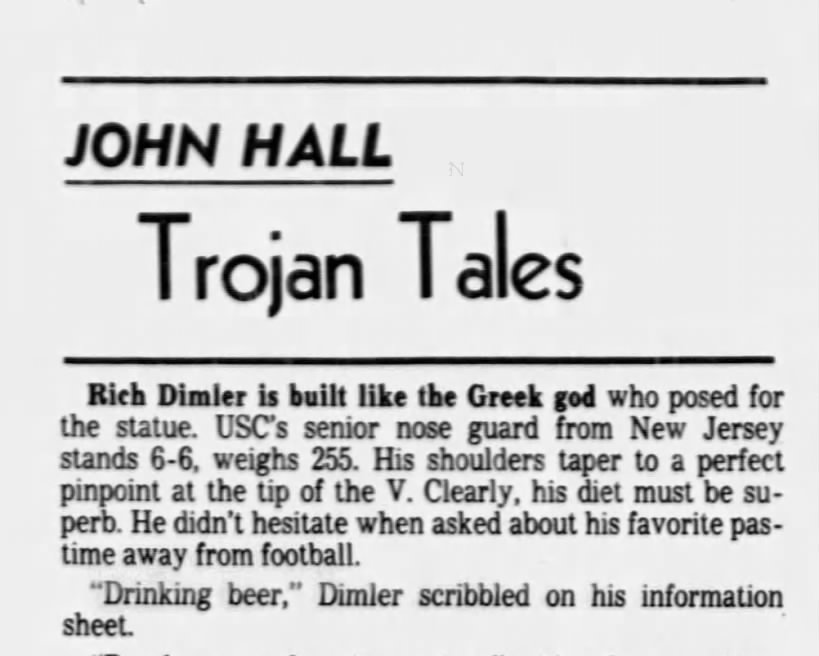
Los Angeles Times, Sept. 8, 1978.

Raise a glass to Rick Dimler. With caution.

The fact he made it through 44 years of roughhousing, and once heralded by USC defensive line coach Marv Goux as “the toughest player I’ve seen in 22 years of coaching” while playing on four straight Trojan bowl victories, is worthy of a toast.

But then again, there was the time when his home town in New Jersey tried to throw a parade in his honor, and it didn’t end well.

Homecomings can be problematic if the honoree celebrates too early and too often.

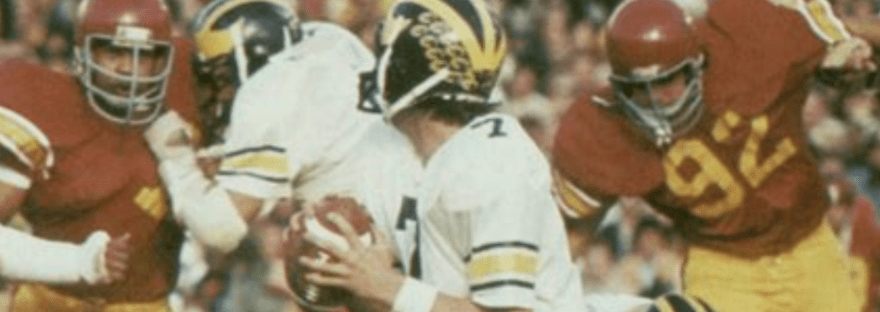
In March of 1979, Dimler was living off the fame of finishing his four years of football at USC, capped off by a 12-1 season, co-captain of the defensive squad that was highly effective in a Rose Bowl win over Michigan, and giving the Trojans a national championship in the eyes of many voters of such polls.

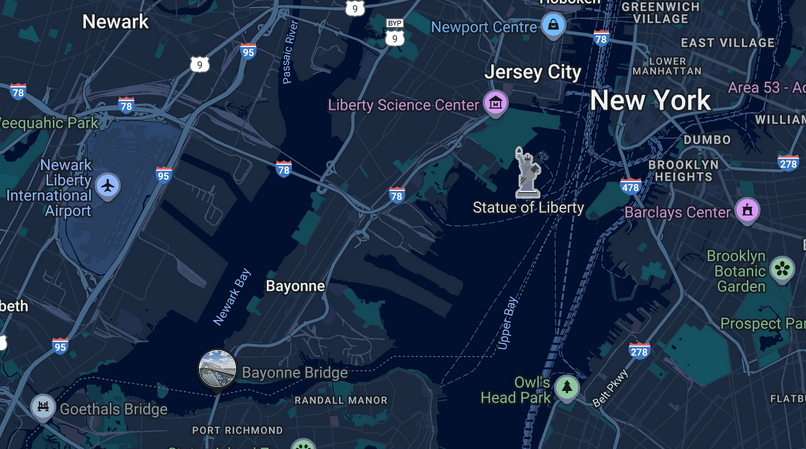
At this point, Dimler was back visiting friends and family in Bayonne, New Jersey. The cityfolk were finalizing plans for what would be Rich Dimler Day — a parade in his honor, a key to the city, the red-carpet treatment. Beers hoisted and thrown back as he could now look forward to what the NFL might bring.

The party was set for April, but, again, Dimler put himself in a situation that had penalty flags flying all over the place.

On March 12, Bayonne police say they saw Dimler in a car racing another car right down Broadway through the city, and started chasing him at 2 a.m. Dimler, according to the authorities, ran three red lights trying to escape. The other car got away. Dimler was hauled in.

At that point, the 6-foot-6, 260-pound Dimler had a dim view on how this might be a teachable moment.

“I’ll have your jobs; I’ll have both your jobs!” Dimler was said to have screamed at the officers, pushing one of them away. He was eventually accused of striking a patrolman in the chest at police headquarters and deemed “unruly” while in the jail cell.

“He flunked his breathalyzer test in flying colors,” said Lt. Vincent Bonner said in newspaper accounts. The .22 result was well above the legal limit of .15.

As soon as Dimler was out on bail facing charges of assault and battery and creating a disturbance, reporters covering the incident discovered he had been arrested just a month earlier in Los Angeles on driving under the influence, but no charges were filed.

Those digging further into his legal history found a disturbing incident in 1973, the year before he left New Jersey to attend USC, when Dimler, then 17, was acquitted of a death by auto charge in juvenile court. He had been charged of hitting and killing a 10-year-old girl as she crossed the street, and he left the scene. All that happened at the time was getting put on probation.

Bayonne City Councilman Donald Ahern — who happened to be Dimler’s high school coach in the mid-’70s — was asked about how all this might tarnish te upcoming day in his honor.

“He’s a good kid with a good heart; I’d be the last guy to leave the ship for that kid,” said Ahern.

If Dimler needed another character witness, in November of ’78, USC coach John Robinson was telling the Los Angeles Times’ John Hall about how the season had been progressing with Dimler in command of the defense.

“If they ever draw up a blueprint for the ideal leader,” Robinson said, “that’s Dimler.”

Continue reading “No. 92: Rich Dimler”

No. 8: Ralphie Valladares

This is the latest post for an ongoing media project — SoCal Sports History 101: The Prime Numbers from 00 to 99 that Uniformly, Uniquely and Unapologetically Reveal The Narrative of Our Region’s Athletic Heritage.  Pick a number and highlight an athlete — person, place or thing — most obviously connected to it by fame and fortune, someone who isn’t so obvious, and then take a deeper dive into the most interesting story tied to it. It’s a combination of star power, achievement, longevity, notoriety, and, above all, what makes that athlete so Southern California. Quirkiness and notoriety factor in. And it should open itself to more discussion and debate — which is what sports is best at doing.

The most obvious choices for No. 8:

= Kobe Bryant: Los Angeles Lakers
= Troy Aikman: UCLA football
= Steve Young: Los Angeles Express
= Drew Doughty: Los Angeles Kings
= Reggie Smith: Los Angeles Dodgers

The not-so-obvious choices for No. 8:

= John Roseboro: Los Angeles Dodgers
= Tommy Maddox: Los Angeles Xtreme
= Ralphie Valladares: Los Angeles Thunderbirds
= Teemu Selanne: Mighty Ducks of Anaheim

The most interesting story for No. 8:
Ralphie Valladares, Los Angeles Braves (1953 to 1959); Los Angeles Thunderbirds (1961 to 1993)
Southern California map pinpoints:
Inglewood, Pico Rivera, Los Angeles (Olympic Auditorium)


In what was a real-deal world of Roller Derby, Ralphie Valladares brought validation, valor and viscosity for those pulling for the underdog. Even a trace of Prince Valiant.

No. 8 wasn’t just gritty great, he could flat-out skate. A lightning-fast play maker for the red, white and blue Los Angeles Thunderbirds, our own very diverse and equally dynamic team of men and women. An abject reflection our city’s inclusive melting pot and blue-color mentality.

It was not a stretch to look back on Valladares as the first high-profile relatable Latino sports star in Los Angeles, some 20 years before Fernando Valenzuela and his mania turned up in the 1980s. At which point in time Valladares was still around to see what kind of magic his sport could squeeze out for this generation at the height of the roller disco scene.

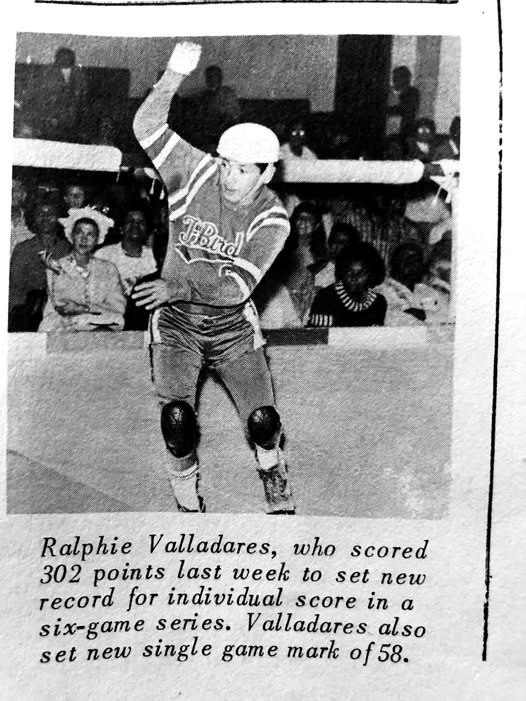
From the 1968 Roller Derby Gazette/Joseph Peters “Who’s Who in Roller Derby” Facebook page

You couldn’t help but buy into the showmanship, and pop culture value, much like an audience would with the Harlem Globetrotters or the Savannah Bananas. There was art, merit and an authentic skill set necessary.

Even kids figured that out if they tried to replicate it on the playground wearing those plastic Dodger give-away batting helmets and hand-me-down four-wheeled skates an older sister might have once worn as a dream to be a figure skater on asphalt, it took talent or else you’d be just another skid mark.

We figured out this was a bit like Three Stooges rough-house theater, cartoons come to life. The merriment of a merry-go-round full of arm whips, flying elbows and heavy pouncing, wrapped up by the theatrics of an obnoxious infield interview and folding-chair throwing, turning over tables in faux anger, was an outlet.

This thing we were captivated by on TV — and at some point, we might have had to adjust tin-foil wrapped TV antennas on the black-and-white Zenith to find the UHF station actually delivering the Sunday night video taped action between 7 and 9 p.m. — also had a scoreboard. A rudimentary graphic popped up full screen to show that what we saw was as important as an MLB or college football game.

Someone was keeping track. We counted on that, too.

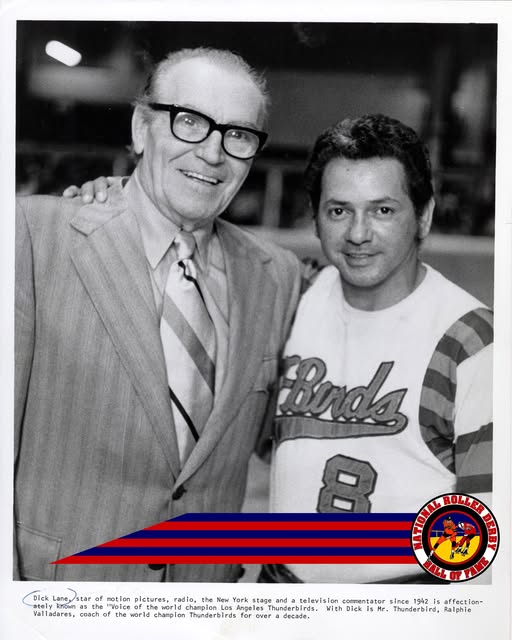
For some 50 years, Valladares played the part of player, coach and manager, spanning the 1950s to the early ’90s as the sport kept changing names and venues, something like a medicine show with Dick Lane as the Professor Harold Hill character, barking out the Richmond-9-5171 phone number to lure anyone into the otherwise sketchy Olympic Auditorium in downtrodden downtown L.A.

Lane was also the one screeching all too often: “There goes Little Ralphie Valllladarrezzzzzz on the jam!!”

That was our jam.

And while we all bought in on the statement that Valladares was the sport’s all-time leader in whatever made-up but important numbers they had created — matches played, career points, points scored in a single game, or bruises distributed — the ageless wheelman was all there for its seemingly entire sweet spot of history.

Scott Stephens, a longtime fan, one-time Roller Games skater and author of the 2019 “Rolling Thunder: The Golden Age of Roller Derby & The Rise And Fall of the L.A. T-Birds,” honestly wrote in his book: “Ralphie Valladares was the first and last T-Bird star.”

Yet none of this might have happened if Valladares had his athletic career go the way he thought it was heading. He dreamed of becoming a championship jockey riding thoroughbreds near his home at another famous oval, Hollywood Park. But something rolled him into a much different arena.

Continue reading “No. 8: Ralphie Valladares”