Day 16 of 30 baseball book reviews for 2018: A Paige-turner, without dictation

IMG_2664
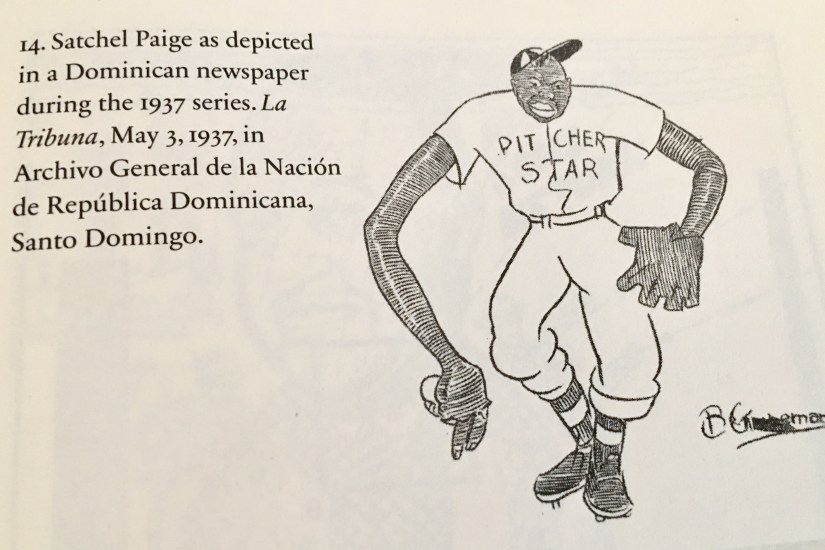
An illustration from “The Pitcher and The Dictator”

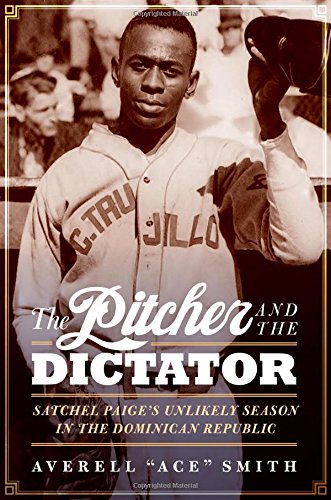
The book: “The Pitcher and the Dictator: Satchel Paige’s Unlikely Season in the Dominican Republic”
The author: Averell “Ace” Smith
How to find it: University of Nebraska Press, 240 pages, $26.95, released April 1.
The links: At Amazon.com, at the publisher’s website.
51Ix418b3ALA review in 90-feet or less: To show you where this is going, consider that last week, Amazon.com had this book listed as the No. 1 new release in “Central America History.

“This is not really a story about baseball,” writes Smith in the epilogue. “It’s a story about power. A dictator on a Caribbean island decided he needed to rent the best baseball players to win a series dedicated to his ‘reelection.’ Oddly this confluence of events brought to the small island the best championship series ever played.”

The story is beyond compelling, a world lesson on what happened in the Dominican when a tyrant named Rafael Trujillo took over, rigged the election of 1930 by having his people kill off his opponents, then decided a winning baseball team with his name splashed across the chest would convince the locals that, through victory on the field, he could get re-elected.
And somehow Satchel Paige, who accepted $30,000 to help make it happen, didn’t really know what he was getting into. He defected from the Negro Leagues to become part of this propaganda machine that eventually led to the recruitment of Josh Gibson and Cool Papa Bell. That was to offset the other local team full of stars that included Cuban pitching and hitting great Martin “El Maestro” Dihigo playing for the Aguilas Cibaenas.
There was a championship game that this all led up to.
With the Dragones de Cuidad Trujillo holding an 8-2 lead in the ninth inning, it started slipping away. Paige came in to save it — but not without dodging some bullets. Just figuratively. But he knew it could be literally.

A story that almost reads like a Richard Pryor script about a bunch of players who went to a banana republic with the promise of money and drinking abilities behind the “whites only” rope but then realized they probably were in way over their heads and realized there were guns pointed at them if they didn’t win and get the heck out of there.
Cuidad Trijillo, on the shore of the Caribbean in Santo Domingo, was daunting enough for the Americans who visited — right beyond the right-field fence was the rusting hulk of the USS Memphis, from the 1916 American invasion and now sitting there, stranded off shore, as a reminder.
Continue reading “Day 16 of 30 baseball book reviews for 2018: A Paige-turner, without dictation”
Day 15 of 30 baseball book reviews for 2018: On Jackie Robinson Day, a look at another player Branch Rickey passed on at that point in time

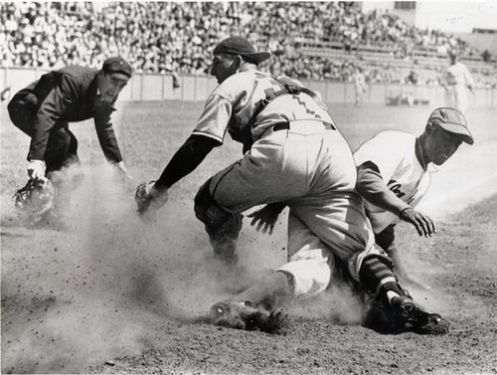
artie-wilson-of-oaks-slides-against-hollywood-stars
Artie Wilson of the PCL’s Oakland Oaks slides in safely against the Hollywood Stars. (Photo: https://90feetofperfection.com)

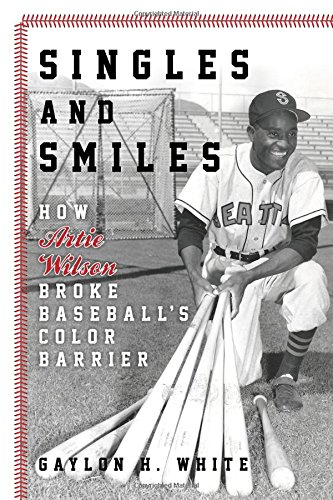
The book: “Singles and Smiles: How Artie Wilson Broke Baseball’s Color Barrier”
The author: Gaylon H. White
How to find it: Rowman & Littlefield Publishers, 270 pages, $35, released March 20
The links: At Amazon.com, at the publishers website.

51z94wUvHHLA review in 90-feet or less: Wait, wait, wait a sec … Someone named Artie Wilson did what now?
“The story of Jackie Robinson is well documented,” White writes in the preface. “But little is known about Artie and the other blacks who integrated the minors. They are mostly footnotes in baseball history, their achievements in need of resurrection and telling so they won’t be forgotten …
“After Artie put on a spectacular performance in the Negro League’s East-West All-Star Game in 1946, the Chicago Tribune reported how he always became the one chosen by Branch Rickey of the Brooklyn Dodgers to break the color barrier in Organized Baseball, or ‘white folks’ ball,’ as (Negro League star second baseman Lorenzo ‘Piper’ Davis) referred to it.
“Rickey passed Artie by and picked Jackie Robinson.”
Those last two paragraphs are on Chapter 1, page 1. So not to marginalize what Wilson did, but we’re just a bit confused by facts presented as we all seem to know versus what the book title is selling us.

Artie WilsonFact: Wilson, a singles-hitting shortstop in the New York Giants organization, did come up to the big leagues from their Oakland PCL team in 1951 at age 30. He got 24 plate appearances in 19 games — four singles, two walks and a couple of stolen bases. Three games at second base, three at shortstop and even two at first base.

And that was it. He basically gave his roster spot away to Willie Mays, over Leo Durocher’s protests.

Another truth: The site RetroSheet.org shows Wilson and Robinson on the MLB field together. One time. (This isn’t in the book).
April 20, 1951 at the Polo Grounds. In the Dodgers’ 7-3 win that Friday day game, Robinson batted cleanup at second base and went 2-for 4. Wilson came in as a pinch hitter for relief pitcher George Spencer when his spot came up in the lineup in the seventh inning, and hit a comeback to pitcher Don Newcomb.
Wilson, once signed by the Cleveland Indians in 1949 where he could have had a chance to come up under progressive owner Bill Veeck, ended up with the New York Yankees organization a few months later, and they sent him to Oakland.
Wilson would retire to Portland and live to be 90 years ago when he died in 2010.

White writes that Wilson was like Ozzie Smith with the glove and like Rod Carew or Ichiro Suzuki with the bat. White even calls him “a black version of Richie Ashburn, the sprinter-quick leadoff hitter for the Philadelphia Phillies in the 1950s.” And Wilson did it all without the tip of his right thumb, the result of a machine shop accident at a cast-iron pipe company.
“Jackie broke Major League Baseball’s color barrier with a relentless fighting spirit,” White writes again. “Artie did it in the minors with singles and smiles.”
Continue reading “Day 15 of 30 baseball book reviews for 2018: On Jackie Robinson Day, a look at another player Branch Rickey passed on at that point in time”

Hoffarth on the media: Catching up for 2018

AMSTZ IMG_1499
Linsday Amstutz, right, with girls from Mulholland Middle School as they talk about career opportunities in the sports television world.

It’s another way to locate our weekly sports columns, which for now appear in the Southern California News Group editions.
In recent weeks:
* Lindsay Amstutz, the SVP and GM of Fox Sports West/Prime Ticket and Fox Sports San Diego, takes us along for a “seed planting” trip to a middle school in her native San Fernando Valley.
* Any idea why it’s not such a great idea to have Facebook.com streaming MLB games? Take the first one for 2018, for example.
* New ESPN “Sunday Night Baseball” play-by-play Matt Vasgersian has a way of comparing this franchise to how people watch “Saturday Night Live.” … Does it match up?
* Former UCLA Final Four MVP Ed O’Bannon explains more about his new book, “Court Justice,” and his battles with the NCAA.
* How LAFC president Tom Penn put his ESPN NBA gig on hold to create a soccer narrative.
* The NBA has star power in the media world. How did it get there?
* Will you be amazed to see a Super Bowl on Amazon Prime some day? Don’t be.


Day 14 of 30 baseball book reviews for 2018: The Mick, in ’56 … just remember it for what it was

1956-135a
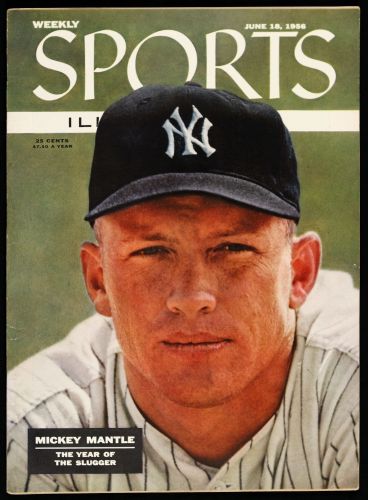
Card No. 135 from the Topps 1956 set.

The book: “A Season in the Sun: The Rise of Mickey Mantle”
The authors: Randy Roberts and Johnny Smith
How to find it: Basic Books, 304 pages, $28, released March 27.
The links: At Amazon.com, at the publishers’ website.

51PIo16uLyLA review in 90-feet or less: There was that moment in grade school when we were trying to memorize terms used for the layers of the Earth below us, and when it became apparent that baseball could help us become smarter.
At the center of the Earth was the core. Like an apple core.
At the edge of the Earth was the crust. Like bread crust.
In between all that was the mantle.
You know, like Mickey Mantle.
The Yankees’ most revered player of his generation retired in 1969 — his June 8 “Day To Remember” ceremony was on a Sunday of that year, on my 8th birthday.
Mantle didn’t call himself the luckiest man on the face of the Earth, but you knew he moved the Earth during his playing days. And we even knew as much on the West Coast.
It encouraged us to check out bios of him in the school library. 7938811120We can’t be certain, but perhaps it was “Mickey Mantle, The Indispensable Yankee,” by Dick Schaap in 1961.
Or “Mister Yankee” in 1963 by Al Silverman.
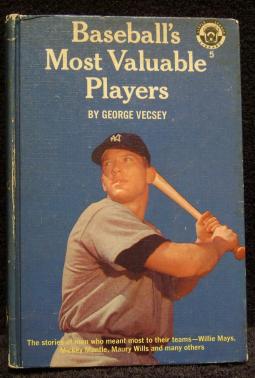
Or 1966’s “Baseball’s Most Valuable Players” by George Vecsey. They all look familiar.

During his career, he was credited with writing books. Yeah, sure. In 1964, Mantle did “The Quality of Courage,” with Robert Cremer, re-released in 1999, four years after his death.
In 1967 was another Mantle release called “The Education of a Baseball Player.
We met him in ’85 while he was touring The Mick,” with Herb Gluck. There was one more in ’94 called “All My Octobers: My Memories of Twelve World Series When the Yankees Ruled Baseball,” with Mickey Herskowitz.

In 1996, the Mantle family put out: “A Hero All His Life: Merlyn, Mickey Jr., David, and Dan Mantle : A Memoir by the Mantle Family” after he was gone. Later came, in 2002,  “Mickey Mantle: America’s Prodigal Son,” by Tony Castro. In 2007 came “7: The Mickey Mantle Novel,” by Peter Golenboch. Most recently there was Jane Leavy’s 2010 “The Last Boy: Mickey Mantle and The End of America’s Childhood,” and in 2012, the Buzz Bizinger try with “The Classic Mantle.”
And somewhere in all of that — 1991 — a Mantle-written book called “My Favorite Summer, 1956,” with Phil Pepe was there. And now it apparently needs updating.

The flashbacks to elementary school return because this book tries so hard to get us to a warm-and-fuzzy time in our lives and related it what Mantle must have felt in that ’56 season.
Give ’em credit for trying to change a narrative about Mantle’s career, since, as the authors put it, “Mantle’s biographers have emphasized his overriding weakness. Too often they have presented his life as seen darkly through a rear-view mirror, interpreting many events during his baseball career as a way station along the road to alcoholism.”
Not the books we read. At least as a kid.

20a073d5d76b30014996607897eef9a6Since his death, Mantle’s life has been couched as more a cautionary tale, behold the tragic hero.
Roberts and Smith, whose previous project in 2016 involved the “fatal friendship” of Muhammad Ali and Malcolm X called “Blood Brothers,” took it upon themselves to spend as many pages as possible reliving Mantle’s 1956 “season in the sun,” with as little influence by all the New York sportswriters who helped create the image of him only to be part of the tear-down years later.
Roberts and Smith have a stated intention — “Our story begins with three questions: How did Mickey Mantle come to be seen as a hero? Why did it happen in 1956? And what did he meant to America?”
He was 25 at the time, almost six years into his career, plucked out of Oklahoma right off Route 66.
As for the Mantle buildup, we’re cruising along and finally realize there’s something missing — the story of a then-19-year-old on a spring day in 1951 during an exhibition at USC that gave him “Wonder Boy” status. For those who aren’t familiar with it, here’s a recap. And another. In Ron Fairly’s new book, he also devotes a couple of pages to it — something that happened six years before Fairly played at USC, but was important enough to recall what he knew about it.
Here’s another brief YouTube.com clip that glosses over it.

Whether or not the story needs to be debunked, it surely needs to be addressed, but the authors don’t.
Why ’56 seems to be the year to focus on is because ’55 was pretty good as well, but something was missing. The Yankees lost to the Brooklyn Dodgers in the World Series, bu Mantle led the AL with a .306 average, 37 homers and in on-base percentage, and he was fifth in the MVP voting behind teammate Yogi Berra. Yankees assistant GM Bill DeWitt advised Mantle to be more media-friendly and “rehabilitate his image” by not brushing off newspapermen. He listened.

Continue reading “Day 14 of 30 baseball book reviews for 2018: The Mick, in ’56 … just remember it for what it was”

Day 13 of 30 baseball book reviews for 2018: All them Goliath achievements we must have overlooked concerning Davey Johnson

14403e_lg
Who can argue Davey Johnson’s qualifications for the Baseball Hall of Fame? He can, for starters.

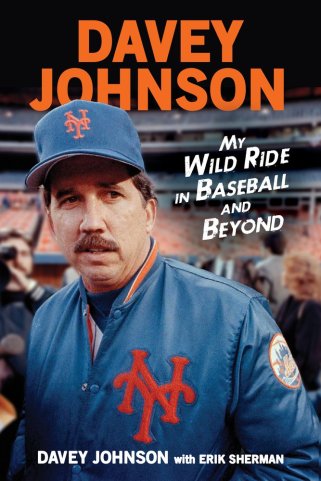
The book: “Davey Johnson: My Wild Ride in Baseball and Beyond”
The author: Davey Johnson with Erik Sherman
How to find it: Triumph Books, 384 pages, $26.95, to be released May 15 but in stock at Amazon.com
The links: At Amazon.com, at the publishers website.

719Hqboz-BLA review in 90-feet or less: How to manage a Baseball Hall of Fame write-in campaign, from the “Write A Book” division.
But first, one must admit a red flag is sent up when you have to start creating an argument to justify how someone — let’s take Davey Johnson — seems to have been passed over for the honor based on his managerial career achievements and stats.
Lately, new metrics have been introduced to push the re-thinking of players’ body of work.
(Heck, we even have Johnny Damon now set for “Dancing With the Stars” to boost his profile … or damage it?)
Biases also come into play. We have to make sure we didn’t miss something.
Three-hundred and eighty-four questionable pages later here, we’re still not sure if he belongs in.
But now we surely know what Johnson thinks.
“I don’t know of any manager who was as special as I was who kept getting the ax,” he writes in the preface. “All I ever did was successfully increase the value of the assets of any ballclub I ever worked for. … But I guess that’s why I’m doing this book, too. It’s all kind of weird, but also pretty interesting.”
Maybe. Continue reading “Day 13 of 30 baseball book reviews for 2018: All them Goliath achievements we must have overlooked concerning Davey Johnson”