No. 69: Chase de Leo

This is the latest post for an ongoing media project — SoCal Sports History 101: The Prime Numbers from 00 to 99 that Uniformly, Uniquely and Unapologetically Reveal The Narrative of Our Region’s Athletic Heritage.  Pick a number and highlight an athlete — person, place or thing — most obviously connected to it by fame and fortune, someone who isn’t so obvious, and then take a deeper dive into the most interesting story tied to it. It’s a combination of star power, achievement, longevity, notoriety, and, above all, what makes that athlete so Southern California. Quirkiness and notoriety factor in. And it should open itself to more discussion and debate — which is what sports is best at doing.

The most obvious choices for No. 69:

= Sebastian Joseph-Day, Los Angeles Rams and Los Angeles Chargers

The not-so-obvious choices for No. 69:

= Chase De Leo, Anaheim Ducks
= Al Barry, Los Angeles Chargers (via USC)

The most interesting story for No. 69:
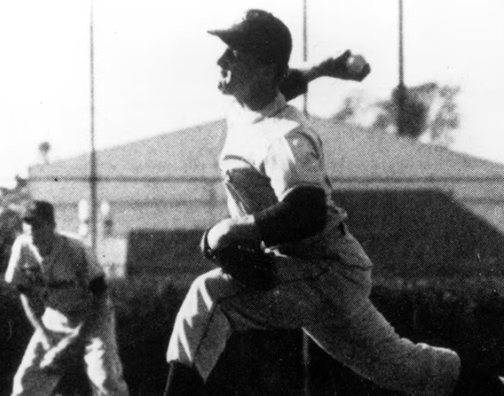
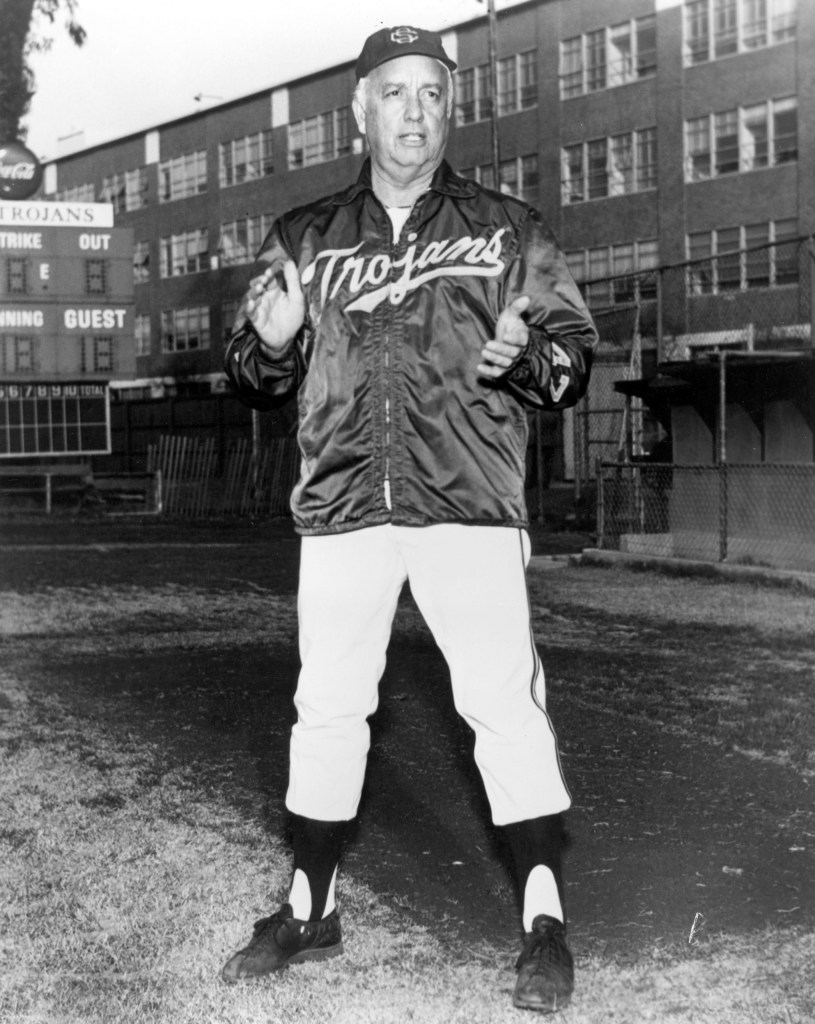
Chase De Leo, Anaheim Ducks center (2023-24)
Southern California map pinpoints:
La Mirada, Norwalk, Whittier, Anaheim


The preamble

Jerry Seinfeld has a rooting interest in the bizarro ways a fan will root for his or her favorite team.

His own fandom not withstanding aligned with the teams of New York — especially the Mets — Seinfield famously has a bit in the evolution of his his comedy career that covers all the bases when it comes to people who are essentially just “rooting for laundry.”

In his 2020 book “Is This Anything?”, which clears out his joke files to examine the evolution of material, that one is covered. So it an observation he once made about the time in our existence when, before caller ID became a thing, we had to punch in *69 — called Star-69 — if we were curious about who just rang us up and we somehow missed it.

Seinfeld’s riff:

“I thought it was a little hostile to the calling party. Someone calls. They hang up. You hit that *69. ‘Nice try, creep. Oh, I know all about your little call. …’

“And 69?

That’s the number they pick for this thing?

So that means there isn’t one person at the phone company that went to junior high school? How did that slip through an entire organization?

“If you worked at the phone company, and you heard they were doing this … wouldn’t you walk into the meeting and go, ’69? Are you kidding me? That’s the number you guys came up for the new feature? What the hell is going on here?’

“ ‘We’re the phone company. We can pick any number we want. 68. 70.’

” ‘I can’t wait to hear what you got for 3-Way Calling’.”

In the grand scheme of everything, what does 69 have to do with anything? It’s a callback to immature double entendre. The ding-dong-ditch statement of a world where “Beavis and Butthead” exist. We’d argue that some can only think of it as a single entendre.

Especially outside the ying/yang conundrum, how does it, or not, fit into a non-sexual connotation in sports?

In the entire history of Southern California sports, only a handful of athletes have dared to wear No. 69. You figure many have asked for it. They just didn’t get it. On several levels.
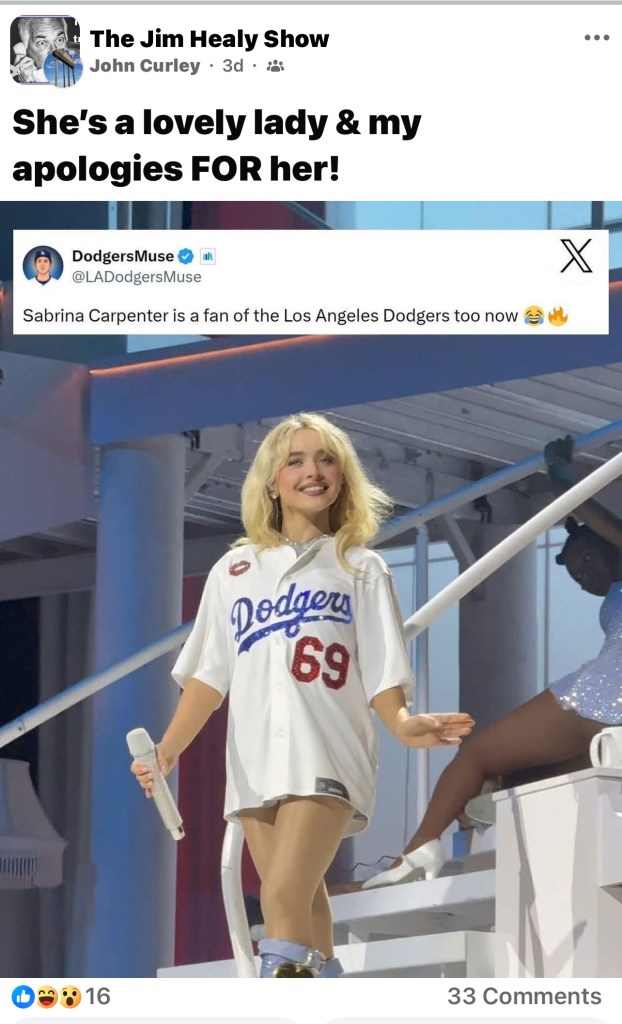
Some may have pulled it off better than others, but in sports, there’s no real star No. 69. It’s more an asterisk. Who’s trying to be the biggest asshat?

Maybe it’s just a call-back to the days we finally stopped using a rotary phone and embraced the push-button technology. To access a voice message. To try to win tickets on a radio station. To try to create a song with the new techno tones.

Continue reading “No. 69: Chase de Leo”
No. 63: Jim Brown

This is the latest post for an ongoing media project — SoCal Sports History 101: The Prime Numbers from 00 to 99 that Uniformly, Uniquely and Unapologetically Reveal The Narrative of Our Region’s Athletic Heritage.  Pick a number and highlight an athlete — person, place or thing — most obviously connected to it by fame and fortune, someone who isn’t so obvious, and then take a deeper dive into the most interesting story tied to it. It’s a combination of star power, achievement, longevity, notoriety, and, above all, what makes that athlete so Southern California. Quirkiness and notoriety factor in. And it should open itself to more discussion and debate — which is what sports is best at doing.

The most obvious choices for No. 63:

= Booker Brown, USC football
= Joe Carollo, Los Angeles Rams
= Jim Brown, UCLA football

The not-so-obvious choices for No. 63:

= Mike McDonald, Los Angeles Rams
= Greg Horton, Los Angeles Rams
= Corey Linsley, Los Angeles Chargers

The most interesting story for No. 63:
Jim Brown, UCLA football offensive lineman via L.A. Loyola High (1954 to 1955)
Southern California map pinpoints:
Los Angeles, Westwood, Glendale


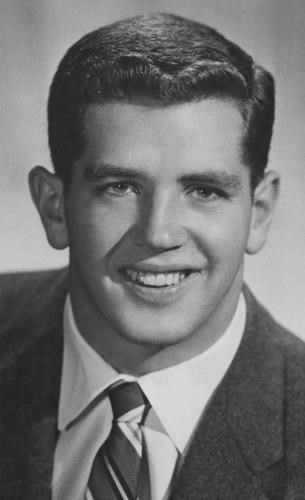
Jim Brown helped make history, perhaps by accident, or by good fortune, as part of UCLA’s most unique 1954 national championship football team.

Decades later, Brown tackled an idea on how to preserve the team’s history, for the good fortune of those who came decades later.

A 6-foot, 204-pound right guard on an explosive line that paved the way for coach Red Sanders’ Single-Wing offense, Brown capped off a two-year run with the Bruins as an All-American in 1955. The teams he was on during his time went 18-2 and won two Pacific Coast Conference titles.

Sanders once referred to Brown as “one of the best football players we have had at UCLA. He has never played a poor game. As an all-around guard, he doesn’t back up from anyone. I haven’t seen anyone whip him yet across the scrimmage line. … In addition, you’ve never heard (Brown) complain or alibi or explain. He just goes out and gives his team the best he has.”

When Brown was inducted into the UCLA Athletic Hall of Fame in 2001, it was noted that he also played rugby for the Bruins and was part of its ROTC program. Instead of signing with the NFL’s Chicago Cardinals, who drafted him in 1956, Brown went to the U.S. Army and became commissioned as a Second Lieutenant.

When Brown died at his home in Glendale in 2022 at age 87, survived by his wife of 66 years, Merrilyn, who was a UCLA song girl when they married in 1956, he took pride in having five children, 12 grandchildren and two great-grandchildren.

Brown left not just his own life story, but those of his teammates from that Bruin era.

Continue reading “No. 63: Jim Brown”

No. 35: Petros Papadakis

This is the latest post for an ongoing media project — SoCal Sports History 101: The Prime Numbers from 00 to 99 that Uniformly, Uniquely and Unapologetically Reveal The Narrative of Our Region’s Athletic Heritage.  Pick a number and highlight an athlete — person, place or thing — most obviously connected to it by fame and fortune, someone who isn’t so obvious, and then take a deeper dive into the most interesting story tied to it. It’s a combination of star power, achievement, longevity, notoriety, and, above all, what makes that athlete so Southern California. Quirkiness and notoriety factor in. And it should open itself to more discussion and debate — which is what sports is best at doing.

The most obvious choices for No. 35:

= Sidney Wicks, UCLA basketball
= Bob Welch, Los Angeles Dodgers
= Cody Bellinger, Los Angeles Dodgers
= Jean-Sebastien Giguere, Anaheim Mighty Ducks
= Christian Okoye, Azusa Pacific College football

The not-so-obvious choices for No. 35:

= Tank Younger, Los Angeles Rams
= Loy Vaught, Los Angeles Clippers
= Rudy LaRusso, Los Angeles Lakers
= Ron Settles, Long Beach State football

The most interesting story for No. 35:
Petros Papadakis, USC football tailback (1996  to 2000)
Southern California map pinpoints:
San Pedro, Palos Verdes, Hollywood, Los Angeles (Coliseum, Sports Arena)


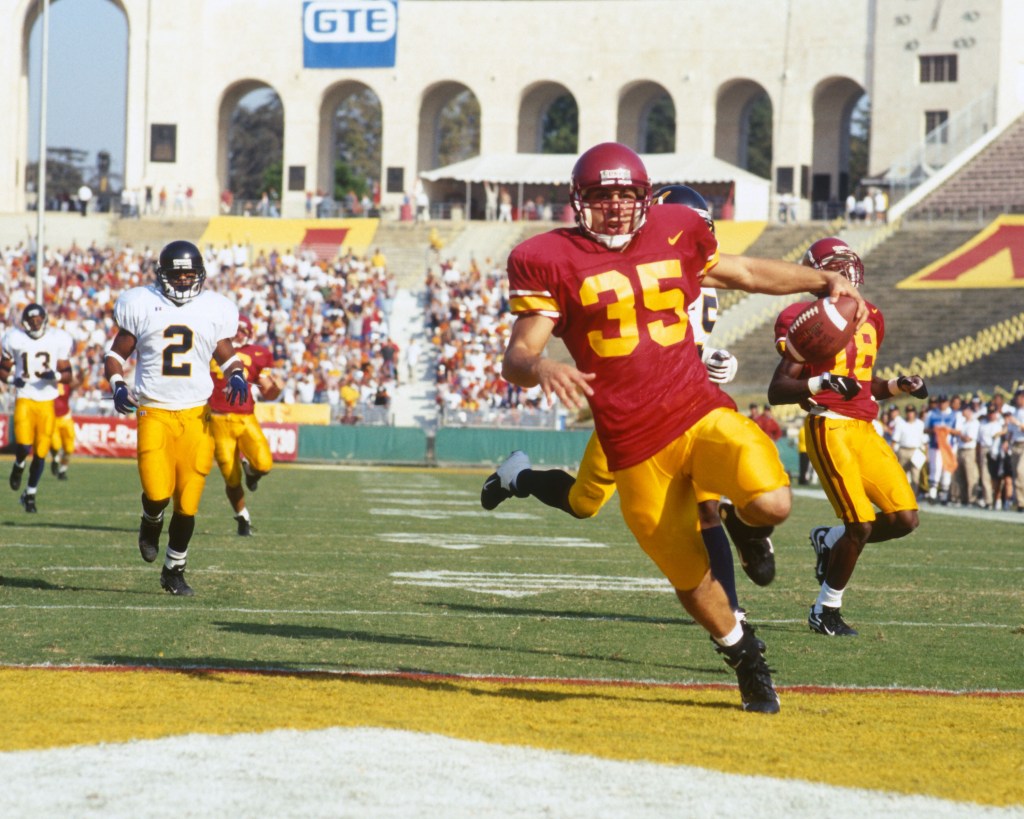
Oct. 15, 1998: On USC’s third play from scrimmage in the first quarter, Trojans junior tailback Petros Papadakis finishes off a 65-yard touchdown run against Cal at the Coliseum (top, and below). Papadakis had 13 carries for 158 yards in his greatest statistical performance of his USC career in a 32-31 Week 6 loss. (Photos by Jon Soohoo/USC)

Any sort of perfunctory profile of Petros Papadakis becomes the proverbial Sisyphean pursuit. Hopefully we don’t have to Greek-splain too much here.

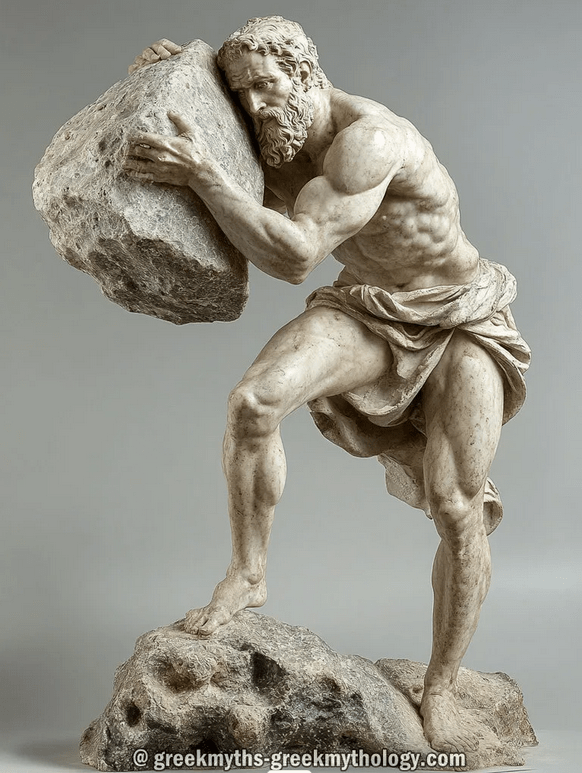
Sisyphus, the first king of Ephyra, found his eternal fate in Hades rolling a huge boulder endlessly up a hill, only to see it come back down at him. Every time he made progress and got on a roll, it reversed on him like a Looney Tunes cartoon. The whole thing seemed so Kafkaesque that French philosopher Albert Camus, writing “The Myth of Sisyphus” in 1942, elevated him to some absurd hero status in Greek mythology.

Something that Papadakis might find relatable.

When Papadakis gets on his own a roll, cutting it up on KLAC-AM (570)’s afternoon sports-talk drive-time “Petros and Money Show,” there is far less sports and much more drive to just being a voice for “la raza.” It’s a focus on a feeling of being in “la ciudad” with Papadakis, as familiar as he is bombastic, just the person in the passenger seat making observational conversation to it real.

He is part of USC football legacy, a linage of Cardinal and Gold athletes whose performance has been documented in Los Angeles’ grand Coliseum. Papadakis’ work ethic formed at his family’s famously iconic San Pedro Taverna, as he went from dishwasher to waiter to spending all his earnings for the night back on his guests to make sure they went home happy.

Maybe Papadakis became an accidental broadcaster, but it’s a career that likely defines him as much if not more than anything else. Once a Trojan workhorse in the USC backfield, he is the sometimes-hoarse former Trojan on the dashboard radio. A Red Bull in a china shop of hot topics. The connoisseurs of SoCal sports who enjoy conquering as much as consuming any kind of history lesson are better for it.

Fox Sports’ Petros Papadakis, left, with USC head football coach Lane Kiffin in 2011.

Back to the profile: Papadakis has provided quips along the way to make his story even more cohesive:

Continue reading “No. 35: Petros Papadakis”

No. 46: Juan Marichal (with John Roseboro)

This is the latest post for an ongoing media project — SoCal Sports History 101: The Prime Numbers from 00 to 99 that Uniformly, Uniquely and Unapologetically Reveal The Narrative of Our Region’s Athletic Heritage.  Pick a number and highlight an athlete — person, place or thing — most obviously connected to it by fame and fortune, someone who isn’t so obvious, and then take a deeper dive into the most interesting story tied to it. It’s a combination of star power, achievement, longevity, notoriety, and, above all, what makes that athlete so Southern California. Quirkiness and notoriety factor in. And it should open itself to more discussion and debate — which is what sports is best at doing.

The most obvious choices for No. 46:

= Burt Hooten: Los Angeles Dodgers
= Todd Christensen: Los Angeles Raiders

The not-so-obvious choices for No. 46:

= Don Aase: California Angels
= Dan Petry: California Angels

The most interesting story for No. 46:
Juan Marichal, Los Angeles Dodgers pitcher (1975)

Southern California map pinpoints:
Dodger Stadium


Juan Marichal’s matriarchal Hall of Fame plaque in Cooperstown seems to have one dandy of a typo.

After all he accomplished for the San Francisco Giants in a 16-year MLB life, the last line of his career ledger reads: “Los Angeles N.L., 1975”

It’s because that actually happened.

What a kicker to a spiteful spit take.

When The Associated Press posted a story prior to the 1975 season, explaining how the nastiest of the rival Giants had accepted a one-year, $60,000 contract with the intent of actually trying to help the Dodgers win games, the lede read: “Baseball, like politics, apparently makes strange bedfellows.”

The Los Angeles Times’ Jim Murray launched into a column a week later: “There’s a new game in town today. It begins, ‘Juan Marichal, playing for the Dodgers, is like …’ And you supply your own punch line.” Murray’s suggestions: “King Faisal at a bar mitzvah … like Brezhnev at a White House prayer meeting … In the view of most Dodger fans, Juan Marichal belongs in the Nuremberg trials, not in Dodger Blue.”

At the Long Beach Press-Telegram, columnist Bud Tucker lamented: “It wouldn’t matter if the guy could win 25 games. Adolph Hitler is Adolph Hitler and Juan Marichal is Juan Marichal.”

A month earlier, Herald-Examiner columnist Melvin Durslag had written: “If all the Dodger hitters that Marichal has put in the dirt were laid end-to-end, they would stretch from Chavez Ravine to Santo Domingo.”

Marichal’s decades-long existence as L.A.’s Public Enemy No. 1 all goes back to one of the most abhorrent incidents in the Dodgers-Giants historic and on-going rivalry.

A now hard-to-find book published in 1964 about the history of this series by Lee Allen called “The Giants & The Dodgers: The Fabulous Story of Baseball’s Fiercest Feud” a cover illustration shows a Brooklyn Bum going after a Giant with a baseball bat. Marichal flipped that script, and was forever linked with John Roseboro, the Dodgers’ catcher, during a game at Candlestick Park in 1965. There is far more context and social significance to what happened that day.

Somehow, Marichal and Roseboro turned it into a story of forgiveness, friendship and the foundation of what sports can do to heal all wounds.


Continue reading “No. 46: Juan Marichal (with John Roseboro)”

No. 37: Tom Seaver

This is the latest post for an ongoing media project — SoCal Sports History 101: The Prime Numbers from 00 to 99 that Uniformly, Uniquely and Unapologetically Reveal The Narrative of Our Region’s Athletic Heritage.  Pick a number and highlight an athlete — person, place or thing — most obviously connected to it by fame and fortune, someone who isn’t so obvious, and then take a deeper dive into the most interesting story tied to it. It’s a combination of star power, achievement, longevity, notoriety, and, above all, what makes that athlete so Southern California. Quirkiness and notoriety factor in. And it should open itself to more discussion and debate — which is what sports is best at doing.

The most obvious choices for No. 37:

= Donnie Moore: California Angels
= Lester Hayes: Los Angeles Raiders
= Ron Artest/Metta World Peace: Los Angeles Lakers

The not-so-obvious choices for No. 37:

= Kermit Johnson, UCLA football
= Bobby Castillo: Los Angeles Dodgers
= Ron Washington: Los Angeles Angels manager
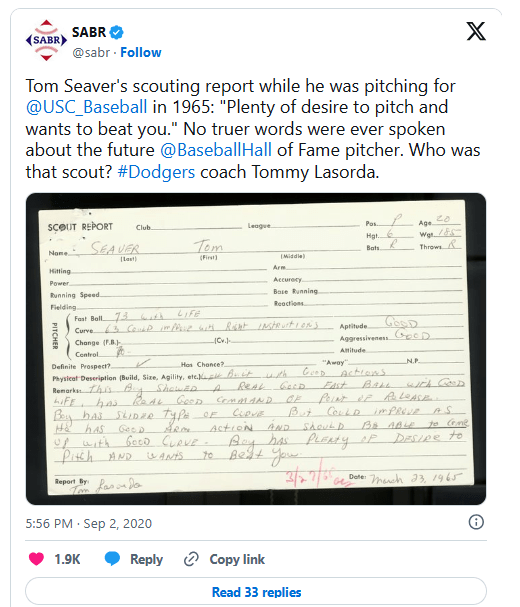
= Tom Seaver: USC baseball

The most interesting story for No. 37:
Tom Seaver: USC baseball pitcher (1965)
Southern California map pinpoints:
Los Angeles (USC), Manhattan Beach, Twentynine Palms


Tom Seaver was a stellar bridge player.

Bridge can be a tricky game. The trick is to gather the least the number of tricks bid by the partnership at the four-person table. The rules seem simple, but mastering the strategy and complexity of it all takes time and practice. Intelligence and patience are rewarded.

During his brief time as a USC student — a pre-denistry major, because he sensed he might need a fallback career — Seaver sometimes could be found with friends hanging out at the 901 Club on Jefferson Blvd., famous for its hamburgers and beer.

And bridge building, when he was there.

In the abridged version of how Seaver went from college baseball to a pro career, there should have been a simple bridge there for him to cross from USC to the Los Angeles Dodgers’ stellar starting rotation of the 1960s.

Instead, there was a toll to pay, and the Dodgers balked.

That’s where Seaver’s poker face came into play. A fantastic 2020 book by acclaimed author and former minor leaguer Pat Jordan revealed how deep a Seaver was. But when it came to his MLB future, Seaver wasn’t bluffing on contract demands. Eventually, both the Dodges and USC lost out.

As the Vietnam War started in 1962, Seaver wasn’t keen on being drafted out of Fresno High, where he just finished his senior baseball season with a 6-5 record but made the Fresno Bee All-City team. Still, he had no pro offers, nor any college interest.

So Seaver enlisted in the U.S. Marine Corps Reserves in 1962 and ’63, with bootcamp at Twentynine Palms. He realized eventually the extra weight and strength he gained in that training allowed him to eventually throw a more effective fastball and slider.

His roadmap to the bigs started with one season at Fresno City College as a freshman, then earning a scholarship to play at USC, the perennial NCAA title team under coach Rod Dedeaux (see SoCal Sports History 101 bio for No. 1).

After Seaver posted an 11-2 mark at Fresno City, the Dodgers were interested. But not more than $2,000 interested. Maybe it was $3,000. That was their reportedly their offer in 1964, the last time MLB teams would have the freedom to sign whomever they wanted before the draft kicked in.

Seaver declined the Dodgers’ gesture and went panning for gold elsewhere.

Dedeaux, who called Seaver the “phee-nom from San Joaquin,” agreed to give him one of his five USC baseball full scholarships — if Seaver first played in Alaska summer ball in ’64. Dedeaux worked out a deal for Seaver to pitch for the Alaska Goldpanners of the Alaska Baseball League, which showcased college talent. The 19-year-old experienced his first Midnight Sun Game in Anchorage — the 10:30 p.m. start on June 21 for the summer solstice that has become part of baseball lore.

In 19 games, starting five, Seaver was 6-2 with a save and 4.70 ERA to go with 70 strike outs in 58 2/3 innings. Later that summer, playing in an National Baseball Congress World Series in Wichita, Kansas, Seaver, now with the Wichita Glassmen, hit a grand slam in a game where he had been called in as a relief pitcher. Seaver would say that was one of his career highlights.

At USC, Dedeaux slotted Seaver as the Trojans’ No. 3 starter – also on the staff was junior Bob Selleck, the 6-foot-6 older brother of eventual USC basketball, baseball and volleyball player and actor Tom Selleck.

Continue reading “No. 37: Tom Seaver”