
This post is part of a media project called SoCal Sports History 101: The Prime Numbers from 00 to 99 that Uniformly, Uniquely and Unapologetically Reveal The Narrative of Our Region’s Athletic Heritage. Pick a number, and consider the list of athletes attached to it. Who wore it best? Or, what’s the most compelling story linked to it? Any person, place or thing is in play with Southern California connections. Star power, transformational achievement, longevity, notoriety and quirkiness all factor in. Whatever leads to a lively discussion and interpretation.
The most obvious choices for No. 37:

Donnie Moore: California Angels
Lester Hayes: Los Angeles Raiders
Ron Artest/Metta World Peace: Los Angeles Lakers
Kermit Johnson: UCLA football, Southern California Sun, out of Blair High of Pasadena
The not-so-obvious choices for No. 37:
Bobby Castillo: Los Angeles Dodgers
Ron Washington: Los Angeles Angels manager
Tom Seaver: USC baseball
Ken McBride: Los Angeles Angels
The most interesting story for No. 37:
Tom Seaver: USC baseball pitcher (1965)
Southern California map pinpoints:
Twentynine Palms, Los Angeles (USC), Manhattan Beach
Reference books on the subject:
“Tom Seaver: A Terrific Live,” by Bill Madden, 2020
“Tom Seaver and Me,” by Pat Jordan, 2020
“Baseball Is My Life,” by Tom Seaver with Steve Jacobson, 1973
“Pitching With Tom Seaver,” by Tom Seaver with Steve Jacobson, 1973
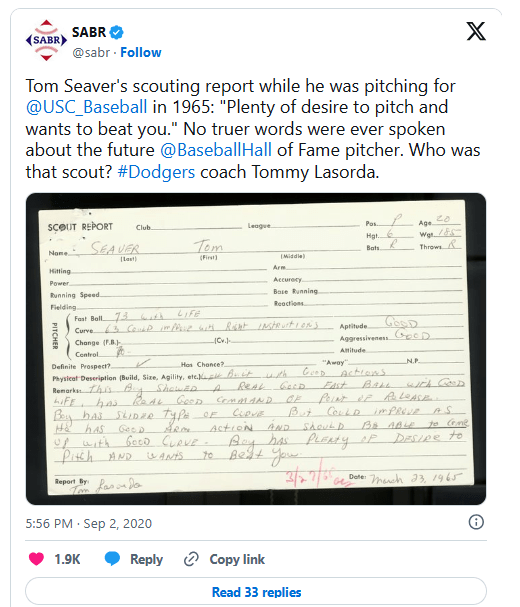
Tom Seaver was a stellar bridge player. And bridge can be a tricky card game.
The trick is to gather the fewest the number of tricks bid by those playing together as partners at a four-person table. The rules seem simple, but mastering the strategy and complexity takes time. Intelligence and patience are rewarded.
That’s Tom Seaver, USC student.
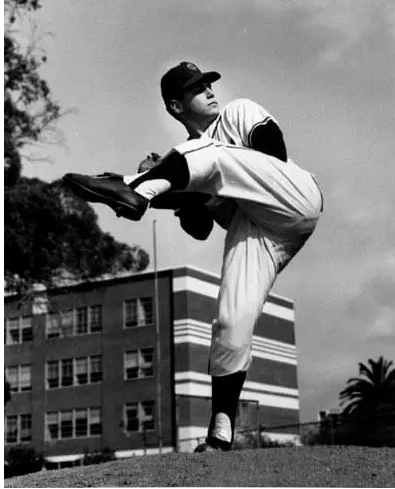
As pre-denistry major — he sensed he might need a fallback career — Seaver often found himself with a group of friends at the popular 901 Club on Jefferson Blvd., famous for its hamburgers and beer. It’s been called the “9-0” since the late 1940s.
This gave Seaver a place to bridge build a career as a deep thinker.
In the abridged version of how Seaver slithered his way out of USC, could have build a bridge to becoming a Los Angeles Dodger, but crafted a Hall of Fame career as a player elsewhere speaks more to his way of playing cards close to the uniform.
A fantastic 2020 book by acclaimed author and former minor leaguer Pat Jordan reveals how Seaver knew and believed in himself enough to where he didn’t bluff when it came to his own contract demands. His poker face worked.
Because of that, both USC and the Dodgers lost.

Tom Seaver was already concerned about where he future would take him when the Vietnam War came onto his radar in 1962.
He wasn’t keen on being drafted for the military out of Fresno High, where he just finished his senior baseball season with a modest 6-5 record, making the Fresno Bee All-City team. There were no pro offers to field. No college interest.
Seaver’s idea to instead enlist in the U.S. Marine Corps Reserves in 1962 and ’63 led to bootcamp at Twentynine Palms, in the heart of Mojave Desert. He had to gain extra weight and strength. As it turned out, that would help him throw a more effective fastball and slider.
“The best thing that happened to me was a strenuous summer job in which I had to lift heavy crates that brought raisins in from the fields,” he explained in his 1973 book, “Pitching with Tom Seaver.” “A machine emptied the raisins but somebody had to get the empty boxes off and they were heavy. They were called ‘sweat boxes,’ which was exactly right. I was actually smaller than almost everybody in high school but that job and the six months I spent in the Marine Corps build up my whole body.”
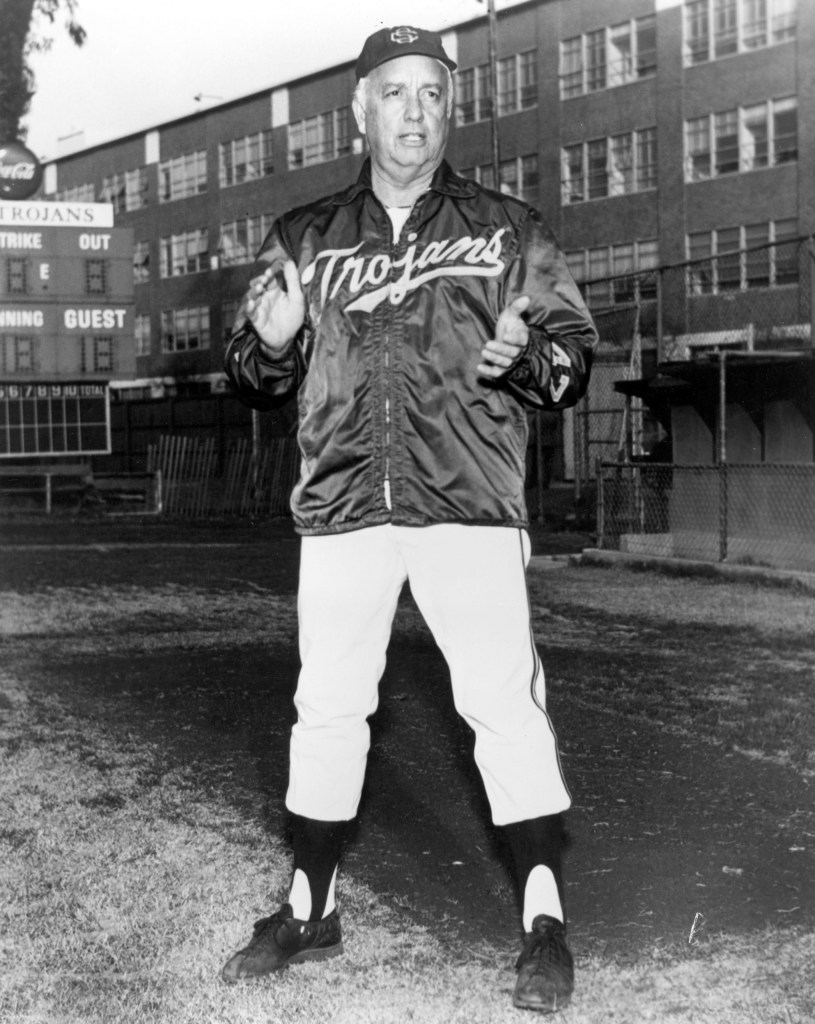
Seaver pitched one freshman season at Fresno City College and sported an 11-2 record. USC, the perennial NCAA title team under Rod Dedeaux (see SoCal Sports History 101 bio for No. 1), led to the coach calling Seaver the “phee-nom from San Joaquin.”
The Dodgers’ interests might have got in the way, too. Reports vary, but they were said to be ready to give Seaver a $2,000 deal — maybe $3,000 — in 1964. This would be the final year before the MLB Draft and teams were free to negotiate at will.
Seaver declined. He went panning for gold elsewhere.
Dedeaux’s deal was to give him one of his USC baseball full scholarships if he first pitched in Alaska Summer League of ’64. Dedeaux worked out a deal for Seaver to join the Alaska Goldpanners. Seaver, then 19, experienced his first Midnight Sun Game in Anchorage — the 10:30 p.m. start on June 21 for the summer solstice that has become part of baseball lore.
In 19 games, with five starts, Seaver struck out 70 in 58 2/3 innings, posting a 6-2 mark with one save and 4.70 ERA. Later that summer, he played for the Wichita Glassmen in the National Baseball Congress World Series in Wichita, Kansas. That’s when he hit a grand slam in a game where he had been called in as a relief pitcher. Seaver called it one of his baseball career highlights.
USC had Seaver slotted as its No. 3 starter on a staff that included junior Bob Selleck, the 6-foot-6 older brother of eventual USC basketball, baseball and volleyball player (and actor) Tom Selleck (see Selleck’s bio for No. 42).
When USC started practices in March of ’65, it was said that some of Seaver’s teammates suggested he start lifting weights to increase his upper body strength, which matched up to his already impressive leg mechanics. That was said to be the starting point of Seaver’s ultra-effective drop-and-drive delivery. His fastball went up from 85 mph to the mid-90s in that time.
Continue reading “No. 37: Tom Seaver (and Bill Bordley)”