
“The Ballpark and Beyond:
An Illustrated Celebration of
Baseball’s Rich History”
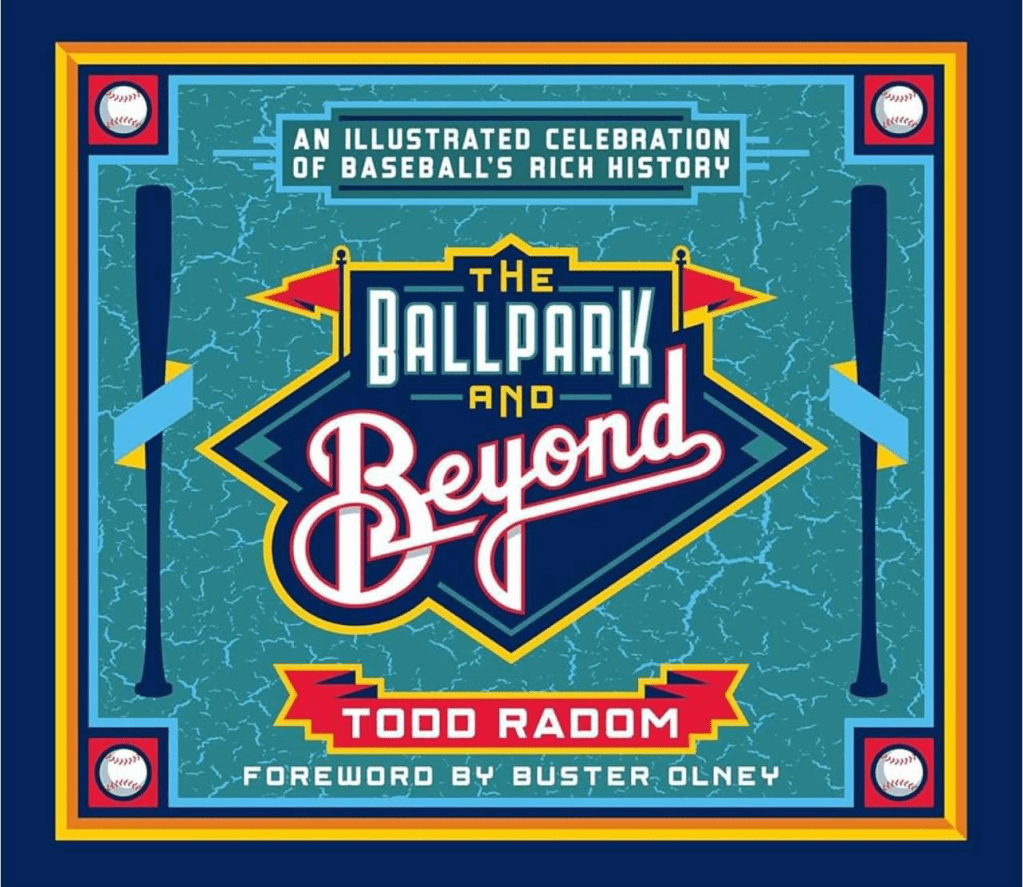
The author: Todd Radom
The details: Sports Publishing/Skyhorse/Simon & Schuster, 248 pages, $29.99, to be released May 26, ’26
The links: The publisher, the author, Bookshop.org
A review in 90 feet or less:
So, whatta you think about the newest Geffen Playhouse?
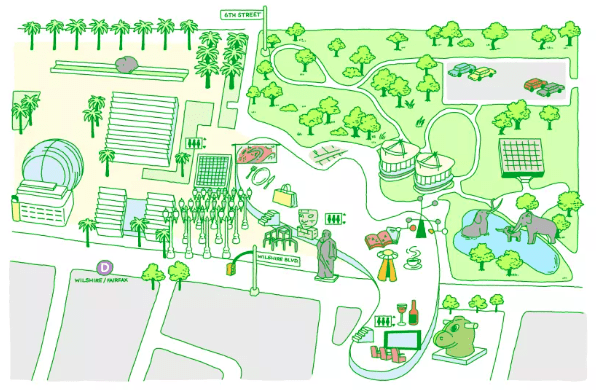
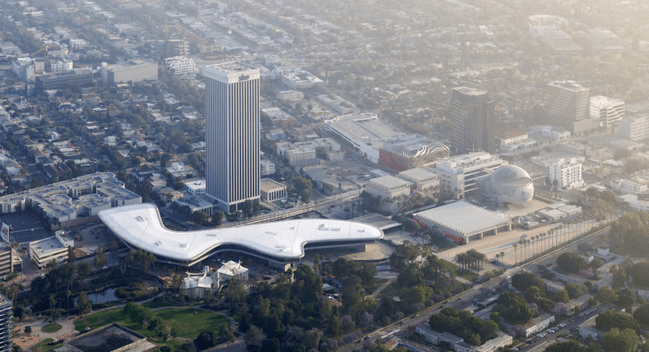
That’s our playful referencing of the Los Angeles County Museum of Art’s new $724 million addition, the Geffen Galleries, opened to the public as of May 4. It took 20 years of planning and six years of construction. It took going back to the drawing board, a lot of patience and persistence, and a city’s open-mindedness to add something this miraculous on the Miracle Mile.
A rule-bending, disorienting design brings us:
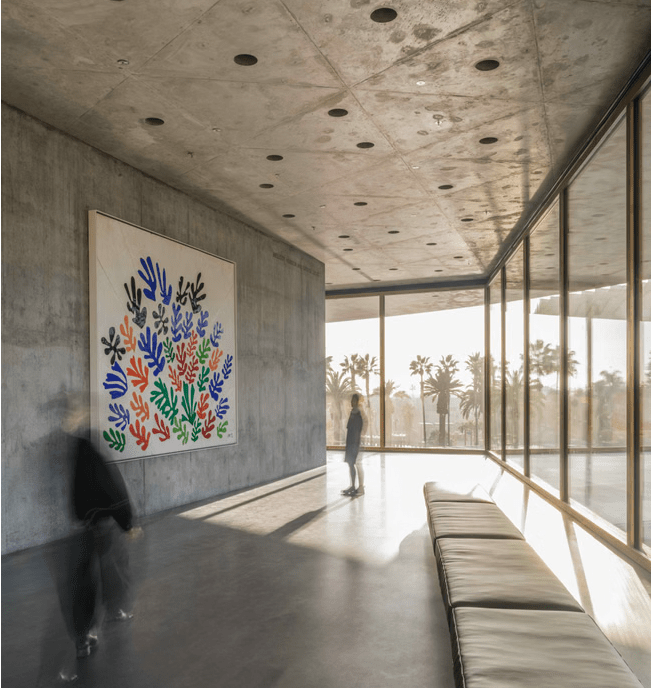
== A Peter Zumthor creation that’s been compared to a “concrete blob.” And a “concrete sandwich.” And a “concrete cow-paddy.” And a “concrete amoeba.” One even went so far as to call it “The Great Los Angeles Turd.” The New York Times called it “uplifting, lyrical and pugnacious.” The Wall Street Journal called it “a work of furious originality and ambition.”
== Counter-initiative floor-to-ceiling windows to draw in all the “urban light,” but if you’re really having a moody day, just draw the metal curtains.
== Cold, and cool, dungeon-like rooms to display an eclectic arrangement spanning Van Gogh to Ansel Adams to Diego Rivera among its 2,000 pieces, with far more awaiting in storage.
== A scrumptious 30-foot-span pedestrian overpass bridging Wilshire Boulevard, which might seem unnecessary until you park yourself on one of the benches and feel levitated over the mindless Door Dash traffic flow below.
== Its own Erewhon cafe. Drink, presented in art form. So why not?
If one dares to call it polarizing, another insists it’s a “petri dish for experimental design.” And, oh the social media photo ops. TimeOut Los Angeles has put in the time to offer the 10-most photogenic things to see, as you angle to get a litter of tar-soaked Saber-Toothed Cats in the background with the proper aperture. Bravo, Pleistocene megafauna.
Don’t spin your wheels here on Superlative Alley. Cruise through if you’re over in that part of the freeway-free grid. Because, as you may know, art always brings serendipitous joy and rhythm to one’s spirits, especially if you’re experiencing May Gray, heading into June Gloom.
Raise the bar, too, when art is mashed up with anything sporty.
Not to paint ourselves into a divergent corner here, but …
I was stumped for ways to size up the latest amazing graphic art-meets-well-researched story presentation that Todd Radom has created and, seeking enlightenment and inspiration, I took an artistic side trip. I decided to contact him directly and flip this on him for a moment of glee.
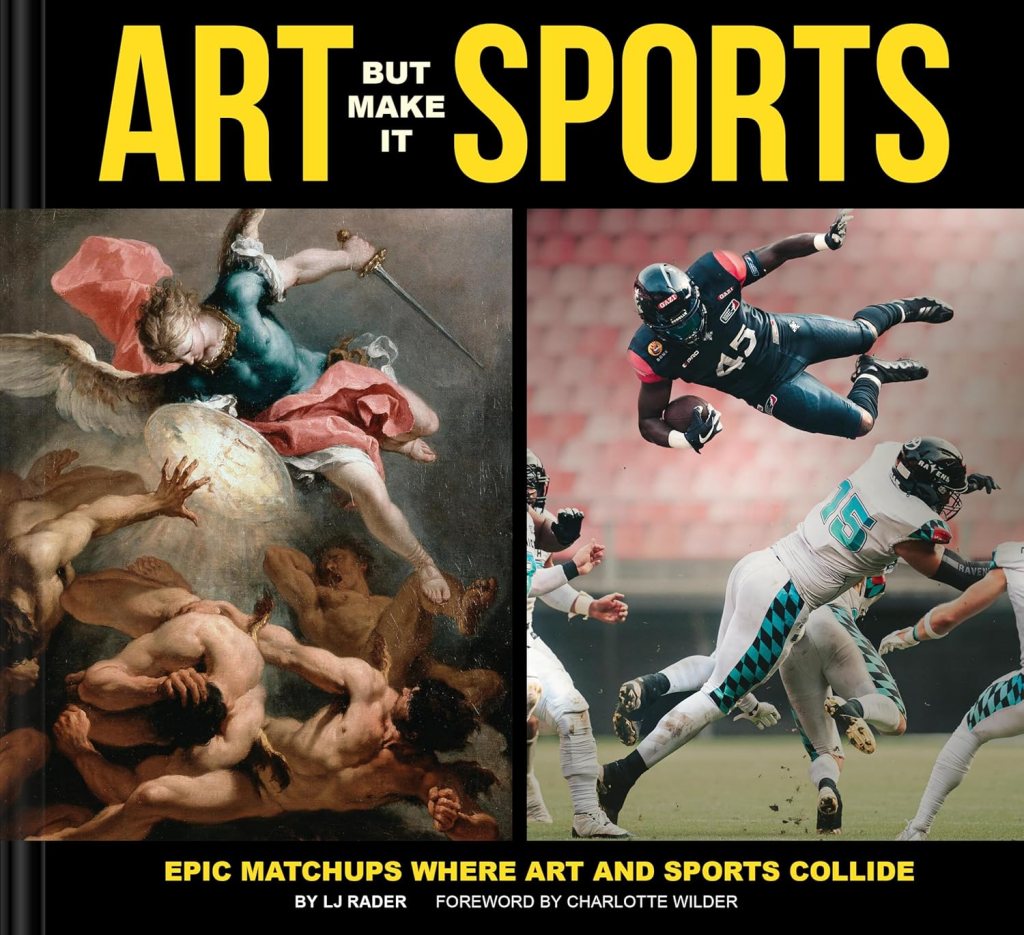
During an email exchange, I asked Radom if he had seen the new collection of published work by LJ Rader called “Art But Make it Sports: Where Art and Sports Collide” (Chronicle Books, 176 pages, $18.95, released March 16, ’26.) This book is deserving, perhaps, of its own review amidst these new baseball books. But I wanted Radom’s take on it first.
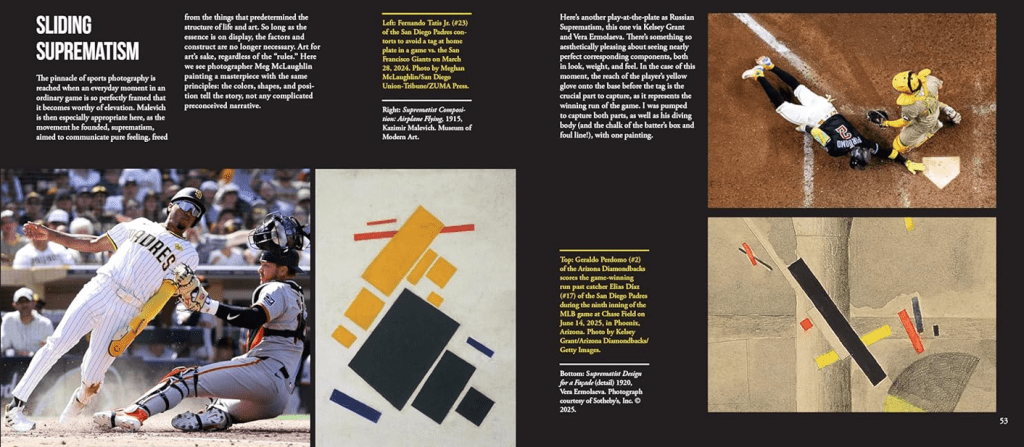
“LJ Rader is brilliant — the guy is a genius, seriously,” Radom said. “I took art history classes in college and I’m married to a trained art historian, but his photographic memory and knowledge of art is striking, funny, and unique.”
Radam said he first connected with Radar on social media “when I conflated the Astros’ World Series scandal and The Ashcan School, the early 20th century art movement that depicted urban scenes with dark, gritty realism. I think ‘Art But Make it Sports’ is the only forum where you can include ‘ashcan’ and ‘trash can’ and connect artist John Sloan to the 2017 Astros.”
What Radam appreciates most about Rader is how he has “a unique brain. A layman who is interested in art and has the ability to retain shapes, colors, composition … all toward fun! We need more of that!”
So while that may seem like the perfect endorsement for Rader when his book goes to paperback — but, resist if possible — it’s also interesting to us that a review of “Art But Make It Sports” in the New York Times/The Athletic provoked Keith Law to write in the lead: “LJ Rader is the genius behind” … and then went on to explain how this project started on Instagram in 2019 and then bled over into Bluesky, and here’s a Q&A with the gentleman.
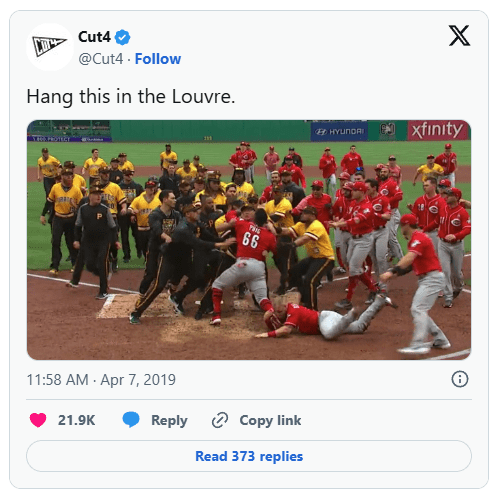
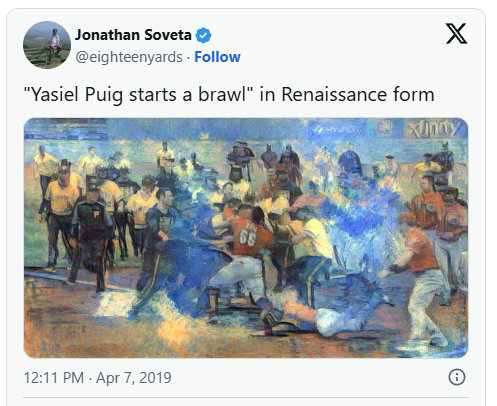
Another sidenote: Wasn’t it Rader who was responsible for seizing on a photo of a 2019 home-plate scuffle featuring Cincinnati Reds hitter Yasiel Puig taking on a hoard of yellow-clad Pittsburgh Pirates and suggesting it looked like some Renaissance battle painting? Somehow, we just assumed it was him — but then, there wasn’t an actual painting that the photo mimicked. Was there?
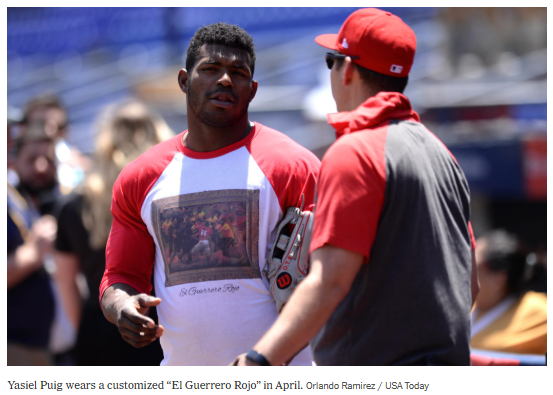
Cincy Shirts, a Cincinnati-based apparel company, seems to have commissioned a faux version of the moment to look like a Renaissance era work and dubbed it “El Guerrero Rojo” — aka, the Red Warrior — then slapped it on T-shirts. Puig then wore it out in public.
For the acuteness, perspicacity, inventiveness and a soothing virtuosity Radom pours into this latest work, it’s not a surprise we’ve come to link it to all sorts of other inspiring sports/art mashups lately.
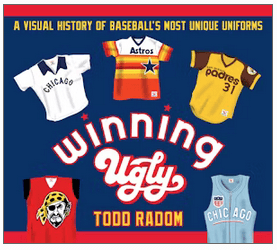
When we caught wind that Radom produced “The Ballpark and Beyond” — and immediately paid up to get a signed copy — our expectations were a bit lofty after embracing his previous work, “Winning Ugly: A Visual History of Baseball’s Most Unique Uniforms” (Skyhorse Publishing, 184 pages, $19.99 paperback, released 2018). Our review at the time noted Radom had put together something that was “uniformly superior to anything we’ve seen like this before.”
When he did “Fabric of the Game: The Stories Behind the NHL’s Names, Logos and Uniforms” with Chris Creamer, Radom could expand more on this imaginative merger of imagery and verbiage.
This time, combining 150 original illustrations to go with his own 75,000-plus words, Radom creates 75 unique entries to soak in for all they’re worth. He goes off on appreciations of the game’s origins, its personalities, the quirky equipment, strange-but-true happening — leading the reader into his climactic wheelhouse, the “Hall of Jerseys,” under the umbrella of “The Look of the Game.”
If the purpose of this is, as Radom writes in his intro, to spark “introspection, discussion and curiosity … how can you not be intellectually curious about baseball?” — please indulge us in that exercise as we have our top half-dozen playlist of what resonated most with us:
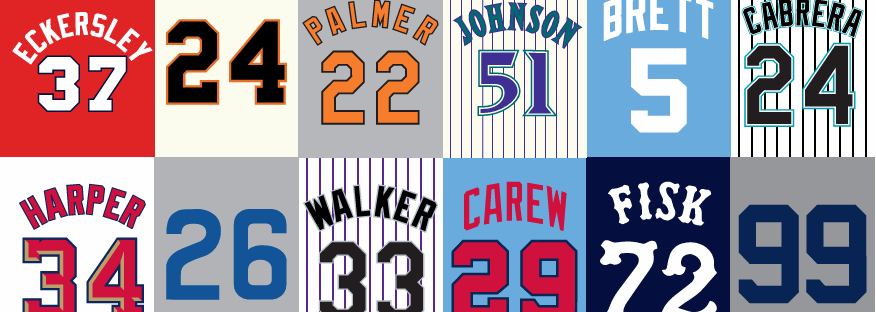
== “Dawn of the Digits,” page 60:
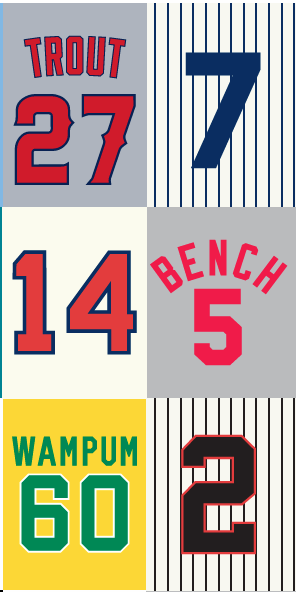
We’re so hellbent on wrapping up the SoCal Sports History 101 bio project — it’s been more than two years now of research into linking the uniform number of a person, place or thing to a story that uniquely defines Los Angeles and its adjacent communities over the last 101 years.
Radom’s research on baseball jersey numbers here gets to the heart of our journey and covers the spectrum of coolness.
He correctly points out that the Angels retired No. 26 for owner Gene Autry, citing how this was what players determined was his true status, worthy of the next roster spot beyond the 25-man limit.
In our own post about Autry, we feel now compelled to include this not-so-random Radom tidbit: “(No. 26 was) ceded by pitcher Bill Travers, who was on the injured list at the time.” When we went to Travers’ Baseball-Reference.com page, it shows he did have No. 26 in 1981, the year Autry approved a four-year, $1.5 million free-agent deal, obtaining the services of someone who had moderate success in the previous seven seasons in Milwaukee. But then Travers needed all of ’82 off for arm surgery. That’s when his jersey number was appropriated. Coming back briefly in ’83 in what would be hiss final year — 10 games, an 0-3 mark and 5.91 ERA — Travers had to now sport No. 35. But the Angels 86’d him by them. What a sour footnote for Autry, to get saddled with that number after Travers’ slow burnout and little return on the owner’s investment.
== “Famous Fans,” page 195:
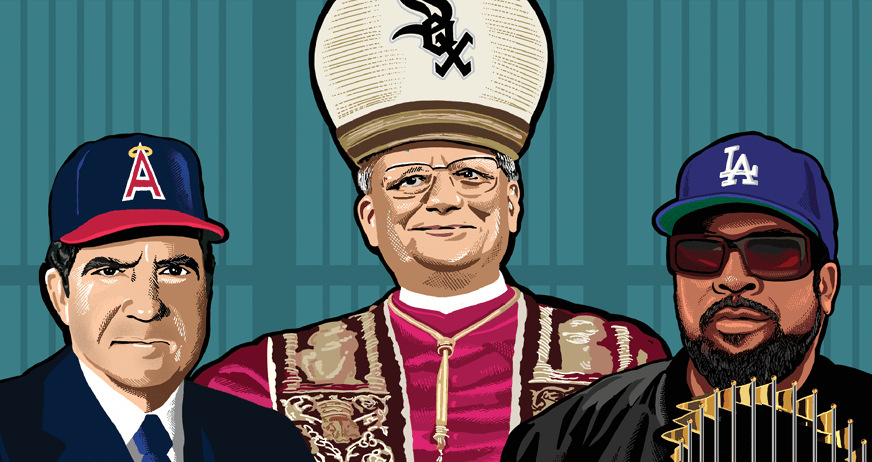
Three people you’d never imagine hanging out in the same waiting room: Richard Nixon in an Angels’ cap, Ice Cube in a Dodgers’ cap, on either side of Pope Leo XIV in a White Sox-tribute miter. “It really doesn’t matter whether you are a peon, a president, a pope, or a pop star — we are all united by fandom,” Radom writes. The Nixon reference gives us even more glee in that he represents No. 12 in our SoCal Sports History 101 bio project based on his football days as a Whittier College Poet. Pope Leo XIV’s name came up in a recent book review that focused on baseball promotions. Ice Cube just had his second bobblehead night at Dodger Stadium, and we’re all the richer for it.
== “The Angels Take Flight,” page 117:
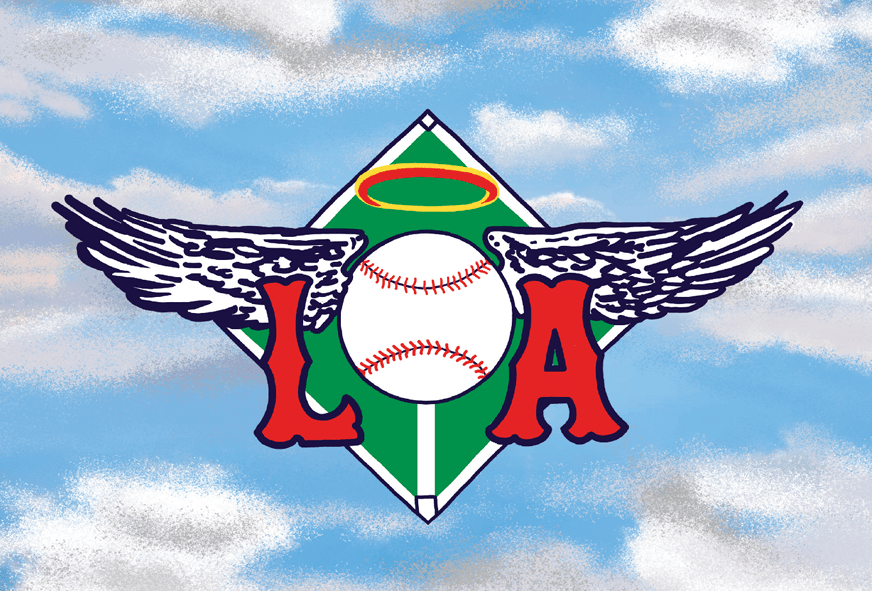
Autry’s Angels were my guardian Angels. We were both birthed into being in 1961. That gives me some kind of halo effect — my arrival into the world nearly 65 years ago was in a now-demolished hospital not to far from where the Angels were playing at the now-demolished Wrigley Field, over on Avalon and San Pedro. The Angels were part of a hurried American League expansion, three years after the Dodgers moved to Los Angeles. I was the first step in my parent’s family expansion in South L.A., less than three years after they were out of high school. The Angels’ logo had to embrace a different look than what the Dodgers had imported with its blue palate and “LA” linking logo. The Angels’ name was somewhat redundant for those who knew Spanish and English. It played off the city’s original name: El Pueblo de Nuestra Senora la Reina de los Angeles/The Town of Our Lady the Queen of the Angels.
What we also learned from Radom’s post: Casey Stengel was asked to be the original Angels manager, having been let go by the New York Yankees after they lost to Pittsburgh in the 1960 World Series. Stengel declined, “citing the fact he just signed a $400,000 deal to serialize his life story for the Saturday Evening Post, an arrangement which stipulated that he not manage in 1961.” Damn media contracts.
Radom also adds: “Just 125 days after they were created out of thin air, the mighty Los Angeles Angels were not only alive, but undefeated” after their April 11 opening-day win in Baltimore. That was powered by two Ted Kluszewski homers in his first two at bats.
In a 2011 interview prior to the Angels’ 50th anniversary season, Eli Grba, who started that first game and was the Angels’ first player picked in the expansion draft, told us: “When I started, I just felt like it was just another game. … It really wasn’t until afterward that everyone starts making a big deal out of it. Mr. Autry comes down to the locker room, and there’s the newspaper guys and the whole thing. That’s when I guess I really understood what was happening. … “Maybe it just took a while for everyone to figure us out. Who’s this team? Who are they? Who’s Eli Grba, that guy with the funny name?”
== “Guns-A-Blazing,” Page 114:
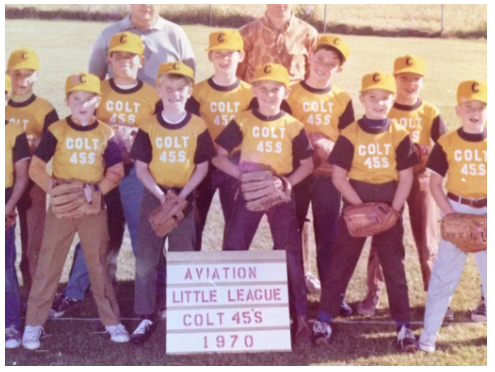
Honoring “the only MLB club ever to have displayed a smoking Colt .45 pistol across the front of their uniforms,” Houston’s expansion team of 1962 was relegated to a “bare bones” and “mosquito-plagued” Colt Stadium that never could purposefully harness the extreme Texas summer heat.
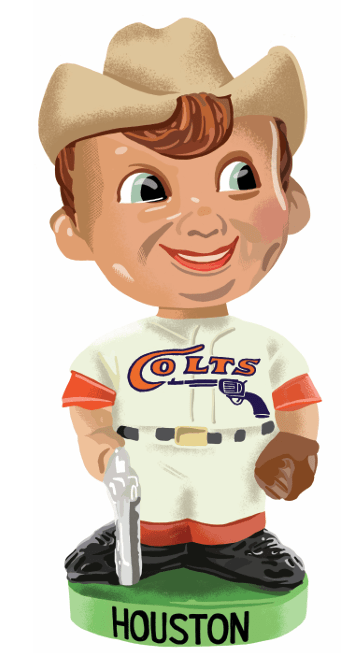
They stayed three three seasons. The Dodgers’ Don Drysdale found himself on the Colt Stadium mound for the final game on Sept. 27, 1964, trying to match pitches with someone named Bob Bruce sent out there by Houston. Bruce threw all 12 innings in a 1-0 shutout witnessed by some 6,000; Drysdale could only go the first 10 innings. And so the Colt .45s had emptied their chamber, the stadium was disassembled and shipped to Mexico, and the roster was relocated across the parking lot to the brand-new Houston Astrodome.
The Colts morphed into the Astros. From cowboys to space cadets.
The reason why the Colt .45s still stick to our ribs: For some inexplicable reason, that was the name of the first Little League team I played on at age 9. But this was 1970, as the name had been taken out of MLB circulation for at least four years. It’s not like we hand hand-me-down jerseys to wear. They were just T-shirt upgrades with black letters ironed on. And even then, whoever did the tailoring couldn’t figure out how to coordinate the way someone spelled out “Colt 45.s” on the shirt and how “Colt 45’s” appeared on the photo board. So, neither the fact that the team didn’t exist, nor there was still that gun-play component seared into a bunch of naive kids’ heads, nor the typographical mess of how it would be written was reason enough for our parents to be at all offended as they sat in the stands and compared Marlboro cigarette packaging. We all knew it was the Greatest Team Ever Assembled, but we could have been cooler if we had the real Colt .45 logos.
== “Nolan Ryan Has No Pitch Count Limit,” page 166:
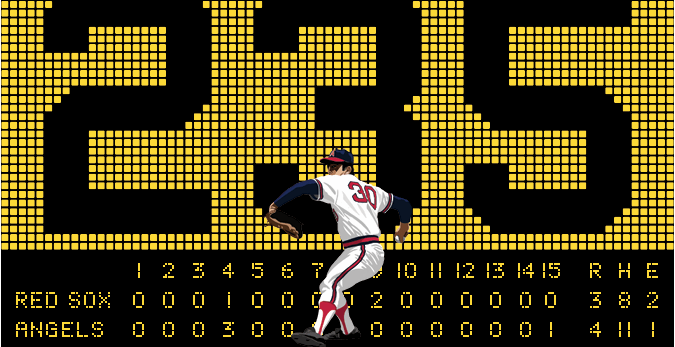
Radom re-imagines an old-time lighted scoreboard display that shows “235,” referencing not the number of Nolan Ryan strikeouts, but how on June 14, 1974 at Anaheim Stadium, just 11,083 “witnessed one of baseball’s most legendary pitching performances.” Ryan got through 13 innings, facing 58 batters, striking out 19 and walking 10. He threw a reported 235 pitches. The visiting Boston Red Sox were not all that impressed.
What Radom creates here creation reminds us of the time meeting Torrance-based artist Peter Chen in 2012 to talk about the book of work he created called Jumbotron Art, which we circled back to in 2019 for the Los Angeles Times in his book form.
“Pitch counts were not really a part of the game in those days,” Radom notes in the Ryan story, “but this achievement stood out to contemporary observers.” The Los Angeles Times story even mentioned that Ryan threw 84 pitches in the first four innings when he struck out nine and walked six. Ryan apparently convinced manager Bobby Winkles to let him go out for the 13th inning during the nagging 3-3 tie game. Ryan thought he was durable enough to knock off what was thought to be a personal-record 242-pitch game in Detroit in 1973 when he went all 12 innings of a complete-game win. Ryan was ready to crank it up to 13.
If you dig up the boxscore, as Radom did for more research, you’ll see there are no official pitch-counts listed on Baseball-Register.com. But there is another quirky thing about that game — after Ryan was lifted to start the 14th inning, reliever Barry Raziano arrived. When Denny Doyle had a walk-off double in the bottom of the 14th to score Mickey Rivers, Raziano got the win — the only one of his MLB career. He threw the last two innings (facing six hitters) and outlasted Boston’s Luis Tiant, who encountered 56 batters himself over all 14 1/3 innings. It’s reasonable to assume El Tiante threw at least 200 pitches himself in this game. How are we to know, either in English or Spanish?
(Memo to Todd for his next book: Wouldn’t it be something to illustrate the game 10 years before this when Juan Marichal outlasted Warren Spahn as both went a full 16-inning game ended by a Willie Mays homer? But then again, Spahn threw 201 pitches in his losing effort. Marichal threw 227 to beat him. Neither of them could match Ryan).
== “An Architect For The Fans,” page 192:
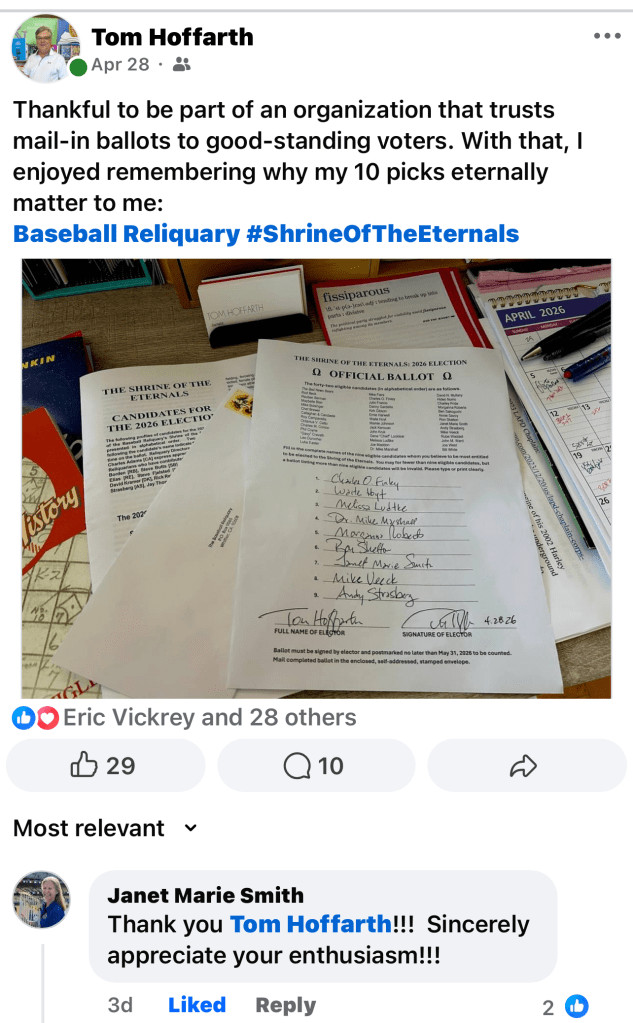
A very sweet portrait of Janet Marie Smith to honor her “influence on the game that spans the continent — from Boston to San Diego to Atlanta to Los Angeles — but her magnum opus is and will always be Oriole Park at Camden Yards in Baltimore, a ballpark which set the standard for a wave of classically inspired baseball-only facilities after its 1992 opening.”
In our most recent ballot for the Baseball Reliquary’s Shrine of the Eternals, Smith easily made it into our Top 10 list. It’s overdue. See SABR’s own story on Janet here.
How it goes in the scorebook:
Todd Radom is brilliant — the guy is a genius, seriously. Déjà vu all over again.
An inventive, discerning, aesthetically pleasing around-the-horn double play. Radom is our modern-day media dual-threat Ohtani. Everyone wins with this showtime.
Trust that these stories will take you on a journey, that Radom is committed to making it congenial and euphoric, setting off a fireworks display of memories. This is another example of how telling stories are bigger than all of us when done effectively. They preserve history for those coming after the time we’ve all run out of innings. Having the talent to convey a story with both exceptional artistic means to compliment the written word shows takes this process up a few more notches of ebullience than anticipated.
Now, a memo to the effin’ Geffen Galleries: Not only could it offer this for sale in its bookstore, but do it as an extension of a curated display of Radom’s original artwork housed in one of your concrete coves so we can all find a cool place this summer to cool off and think of all the ways baseball moves our essential being.
More to followup:

== The Society of American Baseball Research’s Four Pillars Fund, aimed to promote research, preservation, scholarship and future of the game, has incorporated Radom into its fundraising program that gives donors access to an exclusive virtual event with him as well as a signed copy of his book. More details: https://sabr.org/donate/four-pillars
== On this topic of baseball and art: The Beauty of a Game/The Aesthetics of Athletics substack has a marvelous post about artist Gio Balistreri / WhenToppsHadBalls blogspot and his creation of a baseball bard set “worthy of Cooperstown.”
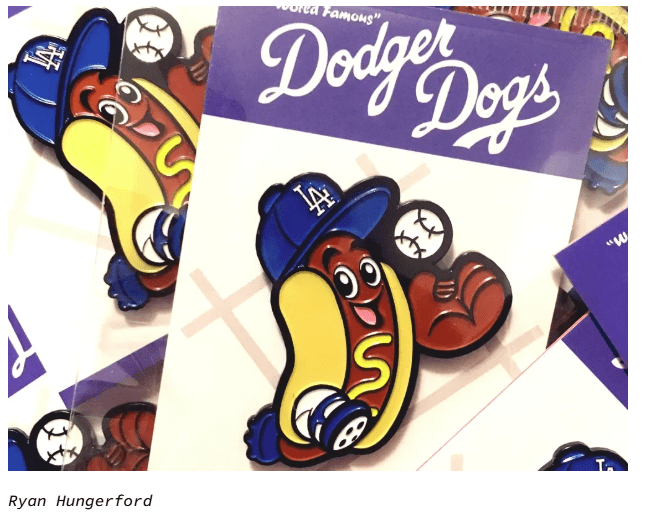
== Even more on this topic of baseball and art: Tiffany Babb of The Fan Files profiles Ryan Hungerford and his graphic design prints, pins and even scarves related to baseball — specifically, the Dodger Dog — with links to his Instagram account.


1 thought on “Day 15 of 2026 baseball books: The drawing power of dual-edged storytelling”