The Drill E7: All in all, another brick in the wall on the boxer’s shorts, plus Kap to Rams, Chosen Rosen’s choices, ‘Brockmire’ in person and … an NHL minute

Fifth one minutes and 59 seconds is a personal best — for longest show in “The Drill” history. Worthy if nearly a full hour?
Well, it’s chock full of nuts. Aside from the panelists.

Here’s how we break it down for those who need some help:

*Two minutes in: The new business card to take to the CAA Sports Congress at LA Live:

*Four minutes in: The Mahoney Valley Scrappers, a real Single-A short-season team
*Five minutes in: Introducing the “Heberts” — Guy Hebert vs. Bobby Hebert
And more about Beyonce at Coachella while noting Kendrick has won a Pulitzer before any of us journalists.

*THE DRILL:
*Eight minutes in: Clippers have missed their LA chance and we’ve been there with the Lakers. More on the Lakers’ offseason.
* 13 minutes in comes “The NHL minute” with Eric: Drew Doughty’s “questionable” suspension and the Ducks give up 8. Anddddd, we’re done.
* 15 minutes in: Shhhhhhhh … Ohtani needs quiet time?
* 16 minutes in: The Jim Thompson illustration on Angels vs. Dodgers bandwagon fans who are image consciousness, exclusive to viewers of “The Drill”:
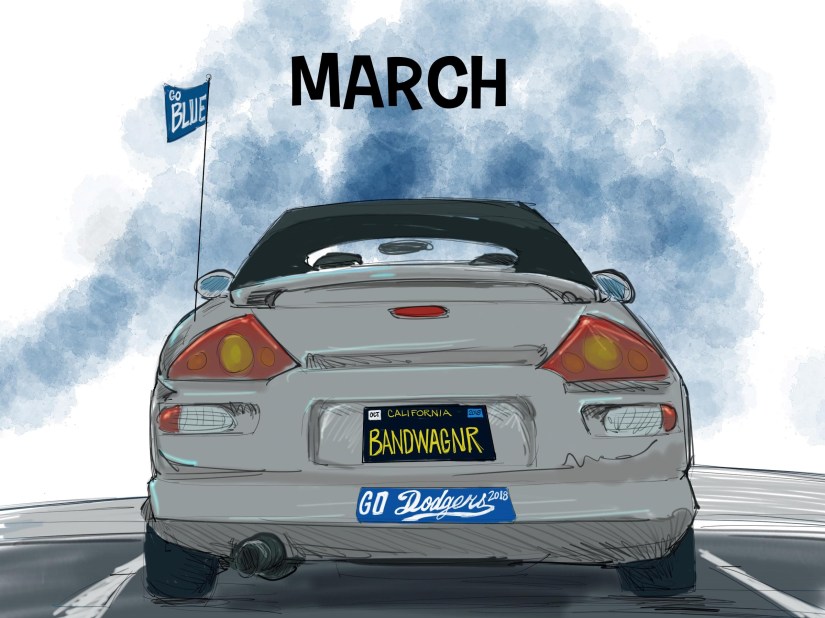
march

april

* 20 minutes in: Beto’s incredible first-hand account of watching and reporting on how “Lightning” Rod Salka’s “America First” trunks didn’t do him any favors against Francisco Vargas and only made it a national story.

* Which leads to Jon’s reference to Tommy Z’s KO once upon a bad-strategy time:

*THE BUSINESS (at the 36 minute mark)
* The ESPN Magazine cover story on Josh Rosen, along with the Washington Post story that uses “Jewish” and “millennial” in the headline.
(And with our new feature, “Drill Bits,” we can isolate that discussion (eight minutes long) right here (also noting that 42 minutes in, John uses the first F-bomb in “The Drill” history. A few times. In context …)

* 45 minutes in: More about our time spent with Hank Azaria as “Jim Brockmire” leads to this clip of “The Meltdown”:

* And we have this exclusive four-minute interview with Azaria after we visited him and his appearances Monday on “The Rich Eisen Show” (DirecTV’s Audience Network) and “Mason and Ireland” at 710-AM ESPN:

THE ENDING:
* More on the Los Angeles Azules and we’ll take you out with cuts from The Bronx:

And Mariachi El Bronx (which we believe could be our new bumper music):

Day 17 of 30 baseball book reviews for 2018: No patronizing the Red Sox patriarch, but there’s lots of explaining to do

green-black-red-brand
It’s as good a time as any to show off some of the orange crate-style artwork from Pasadena’s Ben Sakoguchi (https://www.sakoguchi.info/segregation-desegregation/)

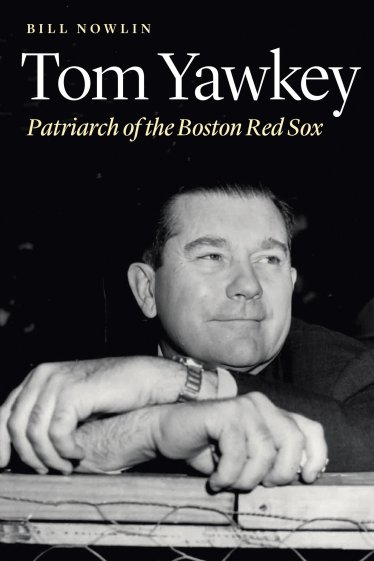
The book: “Tom Yawkey: Patriarch of the Boston Red Sox”
The author: Bill Nowlin
How to find it: University of Nebraska Press, 560 pages, $36.95, release Feb. 1.
The links: At Amazon.com, at the publisher’s website.

DTZAcsAUQAAXAam.jpg largeA review in 90-feet or less: Today’s Boston Red Sox, who visit Anaheim for a three-game series starting tonight facing Shohei Ohtani, have been owned by a group led by John Henry, Tom Werner and Larry Lucchino since 2002. They made a  then-record $700 million purchase of the franchise from the Jean R. Yawkey Trust.
Mrs. Yawkey actually died in 1992 and held a majority ownership of the franchise since 1976.
Before that, her husband, Tom Yawkey was in charge.
So the story goes …
His run started in 1933, when he bought the team for $1.2 million. The Red Sox never won a World Series during his reign, but that’s not why so many pages here are devoted to him.
Nowlin, whom we mentioned earlier this month as the co-editor of the SABR publication about baseball players who made it to Hollywood, isn’t saber-rattling here. We also recognize from many books he has done about Red Sox history, he spares no trees to make his very deep dive in to the Yawkey reign.
But 560 pages worth? It’s 434 pages of chapter reads, plus the epilogue, acknowledgements, notes and index bring up the final 100-plus pages. Because on a project like this, everything must be accounted for.
And, after all, this is the first book ever done on the man, as Nowlin says.
While a lot of this book reminds us of the job Andy McCue did on the Walter O’Malley bio from 2014 — 480 pages deep, also from University of Nebraska Press — it’s needed to help clear the air about some possible false narratives.

Continue reading “Day 17 of 30 baseball book reviews for 2018: No patronizing the Red Sox patriarch, but there’s lots of explaining to do”

Day 16 of 30 baseball book reviews for 2018: A Paige-turner, without dictation

IMG_2664
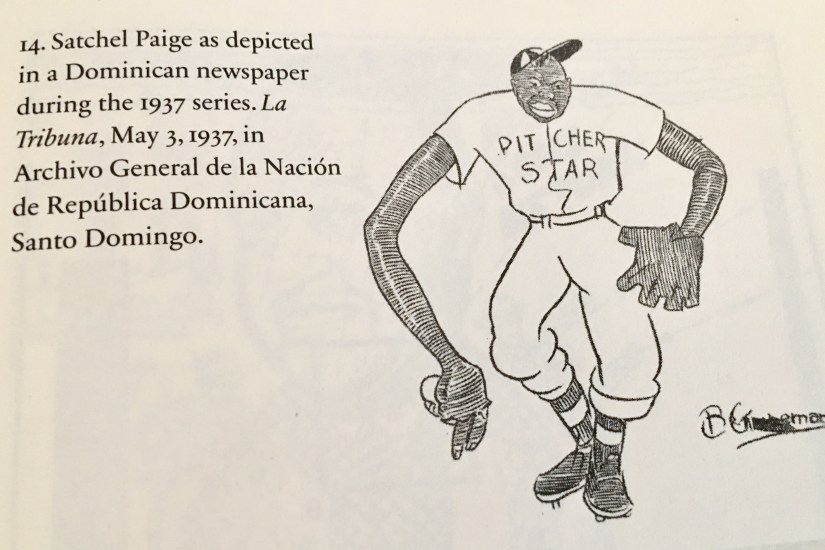
An illustration from “The Pitcher and The Dictator”

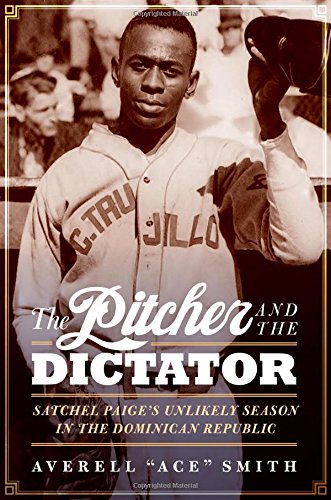
The book: “The Pitcher and the Dictator: Satchel Paige’s Unlikely Season in the Dominican Republic”
The author: Averell “Ace” Smith
How to find it: University of Nebraska Press, 240 pages, $26.95, released April 1.
The links: At Amazon.com, at the publisher’s website.

51Ix418b3ALA review in 90-feet or less: To show you where this is going, consider that last week, Amazon.com had this book listed as the No. 1 new release in “Central America History.
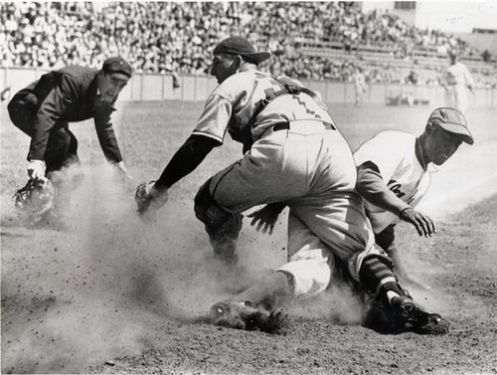
“This is not really a story about baseball,” writes Smith in the epilogue. “It’s a story about power. A dictator on a Caribbean island decided he needed to rent the best baseball players to win a series dedicated to his ‘reelection.’ Oddly this confluence of events brought to the small island the best championship series ever played.”

The story is beyond compelling, a world lesson on what happened in the Dominican when a tyrant named Rafael Trujillo took over, rigged the election of 1930 by having his people kill off his opponents, then decided a winning baseball team with his name splashed across the chest would convince the locals that, through victory on the field, he could get re-elected.
And somehow Satchel Paige, who accepted $30,000 to help make it happen, didn’t really know what he was getting into. He defected from the Negro Leagues to become part of this propaganda machine that eventually led to the recruitment of Josh Gibson and Cool Papa Bell. That was to offset the other local team full of stars that included Cuban pitching and hitting great Martin “El Maestro” Dihigo playing for the Aguilas Cibaenas.
There was a championship game that this all led up to.
With the Dragones de Cuidad Trujillo holding an 8-2 lead in the ninth inning, it started slipping away. Paige came in to save it — but not without dodging some bullets. Just figuratively. But he knew it could be literally.

A story that almost reads like a Richard Pryor script about a bunch of players who went to a banana republic with the promise of money and drinking abilities behind the “whites only” rope but then realized they probably were in way over their heads and realized there were guns pointed at them if they didn’t win and get the heck out of there.
Cuidad Trijillo, on the shore of the Caribbean in Santo Domingo, was daunting enough for the Americans who visited — right beyond the right-field fence was the rusting hulk of the USS Memphis, from the 1916 American invasion and now sitting there, stranded off shore, as a reminder.
Continue reading “Day 16 of 30 baseball book reviews for 2018: A Paige-turner, without dictation”

Day 15 of 30 baseball book reviews for 2018: On Jackie Robinson Day, a look at another player Branch Rickey passed on at that point in time

artie-wilson-of-oaks-slides-against-hollywood-stars
Artie Wilson of the PCL’s Oakland Oaks slides in safely against the Hollywood Stars. (Photo: https://90feetofperfection.com)

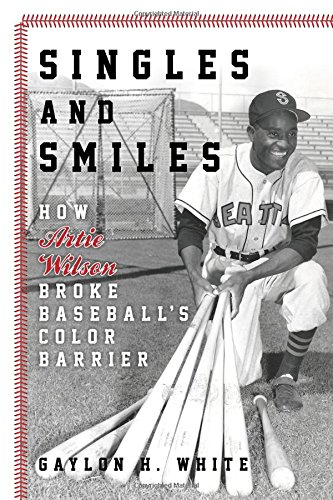
The book: “Singles and Smiles: How Artie Wilson Broke Baseball’s Color Barrier”
The author: Gaylon H. White
How to find it: Rowman & Littlefield Publishers, 270 pages, $35, released March 20
The links: At Amazon.com, at the publishers website.

51z94wUvHHLA review in 90-feet or less: Wait, wait, wait a sec … Someone named Artie Wilson did what now?
“The story of Jackie Robinson is well documented,” White writes in the preface. “But little is known about Artie and the other blacks who integrated the minors. They are mostly footnotes in baseball history, their achievements in need of resurrection and telling so they won’t be forgotten …
“After Artie put on a spectacular performance in the Negro League’s East-West All-Star Game in 1946, the Chicago Tribune reported how he always became the one chosen by Branch Rickey of the Brooklyn Dodgers to break the color barrier in Organized Baseball, or ‘white folks’ ball,’ as (Negro League star second baseman Lorenzo ‘Piper’ Davis) referred to it.
“Rickey passed Artie by and picked Jackie Robinson.”
Those last two paragraphs are on Chapter 1, page 1. So not to marginalize what Wilson did, but we’re just a bit confused by facts presented as we all seem to know versus what the book title is selling us.

Artie WilsonFact: Wilson, a singles-hitting shortstop in the New York Giants organization, did come up to the big leagues from their Oakland PCL team in 1951 at age 30. He got 24 plate appearances in 19 games — four singles, two walks and a couple of stolen bases. Three games at second base, three at shortstop and even two at first base.

And that was it. He basically gave his roster spot away to Willie Mays, over Leo Durocher’s protests.

Another truth: The site RetroSheet.org shows Wilson and Robinson on the MLB field together. One time. (This isn’t in the book).
April 20, 1951 at the Polo Grounds. In the Dodgers’ 7-3 win that Friday day game, Robinson batted cleanup at second base and went 2-for 4. Wilson came in as a pinch hitter for relief pitcher George Spencer when his spot came up in the lineup in the seventh inning, and hit a comeback to pitcher Don Newcomb.
Wilson, once signed by the Cleveland Indians in 1949 where he could have had a chance to come up under progressive owner Bill Veeck, ended up with the New York Yankees organization a few months later, and they sent him to Oakland.
Wilson would retire to Portland and live to be 90 years ago when he died in 2010.

White writes that Wilson was like Ozzie Smith with the glove and like Rod Carew or Ichiro Suzuki with the bat. White even calls him “a black version of Richie Ashburn, the sprinter-quick leadoff hitter for the Philadelphia Phillies in the 1950s.” And Wilson did it all without the tip of his right thumb, the result of a machine shop accident at a cast-iron pipe company.
“Jackie broke Major League Baseball’s color barrier with a relentless fighting spirit,” White writes again. “Artie did it in the minors with singles and smiles.”
Continue reading “Day 15 of 30 baseball book reviews for 2018: On Jackie Robinson Day, a look at another player Branch Rickey passed on at that point in time”

Hoffarth on the media: Catching up for 2018

AMSTZ IMG_1499
Linsday Amstutz, right, with girls from Mulholland Middle School as they talk about career opportunities in the sports television world.

It’s another way to locate our weekly sports columns, which for now appear in the Southern California News Group editions.
In recent weeks:
* Lindsay Amstutz, the SVP and GM of Fox Sports West/Prime Ticket and Fox Sports San Diego, takes us along for a “seed planting” trip to a middle school in her native San Fernando Valley.
* Any idea why it’s not such a great idea to have Facebook.com streaming MLB games? Take the first one for 2018, for example.
* New ESPN “Sunday Night Baseball” play-by-play Matt Vasgersian has a way of comparing this franchise to how people watch “Saturday Night Live.” … Does it match up?
* Former UCLA Final Four MVP Ed O’Bannon explains more about his new book, “Court Justice,” and his battles with the NCAA.
* How LAFC president Tom Penn put his ESPN NBA gig on hold to create a soccer narrative.
* The NBA has star power in the media world. How did it get there?
* Will you be amazed to see a Super Bowl on Amazon Prime some day? Don’t be.