Blog

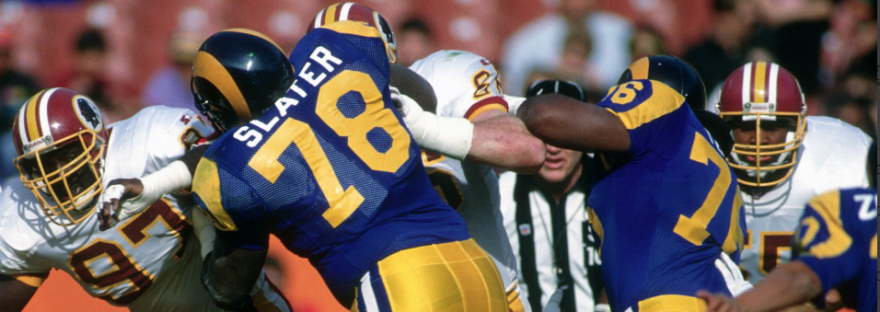
No. 78: Jackie Slater

This is the latest post for an ongoing media project — SoCal Sports History 101: The Prime Numbers from 00 to 99 that Uniformly, Uniquely and Unapologetically Reveal The Narrative of Our Region’s Athletic Heritage.  Pick a number and highlight an athlete — person, place or thing — most obviously connected to it by fame and fortune, someone who isn’t so obvious, and then take a deeper dive into the most interesting story tied to it. It’s a combination of star power, achievement, longevity, notoriety, and, above all, what makes that athlete so Southern California. Quirkiness and notoriety factor in. And it should open itself to more discussion and debate — which is what sports is best at doing.

The most obvious choices for No. 78:
= Jackie Slater: Los Angeles Rams
= George Achica: USC football, Los Angeles Express
= Art Shell: Los Angeles Raiders

The not-so-obvious choices for No. 78:
= Grenny Lansdell,
USC football
= Alex Laferriere, Los Angeles Kings

The most interesting story for No. 78:
Jackie Slater: Los Angeles Rams right tackle (1976 to 1995)
Southern California map pinpoints:
Los Angeles Coliseum, Anaheim Stadium


Jackie Slater’s livelihood was predicated on preventing quarterbacks sacks. Turns out, he can also play a mean tenor sax.

By which, we mean, he can pretend.

If only one person came out with some dignity left after a herd of Los Angeles Rams were talked into recording a 1985 music video “Let’s Ram It!” it was the 6-foot-4, 284-pounder who introduces himself at the top of it as “Big Bad Jackie.”

To wit:

I’m Big Bad Jackie and I’m starting us off
The Rams getting down so nobody’s soft
And don’t you worry cuz the Rams are rappin’
When game time comes we’ll get back to zappin’
We can’t sing and our dance is not pretty
But we’ll do our best for the team and the city
So get on your feet and clap your hands
Let’s Ram it right now with the L.A. Rams

This by no means defines the career of a Pro Football Hall of Famer who played one of the most demanding positions for 20 straight years — the first 19 in L.A. before its move to St. Louis, where he called it over.

But let the record show, Slater made this record. And broke many others.

Continue reading “No. 78: Jackie Slater”

No. 16: Rick Monday

This is the latest post for an ongoing media project — SoCal Sports History 101: The Prime Numbers from 00 to 99 that Uniformly, Uniquely and Unapologetically Reveal The Narrative of Our Region’s Athletic Heritage.  Pick a number and highlight an athlete — person, place or thing — most obviously connected to it by fame and fortune, someone who isn’t so obvious, and then take a deeper dive into the most interesting story tied to it. It’s a combination of star power, achievement, longevity, notoriety, and, above all, what makes that athlete so Southern California. Quirkiness and notoriety factor in. And it should open itself to more discussion and debate — which is what sports is best at doing.

The most obvious choices for No. 16:
= Marcel Dionne, Los Angeles Kings
= Gary Beban, UCLA football
= Pau Gasol, Los Angeles Lakers
= Frank Gifford, USC football
= Hideo Nomo, Los Angeles Dodgers
= Rodney Peete, USC football
= Rick Monday, Los Angeles Dodgers
= Jim Plunkett, Los Angeles Raiders

The not-so-obvious choices for No. 16:
= Brice Taylor, USC football
= Willie Wood, USC football
= Jarred Goff, Los Angeles Rams
= Garrett Anderson, California/Anaheim/Los Angeles Angels of Anaheim
= Lisa Fernandez, UCLA softball
= Will Smith, Los Angeles Dodgers

The most interesting story for No. 16:
Rick Monday, Los Angeles Dodgers center fielder (1978 to 1984)
Southern California map pinpoints:
Santa Monica, Dodger Stadium


On the 60th anniversary of Dodger Stadium in 2022, the Dodgers gave fans a Top 60 countdown of the greatest moments in the ballpark’s history.

An event that happened on a Sunday afternoon, April 25, 1976, planted its flag in the No. 5 spot. It was also important enough to be included in a 2000 Baseball Hall of Fame’s 100 classic moments in the game’s history.

It involved a SoCal guy playing against the SoCal team. The Dodgers were mere bystanders.

Rick Monday, front and center as he patrolled center field for the visiting Chicago Cubs, wore No. 7 as a tribute to his baseball idol, Mickey Mantle. In a game the Dodgers won 5-4 in 10 innings, Monday had three hits, score twice and drove in a run as the Cubs rallied from a three-run deficit.

In the play-by-play of each inning is posted in a Retrosheet.org account of the contest, this is how the Dodgers’ four-run fourth was recorded:

By more than one patriotic group or another, it has been referred to as baseball’s “greatest play.”

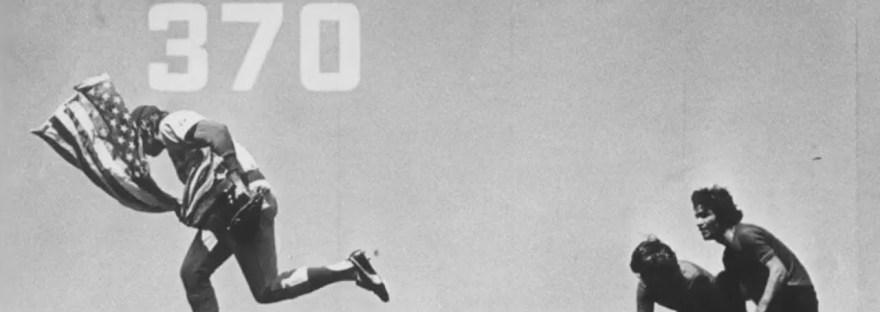
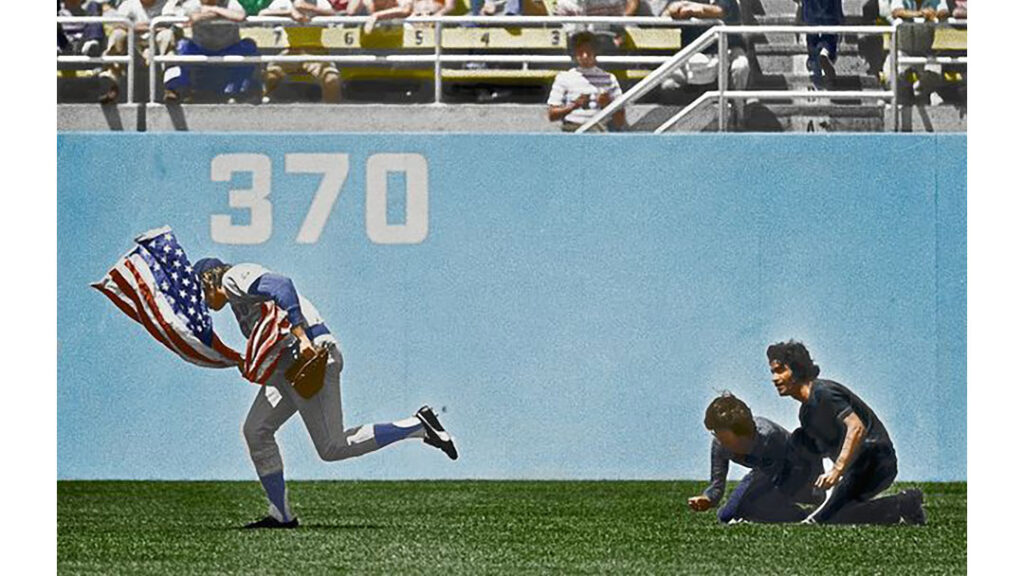
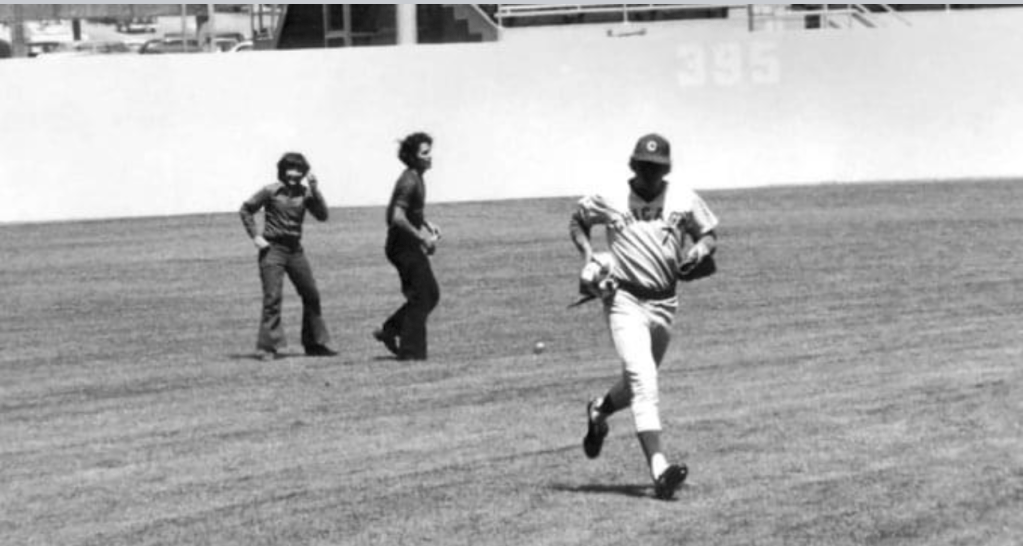
A colorized version of the Jim Roark/Los Angeles Herald-Examiner photo.

The most iconic image of Monday swooping with his right hand — the left-hander had taken off his glove and held it in his left hand — to snatch the American flag out of the hands of a man and his son as they knelt in the outfield grass, having already doused it with lighter fluid and unsuccessful in lighting a match as the wind blew out their first try, was dutifully captured by Los Angeles Herald-Examiner photographer Jim Roark. It was nominated for a Pulitzer Prize.

The late Los Angeles Times columnist Jim Murray referred to it as “the most famous picture of its kind since the flag-raising at Iwo Jima.”

It was “Francis Scott Key, Betsy Ross, Verdun and Iwo Jima—all wrapped up on one fleeting instant of patriotism,” added The Sporting News, and calling Monday’s run a resemblance of “Paul Revere at full gallop.”

The description Vin Scully conjured up for the Dodgers’ radio audience as Ted Sizemore was at bat with a 1-0 count was equally as etched in the fans’ psyche.

“Outside, ball one … and wait a minute … We’re not sure what he’s doing out there … It looks like he’s going to burn a flag … and Rick Monday runs and takes it away from him! (Crowd cheers) … I think the guy was going to set fire to the American flag! Can you imagine that? … Monday, when he realized what he was going to do, raced over and took the flag away from him.”

And Scully took our breath away.

Right away, Dodgers publicity director Fred Claire had the scoreboard operator, Jeff Fellingzer, type in a message:

As Monday continued running toward the Dodgers’ dugout, he handed the flag to Dodgers pitcher Doug Rau. Monday recalled seeing Dodgers third base coach Tommy Lasorda running past him toward the perpetrators and “called these guys every name in the longshoreman’s encyclopedia.”

The 25,000-plus fans in the stands began to sing “God Bless America,” prompted by stadium organist Helen Dell.

After the game, Monday was still agitated as he told reporters: “If he’s going to burn a flag, he better do it in front of somebody who doesn’t appreciate it. I’ve visited enough veterans hospitals and seen enough guys with their legs blown off defending the flag.”

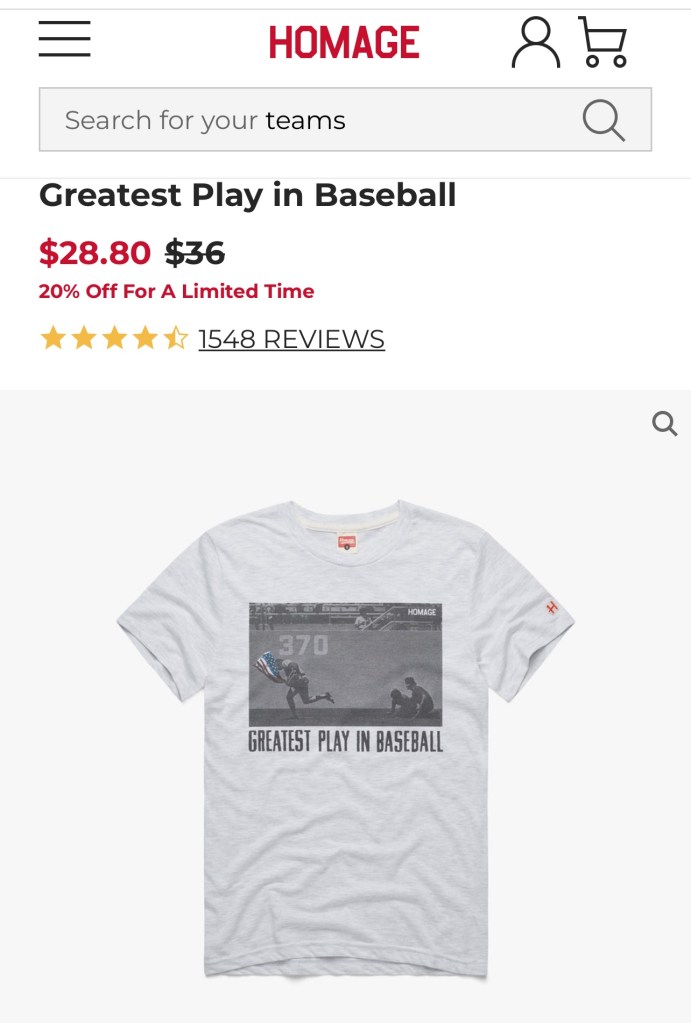
And you can still get the whole thing (for a discount) on a T-shirt.

Monday served as a reserve in the Marine Corps for the first six years of his MLB career. He said he had lost friends in Vietnam, a war that had just ended in 1976, the country’s bicentennial year. He had heard stories of his father and the Army. Now the country’s convoluted ideas of patriotism, politics, and protests had spilled onto a baseball field.

“Now we’ve got three great patriots — George Washington, Abraham Lincoln, and Rick Monday,” said Cubs teammate Jose Cardinal as mentioned in the game’s SABR recap.

President Gerald R. Ford called Monday after the game and issued a Presidential Commendation for “Service To Others.”

Two weeks later, when the Dodgers went to Chicago to play a series against the Cubs in Wrigley Field, Dodgers general manager Al Campanis presented Monday with the flag.

Some 30 years after it happened, Monday received a U.S. Senate Resolution.

It has since been commemorated on posters, coins, pennants, U.S. postage collectables and a Dodger Stadium bobblehead giveaway. The Dodgers gave away a copy of the Roark photo as a poster in 1977 when Monday joined the Dodgers.

A self-published children’s book is titled: “Rick Monday: An American Hero.”

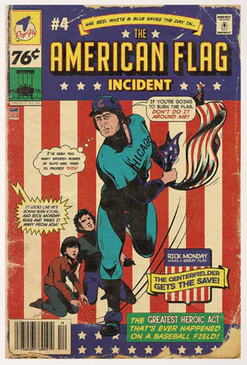
An artist who does mock ups of a retro comic book covers even created something for pop culture history.

Few journalists followed up to investigate any logic into why the man and his son tried to do this. The stories get kind of foggy.

In the 2018 book he compiled and wrote for the Los Angeles Public Library called “L.A. Baseball: From The Pacific Coast League to the Major Leagues,” David Davis summed it up this way:

“The blink-and-you’ll-miss-it moment entwined four unlikely and disparate individuals: a Major League Baseball outfielder who instantaneously became a national hero; a photojournalist whose career was made, seemingly for life, with a single shot; and a father-son duo who faced so much mockery and castigation that they have chosen to remain anonymous.”

The stories that continue to be told by Monday as the anniversary comes around each year, and his reactions to it, resonate more.

“You know what’s really kind of strange is I get letters every week, some from people who were not even born at the time,” Monday told writer Mike DiGiovanna before a game in 2023 at Dodger Stadium. “And twice today, here at the ballpark, I’ve already had people say, ‘Thanks for doing something for the flag.’”

When asked about it through the years, Monday has had time to reflect on it.

“I don’t know what I was thinking,” said Monday in 2020. “But I knew what they were doing was wrong.”

“It brings you to tears, to be honest,” Monday admitted in 2013 about the stories he’s heard from veterans since then.

He also said in 2016: “It’s freedom of speech, but the flag itself, I look at it from a positive standpoint … I heard today from one of the moms who lost their son. It’s like Barbaralee (Monday’s wife) says, ‘We drape the caskets of our fallen warriors with the flag, and it’s presented to the family with the words, from a grateful nation.’”

Among the things Monday has on his professional resume:

= The first player taken overall in the first Major League Baseball official draft, in 1965, by the Kansas City Athletics, right out of Arizona State. The 19-year-old led the Sun Devils to the College World Series title. This was three years after he declined an $20,000 signing bonus from Dodgers scout Tommy Lasorda to join his hometown team out of Santa Monica High School because Monday had promised his mother he would attend college.

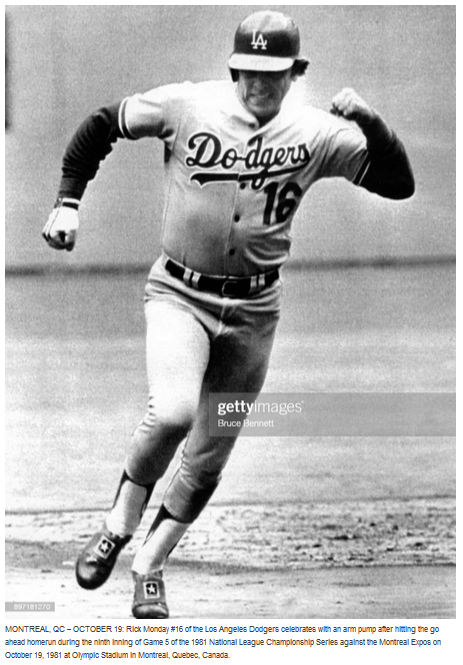
= A dramatic ninth-inning home run off Montreal’s Steve Rogers during the National League Championship Series that gave the Dodgers a 2-1 win and sent them into the 1981 World Series. It is still called “Blue Monday” throughout Canada.

= Two All-Star selections, including 1978 with the Dodgers, a year after he was traded by the Cubs to L.A. in exchange that included Bill Buckner. Monday wanted to keep the No. 7 as he wore with the Cubs, but Steve Yeager had it. So Monday picked 1 plus 6 = 16 instead.

= A total of 241 homers during a 19-year career, eight of them with the Dodgers, as well as 775 RBIs. He had a single-season best of 32 homers for the Cubs as their lead-off hitter for that 1976 season.

= A 30-plus year career as a Dodgers TV and radio broadcaster, brought on in 1993 after the death of Don Drysdale, after Monday had done four years of broadcasting for the San Diego Padres.

But saving that flag from peril …

It remains in a safe deposit box. Secure. Taken out occasionally for fundraising events, especially to help the U.S. military veterans and their families.

 “I didn’t do anything that people I know would not have done had they been geographically close enough to do something about it,” Monday has said. “I’m proud to say that all of my friends would have done the same thing. I think it’s about respect. I respect this country and what that flag represents.

“It’s only a piece of cloth, but, boy, it represents a lot of lives and freedoms that we have available to us because of the people who stepped up and sacrificed. All I did that afternoon was step up. I’m not a hero. I’m just a guy who acted upon what I thought was right. I’m happy I was close enough to do something about it.”

A quote from 1996 on the 20th anniversary continues to resonate most: “I’ve gotten a thousand questions wondering if I’m disappointed being best known for something that had nothing to do with baseball. My answer is, absolutely not.”

He added 20 years later: “If I am remembered only as a guy that stood in the way of two guys trying to desecrate an American flag at a Major League Baseball game, and protect the rights and freedoms that flag represents for all of us, that’s not a bad thing to be remembered for.”

Monday also said in a piece repurposed for the Baseball Hall of Fame: “The back of a baseball card is only good for as long as someone does not put it in the spokes of their bicycle. The flag, hopefully, is going to fly forever.” 

In a story posted in 2025 about Jim Marshall, who, at 90, was the oldest living member of the New York Mets, it mentioned that he was also the manager of the Chicago Cubs that day Monday saved the flag.

Marshall said Monday was his favorite player to manage.

“He was such a great, young kid,” said Marshall. “I was there the day he grabbed the American flag when those kids were about to burn it. That was the greatest play of his career. I told Rick, ‘You owe me money, man. I put you in the lineup so you could do that, now you have a lifetime job with the Dodgers!’ So now he gives me $1 every time he sees me.”

Who else wore No. 16 in SoCal sports history?
Make a case for:

Marcel Dionne, Los Angeles Kings center (1975-76 to 1986-87):

The Little Beaver — a nickname that stuck to the Hockey Hall of Famer because of his 5-foot-9 stature — continues to lead the franchise in career points (1,307) nearly 40 years after he left L.A. He is also standing second in total goals (550) and total assists (757), collected in less than 1,000 games.

Add to that the all-time leader in hat tricks (24, 10 more than second-place Bernie Nichols and Luc Robitaille), goals created (507.5), even-strength goals (369), total goals on-ice for (1,723), power play goals on-ice for (670) and offensive points share of 101.0. All of which may mean nothing to the non-hockey fan.

But until the Kings pulled the trigger before the 1975 season and got him from Detroit in a multi-player deal involving Dan Maloney and Terry Harper, the legend of Dionne in Southern California sports wouldn’t have happened as he combined with Dave Taylor and Charlie Simmer on the “Triple Crown Line” from 1979 to 1984. Incoming coach Bob Berry was the one to put Dionne on the line with second-year right winger Taylor and career minor-leaguer Simmer. Taylor was the play maker, Dionne was the scorer and Simmer was the one who pulled the puck out of the corners. Perhaps by no coincidence, after the Triple Crown Line’s first season together, Dr. Jerry Buss bought the Kings, Lakers and the Forum from Jack Kent Cooke fr $67.5 million. the Triple Crown Line dominated the NHL in its first season, scoring 146 goals and 182 assists, good for 328 points and Dionne was also awarded the Art Ross Trophy as the league’s greatest scorer — two more goals than rookie Wayne Gretzky. By ’80-’81, the line did better: 161 goals, 191 assists and 352 points, and was voted into the 1981 All Star Game as a unit in a game played at the Forum in Inglewood.

Hideo Nomo, Los Angeles Dodgers pitcher (1995 to 1998):

The “Nomomania” that erupted in Los Angeles upon the arrival of “The Tornado” during the ’95 post-strike delay generated a Japanese fan following that had not been seen before in Major League Baseball. The ’95 NL Rookie of the Year and league strike-out leader with his baffling forkball and deceptive windup was also the starting NL pitcher in the All Star game, striking out three of the six he faced. A no-hitter at Coors Field in Denver added to his legend. After stops in New York, Milwaukee, Detroit and Boston, Nomo returned to L.A. (wearing No. 10, as catcher Paul LoDuca had No. 16, the magical number for Japanese players) and had back-to-back 16-win seasons before undergoing shoulder surgery.

In honor of Nomo and the Japanese history of pitchers, Yusei Kikuchi made the 2025 Opening Day start with No. 16, having worn it with Houston and Toronto previously.

Gary Beban, UCLA football quarterback (1965 to 1967):

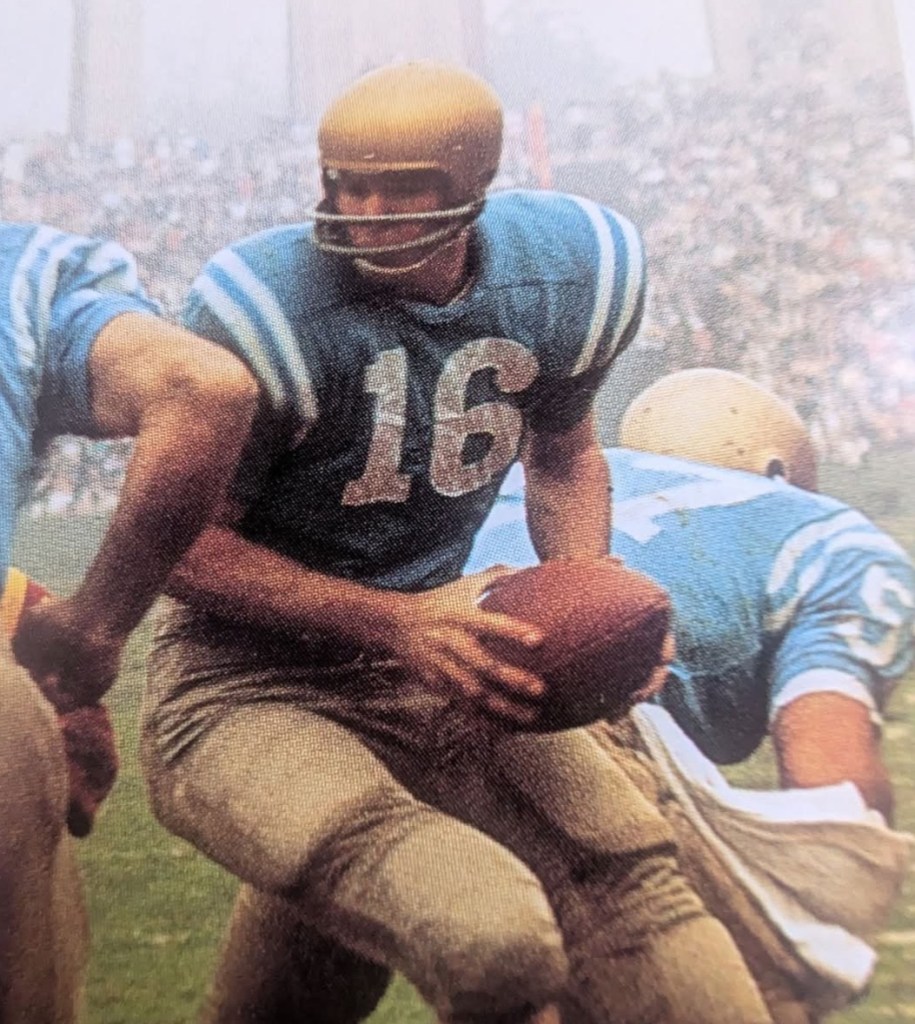
In ESPN’s 2020 list of the 150 greatest college football players in the game’s first 150 years, Beban managed to get in at No. 146, still the only Bruin to win a Heisman. The blurb reads: “Beban may be the classic example of the bromide: All he could do was beat you. He was not big (6-0, 191), didn’t have a particularly strong arm, and beat no one with his legs. But Bruins coach Tommy Prothro made two comments about Beban that defined his worth: “He has no weaknesses.” And: “The more pressure, the better he is.” As a three-year starter, Beban went 24-5-2, including an upset of national champion Michigan State in the 1966 Rose Bowl, 14-12. Beban and No. 1 UCLA lost to O.J. Simpson and No. 3 USC, 21-20, in 1967. Beban threw for 301 yards and two touchdowns, and he beat Simpson for the 1967 Heisman.” That ’67 season, by the way, showed Beban throwing for 1,359 yards and eight TDs, and UCLA finishing 7-2-1. But since he was fourth in the Heisman voting in ’66, Beban  seemed to have the best qualifications, considering his career stats: 33 TDs, 3,940 of passing yards and 5,197 of total offense.

Still, if UCLA fans were to conjure a list of the Top 5 quarterbacks in its history, Beban might only be included with Troy Aikman, Cade McNown or Billy Kilmer because of the Heisman hardware, and because so much has happened to the game statistically in measuring success over the last 50-plus years. Since Beban’s time, only a few UCLA players have ever finished in the Top 3 in the Heisman voting: Quarterbacks Aikman (1988) and McNown (1998) were third. Prior to Beban, only Bruins running back Paul Cameron had made it into the Top 3 (in 1953). Quarterback Kilmer was fifth in the 1960 voting and Donn Moomaw finished fourth in 1952. A second-round pick by the Los Angeles Rams in 1968 — 30th overall — Beban’s rights were  traded to Washington and only got into five pro games (also wearing No. 16 for the Redskins) as a backup to future Hall of Famer Sonny Jurgensen.

Frank Gifford, USC football multi-purpose player (1949 to 1951):

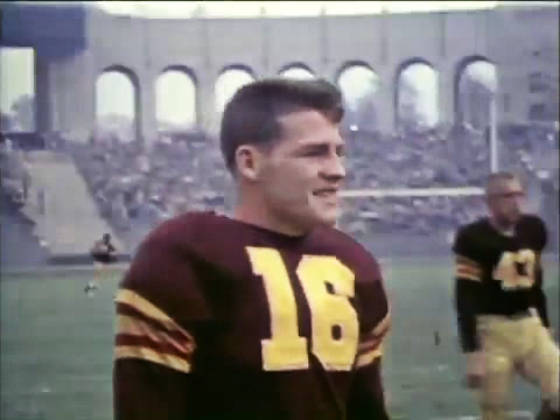
The Santa Monica-born Gifford wrote in his 2008 biography that he was given No. 16 by coach Jeff Cravath because USC initially recruited him as a quarterback after he spent a year at Bakersfield Junior College, trying to get his grades up as his dad provided for the family working in the oilfields. By the time Jess Hill took over as coach, Gifford became everyone’s All-American running back, piling up 841 yards on 195 carries, completed 32 of 61 passes, made 11 receptions, had three interceptions and kicked 26 PATs and two field goals. “Hill switched us from the T-formation to a combination of the winged T and the single wing and built his attack around me at tailback,” Gifford wrote in his autobiography. “Besides continuing to play defensive back, I ran, passed and blocked — and we won our first seven games.”

His first action was as a sophomore safety, recording two interceptions in a 42-20 season opening win against Navy at the Coliseum. He was also USC’s placekicker, making 25 of 31 PATs that season. A 22-yard field goal that season against Cal was USC’s first field goal made since the 1935 season, 14 years earlier. He led USC in scoring and interceptions in 1950.

Before he graduated, Gifford married his college sweetheart, USC homecoming queen Maxine Ewart, in early 1952, and they had three children. As a first-round pick by the NFL’s New York Giants — becoming a league MVP, an eight-time Pro Bowl pick and having his No. 16 retired by the franchise — he parlayed that into a longtime career as a TV broadcaster on “Monday Night Football.” Gifford was inducted into the inaugural USC Athletic Hall of Fame in 1994, after he made the College Football Hall of Fame in 1975, the Pro Football Hall of Fame in ’77 and the Sports Broadcasting Hall of Fame in 2012.

Garrett Anderson, California/Anaheim/Los Angeles Angels of Anaheim outfielder (1994 to 2008):

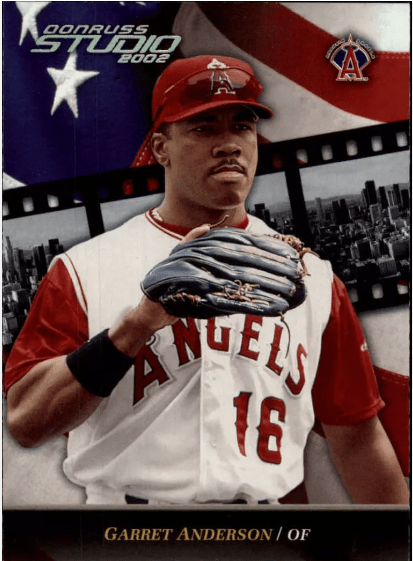
The 15 seasons he spent in three different variations of the Angels’ franchise existence speaks to the fact — no one else in franchise history had done that before (until Mike Trout tied it in 2024). The Kennedy High of Granada Hills standout was picked by the team in the fourth round right out of high school in 1990. He was second in the AL Rookie of the Year voting in 1995 (.321 in 106 games, 16 HR, 69 RBIs). The three-time AL All Star was MVP of the 2003 game when he came off the bench in the sixth to hit a two-run homer and a double in the eighth to lead to an AL comeback win. Anderson led the league in doubles with 56 in their World Series title year of 2002 and 49 the next season. He also won two Silver Slugger Award. He finished his 17-season career wearing N0. 9 for the Dodgers in 2010.

Rodney Peete, USC football quarterback (1985 to 1988):

The three-year starter was a dual-threat Pac-10 Offensive Player of the Year and as a senior combined to win the Johnny Unitas Award and Pop Warner Award — and finish second in the Heisman voting behind Oklahoma State’s record-breaking running back Barry Sanders. At a school known for its running game success, Peete finished as the all-time leading passer with 8,225 yards and 54 touchdowns, as well as 12 more rushing.

Willie Wood, USC football quarterback/safety (1957 to 1959):

After starring in Washington D.C. and coming West to play as a junior college All-American at Coalinga Junior College, Wood went to USC under first-year head coach Don Clark and became the first Black quarterback in the history of the Pacific Coast Conference (which became the AAWU, which became the Pac-8). Throwing for 772 yards and seven TDs versus eight interceptions, and running for two touchdowns, he was not picked in the 1960 NFL Draft. He wrote a letter to Green Bay Packers head coach Vince Lombardi to ask for a tryout, and the team signed him, but switched him from quarterback to free safety. From there he made it on five NFL Championships (including the first two Super Bowls), was a five-time All-Pro first team and four time second team, led the NFL in interceptions in 1962 with nine and, after 12 seasons, was voted into the Pro Football Hall of Fame.

Pau Gasol, Los Angeles Lakers center/forward (2008 to 2013-14):

His seven seasons with the Lakers as Kobe Bryant’s running made brought him three All-Star selections and two NBA titles, resulting in the team retiring his number in 2023, the same year he was inducted into the Basketball Hall of  Fame. The 7-footer from Barcelona who was the NBA Rookie of the Year with Memphis in 2002 came to L.A. in a deal that upset many league owners — the Lakers were able to unload Kwame Brown, Javaris Crittenton, Aaron McKie — along with his brother, future All Star Marc Gasol — to add him as Bryant’s teammate. In the first game Gasol played with Bryant, he caught a pass and scored, leading Bryant to yell to coach Phil Jackson: “We’ve got a big man that can catch and finish! We’re going to the Finals!” They did for the next three seasons. Gasol averaged 17.7 points and 9.9 rebounds in his seven seasons with the Lakers before leaving to Chicago. As for why Gasol wore No. 16: Rookies in Spain were given that number (or No. 17), as he was in his first season with F.C. Barcelona. He said he had so much success, he wanted to keep it.

Jarred Goff, Los Angeles Rams quarterback (2016 to 2020):

The Rams (and head coach Jeff Fisher) were so convinced they needed the 6-foot-4, 217-pounder out of Cal — even if it was the No. 1 overall pick in the 2016 draft– they gave Tennessee their first-round pick, two second-round picks and a third-round pick, plus their ’17 first- and third-round picks. Goff then signed a four-year, $27.9 million guaranteed contract. A two-time Pro Bowl pick, Goff wore No. 16 as a tribute to his idol, Joe Montana. Four noteworthy moments in his Rams career: On Nov. 19, 2018, he threw for 413 yards and four touchdowns as the Rams outlasted Kansas City, 54-51, at the Los Angeles Coliseum, the highest-scoring Monday Night Football ever. Goff then guided the team to a Super Bowl in the 2018 season (ending a 13-3 loss to New England. His contract option was picked up and extended to $134 million, with $110 million guaranteed, then an NFL record. In a Week 4 loss to Tampa Bay in 2019, Goff threw for a career-high 517 yards (completing a career-high 45 passes on 68 attempts with two TDs and three picks). But by the 2021 draft, the team changed course and traded him to Detroit in a deal (with a ’22 and ’23 first-round pick) for veteran QB Matthew Stafford.

Jim Plunkett, Los Angeles Raiders quarterback (1982 to 1986):

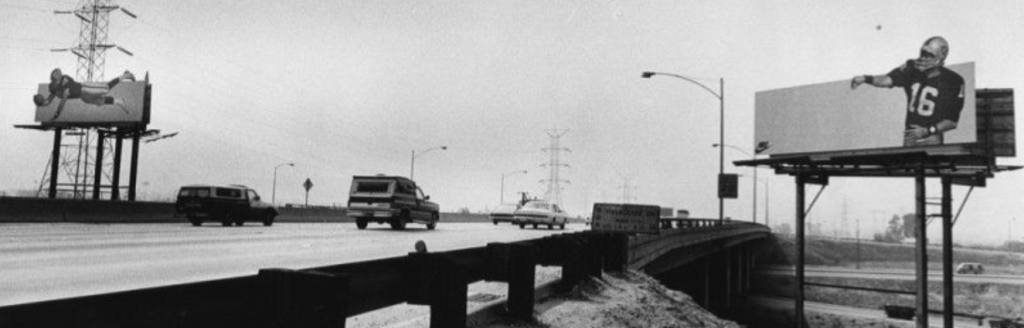
In 1985, a two-pannel billboard by Nike spanning the 605 Freeway near Irwindale showed Raiders quarterback Jim Plunkett, right, completing a pass to tight end Todd Christensen on the other side of the road. The Raiders had just started floating the idea about moving from the L.A. Coliseum to a new home in the San Gabriel Valley area of Irwindale. (Los Angeles Herald-Examiner photo/Mike Mullen/Los Angeles Public Library Digital Collection).

The last five seasons of his 15-year NFL career were in L.A., coming over with the Raiders after having spent three seasons previously in Oakland. In 1982 and ’83, he led the team to eight fourth-quarter comebacks, as well as eight game-winning drives. His record as a starter was 27-12. He arrived in L.A. after leading the Raiders to a Super Bowl XV title on Jan. 25, 1981.

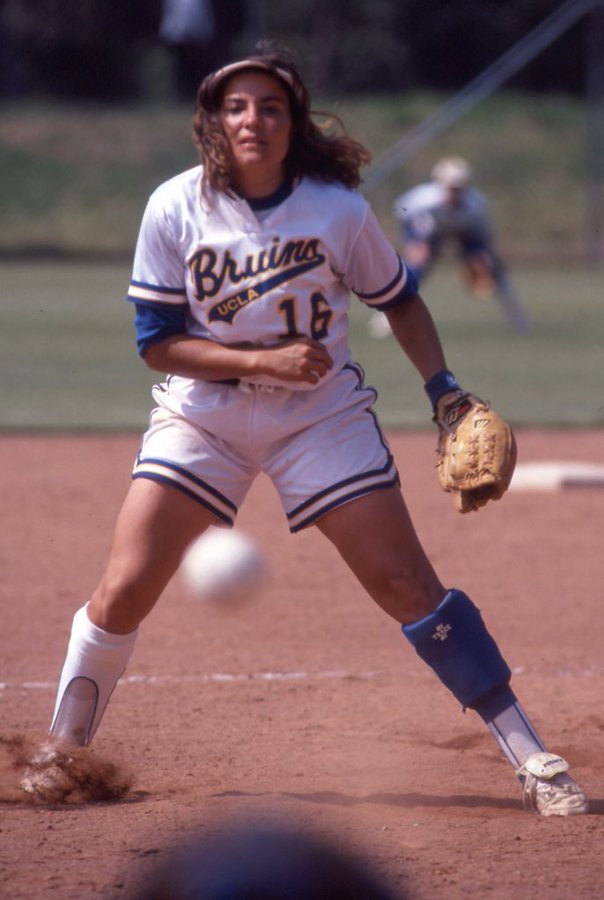
Lisa Fernandez, UCLA softball (1990 to 1993): A three-time winner of softball’s Honda Award, Fernandez became the first in her sport to win the Broderick Cup in 1993, given to the most outstanding collegiate female athlete in all sports. A four-time, first-team All-American led the Bruins to national titles in ’90 and ’92, plus runner-up finishes in ’91 an d’93. The Pac-10 Player of the Year her final three years, she posted a 93-7 record with a 0.22 earned run average, 784 strike outs and 74 shutouts. The Long Beach native from St. Joseph’s High also garnished three Olympic gold medals, in the 1996, 2000 and 2004 Summer Games.  

Andre Ethier, Los Angeles Dodgers outfielder (2006 to 2017): A two-time NL All Star had exactly 4,800 at bats in 12 seasons, where he collected a Gold Glove and Silver Slugger along the way. His top offensive season: 2009 when he hit 31 homers, 42 doubles, drove in 106, scored 92 times and played 160 games, finishing sixth in NL MVP voting. In Game 7 of the 2017 World Series against the Astros, he drove in the only run for the team in a 5-1 series-ending loss with a sixth-inning single. In doing so, he set a Dodgers franchise record by appearing in 51 career post-season contests.

Have you heard this story:

Brice Taylor, USC football fullback/offensive guard (1924 to 1926):

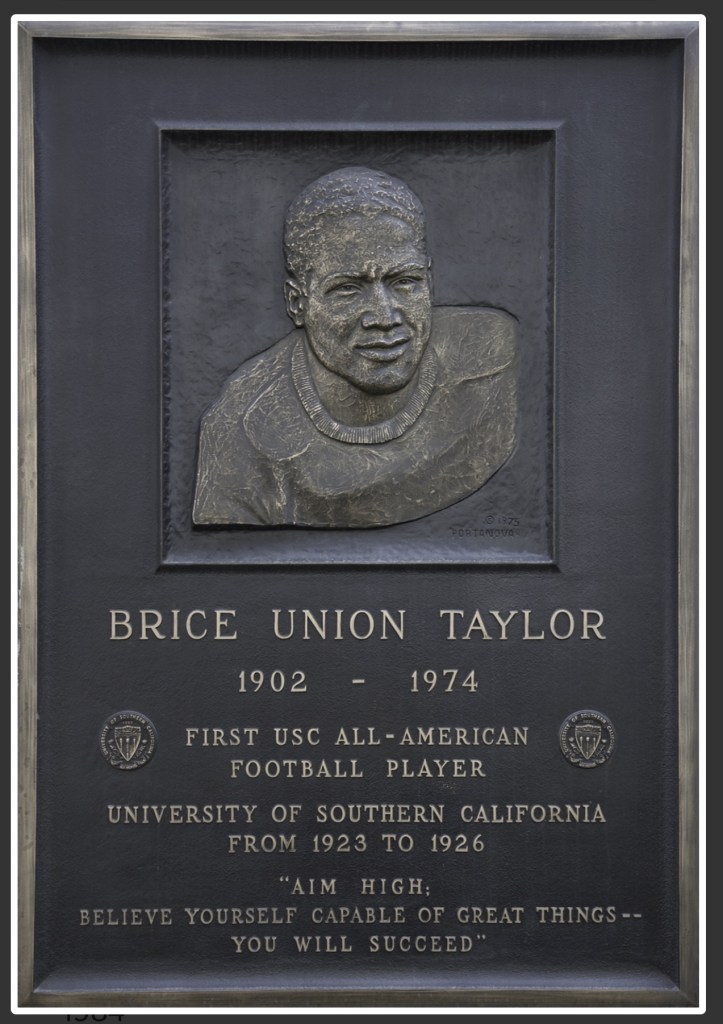
The Trojans’ first All-American player and its first African-American player was a descendant of African slaves and a Shawnee Indian chief, orphaned at age 5. Born without a left hand, he enrolled at USC as Gus Henderson’s starting fullback. When Howard Jones took over the next season, Taylor moved to the defensive line and was also its kicker. He played in all but four minutes of USC’s 11 games in 1924. Taylor was also a sprinter and hurdler at USC and picked to be on the U.S. Olympic track team in 1924. After he coached Southern University, a historically black college in Louisiana, where he started the Bayou Classic game with in-state rival Grambling State, Taylor circled back to become the coach at Jefferson High in L.A. as well as the associate pastor at the First African Methodist Episcopal Church. He was honored as the L.A. City Teacher of the Year in 1969 and L.A. Mayor Sam Yorty appointed him to the Mayor’s Community Advisory Board in ’65. Inducted into the USC Athletic Hall of Fame in 1995, Taylor also has a plaque honoring his career at the Coliseum’s Memorial Court of Honor. The Brice Taylor Award is given annual to USC alums for outstanding civic service. That’s the bronze plaque included in the Los Angeles Coliseum’s Memorial Court of Honor above.

Ken Hubbs, Colton High baseball (1957 to ’59):

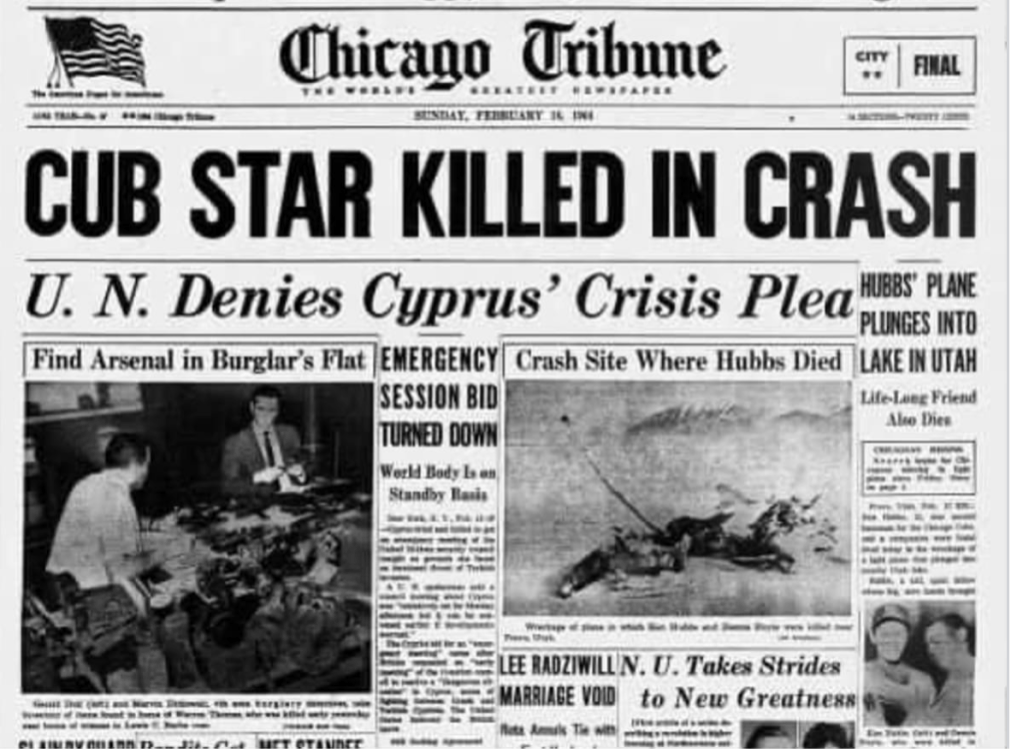
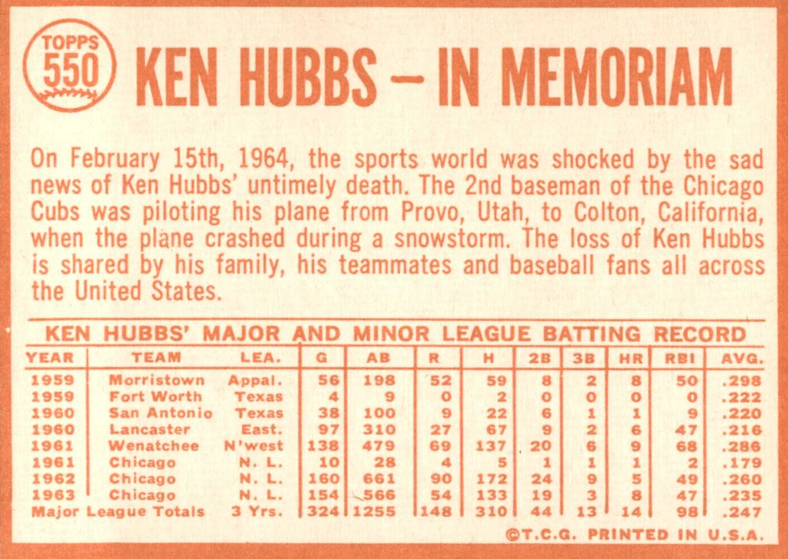
The 1962 National League Rookie of the Year for the Chicago Cubs as a Gold Glove winning second baseman rests today in Colton’s Montecito Cemetery, perishing in a private plane crash in February of 1964 at age 22. His funeral at Colton High’s Whitmer Auditorium drew some 2,000, including Cubs teammates and pallbearers Ron Santo and Ernie Banks. Wearing No. 16 for the Cubs — he came up as a 19-year-old wearing No. 33 for 10 games in the ’61 season — Hubbs played just two full seasons out. The number was never retired, but held out of circulation for nearly a decade. Hubbs was already a local legend a 12 year-old in the 1954 Little League World Series as the shortstop on the Colton team that made it to the championship game where it lost to Schenectady, N.Y. He hit a home run in the game with a broken toe. At Colton High he was All-CIF in football, basketball and baseball and was was a high jumper on the track team. The 1959 Los Angeles Examiner “Best All-Around Athlete in Southern California” was recruited to play basketball for John Wooden at UCLA as well as play quarterback at Notre Dame. A member of the Church of Latter-Day Saints, Hubbs was considering going to BYU or USC when he was signed to a $50,000 bonus to join the Cubs. As a rookie in ’62 he set an MLB record with 78 consecutive games/418 chances without an error — his glove remains on display at the Baseball Hall of Fame. The Riverside-born athlete who was All-American in football and basketball is remembered with the Ken Hubbs Award from the family foundation for the top high school male and female athlete in San Bernardino, celebrating its 60th year in 2024. Notable winners have been Football Hall of Famer Ronnie Lott (1977) and eventual Heisman Trophy winner Jayden Daniels (2019). The L.A. Times’ Jim Murray wrote: “Kenneth Douglass Hubbs was more than just another baseball player. He was the kind of athlete all games need. A devout Mormon, a cheerful leader, a picture-book player, blond-haired, healthy, generous with his time for young boys; he was the kind of youth in short supply in these selfish times.”

We also have:

Rocky Colavito, Los Angeles Dodgers outfielder (1968)
Paul McDonald, USC football quarterback (1976 to 1979)
Will Smith, Los Angeles Dodgers catcher (2019 to present)
Paul LoDuca, Los Angeles Dodgers (1998 to 2004)
Holly McPeak, UCLA women’s volleyball setter (1990)
Eddie Joyal, Los Angeles Kings (1967-68 to 1971-72)
Anyone else worth nominating?

No. 55: Gavin Smith

This is the latest post for an ongoing media project — SoCal Sports History 101: The Prime Numbers from 00 to 99 that Uniformly, Uniquely and Unapologetically Reveal The Narrative of Our Region’s Athletic Heritage.  Pick a number and highlight an athlete — person, place or thing — most obviously connected to it by fame and fortune, someone who isn’t so obvious, and then take a deeper dive into the most interesting story tied to it. It’s a combination of star power, achievement, longevity, notoriety, and, above all, what makes that athlete so Southern California. Quirkiness and notoriety factor in. And it should open itself to more discussion and debate — which is what sports is best at doing.

The most obvious choices for No. 55:
= Orel Hershiser, Los Angeles Dodgers
= Junior Seau, USC football
= Willie McGinnest, USC football
= Chris Clayborne, USC football
= Kiki Vandeweghe, UCLA basketball
= Gary Cunningham, UCLA basketball

The not-so-obvious choices for No. 55:
= Jack Robinson, Pasadena City College football
= Maxie Baughan, Los Angeles Rams

The most interesting story for No. 55:
Gavin Smith, UCLA basketball forward (1973-74 to 1975-76)
Southern California map pinpoints:
Van Nuys, Sherman Oaks, Westwood, Hollywood, Calabasas, West Hills, Porter Ranch, Palmdale


Season 2, Episode 4 of “Homicide: Los Angeles,” the Dick Wolf-created Netflix documentary, is called “A Hollywood Affair.” It aired in July of 2024.

The synopsis: “When a Hollywood studio executive goes missing, a tumultuous affair comes to light, leading investigators to suspect foul play.”

Maybe this evolved from:

Season 25, Episode 47 of NBC’s “Dateline NBC” is titled “Dark Valley.” It aired in September of 2017.

The synopsis: “A philandering film executive, Gavin Smith, goes missing. Is he seeking a new life or has he upset a dangerous rival?”

Surely, host Keith Morison can make this seem even more supernatural.

What else ya got, gumshoe?

Season 5, Episode 9 of “The Perfect Murder,” another made-for-TV series that recreates crime scenes with actors. The title is “Jump Shot.” It aired in September of 2018.

The synopsis: “Hollywood ‘golden boy’ Gavin Smith — a 20th Century Fox executive and former star UCLA basketball player — disappears one night in May, 2012. His family and detectives search tirelessly for answers, but a group of heartless and selfish characters will hold fast to their secrets.

Now the plot thickens. Maybe even into a pasty batter.

Yet, what’s truth and what’s fiction?

In the pantheon of UCLA’s storied basketball, was Gavin Smith really a “star” player with the Bruins’ program? Only if it helps draws in viewers. And how you define player at various points in his evolution.

Gavin Smith was 57 when he died. Or, rather, when he was murdered. And buried. And found two years later.

Let’s investigate all this further.

The background

As a group of former UCLA basketball players honor coach John Wooden in 2003, Gavin Smith stands just to Wooden’s left, holding his left hand.

Van Nuys News columnist Bernie Milligan wrote in 1973 about this 6-foot-6, 190-pound hot shot at Van Nuys High was, “according to most who see him play, the greatest thing to come along in basketball since Elgin Baylor.”

Gavin Smith, who by then was included in a Washington Post story that identified him as of the top 15 basketball players in the country, grew up in Sherman Oaks without playing organized basketball until he was 13. So when he sprouted up in height and average 27 points and 16 rebounds a game in his senior year at Van Nuys to win Mid-Valley League MVP, wearing No. 33, the days that he was remembered as a baseball pitching prospect for the school that created Don Drysdale was long gone.

As Smith told Milligan: “I was a scatter arm and never knew exactly where the ball was going.”

To further prove his athleticism, Smith won the league championship in the long jump and finished sixth in the L.A. City final.

When the Los Angeles Times posted a March 20, 1973 story announcing the L.A. All-City basketball team — Crenshaw’s Marques Johnson was named Player of the Year — it noted that Smith had been “called by one college coach the ‘best white player in the country’.” That quote came from Washington State head coach George Raveling, who had been actively recruiting him. Raveling could get away with saying such a thing that these days might raise eyebrows.

A month later, after returning from the Dapper Dan Classic high school all-star game in Pittsburgh, Smith, who had been a second-team Parade Magazine All-American, gave Raveling his answer — he decided to bank on John Wooden and UCLA.

Wooden’s assistant, Frank Arnold, got him to join a recruiting class that included the same Marques Johnson, plus Richard Washington and Jim Spillane. UCLA fans were told that Smith would remind them of former Bruins star Keith Erickson, both in looks and how he played.

From the UCLA 1973-74 basketball media guide.

UCLA, coming off seven straight NCAA titles, had a 1973-74 roster with seniors Bill Walton, Keith Wilkes and Tommy Curtis, plus juniors David Meyers and Pete Trgovich. Smith could likely have been a starter anywhere else with freshmen eligible now.

“The main reason I chose UCLA was that if I play there, I’ll be playing against the best players and that’s why they win championships,” said Smith. “The players are so good that if you don’t do the job they can have someone else who can.”

As a freshman, Smith practiced with the varsity team and got into seven games, scoring nine points with five rebounds. In nine of the Bruins’ 18 JV games, he averaged 15.7 points, third best on the team, and seven rebounds a contest.

As a sophomore, Wooden had Smith come off the bench in 17 games. As he scored 60 points with 18 rebounds, a key contribution was in an 82-75 win at Pauley Pavilion in December of ’74 against rival Notre Dame. Smith his two long jump shots over the Irish’s 2-1-2 zone during a 10-point run that got UCLA back in the game.

“I was extremely pleased with Gavin,” said Wooden afterward. “Gavin played under control, dribbled well and made a few good shots.”

The Bruins won the 1975 NCAA title that season, the last for Wooden as he retired. Smith didn’t play in that 92-85 championship win over Kentucky.

UCLA’s 1974-75 NCAA title team. Gavin Smith (55), second from left, front row.

Now Smith went into his junior year finally declaring a major — political science — and trying to declare a reason new head coach Gene Bartow should give him more playing time.

Smith still couldn’t break into the starting lineup, stuck now between a shooting guard and a small forward depending on the opponent. He played in 30 games for a Bruins’ team that won the Pac-8 at 12-2, and finished fifth in the final AP poll at 27-5. Smith scored 179 points (6.0 a game) to go with 55 rebounds (1.8 a game) and 22 assists (0.7 a game). During a stretch of games in January and February of ’76, there were some double-digit point production. The Pauley Pavilion crowd picked up on it and often chanted “Shoot, Gavin, shoot!”

UCLA’s season ended with a bitter loss in the NCAA national semifinals to Indiana, 65-51. Smith managed six points in nine minutes with three personal fouls in that game, but in a follow up in the Los Angeles Times, he wasn’t shy about complaining about his limited playing time, benched after his fast-break layup cut Indiana’s lead to six points with six minutes left.

“I could understand it if I were throwing up bricks,” said Smith. “But I wasn’t. I don’t understand why I’m not in there when others are cold.” He also pointed out teammates were playing with a lack of intensity. “We should have had the attitude that we’re the defending champs and Indiana had to beat us. I didn’t have much to do with anything but when I’m in a game I’m fired up and I’ll even scream at some of our dudes.”

The Daily Breeze: March 7, 1976.

In those days, there was a third-place game, and UCLA handily defeated Rutgers, 106-92. Smith had eight points (3 of 9 shooting) and six rebounds in 15 minutes off the bench.

It would be his last game for the Bruins.

On that ’75-’76 roster, nine UCLA players would go into the NBA. Marques Johnson, of course, as eventual winner of the Wooden Award, was coming back for his senior year. David Greenwood now starting on the front line with Richard Washington. Bartow had Palisades High’s Kiki VanDeWeghe and Redondo High’s Gig Sims as new big men on their way in for the ’76-’77 season. Guard play would be split between senior Jim Spillane, junior Raymond Towsend and sophomores Brad Holland and Roy Hamilton.

Smith was caught in between. By July, 1976, his fate was sealed. UCLA declared him scholastically ineligible. The story wasn’t clear how that happened, but it did. and he was free to go.

When Smith’s transferred out to the University of Hawaii, one of his original three schools of interest coming out of high school, VanDeWeghe would get his Bruins’ No. 55 jersey.

Given not just a starting role but a starring one on the island, Smith averaged 23.4 points a game for the Rainbow Warriors, a program that had started just seven seasons earlier and was still an independent.

Just before Smith arrived, at the end of the ’75-’76 season, former graduate assistant Rick Pitino had his first head-coach experience on an interim basis, at age 24. But something was amiss. As Hawaii hired Larry Little as its new coach, he brought in Smith, and the program finished 9-18 in ’76-’77, just as it was hit an NCAA sanction related to Pitino recruiting violations and player benefits.

Smith set four Hawaii program records — most points in a single season (608), best scoring average (23.4), plus most field goals and most field goal attempts (252 of 571), all before the 3-point line came into effect. Those marks that still stand. He had a season-best 37 points with 13 rebounds in an 18-point loss to Oregon State. He also led Hawaii in rebounds (6.5 a game).

He was on the West team for the Aloha Classic college All-Star game, teammates again with Johnson and Spillane.

Not all was smooth sailing in Hawaii for Smith, known for wearing his hair long held with a bandana and bringing his dog to practice. He was suspended one game when he and some teammates broke a curfew. He was also on shaky ground when the school’s second semester started and he hadn’t registered for classes, was thought to be ineligible, but Little scrambled to get him enrolled again.

In a March, 1977 story for the Los Angeles Times, reporter Earl Gustkey caught up with Smith as Hawaii faced Long Beach State at the Long Beach Arena. In that February 24 game, Smith missed his first seven shots, including three air balls, was 2-for-12 at halftime as his team trailed by 21, and ended up with just 12 points in a 110-79 loss before fouling out as well as getting a technical foul. A few games later, in a 40-point loss at UNLV, Smith had 18 points but fouled out with 14 minutes left.

The Times’ feature on Smith ran in the Honolulu Star-Advertiser under the headline “Smith, the former future UCLA star.

“Geez, I was horrendous,” said Smith, back to wearing the No. 33 from Van Nuys High, talking about that loss in Long Beach.

Smith then explained how his situation at UCLA ended:

“I had a long talk with coach Bartow and he told me it’d be very difficult to keep me out of the starting lineup this year, but it wasn’t a guarantee. I was fed up and a little perturbed. I mean, I’m no average ball player and I’d sat for three years.

“After three years, after all the mental and physical exertion from my body, I’d gotten zero in return in terms of playing time. I just became unhappy with the situation. So after my talk with Bartow, I just left.

“A lot of people think I flunked out of UCLA, but I didn’t. I just left. I didn’t even both to drop my classes. I’d met a lady from Santa Rosa, so I went up there with her.”

Women can do that to you.

The aftermath

Gavin Smith, left, wife Lisa, center, and sons Dylan, Austin and Evan.

A 2024 issue of People magazine did a whole big to-do about the life and times of Gavin Smith. It’s probably most appropriate we allow that magazine to pick up the story from here with its collated research:

After playing, it seemed almost natural that Smith pursue a career in the entertainment industry — his mother was an assistant movie producer, as well as a script supervisor and got him involved in the business at an early age. 

The stereotypical California sun-tanned, tall and handsome figure first came in as a stuntman. He hurt his back. The meds he used caught up with him.

Smith’s IMDb.com resume also notes small acting roles in three film and TV spots — a bartender in “Cobb, a bodyguard in “Glitz,” and a role in “Swingin’ in the Painter’s Room” — an 11-minute black-and-white film where Smith is ID’d as “Guy with Fur Hat.”

As an aspiring actor, Smith was also the stereotypical part-time waiter scrambling for a paycheck. That’s where he first met his eventual wife, Lisa Dobson.

“I just thought he was charming and I was thrilled when he asked me for my number,” Dobson said on Dateline in 2017. “He was a wonderful husband. He was a gentleman … He made me feel like a princess.”

Smith found work in 20th Century Fox and somehow worked his way up to the head of film distribution. His top projects included the original “Star Wars” trilogy, “Titanic” and “Avatar,” as a liaison between the studio and theaters. He also got involved in the creative process, working from the studio’s Calabasas office.

Smith and Dobson had three sons: Evan, Austin and Dylan. While Smith worked in the film industry, Lisa raised the kids. Evan, born in 1990, would grow to a 6-foot-7 forward at Calabasas High, averaging 17.7 points and 9.3 rebounds as a senior, making the CIF-SS Division III first team. Wearing No. 22, he went to play at USC from 2009-10 to 2010-11, getting into just 11 games as a freshman and sophomore for coach Kevin O’Neill before an injury derailed him.

According to friends who spoke to The Daily Beast in 2012, the couple’s relationship had been on the rocks. Smith had substance abuse issues as well as financial problems as they bought a house during the 2008 financial crisis and were underwater with bills.

“They were not separated. They were just going through normal stuff couples go through,” Evan told E! News in 2012.

Dobson turned to religion for comfort. Smith turned to the company of Chandrika Cade, a married woman he met during a 2008 stay in rehab center. When Smith’s family found out about his affair, Smith insisted he would call things off — but his promise was only temporary.

“I was the love of Gavin’s life,” Dobson said. “He adored me. Our family was exactly what he wanted to have. He just got lost.”

Then, in May, 2012, Smith officially did get lost. He disappeared.

The L.A. Sheriff’s Department reported that Smith was last seen in the Agoura Hills/Oak Park area in a black Mercedes with the California license plate 6EKT004. The family asked publicly for anyone’s help in the search.

As it turned out, on the evening of his disappearance, Smith secretly met up again with Chandrika Cade. This time, her husband, convicted drug dealer John Creech, tracked them down.

Creech, who found out about the affair in 2010, killed Smith with his bare hands.

Smith’s body wasn’t discovered until more than two years later.

The trial and aftermath

From the Facebook group page: Remembering Gavin Smith

Evan Smith told People Magazine in 2019: “(My dad) just messed up. He got a little lost, and I know if he was still here today that he would be so apologetic for how things finished up.”

As more and more information came out, it was revealed that Evan and one of his brothers had actually approached Creech to apologize for their father’s actions, begging for Creech not to retaliate. Creech told the boys that they saved their father’s life with that visit.

Evan then told his father that he had to “be better” if he wanted to continue to be a part of their family unit. Learning later his father had continued the affair, Evan says he was “crushed.”

In the days before his 2012 disappearance, Smith attended the CinemaCon movie convention in Las Vegas. He went back to the San Fernando Valley, but opted to stay with a nearby family friend in Oak Park on the night of May 1 instead of his West Hills home.

Smith and the friend watched television together before she retired to bed, expecting him to do the same later in the evening.

“They had already gone to bed,” Dobson told ABC. “So, he was still downstairs watching TV when our friend went to bed. And he was going to be coming up to bed shortly.”

But, at around 10 p.m., Smith left in his black Mercedes, wearing purple workout pants that belonged to Evan and he intended to wear to bed. He left most of his belongings behind. According to phone records acquired by police, Smith’s last GPS signal came from Sylmar at 4:30 a.m. on May 2, about 30 minutes from his home.

That morning, his family sensed something was wrong because Smith was supposed to pick up Austin for school. When that didn’t happen, and he didn’t make it to work, Dobson filed a missing person report. Flyers went out. A hotline was established. A $20,000 reward was offered. An episode of “America’s Most Wanted” even did a segment on the case.

At that point, the LAPD started to investigate Creech and Cade, going to their Canoga Park home, seizing cell phones and computers as well as their SUV.

In February of 2013, L.A. County Sheriff’s deputies found Smith’s Mercedes in a Simi Valley storage facility, led to that unit after Creech’s vehicle was found during a drug bust. After inspection, the evidence led to the belief that was where Smith was murdered. Creech was now the person of interest, as he was already serving two years of an eight-year sentence in L.A. County Men’s Central Jail on drug charges.

On Oct. 26, 2014, Smith’s remains were discovered in a shallow grave by a group of hikers in Palmdale, going into Angeles National Forest, 70 miles away from the home where he disappeared.

In January 2015, the district attorney officially filed murder charges against Creech. A grand jury indicted him. In the months that followed, hundreds of pages of court transcripts were made public through the Los Angeles Times.

Testimony from Cade revealed she met up with Smith late in the night when he disappeared. Her husband tracked her location and snuck up on the pair. Cade said Creech immediately began beating Smith and threatened to harm her as well. After pleading for her husband to stop, she fled the scene and returned home in her own vehicle.

Creech then beat Smith to death. The county coroner said Smith’s skull had been crushed on both sides.

Creech decided to store Smith’s Mercedes in a friend’s garage in Porter Ranch, then went to the desert to bury Smith’s body. Creech and several accomplices kept Smith’s death a secret for years as the investigation was underway.

When the trial began in 2017, the Los Angeles Times headline read: “A lurid tale of sex, deceit and brutality as trial begins in the slaying of Fox executive.” Wonder where the subsequent TV shows got their titles from.

Prosecutors described Smith’s murder as “an act of almost stunning brutality — almost indescribable violence.” Creech’s attorney, Deputy Public Defender Irene Nuñez, called her client’s actions self-defense, that he feared for Cade’s safety, found the two in Smith’s car, and Smith began to attack him. He also alleged Smith chased him with a weapon — never found — causing Creech to fight back.

When Creech took the stand, he took “full accountability” for not contacting authorities to help find Smith, per NBC News.

Cade also testified that Creech was covered in blood when he came home later that morning of Smith’s disappearance. She said her husband told her Smith was dead, and they burned their clothes in the home’s fireplace.

At the end of the trial, the jury was presented with several options including first- and second-degree murder. Instead, they found Creech guilty of voluntary manslaughter after an hour of deliberation.

In July 2017, Creech was sentenced to the maximum 11 years in prison. His accomplices were not charged. Cade was not charged. They were given plea deals. In 2019, Creech’s conviction was upheld by a state appeals court.

Detective John O’Brien was disappointed in the verdict, suggesting that the jury had been biassed against Smith because of his infidelity.

“My opinion is that they didn’t like the fact that Gavin and Chandrika had an affair,” he said. “I think the jury felt that he went back even after he had been warned, so in a way he kind of got what was coming to him. I don’t even understand that logic, because there’s no right to kill somebody.”

Gavin Smith’s friends continued to remember him as a “larger-than-life” personality devoted to his sons and hoping to repair his relationship with his wife. Following his death, they worried his memory had been tainted by the sensational circumstances of the murder case.

“He wasn’t some adulterer having flings here and there… that just wasn’t him,” Smith’s brother Greg said. “Unfortunately this liaison cost him his life. Smiling, always happy, he was bigger than life. I loved him and I miss him, but he’ll always be here. Always.”

Makes you wonder: If Gavin Smith had been shown the script for this story, would he have believed it?

Instead, it gets retold now by those who can still milk it for all its details. Over and over again.

Who else wore No. 55 in SoCal sports history? Make a case for:

Orel Hershiser, Los Angeles Dodgers pitcher (1983 to 1994, 2000):

Just reciting the facts and figures of the 1988 season where Hershiser won the Cy Young Award, World Series MVP, NLCS MVP, broke the MLB record for consecutive scoreless innings at 59 (going 10 innings in a 1-0 win in his last start to do it of the regular season), a Gold Glove, sixth in the MVP voting and doing whatever was necessary to pitch the Dodgers to the World Series title as a heavy underdog to both the New York Mets and Oakland A’s makes sure he will never have to buy a drink in Southern California for as long as he lives.

That came after an 1985 season when he 19-3, a 2.03 ERA, nine complete games, and third in the Cy Young voting.

His decision to then become a broadcaster and latch onto the Dodgers’ SportsNet L.A. broadcast team only has made him more visible that people still congratulate him for his induction in the Baseball Hall of Fame for still having his “world record,” as he told us in 2013.

A few of his memorabilia may be on displayed in Cooperstown, but there is no plaque. He had just 11 percent of the votes in his first year of eligibility of 2006. Veterans committees in 2017 and ’19 didn’t generate enough interest. The Bill James’ “Hall of Fame Monitor” has him with a score of 91, when 100 is the passing threshold. Hershiser’s 56.0 career WAR, and 40.1 seven-year peak, while impressive, had him, at time, comparable to Hall of Famers Catfish Hunter and Dazzy Vance on his career trajectory.

The Dodgers’ 17th round pick in 1979 out of Bowling Green made the full circle of his career path when, after leaving as a free agent to play with Cleveland, San Francisco and the Mets, returned to the Dodgers in 2000 at age 41, but lasted until June 27. The 24 innings he pitched to accumulate a 1-5 mark and 13.14 ERA in six starts was not the pitcher who led the National League in innings pitched for three straight seasons from 1987 to 1989, piling up 33 complete games in that span and winning 55 games with ERAs of 3.06, 2.26 and 2.31. His 204-150 record and 3.48 ERA in an 18-year career over more than 3,000 innings, including a comeback from revolutionary shoulder surgery by Dr. Frank Jobe, got Hershiser’s No. 55 put into the Dodgers’ “Legends” status in 2023, a subset of having it fully retired in the “Ring of Honor.” Frequent bobblehead nights in his honor are often still bestowed and milestone anniversaries celebrated. The “Bulldog” will always be top dog.

Kiki VanDeWeghe, UCLA basketball forward (1976-77 to 1979-80); Los Angeles Clippers forward (1992-93):

Out of Palisades High, the 6-foot-8, 220 pounder got his basketball DNA from his father, Doc Vandeweghe, a shooting guard for six seasons with the NBA’s New York Knicks from 1949 to 1956. In his four seasons in Westwood, Kiki VanDeWeghe (who changed the spelling of his name in 2013) was an Academic All-American and NCAA post-graduate scholarship award winner leading the Bruins to a Final Four. He averaged 14.2 points (11th in the Pac-10) and 19.5 points a game (second in the conference) his final two seasons at UCLA, plus 6.3 and 6.8 rebounds. In his UCLA Athletic Hall of Fame induction in 1994, it noted VanDeWeghe was a first-round draft choice of Dallas in 1980, held out and was traded to Denver (with an ’86 first-round pick for the ’81 and ’85 first-round picks) where he played 13 seasons in the NBA for the Nuggets, Trailblazers, Knicks, and Clippers. VanDeWeghe was also general manager of the Mavericks and New Jersey Nets, then assigned himself as the Nets head coach in 2009-10 after Lawrence Frank started 0-16. He ended his 13-year NBA run (which included two All Star appearances with Denver in the early ‘80s) by playing in half the Clippers’ games in his age 34 season. VanDeWeghe once had a 51-point game in 1983 during Denver’s 186-184 3 OT loss, making 21 of 29 shots with no three-pointers. A month later he had a 50 point game in a 163-155 win over San Antonio.

UCLA’s Gary Cunningham (55) featured on the cover of Sports Illustrated in action against USC.

Gary Cunningham, UCLA basketball (1959-60 to 1961-62):

The 6-foot-6 sharpshooter at Inglewood High became a three-year starter was on the Bruins’ first Final Four appearance team in the ’62 tournament. His value to the program came as John Wooden’s assisant coach from 1965 to ’75 on six national title teams, including a run as the freshman team coach that featured all the top incoming players such as Lew Alcindor. He then became UCLA’s head coach from 1977 to ’79, compiling a 50-8 record with a No. 2 ranking in the final polls both seasons. He has the greatest winning percentage as a UCLA coach at .862. He retired in 2008 after 13 years as the athletic director at UC Santa Barbara. In his 2001 UCLA Athletic Hall of Fame induction, it was noted that as the ’62 team’s co-captain, he was also winner of the Ducky Drake Award for best spirit, inspiration and team contribution and a three-time winner of the Ace Calkins Award as Bruin free-throw champion.

The USC “Club 55” tradition:

USC linebacker Jim Snow (55, right) moves in on Purdue quarterback Bob Griese during the Jan. 2, 1967 Rose Bowl. Purdue won, 14-13.

Junior Seau, USC football linebacker (1987 to 1989):

Tiaina Baul “Junior” Seau Jr., may have started a practiced tradition of having the No. 55 bestowed upon the Trojans’ most influential linebacker. In ESPN’s 2020 list of the 150 greatest college football players in the game’s first 150 years, Seau ranked No. 105. His bio noted his 107 tackles and 33 tackles for losses at USC and included: Because of academic restrictions, Seau played only two seasons for the Trojans, but he left an indelible mark. In 1989, he had 19 sacks and 27 tackles for loss and was named a unanimous All-American and the Pac-10 defensive player of the year. The Trojans went 19-4-1, won back-to-back conference titles and played in two Rose Bowls in his two seasons. After bypassing his senior season, Seau was the fifth pick of the 1990 NFL draft and played 20 seasons as a pro, and 12-time Pro Bowl player and a member of the NFL’s 100th Anniversary Team. He wore  No. 55 throughout his professional career and had it retired by San Diego, which took him No. 5 overall in the 1990 draft. In 2015, he became the first player of Polynesian and Samoan descent to be inducted into the Pro Football Hall of Fame. Seau died on May, 2012 of a self-inflicted gun wound to his chest. He was 43. Studies by the Naitonal Institute of Health showed Seau had chronic traumatic encephalopathy (CTE) brain disease cause by repetitive head trauma.

The family of Junior Seau — including his mother Luisa, and his four children — were given a framed No. 55 jersey during a brief ceremony between the first and second quarters of USC’s game against Hawaii on Sept. 1, 2012. (Photo by Harry How/Getty Images)

Willie McGinest, USC football linebacker (1990 to 1993):

The USC football jersey No. 55 for sale at the campus store.

Out of Long Beach Poly High, where he had all-state honors in football and basketball, McGinest was All-Pac-10 Conference three straight years and given All-American status. During his senior year, he was a Lombardi Award finalist. Starting every game at weak-side defensive end, McGinest finished his collegiate career with 193 tackles (134 solos), 29 sacks (171 yards), 48 tackles for loss (238 yards), and 26 passes batted away. The fourth overall pick of the 1994 draft by the New England Patriots, McGinest had a 15-year NFL career with two Pro Bowls and three Super Bowl titles.

Chris Claiborne, USC football linebacker (1996 to 1998):

USC coach John Robinson continued the No. 55 tradition with Claiborne, giving him the number he wore at Riverside North High. “We told him he had to wear 55 because he was going to be great player,” Robinson recalled. “He didn’t think it was great at the time. Once he got in it and recognized it was special, he liked it.” Claiborne went on to become the only USC player to win the Butkus Award, presented annually to the nation’s top linebacker. He was the No. 9 overall pick in the 1999 draft by Detroit. He went on to become the head football coach at Calabasas High in 2018 and was on the USC staff in 2020 as a quality control analyst.

Keith Rivers, USC football linebacker (2004 to 2007):

Born in Riverside, Rivers decided to go to USC over many other offers to be the latest No. 55. USC linebacker coach Ken Norton Jr., gave him the nickname “The Shark” for his aggressive play. He started out on USC’s ’04 national title team as a freshman and would have 215 tackles in his 49-game career before he was the No. 9 overall pick of Cincinnati in the 2008 NFL draft. Rivers once said of honoring Seau by wearing No. 55: “It started with him and lived through all of the 55s that carry the torch.”

Have you heard this story:

Jack Robinson, Pasadena Junior College football running back (1938):

A statue sits outside the Rose Bowl depicting Robinson’s days at the junior college and sporting the No. 55. It commemorates the 13 games he played at the Rose Bowl — four when he attended John Muir High School and nine during his time attending Pasadena Junior College (today known as Pasadena City College). In one notable game against Caltech, Robinson scored a Rose Bowl-record touchdown with a 104-yard kickoff return. That record, which still stands, is likely the inspiration for the statue’s stance.

Tom Fears, UCLA end (1946 to ’47); Los Angeles Rams right and left end/defensive end (1948 to 1956):

Born in Guadalajara, Mexico, Fears was a standout at L.A.’s  Manual Arts High and joined his friend, Toby Freedman, from Beverly Hills High, to enroll at Santa Clara University. Drafted for military service for World War II, he had three years of service and played football at the Colorado Springs platoon.  An 11th-round draft pick of the Cleveland Rams, Fears went to UCLA instead, wearing No. 50 for two seasons as an All-American player. When the Rams’ franchise moved to Los Angeles in ’47, Fears joined them in ’48 for a $6,000 contract and $500 bonus. He led the NFL with 51 receptions despite starting just one of the 12 games. He’d lead the NFL again with 77 catches (a league record) and nine touchdowns in ’49 (to go with 1,013 yards) and, in his only Pro Bowl season, was tops with 84 catches (breaking his own league record) with 1,116 yards and 93 yards a game. In 1952, Fears switched to No. 80 and would keep that the last five years of his career, lasting all nine years in L.A. He died at age 76 in 2000 in Palm Desert as a member of the Pro Football Hall of Fame, the College Football Hall of Fame, and included into the UCLA Athletic Hall of Fame in 1989. Fears was also a Rams’ coach under former teammate Bob Waterfield in the 1950s. He was also named president of the All-Sports Council of Southern California and spent a year coaching at San Bernardino JC and Chapman College. He was director of player personnel for the USFL’s Los Angeles Express in its first year.

Maxie Baughan, Los Angeles Rams linebacker (1966 to 1970):

A Pro Bowl pick in four seasons and first-team All-Pro three times during his five seasons with the Rams, Baughan pulled in 11 interceptions total with the franchise. He came to Los Angeles in a trade to play for head coach George Allen, starting his first season with the organization. Baughan was chosen to be the Rams’ defensive captain and was in charge of signal calling. After an injury-plagued 1970 season, in which he played in only 10 games, Baughan retired from the NFL. But his contractual rights were traded in 1971 to Washington — where Allen had just gone off to work. That deal included Baughan going with Jack Pardee, Myron Pottios, Diron Talbert, John Wilbur, Jeff Jordan and a 1971 fifth-round pick to the Redskins for Marlin McKeever, first- and third-round picks in 1971 (which turned out to be Isiah Robertson and Dave Elmendorf, plus five-more draft picks. After two years as a defensive coordinator at his alma mater, Georgia Tech, Baughan was coaxed by Allen to become a player-coach with his Redskins in 1974 at age 36 for one last season. He was up for Pro Football Hall of Fame considerations in 2025.

We also have:

Albert Pujols, Los Angeles Dodgers (2021)
Russell Martin, Los Angeles Dodgers (2006-2010, 2019)
Jason Isringhausen, Los Angeles Angels (2012)
Tim Lincecum, Los Angeles Angels (2016)
Hideki Matsui, Los Angeles Angels of Anaheim (2010)
Matt Millen, Los Angeles Raiders (1980 to 1988)
Carl Ekern, Los Angeles Rams (1976 to 1988)

Anyone else worth nominating?

Nos. 30 and 44: Bo Kimble and Hank Gathers (and Paul Westhead)

This is the latest post for an ongoing media project — SoCal Sports History 101: The Prime Numbers from 00 to 99 that Uniformly, Uniquely and Unapologetically Reveal The Narrative of Our Region’s Athletic Heritage.  Pick a number and highlight an athlete — person, place or thing — most obviously connected to it by fame and fortune, someone who isn’t so obvious, and then take a deeper dive into the most interesting story tied to it. It’s a combination of star power, achievement, longevity, notoriety, and, above all, what makes that athlete so Southern California. Quirkiness and notoriety factor in. And it should open itself to more discussion and debate — which is what sports is best at doing.

The most obvious choices for No. 30:
= Nolan Ryan: California Angels
= Maury Wills: Los Angeles Dodgers
= Rogie Vachon: Los Angeles Kings
= Bo Kimble: USC, Loyola Marymount University, Los Angeles Clippers
= Dave Roberts: Los Angeles Dodgers
= Lawrence McCutcheon, Los Angeles Rams

The most obvious choices for No. 44:
= Jerry West, Los Angeles Lakers
= Reggie Jackson, California Angels
= Darryl Strawberry, Los Angeles Dodgers
= Gaston Green, UCLA football
= Hank Gathers, USC, Loyola Marymount basketball
= Cynthia Cooper, USC women’s basketball

The most interesting stories for Nos. 30 and 44:
= Bo Kimble: USC basketball guard (1985-86), Loyola Marymount basketball guard (1987-88 to 1989-90), Los Angeles Clippers guard (1990-91 to 1991-92)
= Hank Gathers: USC basketball forward (1985-86), Loyola Marymount basketball forward (1987-88 to 1989-90).
Southern California map pinpoints:
Westchester, Long Beach Sports Arena, L.A. Sports Arena


Bo Kimble shot from the hip launching into a 2015 essay for The Players Tribune with this revelation:

There was a time when all I wanted was to be wherever Hank Gathers wasn’t.

In this 49-year-old version of Kimble, at a point when it was 25 years removed when he last saw Gathers alive, he was just being honest.

When they first met as 13 year olds and played high school ball together at Dobbins Tech in Philadelphia, eventually winning a Public League City title in 1985, “it was hard for us to share” the basketball, Kimble explained.

Hank Gathers and Bo Kimble pose in 1990 with their high school jackets. (Peter Reade Miller/NBAE via Getty Images)

But when USC showed an interest in the 6-foot-7 forward Gathers, and assistant coach David Spencer came all the way East to convince him to leave home and travel 3,000 miles to be part of a roster with some highly-recruited freshman for head coach Stan Morrison, the 6-foot-5 swingman Kimble thought it over as well. He also liked Spencer. He decided to follow Gathers.

It was a good fit.

The Trojans finished last in the Pac-10 during their freshman season, yet “Hank and I didn’t want to leave … We loved USC,” Kimble continued. But when USC had decided to replace Morrison, as well as Spencer, with a new voice — tried-and-true Philadelphia-native George Raveling — Kimble and Gathers did their due diligence.

A bit farther West of USC’s downtown campus was Loyola Marymount University in Westchester, and a another Philly native, Paul Westhead, was performing his magic act.

A player revolt had exiled Westhead from the head coaching job with the Los Angeles Lakers just 18 months after he guided them to an NBA championship in 1980. College was where he was a better fit as a teacher, including a nine-year run at LaSalle in Philadelphia that led to two NCAA Tournament appearances.

Professor Westhead was back in the college game experimenting with this insanely unique style of play — time-is-of-the essence, maximize-the-shot-clock, go-go-go basketball. The recruits at this otherwise docile Catholic university near the ocean were buying into it.

For Kimble and Gathers, this was another very good fit.

Even though they wanted separate housing, separate classes, and separate friends. In preseason pick up games, they even wanted to be on separate teams, neither one allowing the other to win.

But during the games that counted at LMU, they counted on either other. They were inseparable.

“Running the floor coast-to-coast, lots of touches, lots of shots — it was a dream offense,” Kimble said about this calculated full-court press that forced turnovers, fast breaking off rebounds on prescribed routes, shooting the ball somewhere, somehow within seven seconds of gaining possession, and simply wearing the opponents down.

As good a fit it was for Gathers and Kimble, it gave the opponents fits.

In their sophomore season, as LMU averaged an NCAA-record 110.3 points a contest, Kimble and Gathers accounted for 45 points a game. They made it to the second round of the NCAA tournament. As juniors, Gathers somehow led the NCAA with both a 32.7 points per game average (with 1,015 points) and 13.7 rebounds a game, many of them on the offensive end, leading to put-back baskets. Again, LMU recorded a record 112.5 points a game. But the team didn’t make it past the first round of the NCAA Tournament.

As seniors, Kimble and Gathers stepped it up and increased the tempo, their bodies used to this rigor. With teammate Jeff Fryer deadly from 3-point land, LMU cranked it up to a ridiculous 122.4 points a 40-minute game at a time when most teams were fortunate to break 60.

Hank Gathers during a layup drill before a 1990 game. (Mike Powell/Getty Images)

Kimble became the WCC Player of the Year with a nation-leading 35.5 points a game average and a school record 1,131 points – again, the only player in the country scoring more than 1,000 points.

“I never wanted to lead the nation in scoring until Hank did it,” Kimble said. “We made each other better.”

Gathers’ 29.0 points a game was sixth-best in the country. He had a conference-best 10.8 rebounds a game. Both were consensus second-team All-Americans.

“From high school to USC to Loyola Marymount, Hank and I continued to thrive together. Everything seemed perfect,” Kimble went on with his story.

March Madness was coming in like a lion — a roaring group of Lions. Westhead’s team had secured another WCC regular-season conference title, held a Top 20 ranking since New Year’s Day and was building up to the 1990 NCAA Tournament for Gathers’ and Kimble’s final college season.

“When I watch a game on television, and see a team meandering up the floor on offense, then meandering down on defense, it’s only playing half the game,” Westhead was quoted during that ’90 season. “I think you should play a full game. Time is precious.”

Westhead, Kimble, Gathers, their teammates, and the rest of the college basketball would would soon understand those last three words on a much more profound level.


Continue reading “Nos. 30 and 44: Bo Kimble and Hank Gathers (and Paul Westhead)”

No. 81: Dick “Night Train” Lane

This is the latest post for an ongoing media project — SoCal Sports History 101: The Prime Numbers from 00 to 99 that Uniformly, Uniquely and Unapologetically Reveal The Narrative of Our Region’s Athletic Heritage.  Pick a number and highlight an athlete — person, place or thing — most obviously connected to it by fame and fortune, someone who isn’t so obvious, and then take a deeper dive into the most interesting story tied to it. It’s a combination of star power, achievement, longevity, notoriety, and, above all, what makes that athlete so Southern California. Quirkiness and notoriety factor in. And it should open itself to more discussion and debate — which is what sports is best at doing.

The most obvious choices for No. 81:
= Tim Brown, Los Angeles Raiders
= Dick “Night Train” Lane, Los Angeles Rams
= Ron Jessie, Los Angeles Rams

The no-so obvious choices for No. 81:
= Don Hardy, USC football
= Mike Williams, Los Angeles Chargers

The most interesting story for No. 81
Dick “Night Train” Lane, Los Angeles Rams right defensive halfback (1952 to 1953)
Southern California map pinpoints:
Los Angeles Coliseum, Redlands


Richard Lane really had nothing to lose.

On a summer day in 1952, the 24-year-old Army veteran worked up the courage to walk into the Los Angeles Rams’ offices on Wilshire Blvd. He carried a scrapbook of all the stories and photos that documented the football he had played in his lifetime — high school, junior college, U.S. Army military base.

Maybe the defending NFL champs could find a job for him. At least give him a tryout.

The idea struck him because he passed by the team’s building every day he rode the bus to his job at an aircraft plant. He moved to Southern California looking for work, and the best he could find was lifting heavy, oily sheets of metal out of a bin and placing them on a press.

Maybe the Rams, a team proactive in finding talented African-American players that started a few years earlier with their move to L.A. with recruiting Kenny Washington, would be his best chance.

It worked.

The African-American stars of the 1953 Los Angeles Rams: Dick “Night Train” Lane, Deacon Dan Towler, Tank Younger, Woodley Lewis and Hank Thompson (Getty Images)

The stellar 6-foot-3, 195-pounder had his sights set on becoming a receiver, so the team gave him No. 81. His Hall of Fame future was as a defensive back, with a tenacious style of tackling that would eventually be outlawed.

As a rookie, Lane set a NFL regular-season with 14 interceptions, accounting for 298 returns yards, two touchdowns plus a safety — one of the greatest years a defensive player experienced in league history. Then or now. Consider that was all in a 12-game season, and it still hasn’t been matched.

The record would be so remarkable, it was put on his tombstone.

But for someone whose lyrical, legendary nickname came from a popular jazz record, Lane’s career was far from a one-(vicious)-hit wonder.

After the 1953 season, Lane took his gloriously cool new nickname eventually to Motown through Chicago. Away from the Rams, Lane made seven Pro Bowl teams, part of the NFL’s 1950s All-Decade team, the NFL’s 75th Anniversary team and a 1974 Pro Football Hall of Fame selection, ranked No. 20 in The Sporting News’ list of the 100 greatest football players. In 1969 he was chosen as the NFL’s best cornerback of the league’s first 50 years.

The Rams gave him a beginning, but not an ending. It showed its willingness to accept African-American talent at a time when it wasn’t all that accepted, but it didn’t follow through. It failed to see how a life that had been so extremely challenging and difficult to that point wasn’t worth a full investment.

The train left the station too early for SoCal observers to fully appreciate.

The background

Ella Lane was a widow with four children, walking home on a warm summer evening behind a row of houses on East 9th Street in Austin, Tex. She heard what she thought was a cat crying. There was a 3-month old baby boy, wrapped in newspaper, buried in a trash can.

She took the baby home and she adopted him. His name would be Richard.

Johnny Mae King, a local prostitute, was his actual birth mother. His father was the pimp.

“My father was called Texas Slim,” Lane would later say, not knowing his circumstances until he was 11. “I never saw him – I don’t know if he’s the one that told my mother to throw me away. A pimp told my mother I had to go. I never made any attempt to meet my dad. I figured if he didn’t want me around, I didn’t want to meet him, either.”

Lane bussed tables, shined shoes and helped Ella Lane, his rescuer, with her backbreaking home laundry business.

The first nickname Richard Lane pocketed was “Cue Ball.” He remembers it came about while hustling in a pool hall. And winning. The guy he just beat started to run to avoid paying. Lane chased out after him, cue ball in hand. Lane had an arm, too. He threw it, hitting the miscreant upside the head.

Maybe that’s called foreshadowing.

Because he had a sense of playing football with his friends in the neighborhood, Lane got onto the L.C. Anderson High School’s football program. The team won the Texas state championship in 1944 when he was a junior, and they were back in the playoffs his senior year.

That’s when Lane had heard that Johnny Mae, who spent several years in prison for shooting and killing Lane’s birth father., had been released, moved to Scottsbluff, Neb., got married and opened a tavern.

After his high school graduation, Lane wanted to visit her, looking for answers.

Johnny Mae agreed to pay his tuition at Scottsbluff Junior College (later known as Western Nebraska Community College). Lane was the only the only African-American player on the predominantly all-white team.

His overall athletic ability was acknowledged quickly as Lane played in a pickup baseball game the summer of ’47, the year Jackie Robinson broke the MLB color barrier. A scout from the Kansas City Monarchs of the Negro National Baseball League, Robinson’s former team, got Lane to agree to play for its affiliate in Omaha. Lane signed under the name Richard King so even as he was paid, he could stay amateur and remain eligible to play college football.

While he was playing baseball, Lane heard his adopted mother, Ella, was ill and about to die. He he went back to Austin to see her. At that point, Lane was a Junior College All-American for Scottsbluff’s football team and set to play his second year, maybe draw the attention of a major college. Back in Austin, Lane heard Johnny Mae was working the streets again as a prostitute.

He never went back to Nebraska, quit school, and joined the U.S. Army. He would serve four years and become a lieutenant colonel.

After basic training at Kentucky’s Fort Knox, Lane was based at Ford Ord in Monterey Bay, Calif. In addition to playing baseball and basketball, Lane was a receiver on the base’s football team. He caught 18 touchdown passes in 1951 and was named first-team All-Army. Lane heard the San Francisco 49ers might be interested in him, but he never followed up.

Leaving the military in 1952, Lane married, had a son, and saw a chance to work in Southern California in the hiring boom during the Korean War.

Day after day, on the bus to work, he passed the Los Angeles Rams’ office complex. An Army buddy, Gabby Smith, who as a free agent played for the Rams a few years earlier, put the idea in Lane’s head to at least talk to someone there about a tryout. The scrapbook filled with clips from high school, junior high and his days in the military was all Lane had. The sheet metal job he had making a living was demoralizing.

“They told me I’d be a filer,” Lane once said, quoted in the book, “The Football 100,” where he was listed at No. 51 all time in the game’s history. “I though they meant a file clerk in an office. I was a filer, all right. I filed big sheets of metal into bins with oil dripping off the metal onto me.”

He said that each night, his wife Geraldine “would have to shampoo my hair a number of times just so I could get clean enough to ride the bus to work the next day.”

Lane remembered how he walked into the Rams’ offices and said: “I’d like to talk to your coach. I can’t remember his name, I know it starts with an ‘S’.”

Rams head coach “Jumbo Joe” Stydahar, impressed with Lane’s size, knew it would be tough for him to make the team with two future Hall of Fame receivers, Tom Fears and Elroy “Crazylegs” Hirsch, already as his starters. Styhahar still offered Lane a chance at a $4,500 contract if he made the roster.

Lane’s break came when injuries at the team’s training camp at the University or Redlands hit the Rams’ defensive backfield. To fill spots, he was moved to the other side of the ball.

An August, 1952 L.A. Times dispatch from training camp after the team’s first scrimmage picked up on Lane’s ability immediately. Wrriter Frank Finch describe Lane as “the outstanding player in the scrimmage by a country mile.” He added that the “a spidery Negro rookie” at defensive halfback was “practically ferocious as he made tackles all over the lot.” Most notably was a play where Lane didn’t give in to a deke by Hirsch and “he dropped Hirsch with a devastating tackle.”

“Lane came out here to make the ballclub,” said Stydahar. “Well, last night he got himself a job.”

The story may have also been the first to reference what would be a genius branding opportunity for him — Night Train.

“Night Train” was the title of saxophonist Jimmy Forest’s R&B No. 1 instrumental hit, borrowed from a Buddy Morrow tune. The Rams’ Tom Fears played it on his phonograph in his dorm room. It was said that Lane was often “found in the hall … dancing to the music.”

The song reverberated more like something from a strip club than a blue’s revival.

”Every day I’d be going to his room and he’d be playing it,” Lane once recalled about Fears. “He roomed with a guy named Ben Sheets, and whenever I’d walk into the room, Sheets would say, ‘Here comes Night Train.’ He started calling me that, and it stuck.” Lane added in 2001: “I’d been called all sorts of names by that time, I wasn’t sure what they meant by that nickname.”

It meant, in some ways, that Lane was a run-away train in the process of hitting opponents. The name gave him status, like a wrestling hero who had a famous take-down move. In this case, his tackles were called the “Night Train Necktie.” It involved grabbing the facemask, twisting the head and risking serious injury to the receiver. Opposing coaches who wanted to protect their best receivers learned not to have the quarterback throw in Lane’s direction.

“Quarterbacks avoided Night Train’s part of the field like a hunter would avoid a rattlesnake next,” the L.A. Times’ Jim Murray once wrote. “There were games in which Night Train had more receptions than the receivers he was covering.”

In 1954, a  newspaper story described a play in a preseason game that Lane made against the Washington Redskins’ Charlie “Choo Choo” Justice. The headline was: “Night Train Derails Choo Choo.”

In 1952, Lane’s record-setting 14-interception season was even more remarkable in that he didn’t make his first pick until Week 4. Teammate Herb Rich had been among the NFL leaders at that point with six after the first four games, so opponents we learning to avoid him. But there instead was Lane.

Lane played off the receivers to make it appear they were wide open. Lane made up for the real estate difference with his speed and thrust. Then came the tackle — clotheslining as it would be called — with his elbow around the receiver’s necks.

Six of Lane’s 14 interceptions, and both of his TD returns, came in the season’s last two games against Green Bay and Pittsburgh. In the Rams’ playoff loss to Detroit, Lane was shut out by Lions quarterback Bobby Layne, who learned his lesson during Week 4 of the regular season when he was the victim of Lane’s first career interception.

The NFL didn’t give out Defensive Player of the Year Awards until 1967.Lane was far ahead of his time for honors.

In a 1981 story, Lane admitted: “I had no idea — no it wasn’t even in my dreams — that football would ever do for me what it did. I wasn’t looking beyond that first year. I thought if I could make that $4,500, I’d be able to find a better job and maybe get a car and a decent place to live.”

The ’52 Rams finished 9-3, second in the NFL’s National Division. But Lane had immediately lost his greatest ally in Stydahar.

Stydahar, who grew up working in the West Virginia coal mines and was known as a vicious tackler during a career that got him into the College and Pro Football Hall of Fame, saw the raw talent Lane brought. Stydahar knew his stuff, as the 9-3 Rams in his first season lost to Cleveland in the NFL title game of 1950. Stydahar buided the Rams to an 8-4 record and NFL title in ’51 over Cleveland at the L.A. Coliseum, played before a then-record crowd of nearly 60,000.

After the Rams’ ’52 season opening loss to Cleveland, dissension between Stydahar and backfield coach Hampton Pool boiled to the surface and Rams owner Dan Reeves gave Stydahar a $11,900 buyout of his contract. Pool was promoted to head coach.

After Lane blocked two field-goal attempts during a July 1953 scrimmage, Pool remarked: “Night Train has the reflexes of a cat. It just doesn’t seem possible that a man can come in from so far out and get in front of the ball in a matter of a couple of seconds.”

In 11 games during the ’53 season, Lane had only three picks, for nine yards. His first interception wasn’t until Week 7. His only real stat of note was recovering a fumble for a touchdown — he blocked a field-goal attempt by Green Bay’s Fred Cone, picked the ball up as it bounced near midfield, and had a clear path to the end zone.

The Rams finished 8-3-1, third in the NFL West. Lane was disillusioned with how Pool and the Rams used him less as a defensive back and more as a defensive end/pass rusher lined up closer to the offensive tackle.

Lane couldn’t bargain for a larger paycheck for the ’54 season — he was offered only a $2,500 salary increase. So he asked the Rams to trade him. They foolishly did.

In a three-team deal, Lane went to the Chicago Cardinals in ’54. The Cardinals coach was Joe Stydahar.

Chicago’s Dick “Night Train” Lane forces an incomplete pass intended for the Los Angeles Rams’ Tom Fears during a game at the Los Angeles Coliseum in a November, 1954 game. The Rams won the game, 28-17. Lane had an interception in the game.

Back as a right safety with Ollie Matson, and a teammate of future Hall of Famer Charlie Trippi, Lane again led the NFL again with 10 interceptions for 181 yards and was a Pro Bowl pick. The Cardinals didn’t fare as well, finishing 2-10 for Stydahar’s second-straight 10-loss season and he was fired. But the Rams dropped to 6-5-1 without him and fourth in the NFL West.

For six straight seasons in Chicago, Lane was a four-time Pro Bowl pick even as the teams only occasionally finished above .500 while playing home games at Comiskey Park. Lane also got to play some receiver as the team tried to make use of his talents as a two-way star– he established the longest reception in franchise history with a 98-yard touchdown reception he took practically all the way up the field by himself.

In 1960, as the NFL was ruling to outlaw the clothesline tackle, Lane was dealt to Detroit for a throwaway place kicker. But that gave Lane another six years with three more Pro Bowl selections. The NFL’s ban on the tackle came finally in 1961, when Lane received blowback for a hit he put on the Rams’ Jon Arnett, creating an iconic photo and led to the league image in damage control.

In a Lions’ 14-13 win in 1961, Detroit’s Dick “Night Train” Lane tackles Rams star Jon Arnett with a headlock after he gathered in a pass from Zeke Bratkowski during the second quarter. (Getty Images)

Regardless, Lane was quoted as saying about how he played defense: “Coverage was a lot different then. There were no zones — all man-to-man. The league was smaller. You really came to have a friendship with the receivers you covered, guys like (Lenny) Moore and (Jon) Arnett. It was tough just getting a hand on them much less tackle them.”

After two seasons seeing the Lions last in the NFL West playing at Tiger Stadium, Lane retired. His last interception was recorded against Baltimore’s Johnny Unitas in a 34-0 loss in October of ’64, after which Lane was put on waivers and went unclaimed.

Lane left the game with seven NFL records. His 68 picks were second all-time and now sit No. 4 on in league history. Even as the NFL’s regular season has expanded to 17 games, Lane’s single-season mark of 14 interceptions remains the high point more than a half century later. The Raiders’ Lester Hayes was the latest to challenge it with 13 picks in 1980’s 16-game season.

Lane and all-time leader Paul Krause (81) are the only two players in NFL history with two seasons of 10 or more interceptions. Both of Krause’s seasons were 14 games long. Both of Lane’s seasons were a dirty dozen.

The stats only add to Lane’s folk lore.

“He came from Texas and spoke a language that not quite everyone could understand,” said writer George Plimpton.He understood a lot of what he was saying.”

In Plimpton’s famous book, “Paper Lion,” he quotes former Lions assistant coach Aldo Forte trying to recount a hit Lane put on New York Giants quarterback Y.A. Tittle in 1962 that he said “literally knocked the plays out of his head.” Lions teammate Alex Karras also told the story about how Detroit management alled many of its star players into a room one day to try to get them to accept less money in their contracts. The ploy was to show the players howthe concession stand prices were going up for fans as the team needed to meet its costs. “Night Train was in the back of the room just steaming,” said Karras. “He raised his hand and said, ‘I am under the consumption that there ain’t no more money?’”

The legacy

After Lane’s retirement, Lions owner William Clay Ford hired him as a special assistant. Lane stayed there seven years as Ford’s liaison between the players and front office.

Lane had several short stints as an assistant coach at Division I-AA and Division II schools. Having once met comedian Redd Foxx while Lane played for the Rams, he was hired by Foxx as his body guard and road manager. That lasted a year.

Lane returned to Detroit where he was in charge of the city’s Police Athletic League youth athletics programs for many years.

Hall of Fame enshrinee Dick “Night Train” Lane (right) with his presenter, W.E. Pigford, who coaches Lane in high school, during the ceremony in Canton, Ohio in July of 1974. (Ron Kuntz Collection/Diamond Images via Getty Images)

In his 1974 Pro Football Hall of Fame speech, Lane called the league out for its mistreatment of black players as “stepchildren” and added: “I hope the black players will band together to deal with the problem of no black coaches, no black managers and few black quarterbacks in pro football.”

Lane was just the second defensive back ever enshrined at the Hall, and also only the seventh African-American.

Version 1.0.0

A 2001 biography on Lane by Mike Burns, with a forward from Pat Summerall, detailed more about Lane and his three marriages, including the brief time he had with jazz and blues singer Dinah Washington, known as the Queen of the Jukeboxes, inducted into the Rock And Roll Hall of Fame. She died of a drug and alcohol overdose at age 39 in 1963.

Summerall, a kicker and end who was Lane’s teammate on the Cardinals, said, ”I played with him and against him, and he’s the best I’ve ever seen.”

”Night Train was the best defensive back ever to play the game,” Herb Adderley, the Green Bay Packers’ Hall of Fame cornerback, once said. ”I’ve never seen a defensive back hit like him. I mean, take them down, whether it be Jim Brown or Jim Taylor.”

In 2022, Dick Lane’s two sons — Richard Walker Sr., and Richard Lane, Jr., the later of whom grew up in Los Angeles — explained to an Austin, Tex., TV station it wasn’t until their father’s funeral in 2002, when he died at age 73 from diabetes and immobility from numerous knee surgeries, that many of the siblings first met each other.

In a 2002 obituary for the Los Angeles Times, longtime NFL writer Bob Oates, who covered pro football in L.A. newspapers for 60 years, wrote about Lane: “He was far and away the greatest pass interceptor of all time. When I think of him, I think of how far in the air he used to get to make his interceptions. I’d never seen a defensive back who could jump as high as Night Train. He could play today and be All-Pro.”

The sons believed their dad suffered from CTE issues. When Lane died, CTE hadn’t been diagnosed and it was too late to take samples of his brain. The NFL dismissed any of his family’s claims.

That left the brothers even more angry about how the NFL treated their father in his older years as he was living off a $695 a month league pension. The sons petitioned the Alumni Dire Need Fund and were turned away.

In a July 1999 photo shoot for Sports Illustrated, Dick “Night Train” lane sits on a motorcycle in Austin, Tex., along with Oakland Raiders defensive back Charles Woodson, who had been compared to Lane. (Robert Beck/Sports Illustrated via Getty Images)

Jane Arnett, the wife of former USC and Rams star Jon Arnett, told the story in 2019 about how she said she there was a real problem about players from pre-1993 (like her husband) who did not get enough support from the league. When Lane passed away, she said “there was no money to bury him. There was talk of him having a pauper’s funeral, which, unfortunately, happens to a lot of people. But it was shocking that it would happen to a man like that.”

She said people did eventually step in to help cover the funeral costs — but the situation raised red flags.

A 2024 documentary called “Train” by Eric Herbert — a project started by Lane’s two sons that includes a website called ntl81 — Lane’s contemporaries such as Dick Butkus, Fred “The Hammer” Williamson and Dick Le Beau talked about his legacy. Some of that includes how Lane remains as a figure in the Madden NFL video games.

On Lane’s Pro Football Hall of Fame web page, a quote is enlarged that speaks to his spirit of how he saw his job in the NFL: “My object is to stop the guy before he gains another inch. I’m usually dealing with ends who are trying to catch passes, and if I hit them in the legs they may fall forward for a first down. There is nothing I hate worse than a first down.”

In his New York Times’ obituary, it noted Lane often visited nightclubs on the road and saw an affinity between athletes and jazz musicians.

”A musician’s got to have a style — maybe it’s a way of holding the horn or playing a phrase,” Lane once remarked. ”That’s what I was always after. I wanted to create my own style of playing.”

Another quote attributed to Lane: “It is a sign of a coward who says, ‘This is my bad luck and I will have to accept it.’ A positive thinker would say, ‘I will decide my fate and my own destiny’.”

Who else wore No. 81 in SoCal sports history? Make a case for:

Tim Brown, Los Angeles Raiders receiver (1988 to 1994):

(Owen C. Shaw/Getty Images)

The Pro Football Hall of Famer started his pro career as the Heisman Trophy winner out of Notre Dame (the first to win the award officially as a position receiver) with the sixth  overall pick in the 1988 NFL Draft. As a 22-year-old, he made the Pro Bowl his first year primarily by leading the league with a rookie record 2,317 all-purpose yards –1,098 came from 41 kickoff returns, 444 from 49 punt returns, 725 yards from 42 catches and even 50 yards rushing from 14 attempts. Three more Pro Bowl seasons came for Brown while the Raiders were in L.A., and five more after the franchise moved to Oakland, where he had nine seasons in a row of 1,000 yards receiving or more, and led the NFL with 104 catches in ‘97. The most interesting gap in his career was not playing in the NFL in 1999 and 2000, but coming back as a Pro Bowl player at 35 in 2001 and returning a punt 88 yards for a touchdown — the oldest NFL player to score on a punt return. Leaving the Raiders after 2003 as its franchise leader in games played, receptions, receiving yards and punt returns, Brown was the last Los Angeles Raider to stay in Oakland. At 38, he came back to play one more year with Tampa Bay (and former Raiders head coach Jon Gruden) for a final season. He signed a one-day contract in 2005 to retire with the Raiders, leaving with 14,934 yards receiving (second most in NFL history) and 19,682 combined yards (fifth all time), to go with 105 touchdowns total.

Rams receiver Ron Jessie celebrates in the Los Angeles Coliseum end zone after a touchdown catch against the St. Louis Cardinals in December of 1975. (Neil Leifer /Sports Illustrated via Getty Images)

Ron Jessie, Los Angeles Rams receiver (1975 to 1979):

The All-American long jumper at Kansas spent his only Pro Bowl season in 11 years with the Rams in 1976 when he caught 34 passes for 779 yards and six TDs. He was a dependable No. 2 receiver with Harold Jackson and Preston Dennard. Jessie became the beneficiary of a new form of free agency when, after his rookie year in Detroit, he signed with the World Football League, but the team folded. After playing out his contract in Detroit, he signed with the Rams. The NFL ruled that Detroit deserved some sort of compensation as Bryant filed a temporary restraining order that he would never play for the Lions. His time with the Rams after his Pro Bowl season was often spent injured, and a broken leg prevented him from being with the team in the 1980 Super Bowl. As a scout for the Rams after retirement, Jessie died from a heart attack at age 57 in Huntington Beach.

Mike Williams, Los Angeles Chargers receiver (2017 to 2023): The Chargers’ seventh-overall draft pick in 2017, the 6-foot-4, 218-pounder out of Clemson had 4,806 receiving yards on 309 catches in 88 games for the franchise with 31 touchdowns. He led the NFL with an average of 20.4 yards a catch in 2019.

Don Hardy, USC football left end (1943 to ’44, 1946): The 1944 All-Pacific Coast Conference left end out of Fairfax High would eventually be drafted by the Los Angeles Rams in 1947 but never play. He was the younger brother of Jim Hardy, an All-American quarterback at USC who played for the Rams in their inaugural season in L.A. of 1946.

Anyone else worth nominating?