

“Lion of the League: Bob Emslie and
the Evolution of the Baseball Umpire”

The author:
Larry R. Geralch
The publishing info:
University of Nebraska Press
432 pages; $39.95
Released May 1, 2024
The links:
The publishers website
at Bookshop.org
at Powells.com
at Vromans.com;
at {pages: a bookstore};
At BarnesAndNoble.com; at Amazon.com
The review in 90 feet or less
Updated May 28, 2024:
There’s this:
And there’s this:
If Angel Hernandez is the only umpire you know by name currently working MLB games, heaven help us. If he is showing some bedeviling trending on social media at any moment, be sure there’s hell to pay.
His most recent career arch has been, from every vantage point, detrimental for the game’s credibility. And it is amplified even more because of those in the sports wagering business fully engaged in the MLB’s revenue stream and demanding more accuracy in all outcomes. As a result, human error is no longer tolerated. Human incompetence and arrogance make it even more cringe-worthy.
Today’s MLB — following the lead of the NFL — has expanded its video replay system to get as many calls “right” as possible. It compromises the game’s ebb and flow, stopping the action as various moments of suspense to make fans and players await an outcome that, right or wrong, at least allows the game to continue. Soon enough, the refinement of robotic umpires, currently testing out in the minor leagues, are in the on-deck circle for MLB usage.
If the future of robo-calls ever come to pass in the MLB, Angel Hernandez will likely be blamed for it.
Since he came into the National League umpire ranks in 1991 and then was part of the merger of the league’s crews in 2000, Hernandez has now got his Wikipedia page that clearly has a red-flag warning: “Hernandez has been involved in several controversial incidents and has been widely criticized by players, coaches, and fans throughout his career.”
The 63-year-old, by the way, has not worked a World Series since 2002, or a championship series since 2005. It caused him to file a federal discrimination lawsuit in 2017 claiming he’s been wronged. The court action failed. Yet, he keeps working. Because he’s such a nice guy and has a strong union behind him? That seems to be the case.
And then, on Memorial Day, 2024, Hernandez up and retired. It came about a day after a story in the New York Times, via the Athletic, asked in the headline: “Does lightning-rod umpire Angel Hernandez deserve his villainous reputation?”
He must have had enough. So, case closed?
MLB didn’t seem to want to hold him accountable to expectations of performing just credible work to maintain the game’s stated rules.
His work on the basepaths was one thing. He’s had plenty of those safe-out calls overturned by replay. Yet some of his balls-and-strike calls behind the plate come out above average. Not always, but when he did blow it, he did it spectacularly.
To be fair, he did a pretty fair job behind the plate during the Dodgers-Mets game on Sunday at Dodger Stadium. A 95 percent overall accuracy and 95 percent overall consistency in a 10-0 game is considered nice and clean:
However, the game before that one looked more like a Rorschach test with an 85 percent called-strike accuracy — 11 of 72 called strikes were actually balls.
And then there’s this chart 2023, said to be the lowest single-game accuracy rate any MLB umpire over the previous five years. Almost one of every three called strikes was actually a ball. In a 2-0 game, that’s pretty huge:
When Hunter Wendelstedt was behind the plate for an April 22 game between the New York Yankees and Oakland Athletics, and ended up ejecting Yankees manager Aaron Boone five pitches in, it was the start of a long day for the ump. His called strike accuracy was only 68 percent.
Compare that the 100 percent strike called accuracy that umpire John Tumpane had during the Dodgers-Blue Jays game in Toronto on April 27.
All in all, at least they aren’t going to be remembered like Rob Drake, who in 2019 once tweeted out a threat of “a cival war” if Donald Trump was impeached as president. And somehow kept his job.
How much more should umps be held accountable for their own actions?
Which leads us now to the overall question for an arbitrator:
When did umpires come about, why were they actually needed, how were they trained, what is their evolution and … is it still the best-case scenario if fans never get to know their names?
In this moment of time, veteran umpire researcher and University of Utah history professor Larry Gerlach has called our attention to a gem of a project.

In his introduction, the author of the 1980 book, “The Men in Blue: Conversations with Umpires” (originally published by Viking Press, with a 1994 version updated by University of Nebraska Press — and Hernandez is not included in the new material) dials it back to the life and times of someone once referred to as “Blind Bob” Emslie.
It was also a book Gerlach said he didn’t intend to write. He knew nothing about Emslie until March 2019 when heard about him in a baseball history symposium. He decided “an Emslie biography would not only address a void in baseball literature but also amplify baseball’s pursuit to legitimize the modern game and track the umpiring’s transition from “a contentious temporary job to an esteemed professional career.”
Because of Gerlach extensive research — in today’s world, that means having access to many more pieces of game stories and box scores than in the past — it’s not out of the question that Emslie will end up on some future Baseball Hall of Fame Veterans Committee ballots, joining the lonesome 10 already inducted over the last 80-plus years for their outstanding work.

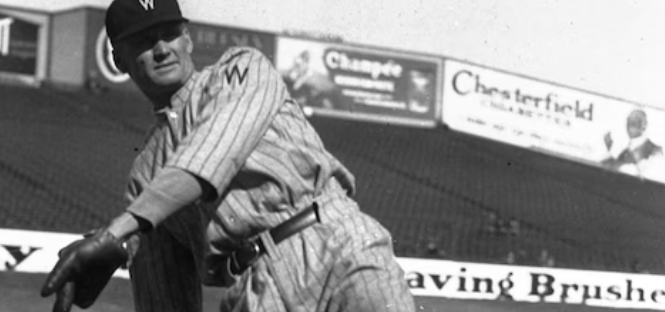
Before setting records for longevity as an umpire, Emslie, born in 1859, was a darn-good player — Canadian born, left-handed pitcher for three seasons for the Baltimore Orioles of the American Association (44-40, 3.08 ERA, 82 complete games in 86 starts). His most amazing stats: Posting a 32-17 record in ’84 with a 2.74 ERA in 50 starts, and 50 complete games, logging 455 1/3 innings. He pitched four more games for the AA’s Philadelphia Athletics before he was done with a sore arm in 1885.
Three years later, he entered the umpire profession, somewhat by accident because one was needed at a game he was attending. First, in the minor leagues, then in the American Association by 1890, then with the National League starting in 1891.
Players could get on him for many reasons but one nickname that stuck was “Wig” because of a receding hairline (he actually wore a toupee during his playing career).
Continue reading “Day 22 of 2024 baseball book reviews: Maybe if justice is blind, “Blind Bob” Emslie can justify a new viewpoint”







 Tom Hoffarth's The Drill: More Farther Off the Wall