This is the latest post for an ongoing media project — SoCal Sports History 101: The Prime Numbers from 00 to 99 that Uniformly, Uniquely and Unapologetically Reveal The Narrative of Our Region’s Athletic Heritage. Pick a number and highlight an athlete — person, place or thing — most obviously connected to it by fame and fortune, someone who isn’t so obvious, and then take a deeper dive into the most interesting story tied to it. It’s a combination of star power, achievement, longevity, notoriety, and, above all, what makes that athlete so Southern California. Quirkiness factors in. And it should open itself to more discussion and debate — which is what sports is best at doing.
The most obvious choices for No. 94:
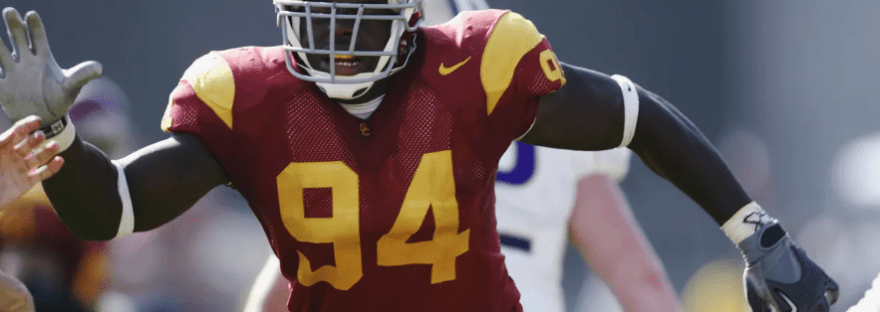
= Kenechi Udeze, USC football = Paul Bergmann, UCLA football = Mateen Bhaghani, UCLA football
The not-so-obvious choices for No. 94:
= Terry Crews, Los Angeles Rams
The most interesting story for No. 94: Don Yi, Korean language interpreter for Chan Ho Park (1994) Southern California map pinpoints: Lakewood, Glendale, Los Angeles (Dodger Stadium)
The 1994 Major League Baseball season started with Don Yi wearing the No. 94 jersey for the Los Angeles Dodgers.
It wasn’t necessarily the Year of Yi in Dodgertown that particular season, but numerically, it made sense.
While Yi was neither bat boy, ball dude nor clubhouse attendant, the 31-year-old UCLA graduate and computer programmer spoke South Korean. The Dodgers in general, and Chan Ho Park, more specifically, could use Yi’s skill set.
As an important part of a contract stipulation when the Dodgers signed a $1.2 million landmark deal with the 20-year-old pitcher, announced at a press conference at a hotel in Koreatown, the team would provide an interpreter.
Where Yi came into the picture, it’s somewhat a mystery.
Park, as the first MLB player brought in from South Korean player, needed to acclimate and assimilate. Yi was there to accomodate. This new-fangled job would evolve, or go sideways, on a daily basis.
It started with this: What is Park’s name?
The first time Yi was in full uniform as the team arrived its Vero Beach, Fla., training camp in March of ’94, reporters and teammates wanted to know what to call him.
Dodgers broadcaster Ross Porter called him “Park Chan-ho,” as per Korean custom to use the family’s given surname first. Park asked if Yi could help him get the media covering him to “Americanize” his name.
Once that box was checked, what else might get found in translation?
This is the latest post for an ongoing media project — SoCal Sports History 101: The Prime Numbers from 00 to 99 that Uniformly, Uniquely and Unapologetically Reveal The Narrative of Our Region’s Athletic Heritage. Pick a number and highlight an athlete — person, place or thing — most obviously connected to it by fame and fortune, someone who isn’t so obvious, and then take a deeper dive into the most interesting story tied to it. It’s a combination of star power, achievement, longevity, notoriety, and, above all, what makes that athlete so Southern California. Quirkiness and notoriety factor in. And it should open itself to more discussion and debate — which is what sports is best at doing.
The most obvious choices for No. 37:
= Donnie Moore: California Angels = Lester Hayes: Los Angeles Raiders = Ron Artest/Metta World Peace: Los Angeles Lakers
The not-so-obvious choices for No. 37:
= Kermit Johnson, UCLA football = Bobby Castillo: Los Angeles Dodgers = Ron Washington: Los Angeles Angels manager = Tom Seaver: USC baseball
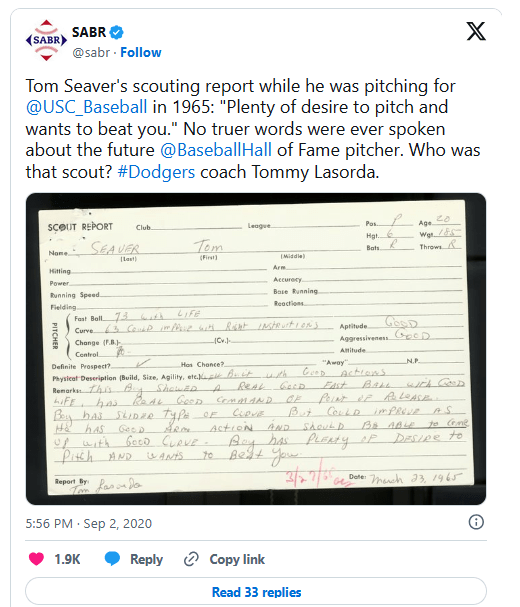
The most interesting story for No. 37: Tom Seaver: USC baseball pitcher (1965) Southern California map pinpoints: Los Angeles (USC), Manhattan Beach, Twentynine Palms
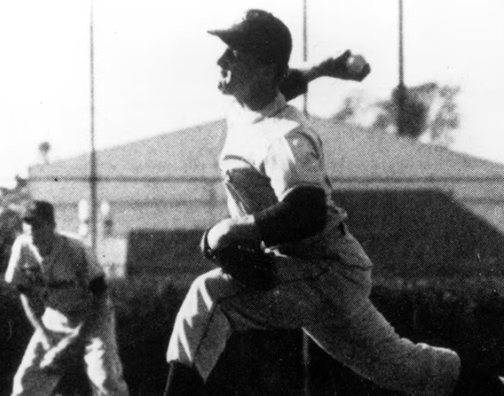
Tom Seaver was a stellar bridge player.
Bridge can be a tricky game. The trick is to gather the least the number of tricks bid by the partnership at the four-person table. The rules seem simple, but mastering the strategy and complexity of it all takes time and practice. Intelligence and patience are rewarded.
During his brief time as a USC student — a pre-denistry major, because he sensed he might need a fallback career — Seaver sometimes could be found with friends hanging out at the 901 Club on Jefferson Blvd., famous for its hamburgers and beer.
And bridge building, when he was there.
In the abridged version of how Seaver went from college baseball to a pro career, there should have been a simple bridge there for him to cross from USC to the Los Angeles Dodgers’ stellar starting rotation of the 1960s.
Instead, there was a toll to pay, and the Dodgers balked.
That’s where Seaver’s poker face came into play. A fantastic 2020 book by acclaimed author and former minor leaguer Pat Jordan revealed how deep a Seaver was. But when it came to his MLB future, Seaver wasn’t bluffing on contract demands. Eventually, both the Dodges and USC lost out.
As the Vietnam War started in 1962, Seaver wasn’t keen on being drafted out of Fresno High, where he just finished his senior baseball season with a 6-5 record but made the Fresno Bee All-City team. Still, he had no pro offers, nor any college interest.
So Seaver enlisted in the U.S. Marine Corps Reserves in 1962 and ’63, with bootcamp at Twentynine Palms. He realized eventually the extra weight and strength he gained in that training allowed him to eventually throw a more effective fastball and slider.
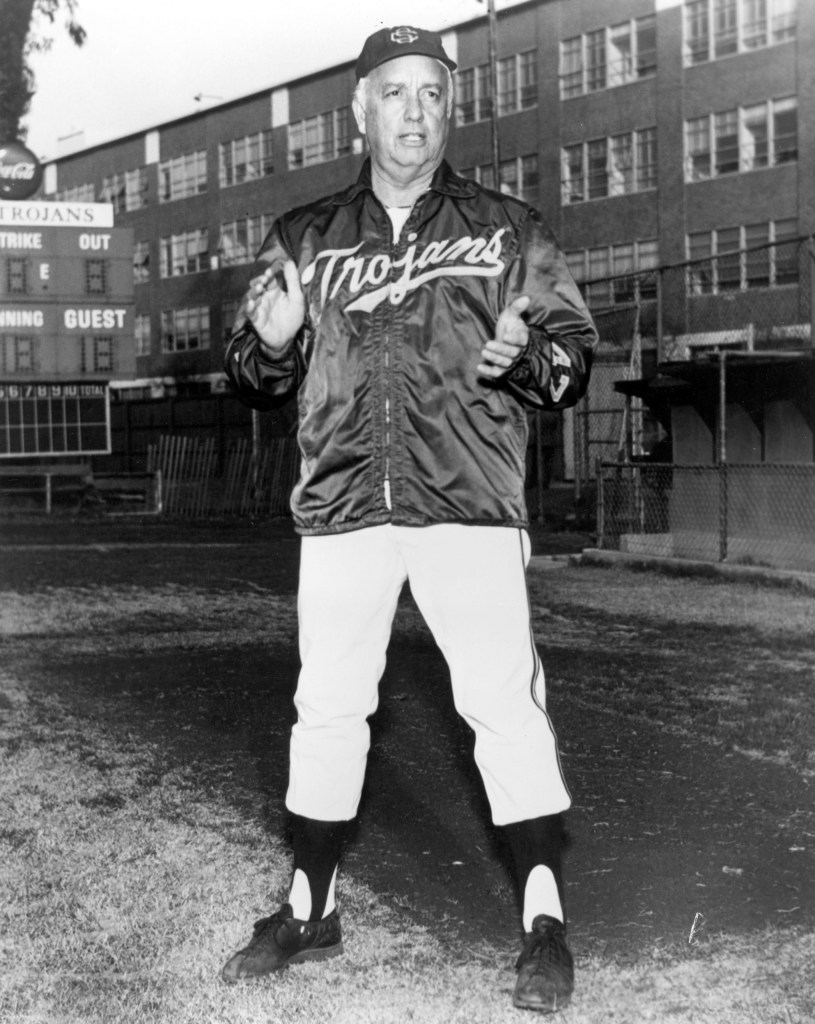
His roadmap to the bigs started with one season at Fresno City College as a freshman, then earning a scholarship to play at USC, the perennial NCAA title team under coach Rod Dedeaux (see SoCal Sports History 101 bio for No. 1).
After Seaver posted an 11-2 mark at Fresno City, the Dodgers were interested. But not more than $2,000 interested. Maybe it was $3,000. That was their reportedly their offer in 1964, the last time MLB teams would have the freedom to sign whomever they wanted before the draft kicked in.
Seaver declined the Dodgers’ gesture and went panning for gold elsewhere.
Dedeaux, who called Seaver the “phee-nom from San Joaquin,” agreed to give him one of his five USC baseball full scholarships — if Seaver first played in Alaska summer ball in ’64. Dedeaux worked out a deal for Seaver to pitch for the Alaska Goldpanners of the Alaska Baseball League, which showcased college talent. The 19-year-old experienced his first Midnight Sun Game in Anchorage — the 10:30 p.m. start on June 21 for the summer solstice that has become part of baseball lore.
In 19 games, starting five, Seaver was 6-2 with a save and 4.70 ERA to go with 70 strike outs in 58 2/3 innings. Later that summer, playing in an National Baseball Congress World Series in Wichita, Kansas, Seaver, now with the Wichita Glassmen, hit a grand slam in a game where he had been called in as a relief pitcher. Seaver would say that was one of his career highlights.
At USC, Dedeaux slotted Seaver as the Trojans’ No. 3 starter – also on the staff was junior Bob Selleck, the 6-foot-6 older brother of eventual USC basketball, baseball and volleyball player and actor Tom Selleck.
This is the latest post for an ongoing media project — SoCal Sports History 101: The Prime Numbers from 00 to 99 that Uniformly, Uniquely and Unapologetically Reveal The Narrative of Our Region’s Athletic Heritage. Pick a number and highlight an athlete — person, place or thing — most obviously connected to it by fame and fortune, someone who isn’t so obvious, and then take a deeper dive into the most interesting story tied to it. It’s a combination of star power, achievement, longevity, notoriety, and, above all, what makes that athlete so Southern California. Quirkiness and notoriety factor in. And it should open itself to more discussion and debate — which is what sports is best at doing.
The most obvious choices for No. 53:
= Don Drysdale, Los Angeles Dodgers = Keith Erickson, UCLA basketball = Rod Martin, Los Angeles Raiders
The not-so-obvious choices for No. 53:
= Jim Youngblood, Los Angeles Rams = Lynn Shackleford, UCLA basketball
The most interesting story for No. 53: Don Drysdale, Los Angeles Dodgers pitcher (1958 to 1969), California Angels broadcaster (1973 to 1981), Los Angeles Rams broadcaster (1973 to 1976), Los Angeles Dodgers broadcaster (1988 to 1993)
Southern California map pinpoints: Van Nuys, Bakersfield, Hollywood, Los Angeles (Coliseum, Dodger Stadium), Anaheim
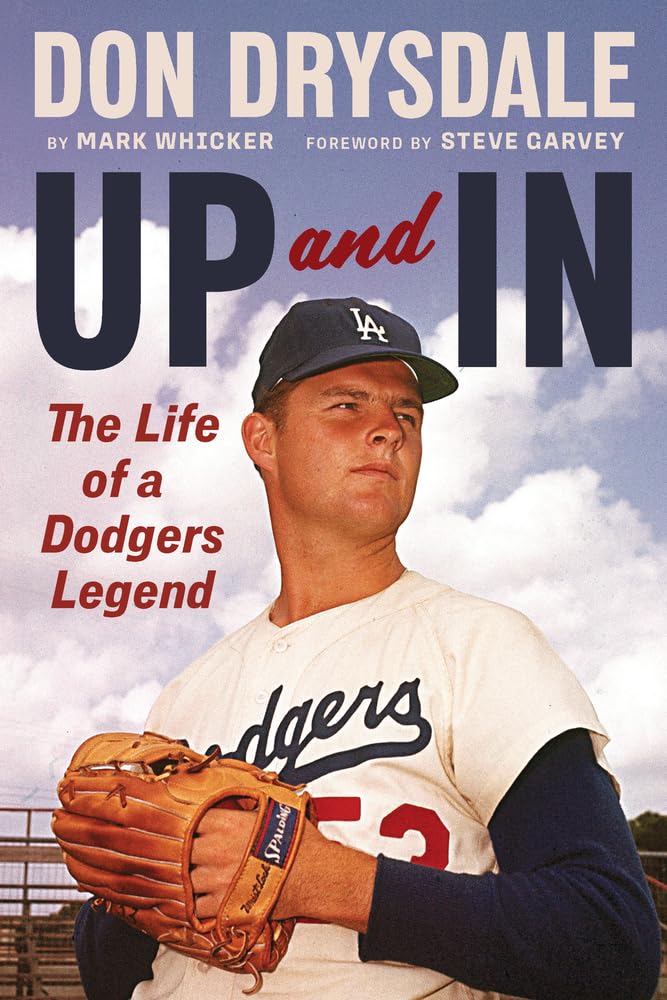
To tell the truth about the dogma of Don Drysdale, there’s a legendary aura of “Big D” that goes beyond bigger-than-life discoveries about the 6-foot-6 right-handed sidewinder, a San Fernando Valley-reared kid who spent all 14 years of his big-league career with the Dodgers organization, moved with them back to Los Angeles from Brooklyn, and spent the last six years of his life as a broadcaster with them.
See how this works:
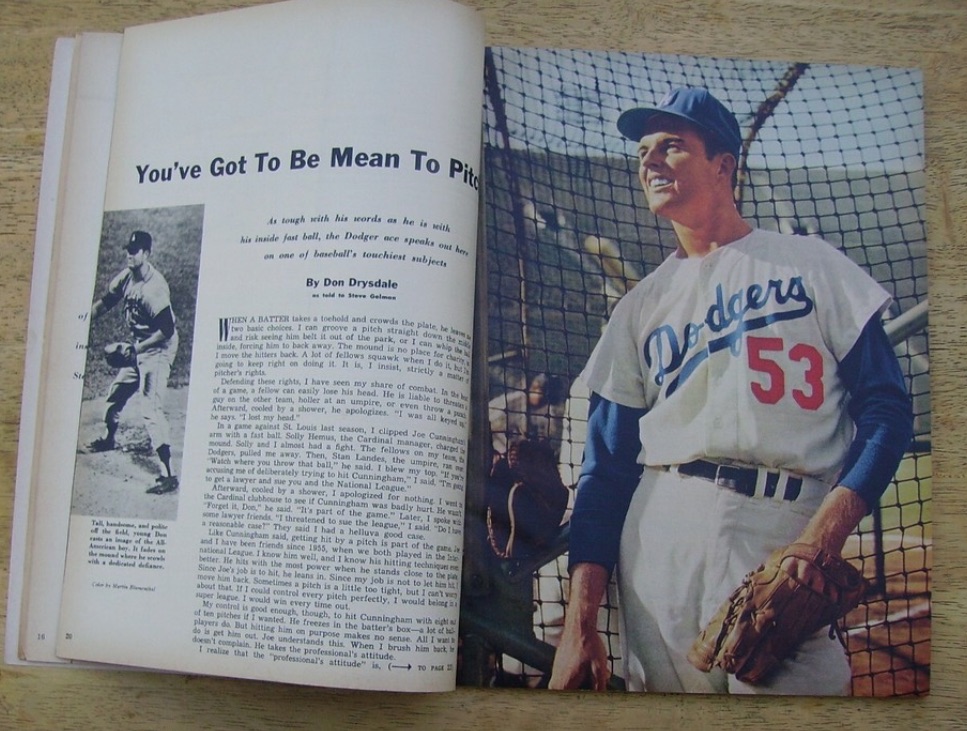
From the 1960 issue of Sport magazine, the self-authored story: “You’ve Got to Be Mean to Pitch”
Truth that’s been told: Don Drysdale led the league in putting the “mean” in a meaningful pitch.
Dare to discover: If some SABR-cat researcher was compelled to look it up, we’d suspect there was enough evidence to confirm Drysdale threw more brushback/purpose pitches than anyone else in his era. Four times, he led the majors in plunking batters — 154 HBP in all, more than 10 a season, and an National League record at the time of his retirement in 1969. But it played into his philosophy: You knock down/hit one of my guys, I knock down/hit two of yours. If they are hit in the process, well …
Further research from Fangraphs on the essence of the “Two For One Special,” aka the “Drysdale Revenge Factor,”‘ shows that 18 times in his career, Drysdale hit two or more batters in a game. That mindset traces back to Drysdale’s by former veteran Brooklyn teammate Sal “The Barber” Maglie. Properly stated, it puts the idea in a batter’s mind that while the pitcher could claim ownership to half of the 17-inch home plate, you weren’t always sure which half Drysdale picked in that situation.
Batters knew the drill.
“Batting against him is the same as making a date with the dentist,” Pittsburgh’s Dick Groat once said. Added San Francisco’s Orlando Cepeda: “The trick against Drysdale is to hit him before he hits you.”
In a 1979 interview with the New York Times’ Dave Anderson, Drysdale, 10 years after his retirement, said delivering the inside pitch was a “lost art.”
“I just feel,” he was saying now, his right forefinger swirling the ice in his Scotch, “that when you’re pitching, part of the plate has to be yours. … The pitcher has to find out if the hitter is timid. And if the hitter is timid, he has to remind the hitter he’s timid.”
Back by somewhat unpopular demand — maybe query a few authors whose books in the recent past I might have ended up splaying with an intent to de-boned, all in the name of honest criticism — the 2025 version of the newest spring/summer baseball book reviews returns for another attempt at education and entertainment.
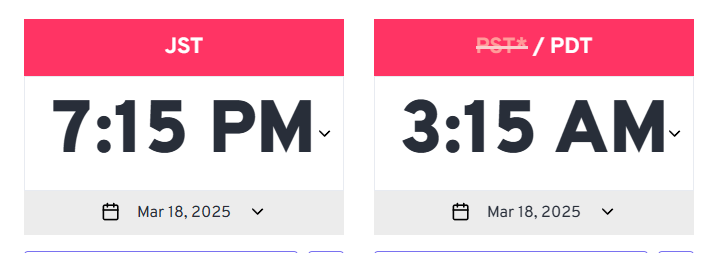
It coincides with the start of the Dodgers-Cubs series leading off the ’25 MLB season in Japan. The clocks are being adjusted as we try to spin forward.
Here, as we have done since 2011*, reviews are more an exercise in empathy for those who open their veins to write these things in the first place, along with our attempt at explaining how the subject matter connects in our universe. Then, there’s an efficiency trying to cover more than a couple dozen new titles that have come into the marketplace since the end of the ’24 season.
This whole thing, initially focused on the insane premise of posting 30 reviews once day over the 30 days in a row in April, challenges us to stay current while also adding some context.
*Our memory is fading and we weren’t actually sure, but that’s the best guess, since we’ve got The Wayback Machine to find things we’ve posted going to the InsideSoCal.com platform that started in 2006.
This ’25 baseball book review project again deviates a bit from its original calisthenics stress test. We can’t do 30 in a row, but the target remains at least 30 reviews. All done by summer.
There’s also a new stipulation: No more links to purchasing books on the website named after a river in South America and empties into the Atlantic. Reviews are no longer posted on the social media site once known as Twitter.
Resistance isn’t futile. It’s long overdue.
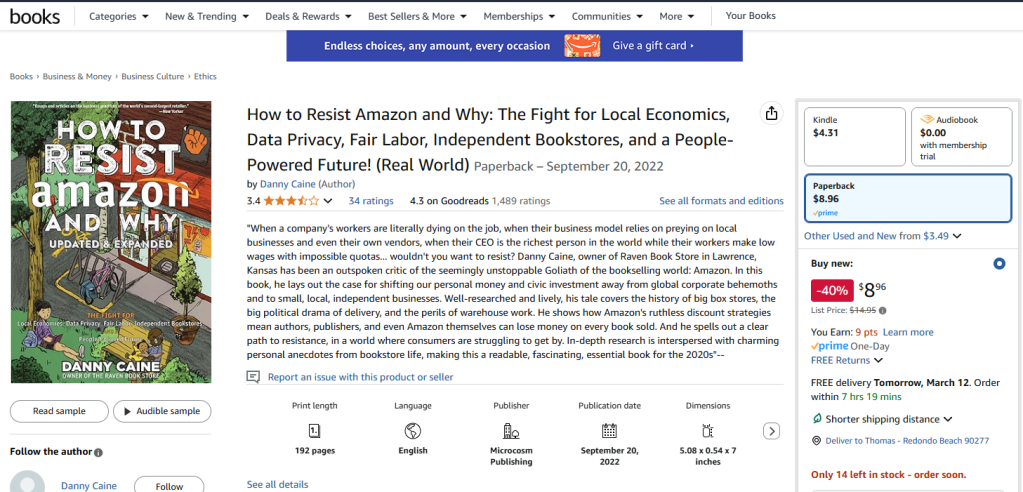
Consider this: A book called “How To Resist Amazon And Why: Updated and Expanded — The Fight For Local Economies, Data Privacy, Fair Labor, Independent Bookstores and a People-Powered Future” by Danny Caine, owner of the Lawrence, Kansas-based Raven Book Store, sells for a reasonable $14.95 on the Microcosm Publishers’ website. As well as on Caine’s store site, a zine version for $3.
The website in question, meanwhile, not only offers this book that meticulously besmirches its existence, but has it at 40 percent off for those looking to prove everything the book points out.
From our storage unit, here’s what we plan to cover in ’25:
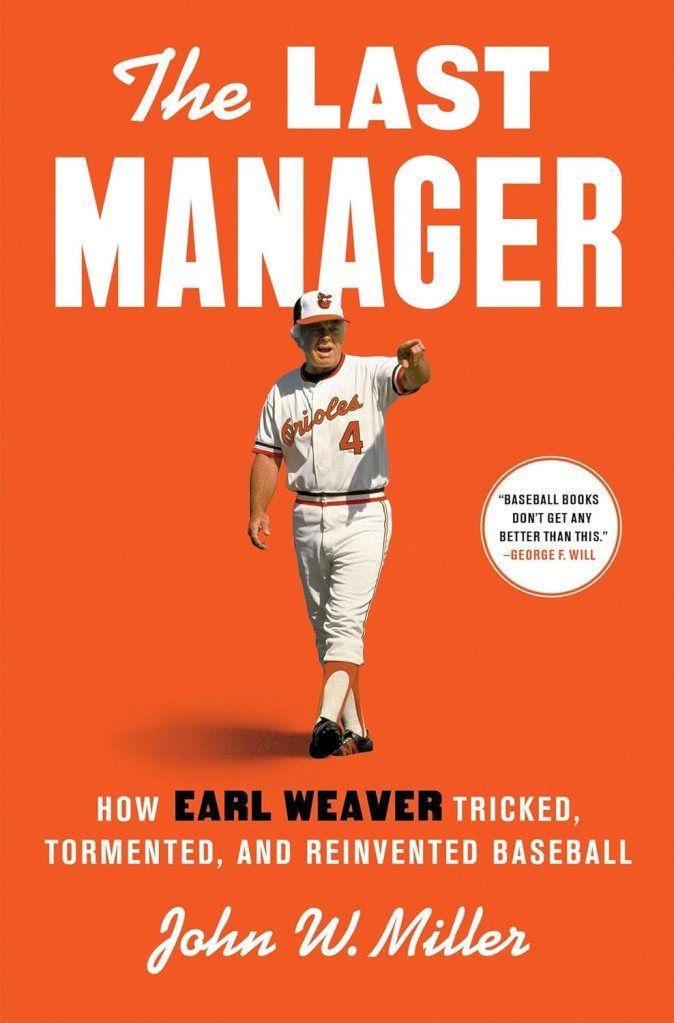
= “I Felt the Cheers: The Remarkable Silent Life of Curtis Pride,” by the former Angels outfielder who also played for Montreal, Detroit, Atlanta, Boston and the Yankees, and was a coach at Gallaudet, the world’s leading university for deaf and hard of hearing students and was also named Major League Baseball’s Ambassador for Inclusion.
The point it to let readers know these works exist, should you be tempted to pick them up for purchase without knowing their caveats. It’s also a way to uncover projects that otherwise might be off the radar. No fees attached. Enjoy.
Before the first reviews, a short Q&A:
Seinäjoki Library in Seinäjoki, Finland.
Q: What happens to all the baseball books collected during the course of the year to review?
A: Pay it forward, if that’s still a phrase. As in, donate them to the local library.
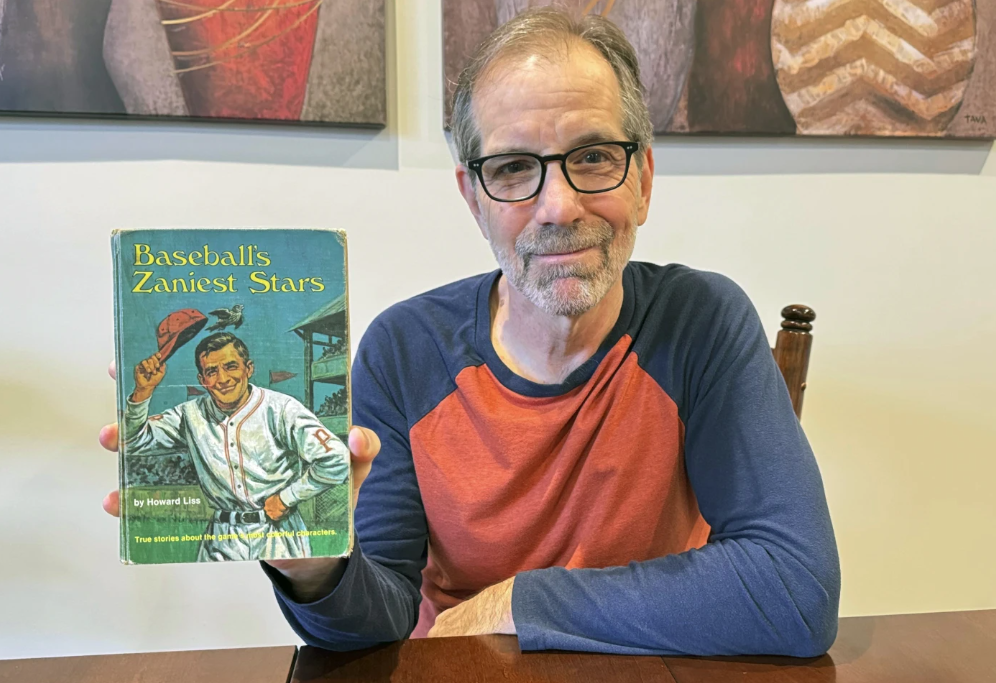
The 144-page book by Howard Liss released by Random House aimed at school kids interested in sports-related bios was first published in 1971.
Chuck Hildebrandt, a 63-year-old retired digital marketing exec living in Chicago, explained to the Detroit Free Press that he purposefully visited the public library in the Detroit suburb of Warren, Mich., while in town visiting family for Thanksgiving. The reason was to bring back a copy of “Baseball’s Zaniest Stars,” which he recalls borrowing from the city’s Walt Whitman Branch on Dec. 4, 1974, when he was a 13-year-old.
He had forgotten to return it. Fifty years later, he sought some closure.
Hildebrant said he came across it on his bookshelf about five years ago, noticed the Dewey decimal library sticker on the spine, and figured out what happened.
In December of 2024, he tried to give it back. The library declined.
“Some people never come back to face the music,” said library director Oksana Urban. “But there was really no music to face, because he and the book were erased from our system.”
Still, what would the fine have been for a return this late? More than $4,500 according to Hildebrant’s math. To be precise, it was $4,563.75 to be precise, if he had been charged the normal fees.
“I am still somewhat embarrassed so I want to make good on it in some way,” Hildebrant wrote on a social media post.
Hildebrant decided to start a GoFundMe.com fundraiser to see if he could match that $4,564 projected fine, and then donate it to Reading Is Fundamental, the nation’s leading children’s literacy non-profit since the 1960s that so many of us Boomer-types remember from our childhood as well.
To date, the effort raised more than $5,300 with more than 100 donations.
Maybe we can keep contributing. Or …
This book looked familiar, and my recollection must have been finding it at my own library when I was in middle school. The cover illustration of Casey Stengel taking off his cap and having a sparrow he kept hidden in his suddenly fly out was something I wouldn’t have forgotten.
In the book, it explains how Stengel, just traded from Wilbert Robinson’s Brooklyn Robins (pre-Dodgers) to the Pittsburgh Pirates in 1918, was back for the first time at Ebbets Field in Brooklyn, playing right field. He noticed in the Brooklyn bullpen that former teammate Leon Cadore was able to scoop up a sparrow that landed. On his way to the dugout at the end of the inning, Stengel asked Cadore to give him the sparrow. When Stengel went to bat that inning, the fans gave him a rousing ovation. He stepped into the batter’s box, dropped his bat, bowed low and raised his cap — and the sparrow fluttered a moment and flew off.
“I always knew that Stengel had birds in his top story,” Robinson was reported to have said.
After reading the story about Hildebrandt — and realizing we are about the same age — I tracked down a New Jersey used book store called Between the Covers listed on AbeBooks.com (the one-stop used book store repository) and picked up a nice copy of “Baseball’s Zaniest Stars.”
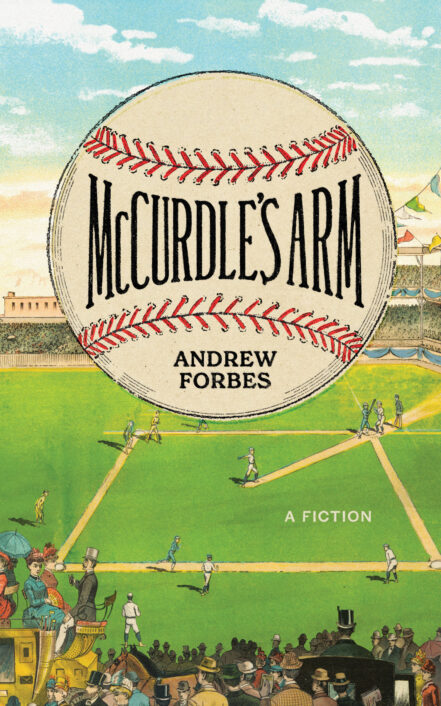
It went for $20 (plus $5 shipping). I really did enjoy re-reading it from cover to cover this past winter. Simultaneously, I had been reading Andrew Forbes’ latest piece of fiction, “McCurdle’s Arm,” a 108-page novella released in August of ’24 by Invisible Publishing, and the two seemed joined at the spine.
Forbes’ ultra-creative use of 1890s quirky baseball prose told the story of Robert James McCurdle, who could have been a character in “Baseball’s Zaniest Stars,” along with Stengel, Bobo Newsom, Dizzy Dean, Babe Herman and Rabbit Maranville.
Re-reading that review recently was again somewhat as therapeutic as it was writing it four years ago. The cover illustrations were spectacular as well.
Armed with “McCurdle’s Arm” and star struck again by “Baseball’s Zaniest Stars,” I felt as if I was thrust back in time. No hurry for anyone to come to my emotional rescue.
So, with the start of this ’25 review, “McCurdle’s Arm” goes back on my shelf for safe keeping, and “Baseball’s Zaniest Stars” will go next to it, or I’ll deliver it to my local library with all the other books set to be donated this time around.
The hope is that everything will be fine, and there are no fines attached to anyone’s future enjoyment. And a RIF donation is forthcoming.
This is the latest post for an ongoing media project — SoCal Sports History 101: The Prime Numbers from 00 to 99 that Uniformly, Uniquely and Unapologetically Reveal The Narrative of Our Region’s Athletic Heritage. Pick a number and highlight an athlete — person, place or thing — most obviously connected to it by fame and fortune, someone who isn’t so obvious, and then take a deeper dive into the most interesting story tied to it. It’s a combination of star power, achievement, longevity, notoriety, and, above all, what makes that athlete so Southern California. Quirkiness and notoriety factor in. And it should open itself to more discussion and debate — which is what sports is best at doing.
The most obvious choices for No. 16:
= Marcel Dionne, Los Angeles Kings = Gary Beban, UCLA football = Pau Gasol, Los Angeles Lakers = Frank Gifford, USC football = Hideo Nomo, Los Angeles Dodgers = Rodney Peete, USC football = Rick Monday, Los Angeles Dodgers = Jim Plunkett, Los Angeles Raiders
The not-so-obvious choices for No. 16:
= Brice Taylor, USC football = Willie Wood, USC football = Jarred Goff, Los Angeles Rams = Garrett Anderson, California/Anaheim/Los Angeles Angels of Anaheim = Lisa Fernandez, UCLA softball = Will Smith, Los Angeles Dodgers
The most interesting story for No. 16: Rick Monday, Los Angeles Dodgers center fielder (1978 to 1984) Southern California map pinpoints: Santa Monica, Dodger Stadium
On the 60th anniversary of Dodger Stadium in 2022, the Dodgers gave fans a Top 60 countdown of the greatest moments in the ballpark’s history.
An event that happened on a Sunday afternoon, April 25, 1976, planted its flag in the No. 5 spot. It was also important enough to be included in a 2000 Baseball Hall of Fame’s 100 classic moments in the game’s history.
It involved a SoCal guy playing against the SoCal team. The Dodgers were mere bystanders.
Rick Monday, front and center as he patrolled center field for the visiting Chicago Cubs, wore No. 7 as a tribute to his baseball idol, Mickey Mantle. In a game the Dodgers won 5-4 in 10 innings, Monday had three hits, score twice and drove in a run as the Cubs rallied from a three-run deficit.
In the play-by-play of each inning is posted in a Retrosheet.org account of the contest, this is how the Dodgers’ four-run fourth was recorded:
By more than one patriotic group or another, it has been referred to as baseball’s “greatest play.”
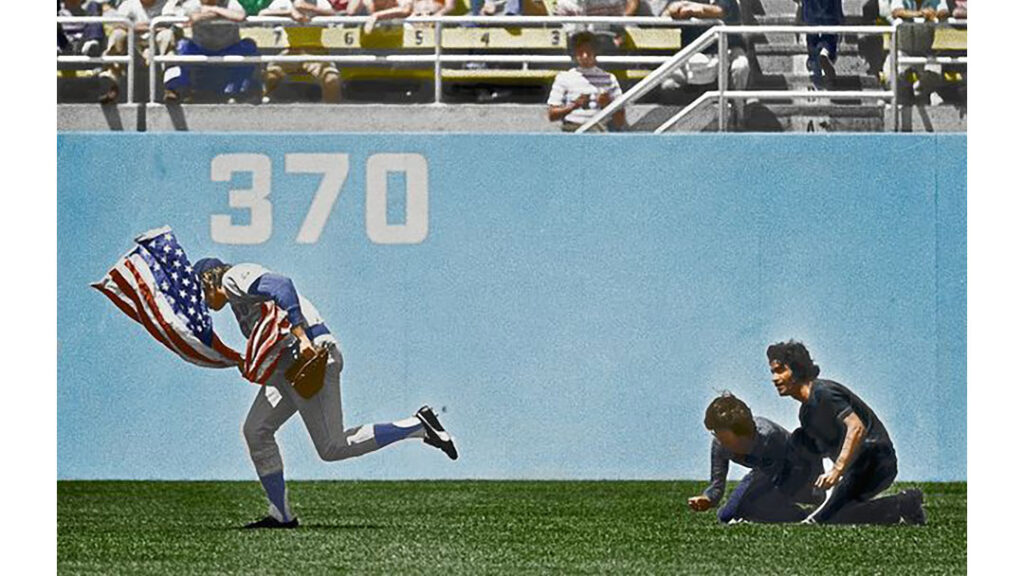
A colorized version of the Jim Roark/Los Angeles Herald-Examiner photo.
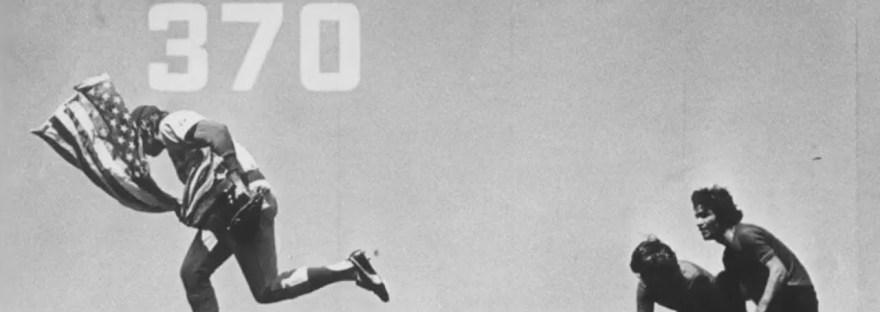
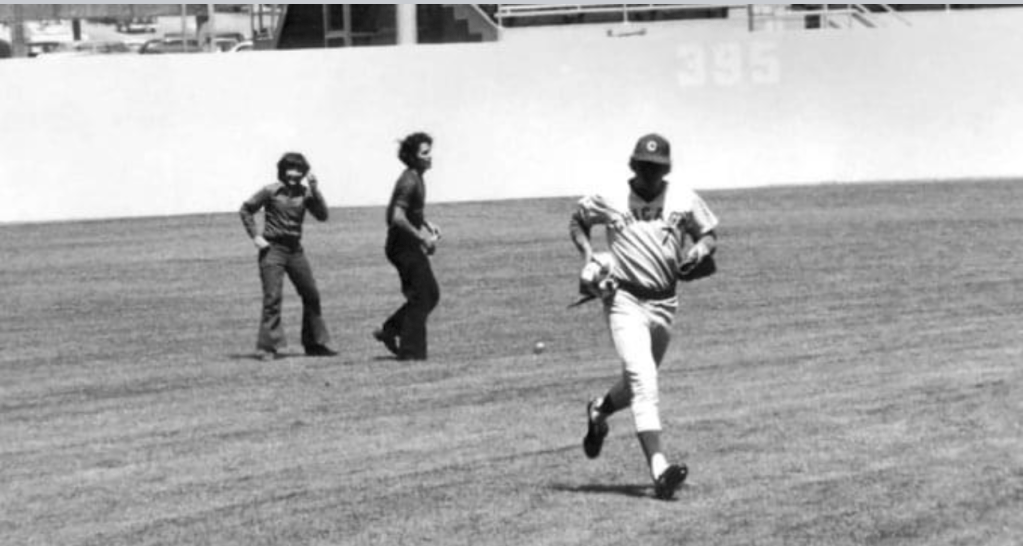
The most iconic image of Monday swooping with his right hand — the left-hander had taken off his glove and held it in his left hand — to snatch the American flag out of the hands of a man and his son as they knelt in the outfield grass, having already doused it with lighter fluid and unsuccessful in lighting a match as the wind blew out their first try, was dutifully captured by Los Angeles Herald-Examiner photographer Jim Roark. It was nominated for a Pulitzer Prize.
The late Los Angeles Times columnist Jim Murray referred to it as “the most famous picture of its kind since the flag-raising at Iwo Jima.”
It was “Francis Scott Key, Betsy Ross, Verdun and Iwo Jima—all wrapped up on one fleeting instant of patriotism,” added The Sporting News, and calling Monday’s run a resemblance of “Paul Revere at full gallop.”
The description Vin Scully conjured up for the Dodgers’ radio audience as Ted Sizemore was at bat with a 1-0 count was equally as etched in the fans’ psyche.
“Outside, ball one … and wait a minute … We’re not sure what he’s doing out there … It looks like he’s going to burn a flag … and Rick Monday runs and takes it away from him! (Crowd cheers) … I think the guy was going to set fire to the American flag! Can you imagine that? … Monday, when he realized what he was going to do, raced over and took the flag away from him.”
And Scully took our breath away.
Right away, Dodgers publicity director Fred Claire had the scoreboard operator, Jeff Fellingzer, type in a message:
As Monday continued running toward the Dodgers’ dugout, he handed the flag to Dodgers pitcher Doug Rau. Monday recalled seeing Dodgers third base coach Tommy Lasorda running past him toward the perpetrators and “called these guys every name in the longshoreman’s encyclopedia.”
After the game, Monday was still agitated as he told reporters: “If he’s going to burn a flag, he better do it in front of somebody who doesn’t appreciate it. I’ve visited enough veterans hospitals and seen enough guys with their legs blown off defending the flag.”
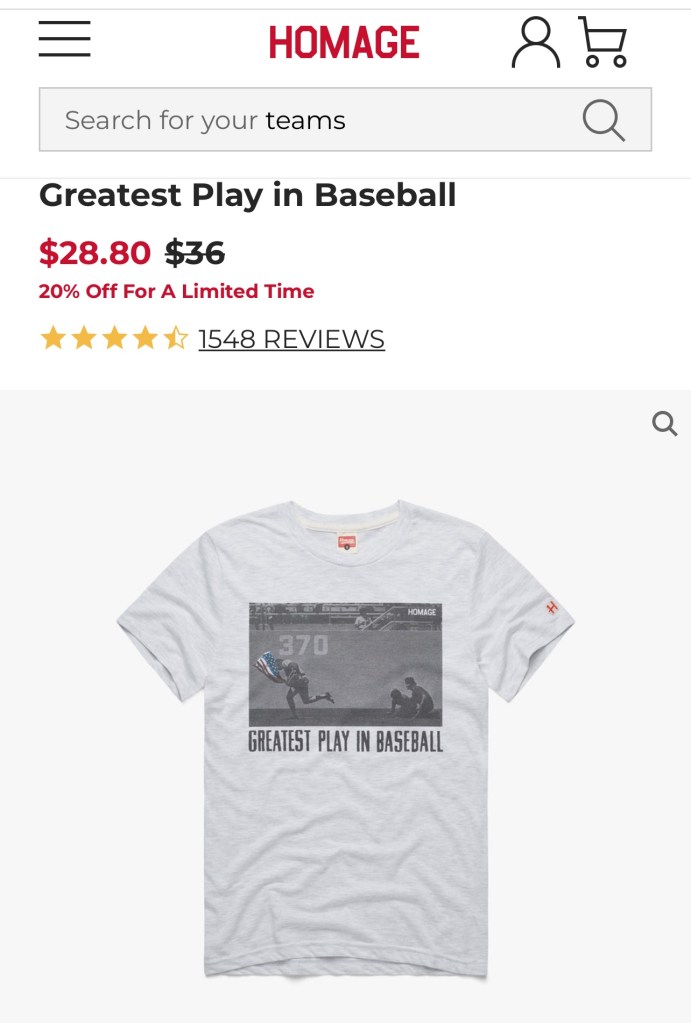
And you can still get the whole thing (for a discount) on a T-shirt.
Monday served as a reserve in the Marine Corps for the first six years of his MLB career. He said he had lost friends in Vietnam, a war that had just ended in 1976, the country’s bicentennial year. He had heard stories of his father and the Army. Now the country’s convoluted ideas of patriotism, politics, and protests had spilled onto a baseball field.
“Now we’ve got three great patriots — George Washington, Abraham Lincoln, and Rick Monday,” said Cubs teammate Jose Cardinal as mentioned in the game’s SABR recap.
President Gerald R. Ford called Monday after the game and issued a Presidential Commendation for “Service To Others.”
Two weeks later, when the Dodgers went to Chicago to play a series against the Cubs in Wrigley Field, Dodgers general manager Al Campanis presented Monday with the flag.
Some 30 years after it happened, Monday received a U.S. Senate Resolution.
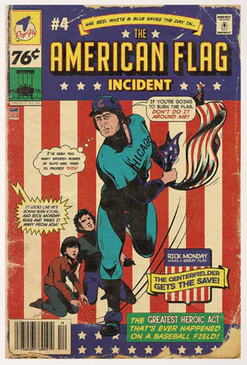
It has since been commemorated on posters, coins, pennants, U.S. postage collectables and a Dodger Stadium bobblehead giveaway. The Dodgers gave away a copy of the Roark photo as a poster in 1977 when Monday joined the Dodgers.
“The blink-and-you’ll-miss-it moment entwined four unlikely and disparate individuals: a Major League Baseball outfielder who instantaneously became a national hero; a photojournalist whose career was made, seemingly for life, with a single shot; and a father-son duo who faced so much mockery and castigation that they have chosen to remain anonymous.”
The stories that continue to be told by Monday as the anniversary comes around each year, and his reactions to it, resonate more.
“You know what’s really kind of strange is I get letters every week, some from people who were not even born at the time,” Monday told writer Mike DiGiovanna before a game in 2023 at Dodger Stadium. “And twice today, here at the ballpark, I’ve already had people say, ‘Thanks for doing something for the flag.’”
When asked about it through the years, Monday has had time to reflect on it.
“I don’t know what I was thinking,” said Monday in 2020. “But I knew what they were doing was wrong.”
“It brings you to tears, to be honest,” Monday admitted in 2013 about the stories he’s heard from veterans since then.
He also said in 2016: “It’s freedom of speech, but the flag itself, I look at it from a positive standpoint … I heard today from one of the moms who lost their son. It’s like Barbaralee (Monday’s wife) says, ‘We drape the caskets of our fallen warriors with the flag, and it’s presented to the family with the words, from a grateful nation.’”
Among the things Monday has on his professional resume:
= The first player taken overall in the first Major League Baseball official draft, in 1965, by the Kansas City Athletics, right out of Arizona State. The 19-year-old led the Sun Devils to the College World Series title. This was three years after he declined an $20,000 signing bonus from Dodgers scout Tommy Lasorda to join his hometown team out of Santa Monica High School because Monday had promised his mother he would attend college.
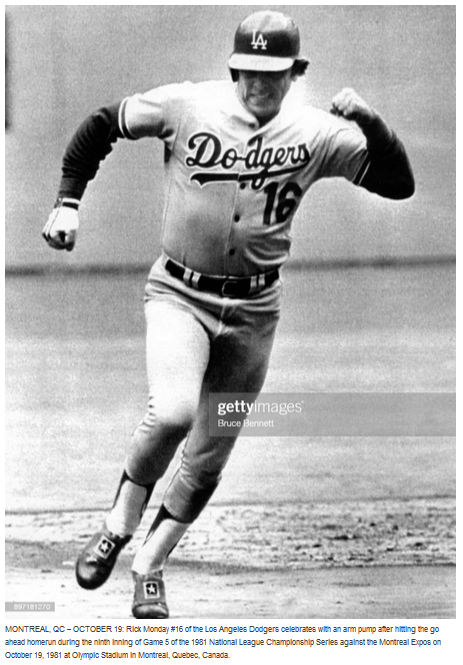
= A dramatic ninth-inning home run off Montreal’s Steve Rogers during the National League Championship Series that gave the Dodgers a 2-1 win and sent them into the 1981 World Series. It is still called “Blue Monday” throughout Canada.
= Two All-Star selections, including 1978 with the Dodgers, a year after he was traded by the Cubs to L.A. in exchange that included Bill Buckner. Monday wanted to keep the No. 7 as he wore with the Cubs, but Steve Yeager had it. So Monday picked 1 plus 6 = 16 instead.
= A total of 241 homers during a 19-year career, eight of them with the Dodgers, as well as 775 RBIs. He had a single-season best of 32 homers for the Cubs as their lead-off hitter for that 1976 season.
= A 30-plus year career as a Dodgers TV and radio broadcaster, brought on in 1993 after the death of Don Drysdale, after Monday had done four years of broadcasting for the San Diego Padres.
But saving that flag from peril …
It remains in a safe deposit box. Secure. Taken out occasionally for fundraising events, especially to help the U.S. military veterans and their families.
“I didn’t do anything that people I know would not have done had they been geographically close enough to do something about it,” Monday has said. “I’m proud to say that all of my friends would have done the same thing. I think it’s about respect. I respect this country and what that flag represents.
“It’s only a piece of cloth, but, boy, it represents a lot of lives and freedoms that we have available to us because of the people who stepped up and sacrificed. All I did that afternoon was step up. I’m not a hero. I’m just a guy who acted upon what I thought was right. I’m happy I was close enough to do something about it.”
A quote from 1996 on the 20th anniversary continues to resonate most: “I’ve gotten a thousand questions wondering if I’m disappointed being best known for something that had nothing to do with baseball. My answer is, absolutely not.”
He added 20 years later: “If I am remembered only as a guy that stood in the way of two guys trying to desecrate an American flag at a Major League Baseball game, and protect the rights and freedoms that flag represents for all of us, that’s not a bad thing to be remembered for.”
Monday also said in a piece repurposed for the Baseball Hall of Fame: “The back of a baseball card is only good for as long as someone does not put it in the spokes of their bicycle. The flag, hopefully, is going to fly forever.”
In a story posted in 2025 about Jim Marshall, who, at 90, was the oldest living member of the New York Mets, it mentioned that he was also the manager of the Chicago Cubs that day Monday saved the flag.
Marshall said Monday was his favorite player to manage.
“He was such a great, young kid,” said Marshall. “I was there the day he grabbed the American flag when those kids were about to burn it. That was the greatest play of his career. I told Rick, ‘You owe me money, man. I put you in the lineup so you could do that, now you have a lifetime job with the Dodgers!’ So now he gives me $1 every time he sees me.”
As part of the National Baseball Hall of Fame and Museum’s celebration of America’s 250th birthday in 2026, the flag Monday rescued will be exhibited in Cooperstown from from Memorial Day Weekend through Labor Day Weekend. It has never previously been exhibited in one public location for as many days. Monday will be at Doubleday Field in Cooperstown on May 23 for the Hall of Fame Military Classic, a seven-inning legends game.
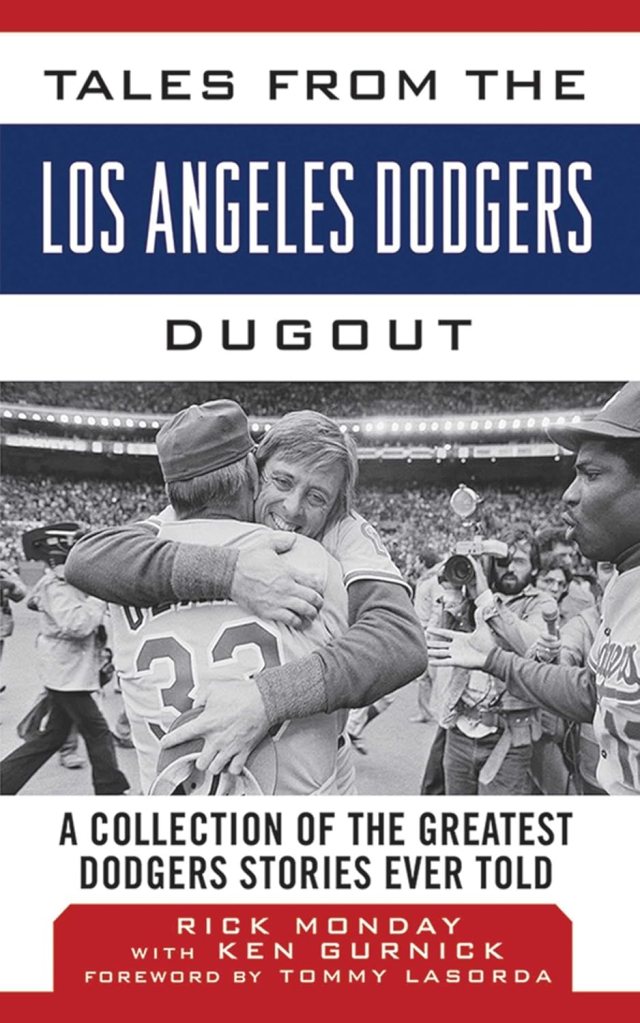
Monday, who turned 80 in November of ’25, has already done one update of his 2006 book, “Tales From the Los Angeles Dodgers Dugout.” But that was more than a decade ago. Maybe he’s due for another revision.
Who else wore No. 16 in SoCal sports history? Make a case for:
Marcel Dionne, Los Angeles Kings center (1975-76 to 1986-87):
Best known: The Little Beaver — a nickname that stuck to the Hockey Hall of Famer because of his 5-foot-9 stature — continues to lead the franchise in career points (1,307) nearly 40 years after he was done playing in L.A. He is also standing second in total goals (550) and total assists (757), collected in less than 1,000 games.
Until the Kings pulled the trigger before the 1975 season and got him from Detroit in a multi-player deal involving Dan Maloney and Terry Harper, the legend of Dionne in Southern California sports wouldn’t have happened as he combined with Dave Taylor and Charlie Simmer on the “Triple Crown Line” from 1979 to 1984. Incoming coach Bob Berry put Dionne in the middle with second-year right winger Taylor and career minor-leaguer Simmer. Taylor was the play maker, Dionne was the scorer and Simmer pulled the puck out of the corners. Perhaps by no coincidence, after the Triple Crown Line’s first season together, Dr. Jerry Buss bought the Kings, Lakers and the Forum from Jack Kent Cooke for $67.5 million. The Triple Crown Line dominated the NHL in its first season, scoring 146 goals and 182 assists, good for 328 points and Dionne was also awarded the Art Ross Trophy as the league’s top scorer — two more goals than rookie Wayne Gretzky. By ’80-’81, the line did better: 161 goals, 191 assists and 352 points, and, for the 1981 All Star Game played at the Forum in Inglewood, the three were voted in as a unit. Not well remembered:Dionne remains the Kings’ all-time leader in hat tricks (24, 10 more than second-place Bernie Nichols and Luc Robitaille), goals created (507.5), even-strength goals (369), total goals on-ice for (1,723), power play goals on-ice for (670) and offensive points share of 101.0.
Hideo Nomo, Los Angeles Dodgers pitcher(1995 to 1998):
Best known: The “Nomomania” that happened in Los Angeles upon the arrival of “The Tornado” during the ’95 post-strike delay generated a Japanese fan following that had not been seen before in Major League Baseball. The ’95 NL Rookie of the Year and league strike-out leader with his baffling forkball and deceptive windup was also the starting NL pitcher in the All Star game, striking out three of the six he faced. A no-hitter at Coors Field in Denver added to his legend. After stops in New York, Milwaukee, Detroit and Boston, Nomo returned to L.A. (wearing No. 10, as catcher Paul LoDuca had No. 16, the magical number for Japanese players) and had back-to-back 16-win seasons before undergoing shoulder surgery. In honor of Nomo and the Japanese history of pitchers, Yusei Kikuchi made the 2025 Opening Day start with No. 16, having worn it with Houston and Toronto previously.
Will Smith, Los Angeles Dodgers catcher (2019 to present):
Best known: His 11th inning solo home run in Game 7 of the 2025 World Series at Toronto provided the winning margin as the Dodgers clinched the championship. A three-time NL All Star, Smith was a first-round draft pick by the Dodgers out of Louisville. He went 2-for-4 in his MLB debut on May 27, 2019 and a month later, he hit a walk-off homer against Colorado. He served mostly as a DH in the Dodgers’ 2020 World Series run and became the full-time starting catcher in 2021. He signed a 10-year, $140 million contract extension in 2024 as he became the fourth catcher in franchise history to hit more than 100 career homers. Smith set a World Series record for most innings caught — 73 — as he handled every inning of the Dodgers’ 2025 run, including the 18 inning Game 3 victory and 11 in the Game 7.
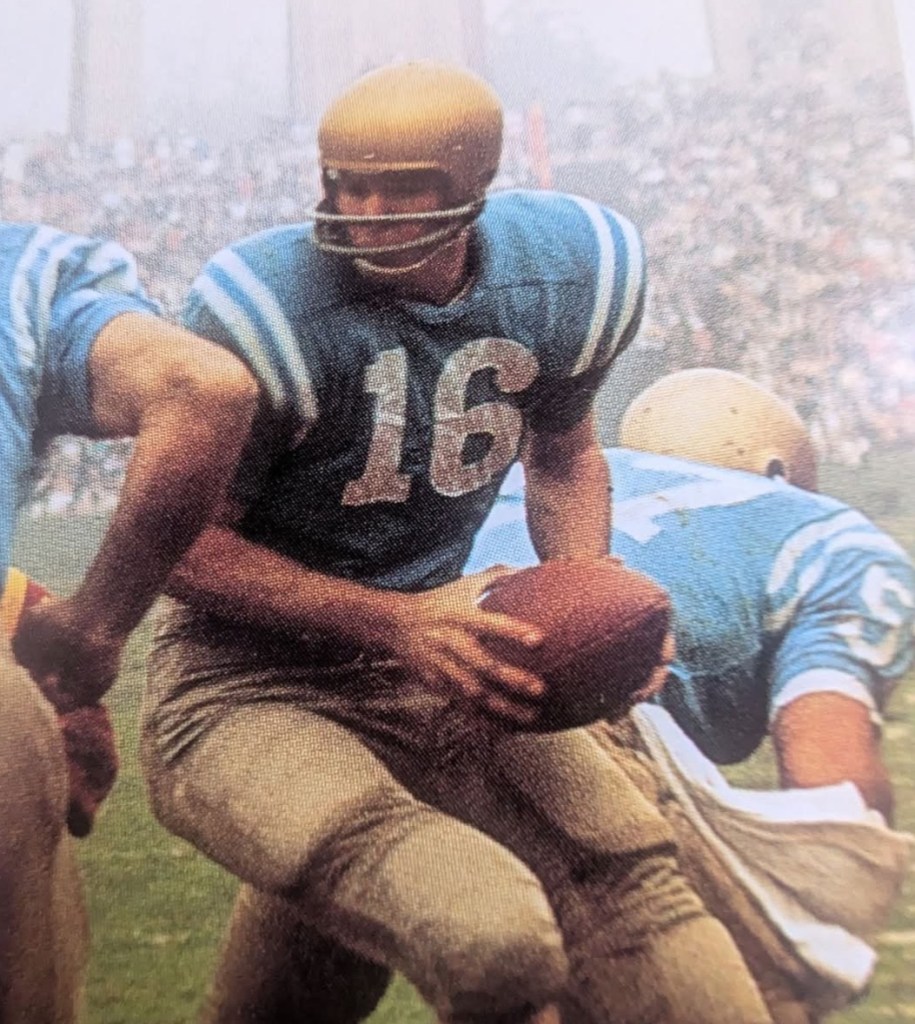
Gary Beban, UCLA football quarterback (1965 to 1967):
Best known: In ESPN’s 2020 list of the 150 greatest college football players in the game’s first 150 years, Beban managed to get in at No. 146 as still the only Bruin to win a Heisman. The blurb reads: “Beban may be the classic example of the bromide: All he could do was beat you. He was not big (6-0, 191), didn’t have a particularly strong arm, and beat no one with his legs. But Bruins coach Tommy Prothro made two comments about Beban that defined his worth: ‘He has no weaknesses.’ And: ‘The more pressure, the better he is.’ As a three-year starter, Beban went 24-5-2, including an upset of national champion Michigan State in the 1966 Rose Bowl, 14-12. Beban and No. 1 UCLA lost to O.J. Simpson and No. 3 USC, 21-20, in 1967. Beban threw for 301 yards and two touchdowns, and he beat Simpson for the 1967 Heisman.” That ’67 season, by the way, showed Beban throwing for 1,359 yards and eight TDs, and UCLA finishing 7-2-1. But since he was fourth in the Heisman voting in ’66, Beban seemed to have the best qualifications, considering his career stats: 33 TDs, 3,940 of passing yards and 5,197 of total offense.
Not well known: If UCLA fans were to draw up a list of the Top 5 quarterbacks in its history, Beban might be somewhat forgotten. Since Beban’s time, only a few UCLA players have ever finished in the Top 3 in the Heisman voting: Quarterbacks Troy Aikman (1988) and Cade McNown (1998) were third. Prior to Beban, only Bruins running back Paul Cameron had made it into the Top 3 (in 1953). Quarterback Billy Kilmer was fifth in the 1960 voting and Donn Moomaw finished fourth in 1952. A second-round pick by the Los Angeles Rams in 1968 — 30th overall — Beban’s rights were traded to Washington and only got into five pro games, also wearing No. 16 for the Redskins) as a backup to future Hall of Famer Sonny Jurgensen.
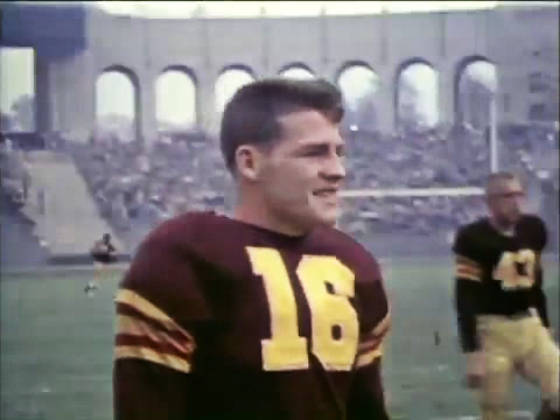
Frank Gifford, USC football running back, quarterback, defensive backer and kicker (1949 to 1951):
Best known: As a senior, the Santa Monica-born Gifford ran for 841 yards on 195 carries and seven touchdowns, completed 32 of 61 passes for 303 yards and two touchdowns, made 11 receptions, had three interceptions, kicked 26 PATs and two field goals. Gifford benefited from incoming coach Jess Hill switching from the T-formation to a combination of the winged T and the single wing. His first action was as a sophomore safety, recording two interceptions in a 42-20 season opening win against Navy at the Coliseum. He was also USC’s placekicker, making 25 of 31 PATs that season. A 22-yard field goal that season against Cal was USC’s first field goal made since the 1935 season, 14 years earlier. He led USC in scoring and interceptions in 1950. Before he graduated, Gifford married his college sweetheart, USC homecoming queen Maxine Ewart, in early 1952, and they had three children. As a first-round pick by the NFL’s New York Giants — becoming a league MVP, an eight-time Pro Bowl pick and having his No. 16 retired by the franchise — he parlayed that into a longtime career as a TV broadcaster on “Monday Night Football.” Gifford was inducted into the inaugural USC Athletic Hall of Fame in 1994, after he made the College Football Hall of Fame in 1975, the Pro Football Hall of Fame in ’77 and the Sports Broadcasting Hall of Fame in 2012. Not well known: Gifford wrote in his 2008 biography that he was given No. 16 by coach Jeff Cravath because USC initially recruited him as a quarterback after he spent a year at Bakersfield Junior College, trying to get his grades up as his dad provided for the family working in the oilfields.
Rodney Peete, USC football quarterback (1985 to 1988):
Best known: The three-year starter was a dual-threat Pac-10 Offensive Player of the Year and as a senior combined to win the Johnny Unitas Award and Pop Warner Award — and finish second in the Heisman voting behind Oklahoma State’s record-breaking running back Barry Sanders. At a school known for its running game success, Peete finished as the all-time leading passer with 8,225 yards and 54 touchdowns, as well as 12 more rushing.
Pau Gasol, Los Angeles Lakers center/forward (2008 to 2013-14):
Best known: His seven seasons with the Lakers as Kobe Bryant’s running mate brought him three All-Star selections and two NBA titles, resulting in the team retiring his number in 2023, the same year he was inducted into the Basketball Hall of Fame. The 7-footer from Barcelona who was the NBA Rookie of the Year with Memphis in 2002 came to L.A. in a deal that upset many league owners — the Lakers were able to unload Kwame Brown, Javaris Crittenton, Aaron McKie — along with his brother, future All Star Marc Gasol — to add him as Bryant’s teammate. In the first game Gasol played with Bryant, he caught a pass and scored, leading Bryant to yell to coach Phil Jackson: “We’ve got a big man that can catch and finish! We’re going to the Finals!” They did for the next three seasons. Gasol averaged 17.7 points and 9.9 rebounds in his seven seasons with the Lakers before leaving to Chicago. Not well known: Gasol wore No. 16 because rookies in Spain were given that number (or No. 17), as he was in his first season with F.C. Barcelona. He said he had so much success, he wanted to keep it.
Jarred Goff, Los Angeles Rams quarterback (2016 to 2020):
Best known: Rams head coach Jeff Fisher was so convinced the team needed the 6-foot-4, 217-pounder out of Cal they gave Tennessee their first-round pick, two second-round picks and a third-round pick, plus their ’17 first- and third-round picks, so they could take Goff No. 1 overall. Goff then signed a four-year, $27.9 million guaranteed contract. Four noteworthy moments in his Rams career: On Nov. 19, 2018, he threw for 413 yards and four touchdowns as the Rams outlasted Kansas City, 54-51, at the Los Angeles Coliseum, the highest-scoring Monday Night Football ever. Goff guided the team to a Super Bowl in the 2018 season, ending with a 13-3 loss to New England. His contract option was picked up and extended to $134 million, with $110 million guaranteed, then an NFL record. In a Week 4 loss to Tampa Bay in 2019, Goff threw for a career-high 517 yards (completing a career-high 45 passes on 68 attempts with two TDs and three picks). But by the 2021 draft, the team changed course and traded him to Detroit in a deal (with a ’22 and ’23 first-round pick) for veteran QB Matthew Stafford. Not well known: Goff wore No. 16 as a tribute to his idol, Joe Montana.
Jim Plunkett, Los Angeles Raiders quarterback (1982 to 1986):
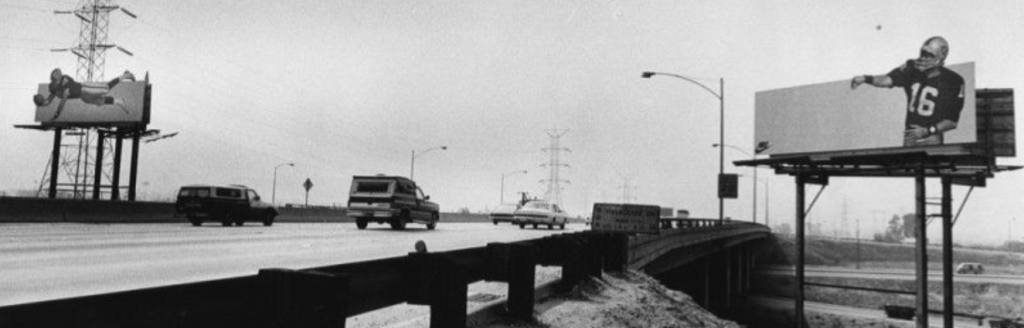
In 1985, a two-pannel billboard by Nike spanning the 605 Freeway near Irwindale showed Raiders quarterback Jim Plunkett, right, completing a pass to tight end Todd Christensen on the other side of the road. The Raiders had just started floating the idea about moving from the L.A. Coliseum to a new home in the San Gabriel Valley area of Irwindale. (Los Angeles Herald-Examiner photo/Mike Mullen/Los Angeles Public Library Digital Collection).
Best known: The last five seasons Plunkett’s 15-year NFL career were in L.A., coming over with the Raiders after having spent three seasons previously in Oakland. In 1982 and ’83, he led the team to eight fourth-quarter comebacks, as well as eight game-winning drives. His record as a starter was 27-12. He arrived in L.A. after leading the Raiders to a Super Bowl XV title on Jan. 25, 1981.
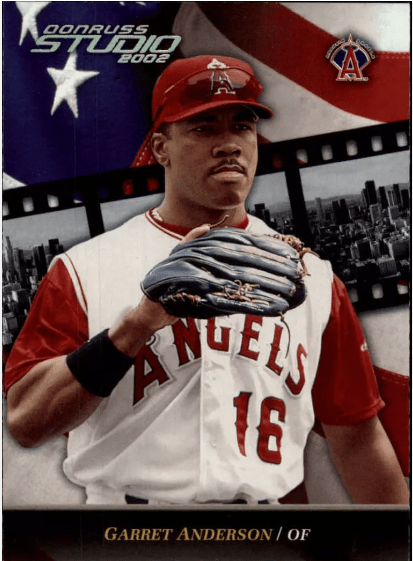
Garrett Anderson, California/Anaheim/Los Angeles Angels of Anaheim outfielder (1994 to 2008):
The 15 seasons he spent in three different variations of the Angels’ franchise existence speaks to the fact — no one else in franchise history had done that before (until Mike Trout tied it in 2024). The Kennedy High of Granada Hills standout was picked by the team in the fourth round right out of high school in 1990. He was second in the AL Rookie of the Year voting in 1995 (.321 in 106 games, 16 HR, 69 RBIs). The three-time AL All Star was MVP of the 2003 game when he came off the bench in the sixth to hit a two-run homer and a double in the eighth to lead to an AL comeback win. Anderson led the league in doubles with 56 in their World Series title year of 2002 and 49 the next season. He also won two Silver Slugger Award. He finished his 17-season career wearing N0. 9 for the Dodgers in 2010.
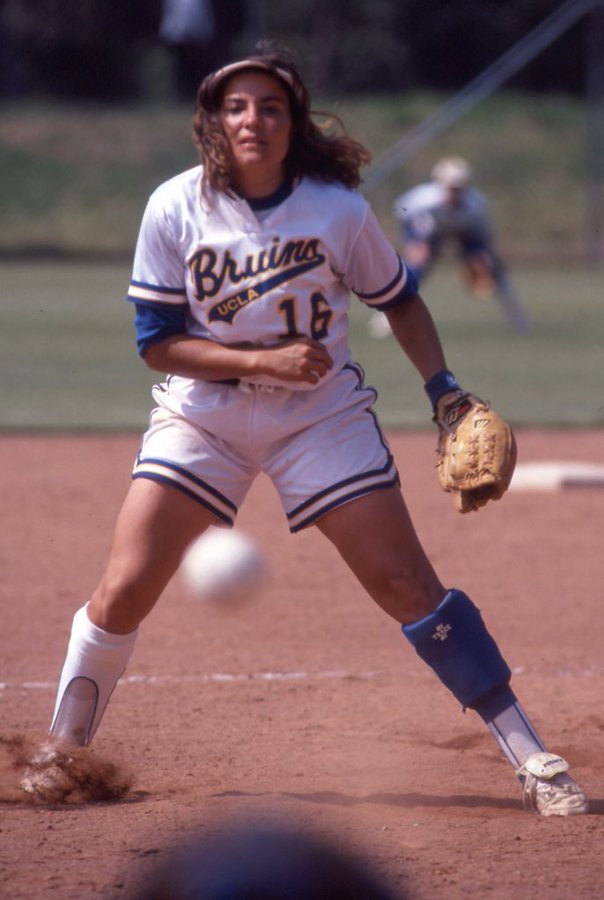
Lisa Fernandez, UCLA softball (1990 to 1993): A three-time winner of softball’s Honda Award, Fernandez became the first in her sport to win the Broderick Cup in 1993, given to the most outstanding collegiate female athlete in all sports. A four-time, first-team All-American led the Bruins to national titles in ’90 and ’92, plus runner-up finishes in ’91 an d’93. The Pac-10 Player of the Year her final three years, she posted a 93-7 record with a 0.22 earned run average, 784 strike outs and 74 shutouts. The Long Beach native from St. Joseph’s High also garnished three Olympic gold medals, in the 1996, 2000 and 2004 Summer Games.
Andre Ethier, Los Angeles Dodgers outfielder (2006 to 2017): A two-time NL All Star had a Gold Glove and Silver Slugger in his 12 seasons. His top offensive year — 2009, when he hit 31 homers, 42 doubles, drove in 106, scored 92 times and played 160 games, finishing sixth in NL MVP voting. In Game 7 of the 2017 World Series against the Astros, he drove in the only run for the team in a 5-1 series-ending loss with a sixth-inning single. In doing so, he set a Dodgers franchise record by appearing in 51 career post-season contests. Ethier came to the Dodgers from Oakland in a December, 2005 trade for Milton Bradley and Antonio Perez and was the first Dodger to have 30 doubles in seven straight seasons.
Have you heard this story:
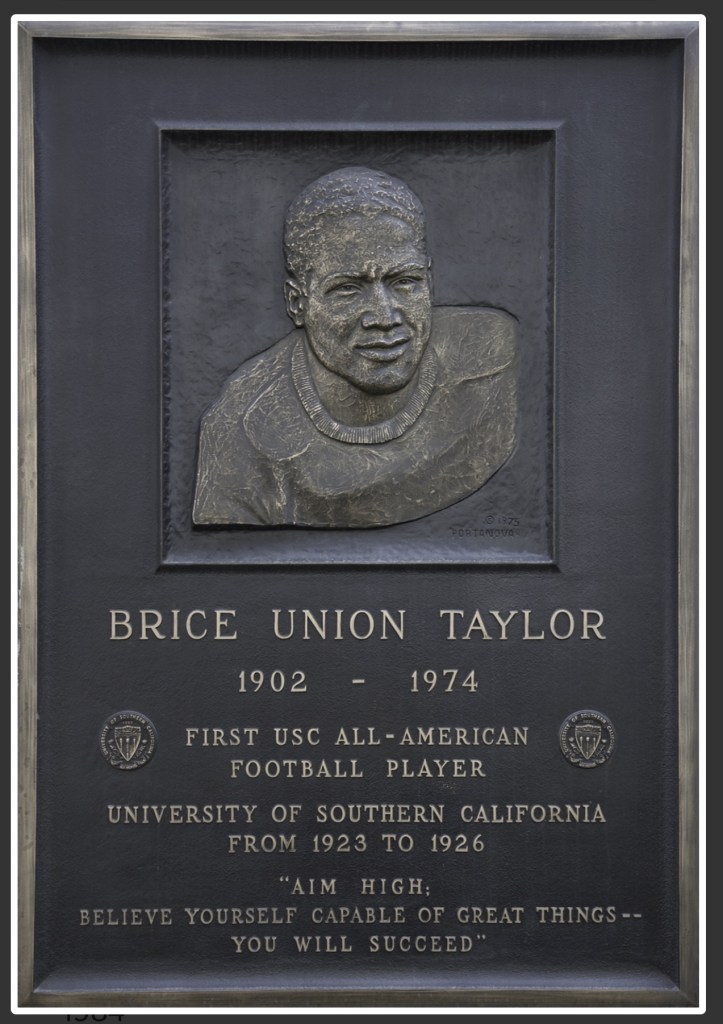
Brice Taylor, USC football fullback/offensive guard (1924 to 1926):
Best known: The Trojans’ first All-American player and its first African-American player was a descendant of African slaves and a Shawnee Indian chief, orphaned at age 5. Born without a left hand, he enrolled at USC as Gus Henderson’s starting fullback. When Howard Jones took over the next season, Taylor moved to the defensive line and was also its kicker. He played in all but four minutes of USC’s 11 games in 1924. Taylor was also a sprinter and hurdler at USC and picked to be on the U.S. Olympic track team in 1924. After he coached Southern University, a historically black college in Louisiana, where he started the Bayou Classic game with in-state rival Grambling State, Taylor circled back to become the coach at Jefferson High in L.A. as well as the associate pastor at the First African Methodist Episcopal Church. He was honored as the L.A. City Teacher of the Year in 1969 and L.A. Mayor Sam Yorty appointed him to the Mayor’s Community Advisory Board in ’65. Not well known: Inducted into the USC Athletic Hall of Fame in 1995, Taylor has a plaque honoring his career at the Coliseum’s Memorial Court of Honor. The Brice Taylor Award is given annual to USC alums for outstanding civic service.
Willie Wood, USC football quarterback/safety (1957 to 1959):
Best known: The first Black quarterback in the history of the Pacific Coast Conference (which became the AAWU, which became the Pac-8), Wood threw for 772 yards and seven TDs versus eight interceptions, and also ran for two touchdowns. When he was not picked in the 1960 NFL Draft, Wood wrote a letter to Green Bay Packers head coach Vince Lombardi to ask for a tryout. The team signed him, switched him to safety, and he made it onto five NFL Championship teams (including the first two Super Bowls), was a five-time All-Pro first team and four time second team. He led the NFL in interceptions in 1962 with nine and, after 12 seasons, was voted into the Pro Football Hall of Fame. Not well known: After starring in Washington D.C. and coming West to play as a junior college All-American at Coalinga Junior College, Wood went to USC under first-year head coach Don Clark.
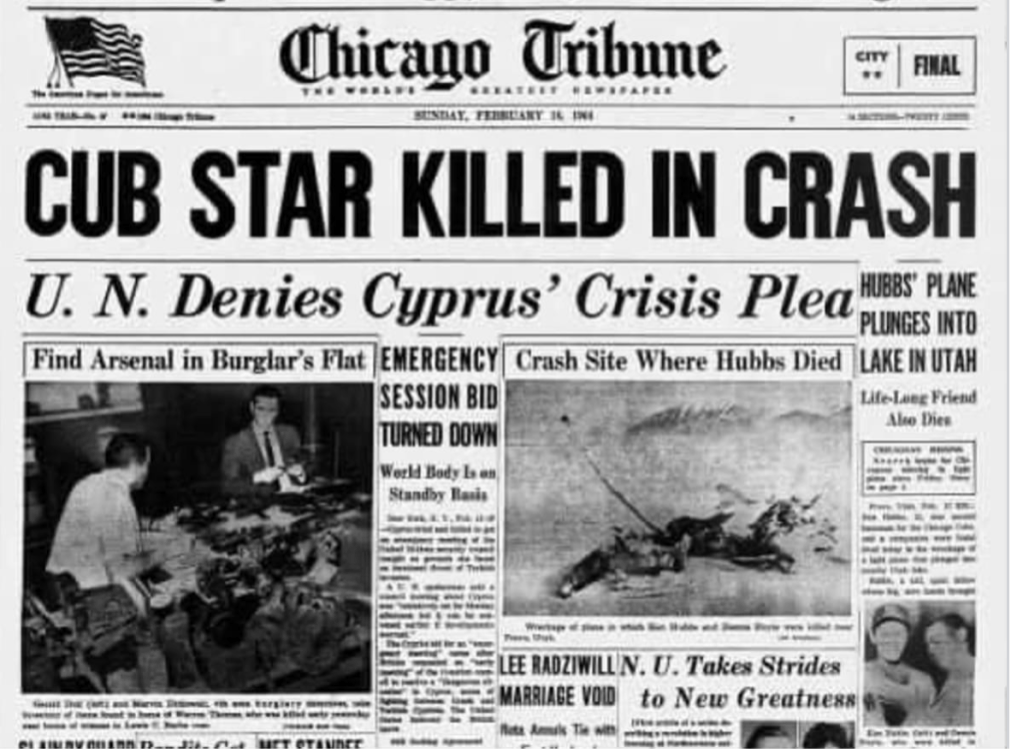
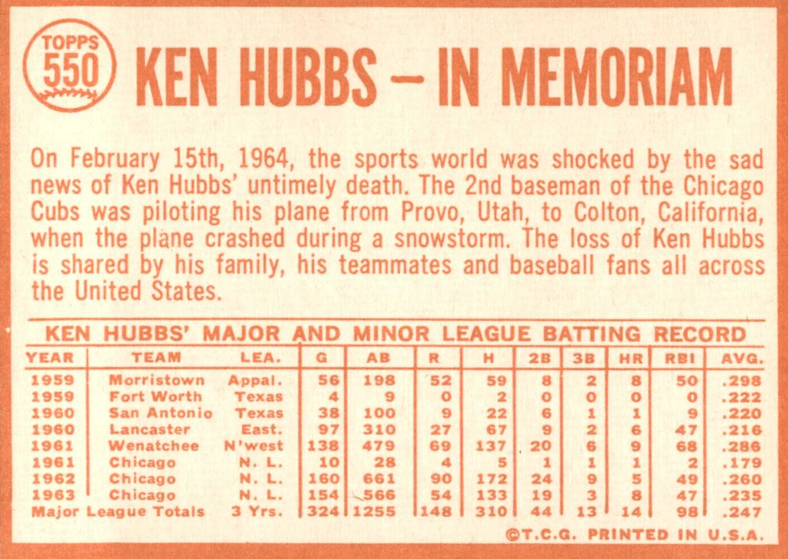
The 1962 National League Rookie of the Year for the Chicago Cubs as a Gold Glove winning second baseman rests today in Colton’s Montecito Cemetery, having perished in a private plane crash in February of 1964 at age 22.
The front of a special Topps baseball card issued in 1964 after Hubbs’ death.
His funeral at Colton High’s Whitmer Auditorium drew some 2,000, including Cubs teammates and pallbearers Ron Santo and Ernie Banks. Wearing No. 16 for the Cubs — he came up as a 19-year-old wearing No. 33 for 10 games in the ’61 season — Hubbs played just two full seasons out. The number was never retired, but held out of circulation for nearly a decade. Hubbs was already a local legend a 12 year-old in the 1954 Little League World Series as the shortstop on the Colton team that made it to the championship game where it lost to Schenectady, N.Y. He hit a home run in the game with a broken toe. At Colton High he was All-CIF in football, basketball and baseball and was was a high jumper on the track team. The 1959 Los Angeles Examiner “Best All-Around Athlete in Southern California” was recruited to play basketball for John Wooden at UCLA as well as play quarterback at Notre Dame. A member of the Church of Latter-Day Saints, Hubbs was considering going to BYU or USC when he was signed to a $50,000 bonus to join the Cubs.
The back of a special Topps baseball card issued in 1964 after Hubbs’ death.
As a rookie in ’62 he set an MLB record with 78 consecutive games/418 chances without an error — his glove remains on display at the Baseball Hall of Fame. The Riverside-born athlete who was All-American in football and basketball is remembered with the Ken Hubbs Award from the family foundation for the top high school male and female athlete in San Bernardino, celebrating its 60th year in 2024. Notable winners have been Football Hall of Famer Ronnie Lott (1977) and eventual Heisman Trophy winner Jayden Daniels (2019). The L.A. Times’ Jim Murray wrote: “Kenneth Douglass Hubbs was more than just another baseball player. He was the kind of athlete all games need. A devout Mormon, a cheerful leader, a picture-book player, blond-haired, healthy, generous with his time for young boys; he was the kind of youth in short supply in these selfish times.”
We also have:
Rocky Colavito, Los Angeles Dodgers outfielder (1968) Paul LoDuca, Los Angeles Dodgers catcher (1998 to 2004) Paul McDonald, USC football quarterback (1976 to 1979) Holly McPeak, UCLA women’s volleyball setter (1990) Eddie Joyal, Los Angeles Kings center (1967-68 to 1971-72)























 Tom Hoffarth's The Drill: More Farther Off the Wall